
Constipation Formula Vanilla Flavor Ingredients & Drug Interactions
by TerraVita
What is this page for?
First and foremost: checking Constipation Formula Vanilla Flavor against your medications. The heart of this page is the interaction checker and the full interaction report — how this product’s ingredients may interact with prescription and over-the-counter medicines you may be taking.
Around that, we add a pharmacist’s high-level view of the product as a whole — what’s inside, the evidence for its stated use, how transparent the label is, and what safety data exists — so you can see the full picture in one place. It’s educational information from our licensed clinical databases and the clinical staff at HelloPharmacist — not medical advice — and we don’t sell or endorse products. Our editorial policy
Constipation Formula Vanilla Flavor is a dietary supplement by TerraVita with 3 active ingredients. Its ingredients are commonly taken for high cholesterol, indigestion and heartburn, constipation and bloating.Based on those ingredients, 793 medications have a known interaction with it, the most serious rated moderate. The ingredients most likely to interact are Boldo Glycerite Liquid Extract, Artichoke Leaf Glycerite Liquid Extract, Black Radish Glycerite Liquid Extract. Use the checker below to test your specific medication, or read the full HelloPharmacist Interaction Report.
Check Your Meds Against Constipation Formula Vanilla Flavor by TerraVita
Ask about any prescription or over-the-counter medication and we check it for interactions with Constipation Formula Vanilla Flavor by TerraVita — and tell you which ingredient is responsible.
AI summaries are generated from our interaction database for education only — always confirm with your pharmacist. How we use AI
Ask the Pharmacist
A licensed pharmacist will answer your question by email — free, usually within 24 hours.
Got it — thank you!
A licensed pharmacist will answer within 24 hours. Keep an eye on your email (worth checking spam, just in case).
HelloPharmacist Scorecard of Constipation Formula Vanilla Flavor by TerraVita
Our pharmacy team’s full take, with four database checks built into the cards below — a summary of what is known, not a grade of the product itself.
What’s inside
Low disclosure
This formula contains 3 active ingredients in liquid extract form: artichoke leaf glycerite, boldo glycerite, and black radish glycerite. The inactive ingredients are glycerin and vanilla flavor.
The first two are delivered as a proprietary blend, so you won't see the exact dose of each one.
Does it work?
Not established
The evidence for this formula's ingredients is mixed. Artichoke leaf extract is possibly effective for high cholesterol (hyperlipidemia) and indigestion (dyspepsia), but the evidence for fatty liver disease is insufficient to rate.
Boldo and black radish both have insufficient evidence—we don't have reliable data showing they work for the conditions they're traditionally used for, including gallbladder issues, kidney stones, joint pain, and diabetes. If you're taking this for constipation specifically, the facts we hold don't cover that claim.
How safe is it?
Well-documented data
Artichoke is generally well tolerated when used short-term, though quality and dosing vary by product. The most common side effects are abdominal pain, diarrhea, bloating, hunger, and nausea.
A rare but serious risk is anaphylaxis in people sensitive to inulin; artichokes are also risky for anyone allergic to ragweed, chrysanthemums, daisies, or other plants in the Asteraceae family. Boldo is generally well tolerated in food amounts but can cause serious harm in medicinal doses.
Liver damage is the main concern—cases of elevated liver enzymes and jaundice have been reported. Common side effects are abdominal pain, nausea, and vomiting.
Black radish is safe in normal food amounts; large concentrated doses may irritate the stomach and cause indigestion. One case of allergic reaction with throat tightness and hives has been reported.
During pregnancy, boldo is unsafe (may stimulate the uterus); artichoke has not been studied enough and is best avoided; there isn't enough data on black radish. During breastfeeding, both boldo and artichoke are best avoided due to lack of safety information; black radish's safety is also not well studied.
Meds to double-check
Moderate interaction found
Before taking this product, check with your doctor or pharmacist if you take blood pressure medications (artichoke may lower your pressure further), blood thinners or antiplatelet drugs (boldo may increase bleeding risk), diabetes medications (artichoke and black radish may lower your blood sugar), lithium (boldo may raise its levels), warfarin (boldo may increase bleeding risk), tacrolimus (boldo may lower its levels), or any drugs processed by your liver, especially through the CYP2C19 or CYP2B6 pathways. Also mention if you take medications toxic to the liver.
The bottom line
Scorecard at a glanceFormula with limited ingredient disclosure with no established evidence rating for its marketed use. Moderate medication interactions have been identified, and safety information is well characterized.
This product is intended for digestive support, though its effectiveness is not well established in the data we hold. If you take any medications—especially blood pressure drugs, blood thinners, diabetes medications, lithium, warfarin, tacrolimus, or drugs processed by your liver—you'll need to check your exact medications before starting.
The boldo ingredient carries real safety concerns, particularly for your liver and with certain medications. Talk with your doctor or pharmacist before adding this to your routine.
Educational only — not medical advice; always confirm with your pharmacist. Our editorial policy · How we use AI
Assessment coverage: 3 of 3 active ingredients matched to our full ingredient reviews (monographs). Based on the product label dated Feb 21, 2023.
This Scorecard evaluates available label information, ingredient evidence, and known medication-safety considerations. It does not independently verify product identity, purity, potency, contamination, or manufacturing quality. How these ratings are computed
General information
Key facts about Constipation Formula Vanilla Flavor, straight from the product label.
Everything in this section is reproduced from the manufacturer’s own product label — it’s the label speaking, not HelloPharmacist. We show it so you can see exactly what the maker states; we don’t verify or endorse those statements.
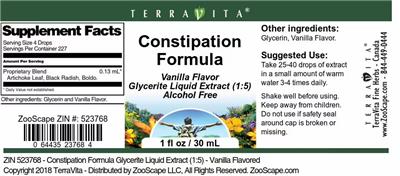
Supplement Facts
The label details for Constipation Formula Vanilla Flavor by TerraVita, sourced from the NIH Dietary Supplement Label Database.
Supplement Facts
| Ingredient | Amount | % DV |
|---|---|---|
| Proprietary Blend | 0.13 mL | -- |
| Artichoke Leaf Glycerite Liquid Extract | 0 NP | -- |
| Boldo Glycerite Liquid Extract | 0 NP | -- |
| Black Radish Glycerite Liquid Extract | 0 NP | -- |
Other ingredients: Glycerin, Vanilla flavor
Tap any ingredient to jump to its full detail below.
These statements are the manufacturer’s wording, reproduced from the product label — the label is saying it, not HelloPharmacist. We don’t verify or endorse them.
Brand IP Statement(s)
Copyright 2018 TerraVita - Distributed by ZooScape LLC, All Rights Reserved.
Formula
Glycerite liquid extract (1:5)
Formulation
Alcohol free
Suggested/Recommended/Usage/Directions
Suggested Use: Take 25-40 drops of extract in a small amount of warm water 3-4 times daily. Shake well before using.
Precautions
Keep away from children.
Do not use if safety seal around cap is broken or missing.
Is this label outdated? Report a formula or label change and our pharmacy team will review it.
Constipation Formula Vanilla Flavor by TerraVita label
The label scan from the NIH Dietary Supplement Label Database. Tap to enlarge.
Label images are published by the NIH Dietary Supplement Label Database for the version of this product on file. Always read your actual product label.
View the full label (PDF)The Ingredients in Constipation Formula Vanilla Flavor by TerraVita
These are the 3 active ingredients this product is made of. Select any to open its full monograph.
Serving size25 Drop(s) Dosage formLiquid Servings per container227 Amounts shown are per serving.
Most supplement products combine several ingredients, and a medication can interact with the product through any one of them. Each ingredient below shows whether it has known drug interactions.
Other (inactive) ingredients: Glycerin, Vanilla flavor. These complete the product’s ingredient list but are not active constituents.
Constipation Formula Vanilla Flavor by TerraVita Drug Interactions
HelloPharmacist Interaction Report
TerraVita's Constipation Formula Vanilla Flavor contains three active ingredients, two of which carry documented interactions with medications.
The most serious concern is boldo, which may increase the risk of liver damage when combined with medications that are toxic to the liver (hepatotoxic drugs)—boldo itself contains ascaridole, a known liver toxin, and cases of elevated liver enzymes and jaundice have been reported in people taking it.
Read the full breakdown — every affected drug type, severity by severity
Boldo also interacts with blood thinners and antiplatelet drugs (a Moderate severity risk of bleeding), lithium (may raise lithium levels), warfarin specifically (may increase bleeding risk), and tacrolimus (may lower tacrolimus levels and increase transplant rejection risk). Artichoke leaf extract carries Moderate interactions with blood pressure medications (may lower blood pressure further), drugs processed by the liver enzyme CYP2C19 (may raise their levels), diabetes medications (may lower blood sugar further), and drugs processed by CYP2B6 (may raise their levels).
Black radish may increase the risk of low blood sugar (hypoglycemia) when taken with diabetes medications.
Altogether, these interactions span 791 individual medications. Use the medication checker on this page to search your exact prescriptions before starting this product.
Check your own medications below · Editorial policy · How we use AI
Want to check YOUR meds against Constipation Formula Vanilla Flavor?
Ask about interactions with your drugs in plain English — “Can I take it with lisinopril?” — and we find you the answer in seconds, ingredient by ingredient.
Go to the checkerIngredients driving the most interactions
Individual Drug Interactions
The ingredients in Constipation Formula Vanilla Flavor interact with 793 drugs. Click any drug to see the details.
3 of the 3 ingredients in Constipation Formula Vanilla Flavor interact with drugs. Each result below shows which ingredient is responsible. Boldo Glycerite Liquid Extract Artichoke Leaf Glycerite Liquid Extract Black Radish Glycerite Liquid Extract
6-mercaptopurinePurinethol
How 6-mercaptopurine interacts with Constipation Formula Vanilla Flavor — through 1 ingredient. Tap an ingredient for the detail:
Boldo Glycerite Liquid ExtractHepatotoxic Drugs Moderate
Interaction Summary
Theoretically, taking boldo with hepatotoxic drugs might increase the risk of hepatic injury and disease.
Read the full Boldo Glycerite Liquid Extract + 6-mercaptopurine interactionAbacavir Sulfate, Dolutegravir, LamivudineTriumeq
How Abacavir Sulfate, Dolutegravir, Lamivudine interacts with Constipation Formula Vanilla Flavor — through 1 ingredient. Tap an ingredient for the detail:
Boldo Glycerite Liquid ExtractHepatotoxic Drugs Moderate
Interaction Summary
Theoretically, taking boldo with hepatotoxic drugs might increase the risk of hepatic injury and disease.
Read the full Boldo Glycerite Liquid Extract + Abacavir Sulfate, Dolutegravir, Lamivudine interactionAbacavir, LamivudineEpzicom
How Abacavir, Lamivudine interacts with Constipation Formula Vanilla Flavor — through 1 ingredient. Tap an ingredient for the detail:
Boldo Glycerite Liquid ExtractHepatotoxic Drugs Moderate
Interaction Summary
Theoretically, taking boldo with hepatotoxic drugs might increase the risk of hepatic injury and disease.
Read the full Boldo Glycerite Liquid Extract + Abacavir, Lamivudine interactionAbciximabReoPro
How Abciximab interacts with Constipation Formula Vanilla Flavor — through 1 ingredient. Tap an ingredient for the detail:
Boldo Glycerite Liquid ExtractAnticoagulant/antiplatelet Drugs Moderate
Interaction Summary
Theoretically, taking boldo with anticoagulant/antiplatelet drugs might increase the risk of bleeding.
Read the full Boldo Glycerite Liquid Extract + Abciximab interactionAbiraterone
How Abiraterone interacts with Constipation Formula Vanilla Flavor — through 1 ingredient. Tap an ingredient for the detail:
Boldo Glycerite Liquid ExtractHepatotoxic Drugs Moderate
Interaction Summary
Theoretically, taking boldo with hepatotoxic drugs might increase the risk of hepatic injury and disease.
Read the full Boldo Glycerite Liquid Extract + Abiraterone interactionAbiraterone AcetateYonsa, Zytiga
How Abiraterone Acetate interacts with Constipation Formula Vanilla Flavor — through 1 ingredient. Tap an ingredient for the detail:
Boldo Glycerite Liquid ExtractHepatotoxic Drugs Moderate
Interaction Summary
Theoretically, taking boldo with hepatotoxic drugs might increase the risk of hepatic injury and disease.
Read the full Boldo Glycerite Liquid Extract + Abiraterone Acetate interactionAbrocitinibCibinqo
How Abrocitinib interacts with Constipation Formula Vanilla Flavor — through 2 ingredients. Tap an ingredient for the detail:
Artichoke Leaf Glycerite Liquid ExtractCytochrome P450 2c19 (cyp2c19) Substrates Moderate
Interaction Summary
Theoretically, artichoke might increase serum levels of drugs metabolized by CYP2C19.
Read the full Artichoke Leaf Glycerite Liquid Extract + Abrocitinib interactionBoldo Glycerite Liquid ExtractAnticoagulant/antiplatelet Drugs Moderate
Interaction Summary
Theoretically, taking boldo with anticoagulant/antiplatelet drugs might increase the risk of bleeding.
Read the full Boldo Glycerite Liquid Extract + Abrocitinib interactionAcarboseGlucobay, Prandase, Precose
How Acarbose interacts with Constipation Formula Vanilla Flavor — through 3 ingredients. Tap an ingredient for the detail:
Black Radish Glycerite Liquid ExtractAntidiabetes Drugs Moderate
Interaction Summary
Theoretically, radish might increase the risk of hypoglycemia when taken with antidiabetes drugs.
Read the full Black Radish Glycerite Liquid Extract + Acarbose interactionBoldo Glycerite Liquid ExtractHepatotoxic Drugs Moderate
Interaction Summary
Theoretically, taking boldo with hepatotoxic drugs might increase the risk of hepatic injury and disease.
Read the full Boldo Glycerite Liquid Extract + Acarbose interactionArtichoke Leaf Glycerite Liquid ExtractAntidiabetes Drugs Moderate
Interaction Summary
Theoretically, artichoke leaf extract may increase the risk of hypoglycemia when taken with antidiabetes drugs.
Read the full Artichoke Leaf Glycerite Liquid Extract + Acarbose interactionAcebutololRhotral, Sectral
How Acebutolol interacts with Constipation Formula Vanilla Flavor — through 2 ingredients. Tap an ingredient for the detail:
Artichoke Leaf Glycerite Liquid ExtractAntihypertensive Drugs Moderate
Interaction Summary
Theoretically, artichoke leaf extract may increase the risk of hypotension when taken with antihypertensive drugs.
Read the full Artichoke Leaf Glycerite Liquid Extract + Acebutolol interactionBoldo Glycerite Liquid ExtractHepatotoxic Drugs Moderate
Interaction Summary
Theoretically, taking boldo with hepatotoxic drugs might increase the risk of hepatic injury and disease.
Read the full Boldo Glycerite Liquid Extract + Acebutolol interactionAcenocoumarolSintrom
How Acenocoumarol interacts with Constipation Formula Vanilla Flavor — through 1 ingredient. Tap an ingredient for the detail:
Boldo Glycerite Liquid ExtractAnticoagulant/antiplatelet Drugs Moderate
Interaction Summary
Theoretically, taking boldo with anticoagulant/antiplatelet drugs might increase the risk of bleeding.
Read the full Boldo Glycerite Liquid Extract + Acenocoumarol interactionAcetaminophenChildren's Tylenol, Children's Tylenol Meltaways, Tylenol, Tylenol Ex Strength
How Acetaminophen interacts with Constipation Formula Vanilla Flavor — through 1 ingredient. Tap an ingredient for the detail:
Boldo Glycerite Liquid ExtractHepatotoxic Drugs Moderate
Interaction Summary
Theoretically, taking boldo with hepatotoxic drugs might increase the risk of hepatic injury and disease.
Read the full Boldo Glycerite Liquid Extract + Acetaminophen interactionAcetaminophen, AspirinGemnisyn
How Acetaminophen, Aspirin interacts with Constipation Formula Vanilla Flavor — through 1 ingredient. Tap an ingredient for the detail:
Boldo Glycerite Liquid ExtractHepatotoxic Drugs, Anticoagulant/antiplatelet Drugs Moderate
Interaction Summary
Theoretically, taking boldo with hepatotoxic drugs might increase the risk of hepatic injury and disease.
Read the full Boldo Glycerite Liquid Extract + Acetaminophen, Aspirin interactionAcetaminophen, Aspirin, CaffeineExcedrin, Excedrin Extra Strength, Excedrin Migraine
How Acetaminophen, Aspirin, Caffeine interacts with Constipation Formula Vanilla Flavor — through 1 ingredient. Tap an ingredient for the detail:
Boldo Glycerite Liquid ExtractAnticoagulant/antiplatelet Drugs, Hepatotoxic Drugs Moderate
Interaction Summary
Theoretically, taking boldo with anticoagulant/antiplatelet drugs might increase the risk of bleeding.
Read the full Boldo Glycerite Liquid Extract + Acetaminophen, Aspirin, Caffeine interactionAcetaminophen, Brompheniramine, PhenylpropanolamineDimetapp Cold and Flu
How Acetaminophen, Brompheniramine, Phenylpropanolamine interacts with Constipation Formula Vanilla Flavor — through 1 ingredient. Tap an ingredient for the detail:
Boldo Glycerite Liquid ExtractHepatotoxic Drugs Moderate
Interaction Summary
Theoretically, taking boldo with hepatotoxic drugs might increase the risk of hepatic injury and disease.
Read the full Boldo Glycerite Liquid Extract + Acetaminophen, Brompheniramine, Phenylpropanolamine interactionAcetaminophen, ButalbitalAxocet, Bancap, Bucet, Butex Forte, Esgic CF, Orbivan CF +5 more
How Acetaminophen, Butalbital interacts with Constipation Formula Vanilla Flavor — through 1 ingredient. Tap an ingredient for the detail:
Boldo Glycerite Liquid ExtractHepatotoxic Drugs Moderate
Interaction Summary
Theoretically, taking boldo with hepatotoxic drugs might increase the risk of hepatic injury and disease.
Read the full Boldo Glycerite Liquid Extract + Acetaminophen, Butalbital interactionAcetaminophen, Butalbital, CaffeineEsgic, Esgic Plus, Fiogesic, Fioricet, Repan, Tecnal +1 more
How Acetaminophen, Butalbital, Caffeine interacts with Constipation Formula Vanilla Flavor — through 1 ingredient. Tap an ingredient for the detail:
Boldo Glycerite Liquid ExtractHepatotoxic Drugs Moderate
Interaction Summary
Theoretically, taking boldo with hepatotoxic drugs might increase the risk of hepatic injury and disease.
Read the full Boldo Glycerite Liquid Extract + Acetaminophen, Butalbital, Caffeine interactionAcetaminophen, Butalbital, Caffeine, CodeineEsgic with Codeine, Fioricet w/ Codeine
How Acetaminophen, Butalbital, Caffeine, Codeine interacts with Constipation Formula Vanilla Flavor — through 1 ingredient. Tap an ingredient for the detail:
Boldo Glycerite Liquid ExtractHepatotoxic Drugs Moderate
Interaction Summary
Theoretically, taking boldo with hepatotoxic drugs might increase the risk of hepatic injury and disease.
Read the full Boldo Glycerite Liquid Extract + Acetaminophen, Butalbital, Caffeine, Codeine interactionAcetaminophen, Butalbital, CodeineBancap w/ Codeine
How Acetaminophen, Butalbital, Codeine interacts with Constipation Formula Vanilla Flavor — through 1 ingredient. Tap an ingredient for the detail:
Boldo Glycerite Liquid ExtractHepatotoxic Drugs Moderate
Interaction Summary
Theoretically, taking boldo with hepatotoxic drugs might increase the risk of hepatic injury and disease.
Read the full Boldo Glycerite Liquid Extract + Acetaminophen, Butalbital, Codeine interactionAcetaminophen, Butalbital, Codeine PhosphatePhrenilin #3
How Acetaminophen, Butalbital, Codeine Phosphate interacts with Constipation Formula Vanilla Flavor — through 1 ingredient. Tap an ingredient for the detail:
Boldo Glycerite Liquid ExtractHepatotoxic Drugs Moderate
Interaction Summary
Theoretically, taking boldo with hepatotoxic drugs might increase the risk of hepatic injury and disease.
Read the full Boldo Glycerite Liquid Extract + Acetaminophen, Butalbital, Codeine Phosphate interactionAcetaminophen, Caffeine, Chlorpheniramine, Hydrocodone, PhenylephrineHycomine Compound
How Acetaminophen, Caffeine, Chlorpheniramine, Hydrocodone, Phenylephrine interacts with Constipation Formula Vanilla Flavor — through 1 ingredient. Tap an ingredient for the detail:
Boldo Glycerite Liquid ExtractHepatotoxic Drugs Moderate
Interaction Summary
Theoretically, taking boldo with hepatotoxic drugs might increase the risk of hepatic injury and disease.
Read the full Boldo Glycerite Liquid Extract + Acetaminophen, Caffeine, Chlorpheniramine, Hydrocodone, Phenylephrine interactionAcetaminophen, Caffeine, CodeineGesic C15, Gesic C30, Gesic C8, Lenoltec 1, Lenoltec 2, Lenoltec 3 +1 more
How Acetaminophen, Caffeine, Codeine interacts with Constipation Formula Vanilla Flavor — through 1 ingredient. Tap an ingredient for the detail:
Boldo Glycerite Liquid ExtractHepatotoxic Drugs Moderate
Interaction Summary
Theoretically, taking boldo with hepatotoxic drugs might increase the risk of hepatic injury and disease.
Read the full Boldo Glycerite Liquid Extract + Acetaminophen, Caffeine, Codeine interactionAcetaminophen, Caffeine, Codeine, SalicylamideCodalan No.1, Codalan No.2, Codalan No.3
How Acetaminophen, Caffeine, Codeine, Salicylamide interacts with Constipation Formula Vanilla Flavor — through 1 ingredient. Tap an ingredient for the detail:
Boldo Glycerite Liquid ExtractHepatotoxic Drugs Moderate
Interaction Summary
Theoretically, taking boldo with hepatotoxic drugs might increase the risk of hepatic injury and disease.
Read the full Boldo Glycerite Liquid Extract + Acetaminophen, Caffeine, Codeine, Salicylamide interactionAcetaminophen, Caffeine, DihydrocodeineDHC Plus, Panlor DC, Panlor SS
How Acetaminophen, Caffeine, Dihydrocodeine interacts with Constipation Formula Vanilla Flavor — through 1 ingredient. Tap an ingredient for the detail:
Boldo Glycerite Liquid ExtractHepatotoxic Drugs Moderate
Interaction Summary
Theoretically, taking boldo with hepatotoxic drugs might increase the risk of hepatic injury and disease.
Read the full Boldo Glycerite Liquid Extract + Acetaminophen, Caffeine, Dihydrocodeine interactionAcetaminophen, Caffeine, IsomethepteneMigralam
How Acetaminophen, Caffeine, Isometheptene interacts with Constipation Formula Vanilla Flavor — through 1 ingredient. Tap an ingredient for the detail:
Boldo Glycerite Liquid ExtractHepatotoxic Drugs Moderate
Interaction Summary
Theoretically, taking boldo with hepatotoxic drugs might increase the risk of hepatic injury and disease.
Read the full Boldo Glycerite Liquid Extract + Acetaminophen, Caffeine, Isometheptene interactionAcetaminophen, Caffeine, PyrilamineMidol Max Strength Menstrual
How Acetaminophen, Caffeine, Pyrilamine interacts with Constipation Formula Vanilla Flavor — through 1 ingredient. Tap an ingredient for the detail:
Boldo Glycerite Liquid ExtractHepatotoxic Drugs Moderate
Interaction Summary
Theoretically, taking boldo with hepatotoxic drugs might increase the risk of hepatic injury and disease.
Read the full Boldo Glycerite Liquid Extract + Acetaminophen, Caffeine, Pyrilamine interactionAcetaminophen, Chlorpheniramine Maleate, Dextromethorphan HbrVicks Formula 44M Cough, Cold & Flu Relief
How Acetaminophen, Chlorpheniramine Maleate, Dextromethorphan Hbr interacts with Constipation Formula Vanilla Flavor — through 1 ingredient. Tap an ingredient for the detail:
Boldo Glycerite Liquid ExtractHepatotoxic Drugs Moderate
Interaction Summary
Theoretically, taking boldo with hepatotoxic drugs might increase the risk of hepatic injury and disease.
Read the full Boldo Glycerite Liquid Extract + Acetaminophen, Chlorpheniramine Maleate, Dextromethorphan Hbr interactionAcetaminophen, Chlorpheniramine, Codeine, PhenylephrineColrex
How Acetaminophen, Chlorpheniramine, Codeine, Phenylephrine interacts with Constipation Formula Vanilla Flavor — through 1 ingredient. Tap an ingredient for the detail:
Boldo Glycerite Liquid ExtractHepatotoxic Drugs Moderate
Interaction Summary
Theoretically, taking boldo with hepatotoxic drugs might increase the risk of hepatic injury and disease.
Read the full Boldo Glycerite Liquid Extract + Acetaminophen, Chlorpheniramine, Codeine, Phenylephrine interactionAcetaminophen, Chlorpheniramine, DextromethorphanCoricidin II Extra Strength Cold and Flu
How Acetaminophen, Chlorpheniramine, Dextromethorphan interacts with Constipation Formula Vanilla Flavor — through 1 ingredient. Tap an ingredient for the detail:
Boldo Glycerite Liquid ExtractHepatotoxic Drugs Moderate
Interaction Summary
Theoretically, taking boldo with hepatotoxic drugs might increase the risk of hepatic injury and disease.
Read the full Boldo Glycerite Liquid Extract + Acetaminophen, Chlorpheniramine, Dextromethorphan interactionAcetaminophen, Chlorpheniramine, Dextromethorphan HydrobromideCoricidin HBP Maximum Strength Flu
How Acetaminophen, Chlorpheniramine, Dextromethorphan Hydrobromide interacts with Constipation Formula Vanilla Flavor — through 1 ingredient. Tap an ingredient for the detail:
Boldo Glycerite Liquid ExtractHepatotoxic Drugs Moderate
Interaction Summary
Theoretically, taking boldo with hepatotoxic drugs might increase the risk of hepatic injury and disease.
Read the full Boldo Glycerite Liquid Extract + Acetaminophen, Chlorpheniramine, Dextromethorphan Hydrobromide interactionAcetaminophen, Chlorpheniramine, Dextromethorphan, PhenylpropanolamineMulti Symptom Cold Relief
How Acetaminophen, Chlorpheniramine, Dextromethorphan, Phenylpropanolamine interacts with Constipation Formula Vanilla Flavor — through 1 ingredient. Tap an ingredient for the detail:
Boldo Glycerite Liquid ExtractHepatotoxic Drugs Moderate
Interaction Summary
Theoretically, taking boldo with hepatotoxic drugs might increase the risk of hepatic injury and disease.
Read the full Boldo Glycerite Liquid Extract + Acetaminophen, Chlorpheniramine, Dextromethorphan, Phenylpropanolamine interactionEach ingredient & the kinds of drugs it affects
For each ingredient in Constipation Formula Vanilla Flavor with known interactions, here are the types of medications they can affect. Open any type for the detail — or search your exact drug in the checker above.
Boldo Glycerite Liquid Extract
Anticoagulant/Antiplatelet Drugs
Theoretically, taking boldo with anticoagulant/antiplatelet drugs might increase the risk of bleeding.
Animal and in vitro research shows that boldine, a constituent of boldo, has antiplatelet activity. In one case report, an adult taking a combination of boldo and fenugreek with warfarin experienced an increase in international normalized ratio (INR); however, it is unclear if this effect was due to boldo, fenugreek, the combination, or another factor.
Hepatotoxic Drugs
Theoretically, taking boldo with hepatotoxic drugs might increase the risk of hepatic injury and disease.
Boldo leaf contains ascaridole, a known liver toxin. Many cases of hepatotoxicity, including elevated liver transaminase levels and jaundice, have been reported in patients taking boldo.
Lithium
Theoretically, taking boldo with lithium might increase the levels and clinical effects of lithium.
Boldo is believed to have diuretic effects. Theoretically, these diuretic effects might reduce the excretion of lithium. The dose of lithium might need to be decreased.
Tacrolimus (Prograf)
Taking boldo with tacrolimus may decrease the levels and clinical effects of tacrolimus, potentially increasing the risk of transplant rejection.
In one case report, a patient with a long-term history of stable tacrolimus levels developed subtherapeutic levels after taking boldo 300 mg twice daily orally for several weeks. Tacrolimus levels returned to normal after discontinuing boldo. However, the mechanism of this interaction is unclear.
Warfarin (Coumadin)
A combination of boldo and fenugreek was thought to be associated with an increased international normalized ratio (INR) in a female on warfarin. It is not clear if boldo, fenugreek, or the combination played a role in this interaction. Therefore, boldo may have additive effects with warfarin.
Artichoke Leaf Glycerite Liquid Extract
Antidiabetes Drugs
Theoretically, artichoke leaf extract may increase the risk of hypoglycemia when taken with antidiabetes drugs.
A meta-analysis of small clinical studies shows that taking artichoke leaf extract for 8-12 weeks can modestly reduce fasting plasma glucose when compared with placebo.
Antihypertensive Drugs
Theoretically, artichoke leaf extract may increase the risk of hypotension when taken with antihypertensive drugs.
A meta-analysis of small clinical studies in patients with hypertension shows that taking artichoke can reduce systolic blood pressure by around 3 mmHg and diastolic blood pressure by around 2 mmHg when compared with placebo.
Cytochrome P450 2B6 (Cyp2B6) Substrates
Theoretically, artichoke might increase serum levels of drugs metabolized by CYP2B6.
In vitro research shows that artichoke leaf extract inhibits CYP2B6 activity. However, this interaction has not been reported in humans.
Cytochrome P450 2C19 (Cyp2C19) Substrates
Theoretically, artichoke might increase serum levels of drugs metabolized by CYP2C19.
In vitro research shows that artichoke leaf extract inhibits CYP2C19 activity. However, this interaction has not been reported in humans.
Black Radish Glycerite Liquid Extract
Antidiabetes Drugs
Theoretically, radish might increase the risk of hypoglycemia when taken with antidiabetes drugs.
Animal research shows that radish extract, juice, and sprouts can reduce glucose levels. Animal research also shows that radish root juice 300 mg/kg reduces fasting and postprandial blood glucose in a rat model of diabetes, with effects similar to glibenclamide.
Brand information
Manufacturer and brand details for Constipation Formula Vanilla Flavor, from the product label.
TerraVita
See all TerraVita products- Name
- ZooScape LLC
- Phone Number
- 844-449-0444
- Web Address
- www.ZooScape.com
Constipation Formula Vanilla Flavor by TerraVita: Common Questions
Does Constipation Formula Vanilla Flavor by TerraVita interact with any medications?
How can one product interact with so many drugs?
Where does this information come from?
Can I take this while pregnant?
Can I take this while breastfeeding?
What are the most common side effects?
Could I have an allergic reaction to this?
Is boldo safe to take long-term?
How is this different from a fiber supplement?
Written and reviewed by the HelloPharmacist editorial staff. Our editorial policy
Not sure if Constipation Formula Vanilla Flavor is safe with your meds?
Our pharmacists answer your medication & supplement questions — free.
Label information is sourced from the NIH Dietary Supplement Label Database and reflects the product version on file; always read your actual product label. This page is for education only and is not a substitute for professional medical advice. Confirm with your pharmacist or doctor before combining supplements and medications.
The Full Monographs Behind Constipation Formula Vanilla Flavor’s Ingredients
Every ingredient we hold a full HelloPharmacist monograph for — uses, evidence, safety, and the complete interaction list.
Artichoke
Interacts with 364 drugsArtichoke leaf extract is a generally well-tolerated supplement that may have a mild cholesterol-lowering effect and is often used for indigestion, though the evidence is modest. It is not a...
Read the full Artichoke monograph → Herb & supplement monographBoldo
Interacts with 484 drugsBoldo is a South American shrub whose leaves are traditionally used for digestive and gallbladder complaints, but good human evidence is very limited. The leaves and oil contain ascaridole,...
Read the full Boldo monograph → Herb & supplement monographRadish
Interacts with 86 drugsRadish is a common edible root vegetable that is nutritious and generally safe to eat as food. Some people use radish (especially black radish) and its extracts for digestion and liver suppo...
Read the full Radish monograph →Sources & How We Checked
Constipation Formula Vanilla Flavor's label data comes from the NIH Dietary Supplement Label Database; the ingredient interaction data is from the Natural Medicines database, reviewed by our pharmacists.
- NIH Dietary Supplement Label Database (DSLD) — The official product label on file for this supplement.
- Natural Medicines (Therapeutic Research Center) — Evidence-graded clinical reference behind the ingredient interaction data.
Content is written and reviewed by licensed HelloPharmacist pharmacists. See our data sources and editorial standards for how this information is built and checked.
The 31 references behind this product’s interaction data
Every citation that drives the interaction findings for this product’s ingredients, from the evidence-graded Natural Medicines (TRC Healthcare) database. Open an ingredient to browse its citations — links open the study on PubMed or the publisher’s site.
Artichoke 16 references
- Leung AY, Foster S. Encyclopedia of Common Natural Ingredients Used in Food, Drugs and Cosmetics. 2nd ed. New York, NY: John Wiley & Sons, 1996.
- Walker AF, Middleton RW, Petrowicz O. Artichoke leaf extract reduces symptoms of irritable bowel syndrome in a post-marketing surveillance study. Phytother Res 2001;15:58-61. PubMed
- Pittler MH, White AR, Stevinson C, Ernst E. Effectiveness of artichoke extract in preventing alcohol-induced hangovers: a randomized controlled trial. CMAJ 2003;169:1269-73.
- Romano, C., Ferrara, A., and Falagiani, P. A case of allergy to globe artichoke and other clinical cases of rare food allergy. J Investig.Allergol.Clin Immunol. 2000;10(2):102-104.
- Miralles, J. C., Garcia-Sells, J., Bartolome, B., and Negro, J. M. Occupational rhinitis and bronchial asthma due to artichoke (Cynara scolymus). Ann Allergy Asthma Immunol. 2003;91(1):92-95. PubMed
- Franck, P., Moneret-Vautrin, D. A., Morisset, M., Kanny, G., Megret-Gabeaux, M. L., and Olivier, J. L. Anaphylactic reaction to inulin: first identification of specific IgEs to an inulin protein compound. Int Arch Allergy Immunol 2005;136(2):155-158. PubMed
- Meding, B. Allergic contact dermatitis from artichoke, Cynara scolymus. Contact Dermatitis 1983;9(4):314.
- Quirce, S., Tabar, A. I., Olaguibel, J. M., and Cuevas, M. Occupational contact urticaria syndrome caused by globe artichoke (Cynara scolymus). J Allergy Clin Immunol. 1996;97(2):710-711. PubMed
- Held C. Von der 1. Deutsche-Ungarischen Phytopharmakon-Konferenz, Budapest, 20. November 1991. Z Klin Med 1992;47:92-93.
- Barrat E, Zaïr Y, Ogier N, et al. A combined natural supplement lowers LDL cholesterol in subjects with moderate untreated hypercholesterolemia: a randomized placebo-controlled trial. Int J Food Sci Nutr. 2013;64(7):882-9. PubMed
- Huber R, Müller M, Naumann J, Schenk T, Lüdtke R. Artichoke leave extract for chronic hepatitis C - a pilot study. Phytomedicine. 2009 Sep;16(9):801-4. PubMed
- Caputo F, Barranco R, Bonsignore A, Fraternali Orcioni G, Ventura F. A rare case of fatal bowel obstruction secondary to a colonic bezoar. Am J Forensic Med Pathol. 2018;39(1):38-40. PubMed
- Elsebai MF, Abass K, Hakkola J, Atawia AR, Farag MA. The wild Egyptian artichoke as a promising functional food for the treatment of hepatitis C virus as revealed via UPLC-MS and clinical trials. Food Funct. 2016;7(7):3006-16. PubMed
- Moradi M, Sohrabi G, Golbidi M, et al. Effects of artichoke on blood pressure: a systematic review and meta-analysis. Complement Ther Med 2021;57:102668. PubMed
- Jalili C, Moradi S, Babaei A, et al. Effects of Cynara scolymus L. on glycemic indices: a systematic review and meta-analysis of randomized clinical trials. Complement Ther Med 2020;52:102496. PubMed
- Gallo R, Oddenino G, Trave I, Gasparini G, Guadagno A, Parodi A. Contact sensitivity to sesquiterpene lactone mix and artichoke in a patient with severe recurrent dermatitis: A puzzling case. Contact Dermatitis 2023;88(2):156-158. PubMed
Boldo 10 references
- Newall CA, Anderson LA, Philpson JD. Herbal Medicine: A Guide for Healthcare Professionals. London, UK: The Pharmaceutical Press, 1996.
- Lambert J, Cormier J. Potential interaction between warfarin and boldo-fenugreek. Pharmacotherapy 2001;21:509-12. PubMed
- Piscaglia F, Leoni S, Venturi A, et al. Caution in the use of boldo in herbal laxatives: a case of hepatotoxicity. Scand J Gastroenterol 2005;40:236-9. PubMed
- Agarwal SC, Crook JR, Pepper CB. Herbal remedies -- how safe are they? A case report of polymorphic ventricular tachycardia/ventricular fibrillation induced by herbal medication used for obesity. Int J Cardiol 2006;106:260-1. PubMed
- Teng, C. M., Hsueh, C. M., Chang, Y. L., Ko, F. N., Lee, S. S., and Liu, K. C. Antiplatelet effects of some aporphine and phenanthrene alkaloids in rabbits and man. J Pharm Pharmacol 1997;49(7):706-711. PubMed
- Carbajal R, Yisfalem A, Pradhan N, et al. Case report: Boldo (Peumus boldus) and tacrolimus interaction in a renal transplant patient. Transplant Proc 2014;46(7):2400-2. PubMed
- Almeida ER, Melo AM, Xavier H. Toxicological evaluation of the hydro-alcohol extract of the dry leaves of Peumus boldus and boldine in rats. Phytother Res 2000;14(2):99-102. DOI
- Ribeiro RJ, Silvestre C, Duarte C. Hidden risks of alternative medicines: a case of boldo-induced hepatotoxicity. J Diet Suppl 2017;14(2):186-90. PubMed
- Oliveira Sá A, Pimentel T, Oliveira N. Boldo-Induced Hepatotoxicity: A Case of Unexplained Jaundice. Eur J Case Rep Intern Med 2020;7(12):002116. PubMed
- Valdes R, Feuereisen A, Bellinghausen M. Allergic Contact Dermatitis to Boldo. Dermatitis 2021;32(2):e31-e32. PubMed
Radish 5 references
- Gruenwald J, Brendler T, Jaenicke C. PDR for Herbal Medicines. 1st ed. Montvale, NJ: Medical Economics Company, Inc., 1998.
- Damiani E, Aloia AM, Priore MG, Nardulli S, Ferrannini A. Generalized urticaria after ingestion of Raphanus sativus. Ann Allergy Asthma Immunol. 2011 Feb;106(2):168. PubMed
- Evans M, Paterson E, Barnes DM. An open label pilot study to evaluate the efficacy of Spanish black radish on the induction of phase I and phase II enzymes in healthy male subjects. BMC Complement Altern Med. 2014 Dec 9;14:475. PubMed
- Banihani SA. Radish (Raphanus sativus) and diabetes. Nutrients. 2017;9(9). pii: E1014. PubMed
- Shukla S, Chatterji S, Mehta S, Rai PK, Singh RK, Yadav DK, Watal G. Antidiabetic effect of Raphanus sativus root juice. Pharm Biol. 2011 Jan;49(1):32-7.
Parts of this content are provided by the Therapeutic Research Center, LLC.
DISCLAIMER: Currently this does not check for drug-drug interactions. This is not an all-inclusive comprehensive list of potential interactions and is for informational purposes only. Not all interactions are known or well-reported in the scientific literature, and new interactions are continually being reported. Input is needed from a qualified healthcare provider including a pharmacist before starting any therapy. Application of clinical judgment is necessary.
© 2021 Therapeutic Research Center, LLC