
Copper Glycinate 3 mg Ingredients & Drug Interactions
by NOW
What is this page for?
First and foremost: checking Copper Glycinate 3 mg against your medications. The heart of this page is the interaction checker and the full interaction report — how this product’s ingredients may interact with prescription and over-the-counter medicines you may be taking.
Around that, we add a pharmacist’s high-level view of the product as a whole — what’s inside, the evidence for its stated use, how transparent the label is, and what safety data exists — so you can see the full picture in one place. It’s educational information from our licensed clinical databases and the clinical staff at HelloPharmacist — not medical advice — and we don’t sell or endorse products. Our editorial policy
Copper Glycinate 3 mg is a dietary supplement by NOW with 11 active ingredients. Its ingredients are commonly taken for preventing or treating copper deficiency, supporting red blood cell formation, bone and connective tissue health.Based on those ingredients, 1,107 medications have a known interaction with it, the most serious rated moderate. The ingredients most likely to interact are Beet, Cranberry, Strawberry. Use the checker below to test your specific medication, or read the full HelloPharmacist Interaction Report.
Check Your Meds Against Copper Glycinate 3 mg by NOW
Ask about any prescription or over-the-counter medication and we check it for interactions with Copper Glycinate 3 mg by NOW — and tell you which ingredient is responsible.
AI summaries are generated from our interaction database for education only — always confirm with your pharmacist. How we use AI
Ask the Pharmacist
A licensed pharmacist will answer your question by email — free, usually within 24 hours.
Got it — thank you!
A licensed pharmacist will answer within 24 hours. Keep an eye on your email (worth checking spam, just in case).
HelloPharmacist Scorecard of Copper Glycinate 3 mg by NOW
Our pharmacy team’s full take, with four database checks built into the cards below — a summary of what is known, not a grade of the product itself.
What’s inside
Low disclosure
This tablet contains 11 ingredients: copper (as Albion Copper Bisglycinate, a chelated form designed for absorption), plus eight plant-based components — blueberry, spinach, cherry, carrot, cauliflower, strawberry, raspberry, cranberry, tomato, and beet — along with an Organic Fruit & Veggie Blend. These ingredients are wrapped in inactive cellulose, maltodextrin, citric acid, stearic acid, silicon dioxide, and ascorbyl palmitate (a stabilizer).
Copper is an essential mineral involved in energy production, iron metabolism, and connective tissue formation. The fruit and vegetable ingredients add polyphenols and other phytonutrients, though the product's primary active ingredient is the copper itself.
Does it work?
Strong evidence
Copper supplementation is likely effective for treating copper deficiency — the clearest use case for this product. For other claims, the evidence in our data is much weaker: copper is possibly ineffective for Alzheimer's disease, and we don't have enough reliable evidence to rate it for acne, chemotherapy-related anemia, or brain tumors.
As for the plant ingredients, most effectiveness claims lack solid evidence. Cranberry is possibly effective for urinary tract infections, and beet is possibly effective for athletic performance and exercise-related muscle soreness.
Blueberry for hypertension is rated possibly ineffective, and tomato for bladder cancer, breast cancer, and diabetes is also possibly ineffective. The rest — including spinach, strawberry, carrot, and cauliflower — don't have established evidence in our data for the conditions studied.
How safe is it?
Well-documented data
Copper in standard supplement amounts is generally well tolerated, though excess copper can be toxic; stay within recommended doses. The plant ingredients are generally well tolerated when consumed as foods.
Some adverse effects have been reported: freeze-dried blueberry may cause constipation, diarrhea, nausea, or vomiting in a meaningful number of users; cranberry in large doses can cause gastrointestinal upset; beet typically causes harmless red or black stools but rarely can affect calcium or kidney function in very high amounts. For pregnancy and breastfeeding: the safety data on concentrated plant supplements is limited.
Spinach, carrot, tomato, and cranberry as foods are likely safe in pregnancy; blueberry and strawberry concentrates lack safety data in pregnancy. Blueberry, strawberry, and cranberry concentrates are not well studied while breastfeeding.
Copper in recommended amounts is considered acceptable in pregnancy, but avoid high doses without medical advice. Talk to your obstetrician or pharmacist before using this product if you're pregnant or nursing.
Meds to double-check
Moderate interaction found
Before taking this product, check your medications against these drug types: blood thinners and anticoagulants (especially Warfarin and antiplatelet drugs like aspirin and clopidogrel) — Spinach and Strawberry increase bleeding risk; antidiabetes drugs — Blueberry and Spinach may lower blood sugar too much; cholesterol drugs and certain heart medications (CYP3A4 substrates, including atorvastatin and nifedipine) — Cranberry and Beet may raise their levels; oral contraceptives — Copper may accumulate; and penicillamine — Copper blocks its absorption. No interactions are documented in our data for Carrot and Tomato, and we could not check Cherry and Raspberry.
The bottom line
Scorecard at a glanceFormula with limited ingredient disclosure with clinical evidence supporting its stated purpose. Moderate medication interactions have been identified, and safety information is well characterized.
This product is mainly a copper supplement with added fruit and vegetable ingredients. It makes sense if you have low copper or want the possible benefits of beet for exercise performance.
Be cautious if you take blood thinners (warfarin, aspirin, clopidogrel), antidiabetes drugs, certain heart or cholesterol medications, or penicillamine — check your exact prescriptions with the tool below first. If you're pregnant, nursing, or on any regular medication, talk to your pharmacist before starting.
Educational only — not medical advice; always confirm with your pharmacist. Our editorial policy · How we use AI
Assessment coverage: 9 of 11 active ingredients matched to our full ingredient reviews (monographs). Based on the product label dated Jun 20, 2024.
This Scorecard evaluates available label information, ingredient evidence, and known medication-safety considerations. It does not independently verify product identity, purity, potency, contamination, or manufacturing quality. How these ratings are computed
General information
Key facts about Copper Glycinate 3 mg, straight from the product label.
| Brand | NOW |
|---|---|
| Barcode (UPC) | 733739014337 |
| Net contents | 120 Tablet(s) |
| Market status | On market |
| Date entered into DSLD | Jun 20, 2024 |
| DSLD ID | 314116 |
| Product type | Botanical With Nutrients |
| Supplement form | Tablet Or Pill |
| Dietary claims / uses | Nutrient, All Other, Structure/Function |
| Intended target group(s) | Vegan, Vegetarian, Adult (18 - 50 Years), Gluten Free, Dairy Free |
Everything in this section is reproduced from the manufacturer’s own product label — it’s the label speaking, not HelloPharmacist. We show it so you can see exactly what the maker states; we don’t verify or endorse those statements.
Supplement Facts
The label details for Copper Glycinate 3 mg by NOW, sourced from the NIH Dietary Supplement Label Database.
Supplement Facts
| Ingredient | Amount | % DV |
|---|---|---|
| Copper | 3 mg | 333% |
| Blueberry | 0 NP | -- |
| Spinach | 0 NP | -- |
| Cherry | 0 NP | -- |
| Carrot | 0 NP | -- |
| Cauliflower | 0 NP | -- |
| Strawberry | 0 NP | -- |
| Raspberry | 0 NP | -- |
| Cranberry | 0 NP | -- |
| Tomato | 0 NP | -- |
| Beet | 0 NP | -- |
| Organic Fruit & Veggie Blend | 50 mg | -- |
| Albion Copper Bisglycinate | 30 mg | -- |
Other ingredients: Microcrystalline Cellulose, Maltodextrin, Citric Acid, Stearic Acid, Silicon Dioxide, Ascorbyl Palmitate
Tap any ingredient to jump to its full detail below.
These statements are the manufacturer’s wording, reproduced from the product label — the label is saying it, not HelloPharmacist. We don’t verify or endorse them.
Suggested/Recommended/Usage/Directions
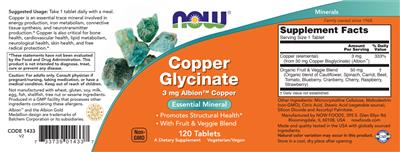
Suggested Usage: Take 1 tablet daily with a meal.
Formula
Copper is an essential trace mineral involved in energy production, iron metabolism, connective tissue synthesis, and neurotransmitter production. Copper is also critical for bone health, cardiovascular health, lipid metabolism, neurological health, skin health, and free radical protection.
Albion Minerals
3 mg Albion Copper Essential Mineral Copper Glycinate with Fruit & Veggie Blend
FDA Disclaimer Statement
These statements have not been evaluated by the Food and Drug Administration. This product is not intended to diagnose, treat, cure or prevent any disease.
Precautions
Caution: For adults only. Keep out of reach of children.
Consult physician if pregnant/nursing, taking medication, or have a medical condition.
Not manufactured with wheat, gluten, soy, milk, egg, fish, shellfish, tree nut or sesame ingredients. Produced in a GMP facility that processes other ingredients containing these allergens.
Formulation
Not manufactured with wheat, gluten, soy, milk, egg, fish, shellfish, tree nut or sesame ingredients.
Promotes Structural Health
Non-GMO
Vegetarian/Vegan
Made and quality tested in the USA with globally sourced ingredients. Natural color variation may occur in this product.
Brand IP Statement(s)
Albion and the Albion Gold Medallion design are trademarks of Balchem Corporation or its subsidiaries.
FDA Statement of Identity
A Dietary Supplement
General Statements
Minerals Family owned since 1968.
Storage
Store in a cool, dry place after opening.
Seals/Symbols
Quality GMP Assured
Is this label outdated? Report a formula or label change and our pharmacy team will review it.
Copper Glycinate 3 mg by NOW label
The label scan from the NIH Dietary Supplement Label Database. Tap to enlarge.
Label images are published by the NIH Dietary Supplement Label Database for the version of this product on file. Always read your actual product label.
View the full label (PDF)The Ingredients in Copper Glycinate 3 mg by NOW
These are the 11 active ingredients this product is made of. Select any to open its full monograph.
Serving size1 Tablet(s) Dosage formTablet Or Pill Servings per container120 Amounts shown are per serving.
Most supplement products combine several ingredients, and a medication can interact with the product through any one of them. Each ingredient below shows whether it has known drug interactions.
Copper
Interacts with31 drugs
Copper is an essential trace mineral your body needs in small amounts for making red blood cells, supporting nerves and bones, and helping enzymes wor...
Copper monograph & interactionsOrganic Fruit & Veggie Blend
- › Blueberry
- › Spinach
- › Cherry
- › Carrot
- › Cauliflower
- › Strawberry
- › Raspberry
- › Cranberry
- › Tomato
- › Beet
Other (inactive) ingredients: Microcrystalline Cellulose, Maltodextrin, Citric Acid, Stearic Acid, Silicon Dioxide, Ascorbyl Palmitate. These complete the product’s ingredient list but are not active constituents.
Copper Glycinate 3 mg by NOW Drug Interactions
HelloPharmacist Interaction Report
NOW's Copper Glycine 3 mg contains copper along with nine plant-based ingredients, and several of them interact with medications.
The most serious documented interaction is between Spinach and Warfarin (a blood thinner), which carries Major severity — spinach's vitamin K content can reduce warfarin's effectiveness, and daily consumption for a week requires dose adjustment.
Read the full breakdown — every affected drug type, severity by severity
Other Moderate-severity interactions span multiple drug types: Blueberry and Spinach may lower blood sugar unpredictably when combined with antidiabetes drugs; Strawberry and Cranberry increase bleeding risk with blood thinners and antiplatelet drugs (like aspirin and clopidogrel); Beet and Cauliflower may affect how your liver clears certain medications (CYP3A4 and CYP1A2 substrates, including some statins and other common drugs); and Cranberry specifically raises concerns with cholesterol drugs like atorvastatin and heart medications like nifedipine. Copper interacts with penicillamine (an older arthritis and copper-chelation drug) at Minor severity, and oral contraceptives may raise copper levels.
Blueberry, Strawberry, and Cranberry carry Minor interactions with additional drug types. Altogether, these interactions span 1,092 individual medications.
Carrot and Tomato were checked with no documented interactions. We could not check Cherry and Raspberry — we hold no data for them.
Use the medication checker on this page to see if any of your prescriptions are affected.
Check your own medications below · Editorial policy · How we use AI
Want to check YOUR meds against Copper Glycinate 3 mg?
Ask about interactions with your drugs in plain English — “Can I take it with lisinopril?” — and we find you the answer in seconds, ingredient by ingredient.
Go to the checkerIngredients driving the most interactions
Individual Drug Interactions
The ingredients in Copper Glycinate 3 mg interact with 1,107 drugs. Click any drug to see the details.
7 of the 11 ingredients in Copper Glycinate 3 mg interact with drugs. Each result below shows which ingredient is responsible. Beet Cranberry Strawberry Cauliflower Blueberry Spinach Copper
Acetaminophen, Chlorpheniramine, Guaifenesin, Phenylephrine, SalicylamideRhinogesic GG
How Acetaminophen, Chlorpheniramine, Guaifenesin, Phenylephrine, Salicylamide interacts with Copper Glycinate 3 mg — through 3 ingredients. Tap an ingredient for the detail:
CranberryCytochrome P450 3a4 (cyp3a4) Substrates Moderate
Interaction Summary
Theoretically, cranberry might increase the levels and adverse effects of CYP3A4 substrates.
Read the full Cranberry + Acetaminophen, Chlorpheniramine, Guaifenesin, Phenylephrine, Salicylamide interactionBeetCytochrome P450 3a4 (cyp3a4) Substrates, Cytochrome P450 1a2 (cyp1a2) Substrates Moderate
Interaction Summary
Theoretically, beet might increase the levels of CYP3A4 substrates.
Read the full Beet + Acetaminophen, Chlorpheniramine, Guaifenesin, Phenylephrine, Salicylamide interactionCauliflowerCytochrome P450 1a2 (cyp1a2) Substrates Moderate
Interaction Summary
Preliminary clinical evidence suggests that eating cruciferous vegetables, including broccoli, cauliflower, daikon radish sprouts, and cabbage, can increase cytochrome P450 1A2 (CYP1A2) activity by 14% to 27%.
Read the full Cauliflower + Acetaminophen, Chlorpheniramine, Guaifenesin, Phenylephrine, Salicylamide interactionAcetaminophen, Chlorpheniramine, PhenylephrineAlka-Seltzer PLUS, Histex SR, Protid
How Acetaminophen, Chlorpheniramine, Phenylephrine interacts with Copper Glycinate 3 mg — through 3 ingredients. Tap an ingredient for the detail:
CauliflowerCytochrome P450 1a2 (cyp1a2) Substrates Moderate
Interaction Summary
Preliminary clinical evidence suggests that eating cruciferous vegetables, including broccoli, cauliflower, daikon radish sprouts, and cabbage, can increase cytochrome P450 1A2 (CYP1A2) activity by 14% to 27%.
Read the full Cauliflower + Acetaminophen, Chlorpheniramine, Phenylephrine interactionCranberryCytochrome P450 3a4 (cyp3a4) Substrates Moderate
Interaction Summary
Theoretically, cranberry might increase the levels and adverse effects of CYP3A4 substrates.
Read the full Cranberry + Acetaminophen, Chlorpheniramine, Phenylephrine interactionBeetCytochrome P450 1a2 (cyp1a2) Substrates, Cytochrome P450 3a4 (cyp3a4) Substrates Moderate
Interaction Summary
Theoretically, beet might decrease the levels and clinical effects of CYP1A2 substrates.
Read the full Beet + Acetaminophen, Chlorpheniramine, Phenylephrine interactionAcetaminophen, Chlorpheniramine, Phenylephrine, SalicylamideRhinogesic, Rhinogesic JR
How Acetaminophen, Chlorpheniramine, Phenylephrine, Salicylamide interacts with Copper Glycinate 3 mg — through 3 ingredients. Tap an ingredient for the detail:
BeetCytochrome P450 1a2 (cyp1a2) Substrates, Cytochrome P450 3a4 (cyp3a4) Substrates Moderate
Interaction Summary
Theoretically, beet might decrease the levels and clinical effects of CYP1A2 substrates.
Read the full Beet + Acetaminophen, Chlorpheniramine, Phenylephrine, Salicylamide interactionCranberryCytochrome P450 3a4 (cyp3a4) Substrates Moderate
Interaction Summary
Theoretically, cranberry might increase the levels and adverse effects of CYP3A4 substrates.
Read the full Cranberry + Acetaminophen, Chlorpheniramine, Phenylephrine, Salicylamide interactionCauliflowerCytochrome P450 1a2 (cyp1a2) Substrates Moderate
Interaction Summary
Preliminary clinical evidence suggests that eating cruciferous vegetables, including broccoli, cauliflower, daikon radish sprouts, and cabbage, can increase cytochrome P450 1A2 (CYP1A2) activity by 14% to 27%.
Read the full Cauliflower + Acetaminophen, Chlorpheniramine, Phenylephrine, Salicylamide interactionAcetaminophen, Chlorpheniramine, PhenylpropanolamineAlumadrine, Conex, Sinadrin Max Strength, Sinulin
How Acetaminophen, Chlorpheniramine, Phenylpropanolamine interacts with Copper Glycinate 3 mg — through 3 ingredients. Tap an ingredient for the detail:
CranberryCytochrome P450 3a4 (cyp3a4) Substrates Moderate
Interaction Summary
Theoretically, cranberry might increase the levels and adverse effects of CYP3A4 substrates.
Read the full Cranberry + Acetaminophen, Chlorpheniramine, Phenylpropanolamine interactionBeetCytochrome P450 3a4 (cyp3a4) Substrates, Cytochrome P450 1a2 (cyp1a2) Substrates Moderate
Interaction Summary
Theoretically, beet might increase the levels of CYP3A4 substrates.
Read the full Beet + Acetaminophen, Chlorpheniramine, Phenylpropanolamine interactionCauliflowerCytochrome P450 1a2 (cyp1a2) Substrates Moderate
Interaction Summary
Preliminary clinical evidence suggests that eating cruciferous vegetables, including broccoli, cauliflower, daikon radish sprouts, and cabbage, can increase cytochrome P450 1A2 (CYP1A2) activity by 14% to 27%.
Read the full Cauliflower + Acetaminophen, Chlorpheniramine, Phenylpropanolamine interactionAcetaminophen, Chlorpheniramine, Phenylpropanolamine, OpiumHista-Derfule
How Acetaminophen, Chlorpheniramine, Phenylpropanolamine, Opium interacts with Copper Glycinate 3 mg — through 3 ingredients. Tap an ingredient for the detail:
CranberryCytochrome P450 3a4 (cyp3a4) Substrates Moderate
Interaction Summary
Theoretically, cranberry might increase the levels and adverse effects of CYP3A4 substrates.
Read the full Cranberry + Acetaminophen, Chlorpheniramine, Phenylpropanolamine, Opium interactionBeetCytochrome P450 3a4 (cyp3a4) Substrates, Cytochrome P450 1a2 (cyp1a2) Substrates Moderate
Interaction Summary
Theoretically, beet might increase the levels of CYP3A4 substrates.
Read the full Beet + Acetaminophen, Chlorpheniramine, Phenylpropanolamine, Opium interactionCauliflowerCytochrome P450 1a2 (cyp1a2) Substrates Moderate
Interaction Summary
Preliminary clinical evidence suggests that eating cruciferous vegetables, including broccoli, cauliflower, daikon radish sprouts, and cabbage, can increase cytochrome P450 1A2 (CYP1A2) activity by 14% to 27%.
Read the full Cauliflower + Acetaminophen, Chlorpheniramine, Phenylpropanolamine, Opium interactionAcetaminophen, Chlorpheniramine, Phenylpropanolamine, PhenyltoloxamineNorel Plus
How Acetaminophen, Chlorpheniramine, Phenylpropanolamine, Phenyltoloxamine interacts with Copper Glycinate 3 mg — through 3 ingredients. Tap an ingredient for the detail:
BeetCytochrome P450 3a4 (cyp3a4) Substrates, Cytochrome P450 1a2 (cyp1a2) Substrates Moderate
Interaction Summary
Theoretically, beet might increase the levels of CYP3A4 substrates.
Read the full Beet + Acetaminophen, Chlorpheniramine, Phenylpropanolamine, Phenyltoloxamine interactionCranberryCytochrome P450 3a4 (cyp3a4) Substrates Moderate
Interaction Summary
Theoretically, cranberry might increase the levels and adverse effects of CYP3A4 substrates.
Read the full Cranberry + Acetaminophen, Chlorpheniramine, Phenylpropanolamine, Phenyltoloxamine interactionCauliflowerCytochrome P450 1a2 (cyp1a2) Substrates Moderate
Interaction Summary
Preliminary clinical evidence suggests that eating cruciferous vegetables, including broccoli, cauliflower, daikon radish sprouts, and cabbage, can increase cytochrome P450 1A2 (CYP1A2) activity by 14% to 27%.
Read the full Cauliflower + Acetaminophen, Chlorpheniramine, Phenylpropanolamine, Phenyltoloxamine interactionAcetaminophen, Chlorpheniramine, PseudoephedrineAlka-Seltzer PLUS Liquid Gels, Children's Tylenol Cold, Codimal, Comtrex, Extra Strength Tylenol Allergy Sinus, Lorsin +3 more
How Acetaminophen, Chlorpheniramine, Pseudoephedrine interacts with Copper Glycinate 3 mg — through 3 ingredients. Tap an ingredient for the detail:
CauliflowerCytochrome P450 1a2 (cyp1a2) Substrates Moderate
Interaction Summary
Preliminary clinical evidence suggests that eating cruciferous vegetables, including broccoli, cauliflower, daikon radish sprouts, and cabbage, can increase cytochrome P450 1A2 (CYP1A2) activity by 14% to 27%.
Read the full Cauliflower + Acetaminophen, Chlorpheniramine, Pseudoephedrine interactionCranberryCytochrome P450 3a4 (cyp3a4) Substrates Moderate
Interaction Summary
Theoretically, cranberry might increase the levels and adverse effects of CYP3A4 substrates.
Read the full Cranberry + Acetaminophen, Chlorpheniramine, Pseudoephedrine interactionBeetCytochrome P450 3a4 (cyp3a4) Substrates, Cytochrome P450 1a2 (cyp1a2) Substrates Moderate
Interaction Summary
Theoretically, beet might increase the levels of CYP3A4 substrates.
Read the full Beet + Acetaminophen, Chlorpheniramine, Pseudoephedrine interactionAcetaminophen, ChlorzoxazoneAcetazone Forte, Extra Strength Tylenol Aches & Strains, Parafon Forte
How Acetaminophen, Chlorzoxazone interacts with Copper Glycinate 3 mg — through 2 ingredients. Tap an ingredient for the detail:
CauliflowerCytochrome P450 1a2 (cyp1a2) Substrates Moderate
Interaction Summary
Preliminary clinical evidence suggests that eating cruciferous vegetables, including broccoli, cauliflower, daikon radish sprouts, and cabbage, can increase cytochrome P450 1A2 (CYP1A2) activity by 14% to 27%.
Read the full Cauliflower + Acetaminophen, Chlorzoxazone interactionBeetCytochrome P450 1a2 (cyp1a2) Substrates Minor
Interaction Summary
Theoretically, beet might decrease the levels and clinical effects of CYP1A2 substrates.
Read the full Beet + Acetaminophen, Chlorzoxazone interactionAcetaminophen, Chlorzoxazone, CodeineAcetazone Forte C8, Parafon Forte C8
How Acetaminophen, Chlorzoxazone, Codeine interacts with Copper Glycinate 3 mg — through 2 ingredients. Tap an ingredient for the detail:
CauliflowerCytochrome P450 1a2 (cyp1a2) Substrates Moderate
Interaction Summary
Preliminary clinical evidence suggests that eating cruciferous vegetables, including broccoli, cauliflower, daikon radish sprouts, and cabbage, can increase cytochrome P450 1A2 (CYP1A2) activity by 14% to 27%.
Read the full Cauliflower + Acetaminophen, Chlorzoxazone, Codeine interactionBeetCytochrome P450 1a2 (cyp1a2) Substrates Minor
Interaction Summary
Theoretically, beet might decrease the levels and clinical effects of CYP1A2 substrates.
Read the full Beet + Acetaminophen, Chlorzoxazone, Codeine interactionAcetaminophen, CodeineTylenol No.3, Tylenol w/ Codeine
How Acetaminophen, Codeine interacts with Copper Glycinate 3 mg — through 2 ingredients. Tap an ingredient for the detail:
CauliflowerCytochrome P450 1a2 (cyp1a2) Substrates Moderate
Interaction Summary
Preliminary clinical evidence suggests that eating cruciferous vegetables, including broccoli, cauliflower, daikon radish sprouts, and cabbage, can increase cytochrome P450 1A2 (CYP1A2) activity by 14% to 27%.
Read the full Cauliflower + Acetaminophen, Codeine interactionBeetCytochrome P450 1a2 (cyp1a2) Substrates Minor
Interaction Summary
Theoretically, beet might decrease the levels and clinical effects of CYP1A2 substrates.
Read the full Beet + Acetaminophen, Codeine interactionAcetaminophen, Codeine, DoxylamineMersyndol
How Acetaminophen, Codeine, Doxylamine interacts with Copper Glycinate 3 mg — through 2 ingredients. Tap an ingredient for the detail:
CauliflowerCytochrome P450 1a2 (cyp1a2) Substrates Moderate
Interaction Summary
Preliminary clinical evidence suggests that eating cruciferous vegetables, including broccoli, cauliflower, daikon radish sprouts, and cabbage, can increase cytochrome P450 1A2 (CYP1A2) activity by 14% to 27%.
Read the full Cauliflower + Acetaminophen, Codeine, Doxylamine interactionBeetCytochrome P450 1a2 (cyp1a2) Substrates Minor
Interaction Summary
Theoretically, beet might decrease the levels and clinical effects of CYP1A2 substrates.
Read the full Beet + Acetaminophen, Codeine, Doxylamine interactionAcetaminophen, Codeine, MethocarbamolAcetaminophen, Codeine, Methocarbamol, Robaxacet 8
How Acetaminophen, Codeine, Methocarbamol interacts with Copper Glycinate 3 mg — through 2 ingredients. Tap an ingredient for the detail:
CauliflowerCytochrome P450 1a2 (cyp1a2) Substrates Moderate
Interaction Summary
Preliminary clinical evidence suggests that eating cruciferous vegetables, including broccoli, cauliflower, daikon radish sprouts, and cabbage, can increase cytochrome P450 1A2 (CYP1A2) activity by 14% to 27%.
Read the full Cauliflower + Acetaminophen, Codeine, Methocarbamol interactionBeetCytochrome P450 1a2 (cyp1a2) Substrates Minor
Interaction Summary
Theoretically, beet might decrease the levels and clinical effects of CYP1A2 substrates.
Read the full Beet + Acetaminophen, Codeine, Methocarbamol interactionAcetaminophen, Dexbrompheniramine, PseudoephedrineSinadrin Plus
How Acetaminophen, Dexbrompheniramine, Pseudoephedrine interacts with Copper Glycinate 3 mg — through 2 ingredients. Tap an ingredient for the detail:
CauliflowerCytochrome P450 1a2 (cyp1a2) Substrates Moderate
Interaction Summary
Preliminary clinical evidence suggests that eating cruciferous vegetables, including broccoli, cauliflower, daikon radish sprouts, and cabbage, can increase cytochrome P450 1A2 (CYP1A2) activity by 14% to 27%.
Read the full Cauliflower + Acetaminophen, Dexbrompheniramine, Pseudoephedrine interactionBeetCytochrome P450 1a2 (cyp1a2) Substrates Minor
Interaction Summary
Theoretically, beet might decrease the levels and clinical effects of CYP1A2 substrates.
Read the full Beet + Acetaminophen, Dexbrompheniramine, Pseudoephedrine interactionAcetaminophen, DextromethorphanTylenol Cough Ex Strength
How Acetaminophen, Dextromethorphan interacts with Copper Glycinate 3 mg — through 3 ingredients. Tap an ingredient for the detail:
BeetCytochrome P450 1a2 (cyp1a2) Substrates, Cytochrome P450 3a4 (cyp3a4) Substrates Moderate
Interaction Summary
Theoretically, beet might decrease the levels and clinical effects of CYP1A2 substrates.
Read the full Beet + Acetaminophen, Dextromethorphan interactionCauliflowerCytochrome P450 1a2 (cyp1a2) Substrates Moderate
Interaction Summary
Preliminary clinical evidence suggests that eating cruciferous vegetables, including broccoli, cauliflower, daikon radish sprouts, and cabbage, can increase cytochrome P450 1A2 (CYP1A2) activity by 14% to 27%.
Read the full Cauliflower + Acetaminophen, Dextromethorphan interactionCranberryCytochrome P450 3a4 (cyp3a4) Substrates Moderate
Interaction Summary
Theoretically, cranberry might increase the levels and adverse effects of CYP3A4 substrates.
Read the full Cranberry + Acetaminophen, Dextromethorphan interactionAcetaminophen, Dextromethorphan, Doxylamine, PseudoephedrineVicks NyQuil
How Acetaminophen, Dextromethorphan, Doxylamine, Pseudoephedrine interacts with Copper Glycinate 3 mg — through 3 ingredients. Tap an ingredient for the detail:
BeetCytochrome P450 1a2 (cyp1a2) Substrates, Cytochrome P450 3a4 (cyp3a4) Substrates Moderate
Interaction Summary
Theoretically, beet might decrease the levels and clinical effects of CYP1A2 substrates.
Read the full Beet + Acetaminophen, Dextromethorphan, Doxylamine, Pseudoephedrine interactionCauliflowerCytochrome P450 1a2 (cyp1a2) Substrates Moderate
Interaction Summary
Preliminary clinical evidence suggests that eating cruciferous vegetables, including broccoli, cauliflower, daikon radish sprouts, and cabbage, can increase cytochrome P450 1A2 (CYP1A2) activity by 14% to 27%.
Read the full Cauliflower + Acetaminophen, Dextromethorphan, Doxylamine, Pseudoephedrine interactionCranberryCytochrome P450 3a4 (cyp3a4) Substrates Moderate
Interaction Summary
Theoretically, cranberry might increase the levels and adverse effects of CYP3A4 substrates.
Read the full Cranberry + Acetaminophen, Dextromethorphan, Doxylamine, Pseudoephedrine interactionAcetaminophen, Dextromethorphan, Guaifenesin, PhenylephrineConar-A
How Acetaminophen, Dextromethorphan, Guaifenesin, Phenylephrine interacts with Copper Glycinate 3 mg — through 3 ingredients. Tap an ingredient for the detail:
BeetCytochrome P450 3a4 (cyp3a4) Substrates, Cytochrome P450 1a2 (cyp1a2) Substrates Moderate
Interaction Summary
Theoretically, beet might increase the levels of CYP3A4 substrates.
Read the full Beet + Acetaminophen, Dextromethorphan, Guaifenesin, Phenylephrine interactionCranberryCytochrome P450 3a4 (cyp3a4) Substrates Moderate
Interaction Summary
Theoretically, cranberry might increase the levels and adverse effects of CYP3A4 substrates.
Read the full Cranberry + Acetaminophen, Dextromethorphan, Guaifenesin, Phenylephrine interactionCauliflowerCytochrome P450 1a2 (cyp1a2) Substrates Moderate
Interaction Summary
Preliminary clinical evidence suggests that eating cruciferous vegetables, including broccoli, cauliflower, daikon radish sprouts, and cabbage, can increase cytochrome P450 1A2 (CYP1A2) activity by 14% to 27%.
Read the full Cauliflower + Acetaminophen, Dextromethorphan, Guaifenesin, Phenylephrine interactionAcetaminophen, Dextromethorphan, Guaifenesin, PhenylpropanolamineAnatuss
How Acetaminophen, Dextromethorphan, Guaifenesin, Phenylpropanolamine interacts with Copper Glycinate 3 mg — through 3 ingredients. Tap an ingredient for the detail:
CauliflowerCytochrome P450 1a2 (cyp1a2) Substrates Moderate
Interaction Summary
Preliminary clinical evidence suggests that eating cruciferous vegetables, including broccoli, cauliflower, daikon radish sprouts, and cabbage, can increase cytochrome P450 1A2 (CYP1A2) activity by 14% to 27%.
Read the full Cauliflower + Acetaminophen, Dextromethorphan, Guaifenesin, Phenylpropanolamine interactionBeetCytochrome P450 1a2 (cyp1a2) Substrates, Cytochrome P450 3a4 (cyp3a4) Substrates Moderate
Interaction Summary
Theoretically, beet might decrease the levels and clinical effects of CYP1A2 substrates.
Read the full Beet + Acetaminophen, Dextromethorphan, Guaifenesin, Phenylpropanolamine interactionCranberryCytochrome P450 3a4 (cyp3a4) Substrates Moderate
Interaction Summary
Theoretically, cranberry might increase the levels and adverse effects of CYP3A4 substrates.
Read the full Cranberry + Acetaminophen, Dextromethorphan, Guaifenesin, Phenylpropanolamine interactionAcetaminophen, Dextromethorphan, Guaifenesin, PseudoephedrineRobitussin Cold, Severe Cold, Suphedrine Cold/Cough
How Acetaminophen, Dextromethorphan, Guaifenesin, Pseudoephedrine interacts with Copper Glycinate 3 mg — through 3 ingredients. Tap an ingredient for the detail:
BeetCytochrome P450 1a2 (cyp1a2) Substrates, Cytochrome P450 3a4 (cyp3a4) Substrates Moderate
Interaction Summary
Theoretically, beet might decrease the levels and clinical effects of CYP1A2 substrates.
Read the full Beet + Acetaminophen, Dextromethorphan, Guaifenesin, Pseudoephedrine interactionCauliflowerCytochrome P450 1a2 (cyp1a2) Substrates Moderate
Interaction Summary
Preliminary clinical evidence suggests that eating cruciferous vegetables, including broccoli, cauliflower, daikon radish sprouts, and cabbage, can increase cytochrome P450 1A2 (CYP1A2) activity by 14% to 27%.
Read the full Cauliflower + Acetaminophen, Dextromethorphan, Guaifenesin, Pseudoephedrine interactionCranberryCytochrome P450 3a4 (cyp3a4) Substrates Moderate
Interaction Summary
Theoretically, cranberry might increase the levels and adverse effects of CYP3A4 substrates.
Read the full Cranberry + Acetaminophen, Dextromethorphan, Guaifenesin, Pseudoephedrine interactionAcetaminophen, Dextromethorphan, Phenylpropanolamine, PyrilamineTheracaps
How Acetaminophen, Dextromethorphan, Phenylpropanolamine, Pyrilamine interacts with Copper Glycinate 3 mg — through 3 ingredients. Tap an ingredient for the detail:
CranberryCytochrome P450 3a4 (cyp3a4) Substrates Moderate
Interaction Summary
Theoretically, cranberry might increase the levels and adverse effects of CYP3A4 substrates.
Read the full Cranberry + Acetaminophen, Dextromethorphan, Phenylpropanolamine, Pyrilamine interactionCauliflowerCytochrome P450 1a2 (cyp1a2) Substrates Moderate
Interaction Summary
Preliminary clinical evidence suggests that eating cruciferous vegetables, including broccoli, cauliflower, daikon radish sprouts, and cabbage, can increase cytochrome P450 1A2 (CYP1A2) activity by 14% to 27%.
Read the full Cauliflower + Acetaminophen, Dextromethorphan, Phenylpropanolamine, Pyrilamine interactionBeetCytochrome P450 3a4 (cyp3a4) Substrates, Cytochrome P450 1a2 (cyp1a2) Substrates Moderate
Interaction Summary
Theoretically, beet might increase the levels of CYP3A4 substrates.
Read the full Beet + Acetaminophen, Dextromethorphan, Phenylpropanolamine, Pyrilamine interactionAcetaminophen, Dextromethorphan, PseudoephedrineAlka-Seltzer PLUS Flu Liquid Gels, Non Aspirin Cold Caps, Tylenol Cold, Tylenol Flu Daytime Ex Strength, Tylenol Flu Ex Strength
How Acetaminophen, Dextromethorphan, Pseudoephedrine interacts with Copper Glycinate 3 mg — through 3 ingredients. Tap an ingredient for the detail:
BeetCytochrome P450 1a2 (cyp1a2) Substrates, Cytochrome P450 3a4 (cyp3a4) Substrates Moderate
Interaction Summary
Theoretically, beet might decrease the levels and clinical effects of CYP1A2 substrates.
Read the full Beet + Acetaminophen, Dextromethorphan, Pseudoephedrine interactionCauliflowerCytochrome P450 1a2 (cyp1a2) Substrates Moderate
Interaction Summary
Preliminary clinical evidence suggests that eating cruciferous vegetables, including broccoli, cauliflower, daikon radish sprouts, and cabbage, can increase cytochrome P450 1A2 (CYP1A2) activity by 14% to 27%.
Read the full Cauliflower + Acetaminophen, Dextromethorphan, Pseudoephedrine interactionCranberryCytochrome P450 3a4 (cyp3a4) Substrates Moderate
Interaction Summary
Theoretically, cranberry might increase the levels and adverse effects of CYP3A4 substrates.
Read the full Cranberry + Acetaminophen, Dextromethorphan, Pseudoephedrine interactionAcetaminophen, Dichloralantipyrine, IsomethepteneAmidrine, Midchlor, Migquin, Migratine
How Acetaminophen, Dichloralantipyrine, Isometheptene interacts with Copper Glycinate 3 mg — through 2 ingredients. Tap an ingredient for the detail:
CauliflowerCytochrome P450 1a2 (cyp1a2) Substrates Moderate
Interaction Summary
Preliminary clinical evidence suggests that eating cruciferous vegetables, including broccoli, cauliflower, daikon radish sprouts, and cabbage, can increase cytochrome P450 1A2 (CYP1A2) activity by 14% to 27%.
Read the full Cauliflower + Acetaminophen, Dichloralantipyrine, Isometheptene interactionBeetCytochrome P450 1a2 (cyp1a2) Substrates Minor
Interaction Summary
Theoretically, beet might decrease the levels and clinical effects of CYP1A2 substrates.
Read the full Beet + Acetaminophen, Dichloralantipyrine, Isometheptene interactionAcetaminophen, Dichloralphenazone, IsomethepteneMidrin
How Acetaminophen, Dichloralphenazone, Isometheptene interacts with Copper Glycinate 3 mg — through 2 ingredients. Tap an ingredient for the detail:
CauliflowerCytochrome P450 1a2 (cyp1a2) Substrates Moderate
Interaction Summary
Preliminary clinical evidence suggests that eating cruciferous vegetables, including broccoli, cauliflower, daikon radish sprouts, and cabbage, can increase cytochrome P450 1A2 (CYP1A2) activity by 14% to 27%.
Read the full Cauliflower + Acetaminophen, Dichloralphenazone, Isometheptene interactionBeetCytochrome P450 1a2 (cyp1a2) Substrates Minor
Interaction Summary
Theoretically, beet might decrease the levels and clinical effects of CYP1A2 substrates.
Read the full Beet + Acetaminophen, Dichloralphenazone, Isometheptene interactionAcetaminophen, Dichlorophenazone, IsometheptaneIsocom
How Acetaminophen, Dichlorophenazone, Isometheptane interacts with Copper Glycinate 3 mg — through 2 ingredients. Tap an ingredient for the detail:
CauliflowerCytochrome P450 1a2 (cyp1a2) Substrates Moderate
Interaction Summary
Preliminary clinical evidence suggests that eating cruciferous vegetables, including broccoli, cauliflower, daikon radish sprouts, and cabbage, can increase cytochrome P450 1A2 (CYP1A2) activity by 14% to 27%.
Read the full Cauliflower + Acetaminophen, Dichlorophenazone, Isometheptane interactionBeetCytochrome P450 1a2 (cyp1a2) Substrates Minor
Interaction Summary
Theoretically, beet might decrease the levels and clinical effects of CYP1A2 substrates.
Read the full Beet + Acetaminophen, Dichlorophenazone, Isometheptane interactionAcetaminophen, DiphenhydramineTylenol PM, Tylenol PM Ex Strength
How Acetaminophen, Diphenhydramine interacts with Copper Glycinate 3 mg — through 2 ingredients. Tap an ingredient for the detail:
CauliflowerCytochrome P450 1a2 (cyp1a2) Substrates Moderate
Interaction Summary
Preliminary clinical evidence suggests that eating cruciferous vegetables, including broccoli, cauliflower, daikon radish sprouts, and cabbage, can increase cytochrome P450 1A2 (CYP1A2) activity by 14% to 27%.
Read the full Cauliflower + Acetaminophen, Diphenhydramine interactionBeetCytochrome P450 1a2 (cyp1a2) Substrates Minor
Interaction Summary
Theoretically, beet might decrease the levels and clinical effects of CYP1A2 substrates.
Read the full Beet + Acetaminophen, Diphenhydramine interactionAcetaminophen, Diphenhydramine, PseudoephedrineChildren's Tylenol Allergy, Cold Control, Contac Night Allergy Relief
How Acetaminophen, Diphenhydramine, Pseudoephedrine interacts with Copper Glycinate 3 mg — through 2 ingredients. Tap an ingredient for the detail:
CauliflowerCytochrome P450 1a2 (cyp1a2) Substrates Moderate
Interaction Summary
Preliminary clinical evidence suggests that eating cruciferous vegetables, including broccoli, cauliflower, daikon radish sprouts, and cabbage, can increase cytochrome P450 1A2 (CYP1A2) activity by 14% to 27%.
Read the full Cauliflower + Acetaminophen, Diphenhydramine, Pseudoephedrine interactionBeetCytochrome P450 1a2 (cyp1a2) Substrates Minor
Interaction Summary
Theoretically, beet might decrease the levels and clinical effects of CYP1A2 substrates.
Read the full Beet + Acetaminophen, Diphenhydramine, Pseudoephedrine interactionAcetaminophen, Doxylamine, PseudoephedrineEx Strength Tylenol Sinus Nighttime
How Acetaminophen, Doxylamine, Pseudoephedrine interacts with Copper Glycinate 3 mg — through 2 ingredients. Tap an ingredient for the detail:
CauliflowerCytochrome P450 1a2 (cyp1a2) Substrates Moderate
Interaction Summary
Preliminary clinical evidence suggests that eating cruciferous vegetables, including broccoli, cauliflower, daikon radish sprouts, and cabbage, can increase cytochrome P450 1A2 (CYP1A2) activity by 14% to 27%.
Read the full Cauliflower + Acetaminophen, Doxylamine, Pseudoephedrine interactionBeetCytochrome P450 1a2 (cyp1a2) Substrates Minor
Interaction Summary
Theoretically, beet might decrease the levels and clinical effects of CYP1A2 substrates.
Read the full Beet + Acetaminophen, Doxylamine, Pseudoephedrine interactionAcetaminophen, HydrocodoneAnexsia, Anodynos DHC, Azdone, Co-Gesic, Doucet, Lorcet +9 more
How Acetaminophen, Hydrocodone interacts with Copper Glycinate 3 mg — through 3 ingredients. Tap an ingredient for the detail:
BeetCytochrome P450 1a2 (cyp1a2) Substrates, Cytochrome P450 3a4 (cyp3a4) Substrates Moderate
Interaction Summary
Theoretically, beet might decrease the levels and clinical effects of CYP1A2 substrates.
Read the full Beet + Acetaminophen, Hydrocodone interactionCauliflowerCytochrome P450 1a2 (cyp1a2) Substrates Moderate
Interaction Summary
Preliminary clinical evidence suggests that eating cruciferous vegetables, including broccoli, cauliflower, daikon radish sprouts, and cabbage, can increase cytochrome P450 1A2 (CYP1A2) activity by 14% to 27%.
Read the full Cauliflower + Acetaminophen, Hydrocodone interactionCranberryCytochrome P450 3a4 (cyp3a4) Substrates Moderate
Interaction Summary
Theoretically, cranberry might increase the levels and adverse effects of CYP3A4 substrates.
Read the full Cranberry + Acetaminophen, Hydrocodone interactionAcetaminophen, IbuprofenCombogesic
How Acetaminophen, Ibuprofen interacts with Copper Glycinate 3 mg — through 4 ingredients. Tap an ingredient for the detail:
StrawberryAnticoagulant/antiplatelet Drugs Moderate
Interaction Summary
In vitro and animal research suggests that strawberry extract can inhibit platelet aggregation due to its phenolic content.
Read the full Strawberry + Acetaminophen, Ibuprofen interactionCauliflowerCytochrome P450 1a2 (cyp1a2) Substrates Moderate
Interaction Summary
Preliminary clinical evidence suggests that eating cruciferous vegetables, including broccoli, cauliflower, daikon radish sprouts, and cabbage, can increase cytochrome P450 1A2 (CYP1A2) activity by 14% to 27%.
Read the full Cauliflower + Acetaminophen, Ibuprofen interactionCranberryCytochrome P450 2c9 (cyp2c9) Substrates Minor
Interaction Summary
Theoretically, cranberry might increase the levels and adverse effects of CYP2C9 substrates.
Read the full Cranberry + Acetaminophen, Ibuprofen interactionBeetCytochrome P450 1a2 (cyp1a2) Substrates Minor
Interaction Summary
Theoretically, beet might decrease the levels and clinical effects of CYP1A2 substrates.
Read the full Beet + Acetaminophen, Ibuprofen interactionAcetaminophen, MeperidineDemerol APAP
How Acetaminophen, Meperidine interacts with Copper Glycinate 3 mg — through 2 ingredients. Tap an ingredient for the detail:
CauliflowerCytochrome P450 1a2 (cyp1a2) Substrates Moderate
Interaction Summary
Preliminary clinical evidence suggests that eating cruciferous vegetables, including broccoli, cauliflower, daikon radish sprouts, and cabbage, can increase cytochrome P450 1A2 (CYP1A2) activity by 14% to 27%.
Read the full Cauliflower + Acetaminophen, Meperidine interactionBeetCytochrome P450 1a2 (cyp1a2) Substrates Minor
Interaction Summary
Theoretically, beet might decrease the levels and clinical effects of CYP1A2 substrates.
Read the full Beet + Acetaminophen, Meperidine interactionAcetaminophen, MethocarbamolRobaxacet
How Acetaminophen, Methocarbamol interacts with Copper Glycinate 3 mg — through 2 ingredients. Tap an ingredient for the detail:
CauliflowerCytochrome P450 1a2 (cyp1a2) Substrates Moderate
Interaction Summary
Preliminary clinical evidence suggests that eating cruciferous vegetables, including broccoli, cauliflower, daikon radish sprouts, and cabbage, can increase cytochrome P450 1A2 (CYP1A2) activity by 14% to 27%.
Read the full Cauliflower + Acetaminophen, Methocarbamol interactionBeetCytochrome P450 1a2 (cyp1a2) Substrates Minor
Interaction Summary
Theoretically, beet might decrease the levels and clinical effects of CYP1A2 substrates.
Read the full Beet + Acetaminophen, Methocarbamol interactionEach ingredient & the kinds of drugs it affects
For each ingredient in Copper Glycinate 3 mg with known interactions, here are the types of medications they can affect. Open any type for the detail — or search your exact drug in the checker above.
Beet
Cytochrome P450 3A4 (Cyp3A4) Substrates
Theoretically, beet might increase the levels of CYP3A4 substrates.
In vitro research suggests that betanin, the major pigment in beet, competitively inhibits CYP3A4 in a dose-dependent manner similarly to strong CYP3A4 inhibitor ketoconazole.
Antihypertensive Drugs
Beet and beetroot contain nitrates, which can cause vasodilation, potentially leading to lower blood pressure. However, a study published in the European Journal of Clinical Nutrition using concentrated beetroot juice found no significant impact on blood pressure or heart rate in different age groups. Other small clinical studies suggest that while beet consumption might transiently lower blood pressure due to vessel dilation, there's no consistent evidence of a lasting effect. Overall, the theoretical risk of reduced blood pressure due to beet's nitrate content exists, but studies generally indicate a low and temporary impact rather than a sustained decrease.
Cytochrome P450 1A2 (Cyp1A2) Substrates
Theoretically, beet might decrease the levels and clinical effects of CYP1A2 substrates.
In vitro research suggests that beet induces CYP1A2 enzymes.
Cranberry
Atorvastatin (Lipitor)
Theoretically, cranberry might increase levels and adverse effects of atorvastatin.
In one case report, a patient taking atorvastatin experienced upper back pain, rhabdomyolysis, and abnormal liver function after drinking cranberry juice 16 ounces daily for 2 weeks. Theoretically, this may have been caused by inhibition of cytochrome P450 3A4 (CYP3A4) enzymes by cranberry juice, as atorvastatin is a CYP3A4 substrate. Creatinine kinase and liver enzymes normalized within 2 weeks of stopping cranberry juice. Patients taking atorvastatin should avoid large quantities of cranberry juice.
Cytochrome P450 3A4 (Cyp3A4) Substrates
Theoretically, cranberry might increase the levels and adverse effects of CYP3A4 substrates.
A case of upper back pain, rhabdomyolysis, and abnormal liver function has been reported for a patient taking atorvastatin, a CYP3A4 substrate, in combination with cranberry juice 16 ounces daily for 2 weeks. Creatinine kinase and liver enzymes normalized within 2 weeks of stopping cranberry juice. Also, animal research suggests that cranberry juice, administered intraduodenally 30 minutes prior to nifedipine, a CYP3A4 substrate, inhibits nifedipine metabolism and increases the area under the concentration-time curve by 1.6-fold compared to control.
Nifedipine (Procardia)
Theoretically, cranberry might increase the levels and adverse effects of nifedipine.
Animal research suggests that cranberry juice, administered intraduodenally 30 minutes prior to nifedipine treatment, inhibits nifedipine metabolism and increases the area under the concentration-time curve by 1.6-fold compared to control. This interaction has not been reported in humans.
Warfarin (Coumadin)
Theoretically, cranberry might increase the levels and adverse effects of warfarin. However, research is conflicting.
There is contradictory evidence about the effect of cranberry juice on warfarin. Case reports have linked cranberry juice consumption to increases in the international normalized ratio (INR) in patients taking warfarin, resulting in severe spontaneous bleeding and excessive postoperative bleeding. Daily consumption of cranberry sauce for one week has also been linked to an increase in INR in one case report. In a small study in healthy young males, taking a high dose of 3 grams of cranberry juice concentrate capsules, equivalent to 57 grams of fruit daily, for 2 weeks produced a 30% increase in the area under the INR-time curve after a single 25-mg dose of warfarin. However, 3 very small clinical studies in patients stabilized on warfarin reported that cranberry juice 250 mL once or twice daily for 7 days (27% cranberry juice or pure cranberry juice) or 240 mL once daily for 14 days does not significantly increase INR or affect plasma warfarin levels. The reasons for these discrepant findings are unclear. It is possible that the form and dose of cranberry may play a role, as cranberry extracts and juices contain different constituents. Additionally, an in vitro study evaluating 5 different cranberry juices found varying effects, with only a cranberry concentrate, and not diluted cranberry juices, inhibiting CYP2C9. However, this concentrate did not inhibit CYP2C9 activity in humans.
Cytochrome P450 2C9 (Cyp2C9) Substrates
Theoretically, cranberry might increase the levels and adverse effects of CYP2C9 substrates. However, research is conflicting.
There is contradictory evidence about the effect of cranberry on CYP2C9 enzymes. In vitro evidence suggests that flavonoids in cranberry inhibit CYP2C9 enzymes. However, clinical research shows that cranberry juice does not significantly affect the levels, metabolism, or elimination of the CYP2C9 substrates flurbiprofen or diclofenac. Also, in patients stabilized on warfarin, drinking cranberry juice 250 mL daily for 7 days does not significantly increase the anticoagulant activity of warfarin, a CYP2C9 substrate. Additional pharmacokinetic research shows that cranberry juice does not increase peak plasma concentrations or area under the concentration-time curve of warfarin.
Diclofenac (Voltaren, Others)
Theoretically, cranberry might modestly increase the levels and adverse effects of diclofenac.
In vitro evidence suggests that cranberry juice inhibits diclofenac metabolism by human liver microsomes. However, drinking cranberry juice does not seem to affect diclofenac metabolism in humans.
Strawberry
Anticoagulant/Antiplatelet Drugs
In vitro and animal research suggests that strawberry extract can inhibit platelet aggregation due to its phenolic content. Theoretically, strawberry might increase the risk of bleeding when used with antiplatelet or anticoagulant drugs.
Some anticoagulant or antiplatelet drugs include aspirin, clopidogrel (Plavix), dalteparin (Fragmin), enoxaparin (Lovenox), heparin, ticlopidine (Ticlid), warfarin (Coumadin), and others.
P-Glycoprotein Substrates
In vitro research suggests that strawberry extract can inhibit p-glycoprotein efflux. Theoretically, strawberry might inhibit p-glycoprotein mediated drug efflux and potentially increase levels of drugs that are substrates of p-glycoprotein. Until more is known, strawberry should be used cautiously in people taking p-glycoprotein substrates.
Drugs that might be affected include some chemotherapeutic agents (etoposide, paclitaxel, vinblastine, vincristine, vindesine), antifungals (ketoconazole, itraconazole), protease inhibitors (amprenavir, indinavir, nelfinavir, saquinavir), H2 antagonists (cimetidine, ranitidine), some calcium channel blockers (diltiazem, verapamil), corticosteroids, erythromycin, cisapride (Propulsid), fexofenadine (Allegra), cyclosporine, loperamide (Imodium), quinidine, and others.
Cauliflower
Cytochrome P450 1A2 (Cyp1A2) Substrates
Preliminary clinical evidence suggests that eating cruciferous vegetables, including broccoli, cauliflower, daikon radish sprouts, and cabbage, can increase cytochrome P450 1A2 (CYP1A2) activity by 14% to 27%. Theoretically, cauliflower might increase the clearance and decrease the effects of drugs metabolized by CYP1A2. Some drugs metabolized by CYP1A2 include clozapine (Clozaril), cyclobenzaprine (Flexeril), fluvoxamine (Luvox), haloperidol (Haldol), imipramine (Tofranil), mexiletine (Mexitil), olanzapine (Zyprexa), pentazocine (Talwin), propranolol (Inderal), tacrine (Cognex), theophylline, zileuton (Zyflo), zolmitriptan (Zomig), and others.
Blueberry
Antidiabetes Drugs
Theoretically, blueberries or blueberry leaf extracts might increase the risk of hypoglycemia when taken with antidiabetes drugs.
Animal and in vitro research suggests that blueberry and/or blueberry leaf extracts can lower blood glucose levels.
Buspirone (Buspar)
Theoretically, blueberry juice might increase blood levels of buspirone.
In vitro research shows that blueberry juice can inhibit the metabolism of buspirone, possibly by inhibiting cytochrome P450 3A (CYP3A) enzymes. However, pharmacokinetic research in humans shows that drinking 300 mL of blueberry juice 30 minutes before taking buspirone hydrochloride 10 mg does not significantly affect the concentration or clearance of buspirone.
Flurbiprofen (Ansaid, Others)
Theoretically, blueberry juice might increase blood levels of flurbiprofen.
In vitro research shows that blueberry juice can inhibit the metabolism of flurbiprofen, possibly by inhibiting cytochrome P450 2C9 (CYP2C9) enzymes. However, pharmacokinetic research in humans shows that drinking 300 mL of blueberry juice 30 minutes before taking flurbiprofen 100 mg does not significantly affect the concentration or clearance of flurbiprofen.
Spinach
Antidiabetes Drugs
There are claims that spinach leaves have hypoglycemic effects. Evidence from clinical research suggests that consumption of a spinach-rich meal reduces post-meal blood glucose levels. Theoretically, spinach might have additive effects with antidiabetes drugs and increase the risk of hypoglycemia. Monitor blood glucose levels closely. Dose adjustments might be necessary. Some antidiabetes drugs include glimepiride (Amaryl), glyburide (DiaBeta, Glynase PresTab, Micronase), insulin, pioglitazone (Actos), rosiglitazone (Avandia), and others.
Warfarin (Coumadin)
Spinach contains vitamin K, which can interfere with the activity of warfarin.
In human research, although eating spinach with one meal does not result in coagulation test results outside the therapeutic range, daily consumption for one week necessitates dose adjustment of warfarin. Individuals using anticoagulants should consume a consistent daily amount of spinach to maintain the effect of anticoagulant therapy.
Copper
Penicillamine (Cuprimine, Depen)
Theoretically, taking copper with penicillamine might decrease the absorption of penicillamine; separate dosing by at least 2 hours.
Copper chelates penicillamine, which decreases its absorption and may reduce its clinical effects.
Contraceptive Drugs
Theoretically, taking copper with contraceptive drugs might increase the levels and toxic effects of copper.
A meta-analysis of clinical studies suggests that chronic use of oral contraceptives increases serum copper levels by a mean of 57 mcg/dL. In most people, this resulted in levels above the normal reference range for copper.
Brand information
Manufacturer and brand details for Copper Glycinate 3 mg, from the product label.
NOW
See all NOW products- Name
- NOW Foods
- Street Address
- 395 S. Glen Ellyn Rd.
- City
- Bloomingdale
- State
- IL
- ZipCode
- 60108
- Web Address
- nowfoods.com
Copper Glycinate 3 mg by NOW: Common Questions
Does Copper Glycinate 3 mg by NOW interact with any medications?
How can one product interact with so many drugs?
Where does this information come from?
Can I take this if I'm on warfarin?
Is this safe if I take blood sugar medication?
What's the copper in this product for?
Will this help my memory or brain health?
Are there any side effects I should expect?
Is this safe during pregnancy?
Written and reviewed by the HelloPharmacist editorial staff. Our editorial policy
Not sure if Copper Glycinate 3 mg is safe with your meds?
Our pharmacists answer your medication & supplement questions — free.
Label information is sourced from the NIH Dietary Supplement Label Database and reflects the product version on file; always read your actual product label. This page is for education only and is not a substitute for professional medical advice. Confirm with your pharmacist or doctor before combining supplements and medications.
The Full Monographs Behind Copper Glycinate 3 mg’s Ingredients
Every ingredient we hold a full HelloPharmacist monograph for — uses, evidence, safety, and the complete interaction list.
Copper
Interacts with 31 drugsCopper is an essential trace mineral your body needs in small amounts for making red blood cells, supporting nerves and bones, and helping enzymes work. Most people get enough copper from fo...
Read the full Copper monograph → Herb & supplement monographBlueberry
Interacts with 88 drugsBlueberries are a nutritious fruit rich in antioxidants called anthocyanins, and eating them as part of a balanced diet is healthy and safe for most people. Concentrated supplements are mark...
Read the full Blueberry monograph → Herb & supplement monographSpinach
Interacts with 88 drugsSpinach is a nutrient-dense leafy green that is a healthy part of a balanced diet, providing vitamins, minerals, fiber, and antioxidants. While it is very safe as a food, concentrated supple...
Read the full Spinach monograph → Herb & supplement monographCarrot
Carrot is a common food vegetable that is a rich source of beta-carotene (which the body turns into vitamin A) and other nutrients. Eating carrots is safe and nutritious for most people, but...
Read the full Carrot monograph → Herb & supplement monographCauliflower
Interacts with 186 drugsCauliflower is a nutritious cruciferous vegetable that provides vitamin C, fiber, and plant compounds called glucosinolates. As a food it is healthy and safe for most people, but there is no...
Read the full Cauliflower monograph → Herb & supplement monographStrawberry
Interacts with 316 drugsStrawberry is a popular, nutrient-rich fruit that supplies vitamin C, fiber, and antioxidant plant compounds. Eating strawberries as part of a balanced diet is healthy for most people, but c...
Read the full Strawberry monograph → Herb & supplement monographCranberry
Interacts with 712 drugsCranberry is best known for helping to prevent repeated urinary tract infections (UTIs) in some people, and the evidence here is moderate but mixed. It is not a reliable treatment for an act...
Read the full Cranberry monograph → Herb & supplement monographTomato
Tomato is a common food rich in vitamins, potassium, and the antioxidant lycopene, and eating it as part of a balanced diet is healthy for most people. Concentrated tomato or lycopene supple...
Read the full Tomato monograph → Herb & supplement monographBeet
Interacts with 861 drugsBeet, especially beetroot juice, is a nitrate-rich food that may modestly lower blood pressure and slightly improve exercise performance in some people. It is generally safe as a food, but s...
Read the full Beet monograph →Sources & How We Checked
Copper Glycinate 3 mg's label data comes from the NIH Dietary Supplement Label Database; the ingredient interaction data is from the Natural Medicines database, reviewed by our pharmacists.
- NIH Dietary Supplement Label Database (DSLD) — The official product label on file for this supplement.
- Natural Medicines (Therapeutic Research Center) — Evidence-graded clinical reference behind the ingredient interaction data.
Content is written and reviewed by licensed HelloPharmacist pharmacists. See our data sources and editorial standards for how this information is built and checked.
The 115 references behind this product’s interaction data
Every citation that drives the interaction findings for this product’s ingredients, from the evidence-graded Natural Medicines (TRC Healthcare) database. Open an ingredient to browse its citations — links open the study on PubMed or the publisher’s site.
Copper 11 references
- Murry JJ, Healy MD. Drug-mineral interactions: a new responsibility for the hospital dietician. J Am Diet Assoc 1991;91:66-73.
- Campbell IA, Elmes PC. Ethambutol and the eye: zinc and copper (letter). Lancet 1975;2:711. DOI
- Segal S, Kaminski S. Drug-nutrient interactions. American Druggist 1996 Jul;42-8.
- Kozak SF, Inderlied CB, Hsu HY, et al. The role of copper on ethambutol's antimicrobial action and implications for ethambutol-induced optic neuropathy. Diag Microbiol Infect Dis 1998;30:83-7. PubMed
- Food and Nutrition Board, Institute of Medicine. Dietary Reference Intakes for Vitamin A, Vitamin K, Arsenic, Boron, Chromium, Copper, Iodine, Iron, Manganese, Molybdenum, Nickel, Silicon, Vanadium, and Zinc. Washington, DC: National Academy Press, 2002.
- Cantilena LR, Klaassen CD. The effect of chelating agents on the excretion of endogenous metals. Toxicol Appl Pharmacol 1982;63:344-50.
- Babic Z, Tariba B, Kovacic J, Pizent A, Varnai VM, Macan J. Relevance of serum copper elevation induced by oral contraceptives: a meta-analysis. Contraception. 2013 Jun;87(6):790-800. PubMed
- Qui Q, Zhang F, Zhu W, Wu J, Liang M. Copper in diabetes mellitus: a meta-analysis and systematic review of plasma and serum studies. Biol Trace Elem Res 2017;177(1):53-63.
- Walker-Smith PK, Keith DJ, Kennedy CT, Sansom JE. Allergic contact dermatitis caused by copper. Contact Dermatitis 2016;75(3):186-7. PubMed
- Gallentine A. Third-degree burn on the neuropathic lower extremity in a patient with diabetes while wearing a copper-containing compression sock: a case report. Wound Manag Prev 2021;67(12):26-29. DOI
- Chung KJ, Chin YM, Wong MS, Sanmugam A, Singaravel S, Nah SA. Effectiveness of table salt versus copper sulphate in treating umbilical granuloma: A pilot randomized controlled trial. J Pediatr Surg 2022;57(2):261-265. PubMed
Blueberry 7 references
- Cignarella A, Nastasi M, Cavalli E, Puglisi L. Novel lipid-lowering properties of Vaccinium myrtillus L. leaves, a traditional antidiabetic treatment, in several models of rat dyslipidaemia: a comparison with ciprofibrate. Thromb Res 1996;84:311-22. PubMed
- Wang SY, Lin HS. Antioxidant activity in fruits and leaves of blackberry, raspberry, and strawberry varies with cultivar and developmental stage. J Agric Food Chem 2000;48:140-6.. PubMed
- Martineau, L. C., Couture, A., Spoor, D., Benhaddou-Andaloussi, A., Harris, C., Meddah, B., Leduc, C., Burt, A., Vuong, T., Mai, Le P., Prentki, M., Bennett, S. A., Arnason, J. T., and Haddad, P. S. Anti-diabetic properties of the Canadian lowbush bluebe
- Vuong, T., Martineau, L. C., Ramassamy, C., Matar, C., and Haddad, P. S. Fermented Canadian lowbush blueberry juice stimulates glucose uptake and AMP-activated protein kinase in insulin-sensitive cultured muscle cells and adipocytes. Can J Physiol Pharma
- Hanley MJ, Masse G, Harmatz JS, Cancalon PF, Dolnikowski GG, Court MH, Greenblatt DJ. Effect of blueberry juice on clearance of buspirone and flurbiprofen in human volunteers. Br J Clin Pharmacol. 2013 Apr;75(4):1041-52. PubMed
- Basu A, Du M, Leyva MJ, et al. Blueberries decrease cardiovascular risk factors in obese men and women with metabolic syndrome. J Nutr 2010;140(9):1582-7. PubMed
- Basu A, Feng D, Planinic P, Ebersole JL, Lyons TJ, Alexander JM. Dietary blueberry and soluble fiber supplementation reduces risk of gestational diabetes in women with obesity in a randomized controlled trial. J Nutr 2021;151(5):1128-38. PubMed
Spinach 6 references
- Brinker F. Herb Contraindications and Drug Interactions. 2nd ed. Sandy, OR: Eclectic Medical Publications, 1998.
- Karlson, B., Leijd, B., and Hellstrom, K. On the influence of vitamin K-rich vegetables and wine on the effectiveness of warfarin treatment. Acta Med Scand. 1986;220(4):347-350. PubMed
- Roller, E., Meller, S., Homey, B., Ruzicka, T., and Neumann, N. J. [Contact dermatitis caused by spinach, hedge mustard and chives]. Hautarzt 2003;54(4):374-375.
- Schuller, A., Morisset, M., Maadi, F., Kolopp Sarda, M. N., Fremont, S., Parisot, L., Kanny, G., and Moneret-Vautrin, D. A. Occupational asthma due to allergy to spinach powder in a pasta factory. Allergy 2005;60(3):408-409. PubMed
- Gustafsson, K., Asp, N. G., Hagander, B., and Nyman, M. Satiety effects of spinach in mixed meals: comparison with other vegetables. Int.J.Food Sci.Nutr. 1995;46(4):327-334. PubMed
- Schreiber, J., Muller, E., Becker, W. M., Zabel, P., Schlaak, M., and Amthor, M. [Spinach powder-induced exogenous allergic alveolitis]. Pneumologie 1998;52(1):61-65.
Carrot 14 references
- Electronic Code of Federal Regulations. Title 21. Part 182 -- Substances Generally Recognized As Safe. Available at: https://www.accessdata.fda.gov/scripts/cdrh/cfdocs/cfcfr/CFRSearch.cfm?CFRPart=182
- Wetzel WE, Lehn W, Grieb A. [Carotene jaundice in infants with "sugar nursing bottle syndrome"]. Monatsschr Kinderheilkd 1989;137(10):659-61.
- el-Arab AE, Khalil F, Hussein L. Vitamin A deficiency among preschool children in a rural area of Egypt: the results of dietary assessment and biochemical assay. Int J Food Sci Nutr 2002;53(6):465-74. PubMed
- Helbling A. [Food allergy]. Ther Umsch 1994;51(1):31-7.
- Kaplan R. Carrot addiction. Aust N Z J Psychiatry 1996;30(5):698-700.
- Ncube, T. N., Greiner, T., Malaba, L. C., and Gebre-Medhin, M. Supplementing lactating women with puréed papaya and grated carrots improved vitamin A status in a placebo-controlled trial. J Nutr 2001;131(5):1497-1502. PubMed
- Mullins M, Froelke BR, Rivera MR. Effect of delayed activated charcoal on acetaminophen concentration after simulated overdose of oxycodone and acetaminophen. Clin Toxicol (Phila) 2009;47(2):112-5. PubMed
- Kawai M, Tamagawa-Mineoka R, Hagura A, Masuda K, Katoh N. Allergic contact dermatitis due to carrots. J Dermatol 2014;41(8):753-4. PubMed
- Xu X, Cheng Y, Li S, et al. Dietary carrot consumption and the risk of prostate cancer. Eur J Nutr 2014;53(8):1615-23. PubMed
- Donaldson MS, Speight N, Loomis S. Fibromyalgia syndrome improved using a mostly raw vegetarian diet: an observational study. BMC Complement Altern Med. 2001;1:7. PubMed
- Chen H, Shao F, Zhang F, Miao Q. Association between dietary carrot intake and breast cancer: A meta-analysis. Medicine (Baltimore). 2018;97(37):e12164. PubMed
- Bosanac SS, Clark AK, Sivamani RK. Phytophotodermatitis related to carrot extract-containing sunscreen. Dermatol Online J. 2018;24(1). pii: 13030/qt2nv2d1n0. DOI
- Deding U, Baatrup G, Christensen LP, Kobaek-Larsen M. Carrot Intake and Risk of Colorectal Cancer: A Prospective Cohort Study of 57,053 Danes. Nutrients 2020;12(2):332. PubMed
- Sánchez-Guerrero IM, Nieto A, Meseguer J, et al. Occupational Rhinoconjunctivitis Induced by Unusual Allergens of Carrot. J Investig Allergol Clin Immunol 2020;30(3):204-206. PubMed
Cauliflower 9 references
- Joshipura KJ, Ascherio A, Manson JE, et al. Fruit and vegetable intake in relation to risk of ischemic stroke. JAMA 1999;282:1233-39. PubMed
- Zhao H, Lin J, Grossman HB, et al. Dietary isothiocyanates, GSTM1, GSTT1, NAT2 polymorphisms and bladder cancer risk. Int J Cancer 2007;120:2208-13.
- Cohen, J. H., Kristal, A. R., and Stanford, J. L. Fruit and vegetable intakes and prostate cancer risk. J Natl.Cancer Inst. 1-5-2000;92(1):61-68. PubMed
- Michaud DS, Spiegelman D, Clinton SK, et al. Fruit and vegetable intake and incidence of bladder cancer in a male prospective cohort. J Natl Cancer Inst 1999;91(7):605-13. PubMed
- Feskanich D, Ziegler RG, Michaud DS, et al. Prospective study of fruit and vegetable consumption and risk of lung cancer among men and women. J Natl Cancer Inst 2000;92(22):1812-23. PubMed
- Chang ET, Smedby KE, Zhang SM, et al. Dietary factors and risk of non-Hodgkin lymphoma in men and women. Cancer Epidemiol Biomarkers Prev 2005;14(2):512-20. PubMed
- Liu S, Serdula M, Janket SJ, et al. A prospective study of fruit and vegetable intake and the risk of type 2 diabetes in women. Diabetes Care 2004;27(12):2993-6. PubMed
- Gaudet MM, Britton JA, Kabat GC, et al. Fruits, vegetables, and micronutrients in relation to breast cancer modified by menopause and hormone receptor status. Cancer Epidemiol Biomarkers Prev 2004;13(9):1485-94. DOI
- Peterson S, Schwarz Y, Li SS, et al. CYP1A2, GSTM1, and GSTT1 polymorphisms and diet effects on CYP1A2 activity in a crossover feeding trial. Cancer Epidemiol Biomarkers Prev 2009;18(11):3118-25.
Strawberry 18 references
- Grattan CE, Harman RR. Contact urticaria to strawberry. Contact Dermatitis 1985;13:191-2. . PubMed
- Dutta-Roy, A. K., Crosbie, L., and Gordon, M. J. Effects of tomato extract on human platelet aggregation in vitro. Platelets. 2001;12(4):218-227. PubMed
- Van Gelder, J., Deferme, S., Naesens, L., De Clercq, E., van den, Mooter G., Kinget, R., and Augustijns, P. Intestinal absorption enhancement of the ester prodrug tenofovir disoproxil fumarate through modulation of the biochemical barrier by defined este
- Deferme, S., Van Gelder, J., and Augustijns, P. Inhibitory effect of fruit extracts on P-glycoprotein-related efflux carriers: an in-vitro screening. J Pharm Pharmacol 2002;54(9):1213-1219.
- Naemura, A., Mitani, T., Ijiri, Y., Tamura, Y., Yamashita, T., Okimura, M., and Yamamoto, J. Anti-thrombotic effect of strawberries. Blood Coagul.Fibrinolysis 2005;16(7):501-509. PubMed
- Basu A, Betts NM, Nguyen A, Newman ED, Fu D, Lyons TJ. Freeze-dried strawberries lower serum cholesterol and lipid peroxidation in adults with abdominal adiposity and elevated serum lipids. J Nutr. 2014;144(6):830-7. PubMed
- Feresin RG, Johnson SA, Pourafshar S, et al. Impact of daily strawberry consumption on blood pressure and arterial stiffness in pre- and stage 1-hypertensive postmenopausal women: a randomized controlled trial. Food Funct. 2017;8(11):4139-4149. PubMed
- Moazen S, Amani R, Homayouni Rad A, Shahbazian H, Ahmadi K, Taha Jalali M. Effects of freeze-dried strawberry supplementation on metabolic biomarkers of atherosclerosis in subjects with type 2 diabetes: a randomized double-blind controlled trial. Ann Nutr PubMed
- Schell J, Scofield RH, Barrett JR, et al. Strawberries improve pain and inflammation in obese adults with radiographic evidence of knee osteoarthritis. Nutrients. 2017;9(9):949. PubMed
- Zunino SJ, Parelman MA, Freytag TL, et al. Effects of dietary strawberry powder on blood lipids and inflammatory markers in obese human subjects. Br J Nutr. 2012;108(5):900-9. PubMed
- Amani R, Moazen S, Shahbazian H, Ahmadi K, Jalali MT. Flavonoid-rich beverage effects on lipid profile and blood pressure in diabetic patients. World J Diabetes. 2014;5(6):962-8. PubMed
- Cabrera-Freitag P, Bermejo Becerro A, Abreu Ramírez MG, et al. Allergy to strawberry in children from the Mediterranean area: is it really allergy? J Investig Allergol Clin Immunol 2020;30(4):283-5. PubMed
- Hadi A, Askarpour M, Miraghajani M, Symonds ME, Sheikhi A, Ghaedi E. Effects of strawberry supplementation on cardiovascular risk factors: a comprehensive systematic review and meta-analysis of randomized controlled trials. Food Funct 2019;10(11):6987-98. PubMed
- Gao Q, Qin LQ, Arafa A, Eshak ES, Dong JY. Effects of strawberry intervention on cardiovascular risk factors: a meta-analysis of randomised controlled trials. Br J Nutr 2020;124(3):241-6. PubMed
- Basu A, Izuora K, Hooyman A, Scofield HR, Ebersole JL. Dietary Strawberries Improve Serum Metabolites of Cardiometabolic Risks in Adults with Features of the Metabolic Syndrome in a Randomized Controlled Crossover Trial. Int J Mol Sci 2023;24(3):2051. PubMed
- Huang L, Xiao D, Zhang X, et al. Strawberry Consumption, Cardiometabolic Risk Factors, and Vascular Function: A Randomized Controlled Trial in Adults with Moderate Hypercholesterolemia. J Nutr 2021;151(6):1517-1526. PubMed
- Basu A, Izuora K, Betts NM, et al. Dietary Strawberries Improve Cardiometabolic Risks in Adults with Obesity and Elevated Serum LDL Cholesterol in a Randomized Controlled Crossover Trial. Nutrients 2021;13(5):1421. PubMed
- Wilken MR, Lambert MNT, Christensen CB, Jeppesen PB. Effects of Anthocyanin-rich Berries on the Risk of Metabolic Syndrome: A Systematic Review and Meta-analysis. Rev Diabet Stud 2022;18(1):42-57. PubMed
Cranberry 33 references
- Anon. Possible interaction between warfarin and cranberry juice. Current Problems in Pharmacovigilance 2003;29:8. PubMed
- Greenblatt DJ, von Moltke LL, Perloff ES, et al. Interaction of flurbiprofen with cranberry juice, grape juice, tea, and fluconazole: in vitro and clinical studies. Clin Pharmacol Ther 2006;79:125-33. PubMed
- Hodek P, Trefil P, Stiborova M. Flavonoids-potent and versatile biologically active compounds interacting with cytochromes P450. Chem Biol Interact 2002;139:1-21.. PubMed
- Grant P. Warfarin and cranberry juice: An interaction? J Heart Valve Dis 2004;13:25-6.
- Suvarna R, Pirmohamed M, Henderson L. Possible interaction between warfarin and cranberry juice. BMJ 2003;327:1454. PubMed
- Li Z, Seeram NP, Carpenter CL, et al. Cranberry does not affect prothrombin time in male subjects on warfarin. J Am Diet Assoc 2006;106:2057-61. PubMed
- Lilja JJ, Backman JT, Neuvonen PJ. Effects of daily ingestion of cranberry juice on the pharmacokinetics of warfarin, tizanidine, and midazolam - probes of CYP2C9, CYP1A2 and CYP3A4. Clin Pharmacol The 2007:81:833-9. PubMed
- Wing DA, Rumney PJ, Preslicka CW, Chung JH. Daily cranberry juice for the prevention of asymptomatic bacteriuria in pregnancy: a randomized, controlled pilot study. J Urol 2008;180:1367-72. PubMed
- Mohammed Abdul MI, Jiang X, Williams KM, et al. Pharmacodynamic interaction of warfarin with cranberry but not with garlic in healthy subjects. Br J Pharmacol 2008;154:1691-700. PubMed
- McMurdo MET, Argo I, Phillips G, et al. Cranberry or trimethoprim for the prevention of recurrently urinary tract infections? A randomized controlled trial in older women. J Antimicrob Chemother 2009;63:389-95.
- Mergenhagen KA, Sherman O. Elevated International Normalized Ratio after concurrent ingestion of cranberry sauce and warfarin. Am J Health-Syst Pharm 2008;65:2113-6. PubMed
- Ansell J, McDonough M, Zhao Y, et al. The absence of an interaction between warfarin and cranberry juice: a randomized, double-blind trial. J Clin Pharmacol 2009;49:824-30. PubMed
- Haber SL, Cauthon KA, Raney EC. Cranberry and warfarin interaction: a case report and review of the literature. Consult Pharm 2012;27:58-65. PubMed
- Hamann GL, Campbell JD, George CM. Warfarin-cranberry juice interaction. Ann Pharmacother 2011;45:e17. PubMed
- Roberts D, Flanagan P. Case report: Cranberry juice and warfarin. Home Healthc Nurse 2011;29:92-7.
- Garcia-Calatayud, S., Larreina Cordoba, J. J., and Lozano De La Torre MJ. [Severe cranberry juice poisoning]. An.Esp.Pediatr. 2002;56(1):72-73.
- Patel, D. A., Gillespie, B., Sobel, J. D., Leaman, D., Nyirjesy, P., Weitz, M. V., and Foxman, B. Risk factors for recurrent vulvovaginal candidiasis in women receiving maintenance antifungal therapy: results of a prospective cohort study. Am J Obstet.Gy PubMed
- Isele, H. [Fatal bleeding under warfarin plus cranberry juice. Is it due to salicylic acid?]. MMW.Fortschr.Med 3-11-2004;146(11):13.
- Linsenmeyer, T. A., Harrison, B., Oakley, A., Kirshblum, S., Stock, J. A., and Millis, S. R. Evaluation of cranberry supplement for reduction of urinary tract infections in individuals with neurogenic bladders secondary to spinal cord injury. A prospecti
- McMurdo, M. E., Bissett, L. Y., Price, R. J., Phillips, G., and Crombie, I. K. Does ingestion of cranberry juice reduce symptomatic urinary tract infections in older people in hospital? A double-blind, placebo-controlled trial. Age Ageing 2005;34(3):256- PubMed
- Sylvan, L. and Justice, N. P. Possible interaction between warfarin and cranberry juice. Am Fam.Physician 9-15-2005;72(6):1000.
- Niklasson, A. and Andren, L. [Interaction between Waran and cranberry juice]. Lakartidningen 3-15-2006;103(11):853-854.
- Rindone, J. P. and Murphy, T. W. Warfarin-cranberry juice interaction resulting in profound hypoprothrombinemia and bleeding. Am J Ther 2006;13(3):283-284. PubMed
- Uesawa, Y. and Mohri, K. Effects of cranberry juice on nifedipine pharmacokinetics in rats. J Pharm Pharmacol 2006;58(8):1067-1072. PubMed
- Valentova, K., Stejskal, D., Bednar, P., Vostalova, J., Cihalik, C., Vecerova, R., Koukalova, D., Kolar, M., Reichenbach, R., Sknouril, L., Ulrichova, J., and Simanek, V. Biosafety, antioxidant status, and metabolites in urine after consumption of dried
- Royer, D. J., George, J. N., and Terrell, D. R. Thrombocytopenia as an adverse effect of complementary and alternative medicines, herbal remedies, nutritional supplements, foods, and beverages. Eur J Haematol 2010;84(5):421-429. PubMed
- Stapleton, A. E., Dziura, J., Hooton, T. M., Cox, M. E., Yarova-Yarovaya, Y., Chen, S., and Gupta, K. Recurrent urinary tract infection and urinary Escherichia coli in women ingesting cranberry juice daily: a randomized controlled trial. Mayo.Clin.Proc. PubMed
- Doad GJ, Kabange W. Cranberry juice, atorvastatin and back pain. J Med Assoc Ga 2014;103(1):14.
- Griffiths AP, Beddall A, Pegler S. Fatal haemopericardium and gastrointestinal haemorrhage due to possible interaction of cranberry juice with warfarin. J R Soc Promot Health 2008;128(6):324-6. PubMed
- Mellen CK, Ford M, Rindone JP. Effect of high-dose cranberry juice on the pharmacodynamics of warfarin in patients. Br J Clin Pharmacol 2010;70(1):139-42. PubMed
- Ushijima K, Tsuruoka S, Tsuda H, Hasegawa G, Obi Y, Kaneda T, Takahashi M, Maekawa T, Sasaki T, Koshimizu TA, Fujimura A. Cranberry juice suppressed the diclofenac metabolism by human liver microsomes, but not in healthy human subjects. Br J Clin Pharmaco PubMed
- Ngo N, Brantley SJ, Carrizosa DR, et al. The warfarin-cranberry juice interaction revisited: A systematic in vitro-in vivo evaluation. J Exp Pharmacol. 2010;2010(2):83-91.
- Williams G, Stothart CI, Hahn D, Stephens JH, Craig JC, Hodson EM. Cranberries for preventing urinary tract infections. Cochrane Database Syst Rev 2023;11(11):CD001321. PubMed
Tomato 3 references
- Gruenwald J, Brendler T, Jaenicke C. PDR for Herbal Medicines. 1st ed. Montvale, NJ: Medical Economics Company, Inc., 1998.
- Asero R, Mistrello G, Amato S. Airborne allergy to tomato proteins. Allergy. 2010;65(12):1626-7. PubMed
- Friedman M. Tomato Glycoalkaloids: Role in the Plant and in the Diet. J Agric Food Chem. 2002;50(21):5751-80. PubMed
Beet 14 references
- Gruenwald J, Brendler T, Jaenicke C. PDR for Herbal Medicines. 1st ed. Montvale, NJ: Medical Economics Company, Inc., 1998.
- Clifford T, Berntzen B, Davison GW, et al. Effects of beetroot juice on recovery of muscle function and performance between bouts of repeated sprint exercise. Nutrients 2016;8. pii: E506. PubMed
- Siervo M, Lara J, Ogbonmwan I, Mathers JC. Inorganic nitrate and beetroot juice supplementation reduces blood pressure in adults: a systematic review and meta-analysis. J Nutr 2013;143:818-26. PubMed
- Clifford T, Howatson G, West DJ, Stevenson EJ. Beetroot juice is more beneficial than sodium nitrate for attenuating muscle pain after strenuous eccentric-bias exercise. Appl Physiol Nutr Metab. 2017;42(11):1185-1191. PubMed
- Clifford T, Bell O, West DJ, Howatson G, Stevenson EJ. The effects of beetroot juice supplementation on indices of muscle damage following eccentric exercise. Eur J Appl Physiol. 2016;116(2):353-62. PubMed
- Wylie LJ, Kelly J, Bailey SJ, et al. Beetroot juice and exercise: pharmacodynamic and dose-response relationships. J Appl Physiol (1985). 2013;115(3):325-36. PubMed
- Garnacho-Castaño MV, Palau-Salvà G, Cuenca E, et al. Effects of a single dose of beetroot juice on cycling time trial performance at ventilatory thresholds intensity in male triathletes. J Int Soc Sports Nutr. 2018;15(1):49. PubMed
- Rasica L, Porcelli S, Marzorati M, et al. Ergogenic effects of beetroot juice supplementation during severe-intensity exercise in obese adolescents. Am J Physiol Regul Integr Comp Physiol. 2018;315(3):R453-R460. PubMed
- Henrohn D, Björkstrand K, Lundberg JO, et al. Effects of oral supplementation with nitrate-rich beetroot juice in patients with pulmonary arterial hypertension-results from BEET-PAH, an exploratory randomized, double-blind, placebo-controlled, crosso
- Serra-Payá N, Garnacho-Castaño MV, Sánchez-Nuño S, et al. The relationship between resistance exercise performance and ventilatory efficiency after beetroot juice intake in well-trained athletes. Nutrients 2021;13(4):1094. PubMed
- Haron MH, Dale O, Martin K, et al. Evaluation of the Herb-Drug Interaction Potential of Commonly Used Botanicals on the US Market with Regard to PXR- and AhR-Mediated Influences on CYP3A4 and CYP1A2. J Diet Suppl 2022. PubMed
- Hemmatinafar M, Zaremoayedi L, Koushkie Jahromi M, et al. Effect of Beetroot Juice Supplementation on Muscle Soreness and Performance Recovery after Exercise-Induced Muscle Damage in Female Volleyball Players. Nutrients 2023;15(17):3763. PubMed
- Lim SH, Bae S, Lee HS, Han HK, Choi CI. Effect of Betanin, the Major Pigment of Red Beetroot (Beta vulgaris L.), on the Activity of Recombinant Human Cytochrome P450 Enzymes. Pharmaceuticals (Basel) 2023;16(9):1224. PubMed
- Oscherwitz M, Tamayo RM, Heudebert A, Centor R. A Case of Pseudo-Hematochezia from Beet Supplement Ingestion. Am J Med 2023;136(9):e177-e178. PubMed
Parts of this content are provided by the Therapeutic Research Center, LLC.
DISCLAIMER: Currently this does not check for drug-drug interactions. This is not an all-inclusive comprehensive list of potential interactions and is for informational purposes only. Not all interactions are known or well-reported in the scientific literature, and new interactions are continually being reported. Input is needed from a qualified healthcare provider including a pharmacist before starting any therapy. Application of clinical judgment is necessary.
© 2021 Therapeutic Research Center, LLC