
Digestive Support Ingredients & Drug Interactions
by Herbal Zap
What is this page for?
First and foremost: checking Digestive Support against your medications. The heart of this page is the interaction checker and the full interaction report — how this product’s ingredients may interact with prescription and over-the-counter medicines you may be taking.
Around that, we add a pharmacist’s high-level view of the product as a whole — what’s inside, the evidence for its stated use, how transparent the label is, and what safety data exists — so you can see the full picture in one place. It’s educational information from our licensed clinical databases and the clinical staff at HelloPharmacist — not medical advice — and we don’t sell or endorse products. Our editorial policy
Digestive Support is a dietary supplement by Herbal Zap with 6 active ingredients. Its ingredients are commonly taken for digestive upset and gas, appetite stimulation, mild antimicrobial (topical).Based on those ingredients, 1,297 medications have a known interaction with it, the most serious rated moderate. The ingredients most likely to interact are dried Grapes, Coriander, Amla. Use the checker below to test your specific medication, or read the full HelloPharmacist Interaction Report.
Check Your Meds Against Digestive Support by Herbal Zap
Ask about any prescription or over-the-counter medication and we check it for interactions with Digestive Support by Herbal Zap — and tell you which ingredient is responsible.
AI summaries are generated from our interaction database for education only — always confirm with your pharmacist. How we use AI
Ask the Pharmacist
A licensed pharmacist will answer your question by email — free, usually within 24 hours.
Got it — thank you!
A licensed pharmacist will answer within 24 hours. Keep an eye on your email (worth checking spam, just in case).
HelloPharmacist Scorecard of Digestive Support by Herbal Zap
Our pharmacy team’s full take, with four database checks built into the cards below — a summary of what is known, not a grade of the product itself.
What’s inside
Low disclosure
Digestive Support contains five active ingredients. Coriander and dried grapes are culinary spices and fruit used in traditional digestive tonics.
Amla, also called Indian gooseberry, is a vitamin C–rich fruit often used in Ayurvedic medicine. Vasaka (Malabar nut) is an herb from South Asian traditional practice.
The product also contains a proprietary herbal blend whose specific components are listed separately. One inactive ingredient, cane sugar, is included as a filler.
Does it work?
Moderate evidence
The evidence for these ingredients is limited. Amla is rated possibly effective for gastroesophageal reflux disease (GERD)—stomach acid backing up into the esophagus—and possibly effective for high cholesterol.
Dried grapes (grape seed extract) are rated possibly effective for chronic venous insufficiency (poor circulation in the legs) but possibly ineffective for chemotherapy-related nausea, hay fever, and obesity. Coriander, vasaka, and the proprietary blend lack sufficient evidence to rate their effectiveness for digestive complaints.
If you're looking to address a specific digestive issue, talk it over with your doctor or pharmacist about whether this product's evidence matches your needs.
How safe is it?
Well-documented data
Coriander is generally well tolerated in food amounts; however, concentrated medicinal doses or essential oils lack safety data and should be avoided without medical guidance. A rare but serious allergic reaction (anaphylaxis) and contact dermatitis have been reported.
Amla is generally well tolerated as a food, but supplement safety is less studied, and it is best avoided at medicinal doses due to insufficient safety data. A small number of trial participants reported stomach upset, fatigue, or muscle pain.
Dried grapes are well tolerated as food and as a supplement in studies; common side effects may include stomach pain, diarrhea, dry mouth, indigestion, headache, joint pain, and nausea, with rare anaphylaxis reported. Vasaka has limited human safety data and should be used with caution.
Meds to double-check
Moderate interaction found
Before taking this product, check with your doctor or pharmacist if you take blood thinners (anticoagulants/antiplatelet drugs like warfarin or clopidogrel) or aspirin—dried grapes and amla may increase bleeding risk. Also double-check if you're on blood pressure medications (coriander may lower blood pressure further), diabetes medications (coriander and amla may lower blood sugar), sedating drugs like benzodiazepines or sleep aids (coriander may add drowsiness), sun-sensitizing medications, cyclosporine, midazolam, or phenacetin—dried grapes can alter how your body processes these.
If any of these apply, confirm it's okay with your own healthcare provider before starting.
The bottom line
Scorecard at a glanceFormula with limited ingredient disclosure with some supporting evidence behind its ingredients' uses. Moderate medication interactions have been identified, and safety information is well characterized.
Digestive Support may appeal to you if you're interested in traditional herbal digestive support and have no blood thinners, blood pressure medications, diabetes medications, or sedating drugs on your current list. If you take any of those, blood sugar medication, sun-sensitizing drugs, or cyclosporine, check your exact medications with your pharmacist before starting.
Pregnant or breastfeeding individuals should talk with their doctor or pharmacist first—safety data are incomplete for most of these ingredients, and vasaka is considered unsafe in pregnancy.
Educational only — not medical advice; always confirm with your pharmacist. Our editorial policy · How we use AI
Assessment coverage: 4 of 5 active ingredients matched to our full ingredient reviews (monographs). Based on the product label dated Mar 23, 2018.
This Scorecard evaluates available label information, ingredient evidence, and known medication-safety considerations. It does not independently verify product identity, purity, potency, contamination, or manufacturing quality. How these ratings are computed
General information
Key facts about Digestive Support, straight from the product label.
| Brand | Herbal Zap |
|---|---|
| Barcode (UPC) | 852486005006 |
| Net contents | 10 Individual Packet(s); 1.41 Oz(s); 40 Gram(s) |
| Market status | On market |
| Date entered into DSLD | Mar 23, 2018 |
| DSLD ID | 175099 |
| Product type | Botanical |
| Supplement form | Powder |
| Dietary claims / uses | All Other, Structure/Function |
| Intended target group(s) | Children 4 or More Years of Age, Vegan, Vegetarian, Adult (18 - 50 Years), Kosher, Gluten Free |
Everything in this section is reproduced from the manufacturer’s own product label — it’s the label speaking, not HelloPharmacist. We show it so you can see exactly what the maker states; we don’t verify or endorse those statements.
Supplement Facts
The label details for Digestive Support by Herbal Zap, sourced from the NIH Dietary Supplement Label Database.
Supplement Facts
| Ingredient | Amount | % DV |
|---|---|---|
| Calories | 15 Calorie(s) | -- |
| Total Carbohydrates | 3.9 Gram(s) | 1% |
| Sugar | 3.9 Gram(s) | -- |
| Coriander | 0 NP | -- |
| Amla | 0 NP | -- |
| Herbal Extract Proprietary Blend | 100 mg | -- |
| Parpataka | 0 NP | -- |
| dried Grapes | 0 NP | -- |
| Vasaka | 0 NP | -- |
Other ingredients: Cane Sugar
Tap any ingredient to jump to its full detail below.
These statements are the manufacturer’s wording, reproduced from the product label — the label is saying it, not HelloPharmacist. We don’t verify or endorse them.
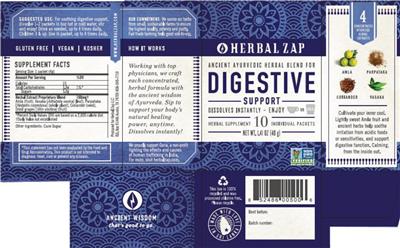
Suggested/Recommended/Usage/Directions
Suggested Use: For soothing digestive support, dissolve 1-2 packets in 6oz hot or cold water, stir and enjoy! Drink as needed, up to 4 times daily. Children 3 & Up: Use 1/2 packet, up to 4 times daily.
Sip to support your body's natural healing power, anytime.
Dissolves instantly - enjoy hot or cold
Formulation
Gluten free
Vegan
Non GMO
Formula
Kosher
4 concentrated ayurvedic herbal extracts Amla Coriander Parpataka Vasaka
FDA Disclaimer Statement
This statement has not been evaluated by the Food and Drug Administration. This product is not intended to diagnose, treat, cure or prevent any disease.
General Statements
Our Commitment: We source our herbs from small, sustainable farms to ensure the highest quality, potency and purity. Fair trade farming feels good soil-to-sip.
How It Works Working with top physicians, we craft each concentrated, herbal formula with the ancient wisdom of Ayurveda.
Dissolves instantly!
We proudlly support Guria, a non-profit fighting the effects and causes of human trafficking in India.
Ancient wisdom That's good to go.
Ancient Ayurvedic herbal blend for Digestive Support
This box is 100% recycled and was processed chlorine free. Please recycle. Made with love in Sri Lanka
Cultivate your inner cool.
Lightly sweet Amla fruit and ancient herbs help soothe irritation from acidic foods or sensitivities, and support digestive function. Calming from the inside out.
FDA Statement of Identity
Herbal Supplement
Seals/Symbols
Non GMO Project Verified Nongmoproject.org
Is this label outdated? Report a formula or label change and our pharmacy team will review it.
Digestive Support by Herbal Zap label
The label scan from the NIH Dietary Supplement Label Database. Tap to enlarge.
Label images are published by the NIH Dietary Supplement Label Database for the version of this product on file. Always read your actual product label.
View the full label (PDF)The Ingredients in Digestive Support by Herbal Zap
These are the 6 active ingredients this product is made of. Select any to open its full monograph.
Serving size2 Gram(s) Dosage formPowder Amounts shown are per serving.
Most supplement products combine several ingredients, and a medication can interact with the product through any one of them. Each ingredient below shows whether it has known drug interactions.
Sugar
Herbal Extract Proprietary Blend
- › Coriander
- › Amla
- › Parpataka
- › Dried Grapes
- › Vasaka
Other (inactive) ingredients: Cane Sugar. These complete the product’s ingredient list but are not active constituents.
Digestive Support by Herbal Zap Drug Interactions
HelloPharmacist Interaction Report
Digestive Support by Herbal Zap contains five active ingredients, and through its coriander, amla, dried grapes, and vasaka content, it documents interactions with a range of medications.
The most serious concern involves dried grapes and blood thinners (anticoagulants/antiplatelet drugs)—grape extracts may have antiplatelet effects and could increase bleeding risk when combined with these medications.
Read the full breakdown — every affected drug type, severity by severity
Coriander carries Moderate interactions with medications for blood pressure, blood sugar, sleep/sedation, and sun sensitivity. It may lower blood pressure (risk of dizziness or fainting with blood pressure drugs), reduce blood sugar (hypoglycemia risk with diabetes medications), cause drowsiness when combined with sedating drugs, or worsen sun sensitivity with photosensitizing medications.
Amla (Indian gooseberry) also has Moderate interactions with blood thinners and aspirin—similar bleeding concerns as dried grapes—and with diabetes medications, where it may lower blood sugar further and require dose adjustments.
Dried grapes additionally interact with several drug-metabolizing enzymes in the liver (CYP1A2, CYP2D6, CYP3A4, and CYP2E1 substrates), which may alter how your body processes certain medications, and with cyclosporine (an immunosuppressant) and midazolam (a sedative), where grape juice can reduce their absorption or effects. We could not check Parpataka—no interaction data is on file for it.
Altogether, these interactions span 1,298 individual medications.
Before you start this product, use the medication checker below to verify your exact prescriptions.
Check your own medications below · Editorial policy · How we use AI
Want to check YOUR meds against Digestive Support?
Ask about interactions with your drugs in plain English — “Can I take it with lisinopril?” — and we find you the answer in seconds, ingredient by ingredient.
Go to the checkerIngredients driving the most interactions
Individual Drug Interactions
The ingredients in Digestive Support interact with 1,297 drugs. Click any drug to see the details.
3 of the 6 ingredients in Digestive Support interact with drugs. Each result below shows which ingredient is responsible. dried Grapes Coriander Amla
Acetaminophen, Chlorpheniramine, Dextromethorphan, PhenylpropanolamineMulti Symptom Cold Relief
How Acetaminophen, Chlorpheniramine, Dextromethorphan, Phenylpropanolamine interacts with Digestive Support — through 2 ingredients. Tap an ingredient for the detail:
Dried GrapesCytochrome P450 2e1 (cyp2e1) Substrates, Cytochrome P450 2d6 (cyp2d6) Substrates +2 Moderate
Interaction Summary
Theoretically, grape seed extract might increase the levels of CYP2E1 substrates.
Read the full Dried Grapes + Acetaminophen, Chlorpheniramine, Dextromethorphan, Phenylpropanolamine interactionCorianderPhotosensitizing Drugs Moderate
Interaction Summary
Theoretically, coriander might increase the risk of photosensitivity when taken with photosensitizing drugs.
Read the full Coriander + Acetaminophen, Chlorpheniramine, Dextromethorphan, Phenylpropanolamine interactionAcetaminophen, Chlorpheniramine, Dextromethorphan, PseudoephedrineChildren's Tylenol Cold Plus Cough, Tylenol Cold Ex Strength
How Acetaminophen, Chlorpheniramine, Dextromethorphan, Pseudoephedrine interacts with Digestive Support — through 2 ingredients. Tap an ingredient for the detail:
CorianderPhotosensitizing Drugs Moderate
Interaction Summary
Theoretically, coriander might increase the risk of photosensitivity when taken with photosensitizing drugs.
Read the full Coriander + Acetaminophen, Chlorpheniramine, Dextromethorphan, Pseudoephedrine interactionDried GrapesCytochrome P450 2d6 (cyp2d6) Substrates, Cytochrome P450 2e1 (cyp2e1) Substrates +2 Moderate
Interaction Summary
Theoretically, grape seed extract may increase the levels of CYP2D6 substrates.
Read the full Dried Grapes + Acetaminophen, Chlorpheniramine, Dextromethorphan, Pseudoephedrine interactionAcetaminophen, Chlorpheniramine, Guaifenesin, Phenylephrine, SalicylamideRhinogesic GG
How Acetaminophen, Chlorpheniramine, Guaifenesin, Phenylephrine, Salicylamide interacts with Digestive Support — through 2 ingredients. Tap an ingredient for the detail:
Dried GrapesCytochrome P450 3a4 (cyp3a4) Substrates, Cytochrome P450 1a2 (cyp1a2) Substrates +1 Moderate
Interaction Summary
It is unclear if grape seed extract inhibits or induces CYP3A4; research is conflicting.
Read the full Dried Grapes + Acetaminophen, Chlorpheniramine, Guaifenesin, Phenylephrine, Salicylamide interactionCorianderPhotosensitizing Drugs Moderate
Interaction Summary
Theoretically, coriander might increase the risk of photosensitivity when taken with photosensitizing drugs.
Read the full Coriander + Acetaminophen, Chlorpheniramine, Guaifenesin, Phenylephrine, Salicylamide interactionAcetaminophen, Chlorpheniramine, PhenylephrineAlka-Seltzer PLUS, Histex SR, Protid
How Acetaminophen, Chlorpheniramine, Phenylephrine interacts with Digestive Support — through 2 ingredients. Tap an ingredient for the detail:
Dried GrapesCytochrome P450 2e1 (cyp2e1) Substrates, Cytochrome P450 3a4 (cyp3a4) Substrates +1 Moderate
Interaction Summary
Theoretically, grape seed extract might increase the levels of CYP2E1 substrates.
Read the full Dried Grapes + Acetaminophen, Chlorpheniramine, Phenylephrine interactionCorianderPhotosensitizing Drugs Moderate
Interaction Summary
Theoretically, coriander might increase the risk of photosensitivity when taken with photosensitizing drugs.
Read the full Coriander + Acetaminophen, Chlorpheniramine, Phenylephrine interactionAcetaminophen, Chlorpheniramine, Phenylephrine, SalicylamideRhinogesic, Rhinogesic JR
How Acetaminophen, Chlorpheniramine, Phenylephrine, Salicylamide interacts with Digestive Support — through 2 ingredients. Tap an ingredient for the detail:
Dried GrapesCytochrome P450 2e1 (cyp2e1) Substrates, Cytochrome P450 1a2 (cyp1a2) Substrates +1 Moderate
Interaction Summary
Theoretically, grape seed extract might increase the levels of CYP2E1 substrates.
Read the full Dried Grapes + Acetaminophen, Chlorpheniramine, Phenylephrine, Salicylamide interactionCorianderPhotosensitizing Drugs Moderate
Interaction Summary
Theoretically, coriander might increase the risk of photosensitivity when taken with photosensitizing drugs.
Read the full Coriander + Acetaminophen, Chlorpheniramine, Phenylephrine, Salicylamide interactionAcetaminophen, Chlorpheniramine, PhenylpropanolamineAlumadrine, Conex, Sinadrin Max Strength, Sinulin
How Acetaminophen, Chlorpheniramine, Phenylpropanolamine interacts with Digestive Support — through 2 ingredients. Tap an ingredient for the detail:
Dried GrapesCytochrome P450 3a4 (cyp3a4) Substrates, Cytochrome P450 2e1 (cyp2e1) Substrates +1 Moderate
Interaction Summary
It is unclear if grape seed extract inhibits or induces CYP3A4; research is conflicting.
Read the full Dried Grapes + Acetaminophen, Chlorpheniramine, Phenylpropanolamine interactionCorianderPhotosensitizing Drugs Moderate
Interaction Summary
Theoretically, coriander might increase the risk of photosensitivity when taken with photosensitizing drugs.
Read the full Coriander + Acetaminophen, Chlorpheniramine, Phenylpropanolamine interactionAcetaminophen, Chlorpheniramine, Phenylpropanolamine, OpiumHista-Derfule
How Acetaminophen, Chlorpheniramine, Phenylpropanolamine, Opium interacts with Digestive Support — through 2 ingredients. Tap an ingredient for the detail:
Dried GrapesCytochrome P450 3a4 (cyp3a4) Substrates, Cytochrome P450 2e1 (cyp2e1) Substrates +1 Moderate
Interaction Summary
It is unclear if grape seed extract inhibits or induces CYP3A4; research is conflicting.
Read the full Dried Grapes + Acetaminophen, Chlorpheniramine, Phenylpropanolamine, Opium interactionCorianderCns Depressants, Photosensitizing Drugs Moderate
Interaction Summary
Theoretically, coriander might cause additive sedative effects when taken with CNS depressants.
Read the full Coriander + Acetaminophen, Chlorpheniramine, Phenylpropanolamine, Opium interactionAcetaminophen, Chlorpheniramine, Phenylpropanolamine, PhenyltoloxamineNorel Plus
How Acetaminophen, Chlorpheniramine, Phenylpropanolamine, Phenyltoloxamine interacts with Digestive Support — through 2 ingredients. Tap an ingredient for the detail:
Dried GrapesCytochrome P450 1a2 (cyp1a2) Substrates, Cytochrome P450 3a4 (cyp3a4) Substrates +1 Moderate
Interaction Summary
Theoretically, grape juice might reduce the levels of CYP1A2 substrates.
Read the full Dried Grapes + Acetaminophen, Chlorpheniramine, Phenylpropanolamine, Phenyltoloxamine interactionCorianderPhotosensitizing Drugs Moderate
Interaction Summary
Theoretically, coriander might increase the risk of photosensitivity when taken with photosensitizing drugs.
Read the full Coriander + Acetaminophen, Chlorpheniramine, Phenylpropanolamine, Phenyltoloxamine interactionAcetaminophen, Chlorpheniramine, PseudoephedrineAlka-Seltzer PLUS Liquid Gels, Children's Tylenol Cold, Codimal, Comtrex, Extra Strength Tylenol Allergy Sinus, Lorsin +3 more
How Acetaminophen, Chlorpheniramine, Pseudoephedrine interacts with Digestive Support — through 2 ingredients. Tap an ingredient for the detail:
Dried GrapesCytochrome P450 2e1 (cyp2e1) Substrates, Cytochrome P450 1a2 (cyp1a2) Substrates +1 Moderate
Interaction Summary
Theoretically, grape seed extract might increase the levels of CYP2E1 substrates.
Read the full Dried Grapes + Acetaminophen, Chlorpheniramine, Pseudoephedrine interactionCorianderPhotosensitizing Drugs Moderate
Interaction Summary
Theoretically, coriander might increase the risk of photosensitivity when taken with photosensitizing drugs.
Read the full Coriander + Acetaminophen, Chlorpheniramine, Pseudoephedrine interactionAcetaminophen, ChlorzoxazoneAcetazone Forte, Extra Strength Tylenol Aches & Strains, Parafon Forte
How Acetaminophen, Chlorzoxazone interacts with Digestive Support — through 1 ingredient. Tap an ingredient for the detail:
Dried GrapesCytochrome P450 2e1 (cyp2e1) Substrates, Cytochrome P450 1a2 (cyp1a2) Substrates Moderate
Interaction Summary
Theoretically, grape seed extract might increase the levels of CYP2E1 substrates.
Read the full Dried Grapes + Acetaminophen, Chlorzoxazone interactionAcetaminophen, Chlorzoxazone, CodeineAcetazone Forte C8, Parafon Forte C8
How Acetaminophen, Chlorzoxazone, Codeine interacts with Digestive Support — through 2 ingredients. Tap an ingredient for the detail:
Dried GrapesCytochrome P450 1a2 (cyp1a2) Substrates, Cytochrome P450 2d6 (cyp2d6) Substrates +1 Moderate
Interaction Summary
Theoretically, grape juice might reduce the levels of CYP1A2 substrates.
Read the full Dried Grapes + Acetaminophen, Chlorzoxazone, Codeine interactionCorianderCns Depressants Moderate
Interaction Summary
Theoretically, coriander might cause additive sedative effects when taken with CNS depressants.
Read the full Coriander + Acetaminophen, Chlorzoxazone, Codeine interactionAcetaminophen, CodeineTylenol No.3, Tylenol w/ Codeine
How Acetaminophen, Codeine interacts with Digestive Support — through 2 ingredients. Tap an ingredient for the detail:
Dried GrapesCytochrome P450 2e1 (cyp2e1) Substrates, Cytochrome P450 2d6 (cyp2d6) Substrates +1 Moderate
Interaction Summary
Theoretically, grape seed extract might increase the levels of CYP2E1 substrates.
Read the full Dried Grapes + Acetaminophen, Codeine interactionCorianderCns Depressants Moderate
Interaction Summary
Theoretically, coriander might cause additive sedative effects when taken with CNS depressants.
Read the full Coriander + Acetaminophen, Codeine interactionAcetaminophen, Codeine, DoxylamineMersyndol
How Acetaminophen, Codeine, Doxylamine interacts with Digestive Support — through 2 ingredients. Tap an ingredient for the detail:
CorianderCns Depressants Moderate
Interaction Summary
Theoretically, coriander might cause additive sedative effects when taken with CNS depressants.
Read the full Coriander + Acetaminophen, Codeine, Doxylamine interactionDried GrapesCytochrome P450 2d6 (cyp2d6) Substrates, Cytochrome P450 2e1 (cyp2e1) Substrates +1 Moderate
Interaction Summary
Theoretically, grape seed extract may increase the levels of CYP2D6 substrates.
Read the full Dried Grapes + Acetaminophen, Codeine, Doxylamine interactionAcetaminophen, Codeine, MethocarbamolAcetaminophen, Codeine, Methocarbamol, Robaxacet 8
How Acetaminophen, Codeine, Methocarbamol interacts with Digestive Support — through 2 ingredients. Tap an ingredient for the detail:
Dried GrapesCytochrome P450 1a2 (cyp1a2) Substrates, Cytochrome P450 2d6 (cyp2d6) Substrates +1 Moderate
Interaction Summary
Theoretically, grape juice might reduce the levels of CYP1A2 substrates.
Read the full Dried Grapes + Acetaminophen, Codeine, Methocarbamol interactionCorianderCns Depressants Moderate
Interaction Summary
Theoretically, coriander might cause additive sedative effects when taken with CNS depressants.
Read the full Coriander + Acetaminophen, Codeine, Methocarbamol interactionAcetaminophen, Dexbrompheniramine, PseudoephedrineSinadrin Plus
How Acetaminophen, Dexbrompheniramine, Pseudoephedrine interacts with Digestive Support — through 2 ingredients. Tap an ingredient for the detail:
Dried GrapesCytochrome P450 2e1 (cyp2e1) Substrates, Cytochrome P450 1a2 (cyp1a2) Substrates Moderate
Interaction Summary
Theoretically, grape seed extract might increase the levels of CYP2E1 substrates.
Read the full Dried Grapes + Acetaminophen, Dexbrompheniramine, Pseudoephedrine interactionCorianderPhotosensitizing Drugs Moderate
Interaction Summary
Theoretically, coriander might increase the risk of photosensitivity when taken with photosensitizing drugs.
Read the full Coriander + Acetaminophen, Dexbrompheniramine, Pseudoephedrine interactionAcetaminophen, DextromethorphanTylenol Cough Ex Strength
How Acetaminophen, Dextromethorphan interacts with Digestive Support — through 1 ingredient. Tap an ingredient for the detail:
Dried GrapesCytochrome P450 2e1 (cyp2e1) Substrates, Cytochrome P450 2d6 (cyp2d6) Substrates +2 Moderate
Interaction Summary
Theoretically, grape seed extract might increase the levels of CYP2E1 substrates.
Read the full Dried Grapes + Acetaminophen, Dextromethorphan interactionAcetaminophen, Dextromethorphan, Doxylamine, PseudoephedrineVicks NyQuil
How Acetaminophen, Dextromethorphan, Doxylamine, Pseudoephedrine interacts with Digestive Support — through 1 ingredient. Tap an ingredient for the detail:
Dried GrapesCytochrome P450 2e1 (cyp2e1) Substrates, Cytochrome P450 1a2 (cyp1a2) Substrates +2 Moderate
Interaction Summary
Theoretically, grape seed extract might increase the levels of CYP2E1 substrates.
Read the full Dried Grapes + Acetaminophen, Dextromethorphan, Doxylamine, Pseudoephedrine interactionAcetaminophen, Dextromethorphan, Guaifenesin, PhenylephrineConar-A
How Acetaminophen, Dextromethorphan, Guaifenesin, Phenylephrine interacts with Digestive Support — through 1 ingredient. Tap an ingredient for the detail:
Dried GrapesCytochrome P450 3a4 (cyp3a4) Substrates, Cytochrome P450 1a2 (cyp1a2) Substrates +2 Moderate
Interaction Summary
It is unclear if grape seed extract inhibits or induces CYP3A4; research is conflicting.
Read the full Dried Grapes + Acetaminophen, Dextromethorphan, Guaifenesin, Phenylephrine interactionAcetaminophen, Dextromethorphan, Guaifenesin, PhenylpropanolamineAnatuss
How Acetaminophen, Dextromethorphan, Guaifenesin, Phenylpropanolamine interacts with Digestive Support — through 1 ingredient. Tap an ingredient for the detail:
Dried GrapesCytochrome P450 2d6 (cyp2d6) Substrates, Cytochrome P450 1a2 (cyp1a2) Substrates +2 Moderate
Interaction Summary
Theoretically, grape seed extract may increase the levels of CYP2D6 substrates.
Read the full Dried Grapes + Acetaminophen, Dextromethorphan, Guaifenesin, Phenylpropanolamine interactionAcetaminophen, Dextromethorphan, Guaifenesin, PseudoephedrineRobitussin Cold, Severe Cold, Suphedrine Cold/Cough
How Acetaminophen, Dextromethorphan, Guaifenesin, Pseudoephedrine interacts with Digestive Support — through 1 ingredient. Tap an ingredient for the detail:
Dried GrapesCytochrome P450 2e1 (cyp2e1) Substrates, Cytochrome P450 1a2 (cyp1a2) Substrates +2 Moderate
Interaction Summary
Theoretically, grape seed extract might increase the levels of CYP2E1 substrates.
Read the full Dried Grapes + Acetaminophen, Dextromethorphan, Guaifenesin, Pseudoephedrine interactionAcetaminophen, Dextromethorphan, Phenylpropanolamine, PyrilamineTheracaps
How Acetaminophen, Dextromethorphan, Phenylpropanolamine, Pyrilamine interacts with Digestive Support — through 1 ingredient. Tap an ingredient for the detail:
Dried GrapesCytochrome P450 3a4 (cyp3a4) Substrates, Cytochrome P450 2e1 (cyp2e1) Substrates +2 Moderate
Interaction Summary
It is unclear if grape seed extract inhibits or induces CYP3A4; research is conflicting.
Read the full Dried Grapes + Acetaminophen, Dextromethorphan, Phenylpropanolamine, Pyrilamine interactionAcetaminophen, Dextromethorphan, PseudoephedrineAlka-Seltzer PLUS Flu Liquid Gels, Non Aspirin Cold Caps, Tylenol Cold, Tylenol Flu Daytime Ex Strength, Tylenol Flu Ex Strength
How Acetaminophen, Dextromethorphan, Pseudoephedrine interacts with Digestive Support — through 1 ingredient. Tap an ingredient for the detail:
Dried GrapesCytochrome P450 2d6 (cyp2d6) Substrates, Cytochrome P450 2e1 (cyp2e1) Substrates +2 Moderate
Interaction Summary
Theoretically, grape seed extract may increase the levels of CYP2D6 substrates.
Read the full Dried Grapes + Acetaminophen, Dextromethorphan, Pseudoephedrine interactionAcetaminophen, Dichloralantipyrine, IsomethepteneAmidrine, Midchlor, Migquin, Migratine
How Acetaminophen, Dichloralantipyrine, Isometheptene interacts with Digestive Support — through 2 ingredients. Tap an ingredient for the detail:
Dried GrapesCytochrome P450 1a2 (cyp1a2) Substrates, Cytochrome P450 2e1 (cyp2e1) Substrates Moderate
Interaction Summary
Theoretically, grape juice might reduce the levels of CYP1A2 substrates.
Read the full Dried Grapes + Acetaminophen, Dichloralantipyrine, Isometheptene interactionCorianderCns Depressants Moderate
Interaction Summary
Theoretically, coriander might cause additive sedative effects when taken with CNS depressants.
Read the full Coriander + Acetaminophen, Dichloralantipyrine, Isometheptene interactionAcetaminophen, Dichloralphenazone, IsomethepteneMidrin
How Acetaminophen, Dichloralphenazone, Isometheptene interacts with Digestive Support — through 2 ingredients. Tap an ingredient for the detail:
CorianderCns Depressants Moderate
Interaction Summary
Theoretically, coriander might cause additive sedative effects when taken with CNS depressants.
Read the full Coriander + Acetaminophen, Dichloralphenazone, Isometheptene interactionDried GrapesCytochrome P450 1a2 (cyp1a2) Substrates, Cytochrome P450 2e1 (cyp2e1) Substrates Moderate
Interaction Summary
Theoretically, grape juice might reduce the levels of CYP1A2 substrates.
Read the full Dried Grapes + Acetaminophen, Dichloralphenazone, Isometheptene interactionAcetaminophen, Dichlorophenazone, IsometheptaneIsocom
How Acetaminophen, Dichlorophenazone, Isometheptane interacts with Digestive Support — through 2 ingredients. Tap an ingredient for the detail:
Dried GrapesCytochrome P450 2e1 (cyp2e1) Substrates, Cytochrome P450 1a2 (cyp1a2) Substrates Moderate
Interaction Summary
Theoretically, grape seed extract might increase the levels of CYP2E1 substrates.
Read the full Dried Grapes + Acetaminophen, Dichlorophenazone, Isometheptane interactionCorianderCns Depressants Moderate
Interaction Summary
Theoretically, coriander might cause additive sedative effects when taken with CNS depressants.
Read the full Coriander + Acetaminophen, Dichlorophenazone, Isometheptane interactionAcetaminophen, DiphenhydramineTylenol PM, Tylenol PM Ex Strength
How Acetaminophen, Diphenhydramine interacts with Digestive Support — through 2 ingredients. Tap an ingredient for the detail:
Dried GrapesCytochrome P450 2e1 (cyp2e1) Substrates, Cytochrome P450 1a2 (cyp1a2) Substrates Moderate
Interaction Summary
Theoretically, grape seed extract might increase the levels of CYP2E1 substrates.
Read the full Dried Grapes + Acetaminophen, Diphenhydramine interactionCorianderPhotosensitizing Drugs, Cns Depressants Moderate
Interaction Summary
Theoretically, coriander might increase the risk of photosensitivity when taken with photosensitizing drugs.
Read the full Coriander + Acetaminophen, Diphenhydramine interactionAcetaminophen, Diphenhydramine, PseudoephedrineChildren's Tylenol Allergy, Cold Control, Contac Night Allergy Relief
How Acetaminophen, Diphenhydramine, Pseudoephedrine interacts with Digestive Support — through 2 ingredients. Tap an ingredient for the detail:
CorianderCns Depressants, Photosensitizing Drugs Moderate
Interaction Summary
Theoretically, coriander might cause additive sedative effects when taken with CNS depressants.
Read the full Coriander + Acetaminophen, Diphenhydramine, Pseudoephedrine interactionDried GrapesCytochrome P450 1a2 (cyp1a2) Substrates, Cytochrome P450 2e1 (cyp2e1) Substrates Moderate
Interaction Summary
Theoretically, grape juice might reduce the levels of CYP1A2 substrates.
Read the full Dried Grapes + Acetaminophen, Diphenhydramine, Pseudoephedrine interactionAcetaminophen, Doxylamine, PseudoephedrineEx Strength Tylenol Sinus Nighttime
How Acetaminophen, Doxylamine, Pseudoephedrine interacts with Digestive Support — through 1 ingredient. Tap an ingredient for the detail:
Dried GrapesCytochrome P450 2e1 (cyp2e1) Substrates, Cytochrome P450 1a2 (cyp1a2) Substrates Moderate
Interaction Summary
Theoretically, grape seed extract might increase the levels of CYP2E1 substrates.
Read the full Dried Grapes + Acetaminophen, Doxylamine, Pseudoephedrine interactionAcetaminophen, HydrocodoneAnexsia, Anodynos DHC, Azdone, Co-Gesic, Doucet, Lorcet +9 more
How Acetaminophen, Hydrocodone interacts with Digestive Support — through 2 ingredients. Tap an ingredient for the detail:
Dried GrapesCytochrome P450 1a2 (cyp1a2) Substrates, Cytochrome P450 2e1 (cyp2e1) Substrates +2 Moderate
Interaction Summary
Theoretically, grape juice might reduce the levels of CYP1A2 substrates.
Read the full Dried Grapes + Acetaminophen, Hydrocodone interactionCorianderCns Depressants Moderate
Interaction Summary
Theoretically, coriander might cause additive sedative effects when taken with CNS depressants.
Read the full Coriander + Acetaminophen, Hydrocodone interactionAcetaminophen, IbuprofenCombogesic
How Acetaminophen, Ibuprofen interacts with Digestive Support — through 3 ingredients. Tap an ingredient for the detail:
Dried GrapesCytochrome P450 1a2 (cyp1a2) Substrates, Cytochrome P450 2c9 (cyp2c9) Substrates +2 Moderate
Interaction Summary
Theoretically, grape juice might reduce the levels of CYP1A2 substrates.
Read the full Dried Grapes + Acetaminophen, Ibuprofen interactionCorianderPhotosensitizing Drugs Moderate
Interaction Summary
Theoretically, coriander might increase the risk of photosensitivity when taken with photosensitizing drugs.
Read the full Coriander + Acetaminophen, Ibuprofen interactionAmlaAnticoagulant/antiplatelet Drugs Moderate
Interaction Summary
Theoretically, Indian gooseberry may increase the risk of bleeding if used with anticoagulant or antiplatelet drugs; however, research is conflicting.
Read the full Amla + Acetaminophen, Ibuprofen interactionEach ingredient & the kinds of drugs it affects
For each ingredient in Digestive Support with known interactions, here are the types of medications they can affect. Open any type for the detail — or search your exact drug in the checker above.
dried Grapes
Anticoagulant/Antiplatelet Drugs
Theoretically, grape extracts may have antiplatelet effects and may increase the risk of bleeding if used with anticoagulant or antiplatelet drugs.
In vitro evidence suggests that grape extracts might decrease platelet aggregation.
Cyclosporine (Neoral, Sandimmune)
Ingesting grape juice with cyclosporine can reduce cyclosporine absorption.
A small pharmacokinetic study in healthy young adults shows that intake of purple grape juice 200 mL along with cyclosporine can decrease the absorption of cyclosporine by up to 30% when compared with water. Separate doses of grape juice and cyclosporine by at least 2 hours to avoid this interaction.
Cytochrome P450 1A2 (Cyp1A2) Substrates
Theoretically, grape juice might reduce the levels of CYP1A2 substrates.
A small pharmacokinetic study in healthy adults shows that ingestion of 200 mL of grape juice decreases phenacetin plasma levels. This is thought to be due to induction of CYP1A2.
Cytochrome P450 2D6 (Cyp2D6) Substrates
Theoretically, grape seed extract may increase the levels of CYP2D6 substrates.
In vitro evidence suggests that grape seed extract might inhibit CYP2D6 enzymes. However, this interaction has not been reported in humans.
Cytochrome P450 2E1 (Cyp2E1) Substrates
Theoretically, grape seed extract might increase the levels of CYP2E1 substrates.
In vitro and animal research suggests that grape seed proanthocyanidin extract inhibits CYP2E1 enzymes. However, this interaction has not been reported in humans.
Cytochrome P450 3A4 (Cyp3A4) Substrates
It is unclear if grape seed extract inhibits or induces CYP3A4; research is conflicting.
In vitro evidence suggests that grape seed extract might inhibit CYP3A4 enzymes. However, evidence from animal research shows that grape seed extract may induce CYP3A4 in the liver. So far, these interactions have not been reported in humans.
Midazolam (Versed)
Theoretically, long-term intake of grape seed extract might decrease the effects of midazolam.
Animal research shows that subchronic ingestions of grape seed extract can increase the elimination of intravenous midazolam by increasing hepatic CYP3A4 activity. Single doses of grape seed extract do not appear to affect midazolam elimination.
Phenacetin
Grape juice might decrease phenacetin absorption.
A small pharmacokinetic study in healthy adults shows that ingestion of 200 mL of grape juice decreases phenacetin plasma levels. This is thought to be due to induction of cytochrome P450 1A2 (CYP1A2).
Cytochrome P450 2C9 (Cyp2C9) Substrates
It is unclear if grape juice or grape seed extract inhibits CYP2C9; research is conflicting.
In vitro evidence shows that grape seed extract or grape juice might inhibit CYP2C9 enzymes. However, a small pharmacokinetic study in healthy adults shows that drinking 8 ounces of grape juice once does not affect the clearance of flurbiprofen, a probe-drug for CYP2C9 metabolism. The effects of continued grape juice consumption are unclear.
Coriander
Antidiabetes Drugs
Theoretically, coriander might increase the risk of hypoglycemia when taken with antidiabetes drugs.
Evidence from animal research suggests that coriander fruit and coriander extract can reduce blood glucose levels. Monitor blood glucose levels closely. Dose adjustments might be necessary.
Antihypertensive Drugs
Theoretically, coriander might increase the risk of hypotension when taken with antihypertensive drugs.
Evidence from animal research suggests that coriander fruit can lower blood pressure.
Cns Depressants
Theoretically, coriander might cause additive sedative effects when taken with CNS depressants.
Evidence from animal research suggests that coriander fruit extract has sedative effects.
Photosensitizing Drugs
Theoretically, coriander might increase the risk of photosensitivity when taken with photosensitizing drugs.
Evidence from in vitro research suggests that coriandrin, a constituent of coriander, has photosensitizing effects.
Amla
Anticoagulant/Antiplatelet Drugs
Theoretically, Indian gooseberry may increase the risk of bleeding if used with anticoagulant or antiplatelet drugs; however, research is conflicting.
Clinical research shows that taking Indian gooseberry 500 mg as a single dose or twice daily for 10 days reduces platelet aggregation by about 24% to 36%, increases bleeding time by about 3.8-5.9 seconds, and increases clotting time by about 9.8-12.7 seconds when compared to baseline. However, taking Indian gooseberry 500 mg along with clopidogrel 75 mg or ecosprin 75 mg, as a single dose or for 10 days, does not significantly reduce platelet aggregation or increase bleeding time or clotting time when compared with clopidogrel 75 mg or ecosprin 75 mg alone. Until more is known, use caution when taking Indian gooseberry in combination with anticoagulant/antiplatelet drugs.
Antidiabetes Drugs
Taking Indian gooseberry with antidiabetes drugs might increase the risk of hypoglycemia.
Clinical research shows that taking Indian gooseberry fruit or fruit extract alone or in conjunction with antidiabetes medications can lower blood glucose levels. Dose adjustments to diabetes medications might be necessary.
Aspirin
Theoretically, Indian gooseberry may increase the risk of bleeding if used with aspirin; however, research is conflicting.
Clinical research shows that taking Indian gooseberry 500 mg as a single dose or twice daily for 10 days reduces platelet aggregation by about 24% to 36%, increases bleeding time by about 3.8-5.9 seconds, and increases clotting time by about 9.8-12.7 seconds when compared to baseline. However, taking a single dose of Indian gooseberry 500 mg along with ecosprin 75 mg, or taking a combination of Indian gooseberry 500 mg twice daily plus ecosprin 75 mg once daily for 10 days, does not significantly reduce platelet aggregation or increase bleeding time or clotting time when compared with ecosprin 75 mg alone.
Clopidogrel (Plavix)
Theoretically, Indian gooseberry may increase the risk of bleeding if used with clopidogrel; however, research is conflicting.
Clinical research shows that taking Indian gooseberry 500 mg as a single dose or twice daily for 10 days reduces platelet aggregation by about 24% to 36%, increases bleeding time by about 3.8-5.9 seconds, and increases clotting time by about 9.8-12.7 seconds when compared to baseline. However, taking a single dose of Indian gooseberry 500 mg along with clopidogrel 75 mg, or taking a combination of Indian gooseberry 500 mg twice daily plus clopidogrel 75 mg once daily for 10 days, does not significantly reduce platelet aggregation or increase bleeding time or clotting time when compared with clopidogrel 75 mg alone.
Brand information
Manufacturer and brand details for Digestive Support, from the product label.
Herbal Zap
- Name
- Herbal Zap LLC
- Street Address
- P.O. Box 91446
- City
- Austin
- State
- TX
- Phone Number
- 808-349-7710
- Web Address
- www.herbalzap.com
Digestive Support by Herbal Zap: Common Questions
Does Digestive Support by Herbal Zap interact with any medications?
How can one product interact with so many drugs?
Where does this information come from?
Does this product work for indigestion or upset stomach?
Is it safe to take while pregnant?
Can I take it while breastfeeding?
What side effects might I experience?
What is amla, and why is it in this formula?
I take aspirin for my heart—is it safe to use this product?
Written and reviewed by the HelloPharmacist editorial staff. Our editorial policy
Not sure if Digestive Support is safe with your meds?
Our pharmacists answer your medication & supplement questions — free.
Label information is sourced from the NIH Dietary Supplement Label Database and reflects the product version on file; always read your actual product label. This page is for education only and is not a substitute for professional medical advice. Confirm with your pharmacist or doctor before combining supplements and medications.
The Full Monographs Behind Digestive Support’s Ingredients
Every ingredient we hold a full HelloPharmacist monograph for — uses, evidence, safety, and the complete interaction list.
Coriander
Interacts with 717 drugsCoriander (also called cilantro) is a common cooking herb and spice that has long been used in traditional medicine for digestive complaints. As a food it is generally safe for most people,...
Read the full Coriander monograph → Herb & supplement monographIndian Gooseberry
Interacts with 208 drugsIndian gooseberry (amla) is a vitamin C-rich fruit used in Ayurvedic medicine for many purposes, from antioxidant support to cholesterol and digestion. Early research is promising for some u...
Read the full Indian Gooseberry monograph → Herb & supplement monographGrape
Interacts with 910 drugsGrapes and grape products like grape seed extract contain antioxidant compounds such as resveratrol and proanthocyanidins that may support heart and blood vessel health. While the food is he...
Read the full Grape monograph → Herb & supplement monographMalabar Nut
Malabar nut (vasaka) is a traditional Ayurvedic herb used mostly for coughs and other breathing problems. Lab and animal studies suggest its compounds may help loosen mucus and relax airways...
Read the full Malabar Nut monograph →Sources & How We Checked
Digestive Support's label data comes from the NIH Dietary Supplement Label Database; the ingredient interaction data is from the Natural Medicines database, reviewed by our pharmacists.
- NIH Dietary Supplement Label Database (DSLD) — The official product label on file for this supplement.
- Natural Medicines (Therapeutic Research Center) — Evidence-graded clinical reference behind the ingredient interaction data.
Content is written and reviewed by licensed HelloPharmacist pharmacists. See our data sources and editorial standards for how this information is built and checked.
The 57 references behind this product’s interaction data
Every citation that drives the interaction findings for this product’s ingredients, from the evidence-graded Natural Medicines (TRC Healthcare) database. Open an ingredient to browse its citations — links open the study on PubMed or the publisher’s site.
Coriander 12 references
- Brinker F. Herb Contraindications and Drug Interactions. 2nd ed. Sandy, OR: Eclectic Medical Publications, 1998.
- Swanston-Flatt SK, Day C, Bailey CJ, Flatt PR. Traditional plant treatments for diabetes. Studies in normal and streptozotocin diabetic mice. Diabetologia 1990;33:462-4. PubMed
- Gray, A. M. and Flatt, P. R. Insulin-releasing and insulin-like activity of the traditional anti-diabetic plant Coriandrum sativum (coriander). Br.J Nutr. 1999;81(3):203-209.
- Kanerva, L. and Soini, M. Occupational protein contact dermatitis from coriander. Contact Dermatitis 2001;45(6):354-355. PubMed
- Emamghoreishi, M., Khasaki, M., and Aazam, M. F. Coriandrum sativum: evaluation of its anxiolytic effect in the elevated plus-maze. J Ethnopharmacol. 1-15-2005;96(3):365-370. PubMed
- Ebo, D. G., Bridts, C. H., Mertens, M. H., and Stevens, W. J. Coriander anaphylaxis in a spice grinder with undetected occupational allergy. Acta Clin Belg. 2006;61(3):152-156. PubMed
- Eidi, M., Eidi, A., Saeidi, A., Molanaei, S., Sadeghipour, A., Bahar, M., and Bahar, K. Effect of coriander seed (Coriandrum sativum L.) ethanol extract on insulin release from pancreatic beta cells in streptozotocin-induced diabetic rats. Phytother.Res
- Jabeen, Q., Bashir, S., Lyoussi, B., and Gilani, A. H. Coriander fruit exhibits gut modulatory, blood pressure lowering and diuretic activities. J Ethnopharmacol. 2-25-2009;122(1):123-130. PubMed
- van Toorenenbergen, A. W. and Dieges, P. H. Immunoglobulin E antibodies against coriander and other spices. J Allergy Clin Immunol. 1985;76(3):477-481. PubMed
- Ashwood-Smith, M. J., Warrington, P. J., Jenkins, M., Ceska, O., and Romaniuk, P. J. Photobiological properties of a novel, naturally occurring furoisocoumarin, coriandrin. Photochem.Photobiol. 1989;50(6):745-751. PubMed
- Sastre, J., Olmo, M., Novalvos, A., Ibanez, D., and Lahoz, C. Occupational asthma due to different spices. Allergy 1996;51(2):117-120. PubMed
- Beikert FC, Anastasiadou Z, Fritzen B, Frank U, Augustin M. Topical treatment of tinea pedis using 6% coriander oil in unguentum leniens: a randomized, controlled, comparative pilot study. Dermatology. 2013;226(1):47-51. PubMed
Indian Gooseberry 6 references
- Sabu, M. C. and Kuttan, R. Anti-diabetic activity of medicinal plants and its relationship with their antioxidant property. J Ethnopharmacol. 2002;81(2):155-160. PubMed
- Fatima N, Pingali U, Muralidhar N. Study of pharmacodynamic interaction of Phyllanthus emblica extract with clopidogrel and ecosprin in patients with type II diabetes mellitus. Phytomedicine. 2014;21(5):579-85. PubMed
- Shanmugarajan D, Girish C, Harivenkatesh N, Chanaveerappa B, Prasanna Lakshmi NC. Antihypertensive and pleiotropic effects of Phyllanthus emblica extract as an add-on therapy in patients with essential hypertension-A randomized double-blind placebo-contro
- Akhtar MS, Ramzan A, Ali A, Ahmad M. Effect of amla fruit (Emblica officinalis Gaertn.) on blood glucose and lipid profile of normal subjects and type 2 diabetic patients. Int J Food Sci Nutr. 2011;62(6):609-16.
- Usharani P, Fatima N, Muralidhar N. Effects of Phyllanthus emblica extract on endothelial dysfunction and biomarkers of oxidative stress in patients with type 2 diabetes mellitus: a randomized, double-blind, controlled study. Diabetes Metab Syndr Obes. 20 PubMed
- Majeed M, Mundkur L, Paulose S, Nagabhushanam K. Novel Emblica officinalis extract containing ß-glucogallin vs. metformin: a randomized, open-label, comparative efficacy study in newly diagnosed type 2 diabetes mellitus patients with dyslipidemia. Food Fu
Grape 34 references
- Kiesewetter H, Koscielny J, Kalus U, et al. Efficacy of orally administered extract of red vine leaf AS 195 (folia vitis viniferae) in chronic venous insufficiency (stages I-II). A randomized, double-blind, placebo-controlled trial. Arzneimittelforschung
- Xiao Dong S, Zhi Ping Z, Zhong Xiao W, et al. Possible enhancement of the first-pass metabolism of phenacetin by ingestion of grape juice in Chinese subjects. Br J Clin Pharmacol 1999;48:638-40. PubMed
- Vaswani SK, Hamilton RG, Carey RN, et al. Anaphylaxis recurrent urticaria and angioedema from grape hypersensitivity. J Allergy Clin Immunol 1998;101:S31.
- Chevallier A. The Encyclopedia of Medicinal Plants. London, UK: Dorling Kindersley, Ltd., 1996.
- Bernstein DI, Bernstein CK, Deng C, et al. Evaluation of the clinical efficacy and safety of grapeseed extract in the treatment of fall seasonal allergic rhinitis: a pilot study. Ann Allergy Asthma Immunol 2002;88:272-8.. PubMed
- Greenblatt DJ, von Moltke LL, Perloff ES, et al. Interaction of flurbiprofen with cranberry juice, grape juice, tea, and fluconazole: in vitro and clinical studies. Clin Pharmacol Ther 2006;79:125-33. PubMed
- Ward NC, Hodgson JM, Croft KD, et al. The combination of vitamin C and grape-seed polyphenols increases blood pressure: a randomized, double-blind, placebo-controlled trial. J Hypertens 2005;23:427-34.. PubMed
- Ray, S. D., Parikh, H., Hickey, E., Bagchi, M., and Bagchi, D. Differential effects of IH636 grape seed proanthocyanidin extract and a DNA repair modulator 4-aminobenzamide on liver microsomal cytochrome 4502E1-dependent aniline hydroxylation. Mol Cell B PubMed
- O'Byrne, D. J., Devaraj, S., Grundy, S. M., and Jialal, I. Comparison of the antioxidant effects of Concord grape juice flavonoids alpha-tocopherol on markers of oxidative stress in healthy adults. Am J Clin.Nutr. 2002;76(6):1367-1374.
- Schaefer, E., Peil, H., Ambrosetti, L., and Petrini, O. Oedema protective properties of the red vine leaf extract AS 195 (Folia vitis viniferae) in the treatment of chronic venous insufficiency. A 6-week observational clinical trial. Arzneimittelforschun PubMed
- Nishikawa, M., Ariyoshi, N., Kotani, A., Ishii, I., Nakamura, H., Nakasa, H., Ida, M., Nakamura, H., Kimura, N., Kimura, M., Hasegawa, A., Kusu, F., Ohmori, S., Nakazawa, K., and Kitada, M. Effects of continuous ingestion of green tea or grape seed extra
- de Lange, D. W., Scholman, W. L., Kraaijenhagen, R. J., Akkerman, J. W., and van de Wiel, A. Alcohol and polyphenolic grape extract inhibit platelet adhesion in flowing blood. Eur.J Clin.Invest 2004;34(12):818-824. PubMed
- Samet, J. M. and Coultas, D. B. Reduced forced vital capacity in California grape workers. What does it mean? Am Rev.Respir.Dis 1992;145(2 Pt 1):255-256. PubMed
- Gamsky, T. E., McCurdy, S. A., Samuels, S. J., and Schenker, M. B. Reduced FVC among California grape workers. Am Rev.Respir.Dis 1992;145(2 Pt 1):257-262. PubMed
- de Lange, D. W., Verhoef, S., Gorter, G., Kraaijenhagen, R. J., van de Wiel, A., and Akkerman, J. W. Polyphenolic grape extract inhibits platelet activation through PECAM-1: an explanation for the French paradox. Alcohol Clin.Exp.Res 2007;31(8):1308-1314 PubMed
- Etheridge, A. S., Black, S. R., Patel, P. R., So, J., and Mathews, J. M. An in vitro evaluation of cytochrome P450 inhibition and P-glycoprotein interaction with goldenseal, Ginkgo biloba, grape seed, milk thistle, and ginseng extracts and their constitu
- Krikorian, R., Nash, T. A., Shidler, M. D., Shukitt-Hale, B., and Joseph, J. A. Concord grape juice supplementation improves memory function in older adults with mild cognitive impairment. Br J Nutr. 2010;103(5):730-734. PubMed
- Ingersoll, G. L., Wasilewski, A., Haller, M., Pandya, K., Bennett, J., He, H., Hoffmire, C., and Berry, C. Effect of concord grape juice on chemotherapy-induced nausea and vomiting: results of a pilot study. Oncol.Nurs.Forum 2010;37(2):213-221. PubMed
- Oliveira-Freitas, V. L., Dalla, Costa T., Manfro, R. C., Cruz, L. B., and Schwartsmann, G. Influence of purple grape juice in cyclosporine bioavailability. J Ren Nutr. 2010;20(5):309-313. PubMed
- Hollis, J. H., Houchins, J. A., Blumberg, J. B., and Mattes, R. D. Effects of concord grape juice on appetite, diet, body weight, lipid profile, and antioxidant status of adults. J Am Coll.Nutr. 2009;28(5):574-582. PubMed
- Dohadwala, M. M., Hamburg, N. M., Holbrook, M., Kim, B. H., Duess, M. A., Levit, A., Titas, M., Chung, W. B., Vincent, F. B., Caiano, T. L., Frame, A. A., Keaney, J. F., Jr., and Vita, J. A. Effects of Concord grape juice on ambulatory blood pressure in
- Rabe, E., Stucker, M., Esperester, A., Schafer, E., and Ottillinger, B. Efficacy and tolerability of a red-vine-leaf extract in patients suffering from chronic venous insufficiency--results of a double-blind placebo-controlled study. Eur.J Vasc.Endovasc. PubMed
- Trotta, M., Cesaretti, M., Conzi, R., Derchi, L. E., and Borgonovo, G. Elderly male with mesogastric pain. Small bowel obstruction caused by an intact fresh grape. Ann.Emerg.Med 2011;58(4):e1-e2. PubMed
- McCurdy, S. A., Wiggins, P., Schenker, M. B., Munn, S., Shaieb, A. M., Weinbaum, Z., Goldsmith, D., McGillis, S. T., Berman, B., and Samuels, S. Assessing dermatitis in epidemiologic studies: occupational skin disease among California grape and tomato ha
- Winter, C. K. and Kurtz, P. H. Factors influencing grape worker susceptibility to skin rashes. Bull.Environ.Contam Toxicol. 1985;35(3):418-426. PubMed
- Yamasaki, R., Dekio, S., and Jidoi, J. Contact dermatitis from grape bud. Contact Dermatitis 1985;12(4):226-227. PubMed
- Cox, J. and Grigg, M. Small bowel obstruction by an intact grape. J Am Geriatr.Soc 1986;34(7):550. PubMed
- Faircloth, D. E. and Robison, W. J. Obstruction of the sigmoid colon by grape seeds. JAMA 11-27-1981;246(21):2430. PubMed
- Marguerie, C. and Drouet, M. [Occupational eosinophilic lung in a grape grower: role of sulfites]. Allerg.Immunol.(Paris) 1995;27(5):163-167.
- Brito, FF., Martinez, A., Palacios, R., Mur, P., Gomez, E., Galindo, P. A., Borja, J., and Martinez, J. Rhinoconjunctivitis and asthma caused by vine pollen: a case report. J Allergy Clin Immunol 1999;103(2 Pt 1):262-266. PubMed
- Ras RT, Zock PL, Zebregs YE, et al. Effect of polyphenol-rich grape seed extract on ambulatory blood pressure in subjects with pre- and stage I hypertension. Br J Nutr 2013;110(12):2234-41. PubMed
- Berry AC, Nakshabendi R, Abidali H, et al. Adverse effects of grape seed extract supplement: A clinical case and long-term follow-up. J Diet Suppl. 2016;13(2):232-5. PubMed
- Martínez-Maqueda D, Zapatera B, Gallego-Narbón A, Vaquero MP, Saura-Calixto F, Pérez-Jiménez J. A 6-week supplementation with grape pomace to subjects at cardiometabolic risk ameliorates insulin sensitivity, without affecting other metabolic syndrome mark
- Moon SW, Shin YU, Cho H, Bae SH, Kim HK; and for the Mogen Study Group. Effect of grape seed proanthocyanidin extract on hard exudates in patients with non-proliferative diabetic retinopathy. Medicine (Baltimore) 2019;98(21):e15515. PubMed
Malabar Nut 5 references
- Gruenwald J, Brendler T, Jaenicke C. PDR for Herbal Medicines. 1st ed. Montvale, NJ: Medical Economics Company, Inc., 1998.
- Jayashankar, S., Panagoda, G. J., Amaratunga, E. A., Perera, K., and Rajapakse, P. S. A randomised double-blind placebo-controlled study on the effects of a herbal toothpaste on gingival bleeding, oral hygiene and microbial variables. Ceylon Med.J 2011;5 PubMed
- Narimanian, M., Badalyan, M., Panosyan, V., Gabrielyan, E., Panossian, A., Wikman, G., and Wagner, H. Randomized trial of a fixed combination (KanJang) of herbal extracts containing Adhatoda vasica, Echinacea purpurea and Eleutherococcus senticosus in pa
- Barth A, Hovhannisyan A, Jamalyan K, Narimanyan M. Antitussive effect of a fixed combination of Justicia adhatoda, Echinacea purpurea and Eleutherococcus senticosus extracts in patients with acute upper respiratory tract infection: A comparative, randomiz
- Howshigan J, Perera K, Samita S, Rajapakse PS. The effects of an Ayurvedic medicinal toothpaste on clinical, microbiological and oral hygiene parameters in patients with chronic gingivitis: a double-blind, randomised, placebo-controlled, parallel allocati
Parts of this content are provided by the Therapeutic Research Center, LLC.
DISCLAIMER: Currently this does not check for drug-drug interactions. This is not an all-inclusive comprehensive list of potential interactions and is for informational purposes only. Not all interactions are known or well-reported in the scientific literature, and new interactions are continually being reported. Input is needed from a qualified healthcare provider including a pharmacist before starting any therapy. Application of clinical judgment is necessary.
© 2021 Therapeutic Research Center, LLC