
DIM Gummy+ Ingredients & Drug Interactions
by NutriRise
What is this page for?
First and foremost: checking DIM Gummy+ against your medications. The heart of this page is the interaction checker and the full interaction report — how this product’s ingredients may interact with prescription and over-the-counter medicines you may be taking.
Around that, we add a pharmacist’s high-level view of the product as a whole — what’s inside, the evidence for its stated use, how transparent the label is, and what safety data exists — so you can see the full picture in one place. It’s educational information from our licensed clinical databases and the clinical staff at HelloPharmacist — not medical advice — and we don’t sell or endorse products. Our editorial policy
DIM Gummy+ is a dietary supplement by NutriRise with 4 active ingredients. Its ingredients are commonly taken for replacing fluids and electrolytes, preventing dehydration during exercise or illness, treating low blood sodium (under medical care).Based on those ingredients, 494 medications have a known interaction with it, the most serious rated major. The ingredients most likely to interact are Diindolylmethane, Sodium, Broccoli. Use the checker below to test your specific medication, or read the full HelloPharmacist Interaction Report.
Check Your Meds Against DIM Gummy+ by NutriRise
Ask about any prescription or over-the-counter medication and we check it for interactions with DIM Gummy+ by NutriRise — and tell you which ingredient is responsible.
AI summaries are generated from our interaction database for education only — always confirm with your pharmacist. How we use AI
Ask the Pharmacist
A licensed pharmacist will answer your question by email — free, usually within 24 hours.
Got it — thank you!
A licensed pharmacist will answer within 24 hours. Keep an eye on your email (worth checking spam, just in case).
HelloPharmacist Scorecard of DIM Gummy+ by NutriRise
Our pharmacy team’s full take, with four database checks built into the cards below — a summary of what is known, not a grade of the product itself.
What’s inside
Full disclosure
DIM Gummy+ contains 4 active ingredients: sodium (an electrolyte), diindolylmethane or DIM (a compound from cruciferous vegetables), broccoli, and Angelica sinensis root extract (also called dong quai). The product also contains inactive ingredients — sugar, glucose syrup, water, apple pectin, natural flavors, citric acid, sodium citrate, red beet, coconut oil, and carnauba wax — that serve as sweeteners, thickeners, and coatings.
DIM and broccoli are both compounds from the cruciferous vegetable family. Dong quai is a traditional herbal root used in Asian medicine.
Sodium is added as a mineral supplement.
Does it work?
Not established
The effectiveness data we hold for these ingredients shows mixed results. Sodium is rated Likely Effective for cystic fibrosis and Possibly Effective for amphotericin B nephrotoxicity, but evidence is Insufficient to Rate it for bipolar disorder and congestive heart failure.
Diindolylmethane, broccoli, and dong quai all have Insufficient Reliable Evidence to Rate them for their listed uses — benign prostatic hyperplasia, various cancers, cervical dysplasia, and others. Broccoli is rated Possibly Effective for colorectal cancer.
In short, if you're taking this for prostate, hormone, or cancer-related reasons, the evidence in our data doesn't establish that it works for those purposes.
How safe is it?
Well-documented data
Sodium is generally well tolerated in normal dietary amounts, but too much is linked to high blood pressure, heart strain, and kidney disease. The safety notes advise against sodium supplements or very high intake without medical guidance.
Diindolylmethane is generally well tolerated in short-term studies, but long-term safety isn't established; avoid it if you're pregnant, and don't use it while breastfeeding because of lack of safety information. Broccoli as a food is safe for most people, though concentrated supplements are less studied.
Dong quai is generally well tolerated but may cause burping and flatulence; it can increase bleeding, cause sun sensitivity, and the safety data advises against it in pregnancy and breastfeeding. The most common adverse effects reported with diindolylmethane are diarrhea, gas, headache, nausea, rash, and vomiting.
Broccoli may cause loose stools, diarrhea, abdominal pain, and cramping, especially at high doses. Serious adverse effects are rare but can include worsening cardiovascular or kidney disease with excess sodium.
Meds to double-check
Major interaction found
Most urgent: if you take warfarin or other blood thinners, do not start this product without your doctor's approval — dong quai significantly increases bleeding risk. Also check before taking if you use blood pressure medications, lithium, corticosteroids, diuretics, estrogen therapy, or drugs metabolized by CYP1A2 or CYP2A6 enzymes (your pharmacist can identify these).
Broccoli and diindolylmethane both affect how your body breaks down certain medications, potentially making them less effective.
The bottom line
Scorecard at a glanceFully disclosed formula with no established evidence rating for its marketed use. Major medication interactions have been identified, and safety information is well characterized.
This product combines a mineral, a plant compound, and two herbal ingredients with multiple drug interactions — especially important if you take blood thinners, blood pressure medications, lithium, or certain hormone drugs. The evidence supporting its effectiveness for its listed uses (prostate health, hormonal balance, cancer prevention) is currently insufficient or not established.
Before starting, check your exact medications with the tool on this page, and talk with your pharmacist or doctor, particularly if you're pregnant, breastfeeding, or on any prescription.
Educational only — not medical advice; always confirm with your pharmacist. Our editorial policy · How we use AI
Assessment coverage: 4 of 4 active ingredients matched to our full ingredient reviews (monographs). Based on the product label dated Aug 22, 2024.
This Scorecard evaluates available label information, ingredient evidence, and known medication-safety considerations. It does not independently verify product identity, purity, potency, contamination, or manufacturing quality. How these ratings are computed
General information
Key facts about DIM Gummy+, straight from the product label.
| Brand | NutriRise |
|---|---|
| Net contents | 60 Vegan Gummy(ies) |
| Market status | On market |
| Date entered into DSLD | Aug 22, 2024 |
| DSLD ID | 317983 |
| Product type | Other Combinations |
| Supplement form | Gummy Or Jelly |
| Dietary claims / uses | All Other, Structure/Function |
| Intended target group(s) | Vegan, Vegetarian, Adult (18 - 50 Years), Gluten Free, Dairy Free |
Everything in this section is reproduced from the manufacturer’s own product label — it’s the label speaking, not HelloPharmacist. We show it so you can see exactly what the maker states; we don’t verify or endorse those statements.
Supplement Facts
The label details for DIM Gummy+ by NutriRise, sourced from the NIH Dietary Supplement Label Database.
Supplement Facts
| Ingredient | Amount | % DV |
|---|---|---|
| Calories | 15 Calorie(s) | -- |
| Total Carbohydrates | 3 Gram(s) | 1% |
| Sodium | 5 mg | 2% |
| Added Sugars | 3 Gram(s) | 6% |
| Total Sugars | 3 Gram(s) | -- |
| Diindolylmethane | 300 mg | -- |
| Broccoli | 40 mg | -- |
| Angelica sinensis Root Extract | 10 mg | -- |
| Angelica sinensis | 40 mg | -- |
Other ingredients: Sugar, Glucose Syrup, Water, Apple Pectin, Natural Flavors, Citric Acid, Sodium Citrate, Red Beet, Coconut Oil, Carnauba Wax
Tap any ingredient to jump to its full detail below.
These statements are the manufacturer’s wording, reproduced from the product label — the label is saying it, not HelloPharmacist. We don’t verify or endorse them.
Suggested/Recommended/Usage/Directions
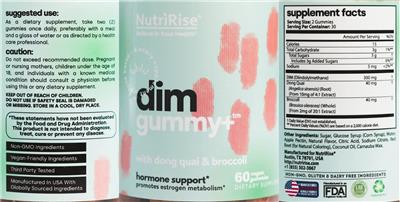
Suggested use: As a dietary supplement, take two (2) gummies once daily, preferably with a meal and a glass of water or as directed by a health care professional.
Precautions
Caution: Do not exceed recommended dose. Do not use if safety seal is damaged or missing.
Pregnant or nursing mothers, children under the age of 18, and individuals with a known medical condition should consult a physician before using this or any dietary supplement.
Pregnant or nursing mothers, children under the age of 18, and individuals with a known medical condition should consult a physician before using this or any dietary supplement. Keep out of reach of children.
Storage
Store in a cool, dry place.
FDA Disclaimer Statement
These statements have not been evaluated by the Food and Drug Administration. This product is not intended to diagnose, treat, cure or prevent any disease.
Formulation
Non-GMO ingredients
Vegan-friendly ingredients
Third party tested Manufactured in USA with globally sourced ingredients
Plant based dietary supplement Hormone support Promotes estrogen metabolism
Non-GMO, gluten & dairy free ingredients
Brand IP Statement(s)
NutriRise Believe in Your Health
Formula
DIM Gummy+ with dong quai & broccoli
FDA Statement of Identity
Dietary Supplement
Seals/Symbols
Manufactured in USA with globally-sourced ingredients Manufactured in an FDA Registered Facility Lab Tested 3rd Party Certified for purity & potency
General Statements
Please recycle
Is this label outdated? Report a formula or label change and our pharmacy team will review it.
DIM Gummy+ by NutriRise label
The label scan from the NIH Dietary Supplement Label Database. Tap to enlarge.
Label images are published by the NIH Dietary Supplement Label Database for the version of this product on file. Always read your actual product label.
View the full label (PDF)The Ingredients in DIM Gummy+ by NutriRise
These are the 4 active ingredients this product is made of. Select any to open its full monograph.
Serving size2 Gummy(ies) Dosage formGummy Or Jelly Servings per container30 Amounts shown are per serving.
Most supplement products combine several ingredients, and a medication can interact with the product through any one of them. Each ingredient below shows whether it has known drug interactions.
Sodium
Interacts with205 drugs
Sodium is an essential mineral and electrolyte your body needs to balance fluids, support nerves, and help muscles work. Most people in modern diets g...
Sodium monograph & interactionsDiindolylmethane
Interacts with269 drugs
Diindolylmethane (DIM) is a compound made when your body digests cruciferous vegetables, and it is sold as a supplement mainly for hormone balance and...
Diindolylmethane monograph & interactionsBroccoli
Interacts with187 drugs
Broccoli is a nutritious cruciferous vegetable rich in fiber, vitamins, and plant compounds like sulforaphane that have drawn scientific interest for...
Broccoli monograph & interactionsAngelica sinensis
Interacts with163 drugs
Dong Quai is a traditional Chinese herb often called "female ginseng" and is mostly used for menstrual and menopausal complaints. High-quality scienti...
Angelica sinensis monograph & interactionsOther (inactive) ingredients: Sugar, Glucose Syrup, Water, Apple Pectin, Natural Flavors, Citric Acid, Sodium Citrate, Red Beet, Coconut Oil, Carnauba Wax. These complete the product’s ingredient list but are not active constituents.
DIM Gummy+ by NutriRise Drug Interactions
HelloPharmacist Interaction Report
DIM Gummy+ by NutriRise contains sodium, diindolylmethane (DIM), broccoli, and Angelica sinensis (dong quai), and this product does interact with a number of medications.
The most serious interaction is with warfarin (a blood thinner), where dong quai may significantly increase bleeding risk — case reports show that dong quai can strengthen warfarin's effects and raise INR levels dangerously.
Read the full breakdown — every affected drug type, severity by severity
Sodium in this product interacts moderately with antihypertensive drugs (blood pressure medications), corticosteroids, lithium, didanosine, sodium phosphates, tolvaptan, and other sodium-containing medications — primarily by altering sodium balance or drug levels. DIM and broccoli both interact with CYP1A2 and CYP2A6 substrates (enzymes that break down certain drugs), potentially lowering their blood levels and reducing effectiveness; broccoli's effect on CYP2A6 is particularly strong.
DIM also interacts moderately with estrogens and diuretics, and dong quai interacts moderately with estrogens and anticoagulant or antiplatelet drugs beyond warfarin.
We could not check one ingredient (the blended Angelica sinensis listed separately in the label) because it's marked as a group container. Altogether, these interactions span 492 individual medications.
Before you start this product, run your exact medications through the checker below.
Check your own medications below · Editorial policy · How we use AI
Want to check YOUR meds against DIM Gummy+?
Ask about interactions with your drugs in plain English — “Can I take it with lisinopril?” — and we find you the answer in seconds, ingredient by ingredient.
Go to the checkerIngredients driving the most interactions
Individual Drug Interactions
The ingredients in DIM Gummy+ interact with 494 drugs. Click any drug to see the details.
4 of the 4 ingredients in DIM Gummy+ interact with drugs. Each result below shows which ingredient is responsible. Diindolylmethane Sodium Broccoli Angelica sinensis
WarfarinWarfarin
How Warfarin interacts with DIM Gummy+ — through 3 ingredients. Tap an ingredient for the detail:
Angelica SinensisAnticoagulant/antiplatelet Drugs, Warfarin (coumadin) Major
Interaction Summary
Theoretically, dong quai may increase the risk of bleeding when used with anticoagulant or antiplatelet drugs; however, research is conflicting.
Read the full Angelica Sinensis + Warfarin interactionBroccoliCytochrome P450 1a2 (cyp1a2) Substrates Moderate
Interaction Summary
Theoretically, broccoli might reduce the levels and effects of drugs metabolized by CYP1A2.
Read the full Broccoli + Warfarin interactionDiindolylmethaneCytochrome P450 1a2 (cyp1a2) Substrates Minor
Interaction Summary
Theoretically, diindolylmethane might lower serum levels of CYP1A2 substrates.
Read the full Diindolylmethane + Warfarin interactionWarfarin SodiumCoumadin, Panwarfin, Sofarin
How Warfarin Sodium interacts with DIM Gummy+ — through 3 ingredients. Tap an ingredient for the detail:
Angelica SinensisAnticoagulant/antiplatelet Drugs, Warfarin (coumadin) Major
Interaction Summary
Theoretically, dong quai may increase the risk of bleeding when used with anticoagulant or antiplatelet drugs; however, research is conflicting.
Read the full Angelica Sinensis + Warfarin Sodium interactionBroccoliCytochrome P450 1a2 (cyp1a2) Substrates Moderate
Interaction Summary
Theoretically, broccoli might reduce the levels and effects of drugs metabolized by CYP1A2.
Read the full Broccoli + Warfarin Sodium interactionDiindolylmethaneCytochrome P450 1a2 (cyp1a2) Substrates Minor
Interaction Summary
Theoretically, diindolylmethane might lower serum levels of CYP1A2 substrates.
Read the full Diindolylmethane + Warfarin Sodium interactionAbciximabReoPro
How Abciximab interacts with DIM Gummy+ — through 1 ingredient. Tap an ingredient for the detail:
Angelica SinensisAnticoagulant/antiplatelet Drugs Moderate
Interaction Summary
Theoretically, dong quai may increase the risk of bleeding when used with anticoagulant or antiplatelet drugs; however, research is conflicting.
Read the full Angelica Sinensis + Abciximab interactionAbrocitinibCibinqo
How Abrocitinib interacts with DIM Gummy+ — through 1 ingredient. Tap an ingredient for the detail:
Angelica SinensisAnticoagulant/antiplatelet Drugs Moderate
Interaction Summary
Theoretically, dong quai may increase the risk of bleeding when used with anticoagulant or antiplatelet drugs; however, research is conflicting.
Read the full Angelica Sinensis + Abrocitinib interactionAcebutololRhotral, Sectral
How Acebutolol interacts with DIM Gummy+ — through 1 ingredient. Tap an ingredient for the detail:
SodiumAntihypertensive Drugs Moderate
Interaction Summary
Theoretically, a high intake of dietary sodium might reduce the effectiveness of antihypertensive drugs.
Read the full Sodium + Acebutolol interactionAcenocoumarolSintrom
How Acenocoumarol interacts with DIM Gummy+ — through 1 ingredient. Tap an ingredient for the detail:
Angelica SinensisAnticoagulant/antiplatelet Drugs Moderate
Interaction Summary
Theoretically, dong quai may increase the risk of bleeding when used with anticoagulant or antiplatelet drugs; however, research is conflicting.
Read the full Angelica Sinensis + Acenocoumarol interactionAcetaminophenChildren's Tylenol, Children's Tylenol Meltaways, Tylenol, Tylenol Ex Strength
How Acetaminophen interacts with DIM Gummy+ — through 2 ingredients. Tap an ingredient for the detail:
BroccoliCytochrome P450 1a2 (cyp1a2) Substrates Moderate
Interaction Summary
Theoretically, broccoli might reduce the levels and effects of drugs metabolized by CYP1A2.
Read the full Broccoli + Acetaminophen interactionDiindolylmethaneCytochrome P450 1a2 (cyp1a2) Substrates Minor
Interaction Summary
Theoretically, diindolylmethane might lower serum levels of CYP1A2 substrates.
Read the full Diindolylmethane + Acetaminophen interactionAcetaminophen, AspirinGemnisyn
How Acetaminophen, Aspirin interacts with DIM Gummy+ — through 3 ingredients. Tap an ingredient for the detail:
BroccoliCytochrome P450 1a2 (cyp1a2) Substrates Moderate
Interaction Summary
Theoretically, broccoli might reduce the levels and effects of drugs metabolized by CYP1A2.
Read the full Broccoli + Acetaminophen, Aspirin interactionAngelica SinensisAnticoagulant/antiplatelet Drugs Moderate
Interaction Summary
Theoretically, dong quai may increase the risk of bleeding when used with anticoagulant or antiplatelet drugs; however, research is conflicting.
Read the full Angelica Sinensis + Acetaminophen, Aspirin interactionDiindolylmethaneCytochrome P450 1a2 (cyp1a2) Substrates Minor
Interaction Summary
Theoretically, diindolylmethane might lower serum levels of CYP1A2 substrates.
Read the full Diindolylmethane + Acetaminophen, Aspirin interactionAcetaminophen, Aspirin, CaffeineExcedrin, Excedrin Extra Strength, Excedrin Migraine
How Acetaminophen, Aspirin, Caffeine interacts with DIM Gummy+ — through 3 ingredients. Tap an ingredient for the detail:
Angelica SinensisAnticoagulant/antiplatelet Drugs Moderate
Interaction Summary
Theoretically, dong quai may increase the risk of bleeding when used with anticoagulant or antiplatelet drugs; however, research is conflicting.
Read the full Angelica Sinensis + Acetaminophen, Aspirin, Caffeine interactionBroccoliCytochrome P450 1a2 (cyp1a2) Substrates Moderate
Interaction Summary
Theoretically, broccoli might reduce the levels and effects of drugs metabolized by CYP1A2.
Read the full Broccoli + Acetaminophen, Aspirin, Caffeine interactionDiindolylmethaneCytochrome P450 1a2 (cyp1a2) Substrates Minor
Interaction Summary
Theoretically, diindolylmethane might lower serum levels of CYP1A2 substrates.
Read the full Diindolylmethane + Acetaminophen, Aspirin, Caffeine interactionAcetaminophen, Brompheniramine, PhenylpropanolamineDimetapp Cold and Flu
How Acetaminophen, Brompheniramine, Phenylpropanolamine interacts with DIM Gummy+ — through 2 ingredients. Tap an ingredient for the detail:
BroccoliCytochrome P450 1a2 (cyp1a2) Substrates Moderate
Interaction Summary
Theoretically, broccoli might reduce the levels and effects of drugs metabolized by CYP1A2.
Read the full Broccoli + Acetaminophen, Brompheniramine, Phenylpropanolamine interactionDiindolylmethaneCytochrome P450 1a2 (cyp1a2) Substrates Minor
Interaction Summary
Theoretically, diindolylmethane might lower serum levels of CYP1A2 substrates.
Read the full Diindolylmethane + Acetaminophen, Brompheniramine, Phenylpropanolamine interactionAcetaminophen, ButalbitalAxocet, Bancap, Bucet, Butex Forte, Esgic CF, Orbivan CF +5 more
How Acetaminophen, Butalbital interacts with DIM Gummy+ — through 2 ingredients. Tap an ingredient for the detail:
BroccoliCytochrome P450 1a2 (cyp1a2) Substrates Moderate
Interaction Summary
Theoretically, broccoli might reduce the levels and effects of drugs metabolized by CYP1A2.
Read the full Broccoli + Acetaminophen, Butalbital interactionDiindolylmethaneCytochrome P450 1a2 (cyp1a2) Substrates Minor
Interaction Summary
Theoretically, diindolylmethane might lower serum levels of CYP1A2 substrates.
Read the full Diindolylmethane + Acetaminophen, Butalbital interactionAcetaminophen, Butalbital, CaffeineEsgic, Esgic Plus, Fiogesic, Fioricet, Repan, Tecnal +1 more
How Acetaminophen, Butalbital, Caffeine interacts with DIM Gummy+ — through 2 ingredients. Tap an ingredient for the detail:
BroccoliCytochrome P450 1a2 (cyp1a2) Substrates Moderate
Interaction Summary
Theoretically, broccoli might reduce the levels and effects of drugs metabolized by CYP1A2.
Read the full Broccoli + Acetaminophen, Butalbital, Caffeine interactionDiindolylmethaneCytochrome P450 1a2 (cyp1a2) Substrates Minor
Interaction Summary
Theoretically, diindolylmethane might lower serum levels of CYP1A2 substrates.
Read the full Diindolylmethane + Acetaminophen, Butalbital, Caffeine interactionAcetaminophen, Butalbital, Caffeine, CodeineEsgic with Codeine, Fioricet w/ Codeine
How Acetaminophen, Butalbital, Caffeine, Codeine interacts with DIM Gummy+ — through 2 ingredients. Tap an ingredient for the detail:
BroccoliCytochrome P450 1a2 (cyp1a2) Substrates Moderate
Interaction Summary
Theoretically, broccoli might reduce the levels and effects of drugs metabolized by CYP1A2.
Read the full Broccoli + Acetaminophen, Butalbital, Caffeine, Codeine interactionDiindolylmethaneCytochrome P450 1a2 (cyp1a2) Substrates Minor
Interaction Summary
Theoretically, diindolylmethane might lower serum levels of CYP1A2 substrates.
Read the full Diindolylmethane + Acetaminophen, Butalbital, Caffeine, Codeine interactionAcetaminophen, Butalbital, CodeineBancap w/ Codeine
How Acetaminophen, Butalbital, Codeine interacts with DIM Gummy+ — through 2 ingredients. Tap an ingredient for the detail:
BroccoliCytochrome P450 1a2 (cyp1a2) Substrates Moderate
Interaction Summary
Theoretically, broccoli might reduce the levels and effects of drugs metabolized by CYP1A2.
Read the full Broccoli + Acetaminophen, Butalbital, Codeine interactionDiindolylmethaneCytochrome P450 1a2 (cyp1a2) Substrates Minor
Interaction Summary
Theoretically, diindolylmethane might lower serum levels of CYP1A2 substrates.
Read the full Diindolylmethane + Acetaminophen, Butalbital, Codeine interactionAcetaminophen, Butalbital, Codeine PhosphatePhrenilin #3
How Acetaminophen, Butalbital, Codeine Phosphate interacts with DIM Gummy+ — through 2 ingredients. Tap an ingredient for the detail:
BroccoliCytochrome P450 1a2 (cyp1a2) Substrates Moderate
Interaction Summary
Theoretically, broccoli might reduce the levels and effects of drugs metabolized by CYP1A2.
Read the full Broccoli + Acetaminophen, Butalbital, Codeine Phosphate interactionDiindolylmethaneCytochrome P450 1a2 (cyp1a2) Substrates Minor
Interaction Summary
Theoretically, diindolylmethane might lower serum levels of CYP1A2 substrates.
Read the full Diindolylmethane + Acetaminophen, Butalbital, Codeine Phosphate interactionAcetaminophen, Caffeine, Chlorpheniramine, Hydrocodone, PhenylephrineHycomine Compound
How Acetaminophen, Caffeine, Chlorpheniramine, Hydrocodone, Phenylephrine interacts with DIM Gummy+ — through 2 ingredients. Tap an ingredient for the detail:
BroccoliCytochrome P450 1a2 (cyp1a2) Substrates Moderate
Interaction Summary
Theoretically, broccoli might reduce the levels and effects of drugs metabolized by CYP1A2.
Read the full Broccoli + Acetaminophen, Caffeine, Chlorpheniramine, Hydrocodone, Phenylephrine interactionDiindolylmethaneCytochrome P450 1a2 (cyp1a2) Substrates Minor
Interaction Summary
Theoretically, diindolylmethane might lower serum levels of CYP1A2 substrates.
Read the full Diindolylmethane + Acetaminophen, Caffeine, Chlorpheniramine, Hydrocodone, Phenylephrine interactionAcetaminophen, Caffeine, CodeineGesic C15, Gesic C30, Gesic C8, Lenoltec 1, Lenoltec 2, Lenoltec 3 +1 more
How Acetaminophen, Caffeine, Codeine interacts with DIM Gummy+ — through 2 ingredients. Tap an ingredient for the detail:
BroccoliCytochrome P450 1a2 (cyp1a2) Substrates Moderate
Interaction Summary
Theoretically, broccoli might reduce the levels and effects of drugs metabolized by CYP1A2.
Read the full Broccoli + Acetaminophen, Caffeine, Codeine interactionDiindolylmethaneCytochrome P450 1a2 (cyp1a2) Substrates Minor
Interaction Summary
Theoretically, diindolylmethane might lower serum levels of CYP1A2 substrates.
Read the full Diindolylmethane + Acetaminophen, Caffeine, Codeine interactionAcetaminophen, Caffeine, Codeine, SalicylamideCodalan No.1, Codalan No.2, Codalan No.3
How Acetaminophen, Caffeine, Codeine, Salicylamide interacts with DIM Gummy+ — through 2 ingredients. Tap an ingredient for the detail:
BroccoliCytochrome P450 1a2 (cyp1a2) Substrates Moderate
Interaction Summary
Theoretically, broccoli might reduce the levels and effects of drugs metabolized by CYP1A2.
Read the full Broccoli + Acetaminophen, Caffeine, Codeine, Salicylamide interactionDiindolylmethaneCytochrome P450 1a2 (cyp1a2) Substrates Minor
Interaction Summary
Theoretically, diindolylmethane might lower serum levels of CYP1A2 substrates.
Read the full Diindolylmethane + Acetaminophen, Caffeine, Codeine, Salicylamide interactionAcetaminophen, Caffeine, DihydrocodeineDHC Plus, Panlor DC, Panlor SS
How Acetaminophen, Caffeine, Dihydrocodeine interacts with DIM Gummy+ — through 2 ingredients. Tap an ingredient for the detail:
BroccoliCytochrome P450 1a2 (cyp1a2) Substrates Moderate
Interaction Summary
Theoretically, broccoli might reduce the levels and effects of drugs metabolized by CYP1A2.
Read the full Broccoli + Acetaminophen, Caffeine, Dihydrocodeine interactionDiindolylmethaneCytochrome P450 1a2 (cyp1a2) Substrates Minor
Interaction Summary
Theoretically, diindolylmethane might lower serum levels of CYP1A2 substrates.
Read the full Diindolylmethane + Acetaminophen, Caffeine, Dihydrocodeine interactionAcetaminophen, Caffeine, IsomethepteneMigralam
How Acetaminophen, Caffeine, Isometheptene interacts with DIM Gummy+ — through 2 ingredients. Tap an ingredient for the detail:
BroccoliCytochrome P450 1a2 (cyp1a2) Substrates Moderate
Interaction Summary
Theoretically, broccoli might reduce the levels and effects of drugs metabolized by CYP1A2.
Read the full Broccoli + Acetaminophen, Caffeine, Isometheptene interactionDiindolylmethaneCytochrome P450 1a2 (cyp1a2) Substrates Minor
Interaction Summary
Theoretically, diindolylmethane might lower serum levels of CYP1A2 substrates.
Read the full Diindolylmethane + Acetaminophen, Caffeine, Isometheptene interactionAcetaminophen, Caffeine, PyrilamineMidol Max Strength Menstrual
How Acetaminophen, Caffeine, Pyrilamine interacts with DIM Gummy+ — through 2 ingredients. Tap an ingredient for the detail:
BroccoliCytochrome P450 1a2 (cyp1a2) Substrates Moderate
Interaction Summary
Theoretically, broccoli might reduce the levels and effects of drugs metabolized by CYP1A2.
Read the full Broccoli + Acetaminophen, Caffeine, Pyrilamine interactionDiindolylmethaneDiuretic Drugs, Cytochrome P450 1a2 (cyp1a2) Substrates Moderate
Interaction Summary
Theoretically, diindolylmethane might increase the risk of hyponatremia if used with sodium-depleting diuretics.
Read the full Diindolylmethane + Acetaminophen, Caffeine, Pyrilamine interactionAcetaminophen, Chlorpheniramine Maleate, Dextromethorphan HbrVicks Formula 44M Cough, Cold & Flu Relief
How Acetaminophen, Chlorpheniramine Maleate, Dextromethorphan Hbr interacts with DIM Gummy+ — through 2 ingredients. Tap an ingredient for the detail:
BroccoliCytochrome P450 1a2 (cyp1a2) Substrates Moderate
Interaction Summary
Theoretically, broccoli might reduce the levels and effects of drugs metabolized by CYP1A2.
Read the full Broccoli + Acetaminophen, Chlorpheniramine Maleate, Dextromethorphan Hbr interactionDiindolylmethaneCytochrome P450 1a2 (cyp1a2) Substrates Minor
Interaction Summary
Theoretically, diindolylmethane might lower serum levels of CYP1A2 substrates.
Read the full Diindolylmethane + Acetaminophen, Chlorpheniramine Maleate, Dextromethorphan Hbr interactionAcetaminophen, Chlorpheniramine, Codeine, PhenylephrineColrex
How Acetaminophen, Chlorpheniramine, Codeine, Phenylephrine interacts with DIM Gummy+ — through 2 ingredients. Tap an ingredient for the detail:
BroccoliCytochrome P450 1a2 (cyp1a2) Substrates Moderate
Interaction Summary
Theoretically, broccoli might reduce the levels and effects of drugs metabolized by CYP1A2.
Read the full Broccoli + Acetaminophen, Chlorpheniramine, Codeine, Phenylephrine interactionDiindolylmethaneCytochrome P450 1a2 (cyp1a2) Substrates Minor
Interaction Summary
Theoretically, diindolylmethane might lower serum levels of CYP1A2 substrates.
Read the full Diindolylmethane + Acetaminophen, Chlorpheniramine, Codeine, Phenylephrine interactionAcetaminophen, Chlorpheniramine, DextromethorphanCoricidin II Extra Strength Cold and Flu
How Acetaminophen, Chlorpheniramine, Dextromethorphan interacts with DIM Gummy+ — through 2 ingredients. Tap an ingredient for the detail:
BroccoliCytochrome P450 1a2 (cyp1a2) Substrates Moderate
Interaction Summary
Theoretically, broccoli might reduce the levels and effects of drugs metabolized by CYP1A2.
Read the full Broccoli + Acetaminophen, Chlorpheniramine, Dextromethorphan interactionDiindolylmethaneCytochrome P450 1a2 (cyp1a2) Substrates Minor
Interaction Summary
Theoretically, diindolylmethane might lower serum levels of CYP1A2 substrates.
Read the full Diindolylmethane + Acetaminophen, Chlorpheniramine, Dextromethorphan interactionAcetaminophen, Chlorpheniramine, Dextromethorphan HydrobromideCoricidin HBP Maximum Strength Flu
How Acetaminophen, Chlorpheniramine, Dextromethorphan Hydrobromide interacts with DIM Gummy+ — through 2 ingredients. Tap an ingredient for the detail:
BroccoliCytochrome P450 1a2 (cyp1a2) Substrates Moderate
Interaction Summary
Theoretically, broccoli might reduce the levels and effects of drugs metabolized by CYP1A2.
Read the full Broccoli + Acetaminophen, Chlorpheniramine, Dextromethorphan Hydrobromide interactionDiindolylmethaneCytochrome P450 1a2 (cyp1a2) Substrates Minor
Interaction Summary
Theoretically, diindolylmethane might lower serum levels of CYP1A2 substrates.
Read the full Diindolylmethane + Acetaminophen, Chlorpheniramine, Dextromethorphan Hydrobromide interactionAcetaminophen, Chlorpheniramine, Dextromethorphan, PhenylpropanolamineMulti Symptom Cold Relief
How Acetaminophen, Chlorpheniramine, Dextromethorphan, Phenylpropanolamine interacts with DIM Gummy+ — through 2 ingredients. Tap an ingredient for the detail:
BroccoliCytochrome P450 1a2 (cyp1a2) Substrates Moderate
Interaction Summary
Theoretically, broccoli might reduce the levels and effects of drugs metabolized by CYP1A2.
Read the full Broccoli + Acetaminophen, Chlorpheniramine, Dextromethorphan, Phenylpropanolamine interactionDiindolylmethaneCytochrome P450 1a2 (cyp1a2) Substrates Minor
Interaction Summary
Theoretically, diindolylmethane might lower serum levels of CYP1A2 substrates.
Read the full Diindolylmethane + Acetaminophen, Chlorpheniramine, Dextromethorphan, Phenylpropanolamine interactionAcetaminophen, Chlorpheniramine, Dextromethorphan, PseudoephedrineChildren's Tylenol Cold Plus Cough, Tylenol Cold Ex Strength
How Acetaminophen, Chlorpheniramine, Dextromethorphan, Pseudoephedrine interacts with DIM Gummy+ — through 2 ingredients. Tap an ingredient for the detail:
BroccoliCytochrome P450 1a2 (cyp1a2) Substrates Moderate
Interaction Summary
Theoretically, broccoli might reduce the levels and effects of drugs metabolized by CYP1A2.
Read the full Broccoli + Acetaminophen, Chlorpheniramine, Dextromethorphan, Pseudoephedrine interactionDiindolylmethaneCytochrome P450 1a2 (cyp1a2) Substrates Minor
Interaction Summary
Theoretically, diindolylmethane might lower serum levels of CYP1A2 substrates.
Read the full Diindolylmethane + Acetaminophen, Chlorpheniramine, Dextromethorphan, Pseudoephedrine interactionAcetaminophen, Chlorpheniramine, Guaifenesin, Phenylephrine, SalicylamideRhinogesic GG
How Acetaminophen, Chlorpheniramine, Guaifenesin, Phenylephrine, Salicylamide interacts with DIM Gummy+ — through 2 ingredients. Tap an ingredient for the detail:
BroccoliCytochrome P450 1a2 (cyp1a2) Substrates Moderate
Interaction Summary
Theoretically, broccoli might reduce the levels and effects of drugs metabolized by CYP1A2.
Read the full Broccoli + Acetaminophen, Chlorpheniramine, Guaifenesin, Phenylephrine, Salicylamide interactionDiindolylmethaneCytochrome P450 1a2 (cyp1a2) Substrates Minor
Interaction Summary
Theoretically, diindolylmethane might lower serum levels of CYP1A2 substrates.
Read the full Diindolylmethane + Acetaminophen, Chlorpheniramine, Guaifenesin, Phenylephrine, Salicylamide interactionAcetaminophen, Chlorpheniramine, PhenylephrineAlka-Seltzer PLUS, Histex SR, Protid
How Acetaminophen, Chlorpheniramine, Phenylephrine interacts with DIM Gummy+ — through 2 ingredients. Tap an ingredient for the detail:
BroccoliCytochrome P450 1a2 (cyp1a2) Substrates Moderate
Interaction Summary
Theoretically, broccoli might reduce the levels and effects of drugs metabolized by CYP1A2.
Read the full Broccoli + Acetaminophen, Chlorpheniramine, Phenylephrine interactionDiindolylmethaneCytochrome P450 1a2 (cyp1a2) Substrates Minor
Interaction Summary
Theoretically, diindolylmethane might lower serum levels of CYP1A2 substrates.
Read the full Diindolylmethane + Acetaminophen, Chlorpheniramine, Phenylephrine interactionAcetaminophen, Chlorpheniramine, Phenylephrine, SalicylamideRhinogesic, Rhinogesic JR
How Acetaminophen, Chlorpheniramine, Phenylephrine, Salicylamide interacts with DIM Gummy+ — through 2 ingredients. Tap an ingredient for the detail:
BroccoliCytochrome P450 1a2 (cyp1a2) Substrates Moderate
Interaction Summary
Theoretically, broccoli might reduce the levels and effects of drugs metabolized by CYP1A2.
Read the full Broccoli + Acetaminophen, Chlorpheniramine, Phenylephrine, Salicylamide interactionDiindolylmethaneCytochrome P450 1a2 (cyp1a2) Substrates Minor
Interaction Summary
Theoretically, diindolylmethane might lower serum levels of CYP1A2 substrates.
Read the full Diindolylmethane + Acetaminophen, Chlorpheniramine, Phenylephrine, Salicylamide interactionEach ingredient & the kinds of drugs it affects
For each ingredient in DIM Gummy+ with known interactions, here are the types of medications they can affect. Open any type for the detail — or search your exact drug in the checker above.
Diindolylmethane
Diuretic Drugs
Theoretically, diindolylmethane might increase the risk of hyponatremia if used with sodium-depleting diuretics.
Large doses of diindolylmethane (600 mg daily) have been associated with two cases of asymptomatic hyponatremia in clinical research.
Estrogens
Theoretically, diindolylmethane might increase or decrease the effects of estrogens.
Diindolylmethane might have mild estrogenic or antiestrogenic effects. Theoretically, large amounts of diindolylmethane might interfere with hormone replacement therapy.
Cytochrome P450 1A2 (Cyp1A2) Substrates
Theoretically, diindolylmethane might lower serum levels of CYP1A2 substrates.
In vitro evidence suggests that diindolylmethane can induce CYP1A2. Theoretically, it might increase metabolism of CYP1A2 substrates and lower serum concentrations. This interaction has not been reported in humans.
Sodium
Antihypertensive Drugs
Theoretically, a high intake of dietary sodium might reduce the effectiveness of antihypertensive drugs.
High intake of dietary sodium can increase systolic and diastolic blood pressure. Also, high intake of sodium may necessitate increased use of antihypertensive medications to achieve blood pressure control in some patients, such as those with chronic kidney disease.
Corticosteroids
Concomitant use of mineralocorticoids and some glucocorticoids with sodium supplements might increase the risk of hypernatremia.
Mineralocorticoids and some glucocorticoids (corticosteroids) cause sodium retention. This effect is dose-related and depends on mineralocorticoid potency. It is most common with hydrocortisone, cortisone, and fludrocortisone, followed by prednisone and prednisolone.
Didanosine (Videx)
Concomitant use of didanosine with additional sodium from dietary or supplemental sources may increase the risk of hypernatremia.
Didanosine formulations contain a significant amount of sodium.
Lithium
Altering dietary intake of sodium might alter the levels and clinical effects of lithium.
High sodium intake can reduce plasma concentrations of lithium by increasing lithium excretion. Reducing sodium intake can significantly increase plasma concentrations of lithium and cause lithium toxicity in patients being treated with lithium carbonate. Stabilizing sodium intake is shown to reduce the percentage of patients with lithium level fluctuations above 0.8 mEq/L. Patients taking lithium should avoid significant alterations in their dietary intake of sodium.
Sodium Phosphates
Theoretically, concomitant use of sodium phosphate with sodium supplements might increase the risk of hypernatremia.
Use of high doses (> 45 mL in 24 hours) of sodium phosphate, such as those used for bowel cleansing before surgery, can lead to serious electrolyte disturbances, including hypernatremia. The risk of hypernatremia is highest in the elderly and people with other risk factors for electrolyte disturbances.
Sodium-Containing Drugs
Concomitant use of sodium-containing drugs with additional sodium from dietary or supplemental sources may increase the risk of hypernatremia and long-term sodium-related complications.
The Chronic Disease Risk Reduction (CDRR) intake level of 2.3 grams of sodium daily indicates the intake at which it is believed that chronic disease risk increases for the apparently healthy population. Some medications contain high quantities of sodium. When used in conjunction with sodium supplements or high-sodium diets, the CDRR may be exceeded. Additionally, concomitant use may increase the risk for hypernatremia; this risk is highest in the elderly and people with other risk factors for electrolyte disturbances.
Tolvaptan (Samsca)
Theoretically, concomitant use of tolvaptan with sodium might increase the risk of hypernatremia.
Tolvaptan is a vasopressin receptor 2 antagonist that is used to increase sodium levels in patients with hyponatremia. Patients taking tolvaptan should use caution with the use of sodium salts such as sodium chloride.
Broccoli
Cytochrome P450 1A2 (Cyp1A2) Substrates
Theoretically, broccoli might reduce the levels and effects of drugs metabolized by CYP1A2.
Pharmacokinetic research in humans shows that eating 500 grams of fresh broccoli daily for 6-12 days can increase CYP1A2 activity by 10% to 200%. Induction of CYP1A2 activity by broccoli is attributed to its glucosinolate constituents.
Cytochrome P450 2A6 (Cyp2A6) Substrates
Theoretically, broccoli might reduce the levels and effects of drugs metabolized by CYP2A6.
Pharmacokinetic research in humans shows that eating 500 grams of broccoli daily for 6 days increases CYP2A6 activity by 135% to 550%. Induction of CYP2A6 activity is attributed to its glucosinolate constituents.
Angelica sinensis
Warfarin (Coumadin)
Dong quai may increase the risk of bleeding when used with warfarin.
Case reports suggest that concomitant use of dong quai with warfarin can increase the anticoagulant effects of warfarin and increase the risk of bleeding. In one case, after 4 weeks of taking dong quai 565 mg once or twice daily, the international normalized ratio (INR) increased to 4.9. The INR normalized 4 weeks after discontinuation of dong quai.
Anticoagulant/Antiplatelet Drugs
Theoretically, dong quai may increase the risk of bleeding when used with anticoagulant or antiplatelet drugs; however, research is conflicting.
Animal studies suggest that dong quai has antithrombin activity and inhibits platelet aggregation due to its coumarin components. Additionally, some case reports in humans suggest that dong quai can increase the anticoagulant effects of warfarin. However, clinical research in healthy adults shows that taking 1 gram of dong quai root daily for 3 weeks does not significantly inhibit platelet aggregation or cause bleeding. Until more is known, use dong quai with caution in patients taking antiplatelet/anticoagulant drugs.
Estrogens
Theoretically, dong quai may reduce the effects of estrogens.
Dong quai has estrogenic effects. Theoretically, concomitant use of large amounts of dong quai might interfere with hormone replacement therapy due to competition for estrogen receptors.
Brand information
Manufacturer and brand details for DIM Gummy+, from the product label.
NutriRise
See all NutriRise products- Name
- NutriRise
- City
- Austin
- State
- TX
- ZipCode
- 78701
- Phone Number
- 1 (855) 302-3867
- Web Address
- http://nutririse.com
DIM Gummy+ by NutriRise: Common Questions
Does DIM Gummy+ by NutriRise interact with any medications?
How can one product interact with so many drugs?
Where does this information come from?
Can I take this while pregnant or breastfeeding?
What side effects might I experience?
Does this product actually work for prostate health or hormone balance?
Why does this gummy contain sodium?
Is broccoli in a gummy as effective as eating fresh broccoli?
Can I take this with my blood pressure medication?
Written and reviewed by the HelloPharmacist editorial staff. Our editorial policy
Not sure if DIM Gummy+ is safe with your meds?
Our pharmacists answer your medication & supplement questions — free.
Label information is sourced from the NIH Dietary Supplement Label Database and reflects the product version on file; always read your actual product label. This page is for education only and is not a substitute for professional medical advice. Confirm with your pharmacist or doctor before combining supplements and medications.
The Full Monographs Behind DIM Gummy+’s Ingredients
Every ingredient we hold a full HelloPharmacist monograph for — uses, evidence, safety, and the complete interaction list.
Sodium
Interacts with 205 drugsSodium is an essential mineral and electrolyte your body needs to balance fluids, support nerves, and help muscles work. Most people in modern diets get more than enough—often too much—from...
Read the full Sodium monograph → Herb & supplement monographDiindolylmethane
Interacts with 269 drugsDiindolylmethane (DIM) is a compound made when your body digests cruciferous vegetables, and it is sold as a supplement mainly for hormone balance and cancer prevention. Although early lab s...
Read the full Diindolylmethane monograph → Herb & supplement monographBroccoli
Interacts with 187 drugsBroccoli is a nutritious cruciferous vegetable rich in fiber, vitamins, and plant compounds like sulforaphane that have drawn scientific interest for health benefits. Eating broccoli as food...
Read the full Broccoli monograph → Herb & supplement monographDong Quai
Interacts with 163 drugsDong Quai is a traditional Chinese herb often called "female ginseng" and is mostly used for menstrual and menopausal complaints. High-quality scientific evidence that it works for these use...
Read the full Dong Quai monograph →Sources & How We Checked
DIM Gummy+'s label data comes from the NIH Dietary Supplement Label Database; the ingredient interaction data is from the Natural Medicines database, reviewed by our pharmacists.
- NIH Dietary Supplement Label Database (DSLD) — The official product label on file for this supplement.
- Natural Medicines (Therapeutic Research Center) — Evidence-graded clinical reference behind the ingredient interaction data.
Content is written and reviewed by licensed HelloPharmacist pharmacists. See our data sources and editorial standards for how this information is built and checked.
The 76 references behind this product’s interaction data
Every citation that drives the interaction findings for this product’s ingredients, from the evidence-graded Natural Medicines (TRC Healthcare) database. Open an ingredient to browse its citations — links open the study on PubMed or the publisher’s site.
Sodium 38 references
- Garabedian-Ruffalo SM, Ruffalo RL. Drug and nutrient interactions. Am Fam Physician 1986;33:165-74.
- Food and Drug Administration Science Background: Safety of Sodium Phosphates Oral Solution. September 17, 2001. Available at: http://www.fda.gov/cder/drug/safety/sodiumphospate.htm
- Coton T, Mallaret C, Coilliot C, Carre D, Guisset M. Severe acute ulcerated gastritis induced by salt. Presse Med 2009;38(3):499-500. PubMed
- Frings-Meuthen P, Buehlmeier J, Baecker N, et al. High sodium chloride intake exacerbates immobilization-induced bone resorption and protein losses. J Appl Physiol 2011;111(2):537-542. PubMed
- Frings-Meuthen P, Baecker N, Heer M. Low-grade metabolic acidosis may be the cause of sodium chloride-induced exaggerated bone resorption. J Bone Miner Res 2008;23(4):517-524. PubMed
- Alam S, Johnson AG. A meta-analysis of randomised controlled trials (RCT) among healthy normotensive and essential hypertensive elderly patients to determine the effect of high salt (NaCl) diet of blood pressure. J Hum Hypertens 1999;13(6):367-74.
- Boudville N, Ward S, Benaroia M, House AA. Increased sodium intake correlates with greater use of antihypertensive agents by subjects with chronic kidney disease. Am J Hypertens 2005;18(10):1300-5. PubMed
- Bennett WM. Drug interactions and consequences of sodium restriction. Am J Clin Nutr 1997;65(2 Suppl):678S-681S. PubMed
- Okusa MD, Crystal LJ. Clinical manifestations and management of acute lithium intoxication. Am J Med 1994;97(4):383-9. PubMed
- Food and Nutrition Board, Institute of Medicine. Dietary reference intakes for water, potassium, sodium, chloride, and sulfate. Washington, DC: National Academy Press, 2005. Available at: http://www.nap.edu/openbook.php?record_id=10925. DOI
- D'Elia L, Rossi G, Ippolito R, Cappuccio FP, Strazzullo P. Habitual salt intake and risk of gastric cancer: a meta-analysis of prospective studies. Clin Nutr 2012;31(4):489-98. PubMed
- Goldsmith SR. Hyponatremia in heart failure: time for a trial. J Card Fail 2013;19(6):398-400. PubMed
- Willocks L, Brettle R, Keen J, Valentine C, Pinching AJ. Formulations of didanosine (ddI) and salt overload. Lancet 1992;339(8786):190.
- Chen L, Zhang Z, Chen W, Whelton PK, Appel LJ. Lower Sodium Intake and Risk of Headaches: Results From the Trial of Nonpharmacologic Interventions in the Elderly. Am J Public Health. 2016;106(7):1270-5. PubMed
- Cook NR, Appel LJ, Whelton PK. Lower levels of sodium intake and reduced cardiovascular risk. Circulation. 2014;129(9):981-9. PubMed
- Cook NR, Appel LJ, Whelton PK. Sodium Intake and All-Cause Mortality Over 20 Years in the Trials of Hypertension Prevention. J Am Coll Cardiol. 2016;68(15):1609-1617. PubMed
- Mente A, O'Donnell M, Rangarajan S, et al. Associations of urinary sodium excretion with cardiovascular events in individuals with and without hypertension: a pooled analysis of data from four studies. Lancet. 2016;388(10043):465-75. PubMed
- Moosavian SP, Haghighatdoost F, Surkan PJ, Azadbakht L. Salt and obesity: a systematic review and meta-analysis of observational studies. Int J Food Sci Nutr. 2017;68(3):265-277. PubMed
- O'Donnell M, Mente A, Rangarajan S, et al. Urinary sodium and potassium excretion, mortality, and cardiovascular events. N Engl J Med. 2014;371(7):612-23. DOI
- Poggio R, Gutierrez L, Matta MG, Elorriaga N, Irazola V, Rubinstein A. Daily sodium consumption and CVD mortality in the general population: systematic review and meta-analysis of prospective studies. Public Health Nutr. 2015;18(4):695-704. PubMed
- Stallings VA, Harrison M, Oria M; Committee to Review the Dietary Reference Intakes for Sodium and Potassium, Food and Nutrition Board, Health and Medicine Division, National Academies of Sciences, Engineering, and Medicine. Washington (DC): National Acad
- Mahtani KR, Heneghan C, Onakpoya I, et al. Reduced Salt Intake for Heart Failure: A Systematic Review. JAMA Intern Med. 2018 Dec 1;178(12):1693-1700. PubMed
- Yancy CW. Sodium Restriction in Heart Failure: Too Much Uncertainty-Do the Trials. JAMA Intern Med. 2018 Dec 1;178(12):1700-1701. PubMed
- He FJ, Campbell NRC, Ma Y, MacGregor GA, Cogswell ME, Cook NR. Errors in estimating usual sodium intake by the Kawasaki formula alter its relationship with mortality: implications for public health. Int J Epidemiol. 2018;47(6):1784-1795. PubMed
- Murthy K, Ondrey GJ, Malkani N, et al. THE EFFECTS OF HYPONATREMIA ON BONE DENSITY AND FRACTURES: A SYSTEMATIC REVIEW AND META-ANALYSIS. Endocr Pract. 2019;25(4):366-378. PubMed
- Messerli FH, Hofstetter L, Syrogiannouli L, et al. Sodium intake, life expectancy, and all-cause mortality. Eur Heart J 2021;42(21):2103-2112. PubMed
- Graudal NA, Hubeck-Graudal T, Jurgens G. Effects of low sodium diet versus high sodium diet on blood pressure, renin, aldosterone, catecholamines, cholesterol, and triglyceride. Cochrane Database Syst Rev 2020;12(12):CD004022. PubMed
- Giatti S, Santos RB, Aielo AN, et al. Association of sodium with obstructive sleep apnea. The ELSA-Brasil study. Ann Am Thorac Soc 2021;18(3):502-510. PubMed
- Nan X, Lu H, Wu J, et al. The interactive association between sodium intake, alcohol consumption and hypertension among elderly in northern China: a cross-sectional study. BMC Geriatr 2021;21(1):135. PubMed
- Kyozuka H, Fukusda T, Murata T, et al. Impact of preconception sodium intake on hypertensive disorders of pregnancy: The Japan Environment and Children's study. Pregnancy Hypertens 2021;23:66-72. PubMed
- Zhao L, Ogden CL, Yang Q, et al. Association of usual sodium intake with obesity among US children and adolescents, NHANES 2009-2016. Obesity (Silver Spring) 2021;29(3):587-594. PubMed
- Ma Y, He FJ, Sun Q, et al. 24-Hour urinary sodium and potassium excretion and cardiovascular risk. N Engl J Med 2022;386(3):252-263. PubMed
- Liu J, Yang X, Zhang P, et al. Association of urinary sodium excretion and left ventricular hypertrophy in people with type 2 diabetes mellitus: A cross-sectional study. Front Endocrinol (Lausanne) 2021;12:728493. PubMed
- Filippini T, Malavolti M, Whelton PK, Vinceti M. Sodium intake and risk of hypertension: A systematic review and dose-response meta-analysis of observational cohort studies. Curr Hypertens Rep 2022;24(5):133-144. PubMed
- Wang DD, Li Y, Nguyen XT, et al. Dietary sodium and potassium intake and risk of non-fatal cardiovascular diseases: The million veteran program. Nutrients 2022;14(5):1121. PubMed
- Kwak JH, Park CH, Eun CS, et al. The associations of dietary intake of high sodium and low zinc with gastric cancer mortality: A prospective cohort study in Korea. Nutr Cancer 2022;74(10):3501-3508. PubMed
- George S, Maiti R, Mishra BR, Jena M, Mohapatra D. Effect of regulated add-on sodium chloride intake on stabilization of serum lithium concentration in bipolar disorder: A randomized controlled trial. Bipolar Disord 2023;25(1):66-75. PubMed
- Zhou TL, Schütten MTJ, Kroon AA, et al. Urinary Sodium Excretion and Salt Intake Are Not Associated With Blood Pressure Variability in a White General Population. J Am Heart Assoc 2023;12(1):e026578. PubMed
Diindolylmethane 14 references
- Natl Inst Health, Natl Inst Environmental Health Sci. Indole-3-carbinol. Available at: http://ntp-server.niehs.nih.gov.
- Balk JL. Indole-3-carbinol for cancer prevention. Altern Med Alert 2000; 3:105-7.
- Riby JE, Chang GHF, Firestone GL, Bjeldanes LF. Ligand-independent activation of estrogen receptor function by 3,3'-diindolylmethane in human breast cancer cells. Biochem Pharmacol 2000;60:167-77. PubMed
- Lake BG, Tredger JM, Renwick AB, et al. 3'3-diindolylmethane induces CYP1A2 in cultured precision-cut human liver slices. Xenobiotica 1998;28:803-11. PubMed
- Dalessandri, K. M., Firestone, G. L., Fitch, M. D., Bradlow, H. L., and Bjeldanes, L. F. Pilot study: effect of 3,3'-diindolylmethane supplements on urinary hormone metabolites in postmenopausal women with a history of early-stage breast cancer. Nutr Canc PubMed
- Reed, G. A., Arneson, D. W., Putnam, W. C., Smith, H. J., Gray, J. C., Sullivan, D. K., Mayo, M. S., Crowell, J. A., and Hurwitz, A. Single-dose and multiple-dose administration of indole-3-carbinol to women: pharmacokinetics based on 3,3'-diindolylmetha
- Reed, G. A., Sunega, J. M., Sullivan, D. K., Gray, J. C., Mayo, M. S., Crowell, J. A., and Hurwitz, A. Single-dose pharmacokinetics and tolerability of absorption-enhanced 3,3'-diindolylmethane in healthy subjects. Cancer Epidemiol.Biomarkers Prev. 2008; PubMed
- Del Priore G., Gudipudi, D. K., Montemarano, N., Restivo, A. M., Malanowska-Stega, J., and Arslan, A. A. Oral diindolylmethane (DIM): pilot evaluation of a nonsurgical treatment for cervical dysplasia. Gynecol.Oncol. 2010;116(3):464-467. PubMed
- Heath, E. I., Heilbrun, L. K., Li, J., Vaishampayan, U., Harper, F., Pemberton, P., and Sarkar, F. H. A phase I dose-escalation study of oral BR-DIM (BioResponse 3,3'- Diindolylmethane) in castrate-resistant, non-metastatic prostate cancer. Am.J.Transl.R
- Jellinck, P. H., Forkert, P. G., Riddick, D. S., Okey, A. B., Michnovicz, J. J., and Bradlow, H. L. Ah receptor binding properties of indole carbinols and induction of hepatic estradiol hydroxylation. Biochem.Pharmacol. 3-9-1993;45(5):1129-1136. PubMed
- Bui PV, Moualla M, Upson DJ. A Possible Association of Diindolylmethane with Pulmonary Embolism and Deep Venous Thrombosis. Case Rep Med. 2016;2016:7527098. PubMed
- Castañon A, Tristram A, Mesher D, Powell N, Beer H, Ashman S, Rieck G, Fielder H, Fiander A, Sasieni P. Effect of diindolylmethane supplementation on low-grade cervical cytological abnormalities: double-blind, randomised, controlled trial. Br J Cancer. 20 PubMed
- Le TM, Sanders CJ, van de Corput L, van Erpecum KJ, Röckmann H. Drug rash with eosinophilia and systemic symptoms caused by the dietary supplement diindolylmethane. J Allergy Clin Immunol Pract. 2016 Jan-Feb;4(1):175-6. PubMed
- Pence ST, Mehta K, Crum-Bailey J. The Serious Side of Supplements: An Ischemic Stroke in a Healthy 38-year-old Female. Mil Med 2022. PubMed
Broccoli 5 references
- Kristal AR, Lampe JW. Brassica vegetables and prostate cancer risk: a review of the epidemiological evidence. Nutr Cancer 2002;42:1-9. PubMed
- Chakrabarti A, Prais L, Foulds IS. Allergic contact dermatitis to broccoli. Br J Dermatol 2003;148:172-3. PubMed
- Hakooz, N. and Hamdan, I. Effects of dietary broccoli on human in vivo caffeine metabolism: a pilot study on a group of Jordanian volunteers. Curr Drug Metab 2007;8(1):9-15. PubMed
- Kall MA, Vang O, Clausen J. Effects of dietary broccoli on human drug metabolising activity. Cancer Lett. 1997;114(1-2):169-70. PubMed
- Bauman JE, Hsu CH, Centuori S, et al. Randomized Crossover Trial Evaluating Detoxification of Tobacco Carcinogens by Broccoli Seed and Sprout Extract in Current Smokers. Cancers (Basel). 2022;14(9):2129. Published 2022 Apr 24. PubMed
Dong Quai 19 references
- Hirata JD, Swiersz LM, Zell B, et al. Does dong quai have estrogenic effects in postmenopausal women? A double-blind, placebo-controlled trial. Fertil Steril 1997;68:981-6. PubMed
- Page RL II, Lawrence JD. Potentiation of warfarin by dong quai. Pharmacotherapy 1999;19:870-6. PubMed
- Heck AM, DeWitt BA, Lukes AL. Potential interactions between alternative therapies and warfarin. Am J Health Syst Pharm 2000;57:1221-7. DOI
- Eagon PK, Elm MS, Hunter DS, et al. Medicinal herbs: modulation of estrogen action. Era of Hope Mtg, Dept Defense; Breast Cancer Res Prog, Atlanta, GA 2000;Jun 8-11.
- Dr. Duke's Phytochemical and Ethnobotanical Databases. Available at: http://www.ars-grin.gov/duke/.
- Amato P, Christophe S, Mellon PL. Estrogenic activity of herbs commonly used as remedies for menopausal symptoms. Menopause 2002;9:145-50. PubMed
- Shi M, Chang L, He G. [Stimulating action of Carthamus tinctorius L., Angelica sinensis (Oliv.) Diels and Leonurus sibiricus L. on the uterus]. Zhongguo Zhong Yao Za Zhi 1995;20:173-5, 192.
- Hoult JR, Paya M. Pharmacological and biochemical actions of simple coumarins: natural products with therapeutic potential. Gen Pharmacol 1996;27:713-22.. PubMed
- Cheong JL, Bucknall R. Retinal vein thrombosis associated with a herbal phytoestrogen preparation in a susceptible patient. Postgrad Med J 2005;81:266-7.. PubMed
- Chang CJ, Chiu JH, Tseng LM, et al. Modulation of HER2 expression by ferulic acid on human breast cancer MCF7 cells. Eur J Clin Invest 2006;36:588-96. PubMed
- Chuang CH, Doyle P, Wang JD, et al. Herbal medicines used during the first trimester and major congenital malformations: an analysis of data from a pregnancy cohort study. Drug Saf 2006;29:537-48. PubMed
- Lau CBS, Ho TCY, Chan TWL, Kim SCF. Use of dong quai (Angelica sinensis) to treat peri- and postmenopausal symptoms in women with breast cancer: is it appropriate? Menopause 2005;12:734-40.
- Ellis GR, Stephens MR. Untitled (photograph and a brief case report). BMJ 1999;319:650.
- Nambiar, S., Schwartz, R. H., and Constantino, A. Hypertension in mother and baby linked to ingestion of Chinese herbal medicine. West J Med 1999;171(3):152.
- Lee, S. K., Cho, H. K., Cho, S. H., Kim, S. S., Nahm, D. H., and Park, H. S. Occupational asthma and rhinitis caused by multiple herbal agents in a pharmacist. Ann.Allergy Asthma Immunol. 2001;86(4):469-474. PubMed
- Xu, J. and Li, G. [Observation on short-term effects of Angelica injection on chronic obstructive pulmonary disease patients with pulmonary hypertension]. Zhongguo Zhong Xi Yi Jie He Za Zhi 2000;20(3):187-189.
- Scott, G. N. and Elmer, G. W. Update on natural product--drug interactions. Am J Health Syst.Pharm 2-15-2002;59(4):339-347. PubMed
- Circosta, C., Pasquale, R. D., Palumbo, D. R., Samperi, S., and Occhiuto, F. Estrogenic activity of standardized extract of Angelica sinensis. Phytother.Res. 2006;20(8):665-669.
- Fung FY, Wong WH, Ang SK, et al. A randomized, double-blind, placebo- controlled study on the anti-haemostatic effects of Curcuma longa, Angelica sinensis and Panax ginseng. Phytomedicine. 2017;32:88-96. PubMed
Parts of this content are provided by the Therapeutic Research Center, LLC.
DISCLAIMER: Currently this does not check for drug-drug interactions. This is not an all-inclusive comprehensive list of potential interactions and is for informational purposes only. Not all interactions are known or well-reported in the scientific literature, and new interactions are continually being reported. Input is needed from a qualified healthcare provider including a pharmacist before starting any therapy. Application of clinical judgment is necessary.
© 2021 Therapeutic Research Center, LLC