
Diosmin & Hesperidin Ingredients & Drug Interactions
by Herbs SRA
What is this page for?
First and foremost: checking Diosmin & Hesperidin against your medications. The heart of this page is the interaction checker and the full interaction report — how this product’s ingredients may interact with prescription and over-the-counter medicines you may be taking.
Around that, we add a pharmacist’s high-level view of the product as a whole — what’s inside, the evidence for its stated use, how transparent the label is, and what safety data exists — so you can see the full picture in one place. It’s educational information from our licensed clinical databases and the clinical staff at HelloPharmacist — not medical advice — and we don’t sell or endorse products. Our editorial policy
Diosmin & Hesperidin is a dietary supplement by Herbs SRA with 2 active ingredients. Its ingredients are commonly taken for hemorrhoids, varicose veins and poor circulation, leg swelling (venous insufficiency).Based on those ingredients, 1,141 medications have a known interaction with it, the most serious rated moderate. The ingredients most likely to interact are Diosmin, Hesperidin. Use the checker below to test your specific medication, or read the full HelloPharmacist Interaction Report.
Check Your Meds Against Diosmin & Hesperidin by Herbs SRA
Ask about any prescription or over-the-counter medication and we check it for interactions with Diosmin & Hesperidin by Herbs SRA — and tell you which ingredient is responsible.
AI summaries are generated from our interaction database for education only — always confirm with your pharmacist. How we use AI
Ask the Pharmacist
A licensed pharmacist will answer your question by email — free, usually within 24 hours.
Got it — thank you!
A licensed pharmacist will answer within 24 hours. Keep an eye on your email (worth checking spam, just in case).
HelloPharmacist Scorecard of Diosmin & Hesperidin by Herbs SRA
Our pharmacy team’s full take, with four database checks built into the cards below — a summary of what is known, not a grade of the product itself.
What’s inside
Full disclosure
This product contains two active ingredients: hesperidin and diosmin. Both are flavonoids — plant compounds with anti-inflammatory properties — that work in your circulation.
Hesperidin is found naturally in citrus, while diosmin (which your body can also make from hesperidin) is used for vein and circulation support. The capsule also contains cellulose as an inactive filler.
Does it work?
Moderate evidence
For hesperidin, the evidence we hold shows it's possibly ineffective for weight loss and cholesterol, and we don't have enough reliable data on whether it helps nonalcoholic fatty liver disease. For diosmin, the data suggests it's possibly effective for chronic venous insufficiency (poor circulation in the legs), venous leg ulcers, and hemorrhoids.
For back pain and diabetic nerve pain, we don't have sufficient evidence to rate it either way.
How safe is it?
Well-documented data
Hesperidin is generally well tolerated in food amounts and short-term supplement use, though long-term data is limited. One case of allergic skin rash was reported with a topical form in an older person with no prior allergies.
Diosmin is generally well tolerated short-term, though long-term safety is less studied. The most common side effects are abdominal pain, diarrhea, dizziness, nausea, and stomach upset.
Rare serious effects include cardiac arrhythmias (irregular heartbeat) and hemolytic anemia (a type of low red blood cell count). For pregnancy and breastfeeding, hesperidin carries conflicting safety ratings in our data — some sources rate it likely safe and others possibly safe.
Diosmin similarly shows likely safe and possibly safe ratings. The safety notes advise against use in pregnancy and breastfeeding due to insufficient information.
If you're pregnant, planning pregnancy, or breastfeeding, talk with your doctor or pharmacist before taking this product.
Meds to double-check
Moderate interaction found
Before taking this product, check with your pharmacist if you take blood thinners or antiplatelet drugs (aspirin, warfarin, others) — both ingredients theoretically increase bleeding risk. Also check if you take sedating medications (CNS depressants), blood pressure drugs, heart medications (especially verapamil or diltiazem), pain relievers or muscle relaxants (especially diclofenac or chlorzoxazone), or anti-seizure medications (especially carbamazepine) — diosmin and hesperidin may alter how your body processes these drugs.
The bottom line
Scorecard at a glanceFully disclosed formula with some supporting evidence for its stated purpose. Moderate medication interactions have been identified, and safety information is well characterized.
This product may help with chronic venous insufficiency and related leg circulation issues (diosmin's main strength), but the evidence for weight loss or cholesterol is weak. If you take blood thinners, sedating medications, heart drugs, pain relievers, muscle relaxants, or anti-seizure medications, check your exact prescriptions with your pharmacist before starting — the interactions are real and some have been confirmed in humans.
Talk with your doctor or pharmacist about whether this product fits your personal health situation.
Educational only — not medical advice; always confirm with your pharmacist. Our editorial policy · How we use AI
Assessment coverage: 2 of 2 active ingredients matched to our full ingredient reviews (monographs). Based on the product label dated Aug 22, 2024.
This Scorecard evaluates available label information, ingredient evidence, and known medication-safety considerations. It does not independently verify product identity, purity, potency, contamination, or manufacturing quality. How these ratings are computed
General information
Key facts about Diosmin & Hesperidin, straight from the product label.
Everything in this section is reproduced from the manufacturer’s own product label — it’s the label speaking, not HelloPharmacist. We show it so you can see exactly what the maker states; we don’t verify or endorse those statements.
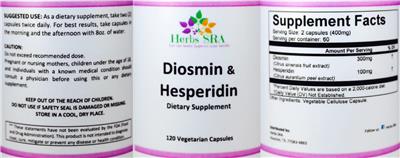
Supplement Facts
The label details for Diosmin & Hesperidin by Herbs SRA, sourced from the NIH Dietary Supplement Label Database.
Supplement Facts
| Ingredient | Amount | % DV |
|---|---|---|
| Hesperidin | 100 mg | -- |
| Diosmin | 300 mg | -- |
Other ingredients: Cellulose
Tap any ingredient to jump to its full detail below.
These statements are the manufacturer’s wording, reproduced from the product label — the label is saying it, not HelloPharmacist. We don’t verify or endorse them.
Suggested/Recommended/Usage/Directions
Suggested use: As a dietary supplement, take two (2) capsules twice daily. For best results, take capsules in the morning and afternoon with 8oz. of water.
Precautions
Caution: Do not exceed recommended dose. Do not use if safety seal is damaged or missing.
Pregnant or nursing mothers, children under the age of 18, and individuals with a known medical condition should consult a physician before using this or any dietary supplement.
Pregnant or nursing mothers, children under the age of 18, and individuals with a known medical condition should consult a physician before using this or any dietary supplement. Keep out of the reach of children.
Storage
Store in a cool, dry place.
FDA Disclaimer Statement
These statements have not been evaluated by the FDA (Food and Drug Administration). This product is not intended to diagnose, treat, cure, mitigate or prevent any disease or health condition.
General Statements
Herbs SRA Let the herbs improve your health
Follow us: Facebook Herbs SRA
FDA Statement of Identity
Dietary Supplement
Is this label outdated? Report a formula or label change and our pharmacy team will review it.
Diosmin & Hesperidin by Herbs SRA label
The label scan from the NIH Dietary Supplement Label Database. Tap to enlarge.
Label images are published by the NIH Dietary Supplement Label Database for the version of this product on file. Always read your actual product label.
View the full label (PDF)The Ingredients in Diosmin & Hesperidin by Herbs SRA
These are the 2 active ingredients this product is made of. Select any to open its full monograph.
Serving size2 Capsule(s) Dosage formCapsule Servings per container60 Amounts shown are per serving.
Most supplement products combine several ingredients, and a medication can interact with the product through any one of them. Each ingredient below shows whether it has known drug interactions.
Hesperidin
Interacts with703 drugs
Hesperidin is a flavonoid found in citrus fruits that is often combined with diosmin and used for vein and circulation problems like hemorrhoids and v...
Hesperidin monograph & interactionsDiosmin
Interacts with885 drugs
Diosmin is a citrus-derived flavonoid most often used for vein-related problems such as chronic venous insufficiency and hemorrhoids, and it is usuall...
Diosmin monograph & interactionsOther (inactive) ingredients: Cellulose. These complete the product’s ingredient list but are not active constituents.
Diosmin & Hesperidin by Herbs SRA Drug Interactions
HelloPharmacist Interaction Report
Diosmin & Hesperidin by Herbs SRA has documented interactions with medications through both of its active ingredients.
The most serious concern involves hesperidin and blood thinners (anticoagulants or antiplatelet drugs) — animal research suggests hesperidin may increase bleeding risk, though this hasn't been confirmed in humans. Hesperidin also theoretically interacts with sedating drugs (CNS depressants), blood pressure medications (antihypertensives), and specific heart drugs like verapamil and diltiazem, where it may increase their levels and effects.
Read the full breakdown — every affected drug type, severity by severity
Diosmin carries additional interactions with a broader range of medications. It may inhibit how your body metabolizes several drug classes — including pain relievers and muscle relaxants that depend on specific liver pathways (CYP2C9, CYP3A4, and CYP2E1 substrates).
Of particular note, diosmin has documented human evidence showing it increases blood levels of the pain reliever diclofenac and the muscle relaxant chlorzoxazone. It also theoretically increases bleeding risk with blood thinners, and may unexpectedly raise carbamazepine (an anti-seizure medication) levels, potentially increasing side effects.
Although many of these interactions are theoretical or from animal studies, several have been confirmed in human pharmacokinetic trials. Altogether, these interactions span 1,141 individual medications.
Use the medication checker on this page to look up your exact prescriptions before starting.
Check your own medications below · Editorial policy · How we use AI
Want to check YOUR meds against Diosmin & Hesperidin?
Ask about interactions with your drugs in plain English — “Can I take it with lisinopril?” — and we find you the answer in seconds, ingredient by ingredient.
Go to the checkerIngredients driving the most interactions
Individual Drug Interactions
The ingredients in Diosmin & Hesperidin interact with 1,141 drugs. Click any drug to see the details.
2 of the 2 ingredients in Diosmin & Hesperidin interact with drugs. Each result below shows which ingredient is responsible. Diosmin Hesperidin
Acetaminophen, Chlorpheniramine, Dextromethorphan, PseudoephedrineChildren's Tylenol Cold Plus Cough, Tylenol Cold Ex Strength
How Acetaminophen, Chlorpheniramine, Dextromethorphan, Pseudoephedrine interacts with Diosmin & Hesperidin — through 1 ingredient. Tap an ingredient for the detail:
DiosminCytochrome P450 3a4 (cyp3a4) Substrates, Cytochrome P450 2e1 (cyp2e1) Substrates Moderate
Interaction Summary
Theoretically, diosmin might inhibit the metabolism of CYP3A4 substrates.
Read the full Diosmin + Acetaminophen, Chlorpheniramine, Dextromethorphan, Pseudoephedrine interactionAcetaminophen, Chlorpheniramine, Guaifenesin, Phenylephrine, SalicylamideRhinogesic GG
How Acetaminophen, Chlorpheniramine, Guaifenesin, Phenylephrine, Salicylamide interacts with Diosmin & Hesperidin — through 1 ingredient. Tap an ingredient for the detail:
DiosminCytochrome P450 2e1 (cyp2e1) Substrates, Cytochrome P450 3a4 (cyp3a4) Substrates Moderate
Interaction Summary
Theoretically, diosmin might inhibit the metabolism of CYP2E1 substrates.
Read the full Diosmin + Acetaminophen, Chlorpheniramine, Guaifenesin, Phenylephrine, Salicylamide interactionAcetaminophen, Chlorpheniramine, PhenylephrineAlka-Seltzer PLUS, Histex SR, Protid
How Acetaminophen, Chlorpheniramine, Phenylephrine interacts with Diosmin & Hesperidin — through 1 ingredient. Tap an ingredient for the detail:
DiosminCytochrome P450 2e1 (cyp2e1) Substrates, Cytochrome P450 3a4 (cyp3a4) Substrates Moderate
Interaction Summary
Theoretically, diosmin might inhibit the metabolism of CYP2E1 substrates.
Read the full Diosmin + Acetaminophen, Chlorpheniramine, Phenylephrine interactionAcetaminophen, Chlorpheniramine, Phenylephrine, SalicylamideRhinogesic, Rhinogesic JR
How Acetaminophen, Chlorpheniramine, Phenylephrine, Salicylamide interacts with Diosmin & Hesperidin — through 1 ingredient. Tap an ingredient for the detail:
DiosminCytochrome P450 3a4 (cyp3a4) Substrates, Cytochrome P450 2e1 (cyp2e1) Substrates Moderate
Interaction Summary
Theoretically, diosmin might inhibit the metabolism of CYP3A4 substrates.
Read the full Diosmin + Acetaminophen, Chlorpheniramine, Phenylephrine, Salicylamide interactionAcetaminophen, Chlorpheniramine, PhenylpropanolamineAlumadrine, Conex, Sinadrin Max Strength, Sinulin
How Acetaminophen, Chlorpheniramine, Phenylpropanolamine interacts with Diosmin & Hesperidin — through 1 ingredient. Tap an ingredient for the detail:
DiosminCytochrome P450 3a4 (cyp3a4) Substrates, Cytochrome P450 2e1 (cyp2e1) Substrates Moderate
Interaction Summary
Theoretically, diosmin might inhibit the metabolism of CYP3A4 substrates.
Read the full Diosmin + Acetaminophen, Chlorpheniramine, Phenylpropanolamine interactionAcetaminophen, Chlorpheniramine, Phenylpropanolamine, OpiumHista-Derfule
How Acetaminophen, Chlorpheniramine, Phenylpropanolamine, Opium interacts with Diosmin & Hesperidin — through 2 ingredients. Tap an ingredient for the detail:
DiosminCytochrome P450 2e1 (cyp2e1) Substrates, Cytochrome P450 3a4 (cyp3a4) Substrates Moderate
Interaction Summary
Theoretically, diosmin might inhibit the metabolism of CYP2E1 substrates.
Read the full Diosmin + Acetaminophen, Chlorpheniramine, Phenylpropanolamine, Opium interactionHesperidinCns Depressants Moderate
Interaction Summary
Theoretically, concomitant use with CNS depressants may cause additive sedative effects.
Read the full Hesperidin + Acetaminophen, Chlorpheniramine, Phenylpropanolamine, Opium interactionAcetaminophen, Chlorpheniramine, Phenylpropanolamine, PhenyltoloxamineNorel Plus
How Acetaminophen, Chlorpheniramine, Phenylpropanolamine, Phenyltoloxamine interacts with Diosmin & Hesperidin — through 1 ingredient. Tap an ingredient for the detail:
DiosminCytochrome P450 3a4 (cyp3a4) Substrates, Cytochrome P450 2e1 (cyp2e1) Substrates Moderate
Interaction Summary
Theoretically, diosmin might inhibit the metabolism of CYP3A4 substrates.
Read the full Diosmin + Acetaminophen, Chlorpheniramine, Phenylpropanolamine, Phenyltoloxamine interactionAcetaminophen, Chlorpheniramine, PseudoephedrineAlka-Seltzer PLUS Liquid Gels, Children's Tylenol Cold, Codimal, Comtrex, Extra Strength Tylenol Allergy Sinus, Lorsin +3 more
How Acetaminophen, Chlorpheniramine, Pseudoephedrine interacts with Diosmin & Hesperidin — through 1 ingredient. Tap an ingredient for the detail:
DiosminCytochrome P450 2e1 (cyp2e1) Substrates, Cytochrome P450 3a4 (cyp3a4) Substrates Moderate
Interaction Summary
Theoretically, diosmin might inhibit the metabolism of CYP2E1 substrates.
Read the full Diosmin + Acetaminophen, Chlorpheniramine, Pseudoephedrine interactionAcetaminophen, ChlorzoxazoneAcetazone Forte, Extra Strength Tylenol Aches & Strains, Parafon Forte
How Acetaminophen, Chlorzoxazone interacts with Diosmin & Hesperidin — through 1 ingredient. Tap an ingredient for the detail:
DiosminCytochrome P450 2e1 (cyp2e1) Substrates, Chlorzoxazone (parafon Forte, Paraflex) Moderate
Interaction Summary
Theoretically, diosmin might inhibit the metabolism of CYP2E1 substrates.
Read the full Diosmin + Acetaminophen, Chlorzoxazone interactionAcetaminophen, Chlorzoxazone, CodeineAcetazone Forte C8, Parafon Forte C8
How Acetaminophen, Chlorzoxazone, Codeine interacts with Diosmin & Hesperidin — through 2 ingredients. Tap an ingredient for the detail:
DiosminChlorzoxazone (parafon Forte, Paraflex), Cytochrome P450 2e1 (cyp2e1) Substrates Moderate
Interaction Summary
Theoretically, diosmin might increase the levels and clinical effects of chlorzoxazone.
Read the full Diosmin + Acetaminophen, Chlorzoxazone, Codeine interactionHesperidinCns Depressants Moderate
Interaction Summary
Theoretically, concomitant use with CNS depressants may cause additive sedative effects.
Read the full Hesperidin + Acetaminophen, Chlorzoxazone, Codeine interactionAcetaminophen, CodeineTylenol No.3, Tylenol w/ Codeine
How Acetaminophen, Codeine interacts with Diosmin & Hesperidin — through 2 ingredients. Tap an ingredient for the detail:
DiosminCytochrome P450 2e1 (cyp2e1) Substrates Moderate
Interaction Summary
Theoretically, diosmin might inhibit the metabolism of CYP2E1 substrates.
Read the full Diosmin + Acetaminophen, Codeine interactionHesperidinCns Depressants Moderate
Interaction Summary
Theoretically, concomitant use with CNS depressants may cause additive sedative effects.
Read the full Hesperidin + Acetaminophen, Codeine interactionAcetaminophen, Codeine, DoxylamineMersyndol
How Acetaminophen, Codeine, Doxylamine interacts with Diosmin & Hesperidin — through 2 ingredients. Tap an ingredient for the detail:
HesperidinCns Depressants Moderate
Interaction Summary
Theoretically, concomitant use with CNS depressants may cause additive sedative effects.
Read the full Hesperidin + Acetaminophen, Codeine, Doxylamine interactionDiosminCytochrome P450 2e1 (cyp2e1) Substrates Moderate
Interaction Summary
Theoretically, diosmin might inhibit the metabolism of CYP2E1 substrates.
Read the full Diosmin + Acetaminophen, Codeine, Doxylamine interactionAcetaminophen, Codeine, MethocarbamolAcetaminophen, Codeine, Methocarbamol, Robaxacet 8
How Acetaminophen, Codeine, Methocarbamol interacts with Diosmin & Hesperidin — through 2 ingredients. Tap an ingredient for the detail:
DiosminCytochrome P450 2e1 (cyp2e1) Substrates Moderate
Interaction Summary
Theoretically, diosmin might inhibit the metabolism of CYP2E1 substrates.
Read the full Diosmin + Acetaminophen, Codeine, Methocarbamol interactionHesperidinCns Depressants Moderate
Interaction Summary
Theoretically, concomitant use with CNS depressants may cause additive sedative effects.
Read the full Hesperidin + Acetaminophen, Codeine, Methocarbamol interactionAcetaminophen, Dexbrompheniramine, PseudoephedrineSinadrin Plus
How Acetaminophen, Dexbrompheniramine, Pseudoephedrine interacts with Diosmin & Hesperidin — through 1 ingredient. Tap an ingredient for the detail:
DiosminCytochrome P450 2e1 (cyp2e1) Substrates Moderate
Interaction Summary
Theoretically, diosmin might inhibit the metabolism of CYP2E1 substrates.
Read the full Diosmin + Acetaminophen, Dexbrompheniramine, Pseudoephedrine interactionAcetaminophen, DextromethorphanTylenol Cough Ex Strength
How Acetaminophen, Dextromethorphan interacts with Diosmin & Hesperidin — through 1 ingredient. Tap an ingredient for the detail:
DiosminCytochrome P450 2e1 (cyp2e1) Substrates, Cytochrome P450 3a4 (cyp3a4) Substrates Moderate
Interaction Summary
Theoretically, diosmin might inhibit the metabolism of CYP2E1 substrates.
Read the full Diosmin + Acetaminophen, Dextromethorphan interactionAcetaminophen, Dextromethorphan, Doxylamine, PseudoephedrineVicks NyQuil
How Acetaminophen, Dextromethorphan, Doxylamine, Pseudoephedrine interacts with Diosmin & Hesperidin — through 1 ingredient. Tap an ingredient for the detail:
DiosminCytochrome P450 3a4 (cyp3a4) Substrates, Cytochrome P450 2e1 (cyp2e1) Substrates Moderate
Interaction Summary
Theoretically, diosmin might inhibit the metabolism of CYP3A4 substrates.
Read the full Diosmin + Acetaminophen, Dextromethorphan, Doxylamine, Pseudoephedrine interactionAcetaminophen, Dextromethorphan, Guaifenesin, PhenylephrineConar-A
How Acetaminophen, Dextromethorphan, Guaifenesin, Phenylephrine interacts with Diosmin & Hesperidin — through 1 ingredient. Tap an ingredient for the detail:
DiosminCytochrome P450 2e1 (cyp2e1) Substrates, Cytochrome P450 3a4 (cyp3a4) Substrates Moderate
Interaction Summary
Theoretically, diosmin might inhibit the metabolism of CYP2E1 substrates.
Read the full Diosmin + Acetaminophen, Dextromethorphan, Guaifenesin, Phenylephrine interactionAcetaminophen, Dextromethorphan, Guaifenesin, PhenylpropanolamineAnatuss
How Acetaminophen, Dextromethorphan, Guaifenesin, Phenylpropanolamine interacts with Diosmin & Hesperidin — through 1 ingredient. Tap an ingredient for the detail:
DiosminCytochrome P450 3a4 (cyp3a4) Substrates, Cytochrome P450 2e1 (cyp2e1) Substrates Moderate
Interaction Summary
Theoretically, diosmin might inhibit the metabolism of CYP3A4 substrates.
Read the full Diosmin + Acetaminophen, Dextromethorphan, Guaifenesin, Phenylpropanolamine interactionAcetaminophen, Dextromethorphan, Guaifenesin, PseudoephedrineRobitussin Cold, Severe Cold, Suphedrine Cold/Cough
How Acetaminophen, Dextromethorphan, Guaifenesin, Pseudoephedrine interacts with Diosmin & Hesperidin — through 1 ingredient. Tap an ingredient for the detail:
DiosminCytochrome P450 3a4 (cyp3a4) Substrates, Cytochrome P450 2e1 (cyp2e1) Substrates Moderate
Interaction Summary
Theoretically, diosmin might inhibit the metabolism of CYP3A4 substrates.
Read the full Diosmin + Acetaminophen, Dextromethorphan, Guaifenesin, Pseudoephedrine interactionAcetaminophen, Dextromethorphan, Phenylpropanolamine, PyrilamineTheracaps
How Acetaminophen, Dextromethorphan, Phenylpropanolamine, Pyrilamine interacts with Diosmin & Hesperidin — through 1 ingredient. Tap an ingredient for the detail:
DiosminCytochrome P450 2e1 (cyp2e1) Substrates, Cytochrome P450 3a4 (cyp3a4) Substrates Moderate
Interaction Summary
Theoretically, diosmin might inhibit the metabolism of CYP2E1 substrates.
Read the full Diosmin + Acetaminophen, Dextromethorphan, Phenylpropanolamine, Pyrilamine interactionAcetaminophen, Dextromethorphan, PseudoephedrineAlka-Seltzer PLUS Flu Liquid Gels, Non Aspirin Cold Caps, Tylenol Cold, Tylenol Flu Daytime Ex Strength, Tylenol Flu Ex Strength
How Acetaminophen, Dextromethorphan, Pseudoephedrine interacts with Diosmin & Hesperidin — through 1 ingredient. Tap an ingredient for the detail:
DiosminCytochrome P450 3a4 (cyp3a4) Substrates, Cytochrome P450 2e1 (cyp2e1) Substrates Moderate
Interaction Summary
Theoretically, diosmin might inhibit the metabolism of CYP3A4 substrates.
Read the full Diosmin + Acetaminophen, Dextromethorphan, Pseudoephedrine interactionAcetaminophen, Dichloralantipyrine, IsomethepteneAmidrine, Midchlor, Migquin, Migratine
How Acetaminophen, Dichloralantipyrine, Isometheptene interacts with Diosmin & Hesperidin — through 2 ingredients. Tap an ingredient for the detail:
DiosminCytochrome P450 2e1 (cyp2e1) Substrates Moderate
Interaction Summary
Theoretically, diosmin might inhibit the metabolism of CYP2E1 substrates.
Read the full Diosmin + Acetaminophen, Dichloralantipyrine, Isometheptene interactionHesperidinCns Depressants Moderate
Interaction Summary
Theoretically, concomitant use with CNS depressants may cause additive sedative effects.
Read the full Hesperidin + Acetaminophen, Dichloralantipyrine, Isometheptene interactionAcetaminophen, Dichloralphenazone, IsomethepteneMidrin
How Acetaminophen, Dichloralphenazone, Isometheptene interacts with Diosmin & Hesperidin — through 2 ingredients. Tap an ingredient for the detail:
DiosminCytochrome P450 2e1 (cyp2e1) Substrates Moderate
Interaction Summary
Theoretically, diosmin might inhibit the metabolism of CYP2E1 substrates.
Read the full Diosmin + Acetaminophen, Dichloralphenazone, Isometheptene interactionHesperidinCns Depressants Moderate
Interaction Summary
Theoretically, concomitant use with CNS depressants may cause additive sedative effects.
Read the full Hesperidin + Acetaminophen, Dichloralphenazone, Isometheptene interactionAcetaminophen, Dichlorophenazone, IsometheptaneIsocom
How Acetaminophen, Dichlorophenazone, Isometheptane interacts with Diosmin & Hesperidin — through 2 ingredients. Tap an ingredient for the detail:
DiosminCytochrome P450 2e1 (cyp2e1) Substrates Moderate
Interaction Summary
Theoretically, diosmin might inhibit the metabolism of CYP2E1 substrates.
Read the full Diosmin + Acetaminophen, Dichlorophenazone, Isometheptane interactionHesperidinCns Depressants Moderate
Interaction Summary
Theoretically, concomitant use with CNS depressants may cause additive sedative effects.
Read the full Hesperidin + Acetaminophen, Dichlorophenazone, Isometheptane interactionAcetaminophen, DiphenhydramineTylenol PM, Tylenol PM Ex Strength
How Acetaminophen, Diphenhydramine interacts with Diosmin & Hesperidin — through 2 ingredients. Tap an ingredient for the detail:
HesperidinCns Depressants Moderate
Interaction Summary
Theoretically, concomitant use with CNS depressants may cause additive sedative effects.
Read the full Hesperidin + Acetaminophen, Diphenhydramine interactionDiosminCytochrome P450 2e1 (cyp2e1) Substrates Moderate
Interaction Summary
Theoretically, diosmin might inhibit the metabolism of CYP2E1 substrates.
Read the full Diosmin + Acetaminophen, Diphenhydramine interactionAcetaminophen, Diphenhydramine, PseudoephedrineChildren's Tylenol Allergy, Cold Control, Contac Night Allergy Relief
How Acetaminophen, Diphenhydramine, Pseudoephedrine interacts with Diosmin & Hesperidin — through 2 ingredients. Tap an ingredient for the detail:
DiosminCytochrome P450 2e1 (cyp2e1) Substrates Moderate
Interaction Summary
Theoretically, diosmin might inhibit the metabolism of CYP2E1 substrates.
Read the full Diosmin + Acetaminophen, Diphenhydramine, Pseudoephedrine interactionHesperidinCns Depressants Moderate
Interaction Summary
Theoretically, concomitant use with CNS depressants may cause additive sedative effects.
Read the full Hesperidin + Acetaminophen, Diphenhydramine, Pseudoephedrine interactionAcetaminophen, Doxylamine, PseudoephedrineEx Strength Tylenol Sinus Nighttime
How Acetaminophen, Doxylamine, Pseudoephedrine interacts with Diosmin & Hesperidin — through 1 ingredient. Tap an ingredient for the detail:
DiosminCytochrome P450 2e1 (cyp2e1) Substrates Moderate
Interaction Summary
Theoretically, diosmin might inhibit the metabolism of CYP2E1 substrates.
Read the full Diosmin + Acetaminophen, Doxylamine, Pseudoephedrine interactionAcetaminophen, HydrocodoneAnexsia, Anodynos DHC, Azdone, Co-Gesic, Doucet, Lorcet +9 more
How Acetaminophen, Hydrocodone interacts with Diosmin & Hesperidin — through 2 ingredients. Tap an ingredient for the detail:
DiosminCytochrome P450 2e1 (cyp2e1) Substrates, Cytochrome P450 3a4 (cyp3a4) Substrates Moderate
Interaction Summary
Theoretically, diosmin might inhibit the metabolism of CYP2E1 substrates.
Read the full Diosmin + Acetaminophen, Hydrocodone interactionHesperidinCns Depressants Moderate
Interaction Summary
Theoretically, concomitant use with CNS depressants may cause additive sedative effects.
Read the full Hesperidin + Acetaminophen, Hydrocodone interactionAcetaminophen, IbuprofenCombogesic
How Acetaminophen, Ibuprofen interacts with Diosmin & Hesperidin — through 2 ingredients. Tap an ingredient for the detail:
DiosminCytochrome P450 2c9 (cyp2c9) Substrates, Cytochrome P450 2e1 (cyp2e1) Substrates +1 Moderate
Interaction Summary
Theoretically, diosmin might inhibit the metabolism of CYP2C9 substrates.
Read the full Diosmin + Acetaminophen, Ibuprofen interactionHesperidinAnticoagulant/antiplatelet Drugs Moderate
Interaction Summary
Theoretically, hesperidin may increase the risk of bleeding if used with anticoagulant or antiplatelet drugs.
Read the full Hesperidin + Acetaminophen, Ibuprofen interactionAcetaminophen, MeperidineDemerol APAP
How Acetaminophen, Meperidine interacts with Diosmin & Hesperidin — through 2 ingredients. Tap an ingredient for the detail:
DiosminCytochrome P450 2e1 (cyp2e1) Substrates Moderate
Interaction Summary
Theoretically, diosmin might inhibit the metabolism of CYP2E1 substrates.
Read the full Diosmin + Acetaminophen, Meperidine interactionHesperidinCns Depressants Moderate
Interaction Summary
Theoretically, concomitant use with CNS depressants may cause additive sedative effects.
Read the full Hesperidin + Acetaminophen, Meperidine interactionEach ingredient & the kinds of drugs it affects
For each ingredient in Diosmin & Hesperidin with known interactions, here are the types of medications they can affect. Open any type for the detail — or search your exact drug in the checker above.
Diosmin
Anticoagulant/Antiplatelet Drugs
Theoretically, diosmin may increase the risk of bleeding if used with anticoagulant or antiplatelet drugs.
A case of spontaneous intraventricular hemorrhage has been reported for a 77-year-old female after 6 weeks of warfarin therapy, despite an international normalized ratio (INR) of only 1.8. The patient had also been taking aspirin and diosmin for several years. Experts speculate that chronic intake of diosmin predisposed the patient to spontaneous intraventricular hemorrhage by inducing chronic microcirculatory hypertension and inhibiting platelet aggregation. The presence of aspirin was also thought to play a role in this event.
Carbamazepine (Tegretol)
Theoretically, diosmin might reduce the effects of carbamazepine and increase the risk for convulsions.
A pharmacokinetic study in humans shows that taking diosmin (Venex) 500 mg daily for 10 days prior to oral administration of carbamazepine 200 mg increases blood levels of carbamazepine by approximately 58% and decreases carbamazepine clearance by 42%. It also decreases the formation of carbamazepine's active metabolite. It is speculated that diosmin reduces the metabolism of carbamazepine by inhibiting cytochrome P450 3A4 (CYP3A4).
Chlorzoxazone (Parafon Forte, Paraflex)
Theoretically, diosmin might increase the levels and clinical effects of chlorzoxazone.
A pharmacokinetic study in humans shows that taking diosmin (Venex 500) 500 mg daily for 9 days prior to oral administration of chlorzoxazone 250 mg increases blood levels of chlorzoxazone by 53% and decreases chlorzoxazone clearance by 40%. It is speculated that diosmin reduces the metabolism of chlorzoxazone by inhibiting cytochrome P450 2E1 (CYP2E1).
Cytochrome P450 2C9 (Cyp2C9) Substrates
Theoretically, diosmin might inhibit the metabolism of CYP2C9 substrates.
Diclofenac is metabolized by CYP2C9 enzymes. Clinical and laboratory research shows that diosmin inhibits the metabolism of diclofenac. A pharmacokinetic study in humans shows that taking diosmin (Venex 500) 500 mg daily for 9 days prior to oral administration of diclofenac 100 mg increases blood levels of diclofenac and decreases diclofenac clearance.
Cytochrome P450 2E1 (Cyp2E1) Substrates
Theoretically, diosmin might inhibit the metabolism of CYP2E1 substrates.
Chlorzoxazone is metabolized by CYP2E1 enzymes. A pharmacokinetic study in humans shows that taking diosmin (Venex 500) 500 mg daily for 9 days prior to oral administration of chlorzoxazone (Paraflex 250) 250 mg increases blood levels of chlorzoxazone by 34% and decreases chlorzoxazone clearance by 40%. It is speculated that diosmin reduces the metabolism of chlorzoxazone by inhibiting CYP2E1.
Cytochrome P450 3A4 (Cyp3A4) Substrates
Theoretically, diosmin might inhibit the metabolism of CYP3A4 substrates.
Laboratory research is conflicting with respect to the effects of diosmin on CYP3A4. Some research suggests that diosmin does not affect CYP3A4 activity. However, other research suggests that diosmin alters the metabolism of carbamazepine, a CYP3A4 substrate. Laboratory and animal research show that oral administration of diosmin for 7 days prior to oral administration of carbamazepine increases plasma concentrations of carbamazepine, decreases the clearance of carbamazepine, and decreases the formation of carbamazepine's active metabolite. Additionally, pharmacokinetic research in healthy male subjects shows that taking diosmin (Venex) 500 mg daily for 10 days prior to oral administration of carbamazepine 200 mg increases blood levels of carbamazepine by approximately 58% and decreases carbamazepine clearance by 42%. It is speculated that diosmin reduces the metabolism of carbamazepine by inhibiting CYP3A4. Diosmetin, a metabolite of diosmin, may also inhibit CYP3A4.
Diclofenac (Voltaren, Others)
Theoretically, diosmin might increase the levels and clinical effects of diclofenac.
Clinical and laboratory research shows that diosmin inhibits the metabolism of diclofenac. A pharmacokinetic study in humans shows that taking diosmin (Venex 500) 500 mg daily for 9 days prior to oral administration of diclofenac 100 mg increases blood levels of diclofenac and decreases diclofenac clearance. It is speculated that diosmin reduces the metabolism of diclofenac by inhibiting cytochrome P450 2C9 (CYP2C9).
Fexofenadine (Allegra)
Theoretically, diosmin might increase the levels and clinical effects of fexofenadine.
A pharmacokinetic study in humans shows that taking diosmin (Venex) 500 mg daily for 10 days prior to oral administration of fexofenadine 120 mg increases blood levels of fexofenadine by approximately 49% and decreases the apparent oral clearance of fexofenadine by 41%. The time taken to reach maximum plasma concentration, the half-life, and the apparent renal clearance of fexofenadine are not affected. For this reason, it is speculated that diosmin alters the pharmacokinetics of fexofenadine via inhibition of P-glycoprotein in the intestine, but not in the kidney or liver.
P-Glycoprotein Substrates
Theoretically, diosmin might increase levels of drugs that are substrates of P-glycoprotein (P-gp).
Preliminary laboratory research suggests that diosmin inhibits P-gp. Additionally, pharmacokinetic research in healthy male subjects shows that taking diosmin (Venex) 500 mg daily for 10 days prior to oral administration of fexofenadine 120 mg increases blood levels of fexofenadine, a P-gp substrate, by approximately 49% and decreases the apparent oral clearance of fexofenadine by 41%. The time taken to reach maximum plasma concentration, the half-life, and the apparent renal clearance of fexofenadine are not affected. For this reason, it is speculated that diosmin inhibits P-gp in the intestine, but not in the kidney or liver.
Hesperidin
Anticoagulant/Antiplatelet Drugs
Theoretically, hesperidin may increase the risk of bleeding if used with anticoagulant or antiplatelet drugs.
Animal research suggests that hesperetin, a bioflavonoid aglycone derivative of hesperidin, may have antiplatelet activity.
Antihypertensive Drugs
Theoretically, taking hesperidin with antihypertensive drugs might increase the risk of hypotension.
Some clinical and animal research shows that hesperidin can decrease blood pressure. However, other clinical research shows that hesperidin does not affect blood pressure.
Celiprolol (Celicard)
Theoretically, hesperidin may decrease the levels and clinical effects of celiprolol.
Animal research shows that concomitant use of hesperidin may reduce the plasma area under the curve of celiprolol by up to 75%. This effect has not been reported in humans.
Cns Depressants
Theoretically, concomitant use with CNS depressants may cause additive sedative effects.
Animal studies show that hesperidin has sedative effects, due to opioid receptor activity and can increase sedation when used with diazepam. This effect has not been reported in humans.
Diltiazem (Cardizem, Others)
Theoretically, hesperidin may increase the levels and clinical effects of diltiazem.
Animal research suggests that hesperidin may enhance the bioavailability of diltiazem, increasing the plasma area under the curve of diltiazem by up to 65.3%. This effect has not been reported in humans.
P-Glycoprotein Substrates
Theoretically, hesperidin might inhibit P-glycoprotein-mediated drug efflux and potentially increase levels of drugs that are substrates of P-glycoprotein.
In vitro research shows that hesperidin can inhibit P-glycoprotein efflux. This effect has not been reported in humans.
Verapamil (Calan, Others)
Theoretically, hesperidin might increase the levels and clinical effects of verapamil.
Animal research suggests that hesperidin may enhance the bioavailability of verapamil, increasing the plasma area under the curve of verapamil by 96.8%. This effect has not been reported in humans
Brand information
Manufacturer and brand details for Diosmin & Hesperidin, from the product label.
Diosmin & Hesperidin by Herbs SRA: Common Questions
Does Diosmin & Hesperidin by Herbs SRA interact with any medications?
How can one product interact with so many drugs?
Where does this information come from?
What is diosmin used for?
Can I take this while pregnant or breastfeeding?
What are the most common side effects?
Is this safe for long-term use?
How much does this product increase my bleeding risk?
Will this interact with my heart medication?
Written and reviewed by the HelloPharmacist editorial staff. Our editorial policy
Not sure if Diosmin & Hesperidin is safe with your meds?
Our pharmacists answer your medication & supplement questions — free.
Label information is sourced from the NIH Dietary Supplement Label Database and reflects the product version on file; always read your actual product label. This page is for education only and is not a substitute for professional medical advice. Confirm with your pharmacist or doctor before combining supplements and medications.
The Full Monographs Behind Diosmin & Hesperidin’s Ingredients
Every ingredient we hold a full HelloPharmacist monograph for — uses, evidence, safety, and the complete interaction list.
Hesperidin
Interacts with 703 drugsHesperidin is a flavonoid found in citrus fruits that is often combined with diosmin and used for vein and circulation problems like hemorrhoids and varicose veins. Some evidence supports th...
Read the full Hesperidin monograph → Herb & supplement monographDiosmin
Interacts with 885 drugsDiosmin is a citrus-derived flavonoid most often used for vein-related problems such as chronic venous insufficiency and hemorrhoids, and it is usually combined with a related flavonoid call...
Read the full Diosmin monograph →Sources & How We Checked
Diosmin & Hesperidin's label data comes from the NIH Dietary Supplement Label Database; the ingredient interaction data is from the Natural Medicines database, reviewed by our pharmacists.
- NIH Dietary Supplement Label Database (DSLD) — The official product label on file for this supplement.
- Natural Medicines (Therapeutic Research Center) — Evidence-graded clinical reference behind the ingredient interaction data.
Content is written and reviewed by licensed HelloPharmacist pharmacists. See our data sources and editorial standards for how this information is built and checked.
The 34 references behind this product’s interaction data
Every citation that drives the interaction findings for this product’s ingredients, from the evidence-graded Natural Medicines (TRC Healthcare) database. Open an ingredient to browse its citations — links open the study on PubMed or the publisher’s site.
Hesperidin 14 references
- Fernandez, S. P., Wasowski, C., Paladini, A. C., and Marder, M. Synergistic interaction between hesperidin, a natural flavonoid, and diazepam. Eur.J.Pharmacol. 4-11-2005;512(2-3):189-198. PubMed
- Jin, Y. R., Han, X. H., Zhang, Y. H., Lee, J. J., Lim, Y., Chung, J. H., and Yun, Y. P. Antiplatelet activity of hesperetin, a bioflavonoid, is mainly mediated by inhibition of PLC-gamma2 phosphorylation and cyclooxygenase-1 activity. Atherosclerosis 200
- Loscalzo, L. M., Wasowski, C., Paladini, A. C., and Marder, M. Opioid receptors are involved in the sedative and antinociceptive effects of hesperidin as well as in its potentiation with benzodiazepines. Eur.J.Pharmacol. 2-12-2008;580(3):306-313. PubMed
- Yamamoto, M., Suzuki, A., Jokura, H., Yamamoto, N., and Hase, T. Glucosyl hesperidin prevents endothelial dysfunction and oxidative stress in spontaneously hypertensive rats. Nutrition 2008;24(5):470-476. PubMed
- El-Readi, M. Z., Hamdan, D., Farrag, N., El-Shazly, A., and Wink, M. Inhibition of P-glycoprotein activity by limonin and other secondary metabolites from Citrus species in human colon and leukaemia cell lines. Eur.J.Pharmacol. 1-25-2010;626(2-3):139-145 PubMed
- Buckshee, K., Takkar, D., and Aggarwal, N. Micronized flavonoid therapy in internal hemorrhoids of pregnancy. Int J Gynaecol Obstet 1997;57(2):145-151. PubMed
- Uesawa, Y. and Mohri, K. Hesperidin in orange juice reduces the absorption of celiprolol in rats. Biopharm Drug Dispos. 2008;29(3):185-188. PubMed
- Cho, YA, Choi, DH, and Choi, JS. Effect of hesperidin on the oral pharmacokinetics of diltiazem and its main metabolite, desacetyldiltiazem, in rats. J Pharm Pharmacol. 2009;61(6):825-829. PubMed
- Piao, YJ and Choi, JS. Enhanced bioavailability of verapamil after oral administration with hesperidin in rats. Arch Pharm Res. 2008;31(4):518-522. PubMed
- Andersen KE. Hesperidin methyl chalcone?-?a new cosmetic contact allergen. Contact Dermatitis. 2015;72(6):402-4. PubMed
- Morand C, Dubray C, Milenkovic D, et al. Hesperidin contributes to the vascular protective effects of orange juice: a randomized crossover study in healthy volunteers. Am J Clin Nutr 2011;93(1):73-80. PubMed
- Homayouni F, Haidari F, Hedayati M, Zakerkish M, Ahmadi K. Blood pressure lowering and anti-inflammatory effects of hesperidin in type 2 diabetes; a randomized double-blind controlled clinical trial. Phytother Res. 2018;32(6):1073-1079. PubMed
- Mohammadi M, Ramezani-Jolfaie N, Lorzadeh E, Khoshbakht Y, Salehi-Abargouei A. Hesperidin, a major flavonoid in orange juice, might not affect lipid profile and blood pressure: A systematic review and meta-analysis of randomized controlled clinical trials PubMed
- Valls RM, Pedret A, Calderón-Pérez L, et al. Effects of hesperidin in orange juice on blood and pulse pressures in mildly hypertensive individuals: a randomized controlled trial (Citrus study). Eur J Nutr. 2021;60(3):1277-1288. PubMed
Diosmin 20 references
- Misra MC, Parshad R. Randomized clinical trial of micronized flavonoids in the early control of bleeding from acute internal haemorrhoids. Br J Surgery 2000;87:868-72. PubMed
- Thanapongsathorn W, Vajrabukka T. Clinical trial of oral diosmin (Daflon) in the treatment of hemorrhoids. Dis Colon Rectum 1992;35:1085-8. PubMed
- Cospite M. Double-blind, placebo-controlled evaluation of clinical activity and safety of Daflon 500 mg in the treatment of acute hemorrhoids. Angiology 1994;45:566-73.
- Guilhou JJ, Dereure O, Marzin L, et al. Efficacy of Daflon 500 mg in venous leg ulcer healing: a double-blind, randomized, controlled versus placebo trial in 107 patients. Angiology 1997;48:77-85.. PubMed
- Cospite, M. and Dominici, A. Double blind study of the pharmacodynamic and clinical activities of 5682 SE in venous insufficiency. Advantages of the new micronized form. Int Angiol. 1989;8(4 Suppl):61-65.
- Buckshee, K., Takkar, D., and Aggarwal, N. Micronized flavonoid therapy in internal hemorrhoids of pregnancy. Int J Gynaecol Obstet 1997;57(2):145-151. PubMed
- Kumar RM, Van Gompel JJ, Bower R, Rabinstein AA. Spontaneous intraventricular hemorrhage associated with prolonged diosmin therapy. Neurocrit Care. 2011 Jun;14(3):438-40. PubMed
- Milano G, Leone S, Fucile C, Zuccoli ML, Stimamiglio A, Martelli A, Mattioli F. Uncommon serum creatine phosphokinase and lactic dehydrogenase increase during diosmin therapy: two case reports. J Med Case Rep. 2014 Jun 16;8:194. PubMed
- Rajnarayana K, Venkatesham A, Krishna DR. Bioavailability of diclofenac sodium after pretreatment with diosmin in healthy volunteers. Drug Metabol Drug Interact. 2007;22(2-3):165-74. PubMed
- Rajnarayana K, Venkatesham A, Nagulu M, Srinivas M, Krishna DR. Influence of diosmin pretreatment on the pharmacokinetics of chlorzoxazone in healthy male volunteers. Drug Metabol Drug Interact. 2008;23(3-4):311-21. PubMed
- Yoo HH, Lee M, Chung HJ, Lee SK, Kim DH. Effects of diosmin, a flavonoid glycoside in citrus fruits, on P-glycoprotein-mediated drug efflux in human intestinal Caco-2 cells. J Agric Food Chem. 2007 Sep 5;55(18):7620-5. PubMed
- Bedada SK, Neerati P. Modulation of CYP3A enzyme activity by diosmin and its consequence on carbamazepine pharmacokinetics in rats. Naunyn Schmiedebergs Arch Pharmacol. 2018;391(2):115-21. PubMed
- Burkina V, Zlabek V, Halsne R, Ropstad E, Zamaratskaia G. In vitro effects of the citrus flavonoids diosmin, naringenin and naringin on the hepatic drug-metabolizing CYP3A enzyme in human, pig, mouse and fish. Biochem Pharmacol. 2016;110-111:109-16 PubMed
- Bedada SK, Boga PK. Influence of diosmin on the metabolism and disposition of carbamazepine in healthy subjects. Xenobiotica. 2017;47(10):879-84. PubMed
- Bedada SK, Boga PK, Kotakonda HK. The effect of diosmin on the pharmacokinetics of fexofenadine in healthy human volunteers. Xenobiotica. 2017;47(3):230-35. PubMed
- Poór M, Boda G, Mohos V, et al. Pharmacokinetic interaction of diosmetin and silibinin with other drugs: Inhibition of CYP2C9-mediated biotransformation and displacement from serum albumin. Biomed Pharmacother. 2018;102:912-921. PubMed
- Gavrilov SG, Karalkin AV, Moskalenko YP, Grishenkova AS. Efficacy of two micronized purified flavonoid fraction dosing regimens in the pelvic venous pain relief. Int Angiol. 2021;40(3):180-186. PubMed
- Steinbruch M, Nunes C, Gama R, et al. Is nonmicronized diosmin 600?mg as effective as micronized diosmin 900?mg plus hesperidin 100?mg on chronic venous disease symptoms? Results of a noninferiority study. Int J Vasc Med. 2020;2020:4237204. PubMed
- Schastlivtsev I, Lobastov K, Barinov V, Kanzafarova I. Diosmin 600 in adjunction to rivaroxaban reduces the risk of post-thrombotic syndrome after femoropopliteal deep vein thrombosis: results of the RIDILOTT DVT study. Int Angiol. 2020;39(5):361-371. PubMed
- Mansilha A, Caldevilla H, Puskás A, Lucien A, Roby L, Kirienko A. MPFF 1000 mg chewable once daily vs. MPFF 500 mg twice daily in chronic venous disease: the double-blind, randomized, non-inferiority CHEWY trial. Int Angiol 2022;41(6):464-475. PubMed
Parts of this content are provided by the Therapeutic Research Center, LLC.
DISCLAIMER: Currently this does not check for drug-drug interactions. This is not an all-inclusive comprehensive list of potential interactions and is for informational purposes only. Not all interactions are known or well-reported in the scientific literature, and new interactions are continually being reported. Input is needed from a qualified healthcare provider including a pharmacist before starting any therapy. Application of clinical judgment is necessary.
© 2021 Therapeutic Research Center, LLC