
Fenugreek 1,350 mg Ingredients & Drug Interactions
by Nutricost
What is this page for?
First and foremost: checking Fenugreek 1,350 mg against your medications. The heart of this page is the interaction checker and the full interaction report — how this product’s ingredients may interact with prescription and over-the-counter medicines you may be taking.
Around that, we add a pharmacist’s high-level view of the product as a whole — what’s inside, the evidence for its stated use, how transparent the label is, and what safety data exists — so you can see the full picture in one place. It’s educational information from our licensed clinical databases and the clinical staff at HelloPharmacist — not medical advice — and we don’t sell or endorse products. Our editorial policy
Fenugreek 1,350 mg is a dietary supplement by Nutricost with 1 active ingredient. Its ingredients are commonly taken for blood sugar control, boosting breast milk supply, high cholesterol.Based on those ingredients, 389 medications have a known interaction with it, the most serious rated moderate. The ingredients most likely to interact are Fenugreek, Powder. Use the checker below to test your specific medication, or read the full HelloPharmacist Interaction Report.
Check Your Meds Against Fenugreek 1,350 mg by Nutricost
Ask about any prescription or over-the-counter medication and we check it for interactions with Fenugreek 1,350 mg by Nutricost — and tell you which ingredient is responsible.
AI summaries are generated from our interaction database for education only — always confirm with your pharmacist. How we use AI
Ask the Pharmacist
A licensed pharmacist will answer your question by email — free, usually within 24 hours.
Got it — thank you!
A licensed pharmacist will answer within 24 hours. Keep an eye on your email (worth checking spam, just in case).
HelloPharmacist Scorecard of Fenugreek 1,350 mg by Nutricost
Our pharmacy team’s full take, with four database checks built into the cards below — a summary of what is known, not a grade of the product itself.
What’s inside
Full disclosure
Nutricost Fenugreek 1,350 mg is a single-ingredient supplement — just fenugreek powder in a capsule. Fenugreek is a plant seed used traditionally for blood sugar support and sexual function.
The capsule itself contains gelatin, microcrystalline cellulose (a binder), magnesium stearate, pure olive oil, and silicon dioxide as inactive ingredients.
Does it work?
Moderate evidence
The evidence on fenugreek for sexual dysfunction and sexual arousal is rated possibly effective — meaning there's some support, but it's not conclusive. The same goes for dysmenorrhea (menstrual pain) and diabetes management.
Fenugreek seed has shown it can lower fasting blood sugar and post-meal blood sugar in people with type 2 diabetes in clinical trials, but the overall body of evidence we hold isn't strong enough to call it established.
How safe is it?
Well-documented data
Fenugreek seed is generally well tolerated, but supplement doses can cause side effects: abdominal pain, bloating, diarrhea, indigestion, gas, and nausea are the most common. Rarely, it can trigger severe allergic reactions including swelling of the throat and airways (angioedema and bronchospasm) and shock.
Avoid medicinal use during pregnancy — the supplement may affect the uterus. If you're breastfeeding and want to try fenugreek to boost milk supply, the evidence is limited; talk it over with your doctor or midwife first.
One more note: fenugreek can cause an unusual body odor in newborns if taken near delivery, and in children drinking fenugreek tea.
Meds to double-check
Moderate interaction found
Before taking this product, check with your doctor or pharmacist if you take blood thinners (warfarin, clopidogrel, or other anticoagulants), diabetes medications, metoprolol or other blood pressure drugs, phenytoin or other seizure medications, theophylline, or sildenafil. Fenugreek may change how well these drugs work or how much they stay in your system.
The bottom line
Scorecard at a glanceFully disclosed formula with some supporting evidence behind its ingredients' uses. Moderate medication interactions have been identified, and safety information is well characterized.
Fenugreek is a good option if you're looking into herbal support for blood sugar or sexual function and you don't take blood thinners, diabetes medications, or heart or seizure drugs. If you do take any of those, or if you're pregnant, check with your doctor or pharmacist before you start.
A small number of people experience digestive side effects or allergic reactions, so watch for them when you first try it.
Educational only — not medical advice; always confirm with your pharmacist. Our editorial policy · How we use AI
Assessment coverage: 1 of 1 active ingredient matched to our full ingredient reviews (monographs). Based on the product label dated Jul 25, 2024.
This Scorecard evaluates available label information, ingredient evidence, and known medication-safety considerations. It does not independently verify product identity, purity, potency, contamination, or manufacturing quality. How these ratings are computed
General information
Key facts about Fenugreek 1,350 mg, straight from the product label.
| Brand | Nutricost |
|---|---|
| Barcode (UPC) | 702669931489 |
| Net contents | 240 Capsule(s) |
| Market status | On market |
| Date entered into DSLD | Jul 25, 2024 |
| DSLD ID | 306217 |
| Product type | Botanical |
| Supplement form | Capsule |
| Dietary claims / uses | All Other, Structure/Function |
| Intended target group(s) | Adult (18 - 50 Years), Gluten Free |
Everything in this section is reproduced from the manufacturer’s own product label — it’s the label speaking, not HelloPharmacist. We show it so you can see exactly what the maker states; we don’t verify or endorse those statements.
Supplement Facts
The label details for Fenugreek 1,350 mg by Nutricost, sourced from the NIH Dietary Supplement Label Database.
Supplement Facts
| Ingredient | Amount | % DV |
|---|---|---|
| Fenugreek, Powder | 1350 mg | -- |
Other ingredients: Gelatin, Microcrystalline Cellulose, Magnesium Stearate, Olive Oil, Pure, Silicon Dioxide
Tap any ingredient to jump to its full detail below.
These statements are the manufacturer’s wording, reproduced from the product label — the label is saying it, not HelloPharmacist. We don’t verify or endorse them.
Suggested/Recommended/Usage/Directions
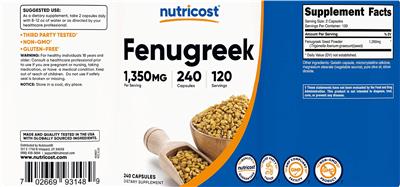
Suggested use: as a dietary supplement, take 2 capsules daily with 8-12 oz of water or as directed by your healthcare professional.
Formulation
Third party tested
Non-GMO Gluten-free
Made and quality tested in the USA with globally sourced ingredients.
Non-GMO product
Precautions
Warning: for healthy individuals 18 years and older. Keep out of reach of children.
Consult a healthcare professional prior to use pregnant or nursing, taking medication, or have a medical condition.
Do not use if safety seal is broken or missing.
Storage
Notice: store in a cool, dry place.
Formula
Fenugreek 1,350mg per serving
FDA Statement of Identity
Dietary Supplement
Seals/Symbols
Nutricost Quality Guaranteed Third party tested GMP Compliant Facility
FDA Disclaimer Statement
These statements have not been evaluated by the Food and Drug Administration. This product is not intended to diagnose, treat, cure, or prevent any disease.
Is this label outdated? Report a formula or label change and our pharmacy team will review it.
Fenugreek 1,350 mg by Nutricost label
The label scan from the NIH Dietary Supplement Label Database. Tap to enlarge.
Label images are published by the NIH Dietary Supplement Label Database for the version of this product on file. Always read your actual product label.
View the full label (PDF)The Ingredients in Fenugreek 1,350 mg by Nutricost
This is the 1 active ingredient this product is made of. Select it to open its full monograph.
Serving size2 Capsule(s) Dosage formCapsule Servings per container120 Amounts shown are per serving.
Fenugreek, Powder
Interacts with389 drugs
Fenugreek is a common kitchen spice that is also taken as a supplement, mainly for blood sugar, cholesterol, and to support breast milk production. So...
Fenugreek, Powder monograph & interactionsOther (inactive) ingredients: Gelatin, Microcrystalline Cellulose, Magnesium Stearate, Olive Oil, Pure, Silicon Dioxide. These complete the product’s ingredient list but are not active constituents.
Fenugreek 1,350 mg by Nutricost Drug Interactions
HelloPharmacist Interaction Report
Nutricost Fenugreek 1,350 mg does interact with medications.
Through its fenugreek powder, it may have additive effects with blood thinners (anticoagulants) and antiplatelet drugs like clopidogrel (Plavix) and warfarin (Coumadin). The most serious concern is with warfarin — fenugreek's constituents may increase your INR (international normalized ratio, a measure of blood thinning), raising bleeding risk.
Read the full breakdown — every affected drug type, severity by severity
Fenugreek may also lower blood sugar (glucose) when taken with diabetes drugs, heightening the risk of low blood sugar (hypoglycemia). It can reduce how well your body processes the blood pressure medication metoprolol (Toprol), potentially causing extra blood pressure drops.
Additionally, it may lower levels of the seizure medication phenytoin (Dilantin), the heart medication theophylline, and the erectile dysfunction drug sildenafil (Viagra), each of which could reduce how well those drugs work.
Altogether, these interactions span 389 individual medications. Before you start, check your exact prescriptions with the tool on this page — and if you take any blood thinner, diabetes medication, or heart or seizure medication, run it by your doctor or pharmacist first.
Check your own medications below · Editorial policy · How we use AI
Want to check YOUR meds against Fenugreek 1,350 mg?
Ask about interactions with your drugs in plain English — “Can I take it with lisinopril?” — and we find you the answer in seconds, ingredient by ingredient.
Go to the checkerIngredients driving the most interactions
Individual Drug Interactions
The ingredients in Fenugreek 1,350 mg interact with 389 drugs. Click any drug to see the details.
1 of the 1 ingredient in Fenugreek 1,350 mg interact with drugs. Each result below shows which ingredient is responsible. Fenugreek, Powder
AbciximabReoPro
How Abciximab interacts with Fenugreek 1,350 mg — through 1 ingredient. Tap an ingredient for the detail:
Fenugreek, PowderAnticoagulant/antiplatelet Drugs Moderate
Interaction Summary
Theoretically, fenugreek might have additive effects when used with anticoagulant or antiplatelet drugs.
Read the full Fenugreek, Powder + Abciximab interactionAbrocitinibCibinqo
How Abrocitinib interacts with Fenugreek 1,350 mg — through 1 ingredient. Tap an ingredient for the detail:
Fenugreek, PowderAnticoagulant/antiplatelet Drugs Moderate
Interaction Summary
Theoretically, fenugreek might have additive effects when used with anticoagulant or antiplatelet drugs.
Read the full Fenugreek, Powder + Abrocitinib interactionAcarboseGlucobay, Prandase, Precose
How Acarbose interacts with Fenugreek 1,350 mg — through 1 ingredient. Tap an ingredient for the detail:
Fenugreek, PowderAntidiabetes Drugs Moderate
Interaction Summary
Theoretically, fenugreek seed might have additive hypoglycemic effects when used with antidiabetes drugs.
Read the full Fenugreek, Powder + Acarbose interactionAcenocoumarolSintrom
How Acenocoumarol interacts with Fenugreek 1,350 mg — through 1 ingredient. Tap an ingredient for the detail:
Fenugreek, PowderAnticoagulant/antiplatelet Drugs Moderate
Interaction Summary
Theoretically, fenugreek might have additive effects when used with anticoagulant or antiplatelet drugs.
Read the full Fenugreek, Powder + Acenocoumarol interactionAcetaminophen, AspirinGemnisyn
How Acetaminophen, Aspirin interacts with Fenugreek 1,350 mg — through 1 ingredient. Tap an ingredient for the detail:
Fenugreek, PowderAnticoagulant/antiplatelet Drugs Moderate
Interaction Summary
Theoretically, fenugreek might have additive effects when used with anticoagulant or antiplatelet drugs.
Read the full Fenugreek, Powder + Acetaminophen, Aspirin interactionAcetaminophen, Aspirin, CaffeineExcedrin, Excedrin Extra Strength, Excedrin Migraine
How Acetaminophen, Aspirin, Caffeine interacts with Fenugreek 1,350 mg — through 1 ingredient. Tap an ingredient for the detail:
Fenugreek, PowderAnticoagulant/antiplatelet Drugs Moderate
Interaction Summary
Theoretically, fenugreek might have additive effects when used with anticoagulant or antiplatelet drugs.
Read the full Fenugreek, Powder + Acetaminophen, Aspirin, Caffeine interactionAcetaminophen, IbuprofenCombogesic
How Acetaminophen, Ibuprofen interacts with Fenugreek 1,350 mg — through 1 ingredient. Tap an ingredient for the detail:
Fenugreek, PowderAnticoagulant/antiplatelet Drugs Moderate
Interaction Summary
Theoretically, fenugreek might have additive effects when used with anticoagulant or antiplatelet drugs.
Read the full Fenugreek, Powder + Acetaminophen, Ibuprofen interactionAcetohexamideDymelor
How Acetohexamide interacts with Fenugreek 1,350 mg — through 1 ingredient. Tap an ingredient for the detail:
Fenugreek, PowderAntidiabetes Drugs Moderate
Interaction Summary
Theoretically, fenugreek seed might have additive hypoglycemic effects when used with antidiabetes drugs.
Read the full Fenugreek, Powder + Acetohexamide interactionAcetylsalicylic AcidEntrophen
How Acetylsalicylic Acid interacts with Fenugreek 1,350 mg — through 1 ingredient. Tap an ingredient for the detail:
Fenugreek, PowderAnticoagulant/antiplatelet Drugs Moderate
Interaction Summary
Theoretically, fenugreek might have additive effects when used with anticoagulant or antiplatelet drugs.
Read the full Fenugreek, Powder + Acetylsalicylic Acid interactionAlbiglutideTanzeum
How Albiglutide interacts with Fenugreek 1,350 mg — through 1 ingredient. Tap an ingredient for the detail:
Fenugreek, PowderAntidiabetes Drugs Moderate
Interaction Summary
Theoretically, fenugreek seed might have additive hypoglycemic effects when used with antidiabetes drugs.
Read the full Fenugreek, Powder + Albiglutide interactionAlogliptinNesina
How Alogliptin interacts with Fenugreek 1,350 mg — through 1 ingredient. Tap an ingredient for the detail:
Fenugreek, PowderAntidiabetes Drugs Moderate
Interaction Summary
Theoretically, fenugreek seed might have additive hypoglycemic effects when used with antidiabetes drugs.
Read the full Fenugreek, Powder + Alogliptin interactionAlogliptin, MetforminKazano
How Alogliptin, Metformin interacts with Fenugreek 1,350 mg — through 1 ingredient. Tap an ingredient for the detail:
Fenugreek, PowderAntidiabetes Drugs Moderate
Interaction Summary
Theoretically, fenugreek seed might have additive hypoglycemic effects when used with antidiabetes drugs.
Read the full Fenugreek, Powder + Alogliptin, Metformin interactionAlogliptin, PioglitazoneOseni
How Alogliptin, Pioglitazone interacts with Fenugreek 1,350 mg — through 1 ingredient. Tap an ingredient for the detail:
Fenugreek, PowderAntidiabetes Drugs Moderate
Interaction Summary
Theoretically, fenugreek seed might have additive hypoglycemic effects when used with antidiabetes drugs.
Read the full Fenugreek, Powder + Alogliptin, Pioglitazone interactionAlteplase, TpaActilyse, Activase
How Alteplase, Tpa interacts with Fenugreek 1,350 mg — through 1 ingredient. Tap an ingredient for the detail:
Fenugreek, PowderAnticoagulant/antiplatelet Drugs Moderate
Interaction Summary
Theoretically, fenugreek might have additive effects when used with anticoagulant or antiplatelet drugs.
Read the full Fenugreek, Powder + Alteplase, Tpa interactionAluminum Hydroxide, Aspirin, Codeine Phosphate, Magnesium HydroxideAscriptin Codeine #2
How Aluminum Hydroxide, Aspirin, Codeine Phosphate, Magnesium Hydroxide interacts with Fenugreek 1,350 mg — through 1 ingredient. Tap an ingredient for the detail:
Fenugreek, PowderAnticoagulant/antiplatelet Drugs Moderate
Interaction Summary
Theoretically, fenugreek might have additive effects when used with anticoagulant or antiplatelet drugs.
Read the full Fenugreek, Powder + Aluminum Hydroxide, Aspirin, Codeine Phosphate, Magnesium Hydroxide interactionAluminum Hydroxide, Aspirin, Magnesium HydroxideAscriptin
How Aluminum Hydroxide, Aspirin, Magnesium Hydroxide interacts with Fenugreek 1,350 mg — through 1 ingredient. Tap an ingredient for the detail:
Fenugreek, PowderAnticoagulant/antiplatelet Drugs Moderate
Interaction Summary
Theoretically, fenugreek might have additive effects when used with anticoagulant or antiplatelet drugs.
Read the full Fenugreek, Powder + Aluminum Hydroxide, Aspirin, Magnesium Hydroxide interactionAnacaulase-bcdbNexoBrid
How Anacaulase-bcdb interacts with Fenugreek 1,350 mg — through 1 ingredient. Tap an ingredient for the detail:
Fenugreek, PowderAnticoagulant/antiplatelet Drugs Moderate
Interaction Summary
Theoretically, fenugreek might have additive effects when used with anticoagulant or antiplatelet drugs.
Read the full Fenugreek, Powder + Anacaulase-bcdb interactionAnagrelideAgrylin
How Anagrelide interacts with Fenugreek 1,350 mg — through 1 ingredient. Tap an ingredient for the detail:
Fenugreek, PowderAnticoagulant/antiplatelet Drugs Moderate
Interaction Summary
Theoretically, fenugreek might have additive effects when used with anticoagulant or antiplatelet drugs.
Read the full Fenugreek, Powder + Anagrelide interactionAnisindioneMiradon
How Anisindione interacts with Fenugreek 1,350 mg — through 1 ingredient. Tap an ingredient for the detail:
Fenugreek, PowderAnticoagulant/antiplatelet Drugs Moderate
Interaction Summary
Theoretically, fenugreek might have additive effects when used with anticoagulant or antiplatelet drugs.
Read the full Fenugreek, Powder + Anisindione interactionAntidiabetes, Dipeptidyl Peptidase-4 (dpp-iv) InhibitorGlyxambi
How Antidiabetes, Dipeptidyl Peptidase-4 (dpp-iv) Inhibitor interacts with Fenugreek 1,350 mg — through 1 ingredient. Tap an ingredient for the detail:
Fenugreek, PowderAntidiabetes Drugs Moderate
Interaction Summary
Theoretically, fenugreek seed might have additive hypoglycemic effects when used with antidiabetes drugs.
Read the full Fenugreek, Powder + Antidiabetes, Dipeptidyl Peptidase-4 (dpp-iv) Inhibitor interactionAntithrombin IiiThrombate III
How Antithrombin Iii interacts with Fenugreek 1,350 mg — through 1 ingredient. Tap an ingredient for the detail:
Fenugreek, PowderAnticoagulant/antiplatelet Drugs Moderate
Interaction Summary
Theoretically, fenugreek might have additive effects when used with anticoagulant or antiplatelet drugs.
Read the full Fenugreek, Powder + Antithrombin Iii interactionApixabanEliquis
How Apixaban interacts with Fenugreek 1,350 mg — through 1 ingredient. Tap an ingredient for the detail:
Fenugreek, PowderAnticoagulant/antiplatelet Drugs Moderate
Interaction Summary
Theoretically, fenugreek might have additive effects when used with anticoagulant or antiplatelet drugs.
Read the full Fenugreek, Powder + Apixaban interactionArgatrobanArgatroban
How Argatroban interacts with Fenugreek 1,350 mg — through 1 ingredient. Tap an ingredient for the detail:
Fenugreek, PowderAnticoagulant/antiplatelet Drugs Moderate
Interaction Summary
Theoretically, fenugreek might have additive effects when used with anticoagulant or antiplatelet drugs.
Read the full Fenugreek, Powder + Argatroban interactionAspirinAngettes 75, ASA, Asaphen, Aspirin, Caprin, Cartia +8 more
How Aspirin interacts with Fenugreek 1,350 mg — through 1 ingredient. Tap an ingredient for the detail:
Fenugreek, PowderAnticoagulant/antiplatelet Drugs Moderate
Interaction Summary
Theoretically, fenugreek might have additive effects when used with anticoagulant or antiplatelet drugs.
Read the full Fenugreek, Powder + Aspirin interactionAspirin, Aluminum Hydroxide, Codeine Phosphate, Magnesium HydroxideAscriptin Codeine #3
How Aspirin, Aluminum Hydroxide, Codeine Phosphate, Magnesium Hydroxide interacts with Fenugreek 1,350 mg — through 1 ingredient. Tap an ingredient for the detail:
Fenugreek, PowderAnticoagulant/antiplatelet Drugs Moderate
Interaction Summary
Theoretically, fenugreek might have additive effects when used with anticoagulant or antiplatelet drugs.
Read the full Fenugreek, Powder + Aspirin, Aluminum Hydroxide, Codeine Phosphate, Magnesium Hydroxide interactionAspirin, ButalbitalAxotal
How Aspirin, Butalbital interacts with Fenugreek 1,350 mg — through 1 ingredient. Tap an ingredient for the detail:
Fenugreek, PowderAnticoagulant/antiplatelet Drugs Moderate
Interaction Summary
Theoretically, fenugreek might have additive effects when used with anticoagulant or antiplatelet drugs.
Read the full Fenugreek, Powder + Aspirin, Butalbital interactionAspirin, Butalbital, CaffeineFiorinal
How Aspirin, Butalbital, Caffeine interacts with Fenugreek 1,350 mg — through 1 ingredient. Tap an ingredient for the detail:
Fenugreek, PowderAnticoagulant/antiplatelet Drugs Moderate
Interaction Summary
Theoretically, fenugreek might have additive effects when used with anticoagulant or antiplatelet drugs.
Read the full Fenugreek, Powder + Aspirin, Butalbital, Caffeine interactionAspirin, Butalbital, Caffeine, Codeine PhosphateFiorinal w/ Codeine
How Aspirin, Butalbital, Caffeine, Codeine Phosphate interacts with Fenugreek 1,350 mg — through 1 ingredient. Tap an ingredient for the detail:
Fenugreek, PowderAnticoagulant/antiplatelet Drugs Moderate
Interaction Summary
Theoretically, fenugreek might have additive effects when used with anticoagulant or antiplatelet drugs.
Read the full Fenugreek, Powder + Aspirin, Butalbital, Caffeine, Codeine Phosphate interactionAspirin, Butalbital, Caffeine, PhenacetinMarnal
How Aspirin, Butalbital, Caffeine, Phenacetin interacts with Fenugreek 1,350 mg — through 1 ingredient. Tap an ingredient for the detail:
Fenugreek, PowderAnticoagulant/antiplatelet Drugs Moderate
Interaction Summary
Theoretically, fenugreek might have additive effects when used with anticoagulant or antiplatelet drugs.
Read the full Fenugreek, Powder + Aspirin, Butalbital, Caffeine, Phenacetin interactionAspirin, CaffeineAnacin
How Aspirin, Caffeine interacts with Fenugreek 1,350 mg — through 1 ingredient. Tap an ingredient for the detail:
Fenugreek, PowderAnticoagulant/antiplatelet Drugs Moderate
Interaction Summary
Theoretically, fenugreek might have additive effects when used with anticoagulant or antiplatelet drugs.
Read the full Fenugreek, Powder + Aspirin, Caffeine interactionEach ingredient & the kinds of drugs it affects
For each ingredient in Fenugreek 1,350 mg with known interactions, here are the types of medications it can affect. Open any type for the detail — or search your exact drug in the checker above.
Fenugreek, Powder
Anticoagulant/Antiplatelet Drugs
Theoretically, fenugreek might have additive effects when used with anticoagulant or antiplatelet drugs.
Some of the constituents in fenugreek have antiplatelet effects in animal and in vitro research. However, common fenugreek products might not contain sufficient concentrations of these constituents for clinical effects. A clinical study in patients with coronary artery disease or diabetes shows that taking fenugreek seed powder 2.5 grams twice daily for 3 months does not affect platelet aggregation, fibrinolytic activity, or fibrinogen levels .
Antidiabetes Drugs
Theoretically, fenugreek seed might have additive hypoglycemic effects when used with antidiabetes drugs.
Clinical research shows that fenugreek seed can reduce fasting blood glucose and 2-hour postprandial glucose levels in adults with type 2 diabetes.
Clopidogrel (Plavix)
Theoretically, fenugreek seed might alter the clinical effects of clopidogrel by inhibiting its conversion to the active form.
Animal research shows that fenugreek seed 200 mg/kg daily for 14 days increases the maximum serum concentration of clopidogrel by 21%. It is unclear how this affects the pharmacokinetics of the active metabolite of clopidogrel; however, this study found that concomitant use of fenugreek seed and clopidogrel prolonged bleeding time by an additional 11%.
Metoprolol (Toprol)
Theoretically, fenugreek seed might have additive hypotensive effects when used with metoprolol.
Animal research shows that fenugreek seed 300 mg/kg daily for 2 weeks decreases systolic and diastolic blood pressure by 9% and 11%, respectively, when administered alone, and by 15% and 22%, respectively, when given with metoprolol 10 mg/kg.
Phenytoin (Dilantin)
Theoretically, fenugreek might decrease plasma levels of phenytoin.
Animal research shows that taking fenugreek seeds for 1 week decreases maximum concentrations and the area under the curve of a single dose of phenytoin by 44% and 72%, respectively. This seems to be related to increased clearance. So far, this interaction has not been reported in humans.
Sildenafil (Viagra)
Theoretically, concurrent use of sildenafil and fenugreek might reduce levels and therapeutic effects of sildenafil.
Animal research shows that taking fenugreek seeds for 1 week reduces maximum concentrations and the area under the curve of a single dose of sildenafil by 27% and 48%, respectively. So far, this interaction has not been reported in humans.
Theophylline
Theoretically, fenugreek may reduce the levels and clinical effects of theophylline.
Animal research shows that fenugreek 50 grams daily for 7 days reduces the maximum serum concentration (Cmax) of theophylline by 28% and the area under the plasma drug concentration-time curve (AUC) by 22%.
Warfarin (Coumadin)
Theoretically, fenugreek might have additive effects with warfarin and increase the international normalized ratio (INR).
Some fenugreek constituents have antiplatelet effects, although these might not be present in concentrations that are clinically significant. In one case report, a patient taking warfarin experienced an increased INR when starting to take fenugreek in combination with boldo.
Antihypertensive Drugs
Fenugreek may also have an additive effect on blood pressure-lowering medications. Studies on animals have shown that fenugreek seed can decrease both systolic and diastolic blood pressure by up to 22% when combined with metoprolol. Therefore, it is essential to monitor your blood pressure regularly if you are taking fenugreek and metoprolol together or any other antihypertensive drugs.
Brand information
Manufacturer and brand details for Fenugreek 1,350 mg, from the product label.
Nutricost
See all Nutricost products- Name
- Nutricost
- Street Address
- 351 E 1750 N
- City
- Vineyard
- State
- UT
- ZipCode
- 84059
- Phone Number
- (866) 438-3694
- Web Address
- www.nutricost.com
Fenugreek 1,350 mg by Nutricost: Common Questions
Does Fenugreek 1,350 mg by Nutricost interact with any medications?
How can one product interact with so many drugs?
Where does this information come from?
Is fenugreek safe to take while I'm pregnant?
Can I use fenugreek to boost milk supply while breastfeeding?
What are the most common side effects?
Does fenugreek actually work for blood sugar control?
Can fenugreek cause an allergic reaction?
Why does fenugreek make you smell?
Written and reviewed by the HelloPharmacist editorial staff. Our editorial policy
Not sure if Fenugreek 1,350 mg is safe with your meds?
Our pharmacists answer your medication & supplement questions — free.
Label information is sourced from the NIH Dietary Supplement Label Database and reflects the product version on file; always read your actual product label. This page is for education only and is not a substitute for professional medical advice. Confirm with your pharmacist or doctor before combining supplements and medications.
The Full Monographs Behind Fenugreek 1,350 mg’s Ingredients
Every ingredient we hold a full HelloPharmacist monograph for — uses, evidence, safety, and the complete interaction list.
Sources & How We Checked
Fenugreek 1,350 mg's label data comes from the NIH Dietary Supplement Label Database; the ingredient interaction data is from the Natural Medicines database, reviewed by our pharmacists.
- NIH Dietary Supplement Label Database (DSLD) — The official product label on file for this supplement.
- Natural Medicines (Therapeutic Research Center) — Evidence-graded clinical reference behind the ingredient interaction data.
Content is written and reviewed by licensed HelloPharmacist pharmacists. See our data sources and editorial standards for how this information is built and checked.
The 30 references behind this product’s interaction data
Every citation that drives the interaction findings for this product’s ingredients, from the evidence-graded Natural Medicines (TRC Healthcare) database. Open an ingredient to browse its citations — links open the study on PubMed or the publisher’s site.
Fenugreek 30 references
- Madar Z, Thorne R. Dietary fiber. Prog Food Nutr Sci 1987;11:153-74.
- Sharma RD, Raghuram TC, Rao NS. Effect of fenugreek seeds on blood glucose and serum lipids in type I diabetes. Eur J Clin Nutr 1990;44:301-6.
- Patil SP, Niphadkar PV, Bapat MM. Allergy to fenugreek (Trigonella foenum graecum). Ann Allergy Asthma Immunol 1997;78:297-300. PubMed
- Lambert J, Cormier J. Potential interaction between warfarin and boldo-fenugreek. Pharmacotherapy 2001;21:509-12. PubMed
- Bordia A, Verma SK, Srivastava KC. Effect of ginger (Zingiber officinale Rosc.) and fenugreek (Trigonella foenumgraecum L.) on blood lipids, blood sugar and platelet aggregation in patients with coronary artery disease. Prostaglandins Leukot Essent Fatty PubMed
- Yalcin SS, Tekinalp G, Ozalp I. Peculiar odor of traditional food and maple syrup urine disease. Pediatr Int 1999;41:108-9. PubMed
- Sewell AC, Mosandl A, Bohles H. False diagnosis of maple syrup urine disease owing to ingestion of herbal tea. N Engl J Med 1999;341:769.. PubMed
- Abdo MS, al-Kafawi AA. Experimental studies on the effect of Trigonella foenum-graecum (abstract). Planta Med 1969;17:14-8.
- Gupta A, Gupta R, Lal B. Effect of Trigonella foenum-graecum (fenugreek) seeds on glycaemic control and insulin resistance in type 2 diabetes mellitus: a double blind placebo controlled study. J Assoc Physicians India 2001;49:1057-61.
- Gabay MP. Galactogogues: medications that induce lactation. J Hum Lact 2002;18:274-9. PubMed
- Chevassus H, Gaillard JB, Farret A, et al. A fenugreek seed extract selectively reduces spontaneous fat intake in overweight subjects. Eur J Clin Pharmacol 2010;66(5):449-55. PubMed
- Turkyilmaz C, Onal E, Hirfanoglu IM, et al. The effect of galactagogue herbal tea on breast milk production and short-term catch-up of birth weight in the first week of life. J Altern Complement Med 2011;17(2):139-42. PubMed
- Swafford S, Berens P. Effect of fenugreek on breast milk volume. Abstract presented at: 5th International Meeting of the Academy of Breastfeeding Medicine; September 11-13,2000, Tucson, Arizona.
- Abdel-Barry, J. A., Abdel-Hassan, I. A., Jawad, A. M., and al Hakiem, M. H. Hypoglycaemic effect of aqueous extract of the leaves of Trigonella foenum-graecum in healthy volunteers. East Mediterr.Health J 2000;6(1):83-88. DOI
- Parvizpur, A., Ahmadiani, A., and Kamalinejad, M. Probable role of spinal purinoceptors in the analgesic effect of Trigonella foenum (TFG) leaves extract. J Ethnopharmacol 3-8-2006;104(1-2):108-112. PubMed
- Mora, A., Herrrera, A., Lopez, C., Dahbi, G., Mamani, R., Pita, J. M., Alonso, M. P., Llovo, J., Bernardez, M. I., Blanco, J. E., Blanco, M., and Blanco, J. Characteristics of the Shiga-toxin-producing enteroaggregative Escherichia coli O104:H4 German ou
- Blanco, J. [Stx2a-producing enteroaggregative Escherichia coli O104:H4-ST678. Microbiological diagnostic already, for this and other STEC/VTEC serotypes!]. Enferm.Infecc.Microbiol.Clin. 2012;30(2):84-89.
- Beutin, L. and Martin, A. Outbreak of Shiga toxin-producing Escherichia coli (STEC) O104:H4 infection in Germany causes a paradigm shift with regard to human pathogenicity of STEC strains. J Food Prot. 2012;75(2):408-418. PubMed
- King LA, Nogareda F, Weill FX, Mariani-Kurkdjian P, Loukiadis E, Gault G, Jourdan-DaSilva N, Bingen E, Macé M, Thevenot D, Ong N, Castor C, Noël H, Van Cauteren D, Charron M, Vaillant V, Aldabe B, Goulet V, Delmas G, Couturier E, Le Strat Y, Combe C, Delm
- Reeder C, Legrand A, O'Connor-Von SK. The Effect of Fenugreek on Milk Production and Prolactin Levels in Mothers of Preterm Infants. Clinical Lactation 2013;4(4):159-165. DOI
- Al-Jenoobi FI, Ahad A, Mahrous GM, Al-Mohizea AM, AlKharfy KM, Al-Suwayeh SA. Effects of fenugreek, garden cress, and black seed on theophylline pharmacokinetics in beagle dogs. Pharm Biol 2015;53(2):296-300. PubMed
- Rao A, Steels E, Inder WJ, Abraham S, Vitetta L. Testofen, a specialised Trigonella foenum-graecum seed extract reduces age-related symptoms of androgen decrease, increases testosterone levels and improves sexual function in healthy aging males in a doubl
- Steels E, Rao A, Vitetta L. Physiological aspects of male libido enhanced by standardized Trigonella foenum-graecum extract and mineral formulation. Phytother Res. 2011 Sep;25(9):1294-300.
- Gong J, Fang K, Dong H, Wang D, Hu M, Lu F. Effect of fenugreek on hyperglycaemia and hyperlipidemia in diabetes and prediabetes: A meta-analysis. J Ethnopharmacol. 2016 Dec 24;194:260-268. PubMed
- Ouzir M, El Bairi K, Amzazi S. Toxicological properties of fenugreek (Trigonella foenum graecum). Food Chem Toxicol. 2016 Oct;96:145-54. PubMed
- Khodamoradi K, Khosropanah MH, Ayati Z, et al. The Effects of Fenugreek on Cardiometabolic Risk Factors in Adults: A Systematic Review and Meta-analysis. Complement Ther Med. 2020;52:102416. PubMed
- Alkharfy K, Jan B, Alotaibi K, et al. Clopidogrel-herb Interactions: A Pharmacokinetic and Pharmacodynamic Assessment in a Rat Model. Curr Drug Metab 2021;22(12):969-977. PubMed
- Bin Jardan YA, Ahad A, Raish M, Alam MA, Al-Mohizea AM, Al-Jenoobi FI. Effects of garden cress, fenugreek and black seed on the pharmacodynamics of metoprolol: an herb-drug interaction study in rats with hypertension. Pharm Biol 2021;59(1):1088-1097. PubMed
- Al-Mohizea AM, Ahad A, El-Maghraby GM, et al. Effects of Nigella sativa, Lepidium sativum and Trigonella foenum-graecum on sildenafil disposition in beagle dogs. Eur J Drug Metab Pharmacokinet. 2015;40(2):219-24. PubMed
- Alkharfy KM, Al-Jenoobi FI, Al-Mohizea AM, et al. Effects of Lepidium sativum, Nigella sativa and Trigonella foenum-graceum on phenytoin pharmacokinetics in beagle dogs. Phytother Res. 2013;27(12):1800-4.
Parts of this content are provided by the Therapeutic Research Center, LLC.
DISCLAIMER: Currently this does not check for drug-drug interactions. This is not an all-inclusive comprehensive list of potential interactions and is for informational purposes only. Not all interactions are known or well-reported in the scientific literature, and new interactions are continually being reported. Input is needed from a qualified healthcare provider including a pharmacist before starting any therapy. Application of clinical judgment is necessary.
© 2021 Therapeutic Research Center, LLC