
Glycine Ingredients & Drug Interactions
What is this page for?
First and foremost: checking Glycine against your medications. The heart of this page is the interaction checker and the full interaction report — how this product’s ingredients may interact with prescription and over-the-counter medicines you may be taking.
Around that, we add a pharmacist’s high-level view of the product as a whole — what’s inside, the evidence for its stated use, how transparent the label is, and what safety data exists — so you can see the full picture in one place. It’s educational information from our licensed clinical databases and the clinical staff at HelloPharmacist — not medical advice — and we don’t sell or endorse products. Our editorial policy
Glycine is a dietary supplement by Earthborn Elements with 1 active ingredient. Its ingredients are commonly taken for sleep quality and insomnia, relaxation, cognitive function.Based on those ingredients, 1 medication has a known interaction with it, the most serious rated moderate. The ingredients most likely to interact are Glycine. Use the checker below to test your specific medication, or read the full HelloPharmacist Interaction Report.
Check Your Meds Against Glycine by Earthborn Elements
Ask about any prescription or over-the-counter medication and we check it for interactions with Glycine by Earthborn Elements — and tell you which ingredient is responsible.
AI summaries are generated from our interaction database for education only — always confirm with your pharmacist. How we use AI
Ask the Pharmacist
A licensed pharmacist will answer your question by email — free, usually within 24 hours.
Got it — thank you!
A licensed pharmacist will answer within 24 hours. Keep an eye on your email (worth checking spam, just in case).
HelloPharmacist Scorecard of Glycine by Earthborn Elements
Our pharmacy team’s full take, with four database checks built into the cards below — a summary of what is known, not a grade of the product itself.
What’s inside
Full disclosure
Earthborn Elements Glycine is a single-ingredient supplement. It contains one active ingredient: glycine, a simple amino acid your body uses for multiple functions, including immune support and tissue repair.
The capsule itself is made from gelatin.
Does it work?
Moderate evidence
Glycine is rated possibly effective for schizophrenia based on available evidence. However, that evidence is complicated by the documented interaction with clozapine, which actually worsened symptoms in one small study.
For other uses listed — including 3-phosphoglycerate dehydrogenase (3-PGDH) deficiency, attention deficit-hyperactivity disorder (ADHD), benign prostatic hyperplasia (BPH), and cystic fibrosis — there isn't enough reliable evidence to rate how well it works.
How safe is it?
Well-documented data
Glycine is generally well tolerated at typical doses, though long-term safety data are limited. Mild sedation, irritability, insomnia, fatigue, memory impairment, headache, and sensory problems have been reported rarely; soft stools, nausea, vomiting, upper GI discomfort, and dry mouth have also occurred rarely and resolve quickly when you stop taking it.
However, any clear link between these symptoms and glycine isn't certain. There isn't enough reliable safety data for pregnancy or breastfeeding, so talk with your doctor before using this supplement if you're pregnant, planning pregnancy, or nursing.
Meds to double-check
Moderate interaction found
If you take clozapine (Clozaril) for schizophrenia, check with your doctor or pharmacist before adding this product — glycine may make it less effective and has been shown to worsen symptoms in one small study.
The bottom line
Scorecard at a glanceFully disclosed formula with some supporting evidence behind its ingredients' uses. Moderate medication interactions have been identified, and safety information is well characterized.
Glycine is a straightforward single-ingredient supplement that most people tolerate well at usual doses. The main concern is if you take clozapine for schizophrenia — in that case, check with your doctor or pharmacist before starting.
If you're pregnant, breastfeeding, or have other health conditions, a quick conversation with your pharmacist can help you decide if it's right for you.
Educational only — not medical advice; always confirm with your pharmacist. Our editorial policy · How we use AI
Assessment coverage: 1 of 1 active ingredient matched to our full ingredient reviews (monographs). Based on the product label dated Dec 21, 2024.
This Scorecard evaluates available label information, ingredient evidence, and known medication-safety considerations. It does not independently verify product identity, purity, potency, contamination, or manufacturing quality. How these ratings are computed
General information
Key facts about Glycine, straight from the product label.
| Brand | Earthborn Elements |
|---|---|
| Net contents | 200 Capsule(s) |
| Market status | On market |
| Date entered into DSLD | Dec 21, 2024 |
| DSLD ID | 319558 |
| Product type | Amino Acid/protein |
| Supplement form | Capsule |
| Dietary claims / uses | All Other |
| Intended target group(s) | Adult (18 - 50 Years) |
Everything in this section is reproduced from the manufacturer’s own product label — it’s the label speaking, not HelloPharmacist. We show it so you can see exactly what the maker states; we don’t verify or endorse those statements.
Supplement Facts
The label details for Glycine by Earthborn Elements, sourced from the NIH Dietary Supplement Label Database.
Tap any ingredient to jump to its full detail below.
These statements are the manufacturer’s wording, reproduced from the product label — the label is saying it, not HelloPharmacist. We don’t verify or endorse them.
Suggested/Recommended/Usage/Directions
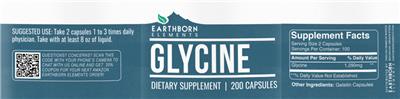
Suggested use: Take 2 capsules 1 to 3 times daily physician. Take with at least 8 oz of liquid.
General Statements
Questions? Concerns? Scan this code with your phone's camera to chat with us online and get 20% coupon for your next Amazon Earthborn Elements order!
FDA Statement of Identity
Dietary Supplement
Is this label outdated? Report a formula or label change and our pharmacy team will review it.
Glycine by Earthborn Elements label
The label scan from the NIH Dietary Supplement Label Database. Tap to enlarge.
Label images are published by the NIH Dietary Supplement Label Database for the version of this product on file. Always read your actual product label.
View the full label (PDF)The Ingredients in Glycine by Earthborn Elements
This is the 1 active ingredient this product is made of. Select it to open its full monograph.
Serving size2 Capsule(s) Dosage formCapsule Servings per container100 Amounts shown are per serving.
Glycine
Interacts with1 drug
Glycine is a non-essential amino acid your body makes on its own and that also appears in protein-rich foods. It is most studied for improving sleep q...
Glycine monograph & interactionsOther (inactive) ingredients: Gelatin. These complete the product’s ingredient list but are not active constituents.
Glycine by Earthborn Elements Drug Interactions
HelloPharmacist Interaction Report
Earthborn Elements Glycine has one documented interaction we need to flag.
Glycine may decrease how well clozapine (Clozaril) works for schizophrenia — a Moderate severity interaction. One small clinical study in patients with schizophrenia showed that adding glycine to clozapine actually worsened their symptoms compared to taking clozapine alone, though we don't yet know exactly why this happens.
Read the full breakdown — every affected drug type, severity by severity
If you take clozapine, don't add this supplement without talking to your doctor or pharmacist first. We've checked the ingredient thoroughly, and this is the only medication interaction documented in our data for it.
Check your own medications below · Editorial policy · How we use AI
Want to check YOUR meds against Glycine?
Ask about interactions with your drugs in plain English — “Can I take it with lisinopril?” — and we find you the answer in seconds, ingredient by ingredient.
Go to the checkerIngredients driving the most interactions
Individual Drug Interactions
The ingredients in Glycine interact with 1 drug. Click any drug to see the details.
1 of the 1 ingredient in Glycine interact with drugs. Each result below shows which ingredient is responsible. Glycine
ClozapineClozaril, Versacloz
How Clozapine interacts with Glycine — through 1 ingredient. Tap an ingredient for the detail:
GlycineClozapine (clozaril) Moderate
Interaction Summary
Theoretically, glycine might decrease the effectiveness of clozapine.
Read the full Glycine + Clozapine interactionEach ingredient & the kinds of drugs it affects
For each ingredient in Glycine with known interactions, here are the types of medications it can affect. Open any type for the detail — or search your exact drug in the checker above.
Glycine
Clozapine (Clozaril)
Theoretically, glycine might decrease the effectiveness of clozapine.
One small clinical study in patients with schizophrenia shows that adding glycine to clozapine therapy worsens symptoms of schizophrenia when compared with clozapine alone. The mechanism of this interaction is unclear.
Brand information
Manufacturer and brand details for Glycine, from the product label.
Earthborn Elements
See all Earthborn Elements products- Name
- Earthborn Elements
- Street Address
- 9450 SW Gemini Dr #49936
- City
- Beaverton
- State
- Oregon
- ZipCode
- 97008
- Web Address
- Earthbornelements.com
Glycine by Earthborn Elements: Common Questions
Does Glycine by Earthborn Elements interact with any medications?
How can one product interact with so many drugs?
Where does this information come from?
What is glycine used for?
Are there any side effects?
Is it safe during pregnancy or while breastfeeding?
What's in each capsule besides glycine?
How long can I take this?
Written and reviewed by the HelloPharmacist editorial staff. Our editorial policy
Not sure if Glycine is safe with your meds?
Our pharmacists answer your medication & supplement questions — free.
Label information is sourced from the NIH Dietary Supplement Label Database and reflects the product version on file; always read your actual product label. This page is for education only and is not a substitute for professional medical advice. Confirm with your pharmacist or doctor before combining supplements and medications.
The Full Monographs Behind Glycine’s Ingredients
Every ingredient we hold a full HelloPharmacist monograph for — uses, evidence, safety, and the complete interaction list.
Sources & How We Checked
Glycine's label data comes from the NIH Dietary Supplement Label Database; the ingredient interaction data is from the Natural Medicines database, reviewed by our pharmacists.
- NIH Dietary Supplement Label Database (DSLD) — The official product label on file for this supplement.
- Natural Medicines (Therapeutic Research Center) — Evidence-graded clinical reference behind the ingredient interaction data.
Content is written and reviewed by licensed HelloPharmacist pharmacists. See our data sources and editorial standards for how this information is built and checked.
The 5 references behind this product’s interaction data
Every citation that drives the interaction findings for this product’s ingredients, from the evidence-graded Natural Medicines (TRC Healthcare) database. Open an ingredient to browse its citations — links open the study on PubMed or the publisher’s site.
Glycine 5 references
- Heresco-Levy U, Javitt DC, Ermilov M, et al. Efficacy of high-dose glycine in the treatment of enduring negative symptoms of schizophrenia. Arch Gen Psychiatry 1999;56:29-36.. PubMed
- Potkin SG, Jin Y, Bunney BG, Costa J, Gulasekaram B. Effect of clozapine and adjunctive high-dose glycine in treatment-resistant schizophrenia. Am J Psychiatry 1999;156:145-7.. PubMed
- Gusev EI, Skvortsova VI, Dambinova SA, et al. Neuroprotective effects of glycine for therapy of acute ischaemic stroke. Cerebrovasc Dis 2000;10:49-60. PubMed
- Inagawa K, Kawai N, Ono K, Sukegawa E, Tsubuku S, Takahashi M. Assessment of acute adverse effects of glycine ingestion at a high dose in human volunteers. Seikatsu Eisei. 2006; 50:27-32.
- Woods SW, Walsh BC, Hawkins KA, Miller TJ, Saksa JR, D'Souza DC, Pearlson GD, Javitt DC, McGlashan TH, Krystal JH. Glycine treatment of the risk syndrome for psychosis: report of two pilot studies. Eur Neuropsychopharmacol. 2013 Aug;23(8):931-40. PubMed
Parts of this content are provided by the Therapeutic Research Center, LLC.
DISCLAIMER: Currently this does not check for drug-drug interactions. This is not an all-inclusive comprehensive list of potential interactions and is for informational purposes only. Not all interactions are known or well-reported in the scientific literature, and new interactions are continually being reported. Input is needed from a qualified healthcare provider including a pharmacist before starting any therapy. Application of clinical judgment is necessary.
© 2021 Therapeutic Research Center, LLC