
Ionic Cobalt Ingredients & Drug Interactions
by Good State
What is this page for?
First and foremost: checking Ionic Cobalt against your medications. The heart of this page is the interaction checker and the full interaction report — how this product’s ingredients may interact with prescription and over-the-counter medicines you may be taking.
Around that, we add a pharmacist’s high-level view of the product as a whole — what’s inside, the evidence for its stated use, how transparent the label is, and what safety data exists — so you can see the full picture in one place. It’s educational information from our licensed clinical databases and the clinical staff at HelloPharmacist — not medical advice — and we don’t sell or endorse products. Our editorial policy
Ionic Cobalt is a dietary supplement by Good State with 2 active ingredients. Its ingredients are commonly taken for anemia (historically), part of vitamin b12 nutrition, general 'energy' tonics (unproven).Based on those ingredients, 257 medications have a known interaction with it, the most serious rated moderate. The ingredients most likely to interact are Fulvic Acid. Use the checker below to test your specific medication, or read the full HelloPharmacist Interaction Report.
Check Your Meds Against Ionic Cobalt by Good State
Ask about any prescription or over-the-counter medication and we check it for interactions with Ionic Cobalt by Good State — and tell you which ingredient is responsible.
AI summaries are generated from our interaction database for education only — always confirm with your pharmacist. How we use AI
Ask the Pharmacist
A licensed pharmacist will answer your question by email — free, usually within 24 hours.
Got it — thank you!
A licensed pharmacist will answer within 24 hours. Keep an eye on your email (worth checking spam, just in case).
HelloPharmacist Scorecard of Ionic Cobalt by Good State
Our pharmacy team’s full take, with four database checks built into the cards below — a summary of what is known, not a grade of the product itself.
What’s inside
Full disclosure
Ionic Cobalt contains 2 active ingredients: cobalt and fulvic acid. Cobalt is a mineral your body uses as part of vitamin B12, though inorganic cobalt supplements (like this one) have no established benefit.
Fulvic acid is an organic compound derived from soil and decomposed plant matter. The product also contains water and sorbic acid as inactive ingredients.
Does it work?
Not established
The evidence we hold doesn't establish that this product works for any condition. Fulvic acid has been studied for respiratory tract infections, lead toxicity, eczema, fatigue, and hay fever, but the data isn't strong enough to rate it effective for any of those uses.
No effectiveness data exists for cobalt as a supplement.
How safe is it?
Well-documented data
Cobalt is generally well tolerated in small amounts for up to 90 days, but the safety data advises against it. Taking cobalt long-term or in high doses may cause serious problems including heart muscle disease, hearing loss, and vision loss — even reversible blindness and deafness have been reported in rare cases.
People on a low-protein diet, those with a thiamine deficiency, or those with low thyroid function appear to be at higher risk. Fulvic acid appears to be tolerated in the short term, though high-quality safety data in humans is limited; a small number of trial participants experienced headache, diarrhea, or sore throat.
One rare serious adverse effect called Kashin-Beck bone disease has been reported. The safety data advises against cobalt during pregnancy because of toxicity concerns and lack of safety data, and advises against it while breastfeeding — rely on vitamin B12 instead.
There isn't enough safety information for fulvic acid during pregnancy or while breastfeeding; talk with your doctor or pharmacist for personalized advice.
Meds to double-check
Moderate interaction found
Before you take this product, check with your doctor or pharmacist if you use blood thinners (anticoagulants or antiplatelet drugs), immunosuppressants, or thyroid hormone therapy. Fulvic acid may reduce how well blood thinners work and interfere with thyroid and immune medication, all at Moderate severity.
The bottom line
Scorecard at a glanceFully disclosed formula with no established evidence rating for its marketed use. Moderate medication interactions have been identified, and safety information is well characterized.
Inorganic cobalt supplements have no proven benefit and carry a real risk of serious harm with long-term use or higher doses, so they're generally not recommended. Fulvic acid's effectiveness for any condition isn't established in our data, and it can interfere with blood thinners, immunosuppressants, and thyroid medications.
If you take any of those drugs — or if you're pregnant or breastfeeding — talk with your doctor or pharmacist before starting.
Educational only — not medical advice; always confirm with your pharmacist. Our editorial policy · How we use AI
Assessment coverage: 2 of 2 active ingredients matched to our full ingredient reviews (monographs). Based on the product label dated Jun 24, 2020.
This Scorecard evaluates available label information, ingredient evidence, and known medication-safety considerations. It does not independently verify product identity, purity, potency, contamination, or manufacturing quality. How these ratings are computed
General information
Key facts about Ionic Cobalt, straight from the product label.
| Brand | Good State |
|---|---|
| Barcode (UPC) | 857515003046 |
| Net contents | 8 fl. Oz.; 240 mL |
| Market status | On market |
| Date entered into DSLD | Jun 24, 2020 |
| DSLD ID | 229159 |
| Product type | Other Combinations |
| Supplement form | Liquid |
| Dietary claims / uses | Nutrient, All Other, Structure/Function |
| Intended target group(s) | Vegetarian, Adult (18 - 50 Years), Gluten Free, Dairy Free, Sugar Free |
Everything in this section is reproduced from the manufacturer’s own product label — it’s the label speaking, not HelloPharmacist. We show it so you can see exactly what the maker states; we don’t verify or endorse those statements.
Supplement Facts
The label details for Ionic Cobalt by Good State, sourced from the NIH Dietary Supplement Label Database.
Supplement Facts
| Ingredient | Amount | % DV |
|---|---|---|
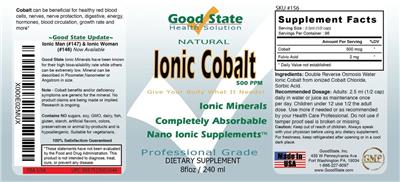
| Cobalt | 500 mcg | -- |
| Fulvic Acid | 2 mg | -- |
Other ingredients: double reverse osmosis Water, Ionic Cobalt, Sorbic Acid
Tap any ingredient to jump to its full detail below.
These statements are the manufacturer’s wording, reproduced from the product label — the label is saying it, not HelloPharmacist. We don’t verify or endorse them.
Formula
Cobalt can be beneficial for healthy red blood cells, nerves, nerve protection, digestive, energy, hormones, blood circulation, growth rate and more.
Good State ionic minerals have been known for their high bioavailability rate while others can be extremely low. Mineral can be described in Picometer, Nanometer, or Angstorm in size.
General Statements
~Good State update~ Ionic Man (#147) & Ionic Woman (#146) now available
Note - Cobalt benefits and/or deficiency symptoms are generic for the mineral. No product claims are being made or implied. Research is ongoing.
100% satisfaction guaranteed
FBA USA
Natural 500 ppm
Give your body what it needs!
Ionic minerals Completely absorbable Nano ionic supplements
Professional grade
X000E02MUX
Health Solution
Formulation
Contains no sugars, soy, GMO, dairy, fish, gluten, starch, artificial flavors, colors, preservatives, or animal by-products and is hypoallergenic.
Suitable for vegetarians.
FDA Disclaimer Statement
These statements have not been evaluated by the Food and Drug Administration. This product is not intended to diagnose, treat, cure, or prevent any disease.
FDA Statement of Identity
Dietary Supplement
Suggested/Recommended/Usage/Directions
Recommended Dosage: Adults: 2.5ml (1/2 cap) daily in water or juice as maintenance once per day. Children under 12 use 1/2 adult dose. Use more if needed or as recommended by your health care professional.
Precautions
Do not use if tamper evident seal is broken or missing.
Caution: Keep out of reach of children.
Always speak with your physician before using any dietary supplement.
Storage
For freshness, keep refrigerated after opening or in cool dark place.
Seals/Symbols
Made in USA GMP Good Manufacturing Practices
Is this label outdated? Report a formula or label change and our pharmacy team will review it.
Ionic Cobalt by Good State label
The label scan from the NIH Dietary Supplement Label Database. Tap to enlarge.
Label images are published by the NIH Dietary Supplement Label Database for the version of this product on file. Always read your actual product label.
View the full label (PDF)The Ingredients in Ionic Cobalt by Good State
These are the 2 active ingredients this product is made of. Select any to open its full monograph.
Serving size1.25 mL Dosage formLiquid Servings per container96 Amounts shown are per serving.
Most supplement products combine several ingredients, and a medication can interact with the product through any one of them. Each ingredient below shows whether it has known drug interactions.
Cobalt
No knowninteractions
Cobalt is a trace element that the body only needs as part of vitamin B12 (cobalamin); there is no proven reason to take inorganic cobalt supplements,...
Cobalt monograph & interactionsFulvic Acid
Interacts with257 drugs
Fulvic acid is a natural compound formed when plants and microbes break down in soil, and it is sold as a supplement for energy, gut, and overall well...
Fulvic Acid monograph & interactionsOther (inactive) ingredients: Double reverse osmosis Water, Ionic Cobalt, Sorbic Acid. These complete the product’s ingredient list but are not active constituents.
Ionic Cobalt by Good State Drug Interactions
HelloPharmacist Interaction Report
Ionic Cobalt by Good State contains cobalt and fulvic acid.
Fulvic acid interacts with blood thinners (anticoagulants and antiplatelet drugs), immunosuppressants, and thyroid hormones — the most serious concern is a Moderate risk that fulvic acid may reduce how well blood thinners work, increasing the chance of clot formation. Cobalt itself has no documented medication interactions in our data.
Read the full breakdown — every affected drug type, severity by severity
Fulvic acid may also weaken immunosuppressive therapy (Moderate severity) by stimulating your immune system, potentially reducing the effect of medications given to prevent organ rejection or manage autoimmune conditions. Additionally, fulvic acid may interfere with thyroid hormone therapy (Moderate severity) by raising thyroid-stimulating hormone (TSH) levels and shifting the balance of thyroid hormones.
Altogether, these interactions span 257 individual medications. If you take any blood thinner, immunosuppressant, or thyroid hormone medication, run your exact prescriptions through the interaction checker on this page before starting this product.
Check your own medications below · Editorial policy · How we use AI
Want to check YOUR meds against Ionic Cobalt?
Ask about interactions with your drugs in plain English — “Can I take it with lisinopril?” — and we find you the answer in seconds, ingredient by ingredient.
Go to the checkerIngredients driving the most interactions
Individual Drug Interactions
The ingredients in Ionic Cobalt interact with 257 drugs. Click any drug to see the details.
1 of the 2 ingredients in Ionic Cobalt interact with drugs. Each result below shows which ingredient is responsible. Fulvic Acid
Aspirin, ButalbitalAxotal
How Aspirin, Butalbital interacts with Ionic Cobalt — through 1 ingredient. Tap an ingredient for the detail:
Fulvic AcidAnticoagulant/antiplatelet Drugs Moderate
Interaction Summary
Theoretically, taking fulvic acid may decrease the effectiveness of anticoagulant and antiplatelet drugs.
Read the full Fulvic Acid + Aspirin, Butalbital interactionAspirin, Butalbital, CaffeineFiorinal
How Aspirin, Butalbital, Caffeine interacts with Ionic Cobalt — through 1 ingredient. Tap an ingredient for the detail:
Fulvic AcidAnticoagulant/antiplatelet Drugs Moderate
Interaction Summary
Theoretically, taking fulvic acid may decrease the effectiveness of anticoagulant and antiplatelet drugs.
Read the full Fulvic Acid + Aspirin, Butalbital, Caffeine interactionAspirin, Butalbital, Caffeine, Codeine PhosphateFiorinal w/ Codeine
How Aspirin, Butalbital, Caffeine, Codeine Phosphate interacts with Ionic Cobalt — through 1 ingredient. Tap an ingredient for the detail:
Fulvic AcidAnticoagulant/antiplatelet Drugs Moderate
Interaction Summary
Theoretically, taking fulvic acid may decrease the effectiveness of anticoagulant and antiplatelet drugs.
Read the full Fulvic Acid + Aspirin, Butalbital, Caffeine, Codeine Phosphate interactionAspirin, Butalbital, Caffeine, PhenacetinMarnal
How Aspirin, Butalbital, Caffeine, Phenacetin interacts with Ionic Cobalt — through 1 ingredient. Tap an ingredient for the detail:
Fulvic AcidAnticoagulant/antiplatelet Drugs Moderate
Interaction Summary
Theoretically, taking fulvic acid may decrease the effectiveness of anticoagulant and antiplatelet drugs.
Read the full Fulvic Acid + Aspirin, Butalbital, Caffeine, Phenacetin interactionAspirin, CaffeineAnacin
How Aspirin, Caffeine interacts with Ionic Cobalt — through 1 ingredient. Tap an ingredient for the detail:
Fulvic AcidAnticoagulant/antiplatelet Drugs Moderate
Interaction Summary
Theoretically, taking fulvic acid may decrease the effectiveness of anticoagulant and antiplatelet drugs.
Read the full Fulvic Acid + Aspirin, Caffeine interactionAspirin, Caffeine, Codeine PhosphateAnacin w/ Codeine
How Aspirin, Caffeine, Codeine Phosphate interacts with Ionic Cobalt — through 1 ingredient. Tap an ingredient for the detail:
Fulvic AcidAnticoagulant/antiplatelet Drugs Moderate
Interaction Summary
Theoretically, taking fulvic acid may decrease the effectiveness of anticoagulant and antiplatelet drugs.
Read the full Fulvic Acid + Aspirin, Caffeine, Codeine Phosphate interactionAspirin, Caffeine, Dihydrocodeine BitartrateSynalgos DC
How Aspirin, Caffeine, Dihydrocodeine Bitartrate interacts with Ionic Cobalt — through 1 ingredient. Tap an ingredient for the detail:
Fulvic AcidAnticoagulant/antiplatelet Drugs Moderate
Interaction Summary
Theoretically, taking fulvic acid may decrease the effectiveness of anticoagulant and antiplatelet drugs.
Read the full Fulvic Acid + Aspirin, Caffeine, Dihydrocodeine Bitartrate interactionAspirin, Caffeine, Dover's PwdAcedoval, Dovacet
How Aspirin, Caffeine, Dover's Pwd interacts with Ionic Cobalt — through 1 ingredient. Tap an ingredient for the detail:
Fulvic AcidAnticoagulant/antiplatelet Drugs Moderate
Interaction Summary
Theoretically, taking fulvic acid may decrease the effectiveness of anticoagulant and antiplatelet drugs.
Read the full Fulvic Acid + Aspirin, Caffeine, Dover's Pwd interactionAspirin, Caffeine, HydrocodoneDamason-P
How Aspirin, Caffeine, Hydrocodone interacts with Ionic Cobalt — through 1 ingredient. Tap an ingredient for the detail:
Fulvic AcidAnticoagulant/antiplatelet Drugs Moderate
Interaction Summary
Theoretically, taking fulvic acid may decrease the effectiveness of anticoagulant and antiplatelet drugs.
Read the full Fulvic Acid + Aspirin, Caffeine, Hydrocodone interactionAspirin, Caffeine, Isobutylallylbarbituric Acid, PhenacetinLanorinal
How Aspirin, Caffeine, Isobutylallylbarbituric Acid, Phenacetin interacts with Ionic Cobalt — through 1 ingredient. Tap an ingredient for the detail:
Fulvic AcidAnticoagulant/antiplatelet Drugs Moderate
Interaction Summary
Theoretically, taking fulvic acid may decrease the effectiveness of anticoagulant and antiplatelet drugs.
Read the full Fulvic Acid + Aspirin, Caffeine, Isobutylallylbarbituric Acid, Phenacetin interactionAspirin, Caffeine, OrphenadrineInvagesic, Invagesic Forte, Norgesic, Norgesic Forte, Orphengesic, Orphengesic Forte
How Aspirin, Caffeine, Orphenadrine interacts with Ionic Cobalt — through 1 ingredient. Tap an ingredient for the detail:
Fulvic AcidAnticoagulant/antiplatelet Drugs Moderate
Interaction Summary
Theoretically, taking fulvic acid may decrease the effectiveness of anticoagulant and antiplatelet drugs.
Read the full Fulvic Acid + Aspirin, Caffeine, Orphenadrine interactionAspirin, Caffeine, Phenacetin, PropoxypheneMargesic Comp. 65
How Aspirin, Caffeine, Phenacetin, Propoxyphene interacts with Ionic Cobalt — through 1 ingredient. Tap an ingredient for the detail:
Fulvic AcidAnticoagulant/antiplatelet Drugs Moderate
Interaction Summary
Theoretically, taking fulvic acid may decrease the effectiveness of anticoagulant and antiplatelet drugs.
Read the full Fulvic Acid + Aspirin, Caffeine, Phenacetin, Propoxyphene interactionAspirin, Calcium Carbonate, Magnesium Carbonate, Magnesium OxideBufferin
How Aspirin, Calcium Carbonate, Magnesium Carbonate, Magnesium Oxide interacts with Ionic Cobalt — through 1 ingredient. Tap an ingredient for the detail:
Fulvic AcidAnticoagulant/antiplatelet Drugs Moderate
Interaction Summary
Theoretically, taking fulvic acid may decrease the effectiveness of anticoagulant and antiplatelet drugs.
Read the full Fulvic Acid + Aspirin, Calcium Carbonate, Magnesium Carbonate, Magnesium Oxide interactionAspirin, CarisoprodolSoma Compound
How Aspirin, Carisoprodol interacts with Ionic Cobalt — through 1 ingredient. Tap an ingredient for the detail:
Fulvic AcidAnticoagulant/antiplatelet Drugs Moderate
Interaction Summary
Theoretically, taking fulvic acid may decrease the effectiveness of anticoagulant and antiplatelet drugs.
Read the full Fulvic Acid + Aspirin, Carisoprodol interactionAspirin, Carisoprodol, Codeine PhosphateSoma Compound w/ Codeine
How Aspirin, Carisoprodol, Codeine Phosphate interacts with Ionic Cobalt — through 1 ingredient. Tap an ingredient for the detail:
Fulvic AcidAnticoagulant/antiplatelet Drugs Moderate
Interaction Summary
Theoretically, taking fulvic acid may decrease the effectiveness of anticoagulant and antiplatelet drugs.
Read the full Fulvic Acid + Aspirin, Carisoprodol, Codeine Phosphate interactionAspirin, Chlorpheniramine, PhenylpropanolamineAlka-Seltzer Plus Cold
How Aspirin, Chlorpheniramine, Phenylpropanolamine interacts with Ionic Cobalt — through 1 ingredient. Tap an ingredient for the detail:
Fulvic AcidAnticoagulant/antiplatelet Drugs Moderate
Interaction Summary
Theoretically, taking fulvic acid may decrease the effectiveness of anticoagulant and antiplatelet drugs.
Read the full Fulvic Acid + Aspirin, Chlorpheniramine, Phenylpropanolamine interactionAspirin, Citric Acid, Sodium BicarbonateAlka-Seltzer Pain Reliever and Antacid
How Aspirin, Citric Acid, Sodium Bicarbonate interacts with Ionic Cobalt — through 1 ingredient. Tap an ingredient for the detail:
Fulvic AcidAnticoagulant/antiplatelet Drugs Moderate
Interaction Summary
Theoretically, taking fulvic acid may decrease the effectiveness of anticoagulant and antiplatelet drugs.
Read the full Fulvic Acid + Aspirin, Citric Acid, Sodium Bicarbonate interactionAspirin, Codeine PhosphateAspirin w/ Codeine
How Aspirin, Codeine Phosphate interacts with Ionic Cobalt — through 1 ingredient. Tap an ingredient for the detail:
Fulvic AcidAnticoagulant/antiplatelet Drugs Moderate
Interaction Summary
Theoretically, taking fulvic acid may decrease the effectiveness of anticoagulant and antiplatelet drugs.
Read the full Fulvic Acid + Aspirin, Codeine Phosphate interactionAspirin, Codeine Phosphate, MethocarbamolRobaxisal C
How Aspirin, Codeine Phosphate, Methocarbamol interacts with Ionic Cobalt — through 1 ingredient. Tap an ingredient for the detail:
Fulvic AcidAnticoagulant/antiplatelet Drugs Moderate
Interaction Summary
Theoretically, taking fulvic acid may decrease the effectiveness of anticoagulant and antiplatelet drugs.
Read the full Fulvic Acid + Aspirin, Codeine Phosphate, Methocarbamol interactionAspirin, Codeine Phosphate, PhenobarbitalPhenaphen
How Aspirin, Codeine Phosphate, Phenobarbital interacts with Ionic Cobalt — through 1 ingredient. Tap an ingredient for the detail:
Fulvic AcidAnticoagulant/antiplatelet Drugs Moderate
Interaction Summary
Theoretically, taking fulvic acid may decrease the effectiveness of anticoagulant and antiplatelet drugs.
Read the full Fulvic Acid + Aspirin, Codeine Phosphate, Phenobarbital interactionAspirin, Diphenhydramine, PhenylpropanolamineAlka Seltzer Plus Night Time Effervescent
How Aspirin, Diphenhydramine, Phenylpropanolamine interacts with Ionic Cobalt — through 1 ingredient. Tap an ingredient for the detail:
Fulvic AcidAnticoagulant/antiplatelet Drugs Moderate
Interaction Summary
Theoretically, taking fulvic acid may decrease the effectiveness of anticoagulant and antiplatelet drugs.
Read the full Fulvic Acid + Aspirin, Diphenhydramine, Phenylpropanolamine interactionAspirin, DipyridamoleAggrenox, Asasantin Retard
How Aspirin, Dipyridamole interacts with Ionic Cobalt — through 1 ingredient. Tap an ingredient for the detail:
Fulvic AcidAnticoagulant/antiplatelet Drugs Moderate
Interaction Summary
Theoretically, taking fulvic acid may decrease the effectiveness of anticoagulant and antiplatelet drugs.
Read the full Fulvic Acid + Aspirin, Dipyridamole interactionAspirin, Ethoheptazine, MeprobamateEquagesic
How Aspirin, Ethoheptazine, Meprobamate interacts with Ionic Cobalt — through 1 ingredient. Tap an ingredient for the detail:
Fulvic AcidAnticoagulant/antiplatelet Drugs Moderate
Interaction Summary
Theoretically, taking fulvic acid may decrease the effectiveness of anticoagulant and antiplatelet drugs.
Read the full Fulvic Acid + Aspirin, Ethoheptazine, Meprobamate interactionAspirin, HydrocodoneAlor 5 500, Lortab ASA
How Aspirin, Hydrocodone interacts with Ionic Cobalt — through 1 ingredient. Tap an ingredient for the detail:
Fulvic AcidAnticoagulant/antiplatelet Drugs Moderate
Interaction Summary
Theoretically, taking fulvic acid may decrease the effectiveness of anticoagulant and antiplatelet drugs.
Read the full Fulvic Acid + Aspirin, Hydrocodone interactionAspirin, MeprobamateMicrainin
How Aspirin, Meprobamate interacts with Ionic Cobalt — through 1 ingredient. Tap an ingredient for the detail:
Fulvic AcidAnticoagulant/antiplatelet Drugs Moderate
Interaction Summary
Theoretically, taking fulvic acid may decrease the effectiveness of anticoagulant and antiplatelet drugs.
Read the full Fulvic Acid + Aspirin, Meprobamate interactionAspirin, MethocarbamolRobaxisal
How Aspirin, Methocarbamol interacts with Ionic Cobalt — through 1 ingredient. Tap an ingredient for the detail:
Fulvic AcidAnticoagulant/antiplatelet Drugs Moderate
Interaction Summary
Theoretically, taking fulvic acid may decrease the effectiveness of anticoagulant and antiplatelet drugs.
Read the full Fulvic Acid + Aspirin, Methocarbamol interactionAspirin, OmeprazoleYosprala
How Aspirin, Omeprazole interacts with Ionic Cobalt — through 1 ingredient. Tap an ingredient for the detail:
Fulvic AcidAnticoagulant/antiplatelet Drugs Moderate
Interaction Summary
Theoretically, taking fulvic acid may decrease the effectiveness of anticoagulant and antiplatelet drugs.
Read the full Fulvic Acid + Aspirin, Omeprazole interactionAspirin, OxycodonePercodan
How Aspirin, Oxycodone interacts with Ionic Cobalt — through 1 ingredient. Tap an ingredient for the detail:
Fulvic AcidAnticoagulant/antiplatelet Drugs Moderate
Interaction Summary
Theoretically, taking fulvic acid may decrease the effectiveness of anticoagulant and antiplatelet drugs.
Read the full Fulvic Acid + Aspirin, Oxycodone interactionAspirin, PentazocineTalwin Compound
How Aspirin, Pentazocine interacts with Ionic Cobalt — through 1 ingredient. Tap an ingredient for the detail:
Fulvic AcidAnticoagulant/antiplatelet Drugs Moderate
Interaction Summary
Theoretically, taking fulvic acid may decrease the effectiveness of anticoagulant and antiplatelet drugs.
Read the full Fulvic Acid + Aspirin, Pentazocine interactionAtezolizumabTecentriq
How Atezolizumab interacts with Ionic Cobalt — through 1 ingredient. Tap an ingredient for the detail:
Fulvic AcidImmunosuppressants Moderate
Interaction Summary
Theoretically, taking fulvic acid might decrease the effects of immunosuppressive therapy.
Read the full Fulvic Acid + Atezolizumab interactionEach ingredient & the kinds of drugs it affects
For each ingredient in Ionic Cobalt with known interactions, here are the types of medications it can affect. Open any type for the detail — or search your exact drug in the checker above.
Fulvic Acid
Anticoagulant/Antiplatelet Drugs
Theoretically, taking fulvic acid may decrease the effectiveness of anticoagulant and antiplatelet drugs.
In vitro evidence shows that fulvic acid, formed from the oxidation and polymerization of protocatechuic acid, can shorten prothrombin time in human plasma, increasing the risk of clot formation.
Immunosuppressants
Theoretically, taking fulvic acid might decrease the effects of immunosuppressive therapy.
Animal research shows that fulvic acid stimulates immune function.
Thyroid Hormone
Theoretically, taking fulvic acid with thyroid hormone therapy might interfere with the ability to normalize thyroid function.
Animal research shows that fulvic acid increases the plasma level of thyroid-stimulating hormone (TSH) and decreases the thyroxine (T4):triiodothyronine (T3) ratio.
Brand information
Manufacturer and brand details for Ionic Cobalt, from the product label.
Good State
- Name
- GoodState, Inc.
- Street Address
- 435 W Pennsylvania Ave
- City
- Fort Washington
- State
- PA
- ZipCode
- 19034
- Phone Number
- 1-866-227-6097
- Web Address
- www.GoodState.com
Ionic Cobalt by Good State: Common Questions
Does Ionic Cobalt by Good State interact with any medications?
How can one product interact with so many drugs?
Where does this information come from?
What is fulvic acid and what does it do?
Is cobalt safe to take long-term?
Can I take this while pregnant or breastfeeding?
What side effects might I get from this product?
Can I take this if I'm on a blood thinner?
Written and reviewed by the HelloPharmacist editorial staff. Our editorial policy
Not sure if Ionic Cobalt is safe with your meds?
Our pharmacists answer your medication & supplement questions — free.
Label information is sourced from the NIH Dietary Supplement Label Database and reflects the product version on file; always read your actual product label. This page is for education only and is not a substitute for professional medical advice. Confirm with your pharmacist or doctor before combining supplements and medications.
The Full Monographs Behind Ionic Cobalt’s Ingredients
Every ingredient we hold a full HelloPharmacist monograph for — uses, evidence, safety, and the complete interaction list.
Cobalt
Cobalt is a trace element that the body only needs as part of vitamin B12 (cobalamin); there is no proven reason to take inorganic cobalt supplements, and doing so can be harmful. If you nee...
Read the full Cobalt monograph → Herb & supplement monographFulvic Acid
Interacts with 257 drugsFulvic acid is a natural compound formed when plants and microbes break down in soil, and it is sold as a supplement for energy, gut, and overall wellness. Human research is very limited, so...
Read the full Fulvic Acid monograph →Sources & How We Checked
Ionic Cobalt's label data comes from the NIH Dietary Supplement Label Database; the ingredient interaction data is from the Natural Medicines database, reviewed by our pharmacists.
- NIH Dietary Supplement Label Database (DSLD) — The official product label on file for this supplement.
- Natural Medicines (Therapeutic Research Center) — Evidence-graded clinical reference behind the ingredient interaction data.
Content is written and reviewed by licensed HelloPharmacist pharmacists. See our data sources and editorial standards for how this information is built and checked.
The 14 references behind this product’s interaction data
Every citation that drives the interaction findings for this product’s ingredients, from the evidence-graded Natural Medicines (TRC Healthcare) database. Open an ingredient to browse its citations — links open the study on PubMed or the publisher’s site.
Cobalt 11 references
- Packer M. Cobalt cardiomyopathy: a critical reappraisal in light of a recent resurgence. Circ Heart Fail 2016;9(12). pii: e003604. PubMed
- Adams TN, Butt YM, Batra K, Glazer CS. Cobalt related interstitial lung disease. Respir Med 2017;129:91-7. PubMed
- Lim CA, Khan J, Chelva E, Khan R, Unsworth-Smith T. The effect of cobalt on the human eye. Doc Ophthalmol 2015;130(1):43-8. PubMed
- Guarneri F, Guarneri C, Cannavò SP. Nail-art and cobalt allergy. Contact Dermatitis 2010;62(5):320-1. PubMed
- Fowler JF Jr. Cobalt. Dermatitis 2016;27(1):3-8.
- Zajdel NJ, Smith WA, Taintor AR, Jacob SE, Olasz EB. Chemical tattoo treatment leading to systemic cobalt hypersensitivity. Skinmed 2017;15(3):221-2.
- Bregnbak D, Opstrup MS, Jellesen MS, Johansen JD, Thyssen JP. Allergic contact dermatitis caused by cobalt in leather - clinical cases. Contact Dermatitis 2017;76(6):366-8. PubMed
- Simonsen AB, Friis UF, Johansen JD, Zachariae C, Sloth JJ, Thyssen JP. Occupational allergic contact dermatitis caused by cobalt in machine oil. Contact Dermatitis 2019;80(1):59-61. PubMed
- Paustenbach DJ, Galbraith DA, Finley BL. Interpreting cobalt blood concentrations in hip implant patients. Clin Toxicol (Phila) 2014;52(2):98-112. PubMed
- Zywiel MG, Cherian JJ, Banerjee S, et al. Systemic cobalt toxicity from total hip arthroplasties: review of a rare condition Part 2. measurement, risk factors, and step-wise approach to treatment. Bone Joint J 2016;98-B(1):14-20. PubMed
- Catalani S, Rizzetti MC, Padovani A, Apostoli P. Neurotoxicity of cobalt. Hum Exp Toxicol 2012;31(5):421-37. PubMed
Fulvic Acid 3 references
- Lu, FJ. Arsenic as a promoter in the effect of humic substances on plasma prothrombin time in vitro. Thromb Res 6-15-1990;58(6):537-541. PubMed
- Vucskits, AV, Hullar, I, Bersenyi, A, Andrasofszky, E, Kulcsar, M, Szabo, J. Effect of fulvic and humic acids on performance, immune response and thyroid function in rats. J Anim Physiol Anim Nutr (Berl) 2010;94(6):721-728. PubMed
- Gandy JJ, Meeding JP, Snyman JR, et al. Phase 1 clinical study of the acute and subacute safety and proof-of-concept efficacy of carbohydrate-derived fulvic acid. Clin Pharmacol. 2012;4:7-11. PubMed
Parts of this content are provided by the Therapeutic Research Center, LLC.
DISCLAIMER: Currently this does not check for drug-drug interactions. This is not an all-inclusive comprehensive list of potential interactions and is for informational purposes only. Not all interactions are known or well-reported in the scientific literature, and new interactions are continually being reported. Input is needed from a qualified healthcare provider including a pharmacist before starting any therapy. Application of clinical judgment is necessary.
© 2021 Therapeutic Research Center, LLC