
L-Tryptophan 500 mg Ingredients & Drug Interactions
by Nutricost
What is this page for?
First and foremost: checking L-Tryptophan 500 mg against your medications. The heart of this page is the interaction checker and the full interaction report — how this product’s ingredients may interact with prescription and over-the-counter medicines you may be taking.
Around that, we add a pharmacist’s high-level view of the product as a whole — what’s inside, the evidence for its stated use, how transparent the label is, and what safety data exists — so you can see the full picture in one place. It’s educational information from our licensed clinical databases and the clinical staff at HelloPharmacist — not medical advice — and we don’t sell or endorse products. Our editorial policy
L-Tryptophan 500 mg is a dietary supplement by Nutricost with 2 active ingredients. Its ingredients are commonly taken for sleep problems, low mood and depression, anxiety.Based on those ingredients, 1,156 medications have a known interaction with it, the most serious rated major. The ingredients most likely to interact are Bioperine, L-Tryptophan. Use the checker below to test your specific medication, or read the full HelloPharmacist Interaction Report.
Check Your Meds Against L-Tryptophan 500 mg by Nutricost
Ask about any prescription or over-the-counter medication and we check it for interactions with L-Tryptophan 500 mg by Nutricost — and tell you which ingredient is responsible.
AI summaries are generated from our interaction database for education only — always confirm with your pharmacist. How we use AI
Ask the Pharmacist
A licensed pharmacist will answer your question by email — free, usually within 24 hours.
Got it — thank you!
A licensed pharmacist will answer within 24 hours. Keep an eye on your email (worth checking spam, just in case).
HelloPharmacist Scorecard of L-Tryptophan 500 mg by Nutricost
Our pharmacy team’s full take, with four database checks built into the cards below — a summary of what is known, not a grade of the product itself.
What’s inside
Full disclosure
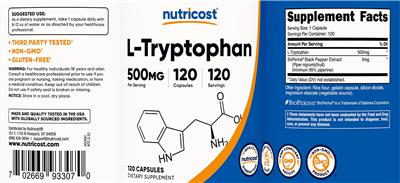
This product contains two active ingredients: L-tryptophan (500 mg per capsule), an amino acid your body uses to make serotonin, and Bioperine (black pepper extract), often added to supplements to enhance absorption. The capsule itself is made of gelatin and contains rice flour, silicon dioxide, and magnesium stearate as inactive ingredients to hold it together.
Does it work?
Couldn't assess
L-tryptophan's evidence is mixed. For depression, it's been rated possibly ineffective — meaning the evidence doesn't support it working for that use.
For anxiety, athletic performance, jaw clenching (bruxism), and premenstrual dysphoric disorder, we don't have enough reliable evidence to say whether it helps or doesn't. Bioperine (black pepper) has insufficient evidence for hay fever, asthma, athletic performance, headache, depression, and diarrhea, so we can't claim benefit for those uses either.
How safe is it?
Well-documented data
L-tryptophan is generally well tolerated, but side effects do occur — belching, diarrhea, drowsiness, dry mouth, gas, headache, heartburn, lightheadedness, nausea, stomach pain, blurred vision, and vomiting are the most common. There's an important historical note: in 1989, a batch of L-tryptophan from a single Japanese manufacturer was contaminated and linked to over 1,500 cases of a serious neurological disorder called eosinophilia-myalgia syndrome (EMS).
Almost all cases traced back to that one source, and the FDA restricted L-tryptophan imports afterward; modern products should be safe, but this history means caution is warranted. Bioperine (black pepper) is generally well tolerated at food amounts but can cause burning aftertaste, indigestion, and reduced taste perception; rarely, allergic reactions occur.
Pregnancy and breastfeeding safety data for L-tryptophan is not on file, so there isn't enough information to know either way — talk with your doctor or pharmacist for personalized advice. We hold no pregnancy or breastfeeding data for Bioperine either.
Meds to double-check
Major interaction found
Check before taking this product if you use CNS depressants (sleeping pills, anti-anxiety drugs, pain relievers, alcohol) — L-tryptophan can add to drowsiness and sedation (Major interaction). Also double-check serotonergic antidepressants and other serotonin-active drugs (Moderate).
The Bioperine in this product may raise blood levels of propranolol, nevirapine, rifampin, phenytoin, cyclosporine, pentobarbital, atorvastatin, and theophylline — all Moderate interactions. Use the medication checker on this page with your exact drug names.
The bottom line
Scorecard at a glanceFully disclosed formula with no assessable stated purpose. Major medication interactions have been identified, and safety information is well characterized.
L-Tryptophan may be worth considering if you're looking to support mood, but evidence for depression is weak and anxiety data is limited. The main concern is interaction with sedating medications and antidepressants, plus the historical contamination scare — modern batches should be safer, but that history is real.
If you take blood pressure, heart, seizure, immune, cholesterol, or breathing medications, or any antidepressant or sleep aid, check with your pharmacist before starting.
Educational only — not medical advice; always confirm with your pharmacist. Our editorial policy · How we use AI
Assessment coverage: 2 of 2 active ingredients matched to our full ingredient reviews (monographs). Based on the product label dated Oct 24, 2024.
This Scorecard evaluates available label information, ingredient evidence, and known medication-safety considerations. It does not independently verify product identity, purity, potency, contamination, or manufacturing quality. How these ratings are computed
General information
Key facts about L-Tryptophan 500 mg, straight from the product label.
| Brand | Nutricost |
|---|---|
| Barcode (UPC) | 702669933070 |
| Net contents | 120 Capsule(s) |
| Market status | On market |
| Date entered into DSLD | Oct 24, 2024 |
| DSLD ID | 306325 |
| Product type | Botanical With Nutrients |
| Supplement form | Capsule |
| Dietary claims / uses | Nutrient, All Other, Structure/Function |
| Intended target group(s) | Adult (18 - 50 Years), Gluten Free |
Everything in this section is reproduced from the manufacturer’s own product label — it’s the label speaking, not HelloPharmacist. We show it so you can see exactly what the maker states; we don’t verify or endorse those statements.
Supplement Facts
The label details for L-Tryptophan 500 mg by Nutricost, sourced from the NIH Dietary Supplement Label Database.
Supplement Facts
| Ingredient | Amount | % DV |
|---|---|---|
| L-Tryptophan | 500 mg | -- |
| Bioperine | 5 mg | -- |
Other ingredients: Rice Flour, Gelatin, Silicon Dioxide, Magnesium Stearate
Tap any ingredient to jump to its full detail below.
These statements are the manufacturer’s wording, reproduced from the product label — the label is saying it, not HelloPharmacist. We don’t verify or endorse them.
Suggested/Recommended/Usage/Directions
Suggested use: As a dietary supplement, take 1 capsule daily with 8-12oz of water or as directed by your healthcare professional.
Formulation
Non-GMO Gluten-free
Made and quality tested in the USA with globally sourced ingredients.
Non-GMO product
Precautions
Warning: For healthy individuals 18 years and older. Keep out of reach of children.
Consult a healthcare professional prior to use if you are pregnant or nursing, taking medication, or have a medical condition.
Do not use if safety seal is broken or missing.
Storage
Note: Store in a cool, dry place.
Formula
L-Tryptophan 500mg per serving
FDA Statement of Identity
Dietary Supplement
Seals/Symbols
Nutricost Quality Guaranteed Third Party Tested GMP Compliant Facility
Brand IP Statement(s)
BioPerine is a Trademark of Sabinsa Corporation.
FDA Disclaimer Statement
These statements have not been evaluated by the Food and Drug Administration. This product is not intended to diagnose, treat, cure or prevent any disease.
Is this label outdated? Report a formula or label change and our pharmacy team will review it.
L-Tryptophan 500 mg by Nutricost label
The label scan from the NIH Dietary Supplement Label Database. Tap to enlarge.
Label images are published by the NIH Dietary Supplement Label Database for the version of this product on file. Always read your actual product label.
View the full label (PDF)The Ingredients in L-Tryptophan 500 mg by Nutricost
These are the 2 active ingredients this product is made of. Select any to open its full monograph.
Serving size1 Capsule(s) Dosage formCapsule Servings per container120 Amounts shown are per serving.
Most supplement products combine several ingredients, and a medication can interact with the product through any one of them. Each ingredient below shows whether it has known drug interactions.
L-Tryptophan
Interacts with394 drugs
L-tryptophan is an essential amino acid the body uses to make serotonin and melatonin, and people take it to support sleep and mood. The evidence for...
L-Tryptophan monograph & interactionsBioperine
Interacts with1,020 drugs
Black pepper is a common kitchen spice that is generally safe in the amounts used in food. Its extract, piperine, is mostly added to supplements to he...
Bioperine monograph & interactionsOther (inactive) ingredients: Rice Flour, Gelatin, Silicon Dioxide, Magnesium Stearate. These complete the product’s ingredient list but are not active constituents.
L-Tryptophan 500 mg by Nutricost Drug Interactions
HelloPharmacist Interaction Report
Nutricost L-Tryptophan 500 mg has documented interactions with two main medication types.
L-tryptophan itself carries a Major interaction with CNS depressants (sedatives, sleep aids, alcohol, opioids) — it can add to their drowsy and sedative effects. The product also contains Bioperine (black pepper extract), which interacts with eight specific medications by raising their blood levels: propranolol, nevirapine, rifampin, phenytoin, cyclosporine, pentobarbital, atorvastatin, and theophylline — all rated Moderate.
Read the full breakdown — every affected drug type, severity by severity
L-tryptophan poses a Moderate interaction with serotonergic drugs (antidepressants, certain pain or migraine medications) because it's a serotonin precursor and could amplify serotonergic side effects, including serotonin syndrome. Altogether, these interactions span 1,142 individual medications.
If you're on any blood pressure, heart, seizure, immunosuppressant, antifungal, antibiotic, cholesterol, or breathing medication — or any antidepressant or CNS depressant — run the exact drug names through the interaction checker below before starting this product. We hold no interaction data for the inactive ingredients.
Check your own medications below · Editorial policy · How we use AI
Want to check YOUR meds against L-Tryptophan 500 mg?
Ask about interactions with your drugs in plain English — “Can I take it with lisinopril?” — and we find you the answer in seconds, ingredient by ingredient.
Go to the checkerIngredients driving the most interactions
Individual Drug Interactions
The ingredients in L-Tryptophan 500 mg interact with 1,156 drugs. Click any drug to see the details.
2 of the 2 ingredients in L-Tryptophan 500 mg interact with drugs. Each result below shows which ingredient is responsible. Bioperine L-Tryptophan
AcepromazineAtravet
How Acepromazine interacts with L-Tryptophan 500 mg — through 1 ingredient. Tap an ingredient for the detail:
L-tryptophanCns Depressants Major
Interaction Summary
Theoretically, concomitant use of L-tryptophan with CNS depressants might cause additive sedative effects.
Read the full L-tryptophan + Acepromazine interactionAcetaminophen, Butalbital, Caffeine, CodeineEsgic with Codeine, Fioricet w/ Codeine
How Acetaminophen, Butalbital, Caffeine, Codeine interacts with L-Tryptophan 500 mg — through 2 ingredients. Tap an ingredient for the detail:
L-tryptophanCns Depressants Major
Interaction Summary
Theoretically, concomitant use of L-tryptophan with CNS depressants might cause additive sedative effects.
Read the full L-tryptophan + Acetaminophen, Butalbital, Caffeine, Codeine interactionBioperineCytochrome P450 1a2 (cyp1a2) Substrates, Cytochrome P450 3a4 (cyp3a4) Substrates +1 Moderate
Interaction Summary
Theoretically, black pepper might decrease levels and clinical effects of drugs metabolized by CYP1A2.
Read the full Bioperine + Acetaminophen, Butalbital, Caffeine, Codeine interactionAcetaminophen, Butalbital, CodeineBancap w/ Codeine
How Acetaminophen, Butalbital, Codeine interacts with L-Tryptophan 500 mg — through 2 ingredients. Tap an ingredient for the detail:
L-tryptophanCns Depressants Major
Interaction Summary
Theoretically, concomitant use of L-tryptophan with CNS depressants might cause additive sedative effects.
Read the full L-tryptophan + Acetaminophen, Butalbital, Codeine interactionBioperineCytochrome P450 2d6 (cyp2d6) Substrates, Cytochrome P450 1a2 (cyp1a2) Substrates Moderate
Interaction Summary
Theoretically, black pepper might increase levels of drugs metabolized by CYP2D6.
Read the full Bioperine + Acetaminophen, Butalbital, Codeine interactionAcetaminophen, Butalbital, Codeine PhosphatePhrenilin #3
How Acetaminophen, Butalbital, Codeine Phosphate interacts with L-Tryptophan 500 mg — through 2 ingredients. Tap an ingredient for the detail:
L-tryptophanCns Depressants Major
Interaction Summary
Theoretically, concomitant use of L-tryptophan with CNS depressants might cause additive sedative effects.
Read the full L-tryptophan + Acetaminophen, Butalbital, Codeine Phosphate interactionBioperineCytochrome P450 2d6 (cyp2d6) Substrates, Cytochrome P450 1a2 (cyp1a2) Substrates Moderate
Interaction Summary
Theoretically, black pepper might increase levels of drugs metabolized by CYP2D6.
Read the full Bioperine + Acetaminophen, Butalbital, Codeine Phosphate interactionAcetaminophen, Caffeine, Chlorpheniramine, Hydrocodone, PhenylephrineHycomine Compound
How Acetaminophen, Caffeine, Chlorpheniramine, Hydrocodone, Phenylephrine interacts with L-Tryptophan 500 mg — through 2 ingredients. Tap an ingredient for the detail:
L-tryptophanCns Depressants Major
Interaction Summary
Theoretically, concomitant use of L-tryptophan with CNS depressants might cause additive sedative effects.
Read the full L-tryptophan + Acetaminophen, Caffeine, Chlorpheniramine, Hydrocodone, Phenylephrine interactionBioperineCytochrome P450 1a2 (cyp1a2) Substrates, Cytochrome P450 3a4 (cyp3a4) Substrates +1 Moderate
Interaction Summary
Theoretically, black pepper might decrease levels and clinical effects of drugs metabolized by CYP1A2.
Read the full Bioperine + Acetaminophen, Caffeine, Chlorpheniramine, Hydrocodone, Phenylephrine interactionAcetaminophen, Caffeine, CodeineGesic C15, Gesic C30, Gesic C8, Lenoltec 1, Lenoltec 2, Lenoltec 3 +1 more
How Acetaminophen, Caffeine, Codeine interacts with L-Tryptophan 500 mg — through 2 ingredients. Tap an ingredient for the detail:
L-tryptophanCns Depressants Major
Interaction Summary
Theoretically, concomitant use of L-tryptophan with CNS depressants might cause additive sedative effects.
Read the full L-tryptophan + Acetaminophen, Caffeine, Codeine interactionBioperineCytochrome P450 2d6 (cyp2d6) Substrates, Cytochrome P450 1a2 (cyp1a2) Substrates +1 Moderate
Interaction Summary
Theoretically, black pepper might increase levels of drugs metabolized by CYP2D6.
Read the full Bioperine + Acetaminophen, Caffeine, Codeine interactionAcetaminophen, Caffeine, Codeine, SalicylamideCodalan No.1, Codalan No.2, Codalan No.3
How Acetaminophen, Caffeine, Codeine, Salicylamide interacts with L-Tryptophan 500 mg — through 2 ingredients. Tap an ingredient for the detail:
L-tryptophanCns Depressants Major
Interaction Summary
Theoretically, concomitant use of L-tryptophan with CNS depressants might cause additive sedative effects.
Read the full L-tryptophan + Acetaminophen, Caffeine, Codeine, Salicylamide interactionBioperineCytochrome P450 1a2 (cyp1a2) Substrates, Cytochrome P450 2d6 (cyp2d6) Substrates +1 Moderate
Interaction Summary
Theoretically, black pepper might decrease levels and clinical effects of drugs metabolized by CYP1A2.
Read the full Bioperine + Acetaminophen, Caffeine, Codeine, Salicylamide interactionAcetaminophen, Caffeine, DihydrocodeineDHC Plus, Panlor DC, Panlor SS
How Acetaminophen, Caffeine, Dihydrocodeine interacts with L-Tryptophan 500 mg — through 2 ingredients. Tap an ingredient for the detail:
L-tryptophanCns Depressants Major
Interaction Summary
Theoretically, concomitant use of L-tryptophan with CNS depressants might cause additive sedative effects.
Read the full L-tryptophan + Acetaminophen, Caffeine, Dihydrocodeine interactionBioperineCytochrome P450 3a4 (cyp3a4) Substrates, Cytochrome P450 2d6 (cyp2d6) Substrates +1 Moderate
Interaction Summary
Theoretically, black pepper might increase levels of drugs metabolized by CYP3A4.
Read the full Bioperine + Acetaminophen, Caffeine, Dihydrocodeine interactionAcetaminophen, Chlorpheniramine, Codeine, PhenylephrineColrex
How Acetaminophen, Chlorpheniramine, Codeine, Phenylephrine interacts with L-Tryptophan 500 mg — through 2 ingredients. Tap an ingredient for the detail:
L-tryptophanCns Depressants, Serotonergic Drugs Major
Interaction Summary
Theoretically, concomitant use of L-tryptophan with CNS depressants might cause additive sedative effects.
Read the full L-tryptophan + Acetaminophen, Chlorpheniramine, Codeine, Phenylephrine interactionBioperineCytochrome P450 1a2 (cyp1a2) Substrates, Cytochrome P450 3a4 (cyp3a4) Substrates +1 Moderate
Interaction Summary
Theoretically, black pepper might decrease levels and clinical effects of drugs metabolized by CYP1A2.
Read the full Bioperine + Acetaminophen, Chlorpheniramine, Codeine, Phenylephrine interactionAcetaminophen, Chlorpheniramine, Phenylpropanolamine, OpiumHista-Derfule
How Acetaminophen, Chlorpheniramine, Phenylpropanolamine, Opium interacts with L-Tryptophan 500 mg — through 2 ingredients. Tap an ingredient for the detail:
L-tryptophanSerotonergic Drugs, Cns Depressants Major
Interaction Summary
Theoretically, combining L-tryptophan with serotonergic drugs might cause additive serotonergic effects.
Read the full L-tryptophan + Acetaminophen, Chlorpheniramine, Phenylpropanolamine, Opium interactionBioperineCytochrome P450 1a2 (cyp1a2) Substrates, Cytochrome P450 3a4 (cyp3a4) Substrates Moderate
Interaction Summary
Theoretically, black pepper might decrease levels and clinical effects of drugs metabolized by CYP1A2.
Read the full Bioperine + Acetaminophen, Chlorpheniramine, Phenylpropanolamine, Opium interactionAcetaminophen, Chlorzoxazone, CodeineAcetazone Forte C8, Parafon Forte C8
How Acetaminophen, Chlorzoxazone, Codeine interacts with L-Tryptophan 500 mg — through 2 ingredients. Tap an ingredient for the detail:
L-tryptophanCns Depressants Major
Interaction Summary
Theoretically, concomitant use of L-tryptophan with CNS depressants might cause additive sedative effects.
Read the full L-tryptophan + Acetaminophen, Chlorzoxazone, Codeine interactionBioperineCytochrome P450 1a2 (cyp1a2) Substrates, Cytochrome P450 2d6 (cyp2d6) Substrates Moderate
Interaction Summary
Theoretically, black pepper might decrease levels and clinical effects of drugs metabolized by CYP1A2.
Read the full Bioperine + Acetaminophen, Chlorzoxazone, Codeine interactionAcetaminophen, CodeineTylenol No.3, Tylenol w/ Codeine
How Acetaminophen, Codeine interacts with L-Tryptophan 500 mg — through 2 ingredients. Tap an ingredient for the detail:
L-tryptophanCns Depressants Major
Interaction Summary
Theoretically, concomitant use of L-tryptophan with CNS depressants might cause additive sedative effects.
Read the full L-tryptophan + Acetaminophen, Codeine interactionBioperineCytochrome P450 2d6 (cyp2d6) Substrates, Cytochrome P450 1a2 (cyp1a2) Substrates Moderate
Interaction Summary
Theoretically, black pepper might increase levels of drugs metabolized by CYP2D6.
Read the full Bioperine + Acetaminophen, Codeine interactionAcetaminophen, Codeine, DoxylamineMersyndol
How Acetaminophen, Codeine, Doxylamine interacts with L-Tryptophan 500 mg — through 2 ingredients. Tap an ingredient for the detail:
L-tryptophanCns Depressants Major
Interaction Summary
Theoretically, concomitant use of L-tryptophan with CNS depressants might cause additive sedative effects.
Read the full L-tryptophan + Acetaminophen, Codeine, Doxylamine interactionBioperineCytochrome P450 2d6 (cyp2d6) Substrates, Cytochrome P450 1a2 (cyp1a2) Substrates Moderate
Interaction Summary
Theoretically, black pepper might increase levels of drugs metabolized by CYP2D6.
Read the full Bioperine + Acetaminophen, Codeine, Doxylamine interactionAcetaminophen, Codeine, MethocarbamolAcetaminophen, Codeine, Methocarbamol, Robaxacet 8
How Acetaminophen, Codeine, Methocarbamol interacts with L-Tryptophan 500 mg — through 2 ingredients. Tap an ingredient for the detail:
L-tryptophanCns Depressants Major
Interaction Summary
Theoretically, concomitant use of L-tryptophan with CNS depressants might cause additive sedative effects.
Read the full L-tryptophan + Acetaminophen, Codeine, Methocarbamol interactionBioperineCytochrome P450 1a2 (cyp1a2) Substrates, Cytochrome P450 2d6 (cyp2d6) Substrates Moderate
Interaction Summary
Theoretically, black pepper might decrease levels and clinical effects of drugs metabolized by CYP1A2.
Read the full Bioperine + Acetaminophen, Codeine, Methocarbamol interactionAcetaminophen, Dichloralantipyrine, IsomethepteneAmidrine, Midchlor, Migquin, Migratine
How Acetaminophen, Dichloralantipyrine, Isometheptene interacts with L-Tryptophan 500 mg — through 2 ingredients. Tap an ingredient for the detail:
L-tryptophanCns Depressants Major
Interaction Summary
Theoretically, concomitant use of L-tryptophan with CNS depressants might cause additive sedative effects.
Read the full L-tryptophan + Acetaminophen, Dichloralantipyrine, Isometheptene interactionBioperineCytochrome P450 1a2 (cyp1a2) Substrates Minor
Interaction Summary
Theoretically, black pepper might decrease levels and clinical effects of drugs metabolized by CYP1A2.
Read the full Bioperine + Acetaminophen, Dichloralantipyrine, Isometheptene interactionAcetaminophen, Dichloralphenazone, IsomethepteneMidrin
How Acetaminophen, Dichloralphenazone, Isometheptene interacts with L-Tryptophan 500 mg — through 2 ingredients. Tap an ingredient for the detail:
L-tryptophanCns Depressants Major
Interaction Summary
Theoretically, concomitant use of L-tryptophan with CNS depressants might cause additive sedative effects.
Read the full L-tryptophan + Acetaminophen, Dichloralphenazone, Isometheptene interactionBioperineCytochrome P450 1a2 (cyp1a2) Substrates Minor
Interaction Summary
Theoretically, black pepper might decrease levels and clinical effects of drugs metabolized by CYP1A2.
Read the full Bioperine + Acetaminophen, Dichloralphenazone, Isometheptene interactionAcetaminophen, Dichlorophenazone, IsometheptaneIsocom
How Acetaminophen, Dichlorophenazone, Isometheptane interacts with L-Tryptophan 500 mg — through 2 ingredients. Tap an ingredient for the detail:
L-tryptophanCns Depressants Major
Interaction Summary
Theoretically, concomitant use of L-tryptophan with CNS depressants might cause additive sedative effects.
Read the full L-tryptophan + Acetaminophen, Dichlorophenazone, Isometheptane interactionBioperineCytochrome P450 1a2 (cyp1a2) Substrates Minor
Interaction Summary
Theoretically, black pepper might decrease levels and clinical effects of drugs metabolized by CYP1A2.
Read the full Bioperine + Acetaminophen, Dichlorophenazone, Isometheptane interactionAcetaminophen, DiphenhydramineTylenol PM, Tylenol PM Ex Strength
How Acetaminophen, Diphenhydramine interacts with L-Tryptophan 500 mg — through 2 ingredients. Tap an ingredient for the detail:
L-tryptophanCns Depressants Major
Interaction Summary
Theoretically, concomitant use of L-tryptophan with CNS depressants might cause additive sedative effects.
Read the full L-tryptophan + Acetaminophen, Diphenhydramine interactionBioperineCytochrome P450 1a2 (cyp1a2) Substrates Minor
Interaction Summary
Theoretically, black pepper might decrease levels and clinical effects of drugs metabolized by CYP1A2.
Read the full Bioperine + Acetaminophen, Diphenhydramine interactionAcetaminophen, Diphenhydramine, PseudoephedrineChildren's Tylenol Allergy, Cold Control, Contac Night Allergy Relief
How Acetaminophen, Diphenhydramine, Pseudoephedrine interacts with L-Tryptophan 500 mg — through 2 ingredients. Tap an ingredient for the detail:
L-tryptophanCns Depressants Major
Interaction Summary
Theoretically, concomitant use of L-tryptophan with CNS depressants might cause additive sedative effects.
Read the full L-tryptophan + Acetaminophen, Diphenhydramine, Pseudoephedrine interactionBioperineCytochrome P450 1a2 (cyp1a2) Substrates Minor
Interaction Summary
Theoretically, black pepper might decrease levels and clinical effects of drugs metabolized by CYP1A2.
Read the full Bioperine + Acetaminophen, Diphenhydramine, Pseudoephedrine interactionAcetaminophen, HydrocodoneAnexsia, Anodynos DHC, Azdone, Co-Gesic, Doucet, Lorcet +9 more
How Acetaminophen, Hydrocodone interacts with L-Tryptophan 500 mg — through 2 ingredients. Tap an ingredient for the detail:
L-tryptophanCns Depressants Major
Interaction Summary
Theoretically, concomitant use of L-tryptophan with CNS depressants might cause additive sedative effects.
Read the full L-tryptophan + Acetaminophen, Hydrocodone interactionBioperineCytochrome P450 1a2 (cyp1a2) Substrates, Cytochrome P450 3a4 (cyp3a4) Substrates +1 Moderate
Interaction Summary
Theoretically, black pepper might decrease levels and clinical effects of drugs metabolized by CYP1A2.
Read the full Bioperine + Acetaminophen, Hydrocodone interactionAcetaminophen, MeperidineDemerol APAP
How Acetaminophen, Meperidine interacts with L-Tryptophan 500 mg — through 2 ingredients. Tap an ingredient for the detail:
L-tryptophanCns Depressants, Serotonergic Drugs Major
Interaction Summary
Theoretically, concomitant use of L-tryptophan with CNS depressants might cause additive sedative effects.
Read the full L-tryptophan + Acetaminophen, Meperidine interactionBioperineCytochrome P450 1a2 (cyp1a2) Substrates, Cytochrome P450 2d6 (cyp2d6) Substrates Moderate
Interaction Summary
Theoretically, black pepper might decrease levels and clinical effects of drugs metabolized by CYP1A2.
Read the full Bioperine + Acetaminophen, Meperidine interactionAcetaminophen, OxycodonePercocet, Roxicet, Tylox, Xartemis XR
How Acetaminophen, Oxycodone interacts with L-Tryptophan 500 mg — through 2 ingredients. Tap an ingredient for the detail:
L-tryptophanCns Depressants Major
Interaction Summary
Theoretically, concomitant use of L-tryptophan with CNS depressants might cause additive sedative effects.
Read the full L-tryptophan + Acetaminophen, Oxycodone interactionBioperineCytochrome P450 1a2 (cyp1a2) Substrates, Cytochrome P450 2d6 (cyp2d6) Substrates Moderate
Interaction Summary
Theoretically, black pepper might decrease levels and clinical effects of drugs metabolized by CYP1A2.
Read the full Bioperine + Acetaminophen, Oxycodone interactionAcetaminophen, PentazocineTalacen
How Acetaminophen, Pentazocine interacts with L-Tryptophan 500 mg — through 2 ingredients. Tap an ingredient for the detail:
L-tryptophanCns Depressants Major
Interaction Summary
Theoretically, concomitant use of L-tryptophan with CNS depressants might cause additive sedative effects.
Read the full L-tryptophan + Acetaminophen, Pentazocine interactionBioperineCytochrome P450 1a2 (cyp1a2) Substrates Minor
Interaction Summary
Theoretically, black pepper might decrease levels and clinical effects of drugs metabolized by CYP1A2.
Read the full Bioperine + Acetaminophen, Pentazocine interactionAcetaminophen, PropoxypheneDarvocet-N 100, Darvocet-N 50, E-Lor, Wygesic
How Acetaminophen, Propoxyphene interacts with L-Tryptophan 500 mg — through 2 ingredients. Tap an ingredient for the detail:
L-tryptophanCns Depressants Major
Interaction Summary
Theoretically, concomitant use of L-tryptophan with CNS depressants might cause additive sedative effects.
Read the full L-tryptophan + Acetaminophen, Propoxyphene interactionBioperineCytochrome P450 1a2 (cyp1a2) Substrates, Cytochrome P450 2d6 (cyp2d6) Substrates Moderate
Interaction Summary
Theoretically, black pepper might decrease levels and clinical effects of drugs metabolized by CYP1A2.
Read the full Bioperine + Acetaminophen, Propoxyphene interactionAcetazolamideAk-Zol, Diamox
How Acetazolamide interacts with L-Tryptophan 500 mg — through 1 ingredient. Tap an ingredient for the detail:
L-tryptophanCns Depressants Major
Interaction Summary
Theoretically, concomitant use of L-tryptophan with CNS depressants might cause additive sedative effects.
Read the full L-tryptophan + Acetazolamide interactionAlfentanilAlfenta
How Alfentanil interacts with L-Tryptophan 500 mg — through 2 ingredients. Tap an ingredient for the detail:
L-tryptophanCns Depressants Major
Interaction Summary
Theoretically, concomitant use of L-tryptophan with CNS depressants might cause additive sedative effects.
Read the full L-tryptophan + Alfentanil interactionBioperineCytochrome P450 3a4 (cyp3a4) Substrates Moderate
Interaction Summary
Theoretically, black pepper might increase levels of drugs metabolized by CYP3A4.
Read the full Bioperine + Alfentanil interactionAlprazolamNiravam, Xanax
How Alprazolam interacts with L-Tryptophan 500 mg — through 2 ingredients. Tap an ingredient for the detail:
L-tryptophanCns Depressants Major
Interaction Summary
Theoretically, concomitant use of L-tryptophan with CNS depressants might cause additive sedative effects.
Read the full L-tryptophan + Alprazolam interactionBioperineCytochrome P450 3a4 (cyp3a4) Substrates Moderate
Interaction Summary
Theoretically, black pepper might increase levels of drugs metabolized by CYP3A4.
Read the full Bioperine + Alprazolam interactionAluminum Hydroxide, Aspirin, Codeine Phosphate, Magnesium HydroxideAscriptin Codeine #2
How Aluminum Hydroxide, Aspirin, Codeine Phosphate, Magnesium Hydroxide interacts with L-Tryptophan 500 mg — through 2 ingredients. Tap an ingredient for the detail:
L-tryptophanCns Depressants Major
Interaction Summary
Theoretically, concomitant use of L-tryptophan with CNS depressants might cause additive sedative effects.
Read the full L-tryptophan + Aluminum Hydroxide, Aspirin, Codeine Phosphate, Magnesium Hydroxide interactionBioperineAnticoagulant/antiplatelet Drugs, Cytochrome P450 2d6 (cyp2d6) Substrates Moderate
Interaction Summary
Theoretically, black pepper might increase the risk of bleeding when taken with antiplatelet or anticoagulant drugs.
Read the full Bioperine + Aluminum Hydroxide, Aspirin, Codeine Phosphate, Magnesium Hydroxide interactionAminoglutethimideCytadren
How Aminoglutethimide interacts with L-Tryptophan 500 mg — through 1 ingredient. Tap an ingredient for the detail:
L-tryptophanCns Depressants Major
Interaction Summary
Theoretically, concomitant use of L-tryptophan with CNS depressants might cause additive sedative effects.
Read the full L-tryptophan + Aminoglutethimide interactionAminophylline, Amobarbital, EphedrineAmesec
How Aminophylline, Amobarbital, Ephedrine interacts with L-Tryptophan 500 mg — through 1 ingredient. Tap an ingredient for the detail:
L-tryptophanCns Depressants Major
Interaction Summary
Theoretically, concomitant use of L-tryptophan with CNS depressants might cause additive sedative effects.
Read the full L-tryptophan + Aminophylline, Amobarbital, Ephedrine interactionEach ingredient & the kinds of drugs it affects
For each ingredient in L-Tryptophan 500 mg with known interactions, here are the types of medications they can affect. Open any type for the detail — or search your exact drug in the checker above.
Bioperine
Anticoagulant/Antiplatelet Drugs
Theoretically, black pepper might increase the risk of bleeding when taken with antiplatelet or anticoagulant drugs.
In vitro research shows that piperine, a constituent of black pepper, seems to inhibit platelet aggregation. This has not been reported in humans.
Antidiabetes Drugs
Theoretically, black pepper might increase the risk of hypoglycemia when taken with antidiabetes drugs.
Animal research shows that piperine, a constituent of black pepper, can reduce blood glucose levels. Monitor blood glucose levels closely. Dose adjustments might be necessary.
Atorvastatin (Lipitor)
Theoretically, black pepper might increase blood levels of atorvastatin.
Animal research shows that taking piperine, a constituent of black pepper, 35 mg/kg can increase the maximum serum concentration of atorvastatin three-fold. This has not been reported in humans.
Cyclosporine (Neoral, Sandimmune)
Theoretically, black pepper might increase the effects and side effects of cyclosporine.
In vitro research shows that piperine, a constituent of black pepper, increases the bioavailability of cyclosporine. This has not been reported in humans.
Cytochrome P450 2D6 (Cyp2D6) Substrates
Theoretically, black pepper might increase levels of drugs metabolized by CYP2D6.
In vitro research suggests that some constituents of black pepper inhibit CYP2D6. This has not been reported in humans.
Cytochrome P450 3A4 (Cyp3A4) Substrates
Theoretically, black pepper might increase levels of drugs metabolized by CYP3A4.
In vitro research and pharmacokinetic simulation data suggest that piperine, a constituent of black pepper, as well as the pepper fruit seem to inhibit CYP3A4. This has not been reported in humans.
Lithium
Theoretically, black pepper might increase blood levels of lithium due to its diuretic effects. The dose of lithium might need to be reduced.
Black pepper is thought to have diuretic properties.
Nevirapine (Viramune)
Black pepper might increase blood levels of nevirapine.
Clinical research shows that piperine, a constituent of black pepper, increases the plasma concentration of nevirapine. However, no adverse effects were observed in this study.
P-Glycoprotein Substrates
Theoretically, black pepper might increase levels of P-glycoprotein substrates.
In vitro research shows that piperine, a constituent of black pepper, seems to inhibit P-glycoprotein.
Pentobarbital (Nembutal)
Theoretically, black pepper might increase the sedative effects of pentobarbital.
Animal research shows that piperine, a constituent of black pepper, increases pentobarbital-induced sleeping time.
Phenytoin (Dilantin)
Black pepper might increase blood levels of phenytoin.
Clinical research shows that piperine, a constituent of black pepper, seems to increase absorption, slow elimination, and increase levels of phenytoin. Taking a single dose of black pepper 1 gram along with phenytoin seems to double the serum concentration of phenytoin. Consuming a soup with black pepper providing piperine 44 mg/200 mL of soup along with phenytoin also seems to increase phenytoin levels when compared with consuming the same soup without black pepper.
Propranolol (Inderal)
Black pepper might increase blood levels of propranolol.
Clinical research shows that piperine, a constituent of black pepper, seems to increase absorption and slow elimination of propranolol.
Rifampin (Rifadin)
Black pepper might increase blood levels of rifampin.
Clinical research shows that piperine, a constituent of black pepper, seems to increase absorption and serum levels of rifampin.
Theophylline
Black pepper might increase blood levels of theophylline.
Clinical research shows that piperine, a constituent of black pepper, seems to increase absorption and slow elimination of theophylline.
Amoxicillin (Amoxil, Trimox)
Theoretically, black pepper might increase the effects and side effects of amoxicillin.
Animal research shows that taking piperine, a constituent of black pepper, with amoxicillin increases plasma levels of amoxicillin. This has not been reported in humans.
Carbamazepine (Tegretol)
Theoretically, black pepper might increase blood levels of carbamazepine, potentially increasing the effects and side effects of carbamazepine.
One clinical study in patients taking carbamazepine 300 mg or 500 mg twice daily shows that taking a single 20 mg dose of purified piperine, a constituent of black pepper, increases carbamazepine levels. Piperine may increase carbamazepine absorption by increasing blood flow to the GI tract, increasing the surface area of the small intestine, or inhibiting cytochrome P450 3A4 (CYP3A4) in the gut wall. Absorption was significantly increased by 7-10 mcg/mL/hour. The time to eliminate carbamazepine was also increased by 4-8 hours. Although carbamazepine levels were increased, this did not appear to increase side effects. In vitro research also shows that piperine can increase carbamazepine levels by 11% in a time-dependent manner.
Cytochrome P450 1A2 (Cyp1A2) Substrates
Theoretically, black pepper might decrease levels and clinical effects of drugs metabolized by CYP1A2.
In vitro research suggests that black pepper induces CYP1A2. This has not been reported in humans.
L-Tryptophan
Cns Depressants
Theoretically, concomitant use of L-tryptophan with CNS depressants might cause additive sedative effects.
Clinical research shows that L-tryptophan can cause fatigue and drowsiness.
Serotonergic Drugs
Theoretically, combining L-tryptophan with serotonergic drugs might cause additive serotonergic effects.
L-tryptophan is a precursor to serotonin. Theoretically, combining serotonergic drugs with L-tryptophan might increase the risk of serotonergic side effects, including serotonin syndrome and cerebral vasoconstrictive disorders.
Brand information
Manufacturer and brand details for L-Tryptophan 500 mg, from the product label.
Nutricost
See all Nutricost products- Name
- Nutricost
- Street Address
- 351 E 1750 N
- City
- Vineyard
- State
- UT
- ZipCode
- 84059
- Phone Number
- (866) 438-3694
- Web Address
- www.nutricost.com
L-Tryptophan 500 mg by Nutricost: Common Questions
Does L-Tryptophan 500 mg by Nutricost interact with any medications?
How can one product interact with so many drugs?
Where does this information come from?
What is L-tryptophan and what does it do?
Why is there black pepper (Bioperine) in an L-tryptophan product?
Can I take this if I'm on an antidepressant?
What are the most common side effects?
Is this safe if I'm pregnant or breastfeeding?
Should I worry about the 1989 contamination scare?
Written and reviewed by the HelloPharmacist editorial staff. Our editorial policy
Not sure if L-Tryptophan 500 mg is safe with your meds?
Our pharmacists answer your medication & supplement questions — free.
Label information is sourced from the NIH Dietary Supplement Label Database and reflects the product version on file; always read your actual product label. This page is for education only and is not a substitute for professional medical advice. Confirm with your pharmacist or doctor before combining supplements and medications.
The Full Monographs Behind L-Tryptophan 500 mg’s Ingredients
Every ingredient we hold a full HelloPharmacist monograph for — uses, evidence, safety, and the complete interaction list.
L-tryptophan
Interacts with 394 drugsL-tryptophan is an essential amino acid the body uses to make serotonin and melatonin, and people take it to support sleep and mood. The evidence for supplement use is limited and mixed, and...
Read the full L-tryptophan monograph → Herb & supplement monographBlack Pepper
Interacts with 1,020 drugsBlack pepper is a common kitchen spice that is generally safe in the amounts used in food. Its extract, piperine, is mostly added to supplements to help the body absorb other ingredients (li...
Read the full Black Pepper monograph →Sources & How We Checked
L-Tryptophan 500 mg's label data comes from the NIH Dietary Supplement Label Database; the ingredient interaction data is from the Natural Medicines database, reviewed by our pharmacists.
- NIH Dietary Supplement Label Database (DSLD) — The official product label on file for this supplement.
- Natural Medicines (Therapeutic Research Center) — Evidence-graded clinical reference behind the ingredient interaction data.
Content is written and reviewed by licensed HelloPharmacist pharmacists. See our data sources and editorial standards for how this information is built and checked.
The 47 references behind this product’s interaction data
Every citation that drives the interaction findings for this product’s ingredients, from the evidence-graded Natural Medicines (TRC Healthcare) database. Open an ingredient to browse its citations — links open the study on PubMed or the publisher’s site.
L-tryptophan 18 references
- Messiha FS. Fluoxetine: adverse effects and drug-drug interactions. J Toxicol Clin Toxicol 1993;31:603-30. PubMed
- Devoe LD, Castillo RA, Searle NS. Maternal dietary substrates and human fetal biophysical activity. The effects of tryptophan and glucose on fetal breathing movements. Am J Obstet Gynecol 1986;155:135-9. DOI
- Lieberman HR, Corkin S, Spring BJ. The effects of dietary neurotransmitter precursors on human behavior. Am J Clin Nutr 1985;42:366-70. PubMed
- U. S. Food and Drug Administration, Center for Food Safety and Applied Nutrition, Office of Nutritional Products, Labeling, and Dietary Supplements. Information Paper on L-Tryptophan and 5-hydroxy-L-tryptophan, February 2001.
- Sullivan EA, Kamb ML, Jones JL, et al. The natural history of eosinophilia-myalgia syndrome in a tryptophan-exposed cohort in South Carolina. Arch Intern Med 1996;156:973-9. DOI
- Philen RM, Hill RH, Flanders WD, et al. Tryptophan contaminants associated with eosinophilia-myalgia syndrome. Am J Epidemiol 1993;138:154-9. PubMed
- Bohme A, Wolter M, Hoelzer D. L-tryptophan-related eosinophilia-myalgia syndrome possibly associated with a chronic B-lymphocytic leukemia. Ann Hematol 1998;77:235-8. PubMed
- Singhal AB, Caviness VS, Begleiter AF, et al. Cerebral vasoconstriction and stroke after use of serotonergic drugs. Neurology 2002;58:130-3. PubMed
- Priori R, Conti F, Luan FL, et al. Chronic fatigue: a peculiar evolution of eosinophilia myalgia syndrome following treatment with L-tryptophan in four Italian adolescents. Eur J Pediatr 1994;153:344-6..
- Klein R, Berg PA. A comparative study on antibodies to nucleoli and 5-hydroxytryptamine in patients with fibromyalgia syndrome and tryptophan-induced eosinophilia-myalgia syndrome. Clin Investig 1994;72:541-9.. PubMed
- Simat TJ, Kleeberg KK, Muller B, Sierts A. Synthesis, formation, and occurrence of contaminants in biotechnologically manufactured L-tryptophan. Adv Exp Med Biol 1999;467:469-80.. PubMed
- Shaw K, Turner J, Del Mar C. Tryptophan and 5-hydroxytryptophan for depression. Cochrane Database Syst Rev 2002;(1):CD003198. PubMed
- Kilbourne EM, Philen RM, Kamb ML, Falk H. Tryptophan produced by Showa Denko and epidemic eosinophilia-myalgia syndrome. J Rheumatol Suppl 1996;46:81-8.
- Horwitz RI, Daniels SR. Bias or biology: evaluating the epidemiologic studies of L-tryptophan and the eosinophilia-myalgia syndrome. J Rheumatol Suppl 1996;46:60-72.
- Shapiro S. Epidemiologic studies of the association of L-tryptophan with the eosinophilia-myalgia syndrome: a critique. J Rheumatol Suppl 1996;46:44-58.
- Mayeno AN, Gleich GJ. The eosinophilia-myalgia syndrome: lessons from Germany. Mayo Clin Proc 1994;69:702-4. PubMed
- Carr L, Ruther E, Berg PA, Lehnert H. Eosinophilia-myalgia syndrome in Germany: an epidemiologic review. Mayo Clin Proc 1994;69:620-5. PubMed
- Ullrich SS, Fitzgerald PCE, Giesbertz P, Steinert RE, Horowitz M, Feinle-Bisset C. Effects of intragastric administration of tryptophan on the blood glucose response to a nutrient drink and energy intake, in lean and obese men. Nutrients 2018;10(4). pii: PubMed
Black Pepper 29 references
- Leung AY, Foster S. Encyclopedia of Common Natural Ingredients Used in Food, Drugs and Cosmetics. 2nd ed. New York, NY: John Wiley & Sons, 1996.
- Brinker F. Herb Contraindications and Drug Interactions. 2nd ed. Sandy, OR: Eclectic Medical Publications, 1998.
- Bano G, Amla V, Raina RK, et al. The effect of piperine on pharmacokinetics of phenytoin in healthy volunteers. Planta Med 1987;53:568-9. PubMed
- Bano G, et al. Effect of piperine on bioavailability and pharmacokinetics of propranolol and theophylline in healthy volunteers. Eur J Clin Pharmacol 1991;41;615-7. PubMed
- Cohle SD, Trestrail JD III, Graham MA, et al. Fatal pepper aspiration. Am J Dis Child 1988;142:633-6. PubMed
- Bhardwaj RK, Glaeser H, Becquemont L, et al. Piperine, a major constituent of black pepper, inhibits human P-glycoprotein and CYP3A4. J Pharmacol Exp Ther 2002;302:645-50. PubMed
- Velpandian T, Jasuja R, Bhardwaj RK, et al. Piperine in food: interference in the pharmacokinetics of phenytoin. Eur J Drug Metab Pharmacokinet 2001;26:241-7. PubMed
- Pattanaik S, Hota D, Prabhakar S, et al. Pharmacokinetic interaction of a single dose of piperine with steady-state carbamazepine in epilepsy patients. Phytother Res 2009;23:1281-6.
- Munakata, M., Kobayashi, K., Niisato-Nezu, J., Tanaka, S., Kakisaka, Y., Ebihara, T., Ebihara, S., Haginoya, K., Tsuchiya, S., and Onuma, A. Olfactory stimulation using black pepper oil facilitates oral feeding in pediatric patients receiving long-term en
- Myers, B. M., Smith, J. L., and Graham, D. Y. Effect of red pepper and black pepper on the stomach. Am J Gastroenterol 1987;82(3):211-214.
- Raghavendra, R. H. and Naidu, K. A. Spice active principles as the inhibitors of human platelet aggregation and thromboxane biosynthesis. Prostaglandins Leukot.Essent.Fatty Acids 2009;81(1):73-78. PubMed
- Subehan, Usia, T., Kadota, S., and Tezuka, Y. Mechanism-based inhibition of human liver microsomal cytochrome P450 2D6 (CYP2D6) by alkamides of Piper nigrum. Planta Med 2006;72(6):527-532.
- Kasibhatta, R. and Naidu, M. U. Influence of piperine on the pharmacokinetics of nevirapine under fasting conditions: a randomised, crossover, placebo-controlled study. Drugs R.D. 2007;8(6):383-391. PubMed
- Usia, T., Iwata, H., Hiratsuka, A., Watabe, T., Kadota, S., and Tezuka, Y. CYP3A4 and CYP2D6 inhibitory activities of Indonesian medicinal plants. Phytomedicine. 2006;13(1-2):67-73. PubMed
- Mujumdar, A. M., Dhuley, J. N., Deshmukh, V. K., Raman, P. H., Thorat, S. L., and Naik, S. R. Effect of piperine on pentobarbitone induced hypnosis in rats. Indian J Exp.Biol. 1990;28(5):486-487.
- Panda, S. and Kar, A. Piperine lowers the serum concentrations of thyroid hormones, glucose and hepatic 5'D activity in adult male mice. Horm.Metab Res. 2003;35(9):523-526. PubMed
- Lawless, H. and Stevens, D. A. Effects of oral chemical irritation on taste. Physiol Behav. 1984;32(6):995-998. PubMed
- Hiwale, A. R., Dhuley, J. N., and Naik, S. R. Effect of co-administration of piperine on pharmacokinetics of beta-lactam antibiotics in rats. Indian J Exp.Biol. 2002;40(3):277-281.
- Han, Y., Chin Tan, T. M., and Lim, L. Y. In vitro and in vivo evaluation of the effects of piperine on P-gp function and expression. Toxicol.Appl.Pharmacol. 8-1-2008;230(3):283-289. PubMed
- Sharma, P., Varma, M. V., Chawla, H. P., and Panchagnula, R. In situ and in vivo efficacy of peroral absorption enhancers in rats and correlation to in vitro mechanistic studies. Farmaco 2005;60(11-12):874-883. PubMed
- Aher, S., Biradar, S., Gopu, C. L., and Paradkar, A. Novel pepper extract for enhanced P-glycoprotein inhibition. J Pharm.Pharmacol. 2009;61(9):1179-1186. PubMed
- Zutshi, R. K., Singh, R., Zutshi, U., Johri, R. K., and Atal, C. K. Influence of piperine on rifampicin blood levels in patients of pulmonary tuberculosis. J Assoc.Physicians India 1985;33(3):223-224.
- Marotta, R. B. and Floch, M. H. Diet and nutrition in ulcer disease. Med Clin North Am 1991;75(4):967-979. PubMed
- Subehan, Usia, T., Iwata, H., Kadota, S., and Tezuka, Y. Mechanism-based inhibition of CYP3A4 and CYP2D6 by Indonesian medicinal plants. J Ethnopharmacol. 5-24-2006;105(3):449-455. PubMed
- Gimenez L, Zacharisen M. Severe pepper allergy in a young child. WMJ. 2011 Jun;110(3):138-9.
- Ren T, Yang M, Xiao M, Zhu J, Xie W, Zuo Z. Time-dependent inhibition of carbamazepine metabolism by piperine in anti-epileptic treatment. Life Sci. 2019;218:314-323. PubMed
- Thomas AB, Choudhary DC, Raje A, Nagrik SS. Pharmacokinetics and pharmacodynamic herb-drug interaction of piperine with atorvastatin in rats. J Chromatogr Sci 2021;59(4):371-80. PubMed
- Haron MH, Dale O, Martin K, et al. Evaluation of the Herb-Drug Interaction Potential of Commonly Used Botanicals on the US Market with Regard to PXR- and AhR-Mediated Influences on CYP3A4 and CYP1A2. J Diet Suppl 2022. PubMed
- Lin F, Hu Y, Zhang Y, Zhao L, Zhong D, Liu J. Predicting Food-Drug Interactions between Piperine and CYP3A4 Substrate Drugs Using PBPK Modeling. Int J Mol Sci 2024;25(20):10955. PubMed
Parts of this content are provided by the Therapeutic Research Center, LLC.
DISCLAIMER: Currently this does not check for drug-drug interactions. This is not an all-inclusive comprehensive list of potential interactions and is for informational purposes only. Not all interactions are known or well-reported in the scientific literature, and new interactions are continually being reported. Input is needed from a qualified healthcare provider including a pharmacist before starting any therapy. Application of clinical judgment is necessary.
© 2021 Therapeutic Research Center, LLC