
Low Thyroid by ProSol Ingredients, Side Effects and Drug Interactions
Dietary Supplement Capsule Other Combinations

Medically reviewed by Dr. Brian Staiger, PharmD, BCPS
Also reviewed by the HelloPharmacist Editorial Team
Updated Details about this page
- Label on file from the NIH Dietary Supplement Label Database, dated Jan 25, 2016.
- The interaction, evidence and safety records come from the Natural Medicines database, which we license, read against this label by our own system; the pharmacy team’s sections are written from those records.
- Dr. Brian Staiger, PharmD, BCPS, is a clinical pharmacist and pharmacotherapy specialist.
- Editorial policy Our sources
AI is used only to summarize verified clinical information, never the open internet. Our AI policy
Summary: The HelloPharmacist Team’s Take
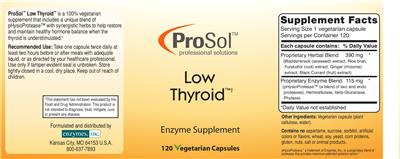
- Form
- Capsule
- Serving Size
- 1 Vegetarian Capsule
- Servings
- 120 per container
- Container Holds
- 120 Vegetarian Capsules
- Status
- No longer sold, per the NIH record
What’s in it, whether it interacts with your drugs, its side effects, whether it works, and what our pharmacists would want you to know before you start it.
- What is Low Thyroid?A supplement from ProSol with ten active ingredients, in capsule form.
- Active Ingredients 3 plant ingredients, 4 enzymes, 1 source of fiber and 2 others: Bladderwrack (seaweed) extractRice BranForskohlii (root) extractGinger (rhizome) extractBlack Currant (fruit) extractpHysioProteaseHemicellulaseBeta-GlucanasePhytaseProprietary Enzyme Blend 115 mg Ten active ingredients. Each one can interact with drugs or cause side effects on its own, so we check every one. The full Supplement Facts
- Drug Interactions 1,224 drugs have a documented interaction with this supplement; the most serious is rated major. Of those, 812 are single drugs and 412 are combination products (two or more drugs in one), each listed under its own name. Based on the 7 of its 10 ingredients we could check. Ask your pharmacist first if you take a drug in any of these categories, the most serious of the 23 on record:
- Major · 22 drugs
- Major · 7 drugs
- Moderate · 645 drugs
- Moderate · 202 drugs
- Possible Side EffectsGas 3 ingredientsStomach upset 3 ingredientsBloating 2 ingredientsStomach discomfort 2 ingredientsChanges in thyroid functionLow blood pressure +15 moreCombined from six of its ten active ingredients. Not studied in this exact product.
- Well documented Why
Does Low Thyroid work?
Not establishedWhat It Is Marketed For
Hormone balance when thyroid is understimulated
From the claims on the product’s label.
There is no graded research for that use. What it does grade for its ingredients, strongest first:
- Dyslipidemia Rice Bran
- Ginger
- Ginger
- Pregnancy-induced nausea and vomiting Ginger
These grades are for each ingredient, not this exact product, and never a promise it will work for you.
What the research says- Low Why
- AllergensNone of its ingredient names point to a major food allergen
Who Might Consider It
- People looking for hormone balance when thyroid is understimulated, which is what it is marketed for. There is no graded research for that use.
- People who want it for dyslipidemia, osteoarthritis, dysmenorrhea or pregnancy-induced nausea and vomiting: the uses with research behind them. See each grade
More Before You Take It Show both answersHide Pregnancy and Breastfeeding The Label’s Directions
-
Pregnant or breastfeeding?
- Pregnancy and Breastfeeding Fucus Vesiculosus
- ! When used orally because it may contain iodine and heavy metals; avoid using.
- Pregnancy Coleus
- ! When used orally.
- Breastfeeding Coleus
- Insufficient reliable information available; avoid using.
- Pregnancy and Breastfeeding Black Currant
- Insufficient reliable information available; avoid using.
-
How does the label say to take it?
“Recommended Use: Take one capsule twice daily at least two hours before or after meals with adequate liquid, or as directed by your healthcare professional.”
The maker’s words. Your pharmacist or doctor may advise differently.
Everything the label says
From the label dated Jan 25, 2016: 7 of its 10 active ingredients were checked against our records; the other three are not in them yet. A summary of what is known, not a grade or a test of the product. How these ratings are computed
Ask Anything About This Supplement
Name a drug you take, or ask about side effects, ingredients or pregnancy.
AI answers come from this label and our own records, never the open internet. AI can make mistakes, so always check with your doctor or pharmacist. How we use AI
Ask the Pharmacist
A licensed pharmacist will answer your question by email — free, as soon as they can.
Got it — thank you!
A licensed pharmacist will answer as soon as they can. Keep an eye on your email (worth checking spam, just in case).
What’s Inside Low Thyroid by ProSol
Ten Active Ingredients, Each Checked on Its Own
A supplement is often several ingredients in one bottle, and each one can interact with drugs or cause side effects on its own. We check every one of them against our records.
- Bladderwrack (seaweed) extractDrug interactions on record, most serious: Moderate
- Rice BranNo drug interactions on record
- Forskohlii (root) extractDrug interactions on record, most serious: Major
- Ginger (rhizome) extractDrug interactions on record, most serious: Moderate
- Black Currant (fruit) extractDrug interactions on record, most serious: Moderate
- pHysioProteaseNo drug interactions on record
- HemicellulaseNot in our interaction records yet
- Beta-GlucanaseNot in our interaction records yet
And 2 more, each with its own card below.
The label gives an exact amount for 1 of its 10 active ingredients. The other nine are inside one proprietary blend, “Proprietary Herbal Blend”, and the label gives one total for it, not how much of each ingredient is in it.
- 1 state an exact amount
- 9 have no amount of their own
- Proprietary Herbal Blend 390 mg in total · 9 ingredients, no amount for each
This rates what the label tells you, not the quality of the product.
Supplement Facts
| Amount Per Serving | % Daily Value | |
|---|---|---|
| Proprietary Herbal Blend | 390 mg | † |
| Bladderwrack (seaweed) extract | † | |
| Rice Bran | † | |
| Forskohlii (root) extract | † | |
| Ginger (rhizome) extract | † | |
| Black Currant (fruit) extract | † | |
| Proprietary Enzyme Blend | 115 mg | † |
| pHysioProtease | † | |
| Hemicellulase | † | |
| Beta-Glucanase | † | |
| Phytase | † | |
Other ingredients: Vegetarian Capsule
† Daily Value not established.
Daily Values for adults and children 4 or more years of age.
As the label prints it, from the NIH Dietary Supplement Label Database.
Each Ingredient and Its Drug Interactions
Tap one for more about it and its full guide. A drug can interact with this supplement through any one of them.
-
Proprietary Herbal Blend 390 mg Nine ingredients inside it, each checked on its own
- Bladderwrack (seaweed) extract 893 drugs
- Rice Bran
- Forskohlii (root) extract 917 drugs
- Ginger (rhizome) extract 1,008 drugs
- Black Currant (fruit) extract 140 drugs
- PHysioProtease
- Hemicellulase
- Beta-Glucanase
- Phytase
-
Proprietary Enzyme Blend 115 mg A blend: its ingredients are checked one by one where the label lists them
Other Ingredients (Inactive)
The capsule or tablet itself, fillers, coatings and flavors. Not part of the drug interaction check; the allergen check below reads them.
- Vegetarian Capsule
Allergens in Low Thyroid
None of its ingredient names point to a major food allergen.
Not named in the ingredients
- Milk
- Egg
- Fish
- Shellfish
- Tree nuts
- Peanuts
- Wheat or other gluten grains
- Soy
- Sesame
- Made without, the label says“ProSol Low Thyroid is a 100% vegetarian supplement that includes a unique blend of pHysioProtease with synergistic herbs to help restore and maintain healthy hormone balance when the thyroid is understimulated.”
- Made without, the label says“Contains no aspartame, sucrose, sorbitol, artificial colors or flavors, wheat, soy, yeast, corn proteins, gluten, nuts, salt or animal products.”
From the label text and ingredient names on file; we do not test products. With a serious allergy, check your bottle and ask the maker or your pharmacist.
What the Label Says
The maker’s own words, from the label. We do not verify or endorse them.
- Storage
-
“Store tightly closed in a cool, dry place.”
- General statements
-
“professional solutions”
- FDA Statement of Identity
-
“Enzyme Supplement”
- Brand IP Statement(s)
-
“pHysioProtease, a trademark of Enzymes, Inc., is a proprietary blend of proteases that provides maximum patented systemic action.”
- Formulation
-
“pHysioProtease, a trademark of Enzymes, Inc., is a proprietary blend of proteases that provides maximum patented systemic action.”
The Low Thyroid Label on File
The label scan on file at the NIH Dietary Supplement Label Database, dated January 2016. Always read the label on the bottle you have.
Product Facts
- Brand
- ProSol
- Net contents
- 120 Vegetarian Capsules
- Market status
- Off market
- Date entered into DSLD
- Jan 25, 2016
- DSLD ID
- 55960
- Product type
- Other Combinations
- Supplement form
- Capsule
- Dietary claims / uses
- All Other, Structure/Function
- Intended target group(s)
- Vegetarian, Adult (18 - 50 Years), Gluten Free
Is this label outdated? Report a formula or label change and our pharmacy team will review it.
Low Thyroid by ProSol Side Effects
Why this rating?
We look for three kinds of safety information on each ingredient: side effects reported in studies, a pregnancy and breastfeeding rating, and a safety write-up from our pharmacy team. All three are on file for each of the seven ingredients we could check.
So this rates how much is known, not whether Low Thyroid is right for you.
Reported with seven of its ingredients
- Most often
- Gas, stomach upset, bloating, stomach discomfort, changes in thyroid function and low blood pressure
- !Rare but serious
- Thyroid cancer, anaphylactic reactions and including urticaria See details
Side Effects, Ingredient by Ingredient
A supplement’s side effects come from its ingredients. Here is what is reported with each one.
Fucus Vesiculosus
Most reported
- Changes in thyroid function
- Metallic taste
- Increased saliva
- Stomach upset
Rice Bran
Most reported
- Gas
- Bloating
- Stomach discomfort
- Changes in bowel movements
Coleus
Most reported
- Low blood pressure
- Fast or irregular heartbeat
- Flushing
- Headache
Ginger
Most reported
- Heartburn
- Stomach discomfort
- Gas
- Burping
Black Currant
Most reported
- Upset stomach, gas, or diarrhea, particularly with the seed oil.
- Mild gas or bloating.
- Allergic reactions in people sensitive to the plant (rare).
Proteolytic Enzymes (Proteases)
Most reported
- Nausea
- Stomach upset
- Diarrhea
- Bloating
Phytase has side-effect reports, but no list of the most common ones. Read them in the Phytase guide
Low Thyroid Warnings: Who Should Be Careful
Low Thyroid has ten active ingredients, and each can carry warnings of its own. We checked the seven in our ingredient guides, and each warning below names the ingredient it comes from. Hemicellulase, Beta-Glucanase and Proprietary Enzyme Blend are not in our guides yet, so ask your pharmacist about them. If any of these apply to you, talk to your doctor or pharmacist before you start it.
- Fucus Vesiculosus3 warnings below
- Rice Bran2 warnings below
- Coleus3 warnings below
- Ginger2 warnings below
- Black Currant2 warnings below
- Proteolytic Enzymes (Proteases)3 warnings below
- Phytase2 warnings below
- HemicellulaseNot in our guides yet
- Beta-GlucanaseNot in our guides yet
- Proprietary Enzyme BlendNot in our guides yet
-
Bleeding Problems or Surgery
- Fucus VesiculosusPeople with kidney disease, those allergic to iodine or seafood, and anyone scheduled for surgery or thyroid testing should also be cautious.
- ColeusPeople with bleeding disorders or those scheduled for surgery should also use caution, as forskolin may affect blood clotting.
- GingerUse extra caution if you have a bleeding disorder or are scheduled for surgery, since ginger may slightly affect blood clotting.
- Proteolytic Enzymes (Proteases)Use caution if you have a bleeding disorder, are scheduled for surgery, or have stomach ulcers, since enzymes may irritate the gut or affect clotting.
-
Blood Pressure
- ColeusBecause forskolin can lower blood pressure and may affect the heart, people with low blood pressure, heart disease, or those taking blood pressure or heart medicines should be especially careful and check with a healthcare provider first.
-
Gallbladder Problems
- GingerPeople with gallstones should also check with a doctor, because ginger can increase the flow of bile.
-
Stomach or Bowel Problems
- Rice BranPeople with bowel narrowing or swallowing problems should be careful with high-fiber products.
-
Thyroid Conditions
- Fucus VesiculosusDifferent products can contain very different amounts, and too much iodine can cause both underactive (hypothyroid) and overactive (hyperthyroid) thyroid problems.
- Fucus VesiculosusPeople with any thyroid condition should avoid it unless a doctor specifically advises otherwise.
-
Allergies
- Proteolytic Enzymes (Proteases)People with allergies to pineapple, papaya, or pork should avoid the related enzymes, and those with latex allergy may react to papaya-based products.
- PhytasePeople with known allergies to the source of the enzyme (for example, fungal or wheat-derived products) should be cautious.
-
If You Take Other Drugs
- Black CurrantAlways tell your pharmacist or doctor about any supplements you are taking, especially if you have a health condition or take prescription medicines.
- PhytaseIf you have a chronic health condition or take medication, check with a pharmacist or doctor first.
-
Other Cautions
- Rice BranConcentrated supplements and high doses have less safety data, so they call for more caution.
- Black CurrantConcentrated supplements, such as seed oil capsules and leaf extracts, are less well studied, so it is wise to use caution.
- Proteolytic Enzymes (Proteases)Still, some people should be more careful.
-
What the Label Warns
- “Use only if tamper-evident seal is unbroken.”
- “Keep out of reach of children.”
The maker’s wording, from the product label.
-
Pregnant or Breastfeeding
Each ingredient’s rating for pregnancy and for breastfeeding, and what it covers.
Pregnancy and Breastfeeding The record rates both the same
-
When used orally because it may contain iodine and heavy metals; avoid using.
Pregnancy
-
When used orally.
Evidence from animal research suggests that high doses of coleus can inhibit embryo implantation and/or delay fetal development; avoid using.
Breastfeeding
-
Insufficient reliable information available; avoid using.
Show 5 more ingredients
Pregnancy and Breastfeeding The record rates both the same
-
Insufficient reliable information available; avoid using.
Proteolytic Enzymes (Proteases)
Pregnancy and Breastfeeding The record rates both the same
-
Insufficient reliable information available; avoid using.
Pregnancy and Breastfeeding The record rates both the same
-
Insufficient reliable information is available; avoid using.
Pregnancy and Breastfeeding The record rates both the same
-
When used orally in amounts commonly found in foods.
There is insufficient reliable information available about the safety of rice bran when used for medicinal purposes during pregnancy and lactation; avoid using.
Pregnancy
-
When consumed in the amounts typically found in foods.
Ginger is considered a first-line nonpharmacological treatment option for nausea in pregnancy by the American College of Obstetrics and Gynecology (ACOG).
However, it should not be used long-term or without medical supervision and close monitoring.
-
When used for medicinal purposes.
Despite some early reports of adverse effects and one observational study suggesting that taking dried ginger and other herbal supplements during the first 20 weeks of pregnancy marginally increased the chance of stillbirth, most research shows that ginger is unlikely to cause harm to the baby.
3 more points on this rating
- The risk for major malformations in infants of parents who took ginger when pregnant does not appear to be higher than the baseline rate of 1% to 3%.
- Also, other research suggests that ginger intake during various trimesters does not significantly affect the risk of spontaneous abortion, congenital malformations, stillbirth, perinatal death, preterm birth, low birth weight, or low Apgar scores.
- Ginger use has been associated with an increase in non-severe vaginal bleeding, including spotting, after week 17 of pregnancy.
Breastfeeding
-
When consumed in the amounts typically found in foods.
There is insufficient reliable information available about the safety of ginger when used for medicinal purposes; avoid amounts greater than those found in foods.
Ratings and the words beside them are from the Natural Medicines database, which we license.
-
Rare but Serious Side Effects
-
!
Fucus Vesiculosus
Allergic reactions are possible, particularly in people sensitive to iodine or seafood.
Orally: Thyroid cancer.
-
!
Rice Bran
Allergic reactions are uncommon but possible.
Anaphylactic reactions, including urticaria and angioedema.
-
!
Ginger
Rarely, some people may have an allergic reaction.
-
!
Black Currant
Serious side effects are uncommon.
-
!
Proteolytic Enzymes (Proteases)
Allergic reactions can happen, especially in people sensitive to pineapple, papaya, or animal-source products.
-
!
Phytase
Allergic reactions are possible, especially in people sensitive to the source the enzyme is made from (such as fungal or grain-derived material).
When to get help: a serious allergic reaction, with trouble breathing or swelling of the face, lips or throat, needs emergency care: call 911. For any other side effect that worries you, call your doctor or pharmacist.
These reports describe each ingredient, not studies of this exact product. Not medical advice: a side effect you notice after starting a supplement is worth a word with your pharmacist or doctor.
Low Thyroid by ProSol Drug Interactions
We checked all ten active ingredients in this supplement against every drug in our records. A drug can interact with it through any one of them. Hemicellulase, Beta-Glucanase and Proprietary Enzyme Blend are not in our interaction records yet.
A major interaction on record
3 of 3, on a scale from Minor or none to Major.Why this rating?
We rate this by the most serious interaction on record, not by how many there are. For Fucus Vesiculosus, Ginger, Coleus and Black Currant, the most serious is rated major, which means the combination is best avoided, or used only under close supervision. Some involve kinds of drugs where a small change can matter, such as blood thinners, transplant drugs and diabetes drugs.
1,225 drugs are on the full list. What matters is whether one you take is on it, so check yours with the interaction checker on this page.
Four of its ten active ingredients have drug interactions on record: Fucus Vesiculosus, Coleus, Ginger and Black Currant.
- Interacts with
- 1,008 drugs
- Most serious
- Moderate
- Most of its records involve Cytochrome P450 3A4 (CYP3A4) Substrates, P-glycoprotein Substrates and Cytochrome P450 1A2 (CYP1A2) Substrates.
- Interacts with
- 917 drugs
- Most serious
- Major
- Most of its records involve Cytochrome P450 3A4 (CYP3A4) Substrates, Antihypertensive Drugs and Anticoagulant/Antiplatelet Drugs.
- Interacts with
- 893 drugs
- Most serious
- Moderate
- Most of its records involve Cytochrome P450 3A4 (CYP3A4) Substrates, Cytochrome P450 2D6 (CYP2D6) Substrates and Anticoagulant/Antiplatelet Drugs.
- Interacts with
- 140 drugs
- Most serious
- Moderate
- Most of its records involve Anticoagulant/Antiplatelet Drugs and Phenothiazines.
Why Low Thyroid Interacts, Ingredient by Ingredient
A product interacts through its ingredients. Each card: how many drugs, the most serious rating, and the kinds of drugs it affects most (tap a kind for what it means).
The ingredients driving the most interactions
-
Ginger (rhizome) extract 1,008 drugs
Most serious: Moderate14 interaction records on file
The kinds of drugs it affects most
- 645 drugs
- 202 drugs
- 186 drugs
- 122 drugs
Every Ginger drug interaction, 14 records The Ginger records cite 65 references, listed in the Ginger guide.
-
Forskohlii (root) extract 917 drugs
Most serious: Major7 interaction records on file
The kinds of drugs it affects most
- 645 drugs
- 172 drugs
- 122 drugs
- 112 drugs
Every Coleus drug interaction, 7 records The Coleus records cite 16 references, listed in the Coleus guide.
-
Bladderwrack (seaweed) extract 893 drugs
Most serious: Moderate9 interaction records on file
The kinds of drugs it affects most
- 645 drugs
- 193 drugs
- 122 drugs
- 112 drugs
Every Fucus Vesiculosus drug interaction, 9 records The Fucus Vesiculosus records cite 15 references, listed in the Fucus Vesiculosus guide.
-
Black Currant (fruit) extract 140 drugs
Most serious: Moderate2 interaction records on file
The kinds of drugs it affects most
- 122 drugs
- Phenothiazines 18 drugs
Every Black Currant drug interaction, 2 records The Black Currant records cite 6 references, listed in the Black Currant guide.
The Breakdown by Severity
Each drug counted once, at its most serious rating. Tap a tile to list those drugs.
Find Your Drug
Type a drug or brand name to see whether it is on the list.
- Only drugs with a documented interaction are listed, the most serious first.
- A drug with no known interaction is not listed, but searching its name tells you so.
- Open a drug to see which ingredient is responsible. Of those, 812 are single drugs and 412 are combination products (two or more drugs in one), each listed under its own name.
-
Bazedoxifene Acetate and Conjugated EstrogensDuavee Moderate
The 3 ingredients responsible:
-
Forskohlii (Root) Extract Moderate Bazedoxifene Acetate and Conjugated Estrogens is in the Cytochrome P450 3A4 (CYP3A4) Substrates category.
Theoretically, taking coleus might decrease serum levels of drugs metabolized by CYP3A4.
The full Forskohlii (Root) Extract + Bazedoxifene Acetate and Conjugated Estrogens interaction -
Ginger (Rhizome) Extract Moderate Bazedoxifene Acetate and Conjugated Estrogens is in these P-glycoprotein Substrates, Cytochrome P450 3A4 (CYP3A4) Substrates categories.
Ginger might increase the absorption and blood levels of P-glycoprotein (P-gp) substrates.
The full Ginger (Rhizome) Extract + Bazedoxifene Acetate and Conjugated Estrogens interaction -
Bladderwrack (Seaweed) Extract Minor Bazedoxifene Acetate and Conjugated Estrogens is in the Cytochrome P450 3A4 (CYP3A4) Substrates category.
Theoretically, concomitant use of Fucus vesiculosus with CYP3A4 substrates might increase the risk for adverse effects.
The full Bladderwrack (Seaweed) Extract + Bazedoxifene Acetate and Conjugated Estrogens interaction
-
-
Conjugated Estrogens and MethyltestosteronePremarin with Methyltestosterone Moderate
The 3 ingredients responsible:
-
Forskohlii (Root) Extract Moderate Conjugated Estrogens and Methyltestosterone is in the Cytochrome P450 3A4 (CYP3A4) Substrates category.
Theoretically, taking coleus might decrease serum levels of drugs metabolized by CYP3A4.
The full Forskohlii (Root) Extract + Conjugated Estrogens and Methyltestosterone interaction -
Ginger (Rhizome) Extract Moderate Conjugated Estrogens and Methyltestosterone is in these Cytochrome P450 3A4 (CYP3A4) Substrates, P-glycoprotein Substrates categories.
Ginger might increase or decrease the levels of CYP3A4 substrates.
The full Ginger (Rhizome) Extract + Conjugated Estrogens and Methyltestosterone interaction -
Bladderwrack (Seaweed) Extract Minor Conjugated Estrogens and Methyltestosterone is in the Cytochrome P450 3A4 (CYP3A4) Substrates category.
Theoretically, concomitant use of Fucus vesiculosus with CYP3A4 substrates might increase the risk for adverse effects.
The full Bladderwrack (Seaweed) Extract + Conjugated Estrogens and Methyltestosterone interaction
-
-
Loratadine and PseudoephedrineClaritin D, Claritin D 24 Hr Moderate
The 3 ingredients responsible:
-
Forskohlii (Root) Extract Moderate Loratadine and Pseudoephedrine is in the Cytochrome P450 3A4 (CYP3A4) Substrates category.
Theoretically, taking coleus might decrease serum levels of drugs metabolized by CYP3A4.
The full Forskohlii (Root) Extract + Loratadine and Pseudoephedrine interaction -
Ginger (Rhizome) Extract Moderate Loratadine and Pseudoephedrine is in the Cytochrome P450 3A4 (CYP3A4) Substrates category.
Ginger might increase or decrease the levels of CYP3A4 substrates.
The full Ginger (Rhizome) Extract + Loratadine and Pseudoephedrine interaction -
Bladderwrack (Seaweed) Extract Minor Loratadine and Pseudoephedrine is in the Cytochrome P450 3A4 (CYP3A4) Substrates category.
Theoretically, concomitant use of Fucus vesiculosus with CYP3A4 substrates might increase the risk for adverse effects.
The full Bladderwrack (Seaweed) Extract + Loratadine and Pseudoephedrine interaction
-
-
Dutasteride and TamsulosinJalyn Moderate
The 3 ingredients responsible:
-
Forskohlii (Root) Extract Moderate Dutasteride and Tamsulosin is in the Cytochrome P450 3A4 (CYP3A4) Substrates category.
Theoretically, taking coleus might decrease serum levels of drugs metabolized by CYP3A4.
The full Forskohlii (Root) Extract + Dutasteride and Tamsulosin interaction -
Ginger (Rhizome) Extract Moderate Dutasteride and Tamsulosin is in the Cytochrome P450 3A4 (CYP3A4) Substrates category.
Ginger might increase or decrease the levels of CYP3A4 substrates.
The full Ginger (Rhizome) Extract + Dutasteride and Tamsulosin interaction -
Bladderwrack (Seaweed) Extract Minor Dutasteride and Tamsulosin is in the Cytochrome P450 3A4 (CYP3A4) Substrates category.
Theoretically, concomitant use of Fucus vesiculosus with CYP3A4 substrates might increase the risk for adverse effects.
The full Bladderwrack (Seaweed) Extract + Dutasteride and Tamsulosin interaction
-
-
Polythiazide and PrazosinMinizide Moderate
The ingredient responsible:
-
Forskohlii (Root) Extract Moderate Polythiazide and Prazosin is in the Antihypertensive Drugs category.
Theoretically, combining coleus with antihypertensive drugs might cause additive blood pressure lowering effects and increase the risk of hypotension.
The full Forskohlii (Root) Extract + Polythiazide and Prazosin interaction
-
-
Cabotegravir and RilpivirineCabenuva Moderate
The 3 ingredients responsible:
-
Forskohlii (Root) Extract Moderate Cabotegravir and Rilpivirine is in the Cytochrome P450 3A4 (CYP3A4) Substrates category.
Theoretically, taking coleus might decrease serum levels of drugs metabolized by CYP3A4.
The full Forskohlii (Root) Extract + Cabotegravir and Rilpivirine interaction -
Ginger (Rhizome) Extract Moderate Cabotegravir and Rilpivirine is in the Cytochrome P450 3A4 (CYP3A4) Substrates category.
Ginger might increase or decrease the levels of CYP3A4 substrates.
The full Ginger (Rhizome) Extract + Cabotegravir and Rilpivirine interaction -
Bladderwrack (Seaweed) Extract Minor Cabotegravir and Rilpivirine is in the Cytochrome P450 3A4 (CYP3A4) Substrates category.
Theoretically, concomitant use of Fucus vesiculosus with CYP3A4 substrates might increase the risk for adverse effects.
The full Bladderwrack (Seaweed) Extract + Cabotegravir and Rilpivirine interaction
-
-
Efavirenz, Lamivudine, and Tenofovir Disoproxil FumarateSymfi Moderate
The 3 ingredients responsible:
-
Forskohlii (Root) Extract Moderate Efavirenz, Lamivudine, and Tenofovir Disoproxil Fumarate is in the Cytochrome P450 3A4 (CYP3A4) Substrates category.
Theoretically, taking coleus might decrease serum levels of drugs metabolized by CYP3A4.
The full Forskohlii (Root) Extract + Efavirenz, Lamivudine, and Tenofovir Disoproxil Fumarate interaction -
Ginger (Rhizome) Extract Moderate Efavirenz, Lamivudine, and Tenofovir Disoproxil Fumarate is in the Cytochrome P450 3A4 (CYP3A4) Substrates category.
Ginger might increase or decrease the levels of CYP3A4 substrates.
The full Ginger (Rhizome) Extract + Efavirenz, Lamivudine, and Tenofovir Disoproxil Fumarate interaction -
Bladderwrack (Seaweed) Extract Minor Efavirenz, Lamivudine, and Tenofovir Disoproxil Fumarate is in the Cytochrome P450 3A4 (CYP3A4) Substrates category.
Theoretically, concomitant use of Fucus vesiculosus with CYP3A4 substrates might increase the risk for adverse effects.
The full Bladderwrack (Seaweed) Extract + Efavirenz, Lamivudine, and Tenofovir Disoproxil Fumarate interaction
-
-
Vonoprazan and AmoxicillinVoquezna Dual Moderate
The 3 ingredients responsible:
-
Ginger (Rhizome) Extract Moderate Vonoprazan and Amoxicillin is in the Cytochrome P450 3A4 (CYP3A4) Substrates category.
Ginger might increase or decrease the levels of CYP3A4 substrates.
The full Ginger (Rhizome) Extract + Vonoprazan and Amoxicillin interaction -
Forskohlii (Root) Extract Moderate Vonoprazan and Amoxicillin is in the Cytochrome P450 3A4 (CYP3A4) Substrates category.
Theoretically, taking coleus might decrease serum levels of drugs metabolized by CYP3A4.
The full Forskohlii (Root) Extract + Vonoprazan and Amoxicillin interaction -
Bladderwrack (Seaweed) Extract Minor Vonoprazan and Amoxicillin is in the Cytochrome P450 3A4 (CYP3A4) Substrates category.
Theoretically, concomitant use of Fucus vesiculosus with CYP3A4 substrates might increase the risk for adverse effects.
The full Bladderwrack (Seaweed) Extract + Vonoprazan and Amoxicillin interaction
-
-
Ethinyl Estradiol and NorgestimateCilest, Mononessa, Ortho Tri-Cyclen 28, Ortho Tri-Cyclen Lo, Ortho Tri-Cylcen and 6 more Moderate
The 3 ingredients responsible:
-
Ginger (Rhizome) Extract Moderate Ethinyl Estradiol and Norgestimate is in these Cytochrome P450 1A2 (CYP1A2) Substrates, P-glycoprotein Substrates, Cytochrome P450 3A4 (CYP3A4) Substrates categories.
Theoretically, ginger might increase the levels of CYP1A2 substrates.
The full Ginger (Rhizome) Extract + Ethinyl Estradiol and Norgestimate interaction -
Forskohlii (Root) Extract Moderate Ethinyl Estradiol and Norgestimate is in the Cytochrome P450 3A4 (CYP3A4) Substrates category.
Theoretically, taking coleus might decrease serum levels of drugs metabolized by CYP3A4.
The full Forskohlii (Root) Extract + Ethinyl Estradiol and Norgestimate interaction -
Bladderwrack (Seaweed) Extract Minor Ethinyl Estradiol and Norgestimate is in the Cytochrome P450 3A4 (CYP3A4) Substrates category.
Theoretically, concomitant use of Fucus vesiculosus with CYP3A4 substrates might increase the risk for adverse effects.
The full Bladderwrack (Seaweed) Extract + Ethinyl Estradiol and Norgestimate interaction
-
-
Azelastine Hydrochloride and Fluticasone PropionateDymista Moderate
The 3 ingredients responsible:
-
Ginger (Rhizome) Extract Moderate Azelastine Hydrochloride and Fluticasone Propionate is in the Cytochrome P450 3A4 (CYP3A4) Substrates category.
Ginger might increase or decrease the levels of CYP3A4 substrates.
The full Ginger (Rhizome) Extract + Azelastine Hydrochloride and Fluticasone Propionate interaction -
Forskohlii (Root) Extract Moderate Azelastine Hydrochloride and Fluticasone Propionate is in the Cytochrome P450 3A4 (CYP3A4) Substrates category.
Theoretically, taking coleus might decrease serum levels of drugs metabolized by CYP3A4.
The full Forskohlii (Root) Extract + Azelastine Hydrochloride and Fluticasone Propionate interaction -
Bladderwrack (Seaweed) Extract Minor Azelastine Hydrochloride and Fluticasone Propionate is in the Cytochrome P450 3A4 (CYP3A4) Substrates category.
Theoretically, concomitant use of Fucus vesiculosus with CYP3A4 substrates might increase the risk for adverse effects.
The full Bladderwrack (Seaweed) Extract + Azelastine Hydrochloride and Fluticasone Propionate interaction
-
-
Sofosbuvir and VelpatasvirEpclusa Moderate
The 3 ingredients responsible:
-
Ginger (Rhizome) Extract Moderate Sofosbuvir and Velpatasvir is in these Cytochrome P450 3A4 (CYP3A4) Substrates, P-glycoprotein Substrates, Cytochrome P450 2B6 (CYP2B6) Substrates categories.
Ginger might increase or decrease the levels of CYP3A4 substrates.
The full Ginger (Rhizome) Extract + Sofosbuvir and Velpatasvir interaction -
Forskohlii (Root) Extract Moderate Sofosbuvir and Velpatasvir is in the Cytochrome P450 3A4 (CYP3A4) Substrates category.
Theoretically, taking coleus might decrease serum levels of drugs metabolized by CYP3A4.
The full Forskohlii (Root) Extract + Sofosbuvir and Velpatasvir interaction -
Bladderwrack (Seaweed) Extract Minor Sofosbuvir and Velpatasvir is in these Cytochrome P450 2C8 (CYP2C8) Substrates, Cytochrome P450 3A4 (CYP3A4) Substrates categories.
Theoretically, concomitant use of Fucus vesiculosus with CYP2C8 substrates might increase the risk for adverse effects.
The full Bladderwrack (Seaweed) Extract + Sofosbuvir and Velpatasvir interaction
-
-
Chlorpheniramine and PhenylpropanolamineAler-Releaf, Conex DA, Contac, Dehist, Histabid Duracaps and 2 more Moderate
The 3 ingredients responsible:
-
Forskohlii (Root) Extract Moderate Chlorpheniramine and Phenylpropanolamine is in the Cytochrome P450 3A4 (CYP3A4) Substrates category.
Theoretically, taking coleus might decrease serum levels of drugs metabolized by CYP3A4.
The full Forskohlii (Root) Extract + Chlorpheniramine and Phenylpropanolamine interaction -
Ginger (Rhizome) Extract Moderate Chlorpheniramine and Phenylpropanolamine is in the Cytochrome P450 3A4 (CYP3A4) Substrates category.
Ginger might increase or decrease the levels of CYP3A4 substrates.
The full Ginger (Rhizome) Extract + Chlorpheniramine and Phenylpropanolamine interaction -
Bladderwrack (Seaweed) Extract Minor Chlorpheniramine and Phenylpropanolamine is in the Cytochrome P450 3A4 (CYP3A4) Substrates category.
Theoretically, concomitant use of Fucus vesiculosus with CYP3A4 substrates might increase the risk for adverse effects.
The full Bladderwrack (Seaweed) Extract + Chlorpheniramine and Phenylpropanolamine interaction
-
-
Dextromethorphan Hbr and Phenylephrine HclVicks Formula 44D Cough & Head Congestion Relief Moderate
The 3 ingredients responsible:
-
Forskohlii (Root) Extract Moderate Dextromethorphan Hbr and Phenylephrine Hcl is in the Cytochrome P450 3A4 (CYP3A4) Substrates category.
Theoretically, taking coleus might decrease serum levels of drugs metabolized by CYP3A4.
The full Forskohlii (Root) Extract + Dextromethorphan Hbr and Phenylephrine Hcl interaction -
Ginger (Rhizome) Extract Moderate Dextromethorphan Hbr and Phenylephrine Hcl is in the Cytochrome P450 3A4 (CYP3A4) Substrates category.
Ginger might increase or decrease the levels of CYP3A4 substrates.
The full Ginger (Rhizome) Extract + Dextromethorphan Hbr and Phenylephrine Hcl interaction -
Bladderwrack (Seaweed) Extract Minor Dextromethorphan Hbr and Phenylephrine Hcl is in these Cytochrome P450 3A4 (CYP3A4) Substrates, Cytochrome P450 2D6 (CYP2D6) Substrates categories.
Theoretically, concomitant use of Fucus vesiculosus with CYP3A4 substrates might increase the risk for adverse effects.
The full Bladderwrack (Seaweed) Extract + Dextromethorphan Hbr and Phenylephrine Hcl interaction
-
-
Mestranol and NorethindroneNecon 1/50, Nelova 1/50M, Norethin 1/50, Norethin 1/50M, Norinyl 1 50 21 Day and 3 more Moderate
The 3 ingredients responsible:
-
Ginger (Rhizome) Extract Moderate Mestranol and Norethindrone is in the Cytochrome P450 3A4 (CYP3A4) Substrates category.
Ginger might increase or decrease the levels of CYP3A4 substrates.
The full Ginger (Rhizome) Extract + Mestranol and Norethindrone interaction -
Forskohlii (Root) Extract Moderate Mestranol and Norethindrone is in the Cytochrome P450 3A4 (CYP3A4) Substrates category.
Theoretically, taking coleus might decrease serum levels of drugs metabolized by CYP3A4.
The full Forskohlii (Root) Extract + Mestranol and Norethindrone interaction -
Bladderwrack (Seaweed) Extract Minor Mestranol and Norethindrone is in the Cytochrome P450 3A4 (CYP3A4) Substrates category.
Theoretically, concomitant use of Fucus vesiculosus with CYP3A4 substrates might increase the risk for adverse effects.
The full Bladderwrack (Seaweed) Extract + Mestranol and Norethindrone interaction
-
-
Atenolol and ChlortalidoneAtenixCo, Tenoret 50, Totaretic Moderate
The ingredient responsible:
-
Forskohlii (Root) Extract Moderate Atenolol and Chlortalidone is in the Antihypertensive Drugs category.
Theoretically, combining coleus with antihypertensive drugs might cause additive blood pressure lowering effects and increase the risk of hypotension.
The full Forskohlii (Root) Extract + Atenolol and Chlortalidone interaction
-
-
Estradiol and MedroxyprogesteroneDivitren Moderate
The 3 ingredients responsible:
-
Ginger (Rhizome) Extract Moderate Estradiol and Medroxyprogesterone is in these Cytochrome P450 1A2 (CYP1A2) Substrates, P-glycoprotein Substrates, Cytochrome P450 3A4 (CYP3A4) Substrates categories.
Theoretically, ginger might increase the levels of CYP1A2 substrates.
The full Ginger (Rhizome) Extract + Estradiol and Medroxyprogesterone interaction -
Forskohlii (Root) Extract Moderate Estradiol and Medroxyprogesterone is in the Cytochrome P450 3A4 (CYP3A4) Substrates category.
Theoretically, taking coleus might decrease serum levels of drugs metabolized by CYP3A4.
The full Forskohlii (Root) Extract + Estradiol and Medroxyprogesterone interaction -
Bladderwrack (Seaweed) Extract Minor Estradiol and Medroxyprogesterone is in the Cytochrome P450 3A4 (CYP3A4) Substrates category.
Theoretically, concomitant use of Fucus vesiculosus with CYP3A4 substrates might increase the risk for adverse effects.
The full Bladderwrack (Seaweed) Extract + Estradiol and Medroxyprogesterone interaction
-
-
Elexacaftor, Tezacaftor, and IvacaftorTrikafta Moderate
The 3 ingredients responsible:
-
Forskohlii (Root) Extract Moderate Elexacaftor, Tezacaftor, and Ivacaftor is in the Cytochrome P450 3A4 (CYP3A4) Substrates category.
Theoretically, taking coleus might decrease serum levels of drugs metabolized by CYP3A4.
The full Forskohlii (Root) Extract + Elexacaftor, Tezacaftor, and Ivacaftor interaction -
Ginger (Rhizome) Extract Moderate Elexacaftor, Tezacaftor, and Ivacaftor is in the Cytochrome P450 3A4 (CYP3A4) Substrates category.
Ginger might increase or decrease the levels of CYP3A4 substrates.
The full Ginger (Rhizome) Extract + Elexacaftor, Tezacaftor, and Ivacaftor interaction -
Bladderwrack (Seaweed) Extract Minor Elexacaftor, Tezacaftor, and Ivacaftor is in the Cytochrome P450 3A4 (CYP3A4) Substrates category.
Theoretically, concomitant use of Fucus vesiculosus with CYP3A4 substrates might increase the risk for adverse effects.
The full Bladderwrack (Seaweed) Extract + Elexacaftor, Tezacaftor, and Ivacaftor interaction
-
-
Dextromethorphan, Pseudoephedrine, and TriprolidineActifed DM Moderate
The 3 ingredients responsible:
-
Forskohlii (Root) Extract Moderate Dextromethorphan, Pseudoephedrine, and Triprolidine is in the Cytochrome P450 3A4 (CYP3A4) Substrates category.
Theoretically, taking coleus might decrease serum levels of drugs metabolized by CYP3A4.
The full Forskohlii (Root) Extract + Dextromethorphan, Pseudoephedrine, and Triprolidine interaction -
Ginger (Rhizome) Extract Moderate Dextromethorphan, Pseudoephedrine, and Triprolidine is in the Cytochrome P450 3A4 (CYP3A4) Substrates category.
Ginger might increase or decrease the levels of CYP3A4 substrates.
The full Ginger (Rhizome) Extract + Dextromethorphan, Pseudoephedrine, and Triprolidine interaction -
Bladderwrack (Seaweed) Extract Minor Dextromethorphan, Pseudoephedrine, and Triprolidine is in these Cytochrome P450 2D6 (CYP2D6) Substrates, Cytochrome P450 3A4 (CYP3A4) Substrates categories.
Theoretically, concomitant use of Fucus vesiculosus with CYP2D6 substrates might alter the effects of these substrates.
The full Bladderwrack (Seaweed) Extract + Dextromethorphan, Pseudoephedrine, and Triprolidine interaction
-
-
Fam-trastuzumab and Deruxtecan-nxkiEnhertu Moderate
The ingredient responsible:
-
Ginger (Rhizome) Extract Moderate Fam-trastuzumab and Deruxtecan-nxki is in the P-glycoprotein Substrates category.
Ginger might increase the absorption and blood levels of P-glycoprotein (P-gp) substrates.
The full Ginger (Rhizome) Extract + Fam-trastuzumab and Deruxtecan-nxki interaction
-
-
Methyclothiazide and ReserpineDiutensen-R Moderate
The ingredient responsible:
-
Forskohlii (Root) Extract Moderate Methyclothiazide and Reserpine is in the Antihypertensive Drugs category.
Theoretically, combining coleus with antihypertensive drugs might cause additive blood pressure lowering effects and increase the risk of hypotension.
The full Forskohlii (Root) Extract + Methyclothiazide and Reserpine interaction
-
-
Ergotamine, Belladonna, and PhenobarbitalBellamine, Bellaspas, Eperbel-S Moderate
The 3 ingredients responsible:
-
Ginger (Rhizome) Extract Moderate Ergotamine, Belladonna, and Phenobarbital is in these Cytochrome P450 2B6 (CYP2B6) Substrates, Cytochrome P450 3A4 (CYP3A4) Substrates categories.
Theoretically, ginger might increase the levels of CYP2B6 substrates.
The full Ginger (Rhizome) Extract + Ergotamine, Belladonna, and Phenobarbital interaction -
Forskohlii (Root) Extract Moderate Ergotamine, Belladonna, and Phenobarbital is in the Cytochrome P450 3A4 (CYP3A4) Substrates category.
Theoretically, taking coleus might decrease serum levels of drugs metabolized by CYP3A4.
The full Forskohlii (Root) Extract + Ergotamine, Belladonna, and Phenobarbital interaction -
Bladderwrack (Seaweed) Extract Minor Ergotamine, Belladonna, and Phenobarbital is in the Cytochrome P450 3A4 (CYP3A4) Substrates category.
Theoretically, concomitant use of Fucus vesiculosus with CYP3A4 substrates might increase the risk for adverse effects.
The full Bladderwrack (Seaweed) Extract + Ergotamine, Belladonna, and Phenobarbital interaction
-
-
Carbetapentane Tannate, Chlorpheniramine Tannate, Ephedrine Tannate, and Phenylephrine TannateQuadratuss, Ry Tuss, Rynatuss, Tri Tannate Plus Moderate
The 3 ingredients responsible:
-
Forskohlii (Root) Extract Moderate Carbetapentane Tannate, Chlorpheniramine Tannate, Ephedrine Tannate, and Phenylephrine Tannate is in the Cytochrome P450 3A4 (CYP3A4) Substrates category.
Theoretically, taking coleus might decrease serum levels of drugs metabolized by CYP3A4.
The full Forskohlii (Root) Extract + Carbetapentane Tannate, Chlorpheniramine Tannate, Ephedrine Tannate, and Phenylephrine Tannate interaction -
Ginger (Rhizome) Extract Moderate Carbetapentane Tannate, Chlorpheniramine Tannate, Ephedrine Tannate, and Phenylephrine Tannate is in the Cytochrome P450 3A4 (CYP3A4) Substrates category.
Ginger might increase or decrease the levels of CYP3A4 substrates.
The full Ginger (Rhizome) Extract + Carbetapentane Tannate, Chlorpheniramine Tannate, Ephedrine Tannate, and Phenylephrine Tannate interaction -
Bladderwrack (Seaweed) Extract Minor Carbetapentane Tannate, Chlorpheniramine Tannate, Ephedrine Tannate, and Phenylephrine Tannate is in the Cytochrome P450 3A4 (CYP3A4) Substrates category.
Theoretically, concomitant use of Fucus vesiculosus with CYP3A4 substrates might increase the risk for adverse effects.
The full Bladderwrack (Seaweed) Extract + Carbetapentane Tannate, Chlorpheniramine Tannate, Ephedrine Tannate, and Phenylephrine Tannate interaction
-
-
Hydrocodone and PseudoephedrineP-V-Tussin, Rezira Moderate
The 3 ingredients responsible:
-
Forskohlii (Root) Extract Moderate Hydrocodone and Pseudoephedrine is in the Cytochrome P450 3A4 (CYP3A4) Substrates category.
Theoretically, taking coleus might decrease serum levels of drugs metabolized by CYP3A4.
The full Forskohlii (Root) Extract + Hydrocodone and Pseudoephedrine interaction -
Ginger (Rhizome) Extract Moderate Hydrocodone and Pseudoephedrine is in the Cytochrome P450 3A4 (CYP3A4) Substrates category.
Ginger might increase or decrease the levels of CYP3A4 substrates.
The full Ginger (Rhizome) Extract + Hydrocodone and Pseudoephedrine interaction -
Bladderwrack (Seaweed) Extract Minor Hydrocodone and Pseudoephedrine is in these Cytochrome P450 2D6 (CYP2D6) Substrates, Cytochrome P450 3A4 (CYP3A4) Substrates categories.
Theoretically, concomitant use of Fucus vesiculosus with CYP2D6 substrates might alter the effects of these substrates.
The full Bladderwrack (Seaweed) Extract + Hydrocodone and Pseudoephedrine interaction
-
-
Budesonide and FormoterolSymbicort Moderate
The 3 ingredients responsible:
-
Forskohlii (Root) Extract Moderate Budesonide and Formoterol is in the Cytochrome P450 2C9 (CYP2C9) Substrates category.
Theoretically, taking coleus may affect drugs metabolized by CYP2C9 and increase the risk of adverse effects or reduce the effectiveness.
The full Forskohlii (Root) Extract + Budesonide and Formoterol interaction -
Bladderwrack (Seaweed) Extract Minor Budesonide and Formoterol is in these Cytochrome P450 2C9 (CYP2C9) Substrates, Cytochrome P450 2D6 (CYP2D6) Substrates categories.
Theoretically, concomitant use of Fucus vesiculosus with CYP2C9 substrates might increase the risk for adverse effects.
The full Bladderwrack (Seaweed) Extract + Budesonide and Formoterol interaction -
Ginger (Rhizome) Extract Minor Budesonide and Formoterol is in the Cytochrome P450 2C9 (CYP2C9) Substrates category.
Theoretically, ginger might increase the levels of CYP2C9 substrates.
The full Ginger (Rhizome) Extract + Budesonide and Formoterol interaction
-
-
Chlorpheniramine Maleate and Hydrocodone BitartrateVituz Moderate
The 3 ingredients responsible:
-
Ginger (Rhizome) Extract Moderate Chlorpheniramine Maleate and Hydrocodone Bitartrate is in the Cytochrome P450 3A4 (CYP3A4) Substrates category.
Ginger might increase or decrease the levels of CYP3A4 substrates.
The full Ginger (Rhizome) Extract + Chlorpheniramine Maleate and Hydrocodone Bitartrate interaction -
Forskohlii (Root) Extract Moderate Chlorpheniramine Maleate and Hydrocodone Bitartrate is in the Cytochrome P450 3A4 (CYP3A4) Substrates category.
Theoretically, taking coleus might decrease serum levels of drugs metabolized by CYP3A4.
The full Forskohlii (Root) Extract + Chlorpheniramine Maleate and Hydrocodone Bitartrate interaction -
Bladderwrack (Seaweed) Extract Minor Chlorpheniramine Maleate and Hydrocodone Bitartrate is in these Cytochrome P450 2D6 (CYP2D6) Substrates, Cytochrome P450 3A4 (CYP3A4) Substrates categories.
Theoretically, concomitant use of Fucus vesiculosus with CYP2D6 substrates might alter the effects of these substrates.
The full Bladderwrack (Seaweed) Extract + Chlorpheniramine Maleate and Hydrocodone Bitartrate interaction
-
-
Dextromethorphan Hbr and GuaifenesinPediatric Vicks Formula 44e Cough & Chest Congesti, Vicks Formula 44E Cough & Chest Congestion Relief Moderate
The 3 ingredients responsible:
-
Ginger (Rhizome) Extract Moderate Dextromethorphan Hbr and Guaifenesin is in the Cytochrome P450 3A4 (CYP3A4) Substrates category.
Ginger might increase or decrease the levels of CYP3A4 substrates.
The full Ginger (Rhizome) Extract + Dextromethorphan Hbr and Guaifenesin interaction -
Forskohlii (Root) Extract Moderate Dextromethorphan Hbr and Guaifenesin is in the Cytochrome P450 3A4 (CYP3A4) Substrates category.
Theoretically, taking coleus might decrease serum levels of drugs metabolized by CYP3A4.
The full Forskohlii (Root) Extract + Dextromethorphan Hbr and Guaifenesin interaction -
Bladderwrack (Seaweed) Extract Minor Dextromethorphan Hbr and Guaifenesin is in these Cytochrome P450 2D6 (CYP2D6) Substrates, Cytochrome P450 3A4 (CYP3A4) Substrates categories.
Theoretically, concomitant use of Fucus vesiculosus with CYP2D6 substrates might alter the effects of these substrates.
The full Bladderwrack (Seaweed) Extract + Dextromethorphan Hbr and Guaifenesin interaction
-
-
Bendroflumethiazide and NadololCorzide Moderate
The ingredient responsible:
-
Forskohlii (Root) Extract Moderate Bendroflumethiazide and Nadolol is in the Antihypertensive Drugs category.
Theoretically, combining coleus with antihypertensive drugs might cause additive blood pressure lowering effects and increase the risk of hypotension.
The full Forskohlii (Root) Extract + Bendroflumethiazide and Nadolol interaction
-
-
Guaifenesin, Hydrocodone, and PseudoephedrineEntuss-D, Tussi-Organidin DM NR Moderate
The 3 ingredients responsible:
-
Ginger (Rhizome) Extract Moderate Guaifenesin, Hydrocodone, and Pseudoephedrine is in the Cytochrome P450 3A4 (CYP3A4) Substrates category.
Ginger might increase or decrease the levels of CYP3A4 substrates.
The full Ginger (Rhizome) Extract + Guaifenesin, Hydrocodone, and Pseudoephedrine interaction -
Forskohlii (Root) Extract Moderate Guaifenesin, Hydrocodone, and Pseudoephedrine is in the Cytochrome P450 3A4 (CYP3A4) Substrates category.
Theoretically, taking coleus might decrease serum levels of drugs metabolized by CYP3A4.
The full Forskohlii (Root) Extract + Guaifenesin, Hydrocodone, and Pseudoephedrine interaction -
Bladderwrack (Seaweed) Extract Minor Guaifenesin, Hydrocodone, and Pseudoephedrine is in these Cytochrome P450 2D6 (CYP2D6) Substrates, Cytochrome P450 3A4 (CYP3A4) Substrates categories.
Theoretically, concomitant use of Fucus vesiculosus with CYP2D6 substrates might alter the effects of these substrates.
The full Bladderwrack (Seaweed) Extract + Guaifenesin, Hydrocodone, and Pseudoephedrine interaction
-
-
Formoterol Fumarate and GlycopyrrolateBevespi Aerosphere Moderate
The 3 ingredients responsible:
-
Forskohlii (Root) Extract Moderate Formoterol Fumarate and Glycopyrrolate is in the Cytochrome P450 2C9 (CYP2C9) Substrates category.
Theoretically, taking coleus may affect drugs metabolized by CYP2C9 and increase the risk of adverse effects or reduce the effectiveness.
The full Forskohlii (Root) Extract + Formoterol Fumarate and Glycopyrrolate interaction -
Ginger (Rhizome) Extract Minor Formoterol Fumarate and Glycopyrrolate is in the Cytochrome P450 2C9 (CYP2C9) Substrates category.
Theoretically, ginger might increase the levels of CYP2C9 substrates.
The full Ginger (Rhizome) Extract + Formoterol Fumarate and Glycopyrrolate interaction -
Bladderwrack (Seaweed) Extract Minor Formoterol Fumarate and Glycopyrrolate is in these Cytochrome P450 2D6 (CYP2D6) Substrates, Cytochrome P450 2C9 (CYP2C9) Substrates categories.
Theoretically, concomitant use of Fucus vesiculosus with CYP2D6 substrates might alter the effects of these substrates.
The full Bladderwrack (Seaweed) Extract + Formoterol Fumarate and Glycopyrrolate interaction
-
-
Promethazine and PseudoephedrinePhenergan D Moderate
The ingredient responsible:
-
Black Currant (Fruit) Extract Moderate Promethazine and Pseudoephedrine is in the Phenothiazines category.
Theoretically, black currant seed oil might increase the risk of seizure in patients receiving phenothiazines.
The full Black Currant (Fruit) Extract + Promethazine and Pseudoephedrine interaction
-
Does It Work? Low Thyroid by ProSol
How it rates in the research so far, then each ingredient on its own. A grade is the research so far, never an endorsement.
What It Is Marketed For
Hormone balance when thyroid is understimulated
From the claims on the product’s label.
Why this rating?
The graded research on its ingredients is about other conditions, so there is no grade for what it is marketed for.
The Evidence, Ingredient by Ingredient
Each card holds our notes on one ingredient, then its uses graded effective, likely effective or possibly effective.
Fucus Vesiculosus
From our Fucus Vesiculosus guide
- Bladderwrack is most commonly used for thyroid support because of its iodine content.
- Iodine is a nutrient the thyroid needs, but more is not better.
No use is graded effective, likely effective or possibly effective for it yet.
Every graded use, in the Fucus Vesiculosus guideRice Bran
From our Rice Bran guide
- The use with the most supporting research is helping to lower cholesterol.
- Rice bran and rice bran oil contain fiber and plant compounds that may modestly lower total and LDL ("bad") cholesterol in some people.
Research suggests a benefit for
- Dyslipidemia
Coleus
From our Coleus guide
- Coleus is most often marketed today as a weight loss aid.
- A few small studies have looked at forskolin and body composition, but the results are mixed and the studies are small.
No use is graded effective, likely effective or possibly effective for it yet.
Every graded use, in the Coleus guideGinger
From our Ginger guide
- The best-supported use of ginger is for nausea and vomiting.
- Several studies suggest it may help with motion sickness, nausea after surgery, nausea from chemotherapy (usually as an add-on to standard medicines), and morning sickness during pregnancy.
Research suggests a benefit for
- Osteoarthritis, dysmenorrhea and pregnancy-induced nausea and vomiting
Black Currant
From our Black Currant guide
- Black currant is used for many purposes, but for most of them the human evidence is limited or preliminary.
- It is fair to say that more good-quality studies are needed before we can call it "proven" for any specific condition.
No use is graded effective, likely effective or possibly effective for it yet.
Every graded use, in the Black Currant guideProteolytic Enzymes (Proteases)
From our Proteolytic Enzymes (Proteases) guide
- The strongest, most accepted use is for people who cannot make enough of their own digestive enzymes.
- For example, pancreatic enzyme replacement (a prescription product) is well established for conditions like cystic fibrosis and chronic pancreatitis.
No use is graded effective, likely effective or possibly effective for it yet.
Every graded use, in the Proteolytic Enzymes (Proteases) guidePhytase
From our Phytase guide
- Most of what we know about phytase comes from food science and animal nutrition rather than human supplement trials.
- In these settings, phytase clearly breaks down phytate and can improve the availability of minerals such as iron, zinc, calcium, and phosphorus.
No use is graded effective, likely effective or possibly effective for it yet.
Every graded use, in the Phytase guideThe grades are the Natural Medicines database’s, which we license; tap a grade for what it means. They are about each ingredient, not this exact product.
About ProSol
Manufacturer and brand details for Low Thyroid, from the product label.
ProSol has 84 products in our supplement database, with labels on file since 2012. Our database is built from the NIH’s Dietary Supplement Label Database and our pharmacy team’s own additions, so it covers the labels filed there, not every product the brand sells.
- Name
- Enzymes, Inc.
- City
- Kansas City
- State
- MO
- ZipCode
- 64153
- Phone Number
- 800-637-7893
Low Thyroid by ProSol: Common Questions
Does Low Thyroid by ProSol interact with any drugs?
What are the side effects of Low Thyroid by ProSol?
Who should be careful taking Low Thyroid by ProSol?
Can Low Thyroid by ProSol affect the kidneys?
Does Low Thyroid by ProSol contain any common allergens?
Is Low Thyroid by ProSol gluten free?
How can Low Thyroid by ProSol interact with so many drugs?
Where does the information about Low Thyroid by ProSol come from?
Written and reviewed by the HelloPharmacist Editorial Team. Our editorial policy
Still Have a Question About Low Thyroid?
Our pharmacists answer drug and supplement questions, free, by email.
Label information is sourced from the NIH Dietary Supplement Label Database and reflects the product version on file; always read your actual product label. This page is for education only and is not a substitute for professional medical advice. Confirm with your pharmacist or doctor before combining supplements and drugs.
Who Reviews This Page
The pharmacist behind it, and how it is checked.
Dr. Brian Staiger, PharmD, BCPS
Clinical pharmacist and founder of HelloPharmacist
A licensed pharmacist for more than 13 years, he built the system behind this page: it reads the label on file, matches each active ingredient to its record in the Natural Medicines database, checks those records against every drug we cover, and our pharmacy team writes the take and the interaction summary from those records.
- 13+ Years in PharmacyRetail and clinical pharmacy, medication safety and healthcare administration.
- Board Certified (BCPS)A pharmacotherapy specialist, certified by the Board of Pharmacy Specialties.
- Herbalist TrainingCertificates in medical ethnobotany, for the herbs and supplements people take.
Where This Page Comes From
Low Thyroid’s label data comes from the NIH Dietary Supplement Label Database; the ingredient interaction data is from the Natural Medicines database, reviewed by our pharmacists.
- NIH Dietary Supplement Label Database (DSLD)
- The official product label on file for this supplement.
- Natural Medicines (Therapeutic Research Center)
- The evidence-graded clinical reference behind the ingredient interaction, evidence and safety records, which we license.
- HelloPharmacist Editorial Team
- Content is reviewed by the HelloPharmacist Editorial Team, the pharmacists on our staff and those we contract. See our data sources and editorial standards for how this information is built and checked.
- The ratings in the Quick Summary
- They summarize available label information, ingredient evidence and known drug-safety records: a summary of what is known, not a grade of the product itself. They do not verify product identity, purity, potency, contamination or manufacturing quality. How these ratings are computed
The References Behind the Interaction Records
Every citation the ingredients’ records rest on is listed in that ingredient’s guide, in context: Fucus Vesiculosus, 15 references; Rice Bran, 7 references; Coleus, 16 references; Ginger, 65 references; Black Currant, 6 references; Proteolytic Enzymes (Proteases), 3 references; Phytase, 7 references .
Parts of this content are provided by the Therapeutic Research Center, LLC.
DISCLAIMER: Currently this does not check for drug-drug interactions. This is not an all-inclusive comprehensive list of potential interactions and is for informational purposes only. Not all interactions are known or well-reported in the scientific literature, and new interactions are continually being reported. Input is needed from a qualified healthcare provider including a pharmacist before starting any therapy. Application of clinical judgment is necessary.
© 2021 Therapeutic Research Center, LLC
Keep Exploring
- Supplement interaction checkerCheck any supplement or product against your drugs
- Drug–drug interactionsCheck two or more of your drugs against each other
- Browse drugs A to ZEvery drug we have checked against herbs and supplements
- NDC and pricing lookupFind a drug’s NDCs, packaging and costs
- Ask a pharmacistA free, personal answer from our licensed team