
Mood Probiotic + 51 Billion CFU Ingredients & Drug Interactions
by Codeage Amen
What is this page for?
First and foremost: checking Mood Probiotic + 51 Billion CFU against your medications. The heart of this page is the interaction checker and the full interaction report — how this product’s ingredients may interact with prescription and over-the-counter medicines you may be taking.
Around that, we add a pharmacist’s high-level view of the product as a whole — what’s inside, the evidence for its stated use, how transparent the label is, and what safety data exists — so you can see the full picture in one place. It’s educational information from our licensed clinical databases and the clinical staff at HelloPharmacist — not medical advice — and we don’t sell or endorse products. Our editorial policy
Mood Probiotic + 51 Billion CFU is a dietary supplement by Codeage Amen with 22 active ingredients. Its ingredients are commonly taken for stress and anxiety, sleep problems, fatigue and low energy.Based on those ingredients, 2,301 medications have a known interaction with it, the most serious rated moderate. The ingredients most likely to interact are Acacia senegal Fiber, Powder, Ashwagandha, Powder, Alpine Blueberry, Powder. Use the checker below to test your specific medication, or read the full HelloPharmacist Interaction Report.
Check Your Meds Against Mood Probiotic + 51 Billion CFU by Codeage Amen
Ask about any prescription or over-the-counter medication and we check it for interactions with Mood Probiotic + 51 Billion CFU by Codeage Amen — and tell you which ingredient is responsible.
AI summaries are generated from our interaction database for education only — always confirm with your pharmacist. How we use AI
Ask the Pharmacist
A licensed pharmacist will answer your question by email — free, usually within 24 hours.
Got it — thank you!
A licensed pharmacist will answer within 24 hours. Keep an eye on your email (worth checking spam, just in case).
HelloPharmacist Scorecard of Mood Probiotic + 51 Billion CFU by Codeage Amen
Our pharmacy team’s full take, with four database checks built into the cards below — a summary of what is known, not a grade of the product itself.
What’s inside
Low disclosure
This product contains 22 ingredients, including 11 active probiotic strains (live bacterial cultures like L. acidophilus, B. longum, and L. helveticus) plus ashwagandha powder, potato starch, blueberry and bilberry powders, and several plant-based prebiotic fibers. The probiotics are meant to support gut and immune health, while ashwagandha is included for stress and mood support.
The blueberries and bilberries add antioxidants. Two inactive ingredients—enteric coating and methylcellulose—are fillers and binders that help the capsule survive stomach acid and release its contents in the intestine.
Does it work?
Moderate evidence
The evidence for this product's ingredients is mixed. Ashwagandha has possibly effective evidence for insomnia, anxiety, and stress.
Several probiotic strains show possibly effective evidence for specific uses: L. acidophilus for irritable bowel syndrome, antibiotic-associated diarrhea, H. pylori, and bacterial vaginosis; B. bifidum for irritable bowel syndrome and respiratory tract infections. Most other uses across the probiotics—allergies, asthma, cognitive decline, and others—fall into insufficient evidence territory, meaning we simply don't have reliable data yet.
Blueberry and bilberry show insufficient evidence for most claimed benefits like cognitive decline and cardiovascular health, and possibly ineffective evidence for high blood pressure and night vision. Potato starch shows possibly ineffective evidence for cancer, heart attack, and stroke prevention.
How safe is it?
Well-documented data
Ashwagandha safety data are limited to short-term use in healthy adults. The facts advise against it in pregnancy due to a traditional concern about miscarriage risk, and there isn't enough safety information for breastfeeding.
Probiotics are generally well tolerated in healthy people, though those who are very ill or immunocompromised should check with their doctor first; pregnancy and breastfeeding safety data are limited. Gastrointestinal side effects—bloating, flatulence, abdominal discomfort, diarrhea—are reported uncommonly with probiotics.
Blueberry and bilberry are generally well tolerated as foods; freeze-dried blueberries can cause constipation, diarrhea, nausea, and vomiting in a meaningful number of people. Potato starch from fresh, cooked potatoes is safe as food, but green, sprouted, or raw potatoes contain natural toxins that can cause serious neurological and cardiac effects—though this product is potato starch, not the raw plant.
Ashwagandha has rare but serious case reports of liver damage and bleeding in the brain.
Meds to double-check
Moderate interaction found
Antibiotics are the most practical concern: the live probiotics in this product may lose their effectiveness if you take them at the same time, so separate dosing by at least 2 hours. Before starting, check with your pharmacist if you take immunosuppressants (like medications after transplant), blood pressure medications, sedatives or anti-anxiety drugs, diabetes medications, thyroid hormones, blood thinners, liver-damaging drugs, or the chemotherapy agent erlotinib.
Minor interactions also exist with specific drugs like flurbiprofen, buspirone, and certain CYP1A2 or CYP2E1-metabolized medications.
The bottom line
Scorecard at a glanceFormula with limited ingredient disclosure with some supporting evidence for its stated purpose. Moderate medication interactions have been identified, and safety information is well characterized.
Consider this product if you're looking for a multiingredient probiotic with added stress and mood support. Ashwagandha does have evidence for anxiety and insomnia, and several of the probiotics have data backing specific uses like IBS or antibiotic-related diarrhea.
If you take any prescription medications—especially blood pressure meds, blood thinners, diabetes drugs, sedatives, thyroid medication, antibiotics, or immunosuppressants—run your full medication list through the interaction checker below first. Pregnant or breastfeeding?
Talk to your doctor or pharmacist, as safety data are limited for several ingredients.
Educational only — not medical advice; always confirm with your pharmacist. Our editorial policy · How we use AI
Assessment coverage: 14 of 22 active ingredients matched to our full ingredient reviews (monographs). Based on the product label dated Sep 25, 2025.
This Scorecard evaluates available label information, ingredient evidence, and known medication-safety considerations. It does not independently verify product identity, purity, potency, contamination, or manufacturing quality. How these ratings are computed
General information
Key facts about Mood Probiotic + 51 Billion CFU, straight from the product label.
| Brand | Codeage Amen |
|---|---|
| Barcode (UPC) | 853919008619 |
| Net contents | 60 Vegetarian Capsule(s) |
| Market status | On market |
| Date entered into DSLD | Sep 25, 2025 |
| DSLD ID | 333458 |
| Product type | Other Combinations |
| Supplement form | Capsule |
| Dietary claims / uses | Nutrient, All Other, Structure/Function |
| Intended target group(s) | Vegan, Vegetarian, Adult (18 - 50 Years), Gluten Free, Dairy Free |
Everything in this section is reproduced from the manufacturer’s own product label — it’s the label speaking, not HelloPharmacist. We show it so you can see exactly what the maker states; we don’t verify or endorse those statements.
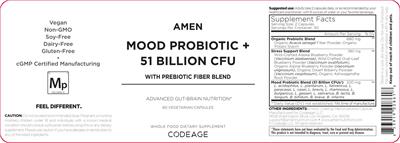
Supplement Facts
The label details for Mood Probiotic + 51 Billion CFU by Codeage Amen, sourced from the NIH Dietary Supplement Label Database.
Supplement Facts
| Ingredient | Amount | % DV |
|---|---|---|
| Potato Starch | 0 NP | -- |
| L. bulgaricus | 0 NP | -- |
| L. acidophilus | 0 NP | -- |
| Ashwagandha, Powder | 0 NP | -- |
| L. paracasei | 0 NP | -- |
| L. casei | 0 NP | -- |
| B. breve | 0 NP | -- |
| B. longum | 0 NP | -- |
| B. bifidum | 0 NP | -- |
| B. longum infantis | 0 NP | -- |
| L. plantarum | 0 NP | -- |
| B. animalis lactis | 0 NP | -- |
| L. gasseri | 0 NP | -- |
| L. rhamnosus | 0 NP | -- |
| L. salivarius | 0 NP | -- |
| L. helveticus | 0 NP | -- |
| L. brevis | 0 NP | -- |
| Stress Support Blend | 380 mg | -- |
| Mood Probiotic Blend | 200 mg | -- |
| Organic Prebiotic Blend | 680 mg | -- |
| Acacia senegal Fiber, Powder | 0 NP | -- |
| Alaska Blueberry, Powder | 0 NP | -- |
| Blueberry, Powder | 0 NP | -- |
| Alpine Blueberry, Powder | 0 NP | -- |
| Dwarf Bilberry, Powder | 0 NP | -- |
Other ingredients: Enteric Coating, Methylcellulose
Tap any ingredient to jump to its full detail below.
These statements are the manufacturer’s wording, reproduced from the product label — the label is saying it, not HelloPharmacist. We don’t verify or endorse them.
Formulation
Vegan
Non-GMO Soy-Free Dairy-Free Gluten-Free
cGMP Certified Manufacturing
Advanced gut-brain nutrition
Precautions
Caution: Do not exceed recommended dose.
Pregnant or nursing mothers, children under 18 and individuals with a known medical condition should consult a physician before using this or any dietary supplement.
Pregnant or nursing mothers, children under 18 and individuals with a known medical condition should consult a physician before using this or any dietary supplement.
Please use caution if you have allergies or sensitivities to any of the listed ingredients.
Do not use if product has been opened or tampered with in any way.
Keep out of reach of children and pets.
Formula
Mood probiotic + 51 billion CFU with prebiotic fiber blend
FDA Statement of Identity
Whole Food Dietary Supplement
Suggested/Recommended/Usage/Directions
Suggested use: Adults take 2 capsules daily, or as recommended by your healthcare practitioner, with 8 ounces of water or your favorite beverage.
Brand IP Statement(s)
Copyright Codeage LLC. All rights reserved.
FDA Disclaimer Statement
These statements have not been evaluated by the Food and Drug Administration. This product is not intended to diagnose, treat, cure or prevent any disease.
Storage
Store in a cool, dry place.
General Statements
Feel Different.
Is this label outdated? Report a formula or label change and our pharmacy team will review it.
Mood Probiotic + 51 Billion CFU by Codeage Amen label
The label scan from the NIH Dietary Supplement Label Database. Tap to enlarge.
Label images are published by the NIH Dietary Supplement Label Database for the version of this product on file. Always read your actual product label.
View the full label (PDF)The Ingredients in Mood Probiotic + 51 Billion CFU by Codeage Amen
These are the 22 active ingredients this product is made of. Select any to open its full monograph.
Serving size2 Capsule(s) Dosage formCapsule Servings per container30 Amounts shown are per serving.
Most supplement products combine several ingredients, and a medication can interact with the product through any one of them. Each ingredient below shows whether it has known drug interactions.
Stress Support Blend
Mood Probiotic Blend
- › L. bulgaricus
- › L. acidophilus
- › L. paracasei
- › L. casei
- › B. breve
- › B. longum
- › B. bifidum
- › B. longum infantis
- › L. plantarum
- › B. animalis lactis
- › L. gasseri
- › L. rhamnosus
- › L. salivarius
- › L. helveticus
- › L. brevis
Organic Prebiotic Blend
Other (inactive) ingredients: Enteric Coating, Methylcellulose. These complete the product’s ingredient list but are not active constituents.
Mood Probiotic + 51 Billion CFU by Codeage Amen Drug Interactions
HelloPharmacist Interaction Report
Codeage Amen Mood Probiotic + 51 Billion CFU has documented interactions with a substantial number of medications, primarily involving ashwagandha and bilberry components.
The most serious interaction is ashwagandha with drugs that suppress the immune system (immunosuppressants), which can theoretically reduce their effectiveness—a Moderate-severity concern.
Read the full breakdown — every affected drug type, severity by severity
Ashwagandha also carries Moderate-severity interactions with blood pressure medications (antihypertensive drugs), sedatives and anti-anxiety medications (CNS depressants and benzodiazepines), blood sugar medications (antidiabetes drugs), thyroid hormones, drugs that harm the liver (hepatotoxic drugs), and a class of liver-metabolizing enzymes (CYP1A2 substrates). Several probiotic strains—L. bulgaricus, L. acidophilus, B. breve, B. longum, B. bifidum, L. gasseri, and L. helveticus—all interact with antibiotics in the same way: they may lose effectiveness if taken simultaneously, since antibiotics can kill the live organisms in the probiotic.
Bilberry components carry Moderate-severity interactions with blood thinners (anticoagulants and antiplatelets), blood sugar medications, certain cancer drugs (erlotinib), and liver enzymes (CYP2E1 substrates). Blueberry ingredients interact at Minor severity with blood sugar medications and specific drugs like flurbiprofen and buspirone.
Potato starch interacts with clot-dissolving drugs (thrombolytics) and a surgical anesthetic (succinylcholine) at Moderate severity. We could not check L. paracasei, L. casei, B. longum infantis, L. plantarum, B. animalis lactis, L. rhamnosus, L. salivarius, L. brevis, Acacia senegal Fiber, or the Stress Support, Mood Probiotic, and Organic Prebiotic Blends themselves—no interaction data are on file for these.
Altogether, these interactions span 1,534 individual medications. Use the search tool on this page to check your exact drugs before you start.
Check your own medications below · Editorial policy · How we use AI
Want to check YOUR meds against Mood Probiotic + 51 Billion CFU?
Ask about interactions with your drugs in plain English — “Can I take it with lisinopril?” — and we find you the answer in seconds, ingredient by ingredient.
Go to the checkerIngredients driving the most interactions
Individual Drug Interactions
The ingredients in Mood Probiotic + 51 Billion CFU interact with 2,301 drugs. Click any drug to see the details.
12 of the 22 ingredients in Mood Probiotic + 51 Billion CFU interact with drugs. Each result below shows which ingredient is responsible. Acacia senegal Fiber, Powder Ashwagandha, Powder Alpine Blueberry, Powder L. bulgaricus L. acidophilus B. breve B. longum B. bifidum L. gasseri L. helveticus Alaska Blueberry, Powder Potato Starch
Acetaminophen, Caffeine, PyrilamineMidol Max Strength Menstrual
How Acetaminophen, Caffeine, Pyrilamine interacts with Mood Probiotic + 51 Billion CFU — through 3 ingredients. Tap an ingredient for the detail:
Ashwagandha, PowderCytochrome P450 3a4 (cyp3a4) Substrates, Cytochrome P450 1a2 (cyp1a2) Substrates +1 Moderate
Interaction Summary
Theoretically, ashwagandha might decrease the levels and clinical effects of CYP3A4 substrates.
Read the full Ashwagandha, Powder + Acetaminophen, Caffeine, Pyrilamine interactionDwarf Bilberry, PowderCytochrome P450 2e1 (cyp2e1) Substrates Moderate
Interaction Summary
Theoretically, bilberry fruit extract might decrease levels of drugs metabolized by CYP2E1.
Read the full Dwarf Bilberry, Powder + Acetaminophen, Caffeine, Pyrilamine interactionAcacia Senegal Fiber, PowderOral Drugs Moderate
Interaction Summary
Theoretically, gum arabic can alter the absorption of oral drugs due to its fiber content.
Read the full Acacia Senegal Fiber, Powder + Acetaminophen, Caffeine, Pyrilamine interactionAcetaminophen, Chlorpheniramine Maleate, Dextromethorphan HbrVicks Formula 44M Cough, Cold & Flu Relief
How Acetaminophen, Chlorpheniramine Maleate, Dextromethorphan Hbr interacts with Mood Probiotic + 51 Billion CFU — through 3 ingredients. Tap an ingredient for the detail:
Dwarf Bilberry, PowderCytochrome P450 2e1 (cyp2e1) Substrates Moderate
Interaction Summary
Theoretically, bilberry fruit extract might decrease levels of drugs metabolized by CYP2E1.
Read the full Dwarf Bilberry, Powder + Acetaminophen, Chlorpheniramine Maleate, Dextromethorphan Hbr interactionAcacia Senegal Fiber, PowderOral Drugs Moderate
Interaction Summary
Theoretically, gum arabic can alter the absorption of oral drugs due to its fiber content.
Read the full Acacia Senegal Fiber, Powder + Acetaminophen, Chlorpheniramine Maleate, Dextromethorphan Hbr interactionAshwagandha, PowderCytochrome P450 1a2 (cyp1a2) Substrates, Cytochrome P450 3a4 (cyp3a4) Substrates +2 Moderate
Interaction Summary
Theoretically, ashwagandha might decrease the levels and clinical effects of CYP1A2 substrates.
Read the full Ashwagandha, Powder + Acetaminophen, Chlorpheniramine Maleate, Dextromethorphan Hbr interactionAcetaminophen, Chlorpheniramine, Codeine, PhenylephrineColrex
How Acetaminophen, Chlorpheniramine, Codeine, Phenylephrine interacts with Mood Probiotic + 51 Billion CFU — through 3 ingredients. Tap an ingredient for the detail:
Ashwagandha, PowderSerotonergic Drugs, Hepatotoxic Drugs +3 Moderate
Interaction Summary
Some animal studies have reported that ashwagandha can enhance serotonergic transmission by altering certain serotonin (5-HT) receptors.
Read the full Ashwagandha, Powder + Acetaminophen, Chlorpheniramine, Codeine, Phenylephrine interactionAcacia Senegal Fiber, PowderOral Drugs Moderate
Interaction Summary
Theoretically, gum arabic can alter the absorption of oral drugs due to its fiber content.
Read the full Acacia Senegal Fiber, Powder + Acetaminophen, Chlorpheniramine, Codeine, Phenylephrine interactionDwarf Bilberry, PowderCytochrome P450 2e1 (cyp2e1) Substrates Moderate
Interaction Summary
Theoretically, bilberry fruit extract might decrease levels of drugs metabolized by CYP2E1.
Read the full Dwarf Bilberry, Powder + Acetaminophen, Chlorpheniramine, Codeine, Phenylephrine interactionAcetaminophen, Chlorpheniramine, DextromethorphanCoricidin II Extra Strength Cold and Flu
How Acetaminophen, Chlorpheniramine, Dextromethorphan interacts with Mood Probiotic + 51 Billion CFU — through 3 ingredients. Tap an ingredient for the detail:
Acacia Senegal Fiber, PowderOral Drugs Moderate
Interaction Summary
Theoretically, gum arabic can alter the absorption of oral drugs due to its fiber content.
Read the full Acacia Senegal Fiber, Powder + Acetaminophen, Chlorpheniramine, Dextromethorphan interactionAshwagandha, PowderCytochrome P450 1a2 (cyp1a2) Substrates, Serotonergic Drugs +2 Moderate
Interaction Summary
Theoretically, ashwagandha might decrease the levels and clinical effects of CYP1A2 substrates.
Read the full Ashwagandha, Powder + Acetaminophen, Chlorpheniramine, Dextromethorphan interactionDwarf Bilberry, PowderCytochrome P450 2e1 (cyp2e1) Substrates Moderate
Interaction Summary
Theoretically, bilberry fruit extract might decrease levels of drugs metabolized by CYP2E1.
Read the full Dwarf Bilberry, Powder + Acetaminophen, Chlorpheniramine, Dextromethorphan interactionAcetaminophen, Chlorpheniramine, Dextromethorphan HydrobromideCoricidin HBP Maximum Strength Flu
How Acetaminophen, Chlorpheniramine, Dextromethorphan Hydrobromide interacts with Mood Probiotic + 51 Billion CFU — through 3 ingredients. Tap an ingredient for the detail:
Dwarf Bilberry, PowderCytochrome P450 2e1 (cyp2e1) Substrates Moderate
Interaction Summary
Theoretically, bilberry fruit extract might decrease levels of drugs metabolized by CYP2E1.
Read the full Dwarf Bilberry, Powder + Acetaminophen, Chlorpheniramine, Dextromethorphan Hydrobromide interactionAcacia Senegal Fiber, PowderOral Drugs Moderate
Interaction Summary
Theoretically, gum arabic can alter the absorption of oral drugs due to its fiber content.
Read the full Acacia Senegal Fiber, Powder + Acetaminophen, Chlorpheniramine, Dextromethorphan Hydrobromide interactionAshwagandha, PowderCytochrome P450 3a4 (cyp3a4) Substrates, Cytochrome P450 1a2 (cyp1a2) Substrates +2 Moderate
Interaction Summary
Theoretically, ashwagandha might decrease the levels and clinical effects of CYP3A4 substrates.
Read the full Ashwagandha, Powder + Acetaminophen, Chlorpheniramine, Dextromethorphan Hydrobromide interactionAcetaminophen, Chlorpheniramine, Dextromethorphan, PhenylpropanolamineMulti Symptom Cold Relief
How Acetaminophen, Chlorpheniramine, Dextromethorphan, Phenylpropanolamine interacts with Mood Probiotic + 51 Billion CFU — through 3 ingredients. Tap an ingredient for the detail:
Ashwagandha, PowderSerotonergic Drugs, Cytochrome P450 3a4 (cyp3a4) Substrates +2 Moderate
Interaction Summary
Some animal studies have reported that ashwagandha can enhance serotonergic transmission by altering certain serotonin (5-HT) receptors.
Read the full Ashwagandha, Powder + Acetaminophen, Chlorpheniramine, Dextromethorphan, Phenylpropanolamine interactionDwarf Bilberry, PowderCytochrome P450 2e1 (cyp2e1) Substrates Moderate
Interaction Summary
Theoretically, bilberry fruit extract might decrease levels of drugs metabolized by CYP2E1.
Read the full Dwarf Bilberry, Powder + Acetaminophen, Chlorpheniramine, Dextromethorphan, Phenylpropanolamine interactionAcacia Senegal Fiber, PowderOral Drugs Moderate
Interaction Summary
Theoretically, gum arabic can alter the absorption of oral drugs due to its fiber content.
Read the full Acacia Senegal Fiber, Powder + Acetaminophen, Chlorpheniramine, Dextromethorphan, Phenylpropanolamine interactionAcetaminophen, Chlorpheniramine, Dextromethorphan, PseudoephedrineChildren's Tylenol Cold Plus Cough, Tylenol Cold Ex Strength
How Acetaminophen, Chlorpheniramine, Dextromethorphan, Pseudoephedrine interacts with Mood Probiotic + 51 Billion CFU — through 3 ingredients. Tap an ingredient for the detail:
Ashwagandha, PowderCytochrome P450 1a2 (cyp1a2) Substrates, Hepatotoxic Drugs +2 Moderate
Interaction Summary
Theoretically, ashwagandha might decrease the levels and clinical effects of CYP1A2 substrates.
Read the full Ashwagandha, Powder + Acetaminophen, Chlorpheniramine, Dextromethorphan, Pseudoephedrine interactionDwarf Bilberry, PowderCytochrome P450 2e1 (cyp2e1) Substrates Moderate
Interaction Summary
Theoretically, bilberry fruit extract might decrease levels of drugs metabolized by CYP2E1.
Read the full Dwarf Bilberry, Powder + Acetaminophen, Chlorpheniramine, Dextromethorphan, Pseudoephedrine interactionAcacia Senegal Fiber, PowderOral Drugs Moderate
Interaction Summary
Theoretically, gum arabic can alter the absorption of oral drugs due to its fiber content.
Read the full Acacia Senegal Fiber, Powder + Acetaminophen, Chlorpheniramine, Dextromethorphan, Pseudoephedrine interactionAcetaminophen, Chlorpheniramine, Guaifenesin, Phenylephrine, SalicylamideRhinogesic GG
How Acetaminophen, Chlorpheniramine, Guaifenesin, Phenylephrine, Salicylamide interacts with Mood Probiotic + 51 Billion CFU — through 3 ingredients. Tap an ingredient for the detail:
Dwarf Bilberry, PowderCytochrome P450 2e1 (cyp2e1) Substrates Moderate
Interaction Summary
Theoretically, bilberry fruit extract might decrease levels of drugs metabolized by CYP2E1.
Read the full Dwarf Bilberry, Powder + Acetaminophen, Chlorpheniramine, Guaifenesin, Phenylephrine, Salicylamide interactionAcacia Senegal Fiber, PowderOral Drugs Moderate
Interaction Summary
Theoretically, gum arabic can alter the absorption of oral drugs due to its fiber content.
Read the full Acacia Senegal Fiber, Powder + Acetaminophen, Chlorpheniramine, Guaifenesin, Phenylephrine, Salicylamide interactionAshwagandha, PowderCytochrome P450 1a2 (cyp1a2) Substrates, Cytochrome P450 3a4 (cyp3a4) Substrates +2 Moderate
Interaction Summary
Theoretically, ashwagandha might decrease the levels and clinical effects of CYP1A2 substrates.
Read the full Ashwagandha, Powder + Acetaminophen, Chlorpheniramine, Guaifenesin, Phenylephrine, Salicylamide interactionAcetaminophen, Chlorpheniramine, PhenylephrineAlka-Seltzer PLUS, Histex SR, Protid
How Acetaminophen, Chlorpheniramine, Phenylephrine interacts with Mood Probiotic + 51 Billion CFU — through 3 ingredients. Tap an ingredient for the detail:
Ashwagandha, PowderCytochrome P450 1a2 (cyp1a2) Substrates, Hepatotoxic Drugs +2 Moderate
Interaction Summary
Theoretically, ashwagandha might decrease the levels and clinical effects of CYP1A2 substrates.
Read the full Ashwagandha, Powder + Acetaminophen, Chlorpheniramine, Phenylephrine interactionDwarf Bilberry, PowderCytochrome P450 2e1 (cyp2e1) Substrates Moderate
Interaction Summary
Theoretically, bilberry fruit extract might decrease levels of drugs metabolized by CYP2E1.
Read the full Dwarf Bilberry, Powder + Acetaminophen, Chlorpheniramine, Phenylephrine interactionAcacia Senegal Fiber, PowderOral Drugs Moderate
Interaction Summary
Theoretically, gum arabic can alter the absorption of oral drugs due to its fiber content.
Read the full Acacia Senegal Fiber, Powder + Acetaminophen, Chlorpheniramine, Phenylephrine interactionAcetaminophen, Chlorpheniramine, Phenylephrine, SalicylamideRhinogesic, Rhinogesic JR
How Acetaminophen, Chlorpheniramine, Phenylephrine, Salicylamide interacts with Mood Probiotic + 51 Billion CFU — through 3 ingredients. Tap an ingredient for the detail:
Dwarf Bilberry, PowderCytochrome P450 2e1 (cyp2e1) Substrates Moderate
Interaction Summary
Theoretically, bilberry fruit extract might decrease levels of drugs metabolized by CYP2E1.
Read the full Dwarf Bilberry, Powder + Acetaminophen, Chlorpheniramine, Phenylephrine, Salicylamide interactionAcacia Senegal Fiber, PowderOral Drugs Moderate
Interaction Summary
Theoretically, gum arabic can alter the absorption of oral drugs due to its fiber content.
Read the full Acacia Senegal Fiber, Powder + Acetaminophen, Chlorpheniramine, Phenylephrine, Salicylamide interactionAshwagandha, PowderSerotonergic Drugs, Cytochrome P450 1a2 (cyp1a2) Substrates +2 Moderate
Interaction Summary
Some animal studies have reported that ashwagandha can enhance serotonergic transmission by altering certain serotonin (5-HT) receptors.
Read the full Ashwagandha, Powder + Acetaminophen, Chlorpheniramine, Phenylephrine, Salicylamide interactionAcetaminophen, Chlorpheniramine, PhenylpropanolamineAlumadrine, Conex, Sinadrin Max Strength, Sinulin
How Acetaminophen, Chlorpheniramine, Phenylpropanolamine interacts with Mood Probiotic + 51 Billion CFU — through 3 ingredients. Tap an ingredient for the detail:
Ashwagandha, PowderHepatotoxic Drugs, Serotonergic Drugs +2 Moderate
Interaction Summary
Theoretically, taking ashwagandha with hepatotoxic drugs might increase the risk of liver damage.
Read the full Ashwagandha, Powder + Acetaminophen, Chlorpheniramine, Phenylpropanolamine interactionDwarf Bilberry, PowderCytochrome P450 2e1 (cyp2e1) Substrates Moderate
Interaction Summary
Theoretically, bilberry fruit extract might decrease levels of drugs metabolized by CYP2E1.
Read the full Dwarf Bilberry, Powder + Acetaminophen, Chlorpheniramine, Phenylpropanolamine interactionAcacia Senegal Fiber, PowderOral Drugs Moderate
Interaction Summary
Theoretically, gum arabic can alter the absorption of oral drugs due to its fiber content.
Read the full Acacia Senegal Fiber, Powder + Acetaminophen, Chlorpheniramine, Phenylpropanolamine interactionAcetaminophen, Chlorpheniramine, Phenylpropanolamine, OpiumHista-Derfule
How Acetaminophen, Chlorpheniramine, Phenylpropanolamine, Opium interacts with Mood Probiotic + 51 Billion CFU — through 3 ingredients. Tap an ingredient for the detail:
Dwarf Bilberry, PowderCytochrome P450 2e1 (cyp2e1) Substrates Moderate
Interaction Summary
Theoretically, bilberry fruit extract might decrease levels of drugs metabolized by CYP2E1.
Read the full Dwarf Bilberry, Powder + Acetaminophen, Chlorpheniramine, Phenylpropanolamine, Opium interactionAcacia Senegal Fiber, PowderOral Drugs Moderate
Interaction Summary
Theoretically, gum arabic can alter the absorption of oral drugs due to its fiber content.
Read the full Acacia Senegal Fiber, Powder + Acetaminophen, Chlorpheniramine, Phenylpropanolamine, Opium interactionAshwagandha, PowderCytochrome P450 3a4 (cyp3a4) Substrates, Cytochrome P450 1a2 (cyp1a2) Substrates +3 Moderate
Interaction Summary
Theoretically, ashwagandha might decrease the levels and clinical effects of CYP3A4 substrates.
Read the full Ashwagandha, Powder + Acetaminophen, Chlorpheniramine, Phenylpropanolamine, Opium interactionAcetaminophen, Chlorpheniramine, Phenylpropanolamine, PhenyltoloxamineNorel Plus
How Acetaminophen, Chlorpheniramine, Phenylpropanolamine, Phenyltoloxamine interacts with Mood Probiotic + 51 Billion CFU — through 3 ingredients. Tap an ingredient for the detail:
Ashwagandha, PowderCytochrome P450 1a2 (cyp1a2) Substrates, Cytochrome P450 3a4 (cyp3a4) Substrates +2 Moderate
Interaction Summary
Theoretically, ashwagandha might decrease the levels and clinical effects of CYP1A2 substrates.
Read the full Ashwagandha, Powder + Acetaminophen, Chlorpheniramine, Phenylpropanolamine, Phenyltoloxamine interactionAcacia Senegal Fiber, PowderOral Drugs Moderate
Interaction Summary
Theoretically, gum arabic can alter the absorption of oral drugs due to its fiber content.
Read the full Acacia Senegal Fiber, Powder + Acetaminophen, Chlorpheniramine, Phenylpropanolamine, Phenyltoloxamine interactionDwarf Bilberry, PowderCytochrome P450 2e1 (cyp2e1) Substrates Moderate
Interaction Summary
Theoretically, bilberry fruit extract might decrease levels of drugs metabolized by CYP2E1.
Read the full Dwarf Bilberry, Powder + Acetaminophen, Chlorpheniramine, Phenylpropanolamine, Phenyltoloxamine interactionAcetaminophen, Chlorpheniramine, PseudoephedrineAlka-Seltzer PLUS Liquid Gels, Children's Tylenol Cold, Codimal, Comtrex, Extra Strength Tylenol Allergy Sinus, Lorsin +3 more
How Acetaminophen, Chlorpheniramine, Pseudoephedrine interacts with Mood Probiotic + 51 Billion CFU — through 3 ingredients. Tap an ingredient for the detail:
Ashwagandha, PowderHepatotoxic Drugs, Serotonergic Drugs +2 Moderate
Interaction Summary
Theoretically, taking ashwagandha with hepatotoxic drugs might increase the risk of liver damage.
Read the full Ashwagandha, Powder + Acetaminophen, Chlorpheniramine, Pseudoephedrine interactionDwarf Bilberry, PowderCytochrome P450 2e1 (cyp2e1) Substrates Moderate
Interaction Summary
Theoretically, bilberry fruit extract might decrease levels of drugs metabolized by CYP2E1.
Read the full Dwarf Bilberry, Powder + Acetaminophen, Chlorpheniramine, Pseudoephedrine interactionAcacia Senegal Fiber, PowderOral Drugs Moderate
Interaction Summary
Theoretically, gum arabic can alter the absorption of oral drugs due to its fiber content.
Read the full Acacia Senegal Fiber, Powder + Acetaminophen, Chlorpheniramine, Pseudoephedrine interactionAcetaminophen, ChlorzoxazoneAcetazone Forte, Extra Strength Tylenol Aches & Strains, Parafon Forte
How Acetaminophen, Chlorzoxazone interacts with Mood Probiotic + 51 Billion CFU — through 3 ingredients. Tap an ingredient for the detail:
Acacia Senegal Fiber, PowderOral Drugs Moderate
Interaction Summary
Theoretically, gum arabic can alter the absorption of oral drugs due to its fiber content.
Read the full Acacia Senegal Fiber, Powder + Acetaminophen, Chlorzoxazone interactionDwarf Bilberry, PowderCytochrome P450 2e1 (cyp2e1) Substrates Moderate
Interaction Summary
Theoretically, bilberry fruit extract might decrease levels of drugs metabolized by CYP2E1.
Read the full Dwarf Bilberry, Powder + Acetaminophen, Chlorzoxazone interactionAshwagandha, PowderHepatotoxic Drugs, Cytochrome P450 1a2 (cyp1a2) Substrates Moderate
Interaction Summary
Theoretically, taking ashwagandha with hepatotoxic drugs might increase the risk of liver damage.
Read the full Ashwagandha, Powder + Acetaminophen, Chlorzoxazone interactionAcetaminophen, Chlorzoxazone, CodeineAcetazone Forte C8, Parafon Forte C8
How Acetaminophen, Chlorzoxazone, Codeine interacts with Mood Probiotic + 51 Billion CFU — through 3 ingredients. Tap an ingredient for the detail:
Ashwagandha, PowderCytochrome P450 1a2 (cyp1a2) Substrates, Cns Depressants +1 Moderate
Interaction Summary
Theoretically, ashwagandha might decrease the levels and clinical effects of CYP1A2 substrates.
Read the full Ashwagandha, Powder + Acetaminophen, Chlorzoxazone, Codeine interactionDwarf Bilberry, PowderCytochrome P450 2e1 (cyp2e1) Substrates Moderate
Interaction Summary
Theoretically, bilberry fruit extract might decrease levels of drugs metabolized by CYP2E1.
Read the full Dwarf Bilberry, Powder + Acetaminophen, Chlorzoxazone, Codeine interactionAcacia Senegal Fiber, PowderOral Drugs Moderate
Interaction Summary
Theoretically, gum arabic can alter the absorption of oral drugs due to its fiber content.
Read the full Acacia Senegal Fiber, Powder + Acetaminophen, Chlorzoxazone, Codeine interactionAcetaminophen, CodeineTylenol No.3, Tylenol w/ Codeine
How Acetaminophen, Codeine interacts with Mood Probiotic + 51 Billion CFU — through 3 ingredients. Tap an ingredient for the detail:
Ashwagandha, PowderHepatotoxic Drugs, Cns Depressants +1 Moderate
Interaction Summary
Theoretically, taking ashwagandha with hepatotoxic drugs might increase the risk of liver damage.
Read the full Ashwagandha, Powder + Acetaminophen, Codeine interactionAcacia Senegal Fiber, PowderOral Drugs Moderate
Interaction Summary
Theoretically, gum arabic can alter the absorption of oral drugs due to its fiber content.
Read the full Acacia Senegal Fiber, Powder + Acetaminophen, Codeine interactionDwarf Bilberry, PowderCytochrome P450 2e1 (cyp2e1) Substrates Moderate
Interaction Summary
Theoretically, bilberry fruit extract might decrease levels of drugs metabolized by CYP2E1.
Read the full Dwarf Bilberry, Powder + Acetaminophen, Codeine interactionAcetaminophen, Codeine, DoxylamineMersyndol
How Acetaminophen, Codeine, Doxylamine interacts with Mood Probiotic + 51 Billion CFU — through 3 ingredients. Tap an ingredient for the detail:
Dwarf Bilberry, PowderCytochrome P450 2e1 (cyp2e1) Substrates Moderate
Interaction Summary
Theoretically, bilberry fruit extract might decrease levels of drugs metabolized by CYP2E1.
Read the full Dwarf Bilberry, Powder + Acetaminophen, Codeine, Doxylamine interactionAcacia Senegal Fiber, PowderOral Drugs Moderate
Interaction Summary
Theoretically, gum arabic can alter the absorption of oral drugs due to its fiber content.
Read the full Acacia Senegal Fiber, Powder + Acetaminophen, Codeine, Doxylamine interactionAshwagandha, PowderHepatotoxic Drugs, Cytochrome P450 1a2 (cyp1a2) Substrates +1 Moderate
Interaction Summary
Theoretically, taking ashwagandha with hepatotoxic drugs might increase the risk of liver damage.
Read the full Ashwagandha, Powder + Acetaminophen, Codeine, Doxylamine interactionAcetaminophen, Codeine, MethocarbamolAcetaminophen, Codeine, Methocarbamol, Robaxacet 8
How Acetaminophen, Codeine, Methocarbamol interacts with Mood Probiotic + 51 Billion CFU — through 3 ingredients. Tap an ingredient for the detail:
Ashwagandha, PowderCns Depressants, Cytochrome P450 1a2 (cyp1a2) Substrates +1 Moderate
Interaction Summary
Theoretically, taking ashwagandha might increase the sedative effects of CNS depressants.
Read the full Ashwagandha, Powder + Acetaminophen, Codeine, Methocarbamol interactionAcacia Senegal Fiber, PowderOral Drugs Moderate
Interaction Summary
Theoretically, gum arabic can alter the absorption of oral drugs due to its fiber content.
Read the full Acacia Senegal Fiber, Powder + Acetaminophen, Codeine, Methocarbamol interactionDwarf Bilberry, PowderCytochrome P450 2e1 (cyp2e1) Substrates Moderate
Interaction Summary
Theoretically, bilberry fruit extract might decrease levels of drugs metabolized by CYP2E1.
Read the full Dwarf Bilberry, Powder + Acetaminophen, Codeine, Methocarbamol interactionAcetaminophen, Dexbrompheniramine, PseudoephedrineSinadrin Plus
How Acetaminophen, Dexbrompheniramine, Pseudoephedrine interacts with Mood Probiotic + 51 Billion CFU — through 3 ingredients. Tap an ingredient for the detail:
Ashwagandha, PowderCytochrome P450 1a2 (cyp1a2) Substrates, Hepatotoxic Drugs Moderate
Interaction Summary
Theoretically, ashwagandha might decrease the levels and clinical effects of CYP1A2 substrates.
Read the full Ashwagandha, Powder + Acetaminophen, Dexbrompheniramine, Pseudoephedrine interactionDwarf Bilberry, PowderCytochrome P450 2e1 (cyp2e1) Substrates Moderate
Interaction Summary
Theoretically, bilberry fruit extract might decrease levels of drugs metabolized by CYP2E1.
Read the full Dwarf Bilberry, Powder + Acetaminophen, Dexbrompheniramine, Pseudoephedrine interactionAcacia Senegal Fiber, PowderOral Drugs Moderate
Interaction Summary
Theoretically, gum arabic can alter the absorption of oral drugs due to its fiber content.
Read the full Acacia Senegal Fiber, Powder + Acetaminophen, Dexbrompheniramine, Pseudoephedrine interactionAcetaminophen, DextromethorphanTylenol Cough Ex Strength
How Acetaminophen, Dextromethorphan interacts with Mood Probiotic + 51 Billion CFU — through 3 ingredients. Tap an ingredient for the detail:
Dwarf Bilberry, PowderCytochrome P450 2e1 (cyp2e1) Substrates Moderate
Interaction Summary
Theoretically, bilberry fruit extract might decrease levels of drugs metabolized by CYP2E1.
Read the full Dwarf Bilberry, Powder + Acetaminophen, Dextromethorphan interactionAcacia Senegal Fiber, PowderOral Drugs Moderate
Interaction Summary
Theoretically, gum arabic can alter the absorption of oral drugs due to its fiber content.
Read the full Acacia Senegal Fiber, Powder + Acetaminophen, Dextromethorphan interactionAshwagandha, PowderCytochrome P450 1a2 (cyp1a2) Substrates, Hepatotoxic Drugs +2 Moderate
Interaction Summary
Theoretically, ashwagandha might decrease the levels and clinical effects of CYP1A2 substrates.
Read the full Ashwagandha, Powder + Acetaminophen, Dextromethorphan interactionAcetaminophen, Dextromethorphan, Doxylamine, PseudoephedrineVicks NyQuil
How Acetaminophen, Dextromethorphan, Doxylamine, Pseudoephedrine interacts with Mood Probiotic + 51 Billion CFU — through 3 ingredients. Tap an ingredient for the detail:
Ashwagandha, PowderSerotonergic Drugs, Hepatotoxic Drugs +2 Moderate
Interaction Summary
Some animal studies have reported that ashwagandha can enhance serotonergic transmission by altering certain serotonin (5-HT) receptors.
Read the full Ashwagandha, Powder + Acetaminophen, Dextromethorphan, Doxylamine, Pseudoephedrine interactionDwarf Bilberry, PowderCytochrome P450 2e1 (cyp2e1) Substrates Moderate
Interaction Summary
Theoretically, bilberry fruit extract might decrease levels of drugs metabolized by CYP2E1.
Read the full Dwarf Bilberry, Powder + Acetaminophen, Dextromethorphan, Doxylamine, Pseudoephedrine interactionAcacia Senegal Fiber, PowderOral Drugs Moderate
Interaction Summary
Theoretically, gum arabic can alter the absorption of oral drugs due to its fiber content.
Read the full Acacia Senegal Fiber, Powder + Acetaminophen, Dextromethorphan, Doxylamine, Pseudoephedrine interactionAcetaminophen, Dextromethorphan, Guaifenesin, PhenylephrineConar-A
How Acetaminophen, Dextromethorphan, Guaifenesin, Phenylephrine interacts with Mood Probiotic + 51 Billion CFU — through 3 ingredients. Tap an ingredient for the detail:
Acacia Senegal Fiber, PowderOral Drugs Moderate
Interaction Summary
Theoretically, gum arabic can alter the absorption of oral drugs due to its fiber content.
Read the full Acacia Senegal Fiber, Powder + Acetaminophen, Dextromethorphan, Guaifenesin, Phenylephrine interactionDwarf Bilberry, PowderCytochrome P450 2e1 (cyp2e1) Substrates Moderate
Interaction Summary
Theoretically, bilberry fruit extract might decrease levels of drugs metabolized by CYP2E1.
Read the full Dwarf Bilberry, Powder + Acetaminophen, Dextromethorphan, Guaifenesin, Phenylephrine interactionAshwagandha, PowderCytochrome P450 1a2 (cyp1a2) Substrates, Hepatotoxic Drugs +2 Moderate
Interaction Summary
Theoretically, ashwagandha might decrease the levels and clinical effects of CYP1A2 substrates.
Read the full Ashwagandha, Powder + Acetaminophen, Dextromethorphan, Guaifenesin, Phenylephrine interactionAcetaminophen, Dextromethorphan, Guaifenesin, PhenylpropanolamineAnatuss
How Acetaminophen, Dextromethorphan, Guaifenesin, Phenylpropanolamine interacts with Mood Probiotic + 51 Billion CFU — through 3 ingredients. Tap an ingredient for the detail:
Ashwagandha, PowderHepatotoxic Drugs, Serotonergic Drugs +2 Moderate
Interaction Summary
Theoretically, taking ashwagandha with hepatotoxic drugs might increase the risk of liver damage.
Read the full Ashwagandha, Powder + Acetaminophen, Dextromethorphan, Guaifenesin, Phenylpropanolamine interactionDwarf Bilberry, PowderCytochrome P450 2e1 (cyp2e1) Substrates Moderate
Interaction Summary
Theoretically, bilberry fruit extract might decrease levels of drugs metabolized by CYP2E1.
Read the full Dwarf Bilberry, Powder + Acetaminophen, Dextromethorphan, Guaifenesin, Phenylpropanolamine interactionAcacia Senegal Fiber, PowderOral Drugs Moderate
Interaction Summary
Theoretically, gum arabic can alter the absorption of oral drugs due to its fiber content.
Read the full Acacia Senegal Fiber, Powder + Acetaminophen, Dextromethorphan, Guaifenesin, Phenylpropanolamine interactionAcetaminophen, Dextromethorphan, Guaifenesin, PseudoephedrineRobitussin Cold, Severe Cold, Suphedrine Cold/Cough
How Acetaminophen, Dextromethorphan, Guaifenesin, Pseudoephedrine interacts with Mood Probiotic + 51 Billion CFU — through 3 ingredients. Tap an ingredient for the detail:
Dwarf Bilberry, PowderCytochrome P450 2e1 (cyp2e1) Substrates Moderate
Interaction Summary
Theoretically, bilberry fruit extract might decrease levels of drugs metabolized by CYP2E1.
Read the full Dwarf Bilberry, Powder + Acetaminophen, Dextromethorphan, Guaifenesin, Pseudoephedrine interactionAcacia Senegal Fiber, PowderOral Drugs Moderate
Interaction Summary
Theoretically, gum arabic can alter the absorption of oral drugs due to its fiber content.
Read the full Acacia Senegal Fiber, Powder + Acetaminophen, Dextromethorphan, Guaifenesin, Pseudoephedrine interactionAshwagandha, PowderCytochrome P450 3a4 (cyp3a4) Substrates, Hepatotoxic Drugs +2 Moderate
Interaction Summary
Theoretically, ashwagandha might decrease the levels and clinical effects of CYP3A4 substrates.
Read the full Ashwagandha, Powder + Acetaminophen, Dextromethorphan, Guaifenesin, Pseudoephedrine interactionAcetaminophen, Dextromethorphan, Phenylpropanolamine, PyrilamineTheracaps
How Acetaminophen, Dextromethorphan, Phenylpropanolamine, Pyrilamine interacts with Mood Probiotic + 51 Billion CFU — through 3 ingredients. Tap an ingredient for the detail:
Ashwagandha, PowderHepatotoxic Drugs, Cytochrome P450 3a4 (cyp3a4) Substrates +2 Moderate
Interaction Summary
Theoretically, taking ashwagandha with hepatotoxic drugs might increase the risk of liver damage.
Read the full Ashwagandha, Powder + Acetaminophen, Dextromethorphan, Phenylpropanolamine, Pyrilamine interactionAcacia Senegal Fiber, PowderOral Drugs Moderate
Interaction Summary
Theoretically, gum arabic can alter the absorption of oral drugs due to its fiber content.
Read the full Acacia Senegal Fiber, Powder + Acetaminophen, Dextromethorphan, Phenylpropanolamine, Pyrilamine interactionDwarf Bilberry, PowderCytochrome P450 2e1 (cyp2e1) Substrates Moderate
Interaction Summary
Theoretically, bilberry fruit extract might decrease levels of drugs metabolized by CYP2E1.
Read the full Dwarf Bilberry, Powder + Acetaminophen, Dextromethorphan, Phenylpropanolamine, Pyrilamine interactionAcetaminophen, Dextromethorphan, PseudoephedrineAlka-Seltzer PLUS Flu Liquid Gels, Non Aspirin Cold Caps, Tylenol Cold, Tylenol Flu Daytime Ex Strength, Tylenol Flu Ex Strength
How Acetaminophen, Dextromethorphan, Pseudoephedrine interacts with Mood Probiotic + 51 Billion CFU — through 3 ingredients. Tap an ingredient for the detail:
Ashwagandha, PowderCytochrome P450 1a2 (cyp1a2) Substrates, Serotonergic Drugs +2 Moderate
Interaction Summary
Theoretically, ashwagandha might decrease the levels and clinical effects of CYP1A2 substrates.
Read the full Ashwagandha, Powder + Acetaminophen, Dextromethorphan, Pseudoephedrine interactionDwarf Bilberry, PowderCytochrome P450 2e1 (cyp2e1) Substrates Moderate
Interaction Summary
Theoretically, bilberry fruit extract might decrease levels of drugs metabolized by CYP2E1.
Read the full Dwarf Bilberry, Powder + Acetaminophen, Dextromethorphan, Pseudoephedrine interactionAcacia Senegal Fiber, PowderOral Drugs Moderate
Interaction Summary
Theoretically, gum arabic can alter the absorption of oral drugs due to its fiber content.
Read the full Acacia Senegal Fiber, Powder + Acetaminophen, Dextromethorphan, Pseudoephedrine interactionAcetaminophen, Dichloralantipyrine, IsomethepteneAmidrine, Midchlor, Migquin, Migratine
How Acetaminophen, Dichloralantipyrine, Isometheptene interacts with Mood Probiotic + 51 Billion CFU — through 3 ingredients. Tap an ingredient for the detail:
Dwarf Bilberry, PowderCytochrome P450 2e1 (cyp2e1) Substrates Moderate
Interaction Summary
Theoretically, bilberry fruit extract might decrease levels of drugs metabolized by CYP2E1.
Read the full Dwarf Bilberry, Powder + Acetaminophen, Dichloralantipyrine, Isometheptene interactionAcacia Senegal Fiber, PowderOral Drugs Moderate
Interaction Summary
Theoretically, gum arabic can alter the absorption of oral drugs due to its fiber content.
Read the full Acacia Senegal Fiber, Powder + Acetaminophen, Dichloralantipyrine, Isometheptene interactionAshwagandha, PowderCytochrome P450 1a2 (cyp1a2) Substrates, Cns Depressants +1 Moderate
Interaction Summary
Theoretically, ashwagandha might decrease the levels and clinical effects of CYP1A2 substrates.
Read the full Ashwagandha, Powder + Acetaminophen, Dichloralantipyrine, Isometheptene interactionAcetaminophen, Dichloralphenazone, IsomethepteneMidrin
How Acetaminophen, Dichloralphenazone, Isometheptene interacts with Mood Probiotic + 51 Billion CFU — through 3 ingredients. Tap an ingredient for the detail:
Ashwagandha, PowderCytochrome P450 1a2 (cyp1a2) Substrates, Hepatotoxic Drugs +1 Moderate
Interaction Summary
Theoretically, ashwagandha might decrease the levels and clinical effects of CYP1A2 substrates.
Read the full Ashwagandha, Powder + Acetaminophen, Dichloralphenazone, Isometheptene interactionDwarf Bilberry, PowderCytochrome P450 2e1 (cyp2e1) Substrates Moderate
Interaction Summary
Theoretically, bilberry fruit extract might decrease levels of drugs metabolized by CYP2E1.
Read the full Dwarf Bilberry, Powder + Acetaminophen, Dichloralphenazone, Isometheptene interactionAcacia Senegal Fiber, PowderOral Drugs Moderate
Interaction Summary
Theoretically, gum arabic can alter the absorption of oral drugs due to its fiber content.
Read the full Acacia Senegal Fiber, Powder + Acetaminophen, Dichloralphenazone, Isometheptene interactionAcetaminophen, Dichlorophenazone, IsometheptaneIsocom
How Acetaminophen, Dichlorophenazone, Isometheptane interacts with Mood Probiotic + 51 Billion CFU — through 3 ingredients. Tap an ingredient for the detail:
Ashwagandha, PowderCns Depressants, Hepatotoxic Drugs +1 Moderate
Interaction Summary
Theoretically, taking ashwagandha might increase the sedative effects of CNS depressants.
Read the full Ashwagandha, Powder + Acetaminophen, Dichlorophenazone, Isometheptane interactionAcacia Senegal Fiber, PowderOral Drugs Moderate
Interaction Summary
Theoretically, gum arabic can alter the absorption of oral drugs due to its fiber content.
Read the full Acacia Senegal Fiber, Powder + Acetaminophen, Dichlorophenazone, Isometheptane interactionDwarf Bilberry, PowderCytochrome P450 2e1 (cyp2e1) Substrates Moderate
Interaction Summary
Theoretically, bilberry fruit extract might decrease levels of drugs metabolized by CYP2E1.
Read the full Dwarf Bilberry, Powder + Acetaminophen, Dichlorophenazone, Isometheptane interactionEach ingredient & the kinds of drugs it affects
For each ingredient in Mood Probiotic + 51 Billion CFU with known interactions, here are the types of medications they can affect. Open any type for the detail — or search your exact drug in the checker above.
Acacia senegal Fiber, Powder
Amoxicillin (Amoxil, Trimox)
Gum arabic can reduce the absorption of amoxicillin.
A small study in healthy volunteers shows that taking amoxicillin and gum arabic concurrently significantly reduces the absorption of amoxicillin. Separate doses of amoxicillin from gum arabic by at least 2 hours.
Oral Drugs
Theoretically, gum arabic can alter the absorption of oral drugs due to its fiber content.
Gum arabic has been used as a suspending osmotic agent in drug formulations. It might improve bioavailability of water-insoluble drugs like naproxen, but reduce absorption of polar drugs like amoxicillin. To avoid changes in absorption, take gum arabic 30-60 minutes after oral medications.
Ashwagandha, Powder
Antidiabetes Drugs
Theoretically, taking ashwagandha with antidiabetes drugs might increase the risk of hypoglycemia.
There is preliminary clinical evidence suggesting that ashwagandha might lower blood glucose levels. Theoretically, ashwagandha might have additive effects when used with antidiabetes drugs and increase the risk of hypoglycemia.
Antihypertensive Drugs
Theoretically, taking ashwagandha with antihypertensive drugs might increase the risk of hypotension.
Animal research suggests that ashwagandha might lower systolic and diastolic blood pressure. Theoretically, ashwagandha might have additive effects when used with antihypertensive drugs and increase the risk of hypotension.
Benzodiazepines
Theoretically, taking ashwagandha might increase the sedative effects of benzodiazepines.
There is preliminary evidence that ashwagandha might have an additive effect with diazepam (Valium) and clonazepam (Klonopin). This may also occur with other benzodiazepines.
Cns Depressants
Theoretically, taking ashwagandha might increase the sedative effects of CNS depressants.
Ashwagandha seems to have sedative effects. Theoretically, this may potentiate the effects of barbiturates, other sedatives, and anxiolytics.
Hepatotoxic Drugs
Theoretically, taking ashwagandha with hepatotoxic drugs might increase the risk of liver damage.
Ashwagandha has been linked to cases of acute hepatitis, liver failure, hepatic encephalopathy, autoimmune hepatitis, the need for liver transplantation, and death due to liver failure.
Immunosuppressants
Theoretically, taking ashwagandha might decrease the effects of immunosuppressants.
Ashwagandha has demonstrated immunostimulant effects in humans. Animal research has shown that ashwagandha can attenuate the immunosuppression caused by cyclophosphamide.
Thyroid Hormone
Ashwagandha might increase the effects and adverse effects of thyroid hormone.
Concomitant use of ashwagandha with thyroid hormones may cause additive therapeutic and adverse effects. Preliminary clinical research and animal studies suggest that ashwagandha boosts thyroid hormone synthesis and secretion. In one clinical study, ashwagandha increased triiodothyronine (T3) and thyroxine (T4) levels by 41.5% and 19.6%, respectively, and reduced serum TSH levels by 17.4% from baseline in adults with subclinical hypothyroidism.
Cytochrome P450 1A2 (Cyp1A2) Substrates
Theoretically, ashwagandha might decrease the levels and clinical effects of CYP1A2 substrates.
In vitro research shows that ashwagandha extract induces CYP1A2 enzymes.
Cytochrome P450 3A4 (Cyp3A4) Substrates
Theoretically, ashwagandha might decrease the levels and clinical effects of CYP3A4 substrates.
In vitro research shows that ashwagandha extract induces CYP3A4 enzymes.
Serotonergic Drugs
Some animal studies have reported that ashwagandha can enhance serotonergic transmission by altering certain serotonin (5-HT) receptors. However, there is no evidence to suggest that ashwagandha increases the risk of serotonin-related effects, and there have been no published case reports of serotonin syndrome when combined with other serotonergic drugs. Nevertheless, due to the lack of extensive studies on the matter and the fact that ashwagandha appears to affect serotonergic pathways, it would be prudent to exercise caution when combining it with drugs that affect serotonin. [References: - Effects of Withania somnifera (Ashwaga ndha) on Stress and the Stress-Related Neuropsychiatric Disorders Anxiety, Depression, and Insomnia. Curr Neuropharmacol. 2021 Sep 14; 19: 1468–1495. - A Prospective, Randomized Double-Blind, Placebo-Controlled Study of Safety and Efficacy of a High-Concentration Full-Spectrum Extract of Ashwagandha Root in Reducing Stress and Anxiety in Adults. https://www.ncbi.nlm.nih.gov/pmc/articles/PMC3573577/]
Alpine Blueberry, Powder
Anticoagulant/Antiplatelet Drugs
Theoretically, bilberry fruit extract might increase the risk of bleeding when taken with anticoagulant or antiplatelet drugs.
In vitro, animal, and clinical research suggest that anthocyanidin extracts from bilberry can inhibit platelet aggregation.
Antidiabetes Drugs
Theoretically, bilberry leaf or fruit extract may increase the risk of hypoglycemia when taken with antidiabetes drugs.
Animal research suggests that bilberry leaf extract might have blood glucose-lowering activity. Also, one small clinical trial in patients with type 2 diabetes shows that taking bilberry fruit extract 470 mg as a single dose prior to an oral glucose tolerance test lowers plasma glucose levels when compared with placebo.
Cytochrome P450 2E1 (Cyp2E1) Substrates
Theoretically, bilberry fruit extract might decrease levels of drugs metabolized by CYP2E1.
Animal research shows that exposure to small concentrations of bilberry extract in drinking water for around one month increased CYP2E1 activity by 31%. However, exposure over a 2-month period did not increase CYP2E1 activity. This effect has not been reported in humans.
Erlotinib (Tarceva)
Theoretically, bilberry fruit extract might reduce the efficacy of erlotinib.
In vitro research suggests that bilberry fruit extract and its constituents, delphinidin and delphinidin-3-O-glucoside, inhibit the activity of erlotinib. This interaction has not been reported in humans.
L. bulgaricus
Antibiotic Drugs
Theoretically, taking Lactobacillus delbrueckii with antibiotic drugs might decrease the effectiveness of L. delbrueckii.
Lactobacillus delbrueckii preparations usually contain live and active organisms. Therefore, simultaneously taking antibiotics might kill a significant number of the organisms. Tell patients to separate administration of antibiotics and L. delbrueckii preparations by at least two hours.
L. acidophilus
Antibiotic Drugs
Theoretically, taking Lactobacillus acidophilus with antibiotic drugs might decrease the effectiveness of L. acidophilus.
L. acidophilus preparations usually contain live and active organisms. Therefore, simultaneously taking antibiotics might kill a significant number of the organisms. Tell patients to separate administration of antibiotics and L. acidophilus preparations by at least two hours.
B. breve
Antibiotic Drugs
Theoretically, taking Bifidobacterium breve with antibiotic drugs might decrease the effectiveness of B. breve.
Since B. breve preparations usually contain live and active organisms, simultaneously taking antibiotics might kill a significant number of the organisms. Tell patients to separate administration of antibiotics and B. breve preparations by at least 2 hours.
B. longum
Antibiotic Drugs
Theoretically, taking Bifidobacterium longum with antibiotic drugs might decrease the effectiveness of B. longum.
Since B. longum preparations usually contain live and active organisms, simultaneously taking antibiotics might kill a significant number of the organisms. Tell patients to separate administration of antibiotics and B. longum preparations by at least 2 hours.
B. bifidum
Antibiotic Drugs
Theoretically, taking Bifidobacterium. bifidum with antibiotic drugs might decrease the effectiveness of B. bifidum.
Since B. bifidum preparations usually contain live and active organisms, simultaneously taking antibiotics might kill a significant number of the organisms. Tell patients to separate administration of antibiotics and B. bifidum preparations by at least 2 hours.
L. gasseri
Antibiotic Drugs
Theoretically, taking Lactobacillus gasseri with antibiotic drugs might decrease the effectiveness of L. gasseri.
Lactobacillus gasseri preparations usually contain live and active organisms. Therefore, simultaneously taking antibiotics might kill a significant number of the organisms. Tell patients to separate administration of antibiotics and L. gasseri preparations by at least two hours.
L. helveticus
Antibiotic Drugs
Theoretically, taking Lactobacillus helveticus with antibiotic drugs might decrease the effectiveness of L. helveticus.
Lactobacillus helveticus preparations usually contain live and active organisms. Therefore, simultaneously taking antibiotics might kill a significant number of the organisms. Tell patients to separate administration of antibiotics and L. helveticus preparations by at least two hours.
Alaska Blueberry, Powder
Antidiabetes Drugs
Theoretically, blueberries or blueberry leaf extracts might increase the risk of hypoglycemia when taken with antidiabetes drugs.
Animal and in vitro research suggests that blueberry and/or blueberry leaf extracts can lower blood glucose levels.
Buspirone (Buspar)
Theoretically, blueberry juice might increase blood levels of buspirone.
In vitro research shows that blueberry juice can inhibit the metabolism of buspirone, possibly by inhibiting cytochrome P450 3A (CYP3A) enzymes. However, pharmacokinetic research in humans shows that drinking 300 mL of blueberry juice 30 minutes before taking buspirone hydrochloride 10 mg does not significantly affect the concentration or clearance of buspirone.
Flurbiprofen (Ansaid, Others)
Theoretically, blueberry juice might increase blood levels of flurbiprofen.
In vitro research shows that blueberry juice can inhibit the metabolism of flurbiprofen, possibly by inhibiting cytochrome P450 2C9 (CYP2C9) enzymes. However, pharmacokinetic research in humans shows that drinking 300 mL of blueberry juice 30 minutes before taking flurbiprofen 100 mg does not significantly affect the concentration or clearance of flurbiprofen.
Potato Starch
Succinylcholine
In humans, consuming potatoes prior to preoperative fasting prolongs the duration of the succinylcholine-induced neuromuscular block and slows recovery from anesthesia. This interaction is possibly related to inhibition of the butyrylcholinesterase enzyme by potato glycoalkaloids.
Thrombolytic Drugs
Theoretically, concomitant use of potato may enhance the effects of thrombolytic drugs. A carboxypeptidase inhibitor isolated from potato tubers may have inhibitory effects on thrombin-activatable thrombolysis inhibitor, and thereby enhance the activity of thrombolytic agents.
Brand information
Manufacturer and brand details for Mood Probiotic + 51 Billion CFU, from the product label.
Codeage Amen
See all Codeage Amen products- Name
- Codeage LLC
- Street Address
- 5628 Washington Blvd
- City
- Los Angeles
- State
- CA
- ZipCode
- 90016
- Web Address
- www.amennutrition.com
Mood Probiotic + 51 Billion CFU by Codeage Amen: Common Questions
Does Mood Probiotic + 51 Billion CFU by Codeage Amen interact with any medications?
How can one product interact with so many drugs?
Where does this information come from?
Can I take this while pregnant?
Can I take this while breastfeeding?
What do the probiotics in this product do?
Does ashwagandha really help with stress and anxiety?
Will this cause side effects?
Should I take this at a specific time?
Written and reviewed by the HelloPharmacist editorial staff. Our editorial policy
Not sure if Mood Probiotic + 51 Billion CFU is safe with your meds?
Our pharmacists answer your medication & supplement questions — free.
Label information is sourced from the NIH Dietary Supplement Label Database and reflects the product version on file; always read your actual product label. This page is for education only and is not a substitute for professional medical advice. Confirm with your pharmacist or doctor before combining supplements and medications.
The Full Monographs Behind Mood Probiotic + 51 Billion CFU’s Ingredients
Every ingredient we hold a full HelloPharmacist monograph for — uses, evidence, safety, and the complete interaction list.
Ashwagandha
Interacts with 1,372 drugsAshwagandha is an Ayurvedic herb most often taken to help with stress, anxiety, and sleep, and some small studies suggest it may help, though the evidence is still limited. It is generally w...
Read the full Ashwagandha monograph → Herb & supplement monographBlueberry
Interacts with 88 drugsBlueberries are a nutritious fruit rich in antioxidants called anthocyanins, and eating them as part of a balanced diet is healthy and safe for most people. Concentrated supplements are mark...
Read the full Blueberry monograph → Herb & supplement monographBilberry
Interacts with 275 drugsBilberry is a blueberry-like fruit rich in antioxidant plant compounds called anthocyanins, and it has a long history of traditional use for eye health, circulation, and mild diarrhea. While...
Read the full Bilberry monograph → Herb & supplement monographLactobacillus Delbrueckii
Interacts with 182 drugsLactobacillus delbrueckii is a 'friendly' bacterium used in food fermentation and sold as a probiotic, often as part of multi-strain products. It is generally considered safe for healthy peo...
Read the full Lactobacillus Delbrueckii monograph → Herb & supplement monographLactobacillus Acidophilus
Interacts with 182 drugsLactobacillus acidophilus is a 'friendly' bacterium used as a probiotic to support gut and vaginal health. It is generally well tolerated in healthy people, and there is reasonable evidence...
Read the full Lactobacillus Acidophilus monograph → Herb & supplement monographBifidobacterium Breve
Interacts with 182 drugsBifidobacterium breve is a 'friendly' gut bacterium taken as a probiotic, most often to support digestion and balance the gut microbiome. Some studies suggest possible benefits for certain d...
Read the full Bifidobacterium Breve monograph → Herb & supplement monographBifidobacterium Longum
Interacts with 182 drugsBifidobacterium longum is a 'friendly' bacterium found naturally in the human gut and used as a probiotic. It is generally well tolerated and is most studied for digestive issues, though evi...
Read the full Bifidobacterium Longum monograph → Herb & supplement monographBifidobacterium Bifidum
Interacts with 182 drugsBifidobacterium bifidum is a 'friendly' bacteria (probiotic) that naturally lives in the human gut and is taken to support digestion and gut balance. Some evidence suggests probiotics may he...
Read the full Bifidobacterium Bifidum monograph → Herb & supplement monographLactobacillus Gasseri
Interacts with 182 drugsLactobacillus gasseri is a 'friendly' probiotic bacterium found naturally in the human gut, mouth, and vaginal tract, and in some fermented foods. Early research suggests it may help with di...
Read the full Lactobacillus Gasseri monograph → Herb & supplement monographLactobacillus Helveticus
Interacts with 182 drugsLactobacillus helveticus is a lactic acid bacterium used as a probiotic, often combined with other strains in mood, gut, and general wellness products. Early research is interesting—especial...
Read the full Lactobacillus Helveticus monograph → Herb & supplement monographPotato
Interacts with 7 drugsPotato is a common food, and as a supplement it is mostly used in folk remedies such as raw potato juice for stomach upset or as a topical poultice. Solid scientific evidence for these uses...
Read the full Potato monograph → Herb & supplement monographGum Arabic
Interacts with 2,022 drugsGum arabic is a soluble dietary fiber from the acacia tree that is widely used as a safe food additive and is sometimes taken as a supplement for digestive health and as a prebiotic. Early s...
Read the full Gum Arabic monograph →Sources & How We Checked
Mood Probiotic + 51 Billion CFU's label data comes from the NIH Dietary Supplement Label Database; the ingredient interaction data is from the Natural Medicines database, reviewed by our pharmacists.
- NIH Dietary Supplement Label Database (DSLD) — The official product label on file for this supplement.
- Natural Medicines (Therapeutic Research Center) — Evidence-graded clinical reference behind the ingredient interaction data.
Content is written and reviewed by licensed HelloPharmacist pharmacists. See our data sources and editorial standards for how this information is built and checked.
The 151 references behind this product’s interaction data
Every citation that drives the interaction findings for this product’s ingredients, from the evidence-graded Natural Medicines (TRC Healthcare) database. Open an ingredient to browse its citations — links open the study on PubMed or the publisher’s site.
Potato 15 references
- The Review of Natural Products by Facts and Comparisons. St. Louis, MO: Wolters Kluwer Co., 1999.
- Klement P, Liao P, Bajzar L. A novel approach to arterial thrombolysis. Blood 1999;94:2735-43. DOI
- Redlitz A, Nicolini FA, Malycky JL, et al. Inducible carboxypeptidase activity. A role in clot lysis in vivo. Circulation 1996;93:1328-30. PubMed
- Larsson SC, Wolk A. Potato consumption and risk of cardiovascular disease: 2 prospective cohort studies. Am J Clin Nutr. 2016;104(5):1245-1252. PubMed
- Vinson JA, Demkosky CA, Navarre DA, Smyda MA. High-antioxidant potatoes: acute in vivo antioxidant source and hypotensive agent in humans after supplementation to hypertensive subjects. J Agric Food Chem. 2012;60(27):6749-54. PubMed
- Bestas A, Goksu H, Erhan OL. The effect of preoperative consumption of potatoes on succinylcholine-induced block and recovery from anesthesia. J Clin Monit Comput. 2013;27(6):609-12. PubMed
- Chrubasik S, Chrubasik C, Torda T, Madisch A. Efficacy and tolerability of potato juice in dyspeptic patients: a pilot study. Phytomedicine. 2006;13(1-2):11-5. PubMed
- Mensinga TT, Sips AJ, Rompelberg CJ, et al. Potato glycoalkaloids and adverse effects in humans: an ascending dose study. Regul Toxicol Pharmacol. 2005;41(1):66-72. PubMed
- Darooghegi Mofrad M, Milajerdi A, Sheikhi A, Azadbakht L. Potato consumption and risk of all cause, cancer and cardiovascular mortality: a systematic review and dose-response meta-analysis of prospective cohort studies. Crit Rev Food Sci Nutr. 2020;60(7): PubMed
- Elefterova-Florova EV, Popova DN, Andreeva RV. An unusual and rare case of food-dependent exercise-induced anaphylaxis caused by ingestion of potatoes. Folia Med (Plovdiv). 2018;60(3):479-82. PubMed
- Schwingshackl L, Schwedhelm C, Hoffmann G, Boeing H. Potatoes and risk of chronic disease: a systematic review and dose-response meta-analysis. Eur J Nutr. 2019;58(6):2243-51. PubMed
- Tsang C, Smail NF, Almoosawi S, McDougall GJM, Al-Dujaili EAS. Antioxidant rich potato improves arterial stiffness in healthy adults. Plant Foods Hum Nutr. 2018;73(3):203-8. PubMed
- Stone MS, Martin BR, Weaver CM. Short-Term RCT of Increased Dietary Potassium from Potato or Potassium Gluconate: Effect on Blood Pressure, Microcirculation, and Potassium and Sodium Retention in Pre-Hypertensive-to-Hypertensive Adults. Nutrients 2021;13( PubMed
- Darooghegi Mofrad M, Mozaffari H, Askari MR, et al. Potato Consumption and Risk of Site-Specific Cancers in Adults: A Systematic Review and Dose-Response Meta-Analysis of Observational Studies. Adv Nutr. 2021 Oct 1;12(5):1705-22. PubMed
- Yiannakou I, Pickering RT, Yuan M, Singer MR, Moore LL. Potato consumption is not associated with cardiometabolic health outcomes in Framingham Offspring Study adults. J Nutr Sci. 2022 Sep 2;11:e73. PubMed
Lactobacillus Delbrueckii 9 references
- Pierce A. The American Pharmaceutical Association Practical Guide to Natural Medicines. New York: The Stonesong Press, 1999:19.
- Rossi F, Amadoro C, Gasperi M, Colavita G. Lactobacilli infection case reports in the last three years and safety implications. Nutrients. 2022;14(6):1178. PubMed
- Ranchal P, Gupta R, Goldberg R, A Lobo S, Pascual A, El Khoury MY. Penicillin-sensitive Lactobacillus jensenii bacteremia. Am J Ther 2021;28(2):e250-e252. PubMed
- Grazioli-Gauthier L, Rigamonti E, Leo LA, Martinetti Lucchini G, Lo Priore E, Bernasconi E. Lactobacillus jensenii mitral valve endocarditis: Case report, literature review and new perspectives. IDCases 2022;27:e01401. PubMed
- Toprak NU, Bozan T, Yilmaz S, Buyukbayrak EE, Tigen ET. Polymicrobial bacteremia due to Lactobacillus jensenii and Veillonella montpellierensis in a pregnant patient; case report and review of literature. Anaerobe 2022;75:102576. PubMed
- Chazan B, Raz R, Shental Y, Sprecher H, Colodner R. Bacteremia and pyelonephritis caused by Lactobacillus jensenii in a patient with urolithiasis. Isr Med Assoc J 2008;10(2):164-5.
- Neonakis IK, Skamagkas I, Stafylaki D, Maraki S. Lactobacillus delbrueckii urinary tract infection in a male patient: a case report. Germs 2022;12(2):304-307. PubMed
- Maillet F, Passeron A, Podglajen I, Ranque B, Pouchot J. Lactobacillus delbrueckii urinary tract infection in a male patient. Med Mal Infect 2019;49(3):226-228. PubMed
- Darbro BW, Petroelje BK, Doern GV. Lactobacillus delbrueckii as the cause of urinary tract infection. J Clin Microbiol 2009;47(1):275-7.
See these in context on the Lactobacillus Delbrueckii monograph →
Lactobacillus Acidophilus 15 references
- Pierce A. The American Pharmaceutical Association Practical Guide to Natural Medicines. New York: The Stonesong Press, 1999:19.
- Begtrup LM, de Muckadell OB, Kjeldsen J, Christensen RD, Jarbøl DE. Long-term treatment with probiotics in primary care patients with irritable bowel syndrome--a randomised, double-blind, placebo controlled trial. Scand J Gastroenterol 2013;48(10):1127-35 PubMed
- Chatterjee S, Kar P, Das T, Ray S, Gangulyt S, Rajendiran C, Mitra M. Randomised placebo-controlled double blind multicentric trial on efficacy and safety of Lactobacillus acidophilus LA-5 and Bifidobacterium BB-12 for prevention of antibiotic-associated
- Shavakhi A, Tabesh E, Yaghoutkar A, Hashemi H, Tabesh F, Khodadoostan M,Minakari M, Shavakhi S, Gholamrezaei A. The effects of multistrain probiotic compound on bismuth-containing quadruple therapy for Helicobacter pylori infection: a randomized placebo-c
- Karamali M, Dadkhah F, Sadrkhanlou M, et al. Effects of probiotic supplementation on glycaemic control and lipid profiles in gestational diabetes: a randomized, double-blind, placebo-controlled trial. Diabetes Metab 2016;42(4):234-41. PubMed
- Badehnoosh B, Karamali M, Zarrati M, et al. The effects of probiotic supplementation on biomarkers of inflammation, oxidative stress and pregnancy outcomes in gestational diabetes. J Matern Fetal Neonatal Med. 2018 May;31(9):1128-1136.
- Kumar S, Kumar R, Rohilla L, Jacob N, Yadav J, Sachdeva N. A high potency multi-strain probiotic improves glycemic control in children with new-onset type 1 diabetes mellitus: A randomized, double-blind, and placebo-controlled pilot study. Pediatr Diabete
- Shahriari A, Karimi E, Shahriari M, Aslani N, Khooshideh M, Arab A. The effect of probiotic supplementation on the risk of gestational diabetes mellitus among high-risk pregnant women: A parallel double-blind, randomized, placebo-controlled clinical trial PubMed
- Xiao SD, Zhang DZ, Lu H, et al. Multicenter, randomized, controlled trial of heat-killed Lactobacillus acidophilus LB in patients with chronic diarrhea. Adv Ther. 2003;20(5):253-60.
- Rossi F, Amadoro C, Gasperi M, Colavita G. Lactobacilli infection case reports in the last three years and safety implications. Nutrients. 2022;14(6):1178. PubMed
- Ozer M, Goksu SY, Shahverdiani A, Mustafa M. Lactobacillus acidophilus-induced endocarditis and associated splenic abscess. Case Rep Infect Dis 2020;2020:1382709.
- Sadrin S, Sennoune S, Gout B, et al. A 2-strain mixture of Lactobacillus acidophilus in the treatment of irritable bowel syndrome: A placebo-controlled randomized clinical trial. Dig Liver Dis 2020;52(5):534-540. PubMed
- Stoffer JN, Slingsby TJ, Giuliari GP. Lactobacillus acidophilus endophthalmitis after intravitreal bevacizumab injection requiring intraocular lens explantation. Can J Ophthalmol 2022;57(1):e21-e22. PubMed
- Cukovic-Cavka S, Likic R, Francetic I, Rustemovic N, Opacic M, Vucelic B. Lactobacillus acidophilus as a cause of liver abscess in a NOD2/CARD15-positive patient with Crohn's disease. Digestion 2006;73(2-3):107-10.
- Hui J, Ren Y, Wang Y, Han Q. Lactobacillus acidophilus endophthalmitis postcataract operation: A case report with a literature review. Ocul Immunol Inflamm 2023.
See these in context on the Lactobacillus Acidophilus monograph →
Ashwagandha 32 references
- McGuffin M, Hobbs C, Upton R, Goldberg A, eds. American Herbal Products Association's Botanical Safety Handbook. Boca Raton, FL: CRC Press, LLC 1997.
- Upton R, ed. Ashwagandha Root (Withania somnifera): Analytical, quality control, and therapuetic monograph. Santa Cruz, CA: American Herbal Pharmacopoeia 2000:1-25.
- Davis L, Kuttan G. Effect of Withania somnifera on cyclophosphamide-induced urotoxicity. Cancer Lett 2000;148:9-17. PubMed
- Davis L, Kuttan G. Suppressive effect of cyclophosphamide-induced toxicity by Withania somnifera extract in mice. J Ethnopharmacol 1998;62:209-14. PubMed
- Mishra LC, Singh BB, Dagenais S. Scientific basis for the therapeutic use of Withania somnifera (ashwagandha): a review. Altern Med Rev 2000;5:334-46. DOI
- Andallu B, Radhika B. Hypoglycemic, diuretic and hypocholesterolemic effect of winter cherry (Withania somnifera, Dunal) root. Indian J Exp Biol 2000;38:607-9.
- Kulkarni RR, Patki PS, Jog VP, et al. Treatment of osteoarthritis with a herbomineral formulation: a double-blind, placebo-controlled, cross-over study. J Ethnopharmacol 1991;33:91-5. PubMed
- Ahumada F, Aspee F, Wikman G, Hancke J. Withania somnifera exract. Its effects on arterial blood pressure in anaesthetized dogs. Phytother Res 1991;5:111-14.
- Panda S, Kar A. Withania somnifera and Bauhinia purpurea in the regulation of circulating thyroid hormone concentrations in female mice. J Ethnopharmacol 1999;67:233-39. PubMed
- Panda S, Kar A. Changes in thyroid hormone concentrations after administration of ashwagandha root extract to adult male mice. J Pharm Pharmacol 1998;50:1065-68. PubMed
- Sehgal, V. N., Verma, P., and Bhattacharya, S. N. Fixed-drug eruption caused by ashwagandha (Withania somnifera): a widely used Ayurvedic drug. Skinmed. 2012;10(1):48-49.
- Agnihotri AP, Sontakke SD, Thawani VR, Saoji A, Goswami VS. Effects of Withania somnifera in patients of schizophrenia: a randomized, double blind, placebo controlled pilot trial study. Indian J Pharmacol. 2013;45(4):417-8. PubMed
- Biswal BM, Sulaiman SA, Ismail HC, Zakaria H, Musa KI. Effect of Withania somnifera (Ashwagandha) on the development of chemotherapy-induced fatigue and quality of life in breast cancer patients. Integr Cancer Ther. 2013;12(4):312-22.
- Sharma AK, Basu I, Singh S. Efficacy and safety of Ashwagandha root extract in subclinical hypothyroid patients: a double-blind, randomized placebo-controlled trial. J Altern Complement Med. 2018 Mar;24(3):243-248. PubMed
- Durg S, Bavage S, Shivaram SB. Withania somnifera (Indian ginseng) in diabetes mellitus: A systematic review and meta-analysis of scientific evidence from experimental research to clinical application. Phytother Res. 2020;34(5):1041-1059.
- Björnsson HK, Björnsson ES, Avula B, et al. Ashwagandha-induced liver injury: A case series from Iceland and the US Drug-Induced Liver Injury Network. Liver Int. 2020;40(4):825-829. PubMed
- Tharakan A, Shukla H, Benny IR, Tharakan M, George L, Koshy S. Immunomodulatory Effect of Withania somnifera (Ashwagandha) Extract-A Randomized, Double-Blind, Placebo Controlled Trial with an Open Label Extension on Healthy Participants. J Clin Med 2021;1 PubMed
- Ireland PJ, Hardy T, Burt AD, Donnelly MC. Drug-induced hepatocellular injury due to herbal supplement ashwagandha. J R Coll Physicians Edinb. 2021;51(4):363-365. PubMed
- Kamal HI, Patel K, Brdak A, Heffernan J, Ahmad N. Ashwagandha as a unique cause of thyrotoxicosis presenting with supraventricular tachycardia. Cureus. 2022 Mar 25;14(3):e23494. PubMed
- Suryawanshi G, Abdallah M, Thomson M, Desai N, Chauhan A, Lim N. Ashwagandha-Associated Acute Liver Failure Requiring Liver Transplantation. Am J Ther 2023;30(1):e80-e83. PubMed
- Pusec CM, Wolsky R, Llerena C, Sura P. A Case of Supplement-Induced Hepatitis. Cureus 2022;14(10):e30433. PubMed
- Ajgaonkar A, Jain M, Debnath K. Efficacy and Safety of Ashwagandha (Withania somnifera) Root Extract for Improvement of Sexual Health in Healthy Women: A Prospective, Randomized, Placebo-Controlled Study. Cureus 2022;14(10):e30787. PubMed
- Haron MH, Dale O, Martin K, et al. Evaluation of the Herb-Drug Interaction Potential of Commonly Used Botanicals on the US Market with Regard to PXR- and AhR-Mediated Influences on CYP3A4 and CYP1A2. J Diet Suppl 2022. PubMed
- Lubarska M, Halasinski P, Hryhorowicz S, et al. Liver Dangers of Herbal Products: A Case Report of Ashwagandha-Induced Liver Injury. Int J Environ Res Public Health 2023;20(5):3921. PubMed
- Tóth M, Benedek AE, Longerich T, Seitz HK. Ashwagandha-induced acute liver injury: A case report. Clin Case Rep 2023;11(3):e7078.
- Bokan G, Glamocanin T, Mavija Z, et al. Herb-Induced Liver Injury by Ayurvedic Ashwagandha as Assessed for Causality by the Updated RUCAM: An Emerging Cause. Pharmaceuticals (Basel) 2023;16(8):1129. PubMed
- Patel PA, Sanborn E, Then R, Williams DM. Recurrent Reversible Cerebral Vasoconstriction Syndrome: A Report of Two Cases. Cureus 2023;15(8):e42992. PubMed
- Majeed M, Nagabhushanam K, Murali A, Vishwanathan DT, Mamidala RV, Mundkur L. A Standardized Withania somniferra (Linn.) Root Extract with Piperine Alleviates the Symptoms of Anxiety and Depression by Increasing Serotonin Levels: A Double-Blind, Randomize
- Philips CA, Valsan A, Theruvath AH, et al. Ashwagandha-induced liver injury-A case series from India and literature review. Hepatol Commun 2023;7(10):e0270. PubMed
- Hayashi M, Hamada H, Azuma SI, Hayashi K. Painless Thyroiditis by Withania somnifera (Ashwagandha). Cureus 2024;16(3):e55352. PubMed
- Vazirani S, Kothari A, Fujimoto J, Gomez M. Supplements Are Not a Synonym for Safe: Suspected Liver Injury From Ashwagandha. Fed Pract 2023;40(9):315-319. PubMed
- Patel M, Newell R, Hillier M, Ramalingam R. Herbal remedies as a potential cause of hypoadrenalism. Br J Hosp Med (Lond) 2024;85(6):1-4. PubMed
Bifidobacterium Breve 9 references
- Pierce A. The American Pharmaceutical Association Practical Guide to Natural Medicines. New York: The Stonesong Press, 1999:19.
- Xiao JZ, Takahashi S, Odamaki T, et al. Antibiotic susceptibility of bifidobacterial strains distributed in the Japanese market. Biosci Biotechnol Biochem. 2010;74(2):336-42. PubMed
- Pruccoli G, Silvestro E, Pace Napoleone C, Aidala E, Garazzino S, Scolfaro C. Are probiotics safe? Bifidobacterium bacteremia in a child with severe heart failure. Infez Med. 2019;27(2):175-178.
- Ohishi A, Takahashi S, Ito Y, et al. Bifidobacterium septicemia associated with postoperative probiotic therapy in a neonate with omphalocele. J Pediatr. 2010;156(4):679-81. PubMed
- Sakurai Y, Watanabe T, Miura Y, et al. Clinical and bacteriologic characteristics of six cases of Bifidobacterium breve bacteremia due to probiotic administration in the neonatal intensive care unit. Pediatr Infect Dis J 2022;41(1):62-65. PubMed
- Esaiassen E, Hjerde E, Cavanagh JP, Simonsen GS, Klingenberg C; Norwegian Study Group on Invasive Bifidobacterial Infections. Bifidobacterium bacteremia: Clinical characteristics and a genomic approach to assess pathogenicity. J Clin Microbiol. 2017;55(7) PubMed
- Wakabayashi Y, Nakayama S, Yamamoto A, et al. First case of necrotizing fasciitis and bacteremia caused by Bifidobacteriumbreve. Anaerobe 2022;76:102613.
- Takeda Y, Ota K, Kondo A, et al. A case of necrotizing fasciitis caused by Bifidobacterium breve. IDCases 2022;31:e01667. PubMed
- Suwantarat N, Romagnoli M, Wakefield T, Carroll KC. Ventriculoperitoneal shunt infection caused by Bifidobacterium breve. Anaerobe 2014;28:1-3. PubMed
See these in context on the Bifidobacterium Breve monograph →
Bifidobacterium Longum 21 references
- Ha GY, Yang CH, Kim H, Chong Y. Case of sepsis caused by Bifidobacterium longum. J Clin Microbiol 1999;37:1227-8.
- Pierce A. The American Pharmaceutical Association Practical Guide to Natural Medicines. New York: The Stonesong Press, 1999:19.
- Xiao JZ, Takahashi S, Odamaki T, et al. Antibiotic susceptibility of bifidobacterial strains distributed in the Japanese market. Biosci Biotechnol Biochem. 2010;74(2):336-42. PubMed
- Rautava S, Kainonen E, Salminen S, Isolauri E. Maternal probiotic supplementation during pregnancy and breast-feeding reduces the risk of eczema in the infant. J Allergy Clin Immunol. 2012;130(6):1355-60. PubMed
- Pruccoli G, Silvestro E, Pace Napoleone C, Aidala E, Garazzino S, Scolfaro C. Are probiotics safe? Bifidobacterium bacteremia in a child with severe heart failure. Infez Med. 2019;27(2):175-178.
- Pellonperä O, Vahlberg T, Mokkala K, et al. Weight gain and body composition during pregnancy: a randomised pilot trial with probiotics and/or fish oil. Br J Nutr. 2020 Nov 4:1-11. PubMed
- Pellonperä O, Mokkala K, Houttu N, et al. Efficacy of fish oil and/or probiotic intervention on the incidence of gestational diabetes mellitus in an at-risk group of overweight and obese women: A randomized, placebo-controlled, double-blind clinical trial PubMed
- Shahriari A, Karimi E, Shahriari M, Aslani N, Khooshideh M, Arab A. The effect of probiotic supplementation on the risk of gestational diabetes mellitus among high-risk pregnant women: A parallel double-blind, randomized, placebo-controlled clinical trial PubMed
- Esaiassen E, Hjerde E, Cavanagh JP, Simonsen GS, Klingenberg C; Norwegian Study Group on Invasive Bifidobacterial Infections. Bifidobacterium bacteremia: Clinical characteristics and a genomic approach to assess pathogenicity. J Clin Microbiol. 2017;55(7) PubMed
- Enomoto T, Sowa M, Nishimori K, et al. Effects of bifidobacterial supplementation to pregnant women and infants in the prevention of allergy development in infants and on fecal microbiota. Allergol Int 2014;63(4):575-85. PubMed
- US Food and Drug Administration (FDA). Dear Healthcare Provider Letter: Warning Regarding Use of Probiotics in Preterm Infants. September 2023. Available at: https://www.fda.gov/media/172606/download?attachment. Accessed November 1, 2023.
- Pillai A, Tan J, Paquette V, Panczuk J. Does probiotic bacteremia in premature infants impact clinically relevant outcomes? A case report and updated review of literature. Clin Nutr ESPEN. 2020;39:255-259. PubMed
- Sabaté JM, Iglicki F. Effect of Bifidobacterium longum 35624 on disease severity and quality of life in patients with irritable bowel syndrome. World J Gastroenterol 2022;28(7):732-744.
- Malaguarnera M, Greco F, Barone G, Gargante MP, Malaguarnera M, Toscano MA. Bifidobacterium longum with fructo-oligosaccharide (FOS) treatment in minimal hepatic encephalopathy: a randomized, double-blind, placebo-controlled study. Dig Dis Sci 2007;52(11) PubMed
- Zbinden A, Zbinden R, Berger C, Arlettaz R. Case series of Bifidobacterium longum bacteremia in three preterm infants on probiotic therapy. Neonatology 2015;107(1):56-9.
- Tamaki H, Nakase H, Inoue S, et al. Efficacy of probiotic treatment with Bifidobacterium longum 536 for induction of remission in active ulcerative colitis: A randomized, double-blinded, placebo-controlled multicenter trial. Dig Endosc 2016;28(1):67-74.
- Bertelli C, Pillonel T, Torregrossa A, et al. Bifidobacterium longum bacteremia in preterm infants receiving probiotics. Clin Infect Dis 2015;60(6):924-7. PubMed
- Esaiassen E, Cavanagh P, Hjerde E, Simonsen GS, Støen R, Klingenberg C. Bifidobacterium longum subspecies infantis bacteremia in 3 extremely preterm infants receiving probiotics. Emerg Infect Dis 2016;22(9):1664-6.
- Tena D, Losa C, Medina MJ, Sáez-Nieto JA. Peritonitis caused by Bifidobacterium longum: case report and literature review. Anaerobe 2014;27:27-30. PubMed
- Sangkanjanavanich S, Pradubpongsa P, Mitthamsiri W, Sangasapaviliya A, Boonpiyathad T. Bifidobacterium infantis 35624 efficacy in patients with uncontrolled asthma: A randomized placebo-controlled trial. Ann Allergy Asthma Immunol 2022;129(6):790-792. PubMed
- Wilson HL, Ong CW. Bifidobacterium longum vertebrodiscitis in a patient with cirrhosis and prostate cancer. Anaerobe 2017;47:47-50. PubMed
See these in context on the Bifidobacterium Longum monograph →
Bifidobacterium Bifidum 7 references
- Pierce A. The American Pharmaceutical Association Practical Guide to Natural Medicines. New York: The Stonesong Press, 1999:19.
- Xiao JZ, Takahashi S, Odamaki T, et al. Antibiotic susceptibility of bifidobacterial strains distributed in the Japanese market. Biosci Biotechnol Biochem. 2010;74(2):336-42. PubMed
- Rerksuppaphol S, Rerksuppaphol L. Randomized controlled trial of probiotics to reduce common cold in schoolchildren. Pediatr Int. 2012;54(5):682-7. PubMed
- Karamali M, Dadkhah F, Sadrkhanlou M, et al. Effects of probiotic supplementation on glycaemic control and lipid profiles in gestational diabetes: a randomized, double-blind, placebo-controlled trial. Diabetes Metab 2016;42(4):234-41. PubMed
- Badehnoosh B, Karamali M, Zarrati M, et al. The effects of probiotic supplementation on biomarkers of inflammation, oxidative stress and pregnancy outcomes in gestational diabetes. J Matern Fetal Neonatal Med. 2018 May;31(9):1128-1136.
- Pruccoli G, Silvestro E, Pace Napoleone C, Aidala E, Garazzino S, Scolfaro C. Are probiotics safe? Bifidobacterium bacteremia in a child with severe heart failure. Infez Med. 2019;27(2):175-178.
- Esaiassen E, Hjerde E, Cavanagh JP, Simonsen GS, Klingenberg C; Norwegian Study Group on Invasive Bifidobacterial Infections. Bifidobacterium bacteremia: Clinical characteristics and a genomic approach to assess pathogenicity. J Clin Microbiol. 2017;55(7) PubMed
See these in context on the Bifidobacterium Bifidum monograph →
Lactobacillus Gasseri 12 references
- Pierce A. The American Pharmaceutical Association Practical Guide to Natural Medicines. New York: The Stonesong Press, 1999:19.
- Ramachandran L, Dontaraju VS, Patel K. Lactobacillus-associated spontaneous bacterial peritonitis in a liver cirrhosis patient on probiotics. Cureus. 2020;12(12):e11896. PubMed
- Rossi F, Amadoro C, Gasperi M, Colavita G. Lactobacilli infection case reports in the last three years and safety implications. Nutrients. 2022;14(6):1178. PubMed
- Ranchal P, Gupta R, Goldberg R, A Lobo S, Pascual A, El Khoury MY. Penicillin-sensitive Lactobacillus jensenii bacteremia. Am J Ther 2021;28(2):e250-e252. PubMed
- Grazioli-Gauthier L, Rigamonti E, Leo LA, Martinetti Lucchini G, Lo Priore E, Bernasconi E. Lactobacillus jensenii mitral valve endocarditis: Case report, literature review and new perspectives. IDCases 2022;27:e01401. PubMed
- Toprak NU, Bozan T, Yilmaz S, Buyukbayrak EE, Tigen ET. Polymicrobial bacteremia due to Lactobacillus jensenii and Veillonella montpellierensis in a pregnant patient; case report and review of literature. Anaerobe 2022;75:102576. PubMed
- Chazan B, Raz R, Shental Y, Sprecher H, Colodner R. Bacteremia and pyelonephritis caused by Lactobacillus jensenii in a patient with urolithiasis. Isr Med Assoc J 2008;10(2):164-5.
- Ramos-Coria D, Canto-Losa J, Carrillo-Vázquez D, Carbajal-Morelos L, Estrada-León R, Corona-Rodarte E. Lactobacillus gasseri liver abscess and bacteremia: a case report. BMC Infect Dis 2021;21(1):518. PubMed
- Elikowski W, Malek-Elikowska M, Lisiecka M, Bodora A, Wisniewska K, Oko-Sarnowska Z. Lactobacillus gasseri endocarditis on the aortic valve bioprosthesis - a case report. Pol Merkur Lekarski 2017;43(257):220-223.
- Esquibel A, Dababneh AS, Palraj BR. Lactobacillus gasseri causing bilateral empyema. Case Rep Infect Dis 2017;2017:4895619.
- Tleyjeh IM, Routh J, Qutub MO, Lischer G, Liang KV, Baddour LM. Lactobacillus gasseri causing Fournier's gangrene. Scand J Infect Dis 2004;36(6-7):501-3. PubMed
- Dickgiesser U, Weiss N, Fritsche D. Lactobacillus gasseri as the cause of septic urinary infection. Infection 1984;12(1):14-6. PubMed
See these in context on the Lactobacillus Gasseri monograph →
Lactobacillus Helveticus 2 references
- Pierce A. The American Pharmaceutical Association Practical Guide to Natural Medicines. New York: The Stonesong Press, 1999:19.
- Rossi F, Amadoro C, Gasperi M, Colavita G. Lactobacilli infection case reports in the last three years and safety implications. Nutrients. 2022;14(6):1178. PubMed
See these in context on the Lactobacillus Helveticus monograph →
Gum Arabic 8 references
- Jensen CD, Spiller GA, Gates JE, et al. The effect of acacia gum and a water-soluble dietary fiber mixture on blood lipids in humans. J Am Coll Nutr 1993;12:147-54. PubMed
- Eltayeb IB, Awad AI, Elderbi MA, Shadad SA. Effect of gum arabic on the absorption of a single oral dose of amoxicillin in healthy Sudanese volunteers. J Antimicrob Chemother 2004;54:577-8. PubMed
- Babiker R, Merghani TH, Elmusharaf K, et al. Effects of gum Arabic ingestion on body mass index and body fat percentage in healthy adult females: two-arm randomized, placebo controlled, double-blind trial. Nutr J 2012;11:111. PubMed
- Babiker R, Elmusharaf K, Keogh MB, Banaga AS, Saeed AM. Metabolic effect of gum Arabic (Acacia senegal) in patients with type 2 diabetes mellitus (T2DM): randomized, placebo controlled double blind trial. Functional Foods in Health and Disease. 2017;7(3): DOI
- Beneke CE, Viljoen AM, Hamman JH. Polymeric plant-derived excipients in drug delivery. Molecules. 2009;14(7):2602-20. PubMed
- Ali NE, Kaddam LA, Alkarib SY, et al. Gum Arabic (Acacia Senegal) Augmented Total Antioxidant Capacity and Reduced C-Reactive Protein among Haemodialysis Patients in Phase II Trial. Int J Nephrol. 2020;2020:7214673.
- Mortensen A, Aguilar F, Crebelli R, et al. Re-evaluation of acacia gum (E 414) as a food additive. EFSA J. 2017;15(4):e04741. PubMed
- Larson R, Nelson C, Korczak R, et al. Acacia Gum Is Well Tolerated While Increasing Satiety and Lowering Peak Blood Glucose Response in Healthy Human Subjects. Nutrients 2021;13(2):618. PubMed
Blueberry 7 references
- Cignarella A, Nastasi M, Cavalli E, Puglisi L. Novel lipid-lowering properties of Vaccinium myrtillus L. leaves, a traditional antidiabetic treatment, in several models of rat dyslipidaemia: a comparison with ciprofibrate. Thromb Res 1996;84:311-22. PubMed
- Wang SY, Lin HS. Antioxidant activity in fruits and leaves of blackberry, raspberry, and strawberry varies with cultivar and developmental stage. J Agric Food Chem 2000;48:140-6.. PubMed
- Martineau, L. C., Couture, A., Spoor, D., Benhaddou-Andaloussi, A., Harris, C., Meddah, B., Leduc, C., Burt, A., Vuong, T., Mai, Le P., Prentki, M., Bennett, S. A., Arnason, J. T., and Haddad, P. S. Anti-diabetic properties of the Canadian lowbush bluebe
- Vuong, T., Martineau, L. C., Ramassamy, C., Matar, C., and Haddad, P. S. Fermented Canadian lowbush blueberry juice stimulates glucose uptake and AMP-activated protein kinase in insulin-sensitive cultured muscle cells and adipocytes. Can J Physiol Pharma
- Hanley MJ, Masse G, Harmatz JS, Cancalon PF, Dolnikowski GG, Court MH, Greenblatt DJ. Effect of blueberry juice on clearance of buspirone and flurbiprofen in human volunteers. Br J Clin Pharmacol. 2013 Apr;75(4):1041-52. PubMed
- Basu A, Du M, Leyva MJ, et al. Blueberries decrease cardiovascular risk factors in obese men and women with metabolic syndrome. J Nutr 2010;140(9):1582-7. PubMed
- Basu A, Feng D, Planinic P, Ebersole JL, Lyons TJ, Alexander JM. Dietary blueberry and soluble fiber supplementation reduces risk of gestational diabetes in women with obesity in a randomized controlled trial. J Nutr 2021;151(5):1128-38. PubMed
Bilberry 14 references
- Cignarella A, Nastasi M, Cavalli E, Puglisi L. Novel lipid-lowering properties of Vaccinium myrtillus L. leaves, a traditional antidiabetic treatment, in several models of rat dyslipidaemia: a comparison with ciprofibrate. Thromb Res 1996;84:311-22. PubMed
- Morazzoni P, Magistretti MJ. Activity of Myrtocyan, an anthosyanoside complex from Vaccinium myrtillus (VMA), on platelet aggregation and adhesiveness. Fitoterapia 1990;61:13-21.
- Erlund, I., Koli, R., Alfthan, G., Marniemi, J., Puukka, P., Mustonen, P., Mattila, P., and Jula, A. Favorable effects of berry consumption on platelet function, blood pressure, and HDL cholesterol. Am J Clin Nutr 2008;87(2):323-331. PubMed
- Hawrelak, J. A. and Myers, S. P. Effects of two natural medicine formulations on irritable bowel syndrome symptoms: a pilot study. J Altern Complement Med 2010;16(10):1065-1071. PubMed
- Morazzoni P and Magistretti MJ. Effects of Vaccinium myrtillus anthocyanosides on prostacyclin-like activity in rat arterial issue. Fitoterapia 1986;57:11-14.
- Pulliero G, Montin S, Bettini V, and et al. Ex vivo study of the inhibitory effects of Vaccinium myrtillus anthocyanosides on human platelet aggregation. Fitoterapia 1989;60:69-75.
- Bottecchia D. Preliminary report on the inhibitory effect of vaccinium myrtillus anthocyanosides on platelet aggregation and clot retraction. Fitoterapia 1987;48:3-8.
- Fdez, M., Zaragoza, F., and Alvarez, P. In vitro platelet aggregation effects of anthocyanosides of vaccinium myrtilus L. Anales de la Real Academia de Farmacia 1983;49:79-90.
- Biedermann L, Mwinyi J, Scharl M, Frei P, Zeitz J, Kullak-Ublick GA, et al. Bilberry ingestion improves disease activity in mild to moderate ulcerative colitis-an open pilot study. 2013 May;7(4):271-9. PubMed
- Hoggard N, Cruickshank M, Moar KM, Bestwick C, Holst J, Russell W, et al. A single supplement of a standardized bilberry (Vaccinium myrtillus L.) extract (36% wet weight anthocyanins) modifies glycaemic response in individuals with type 2 diabetes control
- Aichinger G, Pahlke G, Nagel LJ, Berger W, Marko D. Bilberry extract, its major phenolic compounds, and soy isoflavone genistein antagonize the cytostatic drug erlotinib in human epithelial cells. Food Funct 2016;7(8):3628-36.
- Prokop J, Lněničková K, Cibicek N, et al. Effect of bilberry extract (Vaccinium myrtillus L.) on drug-metabolizing enzymes in rats. Food Chem Toxicol 2019;129:382-90. PubMed
- Chan SW, Chu TTW, Choi SW, Benzie IFF, Tomlinson B. Impact of short-term bilberry supplementation on glycemic control, cardiovascular disease risk factors, and antioxidant status in Chinese patients with type 2 diabetes. Phytother Res 2021. Online ahead o PubMed
- Bøhn SK, Myhrstad MCW, Thoresen M, et al. Bilberry/red grape juice decreases plasma biomarkers of inflammation and tissue damage in aged men with subjective memory impairment -a randomized clinical trial. BMC Nutr 2021;7(1):75. PubMed
Parts of this content are provided by the Therapeutic Research Center, LLC.
DISCLAIMER: Currently this does not check for drug-drug interactions. This is not an all-inclusive comprehensive list of potential interactions and is for informational purposes only. Not all interactions are known or well-reported in the scientific literature, and new interactions are continually being reported. Input is needed from a qualified healthcare provider including a pharmacist before starting any therapy. Application of clinical judgment is necessary.
© 2021 Therapeutic Research Center, LLC