
Nattokinase Ingredients & Drug Interactions
by Carotec
What is this page for?
First and foremost: checking Nattokinase against your medications. The heart of this page is the interaction checker and the full interaction report — how this product’s ingredients may interact with prescription and over-the-counter medicines you may be taking.
Around that, we add a pharmacist’s high-level view of the product as a whole — what’s inside, the evidence for its stated use, how transparent the label is, and what safety data exists — so you can see the full picture in one place. It’s educational information from our licensed clinical databases and the clinical staff at HelloPharmacist — not medical advice — and we don’t sell or endorse products. Our editorial policy
Nattokinase is a dietary supplement by Carotec with 1 active ingredient. Its ingredients are commonly taken for heart and circulatory health, blood clot prevention, high blood pressure.Based on those ingredients, 289 medications have a known interaction with it, the most serious rated moderate. The ingredients most likely to interact are NSK-SD. Use the checker below to test your specific medication, or read the full HelloPharmacist Interaction Report.
Check Your Meds Against Nattokinase by Carotec
Ask about any prescription or over-the-counter medication and we check it for interactions with Nattokinase by Carotec — and tell you which ingredient is responsible.
AI summaries are generated from our interaction database for education only — always confirm with your pharmacist. How we use AI
Ask the Pharmacist
A licensed pharmacist will answer your question by email — free, usually within 24 hours.
Got it — thank you!
A licensed pharmacist will answer within 24 hours. Keep an eye on your email (worth checking spam, just in case).
HelloPharmacist Scorecard of Nattokinase by Carotec
Our pharmacy team’s full take, with four database checks built into the cards below — a summary of what is known, not a grade of the product itself.
What’s inside
Full disclosure
This product contains one active ingredient: nattokinase (a fibrinolytic enzyme derived from fermented soy). It's designed to support circulation and cardiovascular function by working on blood clotting mechanisms.
The capsule also contains microcrystalline cellulose, dextrin, hypromellose, and L-leucine as inactive ingredients.
Does it work?
Not established
The evidence for nattokinase isn't established enough for us to rate it. The data we hold shows insufficient reliable evidence for angina, atherosclerosis, cancer, cardiovascular disease, and chronic fatigue syndrome.
That doesn't mean it doesn't work—it means the studies we have aren't strong enough yet to say either way.
How safe is it?
Well-documented data
Nattokinase is generally well tolerated in the short term, but its blood-thinning properties mean you need to be cautious if you have any bleeding risk. Rarely, people taking nattokinase have reported hemorrhage, including a serious case of brain bleeding.
Because nattokinase can trigger allergic reactions in people sensitive to natto (including anaphylaxis in severe cases), mention any soy allergies to your pharmacist. There isn't enough safety data to use nattokinase during pregnancy, so the safety data advises against it.
Safety while breastfeeding is unknown, so the data advises against it as well. If you're pregnant or nursing and interested in this supplement, talk with your doctor or pharmacist about your options.
Meds to double-check
Moderate interaction found
Before you take nattokinase, double-check if you're on any blood thinners or antiplatelet drugs—that's the most serious interaction. Also flag any blood pressure medications you take.
These are the two medication types documented to interact with this supplement.
The bottom line
Scorecard at a glanceFully disclosed formula with no established evidence rating for its marketed use. Moderate medication interactions have been identified, and safety information is well characterized.
Nattokinase is worth considering if you're looking for circulatory support and you don't take blood thinners or blood pressure medications. If you do take either of those, or if you have any bleeding concerns, check with your pharmacist first.
Pregnant women and those nursing should avoid it based on current safety data.
Educational only — not medical advice; always confirm with your pharmacist. Our editorial policy · How we use AI
Assessment coverage: 1 of 1 active ingredient matched to our full ingredient reviews (monographs). Based on the product label dated Jan 23, 2025.
This Scorecard evaluates available label information, ingredient evidence, and known medication-safety considerations. It does not independently verify product identity, purity, potency, contamination, or manufacturing quality. How these ratings are computed
General information
Key facts about Nattokinase, straight from the product label.
| Brand | Carotec |
|---|---|
| Barcode (UPC) | 671891821205 |
| Net contents | 60 Capsule(s) |
| Market status | On market |
| Date entered into DSLD | Jan 23, 2025 |
| DSLD ID | 320971 |
| Product type | Non-nutrient/non-botanical |
| Supplement form | Capsule |
| Dietary claims / uses | All Other, Structure/Function |
| Intended target group(s) | Adult (18 - 50 Years) |
Everything in this section is reproduced from the manufacturer’s own product label — it’s the label speaking, not HelloPharmacist. We show it so you can see exactly what the maker states; we don’t verify or endorse those statements.
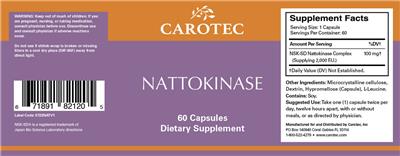
Supplement Facts
The label details for Nattokinase by Carotec, sourced from the NIH Dietary Supplement Label Database.
Supplement Facts
| Ingredient | Amount | % DV |
|---|---|---|
| NSK-SD | 100 mg | -- |
Other ingredients: Microcrystalline Cellulose, Dextrin, Hypromellose, L-Leucine
Tap any ingredient to jump to its full detail below.
These statements are the manufacturer’s wording, reproduced from the product label — the label is saying it, not HelloPharmacist. We don’t verify or endorse them.
Precautions
Warning: Keep out of reach of children.
If you are pregnant, nursing, or taking medication, consult physician before use.
Discontinue use and consult physician if adverse reactions occur. Do not use if shrink-wrap is broken or missing.
Contains: soy.
Storage
Store in a cool dry place (59F-85F) away from direct sunlight.
Brand IP Statement(s)
NSK-SD is a registered trademark of Japan Bio Science Laboratory directions
FDA Statement of Identity
Dietary Supplement
Suggested/Recommended/Usage/Directions
Suggested Use: Take one (1) capsule twice per day, twelve hours apart, with or without meals, or as directed by physician.
Is this label outdated? Report a formula or label change and our pharmacy team will review it.
Nattokinase by Carotec label
The label scan from the NIH Dietary Supplement Label Database. Tap to enlarge.
Label images are published by the NIH Dietary Supplement Label Database for the version of this product on file. Always read your actual product label.
View the full label (PDF)The Ingredients in Nattokinase by Carotec
This is the 1 active ingredient this product is made of. Select it to open its full monograph.
Serving size1 Capsule(s) Dosage formCapsule Servings per container60 Amounts shown are per serving.
NSK-SD
Interacts with289 drugs
Nattokinase is an enzyme from the fermented soybean food natto that may have mild blood-thinning and blood-flow effects. Some small studies hint at be...
NSK-SD monograph & interactionsOther (inactive) ingredients: Microcrystalline Cellulose, Dextrin, Hypromellose, L-Leucine. These complete the product’s ingredient list but are not active constituents.
Nattokinase by Carotec Drug Interactions
HelloPharmacist Interaction Report
Nattokinase by Carotec is a single-ingredient supplement that interacts with blood pressure medications and blood thinners.
The main concern is with anticoagulant and antiplatelet drugs—nattokinase has blood-thinning effects of its own, and combining it with blood thinners like warfarin, dabigatran, or aspirin raises the risk of bleeding. A documented case involved a woman who developed brain bleeding after adding nattokinase to low-dose aspirin therapy.
Read the full breakdown — every affected drug type, severity by severity
You'll also want to flag any antihypertensive drugs (medications that lower blood pressure). Nattokinase may further reduce blood pressure on its own, so using it alongside blood pressure drugs could theoretically lower your pressure too much.
Altogether, these interactions span 287 individual medications.
Run your exact medications through the checker below before you start nattokinase—especially if you take anything for clotting, blood pressure, or stroke prevention.
Check your own medications below · Editorial policy · How we use AI
Want to check YOUR meds against Nattokinase?
Ask about interactions with your drugs in plain English — “Can I take it with lisinopril?” — and we find you the answer in seconds, ingredient by ingredient.
Go to the checkerIngredients driving the most interactions
Individual Drug Interactions
The ingredients in Nattokinase interact with 289 drugs. Click any drug to see the details.
1 of the 1 ingredient in Nattokinase interact with drugs. Each result below shows which ingredient is responsible. NSK-SD
AspirinAngettes 75, ASA, Asaphen, Aspirin, Caprin, Cartia +8 more
How Aspirin interacts with Nattokinase — through 1 ingredient. Tap an ingredient for the detail:
Nsk-sdAnticoagulant/antiplatelet Drugs Moderate
Interaction Summary
Nattokinase might increase the risk of bleeding when used with anticoagulant/antiplatelet drugs.
Read the full Nsk-sd + Aspirin interactionAspirin, Aluminum Hydroxide, Codeine Phosphate, Magnesium HydroxideAscriptin Codeine #3
How Aspirin, Aluminum Hydroxide, Codeine Phosphate, Magnesium Hydroxide interacts with Nattokinase — through 1 ingredient. Tap an ingredient for the detail:
Nsk-sdAnticoagulant/antiplatelet Drugs Moderate
Interaction Summary
Nattokinase might increase the risk of bleeding when used with anticoagulant/antiplatelet drugs.
Read the full Nsk-sd + Aspirin, Aluminum Hydroxide, Codeine Phosphate, Magnesium Hydroxide interactionAspirin, ButalbitalAxotal
How Aspirin, Butalbital interacts with Nattokinase — through 1 ingredient. Tap an ingredient for the detail:
Nsk-sdAnticoagulant/antiplatelet Drugs Moderate
Interaction Summary
Nattokinase might increase the risk of bleeding when used with anticoagulant/antiplatelet drugs.
Read the full Nsk-sd + Aspirin, Butalbital interactionAspirin, Butalbital, CaffeineFiorinal
How Aspirin, Butalbital, Caffeine interacts with Nattokinase — through 1 ingredient. Tap an ingredient for the detail:
Nsk-sdAnticoagulant/antiplatelet Drugs Moderate
Interaction Summary
Nattokinase might increase the risk of bleeding when used with anticoagulant/antiplatelet drugs.
Read the full Nsk-sd + Aspirin, Butalbital, Caffeine interactionAspirin, Butalbital, Caffeine, Codeine PhosphateFiorinal w/ Codeine
How Aspirin, Butalbital, Caffeine, Codeine Phosphate interacts with Nattokinase — through 1 ingredient. Tap an ingredient for the detail:
Nsk-sdAnticoagulant/antiplatelet Drugs Moderate
Interaction Summary
Nattokinase might increase the risk of bleeding when used with anticoagulant/antiplatelet drugs.
Read the full Nsk-sd + Aspirin, Butalbital, Caffeine, Codeine Phosphate interactionAspirin, Butalbital, Caffeine, PhenacetinMarnal
How Aspirin, Butalbital, Caffeine, Phenacetin interacts with Nattokinase — through 1 ingredient. Tap an ingredient for the detail:
Nsk-sdAnticoagulant/antiplatelet Drugs Moderate
Interaction Summary
Nattokinase might increase the risk of bleeding when used with anticoagulant/antiplatelet drugs.
Read the full Nsk-sd + Aspirin, Butalbital, Caffeine, Phenacetin interactionAspirin, CaffeineAnacin
How Aspirin, Caffeine interacts with Nattokinase — through 1 ingredient. Tap an ingredient for the detail:
Nsk-sdAnticoagulant/antiplatelet Drugs Moderate
Interaction Summary
Nattokinase might increase the risk of bleeding when used with anticoagulant/antiplatelet drugs.
Read the full Nsk-sd + Aspirin, Caffeine interactionAspirin, Caffeine, Codeine PhosphateAnacin w/ Codeine
How Aspirin, Caffeine, Codeine Phosphate interacts with Nattokinase — through 1 ingredient. Tap an ingredient for the detail:
Nsk-sdAnticoagulant/antiplatelet Drugs Moderate
Interaction Summary
Nattokinase might increase the risk of bleeding when used with anticoagulant/antiplatelet drugs.
Read the full Nsk-sd + Aspirin, Caffeine, Codeine Phosphate interactionAspirin, Caffeine, Dihydrocodeine BitartrateSynalgos DC
How Aspirin, Caffeine, Dihydrocodeine Bitartrate interacts with Nattokinase — through 1 ingredient. Tap an ingredient for the detail:
Nsk-sdAnticoagulant/antiplatelet Drugs Moderate
Interaction Summary
Nattokinase might increase the risk of bleeding when used with anticoagulant/antiplatelet drugs.
Read the full Nsk-sd + Aspirin, Caffeine, Dihydrocodeine Bitartrate interactionAspirin, Caffeine, Dover's PwdAcedoval, Dovacet
How Aspirin, Caffeine, Dover's Pwd interacts with Nattokinase — through 1 ingredient. Tap an ingredient for the detail:
Nsk-sdAnticoagulant/antiplatelet Drugs Moderate
Interaction Summary
Nattokinase might increase the risk of bleeding when used with anticoagulant/antiplatelet drugs.
Read the full Nsk-sd + Aspirin, Caffeine, Dover's Pwd interactionAspirin, Caffeine, HydrocodoneDamason-P
How Aspirin, Caffeine, Hydrocodone interacts with Nattokinase — through 1 ingredient. Tap an ingredient for the detail:
Nsk-sdAnticoagulant/antiplatelet Drugs Moderate
Interaction Summary
Nattokinase might increase the risk of bleeding when used with anticoagulant/antiplatelet drugs.
Read the full Nsk-sd + Aspirin, Caffeine, Hydrocodone interactionAspirin, Caffeine, Isobutylallylbarbituric Acid, PhenacetinLanorinal
How Aspirin, Caffeine, Isobutylallylbarbituric Acid, Phenacetin interacts with Nattokinase — through 1 ingredient. Tap an ingredient for the detail:
Nsk-sdAnticoagulant/antiplatelet Drugs Moderate
Interaction Summary
Nattokinase might increase the risk of bleeding when used with anticoagulant/antiplatelet drugs.
Read the full Nsk-sd + Aspirin, Caffeine, Isobutylallylbarbituric Acid, Phenacetin interactionAspirin, Caffeine, OrphenadrineInvagesic, Invagesic Forte, Norgesic, Norgesic Forte, Orphengesic, Orphengesic Forte
How Aspirin, Caffeine, Orphenadrine interacts with Nattokinase — through 1 ingredient. Tap an ingredient for the detail:
Nsk-sdAnticoagulant/antiplatelet Drugs Moderate
Interaction Summary
Nattokinase might increase the risk of bleeding when used with anticoagulant/antiplatelet drugs.
Read the full Nsk-sd + Aspirin, Caffeine, Orphenadrine interactionAspirin, Caffeine, Phenacetin, PropoxypheneMargesic Comp. 65
How Aspirin, Caffeine, Phenacetin, Propoxyphene interacts with Nattokinase — through 1 ingredient. Tap an ingredient for the detail:
Nsk-sdAnticoagulant/antiplatelet Drugs Moderate
Interaction Summary
Nattokinase might increase the risk of bleeding when used with anticoagulant/antiplatelet drugs.
Read the full Nsk-sd + Aspirin, Caffeine, Phenacetin, Propoxyphene interactionAspirin, Calcium Carbonate, Magnesium Carbonate, Magnesium OxideBufferin
How Aspirin, Calcium Carbonate, Magnesium Carbonate, Magnesium Oxide interacts with Nattokinase — through 1 ingredient. Tap an ingredient for the detail:
Nsk-sdAnticoagulant/antiplatelet Drugs Moderate
Interaction Summary
Nattokinase might increase the risk of bleeding when used with anticoagulant/antiplatelet drugs.
Read the full Nsk-sd + Aspirin, Calcium Carbonate, Magnesium Carbonate, Magnesium Oxide interactionAspirin, CarisoprodolSoma Compound
How Aspirin, Carisoprodol interacts with Nattokinase — through 1 ingredient. Tap an ingredient for the detail:
Nsk-sdAnticoagulant/antiplatelet Drugs Moderate
Interaction Summary
Nattokinase might increase the risk of bleeding when used with anticoagulant/antiplatelet drugs.
Read the full Nsk-sd + Aspirin, Carisoprodol interactionAspirin, Carisoprodol, Codeine PhosphateSoma Compound w/ Codeine
How Aspirin, Carisoprodol, Codeine Phosphate interacts with Nattokinase — through 1 ingredient. Tap an ingredient for the detail:
Nsk-sdAnticoagulant/antiplatelet Drugs Moderate
Interaction Summary
Nattokinase might increase the risk of bleeding when used with anticoagulant/antiplatelet drugs.
Read the full Nsk-sd + Aspirin, Carisoprodol, Codeine Phosphate interactionAspirin, Chlorpheniramine, PhenylpropanolamineAlka-Seltzer Plus Cold
How Aspirin, Chlorpheniramine, Phenylpropanolamine interacts with Nattokinase — through 1 ingredient. Tap an ingredient for the detail:
Nsk-sdAnticoagulant/antiplatelet Drugs Moderate
Interaction Summary
Nattokinase might increase the risk of bleeding when used with anticoagulant/antiplatelet drugs.
Read the full Nsk-sd + Aspirin, Chlorpheniramine, Phenylpropanolamine interactionAspirin, Citric Acid, Sodium BicarbonateAlka-Seltzer Pain Reliever and Antacid
How Aspirin, Citric Acid, Sodium Bicarbonate interacts with Nattokinase — through 1 ingredient. Tap an ingredient for the detail:
Nsk-sdAnticoagulant/antiplatelet Drugs Moderate
Interaction Summary
Nattokinase might increase the risk of bleeding when used with anticoagulant/antiplatelet drugs.
Read the full Nsk-sd + Aspirin, Citric Acid, Sodium Bicarbonate interactionAspirin, Codeine PhosphateAspirin w/ Codeine
How Aspirin, Codeine Phosphate interacts with Nattokinase — through 1 ingredient. Tap an ingredient for the detail:
Nsk-sdAnticoagulant/antiplatelet Drugs Moderate
Interaction Summary
Nattokinase might increase the risk of bleeding when used with anticoagulant/antiplatelet drugs.
Read the full Nsk-sd + Aspirin, Codeine Phosphate interactionAspirin, Codeine Phosphate, MethocarbamolRobaxisal C
How Aspirin, Codeine Phosphate, Methocarbamol interacts with Nattokinase — through 1 ingredient. Tap an ingredient for the detail:
Nsk-sdAnticoagulant/antiplatelet Drugs Moderate
Interaction Summary
Nattokinase might increase the risk of bleeding when used with anticoagulant/antiplatelet drugs.
Read the full Nsk-sd + Aspirin, Codeine Phosphate, Methocarbamol interactionAspirin, Codeine Phosphate, PhenobarbitalPhenaphen
How Aspirin, Codeine Phosphate, Phenobarbital interacts with Nattokinase — through 1 ingredient. Tap an ingredient for the detail:
Nsk-sdAnticoagulant/antiplatelet Drugs Moderate
Interaction Summary
Nattokinase might increase the risk of bleeding when used with anticoagulant/antiplatelet drugs.
Read the full Nsk-sd + Aspirin, Codeine Phosphate, Phenobarbital interactionAspirin, Diphenhydramine, PhenylpropanolamineAlka Seltzer Plus Night Time Effervescent
How Aspirin, Diphenhydramine, Phenylpropanolamine interacts with Nattokinase — through 1 ingredient. Tap an ingredient for the detail:
Nsk-sdAnticoagulant/antiplatelet Drugs Moderate
Interaction Summary
Nattokinase might increase the risk of bleeding when used with anticoagulant/antiplatelet drugs.
Read the full Nsk-sd + Aspirin, Diphenhydramine, Phenylpropanolamine interactionAspirin, DipyridamoleAggrenox, Asasantin Retard
How Aspirin, Dipyridamole interacts with Nattokinase — through 1 ingredient. Tap an ingredient for the detail:
Nsk-sdAnticoagulant/antiplatelet Drugs Moderate
Interaction Summary
Nattokinase might increase the risk of bleeding when used with anticoagulant/antiplatelet drugs.
Read the full Nsk-sd + Aspirin, Dipyridamole interactionAspirin, Ethoheptazine, MeprobamateEquagesic
How Aspirin, Ethoheptazine, Meprobamate interacts with Nattokinase — through 1 ingredient. Tap an ingredient for the detail:
Nsk-sdAnticoagulant/antiplatelet Drugs Moderate
Interaction Summary
Nattokinase might increase the risk of bleeding when used with anticoagulant/antiplatelet drugs.
Read the full Nsk-sd + Aspirin, Ethoheptazine, Meprobamate interactionAspirin, HydrocodoneAlor 5 500, Lortab ASA
How Aspirin, Hydrocodone interacts with Nattokinase — through 1 ingredient. Tap an ingredient for the detail:
Nsk-sdAnticoagulant/antiplatelet Drugs Moderate
Interaction Summary
Nattokinase might increase the risk of bleeding when used with anticoagulant/antiplatelet drugs.
Read the full Nsk-sd + Aspirin, Hydrocodone interactionAspirin, MeprobamateMicrainin
How Aspirin, Meprobamate interacts with Nattokinase — through 1 ingredient. Tap an ingredient for the detail:
Nsk-sdAnticoagulant/antiplatelet Drugs Moderate
Interaction Summary
Nattokinase might increase the risk of bleeding when used with anticoagulant/antiplatelet drugs.
Read the full Nsk-sd + Aspirin, Meprobamate interactionAspirin, MethocarbamolRobaxisal
How Aspirin, Methocarbamol interacts with Nattokinase — through 1 ingredient. Tap an ingredient for the detail:
Nsk-sdAnticoagulant/antiplatelet Drugs Moderate
Interaction Summary
Nattokinase might increase the risk of bleeding when used with anticoagulant/antiplatelet drugs.
Read the full Nsk-sd + Aspirin, Methocarbamol interactionAspirin, OmeprazoleYosprala
How Aspirin, Omeprazole interacts with Nattokinase — through 1 ingredient. Tap an ingredient for the detail:
Nsk-sdAnticoagulant/antiplatelet Drugs Moderate
Interaction Summary
Nattokinase might increase the risk of bleeding when used with anticoagulant/antiplatelet drugs.
Read the full Nsk-sd + Aspirin, Omeprazole interactionAspirin, OxycodonePercodan
How Aspirin, Oxycodone interacts with Nattokinase — through 1 ingredient. Tap an ingredient for the detail:
Nsk-sdAnticoagulant/antiplatelet Drugs Moderate
Interaction Summary
Nattokinase might increase the risk of bleeding when used with anticoagulant/antiplatelet drugs.
Read the full Nsk-sd + Aspirin, Oxycodone interactionEach ingredient & the kinds of drugs it affects
For each ingredient in Nattokinase with known interactions, here are the types of medications it can affect. Open any type for the detail — or search your exact drug in the checker above.
NSK-SD
Anticoagulant/Antiplatelet Drugs
Nattokinase might increase the risk of bleeding when used with anticoagulant/antiplatelet drugs.
Nattokinase has thrombolytic and anticoagulant effects. There is a case report of intracranial hemorrhage in a patient who added nattokinase to aspirin therapy.
Antihypertensive Drugs
Theoretically, nattokinase might increase the risk of hypotension when used with antihypertensive drugs.
Some clinical research suggests that nattokinase may reduce systolic and diastolic blood pressure.
Brand information
Manufacturer and brand details for Nattokinase, from the product label.
Carotec
See all Carotec products- Name
- Carotec, Inc.
- Street Address
- PO Box 140940
- City
- Coral Gables
- State
- FL
- ZipCode
- 33114
- Phone Number
- 1-800-522-4279
- Web Address
- www.carotec.com
Nattokinase by Carotec: Common Questions
Does Nattokinase by Carotec interact with any medications?
How can one product interact with so many drugs?
Where does this information come from?
Can I take nattokinase if I'm on aspirin?
What's nattokinase actually made from?
Does this product have fillers?
Is nattokinase proven to work for heart health?
Can I take nattokinase while pregnant?
Written and reviewed by the HelloPharmacist editorial staff. Our editorial policy
Not sure if Nattokinase is safe with your meds?
Our pharmacists answer your medication & supplement questions — free.
Label information is sourced from the NIH Dietary Supplement Label Database and reflects the product version on file; always read your actual product label. This page is for education only and is not a substitute for professional medical advice. Confirm with your pharmacist or doctor before combining supplements and medications.
The Full Monographs Behind Nattokinase’s Ingredients
Every ingredient we hold a full HelloPharmacist monograph for — uses, evidence, safety, and the complete interaction list.
Sources & How We Checked
Nattokinase's label data comes from the NIH Dietary Supplement Label Database; the ingredient interaction data is from the Natural Medicines database, reviewed by our pharmacists.
- NIH Dietary Supplement Label Database (DSLD) — The official product label on file for this supplement.
- Natural Medicines (Therapeutic Research Center) — Evidence-graded clinical reference behind the ingredient interaction data.
Content is written and reviewed by licensed HelloPharmacist pharmacists. See our data sources and editorial standards for how this information is built and checked.
The 9 references behind this product’s interaction data
Every citation that drives the interaction findings for this product’s ingredients, from the evidence-graded Natural Medicines (TRC Healthcare) database. Open an ingredient to browse its citations — links open the study on PubMed or the publisher’s site.
Nattokinase 9 references
- Suzuki Y, Kondo K, Matsumoto Y, et al. Dietary supplementation of fermented soybean, natto, suppresses intimal thickening and modulates the lysis of mural thrombi after endothelial injury in rat femoral artery. Life Sci 2003;73:1289-98.. PubMed
- Sumi H, Hamada H, Nakanishi K, Hiratani H. Enchancement of fibrinolytic activity in plasma by oral administration of nattokinase. Acta Haematol 1990;84:139-43.
- Chang, Y. Y., Liu, J. S., Lai, S. L., Wu, H. S., and Lan, M. Y. Cerebellar hemorrhage provoked by combined use of nattokinase and aspirin in a patient with cerebral microbleeds. Intern Med 2008;47(5):467-469. PubMed
- Kim, J. Y., Gum, S. N., Paik, J. K., Lim, H. H., Kim, K. C., Ogasawara, K., Inoue, K., Park, S., Jang, Y., and Lee, J. H. Effects of nattokinase on blood pressure: a randomized, controlled trial. Hypertens.Res 2008;31(8):1583-1588. PubMed
- <p>Maruyama M, Sumi H (eds): Effect of natto diet on blood pressure, in Basic and Clinical Aspects of Japanese Traditional Food Natto II. Japan Technology Transfer Association (JTTAS), 1998, pp 1–3.</p>
- Kurosawa Y, Nirengi S, Homma T, et al. A single-dose of oral nattokinase potentiates thrombolysis and anti-coagulation profiles. Sci Rep 2015;5:11601. PubMed
- Ramachandran L, Aqeel A, Jafri A, Sidhu Y, Mohamed Djirdeh T. Nattokinase-associated hemoperitoneum in an elderly woman. Cureus 2021;13(12):e20074. PubMed
- Awatani-Yoshidome K, Hashimoto T, Satoh T. Anaphylaxis from nattokinase in a patient with fermented soybean (natto) allergy. Allergol Int 2022;71(1):153-4. PubMed
- Suzuki K, Nakamura M, Sato N, Futamura K, Matsunaga K, Yagami A. Nattokinase, a subtilisin family serine protease, is a novel allergen contained in the traditional Japanese fermented food natto. Allergol Int 2022.
Parts of this content are provided by the Therapeutic Research Center, LLC.
DISCLAIMER: Currently this does not check for drug-drug interactions. This is not an all-inclusive comprehensive list of potential interactions and is for informational purposes only. Not all interactions are known or well-reported in the scientific literature, and new interactions are continually being reported. Input is needed from a qualified healthcare provider including a pharmacist before starting any therapy. Application of clinical judgment is necessary.
© 2021 Therapeutic Research Center, LLC