
Niacinamide Vitamin B3 50 mg Ingredients & Drug Interactions
by Dr. Mercola
What is this page for?
First and foremost: checking Niacinamide Vitamin B3 50 mg against your medications. The heart of this page is the interaction checker and the full interaction report — how this product’s ingredients may interact with prescription and over-the-counter medicines you may be taking.
Around that, we add a pharmacist’s high-level view of the product as a whole — what’s inside, the evidence for its stated use, how transparent the label is, and what safety data exists — so you can see the full picture in one place. It’s educational information from our licensed clinical databases and the clinical staff at HelloPharmacist — not medical advice — and we don’t sell or endorse products. Our editorial policy
Niacinamide Vitamin B3 50 mg is a dietary supplement by Dr. Mercola with 1 active ingredient. Its ingredients are commonly taken for acne and skin health, pellagra (niacin deficiency), anti-aging and skin tone.Based on those ingredients, 124 medications have a known interaction with it, the most serious rated moderate. The ingredients most likely to interact are Niacinamide. Use the checker below to test your specific medication, or read the full HelloPharmacist Interaction Report.
Check Your Meds Against Niacinamide Vitamin B3 50 mg by Dr. Mercola
Ask about any prescription or over-the-counter medication and we check it for interactions with Niacinamide Vitamin B3 50 mg by Dr. Mercola — and tell you which ingredient is responsible.
AI summaries are generated from our interaction database for education only — always confirm with your pharmacist. How we use AI
Ask the Pharmacist
A licensed pharmacist will answer your question by email — free, usually within 24 hours.
Got it — thank you!
A licensed pharmacist will answer within 24 hours. Keep an eye on your email (worth checking spam, just in case).
HelloPharmacist Scorecard of Niacinamide Vitamin B3 50 mg by Dr. Mercola
Our pharmacy team’s full take, with four database checks built into the cards below — a summary of what is known, not a grade of the product itself.
What’s inside
Full disclosure
Each tablet contains one active ingredient, niacinamide, a form of vitamin B3, at 50 mg. Its role is as a vitamin, which is why it is studied for the conditions listed in the effectiveness section.
The tablet also contains inactive ingredients, which are fillers, binders, and similar materials rather than active ingredients. These include microcrystalline cellulose, silicon dioxide, maltodextrin, sunflower lecithin, palm oil, guar gum, rice bran extract, rice husk, gum acacia, and sunflower oil.
Does it work?
Strong evidence
For pellagra, niacinamide is rated likely effective. For acne, hyperphosphatemia (high phosphate levels in the blood), osteoarthritis, and diabetes, it is rated possibly effective.
For brain tumor, it is rated possibly ineffective. These ratings reflect the evidence we hold and are not a guarantee of results for you.
Talk with your own doctor about whether it fits your situation.
How safe is it?
Well-documented data
Niacinamide is usually well tolerated at recommended amounts, but high doses can cause side effects and should be supervised. Common side effects include dizziness, drowsiness, itching, stomach upset, headache, and rash.
Large oral doses can cause nausea, vomiting, heartburn, and diarrhea. Skin use may cause burning, itching, or mild dermatitis.
For pregnancy and breastfeeding, our data rates niacinamide as likely safe. Amounts found in food and standard prenatal vitamins are considered acceptable, but high supplemental doses should be discussed with a doctor first.
Meds to double-check
Moderate interaction found
Blood thinners (anticoagulants and antiplatelet drugs) and warfarin (Coumadin) are each rated Moderate for interactions with niacinamide. Carbamazepine (Tegretol) and primidone (Mysoline) are also rated Moderate.
Please double-check any of these with your own doctor or pharmacist before taking this product.
The bottom line
Scorecard at a glanceFully disclosed formula with strong clinical evidence behind its ingredients' uses. Moderate medication interactions have been identified, and safety information is well characterized.
This product may suit adults looking for a standard amount of niacinamide, especially if their doctor has recommended it for a condition in our effectiveness section. People taking blood thinners, carbamazepine, or primidone should be careful and talk it over with their own doctor or pharmacist before starting.
Anyone considering high doses should also discuss them with their own healthcare provider.
Educational only — not medical advice; always confirm with your pharmacist. Our editorial policy · How we use AI
Assessment coverage: 1 of 1 active ingredient matched to our full ingredient reviews (monographs). Based on the product label dated Mar 25, 2025.
This Scorecard evaluates available label information, ingredient evidence, and known medication-safety considerations. It does not independently verify product identity, purity, potency, contamination, or manufacturing quality. How these ratings are computed
General information
Key facts about Niacinamide Vitamin B3 50 mg, straight from the product label.
| Brand | Dr. Mercola |
|---|---|
| Barcode (UPC) | 810094212681 |
| Net contents | 270 Tablet(s) |
| Market status | On market |
| Date entered into DSLD | Mar 25, 2025 |
| DSLD ID | 327185 |
| Product type | Vitamin |
| Supplement form | Tablet Or Pill |
| Dietary claims / uses | Nutrient, All Other |
| Intended target group(s) | Adult (18 - 50 Years) |
Everything in this section is reproduced from the manufacturer’s own product label — it’s the label speaking, not HelloPharmacist. We show it so you can see exactly what the maker states; we don’t verify or endorse those statements.
Supplement Facts
The label details for Niacinamide Vitamin B3 50 mg by Dr. Mercola, sourced from the NIH Dietary Supplement Label Database.
Supplement Facts
| Ingredient | Amount | % DV |
|---|---|---|
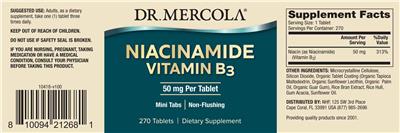
| Niacinamide | 50 mg | 313% |
Other ingredients: Microcrystalline Cellulose, Silicon Dioxide, Maltodextrin, Sunflower Lecithin, Palm Oil, Guar Gum, Rice Bran Extract, Rice Husk, Gum Acacia, Sunflower Oil
Tap any ingredient to jump to its full detail below.
These statements are the manufacturer’s wording, reproduced from the product label — the label is saying it, not HelloPharmacist. We don’t verify or endorse them.
Suggested/Recommended/Usage/Directions
Suggested use: Adults, as a dietary supplement, take one (1) tablet three times daily.
Precautions
Keep out of reach of children.
Do not use if safety seal is broken.
If you are nursing, pregnant, taking medication or have medical condition, consult your physician before taking this product.
Formula
Niacinamide Vitamin B3 50mg per tablet
Formulation
Non-Flushing
FDA Statement of Identity
Dietary Supplement
General Statements
Providing quality products since 2001.
Is this label outdated? Report a formula or label change and our pharmacy team will review it.
Niacinamide Vitamin B3 50 mg by Dr. Mercola label
The label scan from the NIH Dietary Supplement Label Database. Tap to enlarge.
Label images are published by the NIH Dietary Supplement Label Database for the version of this product on file. Always read your actual product label.
View the full label (PDF)The Ingredients in Niacinamide Vitamin B3 50 mg by Dr. Mercola
This is the 1 active ingredient this product is made of. Select it to open its full monograph.
Serving size1 Tablet(s) Dosage formTablet Or Pill Servings per container270 Amounts shown are per serving.
Niacinamide
Interacts with124 drugs
Niacinamide (also called nicotinamide) is a form of vitamin B3 used in supplements and skin-care products. It is well established for preventing and t...
Niacinamide monograph & interactionsOther (inactive) ingredients: Microcrystalline Cellulose, Silicon Dioxide, Maltodextrin, Sunflower Lecithin, Palm Oil, Guar Gum, Rice Bran Extract, Rice Husk, Gum Acacia, Sunflower Oil. These complete the product’s ingredient list but are not active constituents.
Niacinamide Vitamin B3 50 mg by Dr. Mercola Drug Interactions
HelloPharmacist Interaction Report
Dr.
Mercola Niacinamide Vitamin B3 50 mg does interact with several medications, through its niacinamide (the active form of vitamin B3). The most serious interaction we hold data on is with blood thinners (anticoagulants and antiplatelet drugs), rated Moderate.
Niacinamide may have additive effects with these drugs, and in people on hemodialysis, low platelet counts (thrombocytopenia) have been reported with niacinamide at 1 gram daily.
Read the full breakdown — every affected drug type, severity by severity
Niacinamide may also raise the levels and side effects of carbamazepine (Tegretol) and primidone (Mysoline), both rated Moderate. Warfarin (Coumadin) is also rated Moderate, with limited evidence that niacinamide may increase its anticoagulant effect, including one case report of a very high INR.
Altogether, these interactions span 124 individual medications.
Search the tool on this page for your exact medications to see the details for each one.
Check your own medications below · Editorial policy · How we use AI
Want to check YOUR meds against Niacinamide Vitamin B3 50 mg?
Ask about interactions with your drugs in plain English — “Can I take it with lisinopril?” — and we find you the answer in seconds, ingredient by ingredient.
Go to the checkerIngredients driving the most interactions
Individual Drug Interactions
The ingredients in Niacinamide Vitamin B3 50 mg interact with 124 drugs. Click any drug to see the details.
1 of the 1 ingredient in Niacinamide Vitamin B3 50 mg interact with drugs. Each result below shows which ingredient is responsible. Niacinamide
AbciximabReoPro
How Abciximab interacts with Niacinamide Vitamin B3 50 mg — through 1 ingredient. Tap an ingredient for the detail:
NiacinamideAnticoagulant/antiplatelet Drugs Moderate
Interaction Summary
Theoretically, niacinamide may have additive effects when used with anticoagulant or antiplatelet drugs, especially in patients on hemodialysis.
Read the full Niacinamide + Abciximab interactionAbrocitinibCibinqo
How Abrocitinib interacts with Niacinamide Vitamin B3 50 mg — through 1 ingredient. Tap an ingredient for the detail:
NiacinamideAnticoagulant/antiplatelet Drugs Moderate
Interaction Summary
Theoretically, niacinamide may have additive effects when used with anticoagulant or antiplatelet drugs, especially in patients on hemodialysis.
Read the full Niacinamide + Abrocitinib interactionAcenocoumarolSintrom
How Acenocoumarol interacts with Niacinamide Vitamin B3 50 mg — through 1 ingredient. Tap an ingredient for the detail:
NiacinamideAnticoagulant/antiplatelet Drugs Moderate
Interaction Summary
Theoretically, niacinamide may have additive effects when used with anticoagulant or antiplatelet drugs, especially in patients on hemodialysis.
Read the full Niacinamide + Acenocoumarol interactionAcetaminophen, AspirinGemnisyn
How Acetaminophen, Aspirin interacts with Niacinamide Vitamin B3 50 mg — through 1 ingredient. Tap an ingredient for the detail:
NiacinamideAnticoagulant/antiplatelet Drugs Moderate
Interaction Summary
Theoretically, niacinamide may have additive effects when used with anticoagulant or antiplatelet drugs, especially in patients on hemodialysis.
Read the full Niacinamide + Acetaminophen, Aspirin interactionAcetaminophen, Aspirin, CaffeineExcedrin, Excedrin Extra Strength, Excedrin Migraine
How Acetaminophen, Aspirin, Caffeine interacts with Niacinamide Vitamin B3 50 mg — through 1 ingredient. Tap an ingredient for the detail:
NiacinamideAnticoagulant/antiplatelet Drugs Moderate
Interaction Summary
Theoretically, niacinamide may have additive effects when used with anticoagulant or antiplatelet drugs, especially in patients on hemodialysis.
Read the full Niacinamide + Acetaminophen, Aspirin, Caffeine interactionAcetaminophen, IbuprofenCombogesic
How Acetaminophen, Ibuprofen interacts with Niacinamide Vitamin B3 50 mg — through 1 ingredient. Tap an ingredient for the detail:
NiacinamideAnticoagulant/antiplatelet Drugs Moderate
Interaction Summary
Theoretically, niacinamide may have additive effects when used with anticoagulant or antiplatelet drugs, especially in patients on hemodialysis.
Read the full Niacinamide + Acetaminophen, Ibuprofen interactionAcetylsalicylic AcidEntrophen
How Acetylsalicylic Acid interacts with Niacinamide Vitamin B3 50 mg — through 1 ingredient. Tap an ingredient for the detail:
NiacinamideAnticoagulant/antiplatelet Drugs Moderate
Interaction Summary
Theoretically, niacinamide may have additive effects when used with anticoagulant or antiplatelet drugs, especially in patients on hemodialysis.
Read the full Niacinamide + Acetylsalicylic Acid interactionAlteplase, TpaActilyse, Activase
How Alteplase, Tpa interacts with Niacinamide Vitamin B3 50 mg — through 1 ingredient. Tap an ingredient for the detail:
NiacinamideAnticoagulant/antiplatelet Drugs Moderate
Interaction Summary
Theoretically, niacinamide may have additive effects when used with anticoagulant or antiplatelet drugs, especially in patients on hemodialysis.
Read the full Niacinamide + Alteplase, Tpa interactionAluminum Hydroxide, Aspirin, Codeine Phosphate, Magnesium HydroxideAscriptin Codeine #2
How Aluminum Hydroxide, Aspirin, Codeine Phosphate, Magnesium Hydroxide interacts with Niacinamide Vitamin B3 50 mg — through 1 ingredient. Tap an ingredient for the detail:
NiacinamideAnticoagulant/antiplatelet Drugs Moderate
Interaction Summary
Theoretically, niacinamide may have additive effects when used with anticoagulant or antiplatelet drugs, especially in patients on hemodialysis.
Read the full Niacinamide + Aluminum Hydroxide, Aspirin, Codeine Phosphate, Magnesium Hydroxide interactionAluminum Hydroxide, Aspirin, Magnesium HydroxideAscriptin
How Aluminum Hydroxide, Aspirin, Magnesium Hydroxide interacts with Niacinamide Vitamin B3 50 mg — through 1 ingredient. Tap an ingredient for the detail:
NiacinamideAnticoagulant/antiplatelet Drugs Moderate
Interaction Summary
Theoretically, niacinamide may have additive effects when used with anticoagulant or antiplatelet drugs, especially in patients on hemodialysis.
Read the full Niacinamide + Aluminum Hydroxide, Aspirin, Magnesium Hydroxide interactionAnacaulase-bcdbNexoBrid
How Anacaulase-bcdb interacts with Niacinamide Vitamin B3 50 mg — through 1 ingredient. Tap an ingredient for the detail:
NiacinamideAnticoagulant/antiplatelet Drugs Moderate
Interaction Summary
Theoretically, niacinamide may have additive effects when used with anticoagulant or antiplatelet drugs, especially in patients on hemodialysis.
Read the full Niacinamide + Anacaulase-bcdb interactionAnagrelideAgrylin
How Anagrelide interacts with Niacinamide Vitamin B3 50 mg — through 1 ingredient. Tap an ingredient for the detail:
NiacinamideAnticoagulant/antiplatelet Drugs Moderate
Interaction Summary
Theoretically, niacinamide may have additive effects when used with anticoagulant or antiplatelet drugs, especially in patients on hemodialysis.
Read the full Niacinamide + Anagrelide interactionAnisindioneMiradon
How Anisindione interacts with Niacinamide Vitamin B3 50 mg — through 1 ingredient. Tap an ingredient for the detail:
NiacinamideAnticoagulant/antiplatelet Drugs Moderate
Interaction Summary
Theoretically, niacinamide may have additive effects when used with anticoagulant or antiplatelet drugs, especially in patients on hemodialysis.
Read the full Niacinamide + Anisindione interactionAntithrombin IiiThrombate III
How Antithrombin Iii interacts with Niacinamide Vitamin B3 50 mg — through 1 ingredient. Tap an ingredient for the detail:
NiacinamideAnticoagulant/antiplatelet Drugs Moderate
Interaction Summary
Theoretically, niacinamide may have additive effects when used with anticoagulant or antiplatelet drugs, especially in patients on hemodialysis.
Read the full Niacinamide + Antithrombin Iii interactionApixabanEliquis
How Apixaban interacts with Niacinamide Vitamin B3 50 mg — through 1 ingredient. Tap an ingredient for the detail:
NiacinamideAnticoagulant/antiplatelet Drugs Moderate
Interaction Summary
Theoretically, niacinamide may have additive effects when used with anticoagulant or antiplatelet drugs, especially in patients on hemodialysis.
Read the full Niacinamide + Apixaban interactionArgatrobanArgatroban
How Argatroban interacts with Niacinamide Vitamin B3 50 mg — through 1 ingredient. Tap an ingredient for the detail:
NiacinamideAnticoagulant/antiplatelet Drugs Moderate
Interaction Summary
Theoretically, niacinamide may have additive effects when used with anticoagulant or antiplatelet drugs, especially in patients on hemodialysis.
Read the full Niacinamide + Argatroban interactionAspirinAngettes 75, ASA, Asaphen, Aspirin, Caprin, Cartia +8 more
How Aspirin interacts with Niacinamide Vitamin B3 50 mg — through 1 ingredient. Tap an ingredient for the detail:
NiacinamideAnticoagulant/antiplatelet Drugs Moderate
Interaction Summary
Theoretically, niacinamide may have additive effects when used with anticoagulant or antiplatelet drugs, especially in patients on hemodialysis.
Read the full Niacinamide + Aspirin interactionAspirin, Aluminum Hydroxide, Codeine Phosphate, Magnesium HydroxideAscriptin Codeine #3
How Aspirin, Aluminum Hydroxide, Codeine Phosphate, Magnesium Hydroxide interacts with Niacinamide Vitamin B3 50 mg — through 1 ingredient. Tap an ingredient for the detail:
NiacinamideAnticoagulant/antiplatelet Drugs Moderate
Interaction Summary
Theoretically, niacinamide may have additive effects when used with anticoagulant or antiplatelet drugs, especially in patients on hemodialysis.
Read the full Niacinamide + Aspirin, Aluminum Hydroxide, Codeine Phosphate, Magnesium Hydroxide interactionAspirin, ButalbitalAxotal
How Aspirin, Butalbital interacts with Niacinamide Vitamin B3 50 mg — through 1 ingredient. Tap an ingredient for the detail:
NiacinamideAnticoagulant/antiplatelet Drugs Moderate
Interaction Summary
Theoretically, niacinamide may have additive effects when used with anticoagulant or antiplatelet drugs, especially in patients on hemodialysis.
Read the full Niacinamide + Aspirin, Butalbital interactionAspirin, Butalbital, CaffeineFiorinal
How Aspirin, Butalbital, Caffeine interacts with Niacinamide Vitamin B3 50 mg — through 1 ingredient. Tap an ingredient for the detail:
NiacinamideAnticoagulant/antiplatelet Drugs Moderate
Interaction Summary
Theoretically, niacinamide may have additive effects when used with anticoagulant or antiplatelet drugs, especially in patients on hemodialysis.
Read the full Niacinamide + Aspirin, Butalbital, Caffeine interactionAspirin, Butalbital, Caffeine, Codeine PhosphateFiorinal w/ Codeine
How Aspirin, Butalbital, Caffeine, Codeine Phosphate interacts with Niacinamide Vitamin B3 50 mg — through 1 ingredient. Tap an ingredient for the detail:
NiacinamideAnticoagulant/antiplatelet Drugs Moderate
Interaction Summary
Theoretically, niacinamide may have additive effects when used with anticoagulant or antiplatelet drugs, especially in patients on hemodialysis.
Read the full Niacinamide + Aspirin, Butalbital, Caffeine, Codeine Phosphate interactionAspirin, Butalbital, Caffeine, PhenacetinMarnal
How Aspirin, Butalbital, Caffeine, Phenacetin interacts with Niacinamide Vitamin B3 50 mg — through 1 ingredient. Tap an ingredient for the detail:
NiacinamideAnticoagulant/antiplatelet Drugs Moderate
Interaction Summary
Theoretically, niacinamide may have additive effects when used with anticoagulant or antiplatelet drugs, especially in patients on hemodialysis.
Read the full Niacinamide + Aspirin, Butalbital, Caffeine, Phenacetin interactionAspirin, CaffeineAnacin
How Aspirin, Caffeine interacts with Niacinamide Vitamin B3 50 mg — through 1 ingredient. Tap an ingredient for the detail:
NiacinamideAnticoagulant/antiplatelet Drugs Moderate
Interaction Summary
Theoretically, niacinamide may have additive effects when used with anticoagulant or antiplatelet drugs, especially in patients on hemodialysis.
Read the full Niacinamide + Aspirin, Caffeine interactionAspirin, Caffeine, Codeine PhosphateAnacin w/ Codeine
How Aspirin, Caffeine, Codeine Phosphate interacts with Niacinamide Vitamin B3 50 mg — through 1 ingredient. Tap an ingredient for the detail:
NiacinamideAnticoagulant/antiplatelet Drugs Moderate
Interaction Summary
Theoretically, niacinamide may have additive effects when used with anticoagulant or antiplatelet drugs, especially in patients on hemodialysis.
Read the full Niacinamide + Aspirin, Caffeine, Codeine Phosphate interactionAspirin, Caffeine, Dihydrocodeine BitartrateSynalgos DC
How Aspirin, Caffeine, Dihydrocodeine Bitartrate interacts with Niacinamide Vitamin B3 50 mg — through 1 ingredient. Tap an ingredient for the detail:
NiacinamideAnticoagulant/antiplatelet Drugs Moderate
Interaction Summary
Theoretically, niacinamide may have additive effects when used with anticoagulant or antiplatelet drugs, especially in patients on hemodialysis.
Read the full Niacinamide + Aspirin, Caffeine, Dihydrocodeine Bitartrate interactionAspirin, Caffeine, Dover's PwdAcedoval, Dovacet
How Aspirin, Caffeine, Dover's Pwd interacts with Niacinamide Vitamin B3 50 mg — through 1 ingredient. Tap an ingredient for the detail:
NiacinamideAnticoagulant/antiplatelet Drugs Moderate
Interaction Summary
Theoretically, niacinamide may have additive effects when used with anticoagulant or antiplatelet drugs, especially in patients on hemodialysis.
Read the full Niacinamide + Aspirin, Caffeine, Dover's Pwd interactionAspirin, Caffeine, HydrocodoneDamason-P
How Aspirin, Caffeine, Hydrocodone interacts with Niacinamide Vitamin B3 50 mg — through 1 ingredient. Tap an ingredient for the detail:
NiacinamideAnticoagulant/antiplatelet Drugs Moderate
Interaction Summary
Theoretically, niacinamide may have additive effects when used with anticoagulant or antiplatelet drugs, especially in patients on hemodialysis.
Read the full Niacinamide + Aspirin, Caffeine, Hydrocodone interactionAspirin, Caffeine, Isobutylallylbarbituric Acid, PhenacetinLanorinal
How Aspirin, Caffeine, Isobutylallylbarbituric Acid, Phenacetin interacts with Niacinamide Vitamin B3 50 mg — through 1 ingredient. Tap an ingredient for the detail:
NiacinamideAnticoagulant/antiplatelet Drugs Moderate
Interaction Summary
Theoretically, niacinamide may have additive effects when used with anticoagulant or antiplatelet drugs, especially in patients on hemodialysis.
Read the full Niacinamide + Aspirin, Caffeine, Isobutylallylbarbituric Acid, Phenacetin interactionAspirin, Caffeine, OrphenadrineInvagesic, Invagesic Forte, Norgesic, Norgesic Forte, Orphengesic, Orphengesic Forte
How Aspirin, Caffeine, Orphenadrine interacts with Niacinamide Vitamin B3 50 mg — through 1 ingredient. Tap an ingredient for the detail:
NiacinamideAnticoagulant/antiplatelet Drugs Moderate
Interaction Summary
Theoretically, niacinamide may have additive effects when used with anticoagulant or antiplatelet drugs, especially in patients on hemodialysis.
Read the full Niacinamide + Aspirin, Caffeine, Orphenadrine interactionAspirin, Caffeine, Phenacetin, PropoxypheneMargesic Comp. 65
How Aspirin, Caffeine, Phenacetin, Propoxyphene interacts with Niacinamide Vitamin B3 50 mg — through 1 ingredient. Tap an ingredient for the detail:
NiacinamideAnticoagulant/antiplatelet Drugs Moderate
Interaction Summary
Theoretically, niacinamide may have additive effects when used with anticoagulant or antiplatelet drugs, especially in patients on hemodialysis.
Read the full Niacinamide + Aspirin, Caffeine, Phenacetin, Propoxyphene interactionEach ingredient & the kinds of drugs it affects
For each ingredient in Niacinamide Vitamin B3 50 mg with known interactions, here are the types of medications it can affect. Open any type for the detail — or search your exact drug in the checker above.
Niacinamide
Anticoagulant/Antiplatelet Drugs
Theoretically, niacinamide may have additive effects when used with anticoagulant or antiplatelet drugs, especially in patients on hemodialysis.
Several cases of thrombocytopenia have been reported for hemodialysis patients treated with niacinamide 1 gram daily. Hemodialysis patients receiving niacinamide had almost a three-fold higher risk of developing thrombocytopenia when compared with those receiving placebo.
Carbamazepine (Tegretol)
Niacinamide might increase the levels and adverse effects of carbamazepine.
Plasma levels of carbamazepine were increased in two children given high-dose niacinamide, 60-80 mg/kg/day. This might be due to inhibition of the cytochrome P450 enzymes involved in carbamazepine metabolism. There is not enough data to determine the clinical significance of this interaction.
Primidone (Mysoline)
Niacinamide might increase the levels and adverse effects of primidone.
Case reports in children suggest niacinamide 60-100 mg/kg/day reduces hepatic metabolism of primidone to phenobarbital, and reduces the overall clearance rate of primidone; however, there is not enough data to determine the clinical significance of this potential interaction.
Warfarin (Coumadin)
There is limited evidence that niacinamide may increase the anticoagulant effects of warfarin.
In a case report, a patient on warfarin developed an elevated international normalized ratio (INR) of 8.4 after taking niacinamide 500 mg twice daily for 10 days. The patient's INR was previously stable, ranging between 2 and 3, with no other changes to current medications or diet reported. The elevated INR returned to the therapeutic range after receiving vitamin K and discontinuing niacinamide.
Brand information
Manufacturer and brand details for Niacinamide Vitamin B3 50 mg, from the product label.
Dr. Mercola
See all Dr. Mercola products- Name
- NHP
- Street Address
- 125 SW 3rd Place
- City
- Cape Coral
- State
- FL
- ZipCode
- 33991
- Phone Number
- (877) 985-2696
Niacinamide Vitamin B3 50 mg by Dr. Mercola: Common Questions
Does Niacinamide Vitamin B3 50 mg by Dr. Mercola interact with any medications?
How can one product interact with so many drugs?
Where does this information come from?
Is this safe to take during pregnancy?
What are the most common side effects?
Does niacinamide work for acne?
Written and reviewed by the HelloPharmacist editorial staff. Our editorial policy
Not sure if Niacinamide Vitamin B3 50 mg is safe with your meds?
Our pharmacists answer your medication & supplement questions — free.
Label information is sourced from the NIH Dietary Supplement Label Database and reflects the product version on file; always read your actual product label. This page is for education only and is not a substitute for professional medical advice. Confirm with your pharmacist or doctor before combining supplements and medications.
The Full Monographs Behind Niacinamide Vitamin B3 50 mg’s Ingredients
Every ingredient we hold a full HelloPharmacist monograph for — uses, evidence, safety, and the complete interaction list.
Sources & How We Checked
Niacinamide Vitamin B3 50 mg's label data comes from the NIH Dietary Supplement Label Database; the ingredient interaction data is from the Natural Medicines database, reviewed by our pharmacists.
- NIH Dietary Supplement Label Database (DSLD) — The official product label on file for this supplement.
- Natural Medicines (Therapeutic Research Center) — Evidence-graded clinical reference behind the ingredient interaction data.
Content is written and reviewed by licensed HelloPharmacist pharmacists. See our data sources and editorial standards for how this information is built and checked.
The 22 references behind this product’s interaction data
Every citation that drives the interaction findings for this product’s ingredients, from the evidence-graded Natural Medicines (TRC Healthcare) database. Open an ingredient to browse its citations — links open the study on PubMed or the publisher’s site.
Niacinamide 22 references
- Pozzilli P, Browne PD, Kolb H. Meta-analysis of nicotinamide treatment in patients with recent-onset IDDM. The Nicotinamide Trialists. Diabetes Care 1996;19:1357-63. PubMed
- Greenbaum CJ, Kahn SE, Palmer JP. Nicotinamide's effects on glucose metabolism in subjects at risk for IDDM. Diabetes 1996;45:1631-4. DOI
- Food and Nutrition Board, Institute of Medicine. Dietary Reference Intakes for Thiamin, Riboflavin, Niacin, Vitamin B6, Folate, Vitamin B12, Pantothenic Acid, Biotin, and Choline (2000). Washington, DC: National Academy Press, 2000. Available at: http://b
- Anon. Niacinamide Monograph. Alt Med Rev 2002;7:525-9.
- Miralbell R, Mornex F, Greiner R, et al. Accelerated radiotherapy, carbogen, and nicotinamide in glioblastoma multiforme: report of European Organization for Research and Treatment of Cancer trial 22933. J Clin Oncol 1999;17:3143-9. PubMed
- Fatigante L, Ducci F, Cartei F, et al. Carbogen and nicotinamide combined with unconventional radiotherapy in glioblastoma multiforme: a new modality treatment. Int J Radiat Oncol Biol Phys 1997;37:499-504. PubMed
- Hoskin PJ, Stratford MR, Saunders MI, et al. Administration of nicotinamide during chart: pharmacokinetics, dose escalation, and clinical toxicity. Int J Radiat Oncol Biol Phys 1995;32:1111-9. PubMed
- Papa CM. Niacinamide and acanthosis nigricans (letter). Arch Dermatol 1984;120:1281. DOI
- Bourgeois BF, Dodson WE, Ferrendelli JA. Interactions between primidone, carbamazepine, and nicotinamide. Neurology 1982;32:1122-6.
- Visalli N, Cavallo MG, Signore A, et al. A multi-centre randomized trial of two different doses of nicotinamide in patients with recent-onset type 1 diabetes (the IMDIAB VI). Diabetes Metab Res Rev 1999;15:181-5. DOI
- Rottembourg JB, Launay-Vacher V, Massard J. Thrombocytopenia induced by nicotinamide in hemodialysis patients. Kidney Int. 2005;68(6):2911-2. PubMed
- Fabbrocini G, Cantelli M, Monfrecola G. Topical nicotinamide for seborrheic dermatitis: an open randomized study. J Dermatolog Treat. 2014 Jun;25(3):241-5. PubMed
- Khodaeiani E, Fouladi RF, Amirnia M, Saeidi M, Karimi ER. Topical 4% nicotinamide vs. 1% clindamycin in moderate inflammatory acne vulgaris. Int J Dermatol. 2013 Aug;52(8):999-1004. PubMed
- Zhang Y, Ma T, Zhang P. Efficacy and safety of nicotinamide on phosphorus metabolism in hemodialysis patients: A systematic review and meta-analysis. Medicine (Baltimore). 2018;97(41):e12731. PubMed
- Ketteler M, Wiecek A, Rosenkranz AR, et al. Efficacy and Safety of a Novel Nicotinamide Modified-Release Formulation in the Treatment of Refractory Hyperphosphatemia in Patients Receiving Hemodialysis-A Randomized Clinical Trial. Kidney Int Rep 2020;6(3): PubMed
- Mainville L, Smilga AS, Fortin PR. Effect of Nicotinamide in Skin Cancer and Actinic Keratoses Chemoprophylaxis, and Adverse Effects Related to Nicotinamide: A Systematic Review and Meta-Analysis. J Cutan Med Surg 2022;26(3):297-308. PubMed
- Nouh AH, Elshahid AR, Kadah AS, Zeyada YA. Topical niacinamide (Nicotinamide) treatment for discoid lupus erythematosus (DLE): A prospective pilot study. J Cosmet Dermatol 2023.
- El-Khalawany M, Nouh AH, Kadah AS, Elsheikh M, Said M. Evaluation of safety and efficacy of topical 4% nicotinamide in treatment of psoriasis; among a representative sample of Egyptians (an analytical observational study). Dermatol Ther 2022;35(9):e15734. PubMed
- Zhang H, George-Washburn EA, Hashemi KB, et al. Oral Nicotinamide for Actinic Keratosis Prevention in Kidney Transplant Recipients: A Pilot Double-Blind, Randomized, Placebo-Controlled Trial. Transplant Proc 2023;55(9):2079-2084. PubMed
- Oh HJ, Bae SC, Oh IJ, et al. Nicotinamide in Combination with EGFR-TKIs for the Treatment of Stage IV Lung Adenocarcinoma with EGFR Mutations: A Randomized Double-Blind (Phase IIb) Trial. Clin Cancer Res 2024;30(8):1478-1487. PubMed
- Schepers L, Jans I, Pot GK, Smilde AJ, Hofstra JM, de Roos NM. The Effect of Niacinamide Supplementation on Phosphate Concentrations in Dutch Dialysis Patients: A Randomized Crossover Trial. J Ren Nutr 2024;34(5):454-462. PubMed
- Markham DJ, Barbosa NS, Degesys CA. Elevated International Normalized Ratio After Initiation of Niacin and Niacinamide Chemoprophylaxis for Patients on Warfarin. Dermatol Surg 2024;50(7):690-692. PubMed
Parts of this content are provided by the Therapeutic Research Center, LLC.
DISCLAIMER: Currently this does not check for drug-drug interactions. This is not an all-inclusive comprehensive list of potential interactions and is for informational purposes only. Not all interactions are known or well-reported in the scientific literature, and new interactions are continually being reported. Input is needed from a qualified healthcare provider including a pharmacist before starting any therapy. Application of clinical judgment is necessary.
© 2021 Therapeutic Research Center, LLC