
Ocular Pressure & Retina Defense Ingredients & Drug Interactions
What is this page for?
First and foremost: checking Ocular Pressure & Retina Defense against your medications. The heart of this page is the interaction checker and the full interaction report — how this product’s ingredients may interact with prescription and over-the-counter medicines you may be taking.
Around that, we add a pharmacist’s high-level view of the product as a whole — what’s inside, the evidence for its stated use, how transparent the label is, and what safety data exists — so you can see the full picture in one place. It’s educational information from our licensed clinical databases and the clinical staff at HelloPharmacist — not medical advice — and we don’t sell or endorse products. Our editorial policy
Ocular Pressure & Retina Defense is a dietary supplement by Doctors' Preferred with 2 active ingredients. Its ingredients are commonly taken for circulation and vein health, antioxidant support, skin health and aging.Based on those ingredients, 394 medications have a known interaction with it, the most serious rated moderate. The ingredients most likely to interact are Pycnogenol, MirtoSelect. Use the checker below to test your specific medication, or read the full HelloPharmacist Interaction Report.
Check Your Meds Against Ocular Pressure & Retina Defense by Doctors' Preferred
Ask about any prescription or over-the-counter medication and we check it for interactions with Ocular Pressure & Retina Defense by Doctors' Preferred — and tell you which ingredient is responsible.
AI summaries are generated from our interaction database for education only — always confirm with your pharmacist. How we use AI
Ask the Pharmacist
A licensed pharmacist will answer your question by email — free, usually within 24 hours.
Got it — thank you!
A licensed pharmacist will answer within 24 hours. Keep an eye on your email (worth checking spam, just in case).
HelloPharmacist Scorecard of Ocular Pressure & Retina Defense by Doctors' Preferred
Our pharmacy team’s full take, with four database checks built into the cards below — a summary of what is known, not a grade of the product itself.
What’s inside
Low disclosure
This product contains two active ingredients. Pycnogenol is a standardized extract from maritime pine bark, included for its antioxidant properties.
The second active is a proprietary blend called Mirtogenol Proprietary Complex, which combines Pycnogenol with MirtoSelect — a bilberry fruit extract — though we don't have the exact proportions. Inactive ingredients include microcrystalline cellulose, gelatin, magnesium stearate, stearic acid, and silica, which serve as capsule material and flow agents.
Does it work?
Not established
For Pycnogenol, the evidence shows it's possibly effective for osteoarthritis, chronic venous insufficiency (poor blood flow in the legs), and asthma, but possibly ineffective for high cholesterol. For bilberry extract, the data we hold rates it as possibly ineffective for night vision, while evidence is insufficient to rate it for age-related cognitive decline, age-related macular degeneration, atherosclerosis, high cholesterol, or chronic venous insufficiency.
The specific blend in this product hasn't been separately rated in our data.
How safe is it?
Well-documented data
Maritime pine bark extract is generally well tolerated in studies, though long-term safety isn't fully established. Common side effects include gastrointestinal complaints, dizziness, vertigo, and headache.
Rare reports of chest pain and heart failure have been noted, though a direct link to the supplement isn't clear. Bilberry fruit is generally safe as food, but concentrated supplement doses have limited long-term safety data.
The most common side effects are dark-colored stools, gas, and gastrointestinal discomfort — some people may also notice temporary darkening of the tongue or teeth. The safety data advises against Pycnogenol during pregnancy and breastfeeding.
For bilberry, there isn't enough data on its safety in pregnancy or breastfeeding — talk with your doctor or pharmacist about whether it's right for you if you're pregnant or nursing.
Meds to double-check
Moderate interaction found
Before taking this product, check with your doctor or pharmacist if you take blood thinners or antiplatelet drugs (moderate risk of bleeding), diabetes medications (moderate risk of low blood sugar), immunosuppressants, drugs metabolized by the liver enzyme CYP2E1, or the cancer drug erlotinib — all are moderately affected. These are the main medication types documented to interact with the active ingredients we could check.
The bottom line
Scorecard at a glanceFormula with limited ingredient disclosure with no established evidence rating for its marketed use. Moderate medication interactions have been identified, and safety information is well characterized.
This supplement pairs maritime pine bark and bilberry extracts, both of which interact with blood thinners, diabetes medications, and other drug classes. If you take any medications — especially blood thinners, diabetes drugs, immunosuppressants, or cancer therapies — check with your doctor or pharmacist before starting.
Otherwise, it's generally well tolerated, though dizziness and gastrointestinal side effects can occur. Evidence supports a possible benefit for osteoarthritis and venous insufficiency, but the evidence for eye health specifically is weak or unproven.
Educational only — not medical advice; always confirm with your pharmacist. Our editorial policy · How we use AI
Assessment coverage: 2 of 2 active ingredients matched to our full ingredient reviews (monographs). Based on the product label dated Aug 22, 2024.
This Scorecard evaluates available label information, ingredient evidence, and known medication-safety considerations. It does not independently verify product identity, purity, potency, contamination, or manufacturing quality. How these ratings are computed
General information
Key facts about Ocular Pressure & Retina Defense, straight from the product label.
| Brand | Doctors' Preferred |
|---|---|
| Barcode (UPC) | 810047391241 |
| Net contents | 30 Capsule(s) |
| Market status | On market |
| Date entered into DSLD | Aug 22, 2024 |
| DSLD ID | 309893 |
| Product type | Botanical |
| Supplement form | Capsule |
| Dietary claims / uses | All Other, Structure/Function |
| Intended target group(s) | Adult (18 - 50 Years), Gluten Free |
Everything in this section is reproduced from the manufacturer’s own product label — it’s the label speaking, not HelloPharmacist. We show it so you can see exactly what the maker states; we don’t verify or endorse those statements.
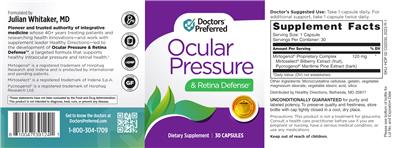
Supplement Facts
The label details for Ocular Pressure & Retina Defense by Doctors' Preferred, sourced from the NIH Dietary Supplement Label Database.
Supplement Facts
| Ingredient | Amount | % DV |
|---|---|---|
| Pycnogenol | 0 NP | -- |
| Mirtogenol Proprietary Complex | 120 mg | -- |
| MirtoSelect | 0 NP | -- |
Other ingredients: Microcrystalline Cellulose, Gelatin, Magnesium Stearate, Stearic Acid, Silica
Tap any ingredient to jump to its full detail below.
These statements are the manufacturer’s wording, reproduced from the product label — the label is saying it, not HelloPharmacist. We don’t verify or endorse them.
Formulation
Formulated by Julian Whitaker, MD Pioneer and trusted authority of integrative medicine whose 40+ years treating patients and researching health innovations-and work with supplement leader Healthy Directions-led to the development of Ocular Pressure & Retina Defense, a targeted formula that supports healthy intraocular pressure and retinal health.
Gluten Free
Unconditionally guaranteed for purity and labeled potency.
Brand IP Statement(s)
Mirtogenol is registered trademark of Horphag Research and Indena and is protected by international and pending patents. Mirtoselect is a registered trademark of Indena S.p.A. Pycnogenol is a registered trademark of Hophag Research Ltd.
FDA Statement of Identity
These statements have not been evaluated by the Food and Drug Administration. This product is not intended to diagnose, treat, cure, or prevent any disease.
Dietary Supplement
General Statements
Get to know the doctors at DoctorsPreferred.com Doctor Developed
Doctor Formulated Doctor Formulated
Seals/Symbols
Triple Tested CGMP Certified Facility
Suggested/Recommended/Usage/Directions
Doctor's suggested use: Take 1 capsule daily, For additional support, take 1 capsule twice daily.
Storage
To preserve quality and freshness, store bottle with cap tightly closed in a cool, dry place.
Precautions
Precautions: This product is not a treatment for glaucoma.
Consult a health care practitioner before use if you are pregnant or nursing, have a serious medical condition, or use any medications.
Keep out of reach of children.
Is this label outdated? Report a formula or label change and our pharmacy team will review it.
Ocular Pressure & Retina Defense by Doctors' Preferred label
The label scan from the NIH Dietary Supplement Label Database. Tap to enlarge.
Label images are published by the NIH Dietary Supplement Label Database for the version of this product on file. Always read your actual product label.
View the full label (PDF)The Ingredients in Ocular Pressure & Retina Defense by Doctors' Preferred
These are the 2 active ingredients this product is made of. Select any to open its full monograph.
Serving size1 Capsule(s) Dosage formCapsule Servings per container30 Amounts shown are per serving.
Most supplement products combine several ingredients, and a medication can interact with the product through any one of them. Each ingredient below shows whether it has known drug interactions.
Mirtogenol Proprietary Complex
Other (inactive) ingredients: Microcrystalline Cellulose, Gelatin, Magnesium Stearate, Stearic Acid, Silica. These complete the product’s ingredient list but are not active constituents.
Ocular Pressure & Retina Defense by Doctors' Preferred Drug Interactions
HelloPharmacist Interaction Report
Ocular Pressure & Retina Defense by Doctors' Preferred contains two active ingredients — Pycnogenol and bilberry extract (MirtoSelect) — and both have documented interactions with medications.
The most serious concern is a moderate risk of increased bleeding when either ingredient is combined with blood thinners or antiplatelet drugs like warfarin, aspirin, or clopidogrel. Both ingredients may slow clotting through different mechanisms.
Read the full breakdown — every affected drug type, severity by severity
Additionally, both ingredients may lower blood sugar when taken with diabetes medications, raising the theoretical risk of low blood sugar (hypoglycemia). If you take diabetes drugs, monitor your glucose closely — your doctor may need to adjust your dose.
Pycnogenol also has a moderate interaction with immunosuppressant medications, where it might reduce their effectiveness. Bilberry extract may affect how your body processes certain drugs broken down by a liver enzyme called CYP2E1, and theoretically could reduce the effectiveness of the cancer drug erlotinib (Tarceva).
Additionally, we could not check the Mirtogenol Proprietary Complex — the product lists it as a blend without breaking out its individual components. Altogether, these interactions span 394 individual medications.
Use the medication checker on this page to look up any drugs you're currently taking before you start this supplement.
Check your own medications below · Editorial policy · How we use AI
Want to check YOUR meds against Ocular Pressure & Retina Defense?
Ask about interactions with your drugs in plain English — “Can I take it with lisinopril?” — and we find you the answer in seconds, ingredient by ingredient.
Go to the checkerIngredients driving the most interactions
Individual Drug Interactions
The ingredients in Ocular Pressure & Retina Defense interact with 394 drugs. Click any drug to see the details.
2 of the 2 ingredients in Ocular Pressure & Retina Defense interact with drugs. Each result below shows which ingredient is responsible. Pycnogenol MirtoSelect
6-mercaptopurinePurinethol
How 6-mercaptopurine interacts with Ocular Pressure & Retina Defense — through 1 ingredient. Tap an ingredient for the detail:
PycnogenolImmunosuppressants Moderate
Interaction Summary
Theoretically, maritime pine bark extract might decrease the effectiveness of immunosuppressant therapy.
Read the full Pycnogenol + 6-mercaptopurine interactionAbciximabReoPro
How Abciximab interacts with Ocular Pressure & Retina Defense — through 2 ingredients. Tap an ingredient for the detail:
PycnogenolAnticoagulant/antiplatelet Drugs Moderate
Interaction Summary
Theoretically, maritime pine bark extract might increase the risk of bleeding when used with antiplatelet or anticoagulant drugs.
Read the full Pycnogenol + Abciximab interactionMirtoselectAnticoagulant/antiplatelet Drugs Moderate
Interaction Summary
Theoretically, bilberry fruit extract might increase the risk of bleeding when taken with anticoagulant or antiplatelet drugs.
Read the full Mirtoselect + Abciximab interactionAbrocitinibCibinqo
How Abrocitinib interacts with Ocular Pressure & Retina Defense — through 2 ingredients. Tap an ingredient for the detail:
MirtoselectAnticoagulant/antiplatelet Drugs Moderate
Interaction Summary
Theoretically, bilberry fruit extract might increase the risk of bleeding when taken with anticoagulant or antiplatelet drugs.
Read the full Mirtoselect + Abrocitinib interactionPycnogenolAnticoagulant/antiplatelet Drugs, Immunosuppressants Moderate
Interaction Summary
Theoretically, maritime pine bark extract might increase the risk of bleeding when used with antiplatelet or anticoagulant drugs.
Read the full Pycnogenol + Abrocitinib interactionAcarboseGlucobay, Prandase, Precose
How Acarbose interacts with Ocular Pressure & Retina Defense — through 2 ingredients. Tap an ingredient for the detail:
PycnogenolAntidiabetes Drugs Moderate
Interaction Summary
Theoretically, maritime pine bark extract might increase the risk of hypoglycemia when used with antidiabetes drugs.
Read the full Pycnogenol + Acarbose interactionMirtoselectAntidiabetes Drugs Moderate
Interaction Summary
Theoretically, bilberry leaf or fruit extract may increase the risk of hypoglycemia when taken with antidiabetes drugs.
Read the full Mirtoselect + Acarbose interactionAcenocoumarolSintrom
How Acenocoumarol interacts with Ocular Pressure & Retina Defense — through 2 ingredients. Tap an ingredient for the detail:
MirtoselectAnticoagulant/antiplatelet Drugs Moderate
Interaction Summary
Theoretically, bilberry fruit extract might increase the risk of bleeding when taken with anticoagulant or antiplatelet drugs.
Read the full Mirtoselect + Acenocoumarol interactionPycnogenolAnticoagulant/antiplatelet Drugs Moderate
Interaction Summary
Theoretically, maritime pine bark extract might increase the risk of bleeding when used with antiplatelet or anticoagulant drugs.
Read the full Pycnogenol + Acenocoumarol interactionAcetaminophenChildren's Tylenol, Children's Tylenol Meltaways, Tylenol, Tylenol Ex Strength
How Acetaminophen interacts with Ocular Pressure & Retina Defense — through 1 ingredient. Tap an ingredient for the detail:
MirtoselectCytochrome P450 2e1 (cyp2e1) Substrates Moderate
Interaction Summary
Theoretically, bilberry fruit extract might decrease levels of drugs metabolized by CYP2E1.
Read the full Mirtoselect + Acetaminophen interactionAcetaminophen, AspirinGemnisyn
How Acetaminophen, Aspirin interacts with Ocular Pressure & Retina Defense — through 2 ingredients. Tap an ingredient for the detail:
MirtoselectAnticoagulant/antiplatelet Drugs, Cytochrome P450 2e1 (cyp2e1) Substrates Moderate
Interaction Summary
Theoretically, bilberry fruit extract might increase the risk of bleeding when taken with anticoagulant or antiplatelet drugs.
Read the full Mirtoselect + Acetaminophen, Aspirin interactionPycnogenolAnticoagulant/antiplatelet Drugs Moderate
Interaction Summary
Theoretically, maritime pine bark extract might increase the risk of bleeding when used with antiplatelet or anticoagulant drugs.
Read the full Pycnogenol + Acetaminophen, Aspirin interactionAcetaminophen, Aspirin, CaffeineExcedrin, Excedrin Extra Strength, Excedrin Migraine
How Acetaminophen, Aspirin, Caffeine interacts with Ocular Pressure & Retina Defense — through 2 ingredients. Tap an ingredient for the detail:
PycnogenolAnticoagulant/antiplatelet Drugs Moderate
Interaction Summary
Theoretically, maritime pine bark extract might increase the risk of bleeding when used with antiplatelet or anticoagulant drugs.
Read the full Pycnogenol + Acetaminophen, Aspirin, Caffeine interactionMirtoselectAnticoagulant/antiplatelet Drugs, Cytochrome P450 2e1 (cyp2e1) Substrates Moderate
Interaction Summary
Theoretically, bilberry fruit extract might increase the risk of bleeding when taken with anticoagulant or antiplatelet drugs.
Read the full Mirtoselect + Acetaminophen, Aspirin, Caffeine interactionAcetaminophen, Brompheniramine, PhenylpropanolamineDimetapp Cold and Flu
How Acetaminophen, Brompheniramine, Phenylpropanolamine interacts with Ocular Pressure & Retina Defense — through 1 ingredient. Tap an ingredient for the detail:
MirtoselectCytochrome P450 2e1 (cyp2e1) Substrates Moderate
Interaction Summary
Theoretically, bilberry fruit extract might decrease levels of drugs metabolized by CYP2E1.
Read the full Mirtoselect + Acetaminophen, Brompheniramine, Phenylpropanolamine interactionAcetaminophen, ButalbitalAxocet, Bancap, Bucet, Butex Forte, Esgic CF, Orbivan CF +5 more
How Acetaminophen, Butalbital interacts with Ocular Pressure & Retina Defense — through 1 ingredient. Tap an ingredient for the detail:
MirtoselectCytochrome P450 2e1 (cyp2e1) Substrates Moderate
Interaction Summary
Theoretically, bilberry fruit extract might decrease levels of drugs metabolized by CYP2E1.
Read the full Mirtoselect + Acetaminophen, Butalbital interactionAcetaminophen, Butalbital, CaffeineEsgic, Esgic Plus, Fiogesic, Fioricet, Repan, Tecnal +1 more
How Acetaminophen, Butalbital, Caffeine interacts with Ocular Pressure & Retina Defense — through 1 ingredient. Tap an ingredient for the detail:
MirtoselectCytochrome P450 2e1 (cyp2e1) Substrates Moderate
Interaction Summary
Theoretically, bilberry fruit extract might decrease levels of drugs metabolized by CYP2E1.
Read the full Mirtoselect + Acetaminophen, Butalbital, Caffeine interactionAcetaminophen, Butalbital, Caffeine, CodeineEsgic with Codeine, Fioricet w/ Codeine
How Acetaminophen, Butalbital, Caffeine, Codeine interacts with Ocular Pressure & Retina Defense — through 1 ingredient. Tap an ingredient for the detail:
MirtoselectCytochrome P450 2e1 (cyp2e1) Substrates Moderate
Interaction Summary
Theoretically, bilberry fruit extract might decrease levels of drugs metabolized by CYP2E1.
Read the full Mirtoselect + Acetaminophen, Butalbital, Caffeine, Codeine interactionAcetaminophen, Butalbital, CodeineBancap w/ Codeine
How Acetaminophen, Butalbital, Codeine interacts with Ocular Pressure & Retina Defense — through 1 ingredient. Tap an ingredient for the detail:
MirtoselectCytochrome P450 2e1 (cyp2e1) Substrates Moderate
Interaction Summary
Theoretically, bilberry fruit extract might decrease levels of drugs metabolized by CYP2E1.
Read the full Mirtoselect + Acetaminophen, Butalbital, Codeine interactionAcetaminophen, Butalbital, Codeine PhosphatePhrenilin #3
How Acetaminophen, Butalbital, Codeine Phosphate interacts with Ocular Pressure & Retina Defense — through 1 ingredient. Tap an ingredient for the detail:
MirtoselectCytochrome P450 2e1 (cyp2e1) Substrates Moderate
Interaction Summary
Theoretically, bilberry fruit extract might decrease levels of drugs metabolized by CYP2E1.
Read the full Mirtoselect + Acetaminophen, Butalbital, Codeine Phosphate interactionAcetaminophen, Caffeine, Chlorpheniramine, Hydrocodone, PhenylephrineHycomine Compound
How Acetaminophen, Caffeine, Chlorpheniramine, Hydrocodone, Phenylephrine interacts with Ocular Pressure & Retina Defense — through 1 ingredient. Tap an ingredient for the detail:
MirtoselectCytochrome P450 2e1 (cyp2e1) Substrates Moderate
Interaction Summary
Theoretically, bilberry fruit extract might decrease levels of drugs metabolized by CYP2E1.
Read the full Mirtoselect + Acetaminophen, Caffeine, Chlorpheniramine, Hydrocodone, Phenylephrine interactionAcetaminophen, Caffeine, CodeineGesic C15, Gesic C30, Gesic C8, Lenoltec 1, Lenoltec 2, Lenoltec 3 +1 more
How Acetaminophen, Caffeine, Codeine interacts with Ocular Pressure & Retina Defense — through 1 ingredient. Tap an ingredient for the detail:
MirtoselectCytochrome P450 2e1 (cyp2e1) Substrates Moderate
Interaction Summary
Theoretically, bilberry fruit extract might decrease levels of drugs metabolized by CYP2E1.
Read the full Mirtoselect + Acetaminophen, Caffeine, Codeine interactionAcetaminophen, Caffeine, Codeine, SalicylamideCodalan No.1, Codalan No.2, Codalan No.3
How Acetaminophen, Caffeine, Codeine, Salicylamide interacts with Ocular Pressure & Retina Defense — through 1 ingredient. Tap an ingredient for the detail:
MirtoselectCytochrome P450 2e1 (cyp2e1) Substrates Moderate
Interaction Summary
Theoretically, bilberry fruit extract might decrease levels of drugs metabolized by CYP2E1.
Read the full Mirtoselect + Acetaminophen, Caffeine, Codeine, Salicylamide interactionAcetaminophen, Caffeine, DihydrocodeineDHC Plus, Panlor DC, Panlor SS
How Acetaminophen, Caffeine, Dihydrocodeine interacts with Ocular Pressure & Retina Defense — through 1 ingredient. Tap an ingredient for the detail:
MirtoselectCytochrome P450 2e1 (cyp2e1) Substrates Moderate
Interaction Summary
Theoretically, bilberry fruit extract might decrease levels of drugs metabolized by CYP2E1.
Read the full Mirtoselect + Acetaminophen, Caffeine, Dihydrocodeine interactionAcetaminophen, Caffeine, IsomethepteneMigralam
How Acetaminophen, Caffeine, Isometheptene interacts with Ocular Pressure & Retina Defense — through 1 ingredient. Tap an ingredient for the detail:
MirtoselectCytochrome P450 2e1 (cyp2e1) Substrates Moderate
Interaction Summary
Theoretically, bilberry fruit extract might decrease levels of drugs metabolized by CYP2E1.
Read the full Mirtoselect + Acetaminophen, Caffeine, Isometheptene interactionAcetaminophen, Caffeine, PyrilamineMidol Max Strength Menstrual
How Acetaminophen, Caffeine, Pyrilamine interacts with Ocular Pressure & Retina Defense — through 1 ingredient. Tap an ingredient for the detail:
MirtoselectCytochrome P450 2e1 (cyp2e1) Substrates Moderate
Interaction Summary
Theoretically, bilberry fruit extract might decrease levels of drugs metabolized by CYP2E1.
Read the full Mirtoselect + Acetaminophen, Caffeine, Pyrilamine interactionAcetaminophen, Chlorpheniramine Maleate, Dextromethorphan HbrVicks Formula 44M Cough, Cold & Flu Relief
How Acetaminophen, Chlorpheniramine Maleate, Dextromethorphan Hbr interacts with Ocular Pressure & Retina Defense — through 1 ingredient. Tap an ingredient for the detail:
MirtoselectCytochrome P450 2e1 (cyp2e1) Substrates Moderate
Interaction Summary
Theoretically, bilberry fruit extract might decrease levels of drugs metabolized by CYP2E1.
Read the full Mirtoselect + Acetaminophen, Chlorpheniramine Maleate, Dextromethorphan Hbr interactionAcetaminophen, Chlorpheniramine, Codeine, PhenylephrineColrex
How Acetaminophen, Chlorpheniramine, Codeine, Phenylephrine interacts with Ocular Pressure & Retina Defense — through 1 ingredient. Tap an ingredient for the detail:
MirtoselectCytochrome P450 2e1 (cyp2e1) Substrates Moderate
Interaction Summary
Theoretically, bilberry fruit extract might decrease levels of drugs metabolized by CYP2E1.
Read the full Mirtoselect + Acetaminophen, Chlorpheniramine, Codeine, Phenylephrine interactionAcetaminophen, Chlorpheniramine, DextromethorphanCoricidin II Extra Strength Cold and Flu
How Acetaminophen, Chlorpheniramine, Dextromethorphan interacts with Ocular Pressure & Retina Defense — through 1 ingredient. Tap an ingredient for the detail:
MirtoselectCytochrome P450 2e1 (cyp2e1) Substrates Moderate
Interaction Summary
Theoretically, bilberry fruit extract might decrease levels of drugs metabolized by CYP2E1.
Read the full Mirtoselect + Acetaminophen, Chlorpheniramine, Dextromethorphan interactionAcetaminophen, Chlorpheniramine, Dextromethorphan HydrobromideCoricidin HBP Maximum Strength Flu
How Acetaminophen, Chlorpheniramine, Dextromethorphan Hydrobromide interacts with Ocular Pressure & Retina Defense — through 1 ingredient. Tap an ingredient for the detail:
MirtoselectCytochrome P450 2e1 (cyp2e1) Substrates Moderate
Interaction Summary
Theoretically, bilberry fruit extract might decrease levels of drugs metabolized by CYP2E1.
Read the full Mirtoselect + Acetaminophen, Chlorpheniramine, Dextromethorphan Hydrobromide interactionAcetaminophen, Chlorpheniramine, Dextromethorphan, PhenylpropanolamineMulti Symptom Cold Relief
How Acetaminophen, Chlorpheniramine, Dextromethorphan, Phenylpropanolamine interacts with Ocular Pressure & Retina Defense — through 1 ingredient. Tap an ingredient for the detail:
MirtoselectCytochrome P450 2e1 (cyp2e1) Substrates Moderate
Interaction Summary
Theoretically, bilberry fruit extract might decrease levels of drugs metabolized by CYP2E1.
Read the full Mirtoselect + Acetaminophen, Chlorpheniramine, Dextromethorphan, Phenylpropanolamine interactionAcetaminophen, Chlorpheniramine, Dextromethorphan, PseudoephedrineChildren's Tylenol Cold Plus Cough, Tylenol Cold Ex Strength
How Acetaminophen, Chlorpheniramine, Dextromethorphan, Pseudoephedrine interacts with Ocular Pressure & Retina Defense — through 1 ingredient. Tap an ingredient for the detail:
MirtoselectCytochrome P450 2e1 (cyp2e1) Substrates Moderate
Interaction Summary
Theoretically, bilberry fruit extract might decrease levels of drugs metabolized by CYP2E1.
Read the full Mirtoselect + Acetaminophen, Chlorpheniramine, Dextromethorphan, Pseudoephedrine interactionAcetaminophen, Chlorpheniramine, Guaifenesin, Phenylephrine, SalicylamideRhinogesic GG
How Acetaminophen, Chlorpheniramine, Guaifenesin, Phenylephrine, Salicylamide interacts with Ocular Pressure & Retina Defense — through 1 ingredient. Tap an ingredient for the detail:
MirtoselectCytochrome P450 2e1 (cyp2e1) Substrates Moderate
Interaction Summary
Theoretically, bilberry fruit extract might decrease levels of drugs metabolized by CYP2E1.
Read the full Mirtoselect + Acetaminophen, Chlorpheniramine, Guaifenesin, Phenylephrine, Salicylamide interactionAcetaminophen, Chlorpheniramine, PhenylephrineAlka-Seltzer PLUS, Histex SR, Protid
How Acetaminophen, Chlorpheniramine, Phenylephrine interacts with Ocular Pressure & Retina Defense — through 1 ingredient. Tap an ingredient for the detail:
MirtoselectCytochrome P450 2e1 (cyp2e1) Substrates Moderate
Interaction Summary
Theoretically, bilberry fruit extract might decrease levels of drugs metabolized by CYP2E1.
Read the full Mirtoselect + Acetaminophen, Chlorpheniramine, Phenylephrine interactionAcetaminophen, Chlorpheniramine, Phenylephrine, SalicylamideRhinogesic, Rhinogesic JR
How Acetaminophen, Chlorpheniramine, Phenylephrine, Salicylamide interacts with Ocular Pressure & Retina Defense — through 1 ingredient. Tap an ingredient for the detail:
MirtoselectCytochrome P450 2e1 (cyp2e1) Substrates Moderate
Interaction Summary
Theoretically, bilberry fruit extract might decrease levels of drugs metabolized by CYP2E1.
Read the full Mirtoselect + Acetaminophen, Chlorpheniramine, Phenylephrine, Salicylamide interactionAcetaminophen, Chlorpheniramine, PhenylpropanolamineAlumadrine, Conex, Sinadrin Max Strength, Sinulin
How Acetaminophen, Chlorpheniramine, Phenylpropanolamine interacts with Ocular Pressure & Retina Defense — through 1 ingredient. Tap an ingredient for the detail:
MirtoselectCytochrome P450 2e1 (cyp2e1) Substrates Moderate
Interaction Summary
Theoretically, bilberry fruit extract might decrease levels of drugs metabolized by CYP2E1.
Read the full Mirtoselect + Acetaminophen, Chlorpheniramine, Phenylpropanolamine interactionEach ingredient & the kinds of drugs it affects
For each ingredient in Ocular Pressure & Retina Defense with known interactions, here are the types of medications they can affect. Open any type for the detail — or search your exact drug in the checker above.
Pycnogenol
Anticoagulant/Antiplatelet Drugs
Theoretically, maritime pine bark extract might increase the risk of bleeding when used with antiplatelet or anticoagulant drugs.
Clinical research suggests that maritime pine bark extract inhibits platelet aggregation. However, the clinical significance of this effect is unclear.
Antidiabetes Drugs
Theoretically, maritime pine bark extract might increase the risk of hypoglycemia when used with antidiabetes drugs.
One clinical study shows that maritime pine bark extract decreases blood sugar in patients with diabetes being treated with antidiabetes agents. Monitor blood glucose levels closely. Dose adjustments might be necessary.
Immunosuppressants
Theoretically, maritime pine bark extract might decrease the effectiveness of immunosuppressant therapy.
In vitro and animal research suggests that maritime pine bark extract has immunostimulant activity. This effect has not been reported in humans.
MirtoSelect
Anticoagulant/Antiplatelet Drugs
Theoretically, bilberry fruit extract might increase the risk of bleeding when taken with anticoagulant or antiplatelet drugs.
In vitro, animal, and clinical research suggest that anthocyanidin extracts from bilberry can inhibit platelet aggregation.
Antidiabetes Drugs
Theoretically, bilberry leaf or fruit extract may increase the risk of hypoglycemia when taken with antidiabetes drugs.
Animal research suggests that bilberry leaf extract might have blood glucose-lowering activity. Also, one small clinical trial in patients with type 2 diabetes shows that taking bilberry fruit extract 470 mg as a single dose prior to an oral glucose tolerance test lowers plasma glucose levels when compared with placebo.
Cytochrome P450 2E1 (Cyp2E1) Substrates
Theoretically, bilberry fruit extract might decrease levels of drugs metabolized by CYP2E1.
Animal research shows that exposure to small concentrations of bilberry extract in drinking water for around one month increased CYP2E1 activity by 31%. However, exposure over a 2-month period did not increase CYP2E1 activity. This effect has not been reported in humans.
Erlotinib (Tarceva)
Theoretically, bilberry fruit extract might reduce the efficacy of erlotinib.
In vitro research suggests that bilberry fruit extract and its constituents, delphinidin and delphinidin-3-O-glucoside, inhibit the activity of erlotinib. This interaction has not been reported in humans.
Brand information
Manufacturer and brand details for Ocular Pressure & Retina Defense, from the product label.
Doctors' Preferred
See all Doctors' Preferred products- Name
- Healthy Directions
- City
- Bethesda
- State
- MD
- ZipCode
- 20817
- Phone Number
- 1-800-304-1709
- Web Address
- DoctorsPreferred.com
Ocular Pressure & Retina Defense by Doctors' Preferred: Common Questions
Does Ocular Pressure & Retina Defense by Doctors' Preferred interact with any medications?
How can one product interact with so many drugs?
Where does this information come from?
Can I take this if I'm on a blood thinner like warfarin?
Will this help my night vision?
What are the most common side effects?
Is it safe to take while pregnant or breastfeeding?
Will this affect my diabetes medication?
What's Pycnogenol and what's it supposed to do?
Written and reviewed by the HelloPharmacist editorial staff. Our editorial policy
Not sure if Ocular Pressure & Retina Defense is safe with your meds?
Our pharmacists answer your medication & supplement questions — free.
Label information is sourced from the NIH Dietary Supplement Label Database and reflects the product version on file; always read your actual product label. This page is for education only and is not a substitute for professional medical advice. Confirm with your pharmacist or doctor before combining supplements and medications.
The Full Monographs Behind Ocular Pressure & Retina Defense’s Ingredients
Every ingredient we hold a full HelloPharmacist monograph for — uses, evidence, safety, and the complete interaction list.
Maritime Pine
Interacts with 327 drugsMaritime pine bark extract (often sold as Pycnogenol) is a plant-based antioxidant most studied for circulation, vein, and skin health. Some research is promising, but many studies are small...
Read the full Maritime Pine monograph → Herb & supplement monographBilberry
Interacts with 275 drugsBilberry is a blueberry-like fruit rich in antioxidant plant compounds called anthocyanins, and it has a long history of traditional use for eye health, circulation, and mild diarrhea. While...
Read the full Bilberry monograph →Sources & How We Checked
Ocular Pressure & Retina Defense's label data comes from the NIH Dietary Supplement Label Database; the ingredient interaction data is from the Natural Medicines database, reviewed by our pharmacists.
- NIH Dietary Supplement Label Database (DSLD) — The official product label on file for this supplement.
- Natural Medicines (Therapeutic Research Center) — Evidence-graded clinical reference behind the ingredient interaction data.
Content is written and reviewed by licensed HelloPharmacist pharmacists. See our data sources and editorial standards for how this information is built and checked.
The 28 references behind this product’s interaction data
Every citation that drives the interaction findings for this product’s ingredients, from the evidence-graded Natural Medicines (TRC Healthcare) database. Open an ingredient to browse its citations — links open the study on PubMed or the publisher’s site.
Maritime Pine 14 references
- Rice-Evans CA, Packer L, eds. Flavonoids in Health and Disease. Manhattan, NY: Marcel Dekker, Inc., 1998.
- Liu FJ, Zhang YX, Lau BH. Pycnogenol enhances immune and haemopoietic functions in senescence-accelerated mice. Cell Mol Life Sci 1998;54:1168-72. PubMed
- Putter M, Grotemeyer KH, Wurthwein G, et al. Inhibition of smoking-induced platelet aggregation by aspirin and pycnogenol. Thromb Res 1999;95:155-61. PubMed
- Kohama T, Inoue M. Pycnogenol alleviates pain associated with pregnancy. Phytother Res 2006;20:232-4.
- Liu X, Zhou HJ, Rohdewald P. French maritime pine bark extract pycnogenol dose-dependently lowers glucose in type 2 diabetic patients (letter). Diabetes Care 2004;27:839. PubMed
- Liu X, Wei J, Tan F, et al. Antidiabetic effect of Pycnogenol French maritime pine bark extract in patients with diabetes type II. Life Sci 2004;75:2505-13. PubMed
- Wilson D, Evans M, Guthrie N et al. A randomized, double-blind, placebo-controlled exploratory study to evaluate the potential of pycnogenol for improving allergic rhinitis symptoms. Phytother Res 2010;24:1115-9.
- Araghi-Niknam, M., Hosseini, S., Larson, D., Rohdewald, P., and Watson, R. R. Pine bark extract reduces platelet aggregation. Integr.Med. 3-21-2000;2(2):73-77. PubMed
- Trebaticka, J., Kopasova, S., Hradecna, Z., Cinovsky, K., Skodacek, I., Suba, J., Muchova, J., Zitnanova, I., Waczulikova, I., Rohdewald, P., and Durackova, Z. Treatment of ADHD with French maritime pine bark extract, Pycnogenol. Eur.Child Adolesc.Psychi PubMed
- Suzuki, N., Uebaba, K., Kohama, T., Moniwa, N., Kanayama, N., and Koike, K. French maritime pine bark extract significantly lowers the requirement for analgesic medication in dysmenorrhea: a multicenter, randomized, double-blind, placebo-controlled study
- Cisar, P., Jany, R., Waczulikova, I., Sumegova, K., Muchova, J., Vojtassak, J., Durackova, Z., Lisy, M., and Rohdewald, P. Effect of pine bark extract (Pycnogenol) on symptoms of knee osteoarthritis. Phytother.Res. 2008;22(8):1087-1092.
- Enseleit, F., Sudano, I., Periat, D., Winnik, S., Wolfrum, M., Flammer, A. J., Frohlich, G. M., Kaiser, P., Hirt, A., Haile, S. R., Krasniqi, N., Matter, C. M., Uhlenhut, K., Hogger, P., Neidhart, M., Luscher, T. F., Ruschitzka, F., and Noll, G. Effects
- Schoonees, A., Visser, J., Musekiwa, A., and Volmink, J. Pycnogenol(R) (extract of French maritime pine bark) for the treatment of chronic disorders. Cochrane.Database.Syst.Rev. 2012;4:CD008294.
- Wang S, Tan D Zhao Y et al. The effect of pycnogenol on the microcirculation, platelet function and ischemic myocardium in patients with coronary artery diseases. Eur Bull Drug Res 1999;7:19-25.
Bilberry 14 references
- Cignarella A, Nastasi M, Cavalli E, Puglisi L. Novel lipid-lowering properties of Vaccinium myrtillus L. leaves, a traditional antidiabetic treatment, in several models of rat dyslipidaemia: a comparison with ciprofibrate. Thromb Res 1996;84:311-22. PubMed
- Morazzoni P, Magistretti MJ. Activity of Myrtocyan, an anthosyanoside complex from Vaccinium myrtillus (VMA), on platelet aggregation and adhesiveness. Fitoterapia 1990;61:13-21.
- Erlund, I., Koli, R., Alfthan, G., Marniemi, J., Puukka, P., Mustonen, P., Mattila, P., and Jula, A. Favorable effects of berry consumption on platelet function, blood pressure, and HDL cholesterol. Am J Clin Nutr 2008;87(2):323-331. PubMed
- Hawrelak, J. A. and Myers, S. P. Effects of two natural medicine formulations on irritable bowel syndrome symptoms: a pilot study. J Altern Complement Med 2010;16(10):1065-1071. PubMed
- Morazzoni P and Magistretti MJ. Effects of Vaccinium myrtillus anthocyanosides on prostacyclin-like activity in rat arterial issue. Fitoterapia 1986;57:11-14.
- Pulliero G, Montin S, Bettini V, and et al. Ex vivo study of the inhibitory effects of Vaccinium myrtillus anthocyanosides on human platelet aggregation. Fitoterapia 1989;60:69-75.
- Bottecchia D. Preliminary report on the inhibitory effect of vaccinium myrtillus anthocyanosides on platelet aggregation and clot retraction. Fitoterapia 1987;48:3-8.
- Fdez, M., Zaragoza, F., and Alvarez, P. In vitro platelet aggregation effects of anthocyanosides of vaccinium myrtilus L. Anales de la Real Academia de Farmacia 1983;49:79-90.
- Biedermann L, Mwinyi J, Scharl M, Frei P, Zeitz J, Kullak-Ublick GA, et al. Bilberry ingestion improves disease activity in mild to moderate ulcerative colitis-an open pilot study. 2013 May;7(4):271-9. PubMed
- Hoggard N, Cruickshank M, Moar KM, Bestwick C, Holst J, Russell W, et al. A single supplement of a standardized bilberry (Vaccinium myrtillus L.) extract (36% wet weight anthocyanins) modifies glycaemic response in individuals with type 2 diabetes control
- Aichinger G, Pahlke G, Nagel LJ, Berger W, Marko D. Bilberry extract, its major phenolic compounds, and soy isoflavone genistein antagonize the cytostatic drug erlotinib in human epithelial cells. Food Funct 2016;7(8):3628-36.
- Prokop J, Lněničková K, Cibicek N, et al. Effect of bilberry extract (Vaccinium myrtillus L.) on drug-metabolizing enzymes in rats. Food Chem Toxicol 2019;129:382-90. PubMed
- Chan SW, Chu TTW, Choi SW, Benzie IFF, Tomlinson B. Impact of short-term bilberry supplementation on glycemic control, cardiovascular disease risk factors, and antioxidant status in Chinese patients with type 2 diabetes. Phytother Res 2021. Online ahead o PubMed
- Bøhn SK, Myhrstad MCW, Thoresen M, et al. Bilberry/red grape juice decreases plasma biomarkers of inflammation and tissue damage in aged men with subjective memory impairment -a randomized clinical trial. BMC Nutr 2021;7(1):75. PubMed
Parts of this content are provided by the Therapeutic Research Center, LLC.
DISCLAIMER: Currently this does not check for drug-drug interactions. This is not an all-inclusive comprehensive list of potential interactions and is for informational purposes only. Not all interactions are known or well-reported in the scientific literature, and new interactions are continually being reported. Input is needed from a qualified healthcare provider including a pharmacist before starting any therapy. Application of clinical judgment is necessary.
© 2021 Therapeutic Research Center, LLC