
Parsley 500 mg Ingredients & Drug Interactions
What is this page for?
First and foremost: checking Parsley 500 mg against your medications. The heart of this page is the interaction checker and the full interaction report — how this product’s ingredients may interact with prescription and over-the-counter medicines you may be taking.
Around that, we add a pharmacist’s high-level view of the product as a whole — what’s inside, the evidence for its stated use, how transparent the label is, and what safety data exists — so you can see the full picture in one place. It’s educational information from our licensed clinical databases and the clinical staff at HelloPharmacist — not medical advice — and we don’t sell or endorse products. Our editorial policy
Parsley 500 mg is a dietary supplement by Dr. Clark Store with 1 active ingredient. Its ingredients are commonly taken for water retention and bloating, urinary and bladder support, digestive upset.Based on those ingredients, 443 medications have a known interaction with it, the most serious rated moderate. The ingredients most likely to interact are Parsley, Freeze-Dried. Use the checker below to test your specific medication, or read the full HelloPharmacist Interaction Report.
Check Your Meds Against Parsley 500 mg by Dr. Clark Store
Ask about any prescription or over-the-counter medication and we check it for interactions with Parsley 500 mg by Dr. Clark Store — and tell you which ingredient is responsible.
AI summaries are generated from our interaction database for education only — always confirm with your pharmacist. How we use AI
Ask the Pharmacist
A licensed pharmacist will answer your question by email — free, usually within 24 hours.
Got it — thank you!
A licensed pharmacist will answer within 24 hours. Keep an eye on your email (worth checking spam, just in case).
HelloPharmacist Scorecard of Parsley 500 mg by Dr. Clark Store
Our pharmacy team’s full take, with four database checks built into the cards below — a summary of what is known, not a grade of the product itself.
What’s inside
Full disclosure
Dr. Clark Store's Parsley 500 mg is a single-ingredient supplement: 500 mg of freeze-dried parsley per capsule.
The capsule itself contains tapioca as an inactive ingredient.
Does it work?
No specific claim
The evidence we hold doesn't establish how well parsley works for any of its proposed uses. The data shows insufficient reliable evidence for urinary tract infections, melasma, osteoarthritis, and nonmelanoma skin cancer, meaning studies are limited or inconclusive.
If you're considering this for a specific condition, it's worth a conversation with your doctor or pharmacist.
How safe is it?
Well-documented data
Parsley eaten as food is generally well tolerated in normal amounts. However, parsley concentrates—including supplements, seeds, and essential oils—may not be safe in large doses.
Very high intakes (200 grams of parsley oil or 10 grams or more of the constituent apiole or myristicin) are associated with rare but serious effects like hemolytic anemia, low blood platelet counts (thrombocytopenia purpura), low blood pressure, liver or kidney damage, and paralysis. A case of severe allergic reaction (anaphylaxis with facial swelling and loss of consciousness) was reported in a woman who consumed about one cup of chopped parsley daily for years; she tested positive for parsley allergy on skin testing.
There is not enough safety data on medicinal or large amounts during pregnancy and breastfeeding, so talk with your doctor or pharmacist before using this if you're pregnant or nursing.
Meds to double-check
Moderate interaction found
Before taking this parsley supplement, double-check these medication types with your pharmacist: blood thinners and antiplatelet drugs (including warfarin and aspirin), diabetes medications, water pills (diuretics), and sedatives like pentobarbital. If you take sirolimus for transplant, mention this supplement as well.
The interactions are Moderate severity.
The bottom line
Scorecard at a glanceFully disclosed formula marketed for general wellness rather than one specific gradeable purpose. Moderate medication interactions have been identified, and safety information is well characterized.
Parsley supplement may interest you if you're exploring herbal options, but the evidence for its effectiveness isn't established in the data we hold. It has moderate interactions with blood thinners, diabetes drugs, diuretics, and several others—so check your exact medications before starting.
Stick with food amounts unless your doctor advises otherwise.
Educational only — not medical advice; always confirm with your pharmacist. Our editorial policy · How we use AI
Assessment coverage: 1 of 1 active ingredient matched to our full ingredient reviews (monographs). Based on the product label dated Jun 20, 2024.
This Scorecard evaluates available label information, ingredient evidence, and known medication-safety considerations. It does not independently verify product identity, purity, potency, contamination, or manufacturing quality. How these ratings are computed
General information
Key facts about Parsley 500 mg, straight from the product label.
| Brand | Dr. Clark Store |
|---|---|
| Barcode (UPC) | 652384800310 |
| Net contents | 42 Tapioca Cap(s) |
| Market status | On market |
| Date entered into DSLD | Jun 20, 2024 |
| DSLD ID | 313178 |
| Product type | Botanical |
| Supplement form | Capsule |
| Dietary claims / uses | All Other, Structure/Function |
| Intended target group(s) | Adult (18 - 50 Years) |
Everything in this section is reproduced from the manufacturer’s own product label — it’s the label speaking, not HelloPharmacist. We show it so you can see exactly what the maker states; we don’t verify or endorse those statements.
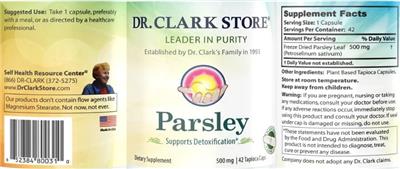
Supplement Facts
The label details for Parsley 500 mg by Dr. Clark Store, sourced from the NIH Dietary Supplement Label Database.
Tap any ingredient to jump to its full detail below.
These statements are the manufacturer’s wording, reproduced from the product label — the label is saying it, not HelloPharmacist. We don’t verify or endorse them.
Suggested/Recommended/Usage/Directions
Suggested Use: Take 1 capsule, preferably with a meal, or as directed by a healthcare professional.
Formulation
Our products don't contain flow agents like magnesium stearate. Not now, not ever.
Supports detoxification
Plant based caps
Seals/Symbols
Made in USA
Brand IP Statement(s)
Dr. Clark Store Leader in purity Established by Dr. Clark's family in 1993
FDA Statement of Identity
Dietary Supplement
Storage
Store at room temperature.
Precautions
Keep away from children.
Warning: If you are pregnant, nursing or taking any medications, consult your doctor before use.
If any adverse reactions occur, immediately stop using this product and consult your doctor. If seal under cap is damaged or missing, do not use.
FDA Disclaimer Statement
These statements have not been evaluated by the Food and Drug Administration. This product is not intended to diagnose, treat, cure or prevent any disease.
General Statements
Company does not adopt any Dr. Clark claims.
Is this label outdated? Report a formula or label change and our pharmacy team will review it.
Parsley 500 mg by Dr. Clark Store label
The label scan from the NIH Dietary Supplement Label Database. Tap to enlarge.
Label images are published by the NIH Dietary Supplement Label Database for the version of this product on file. Always read your actual product label.
View the full label (PDF)The Ingredients in Parsley 500 mg by Dr. Clark Store
This is the 1 active ingredient this product is made of. Select it to open its full monograph.
Serving size1 Capsule(s) Dosage formCapsule Servings per container42 Amounts shown are per serving.
Parsley, Freeze-Dried
Interacts with443 drugs
Parsley is a popular culinary herb that is safe to eat in normal food amounts and is a good source of vitamins K and C. It is traditionally used as a...
Parsley, Freeze-Dried monograph & interactionsOther (inactive) ingredients: Tapioca. These complete the product’s ingredient list but are not active constituents.
Parsley 500 mg by Dr. Clark Store Drug Interactions
HelloPharmacist Interaction Report
Dr.
Clark Store's Parsley 500 mg does interact with medications. Freeze-dried parsley can theoretically increase bleeding risk when combined with blood thinners and antiplatelet drugs like warfarin, aspirin, or clopidogrel—animal research shows parsley has antiplatelet effects, and parsley also contains vitamin K, which can work against warfarin specifically.
Read the full breakdown — every affected drug type, severity by severity
Parsley may also raise blood sugar medication effects and increase hypoglycemia risk; increase levels of certain CYP1A2 substrate drugs (a group of medications your liver processes a particular way); enhance or interfere with water pills (diuretics); prolong the effects of the sedative pentobarbital; and theoretically boost sirolimus levels in transplant patients—one case report described a kidney transplant patient whose sirolimus levels jumped 4–7 times higher after consuming about 30 grams of parsley daily for a week.
Altogether, these interactions span 442 individual medications. Aspirin carries a minor interaction—in one case, a person with mild parsley allergy experienced severe swelling and hives when aspirin was taken alongside parsley.
Use the medication checker below with your exact drugs before starting.
Check your own medications below · Editorial policy · How we use AI
Want to check YOUR meds against Parsley 500 mg?
Ask about interactions with your drugs in plain English — “Can I take it with lisinopril?” — and we find you the answer in seconds, ingredient by ingredient.
Go to the checkerIngredients driving the most interactions
Individual Drug Interactions
The ingredients in Parsley 500 mg interact with 443 drugs. Click any drug to see the details.
1 of the 1 ingredient in Parsley 500 mg interact with drugs. Each result below shows which ingredient is responsible. Parsley, Freeze-Dried
AbciximabReoPro
How Abciximab interacts with Parsley 500 mg — through 1 ingredient. Tap an ingredient for the detail:
Parsley, Freeze-driedAnticoagulant/antiplatelet Drugs Moderate
Interaction Summary
Theoretically, parsley might increase the risk of bleeding when taken with anticoagulant or antiplatelet drugs.
Read the full Parsley, Freeze-dried + Abciximab interactionAbrocitinibCibinqo
How Abrocitinib interacts with Parsley 500 mg — through 1 ingredient. Tap an ingredient for the detail:
Parsley, Freeze-driedAnticoagulant/antiplatelet Drugs Moderate
Interaction Summary
Theoretically, parsley might increase the risk of bleeding when taken with anticoagulant or antiplatelet drugs.
Read the full Parsley, Freeze-dried + Abrocitinib interactionAcarboseGlucobay, Prandase, Precose
How Acarbose interacts with Parsley 500 mg — through 1 ingredient. Tap an ingredient for the detail:
Parsley, Freeze-driedAntidiabetes Drugs Moderate
Interaction Summary
Theoretically, parsley might increase the risk of hypoglycemia when taken with antidiabetes drugs.
Read the full Parsley, Freeze-dried + Acarbose interactionAcenocoumarolSintrom
How Acenocoumarol interacts with Parsley 500 mg — through 1 ingredient. Tap an ingredient for the detail:
Parsley, Freeze-driedAnticoagulant/antiplatelet Drugs Moderate
Interaction Summary
Theoretically, parsley might increase the risk of bleeding when taken with anticoagulant or antiplatelet drugs.
Read the full Parsley, Freeze-dried + Acenocoumarol interactionAcetaminophenChildren's Tylenol, Children's Tylenol Meltaways, Tylenol, Tylenol Ex Strength
How Acetaminophen interacts with Parsley 500 mg — through 1 ingredient. Tap an ingredient for the detail:
Parsley, Freeze-driedCytochrome P450 1a2 (cyp1a2) Substrates Moderate
Interaction Summary
Theoretically, parsley might increase serum levels of CYP1A2 substrates.
Read the full Parsley, Freeze-dried + Acetaminophen interactionAcetaminophen, AspirinGemnisyn
How Acetaminophen, Aspirin interacts with Parsley 500 mg — through 1 ingredient. Tap an ingredient for the detail:
Parsley, Freeze-driedCytochrome P450 1a2 (cyp1a2) Substrates, Anticoagulant/antiplatelet Drugs +1 Moderate
Interaction Summary
Theoretically, parsley might increase serum levels of CYP1A2 substrates.
Read the full Parsley, Freeze-dried + Acetaminophen, Aspirin interactionAcetaminophen, Aspirin, CaffeineExcedrin, Excedrin Extra Strength, Excedrin Migraine
How Acetaminophen, Aspirin, Caffeine interacts with Parsley 500 mg — through 1 ingredient. Tap an ingredient for the detail:
Parsley, Freeze-driedAspirin, Cytochrome P450 1a2 (cyp1a2) Substrates +1 Moderate
Interaction Summary
Theoretically, aspirin might increase the severity of allergic reactions to parsley.
Read the full Parsley, Freeze-dried + Acetaminophen, Aspirin, Caffeine interactionAcetaminophen, Brompheniramine, PhenylpropanolamineDimetapp Cold and Flu
How Acetaminophen, Brompheniramine, Phenylpropanolamine interacts with Parsley 500 mg — through 1 ingredient. Tap an ingredient for the detail:
Parsley, Freeze-driedCytochrome P450 1a2 (cyp1a2) Substrates Moderate
Interaction Summary
Theoretically, parsley might increase serum levels of CYP1A2 substrates.
Read the full Parsley, Freeze-dried + Acetaminophen, Brompheniramine, Phenylpropanolamine interactionAcetaminophen, ButalbitalAxocet, Bancap, Bucet, Butex Forte, Esgic CF, Orbivan CF +5 more
How Acetaminophen, Butalbital interacts with Parsley 500 mg — through 1 ingredient. Tap an ingredient for the detail:
Parsley, Freeze-driedCytochrome P450 1a2 (cyp1a2) Substrates Moderate
Interaction Summary
Theoretically, parsley might increase serum levels of CYP1A2 substrates.
Read the full Parsley, Freeze-dried + Acetaminophen, Butalbital interactionAcetaminophen, Butalbital, CaffeineEsgic, Esgic Plus, Fiogesic, Fioricet, Repan, Tecnal +1 more
How Acetaminophen, Butalbital, Caffeine interacts with Parsley 500 mg — through 1 ingredient. Tap an ingredient for the detail:
Parsley, Freeze-driedCytochrome P450 1a2 (cyp1a2) Substrates Moderate
Interaction Summary
Theoretically, parsley might increase serum levels of CYP1A2 substrates.
Read the full Parsley, Freeze-dried + Acetaminophen, Butalbital, Caffeine interactionAcetaminophen, Butalbital, Caffeine, CodeineEsgic with Codeine, Fioricet w/ Codeine
How Acetaminophen, Butalbital, Caffeine, Codeine interacts with Parsley 500 mg — through 1 ingredient. Tap an ingredient for the detail:
Parsley, Freeze-driedCytochrome P450 1a2 (cyp1a2) Substrates Moderate
Interaction Summary
Theoretically, parsley might increase serum levels of CYP1A2 substrates.
Read the full Parsley, Freeze-dried + Acetaminophen, Butalbital, Caffeine, Codeine interactionAcetaminophen, Butalbital, CodeineBancap w/ Codeine
How Acetaminophen, Butalbital, Codeine interacts with Parsley 500 mg — through 1 ingredient. Tap an ingredient for the detail:
Parsley, Freeze-driedCytochrome P450 1a2 (cyp1a2) Substrates Moderate
Interaction Summary
Theoretically, parsley might increase serum levels of CYP1A2 substrates.
Read the full Parsley, Freeze-dried + Acetaminophen, Butalbital, Codeine interactionAcetaminophen, Butalbital, Codeine PhosphatePhrenilin #3
How Acetaminophen, Butalbital, Codeine Phosphate interacts with Parsley 500 mg — through 1 ingredient. Tap an ingredient for the detail:
Parsley, Freeze-driedCytochrome P450 1a2 (cyp1a2) Substrates Moderate
Interaction Summary
Theoretically, parsley might increase serum levels of CYP1A2 substrates.
Read the full Parsley, Freeze-dried + Acetaminophen, Butalbital, Codeine Phosphate interactionAcetaminophen, Caffeine, Chlorpheniramine, Hydrocodone, PhenylephrineHycomine Compound
How Acetaminophen, Caffeine, Chlorpheniramine, Hydrocodone, Phenylephrine interacts with Parsley 500 mg — through 1 ingredient. Tap an ingredient for the detail:
Parsley, Freeze-driedCytochrome P450 1a2 (cyp1a2) Substrates Moderate
Interaction Summary
Theoretically, parsley might increase serum levels of CYP1A2 substrates.
Read the full Parsley, Freeze-dried + Acetaminophen, Caffeine, Chlorpheniramine, Hydrocodone, Phenylephrine interactionAcetaminophen, Caffeine, CodeineGesic C15, Gesic C30, Gesic C8, Lenoltec 1, Lenoltec 2, Lenoltec 3 +1 more
How Acetaminophen, Caffeine, Codeine interacts with Parsley 500 mg — through 1 ingredient. Tap an ingredient for the detail:
Parsley, Freeze-driedCytochrome P450 1a2 (cyp1a2) Substrates Moderate
Interaction Summary
Theoretically, parsley might increase serum levels of CYP1A2 substrates.
Read the full Parsley, Freeze-dried + Acetaminophen, Caffeine, Codeine interactionAcetaminophen, Caffeine, Codeine, SalicylamideCodalan No.1, Codalan No.2, Codalan No.3
How Acetaminophen, Caffeine, Codeine, Salicylamide interacts with Parsley 500 mg — through 1 ingredient. Tap an ingredient for the detail:
Parsley, Freeze-driedCytochrome P450 1a2 (cyp1a2) Substrates Moderate
Interaction Summary
Theoretically, parsley might increase serum levels of CYP1A2 substrates.
Read the full Parsley, Freeze-dried + Acetaminophen, Caffeine, Codeine, Salicylamide interactionAcetaminophen, Caffeine, DihydrocodeineDHC Plus, Panlor DC, Panlor SS
How Acetaminophen, Caffeine, Dihydrocodeine interacts with Parsley 500 mg — through 1 ingredient. Tap an ingredient for the detail:
Parsley, Freeze-driedCytochrome P450 1a2 (cyp1a2) Substrates Moderate
Interaction Summary
Theoretically, parsley might increase serum levels of CYP1A2 substrates.
Read the full Parsley, Freeze-dried + Acetaminophen, Caffeine, Dihydrocodeine interactionAcetaminophen, Caffeine, IsomethepteneMigralam
How Acetaminophen, Caffeine, Isometheptene interacts with Parsley 500 mg — through 1 ingredient. Tap an ingredient for the detail:
Parsley, Freeze-driedCytochrome P450 1a2 (cyp1a2) Substrates Moderate
Interaction Summary
Theoretically, parsley might increase serum levels of CYP1A2 substrates.
Read the full Parsley, Freeze-dried + Acetaminophen, Caffeine, Isometheptene interactionAcetaminophen, Caffeine, PyrilamineMidol Max Strength Menstrual
How Acetaminophen, Caffeine, Pyrilamine interacts with Parsley 500 mg — through 1 ingredient. Tap an ingredient for the detail:
Parsley, Freeze-driedCytochrome P450 1a2 (cyp1a2) Substrates, Diuretic Drugs Moderate
Interaction Summary
Theoretically, parsley might increase serum levels of CYP1A2 substrates.
Read the full Parsley, Freeze-dried + Acetaminophen, Caffeine, Pyrilamine interactionAcetaminophen, Chlorpheniramine Maleate, Dextromethorphan HbrVicks Formula 44M Cough, Cold & Flu Relief
How Acetaminophen, Chlorpheniramine Maleate, Dextromethorphan Hbr interacts with Parsley 500 mg — through 1 ingredient. Tap an ingredient for the detail:
Parsley, Freeze-driedCytochrome P450 1a2 (cyp1a2) Substrates Moderate
Interaction Summary
Theoretically, parsley might increase serum levels of CYP1A2 substrates.
Read the full Parsley, Freeze-dried + Acetaminophen, Chlorpheniramine Maleate, Dextromethorphan Hbr interactionAcetaminophen, Chlorpheniramine, Codeine, PhenylephrineColrex
How Acetaminophen, Chlorpheniramine, Codeine, Phenylephrine interacts with Parsley 500 mg — through 1 ingredient. Tap an ingredient for the detail:
Parsley, Freeze-driedCytochrome P450 1a2 (cyp1a2) Substrates Moderate
Interaction Summary
Theoretically, parsley might increase serum levels of CYP1A2 substrates.
Read the full Parsley, Freeze-dried + Acetaminophen, Chlorpheniramine, Codeine, Phenylephrine interactionAcetaminophen, Chlorpheniramine, DextromethorphanCoricidin II Extra Strength Cold and Flu
How Acetaminophen, Chlorpheniramine, Dextromethorphan interacts with Parsley 500 mg — through 1 ingredient. Tap an ingredient for the detail:
Parsley, Freeze-driedCytochrome P450 1a2 (cyp1a2) Substrates Moderate
Interaction Summary
Theoretically, parsley might increase serum levels of CYP1A2 substrates.
Read the full Parsley, Freeze-dried + Acetaminophen, Chlorpheniramine, Dextromethorphan interactionAcetaminophen, Chlorpheniramine, Dextromethorphan HydrobromideCoricidin HBP Maximum Strength Flu
How Acetaminophen, Chlorpheniramine, Dextromethorphan Hydrobromide interacts with Parsley 500 mg — through 1 ingredient. Tap an ingredient for the detail:
Parsley, Freeze-driedCytochrome P450 1a2 (cyp1a2) Substrates Moderate
Interaction Summary
Theoretically, parsley might increase serum levels of CYP1A2 substrates.
Read the full Parsley, Freeze-dried + Acetaminophen, Chlorpheniramine, Dextromethorphan Hydrobromide interactionAcetaminophen, Chlorpheniramine, Dextromethorphan, PhenylpropanolamineMulti Symptom Cold Relief
How Acetaminophen, Chlorpheniramine, Dextromethorphan, Phenylpropanolamine interacts with Parsley 500 mg — through 1 ingredient. Tap an ingredient for the detail:
Parsley, Freeze-driedCytochrome P450 1a2 (cyp1a2) Substrates Moderate
Interaction Summary
Theoretically, parsley might increase serum levels of CYP1A2 substrates.
Read the full Parsley, Freeze-dried + Acetaminophen, Chlorpheniramine, Dextromethorphan, Phenylpropanolamine interactionAcetaminophen, Chlorpheniramine, Dextromethorphan, PseudoephedrineChildren's Tylenol Cold Plus Cough, Tylenol Cold Ex Strength
How Acetaminophen, Chlorpheniramine, Dextromethorphan, Pseudoephedrine interacts with Parsley 500 mg — through 1 ingredient. Tap an ingredient for the detail:
Parsley, Freeze-driedCytochrome P450 1a2 (cyp1a2) Substrates Moderate
Interaction Summary
Theoretically, parsley might increase serum levels of CYP1A2 substrates.
Read the full Parsley, Freeze-dried + Acetaminophen, Chlorpheniramine, Dextromethorphan, Pseudoephedrine interactionAcetaminophen, Chlorpheniramine, Guaifenesin, Phenylephrine, SalicylamideRhinogesic GG
How Acetaminophen, Chlorpheniramine, Guaifenesin, Phenylephrine, Salicylamide interacts with Parsley 500 mg — through 1 ingredient. Tap an ingredient for the detail:
Parsley, Freeze-driedCytochrome P450 1a2 (cyp1a2) Substrates Moderate
Interaction Summary
Theoretically, parsley might increase serum levels of CYP1A2 substrates.
Read the full Parsley, Freeze-dried + Acetaminophen, Chlorpheniramine, Guaifenesin, Phenylephrine, Salicylamide interactionAcetaminophen, Chlorpheniramine, PhenylephrineAlka-Seltzer PLUS, Histex SR, Protid
How Acetaminophen, Chlorpheniramine, Phenylephrine interacts with Parsley 500 mg — through 1 ingredient. Tap an ingredient for the detail:
Parsley, Freeze-driedCytochrome P450 1a2 (cyp1a2) Substrates Moderate
Interaction Summary
Theoretically, parsley might increase serum levels of CYP1A2 substrates.
Read the full Parsley, Freeze-dried + Acetaminophen, Chlorpheniramine, Phenylephrine interactionAcetaminophen, Chlorpheniramine, Phenylephrine, SalicylamideRhinogesic, Rhinogesic JR
How Acetaminophen, Chlorpheniramine, Phenylephrine, Salicylamide interacts with Parsley 500 mg — through 1 ingredient. Tap an ingredient for the detail:
Parsley, Freeze-driedCytochrome P450 1a2 (cyp1a2) Substrates Moderate
Interaction Summary
Theoretically, parsley might increase serum levels of CYP1A2 substrates.
Read the full Parsley, Freeze-dried + Acetaminophen, Chlorpheniramine, Phenylephrine, Salicylamide interactionAcetaminophen, Chlorpheniramine, PhenylpropanolamineAlumadrine, Conex, Sinadrin Max Strength, Sinulin
How Acetaminophen, Chlorpheniramine, Phenylpropanolamine interacts with Parsley 500 mg — through 1 ingredient. Tap an ingredient for the detail:
Parsley, Freeze-driedCytochrome P450 1a2 (cyp1a2) Substrates Moderate
Interaction Summary
Theoretically, parsley might increase serum levels of CYP1A2 substrates.
Read the full Parsley, Freeze-dried + Acetaminophen, Chlorpheniramine, Phenylpropanolamine interactionAcetaminophen, Chlorpheniramine, Phenylpropanolamine, OpiumHista-Derfule
How Acetaminophen, Chlorpheniramine, Phenylpropanolamine, Opium interacts with Parsley 500 mg — through 1 ingredient. Tap an ingredient for the detail:
Parsley, Freeze-driedCytochrome P450 1a2 (cyp1a2) Substrates Moderate
Interaction Summary
Theoretically, parsley might increase serum levels of CYP1A2 substrates.
Read the full Parsley, Freeze-dried + Acetaminophen, Chlorpheniramine, Phenylpropanolamine, Opium interactionEach ingredient & the kinds of drugs it affects
For each ingredient in Parsley 500 mg with known interactions, here are the types of medications it can affect. Open any type for the detail — or search your exact drug in the checker above.
Parsley, Freeze-Dried
Anticoagulant/Antiplatelet Drugs
Theoretically, parsley might increase the risk of bleeding when taken with anticoagulant or antiplatelet drugs.
Animal research suggests that parsley has antiplatelet effects.
Antidiabetes Drugs
Theoretically, parsley might increase the risk of hypoglycemia when taken with antidiabetes drugs.
Animal research suggests that parsley might decrease blood glucose. Monitor blood glucose levels closely. Dose adjustments might be necessary.
Cytochrome P450 1A2 (Cyp1A2) Substrates
Theoretically, parsley might increase serum levels of CYP1A2 substrates.
Laboratory research suggests that parsley can inhibit CYP1A2.
Diuretic Drugs
Theoretically, parsley might enhance or interfere with the effects of diuretic drugs.
Animal research suggests that parsley seed extract increases urine elimination. Parsley leaf and root might also interfere with diuretic therapy due their purported aquaretic effects.
Pentobarbital (Nembutal)
Theoretically, parsley might increase the duration of pentobarbital effects.
Animal research suggests that parsley juice prolongs the action of pentobarbital, perhaps by decreasing cytochrome P450 levels. It is not known if this occurs in humans or if this applies to other barbiturates or sedatives.
Sirolimus (Rapamune)
Theoretically, large quantities of parsley might increase sirolimus levels.
In one case report, an adult female with a history of kidney transplant presented with elevated blood sirolimus levels, approximately 4-7 times greater than previous measures, after daily consumption of a juice containing approximately 30 grams of parsley for 7 days. Sirolimus levels returned to normal a week after the parsley juice was discontinued.
Warfarin (Coumadin)
Theoretically, large amounts of parsley leaf and root might decrease the effects of warfarin.
Parlsey contains vitamin K.
Aspirin
Theoretically, aspirin might increase the severity of allergic reactions to parsley.
In one case, severe urticaria and swelling were reported after taking aspirin with parsley in an individual with a known mild parsley allergy.
Brand information
Manufacturer and brand details for Parsley 500 mg, from the product label.
Dr. Clark Store
See all Dr. Clark Store products- Name
- Self Health Resource Center
- Phone Number
- 866-372-5275
- Web Address
- www.DrClarkStore.com
Parsley 500 mg by Dr. Clark Store: Common Questions
Does Parsley 500 mg by Dr. Clark Store interact with any medications?
How can one product interact with so many drugs?
Where does this information come from?
Is parsley safe to take every day?
Can I take this with my blood thinner?
Will this help my blood sugar?
Can I take this while pregnant or breastfeeding?
What's the difference between parsley supplement and eating parsley?
Does this interact with my water pill?
Written and reviewed by the HelloPharmacist editorial staff. Our editorial policy
Not sure if Parsley 500 mg is safe with your meds?
Our pharmacists answer your medication & supplement questions — free.
Label information is sourced from the NIH Dietary Supplement Label Database and reflects the product version on file; always read your actual product label. This page is for education only and is not a substitute for professional medical advice. Confirm with your pharmacist or doctor before combining supplements and medications.
The Full Monographs Behind Parsley 500 mg’s Ingredients
Every ingredient we hold a full HelloPharmacist monograph for — uses, evidence, safety, and the complete interaction list.
Sources & How We Checked
Parsley 500 mg's label data comes from the NIH Dietary Supplement Label Database; the ingredient interaction data is from the Natural Medicines database, reviewed by our pharmacists.
- NIH Dietary Supplement Label Database (DSLD) — The official product label on file for this supplement.
- Natural Medicines (Therapeutic Research Center) — Evidence-graded clinical reference behind the ingredient interaction data.
Content is written and reviewed by licensed HelloPharmacist pharmacists. See our data sources and editorial standards for how this information is built and checked.
The 21 references behind this product’s interaction data
Every citation that drives the interaction findings for this product’s ingredients, from the evidence-graded Natural Medicines (TRC Healthcare) database. Open an ingredient to browse its citations — links open the study on PubMed or the publisher’s site.
Parsley 21 references
- Newall CA, Anderson LA, Philpson JD. Herbal Medicine: A Guide for Healthcare Professionals. London, UK: The Pharmaceutical Press, 1996.
- Leung AY, Foster S. Encyclopedia of Common Natural Ingredients Used in Food, Drugs and Cosmetics. 2nd ed. New York, NY: John Wiley & Sons, 1996.
- McGuffin M, Hobbs C, Upton R, Goldberg A, eds. American Herbal Products Association's Botanical Safety Handbook. Boca Raton, FL: CRC Press, LLC 1997.
- Brinker F. Herb Contraindications and Drug Interactions. 2nd ed. Sandy, OR: Eclectic Medical Publications, 1998.
- Robbers JE, Tyler VE. Tyler's Herbs of Choice: The Therapeutic Use of Phytomedicinals. New York, NY: The Haworth Herbal Press, 1999.
- Foster S, Tyler VE. Tyler's Honest Herbal, 4th ed., Binghamton, NY: Haworth Herbal Press, 1999. DOI
- Eberhard P, Gall HM, Muller I, Moller R. Dramatic augmentation of a food allergy by acetylsalicylic acid. J Allergy Clin Immunol 2000;105:844 PubMed
- Tunali T, Yarat A, Yanardag R, et al. Effect of parsley (Petroselinum crispum) on the skin of STZ induced diabetic rats. Phytother Res 1999;13:138-41.. DOI
- Chuang CH, Doyle P, Wang JD, et al. Herbal medicines used during the first trimester and major congenital malformations: an analysis of data from a pregnancy cohort study. Drug Saf 2006;29:537-48. PubMed
- Ciganda C, and Laborde A. Herbal infusions used for induced abortion. J Toxicol.Clin Toxicol. 2003;41:235-239. PubMed
- Jakovljevic, V., Raskovic, A., Popovic, M., and Sabo, J. The effect of celery and parsley juices on pharmacodynamic activity of drugs involving cytochrome P450 in their metabolism. Eur.J Drug Metab Pharmacokinet. 2002;27(3):153-156. PubMed
- Kreydiyyeh, S. I. and Usta, J. Diuretic effect and mechanism of action of parsley. J Ethnopharmacol 2002;79(3):353-357. PubMed
- Yanardag, R., Bolkent, S., Tabakoglu-Oguz, A., and Ozsoy-Sacan, O. Effects of Petroselinum crispum extract on pancreatic B cells and blood glucose of streptozotocin-induced diabetic rats. Biol Pharm Bull. 2003;26(8):1206-1210. PubMed
- Bolkent, S., Yanardag, R., Ozsoy-Sacan, O., and Karabulut-Bulan, O. Effects of parsley (Petroselinum crispum) on the liver of diabetic rats: a morphological and biochemical study. Phytother.Res 2004;18(12):996-999.
- Ozsoy-Sacan, O., Yanardag, R., Orak, H., Ozgey, Y., Yarat, A., and Tunali, T. Effects of parsley (Petroselinum crispum) extract versus glibornuride on the liver of streptozotocin-induced diabetic rats. J Ethnopharmacol 3-8-2006;104(1-2):175-181. PubMed
- Peterson, S., Lampe, J. W., Bammler, T. K., Gross-Steinmeyer, K., and Eaton, D. L. Apiaceous vegetable constituents inhibit human cytochrome P-450 1A2 (hCYP1A2) activity and hCYP1A2-mediated mutagenicity of aflatoxin B1. Food Chem.Toxicol. 2006;44(9):147 PubMed
- Gadi, D., Bnouham, M., Aziz, M., Ziyyat, A., Legssyer, A., Legrand, C., Lafeve, F. F., and Mekhfi, H. Parsley extract inhibits in vitro and ex vivo platelet aggregation and prolongs bleeding time in rats. J Ethnopharmacol 8-17-2009;125(1):170-174. PubMed
- Arslan S, Ucar R, Caliskaner AZ. A Cases of Near-fatal Anaphylaxis: Parsley "Over-use" as an Herbal Remedy. Med Arch. 2014;68(6):426-7.
- Foti C, Cassano N, Mistrello G, Amato S, Romita P, Vena GA. Contact urticaria to raw arugula and parsley. Ann Allergy Asthma Immunol. 2011 May;106(5):447-8. PubMed
- Farzaei MH, Abbasabadi Z, Ardekani MR, Rahimi R, Farzaei F. Parsley: a review of ethnopharmacology, phytochemistry and biological activities. J Tradit Chin Med. 2013;33(6):815-26. PubMed
- Kurtaran M, Koc NS, Aksun MS, Yildirim T, Yilmaz SR, Erdem Y. Petroselinum crispum, a commonly consumed food, affects sirolimus level in a renal transplant recipient: a case report. Ther Adv Drug Saf 2021;12:20420986211009358.
Parts of this content are provided by the Therapeutic Research Center, LLC.
DISCLAIMER: Currently this does not check for drug-drug interactions. This is not an all-inclusive comprehensive list of potential interactions and is for informational purposes only. Not all interactions are known or well-reported in the scientific literature, and new interactions are continually being reported. Input is needed from a qualified healthcare provider including a pharmacist before starting any therapy. Application of clinical judgment is necessary.
© 2021 Therapeutic Research Center, LLC