
PEA 150 mg Ingredients & Drug Interactions
What is this page for?
First and foremost: checking PEA 150 mg against your medications. The heart of this page is the interaction checker and the full interaction report — how this product’s ingredients may interact with prescription and over-the-counter medicines you may be taking.
Around that, we add a pharmacist’s high-level view of the product as a whole — what’s inside, the evidence for its stated use, how transparent the label is, and what safety data exists — so you can see the full picture in one place. It’s educational information from our licensed clinical databases and the clinical staff at HelloPharmacist — not medical advice — and we don’t sell or endorse products. Our editorial policy
PEA 150 mg is a dietary supplement by BulkSupplements.com with 1 active ingredient. Its ingredients are commonly taken for mood support, focus and concentration, energy and pre-workout boost.Based on those ingredients, 187 medications have a known interaction with it, the most serious rated moderate. The ingredients most likely to interact are Phenylethylamine Hydrochloride. Use the checker below to test your specific medication, or read the full HelloPharmacist Interaction Report.
Check Your Meds Against PEA 150 mg by BulkSupplements.com
Ask about any prescription or over-the-counter medication and we check it for interactions with PEA 150 mg by BulkSupplements.com — and tell you which ingredient is responsible.
AI summaries are generated from our interaction database for education only — always confirm with your pharmacist. How we use AI
Ask the Pharmacist
A licensed pharmacist will answer your question by email — free, usually within 24 hours.
Got it — thank you!
A licensed pharmacist will answer within 24 hours. Keep an eye on your email (worth checking spam, just in case).
HelloPharmacist Scorecard of PEA 150 mg by BulkSupplements.com
Our pharmacy team’s full take, with four database checks built into the cards below — a summary of what is known, not a grade of the product itself.
What’s inside
Full disclosure
This product contains one active ingredient: phenethylamine hydrochloride (also called PEA), a compound naturally found in small amounts in the body and certain foods. There are no inactive ingredients listed.
Does it work?
Not established
The evidence for phenethylamine's effectiveness isn't established in the data we hold. For athletic performance, depression, and obesity—the conditions studied—the monograph rates the evidence as insufficient, meaning there isn't enough reliable research to say whether it works.
How safe is it?
Well-documented data
Phenethylamine may affect your heart rate and blood pressure, and human safety data for supplements is limited. A small number of case reports describe anxiety and agitation, and one case of rapid heart rate (tachycardia), though it wasn't clear whether phenethylamine alone or other ingredients in those products caused the problems.
For pregnancy and breastfeeding, there isn't enough safety information; the data advises against use in both situations. Talk with your doctor or pharmacist if you're pregnant, planning to become pregnant, or nursing before taking this product.
Meds to double-check
Moderate interaction found
Check with your pharmacist or doctor before using this product if you take serotonergic drugs (Moderate risk)—that includes SSRIs, SNRIs, tricyclic antidepressants, tramadol, and some migraine or pain treatments. Do not use this product if you take an MAOI (Moderate risk).
Altogether, these interactions span 187 individual medications.
The bottom line
Scorecard at a glanceFully disclosed formula with no established evidence rating for its marketed use. Moderate medication interactions have been identified, and safety information is well characterized.
PEA may interest those curious about mood or athletic performance, but the evidence doesn't establish that it works. If you take any serotonergic medication (most antidepressants, some pain or migraine drugs) or an MAOI, this product is not for you.
Check your exact medications with the tool on this page before you start.
Educational only — not medical advice; always confirm with your pharmacist. Our editorial policy · How we use AI
Assessment coverage: 1 of 1 active ingredient matched to our full ingredient reviews (monographs). Based on the product label dated Apr 24, 2025.
This Scorecard evaluates available label information, ingredient evidence, and known medication-safety considerations. It does not independently verify product identity, purity, potency, contamination, or manufacturing quality. How these ratings are computed
General information
Key facts about PEA 150 mg, straight from the product label.
| Brand | BulkSupplements.com |
|---|---|
| Barcode (UPC) | X000HHSVSF |
| Net contents | 1 Kilogram(s); 35.3 Ounce(s) |
| Market status | On market |
| Date entered into DSLD | Apr 24, 2025 |
| DSLD ID | 330241 |
| Product type | Non-nutrient/non-botanical |
| Supplement form | Powder |
| Dietary claims / uses | All Other, Structure/Function |
| Intended target group(s) | Adult (18 - 50 Years), Gluten Free, Dairy Free |
Everything in this section is reproduced from the manufacturer’s own product label — it’s the label speaking, not HelloPharmacist. We show it so you can see exactly what the maker states; we don’t verify or endorse those statements.
Supplement Facts
The label details for PEA 150 mg by BulkSupplements.com, sourced from the NIH Dietary Supplement Label Database.
Supplement Facts
| Ingredient | Amount | % DV |
|---|---|---|
| Phenylethylamine Hydrochloride | 150 mg | -- |
Tap any ingredient to jump to its full detail below.
These statements are the manufacturer’s wording, reproduced from the product label — the label is saying it, not HelloPharmacist. We don’t verify or endorse them.
Formula
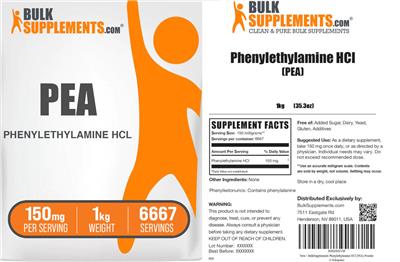
Phenylethylamine HCL 150 mg per serving
Brand IP Statement(s)
BulkSupplements.com Clean & Pure Bulk Supplements
Precautions
Phenylketonurics: Contains phenylalanine
Always consult a physician before taking any dietary supplement.
Keep out of reach of children.
Do not exceed recommended dose.
FDA Disclaimer Statement
Warning: This product is not intended to diagnose, treat, cure, or prevent any disease.
Formulation
Free of: Added sugar, dairy, yeast, gluten, additives
Suggested/Recommended/Usage/Directions
Suggested Use: As a dietary supplement, take 150 mg once daily, or as directed by a physician. Individual needs may vary.
General Statements
Use an accurate milligram scale to measure.
New
Storage
Contents are sold by weight,not volume. Settling may occur. Store in a dry, cool place
Is this label outdated? Report a formula or label change and our pharmacy team will review it.
PEA 150 mg by BulkSupplements.com label
The label scan from the NIH Dietary Supplement Label Database. Tap to enlarge.
Label images are published by the NIH Dietary Supplement Label Database for the version of this product on file. Always read your actual product label.
View the full label (PDF)The Ingredients in PEA 150 mg by BulkSupplements.com
This is the 1 active ingredient this product is made of. Select it to open its full monograph.
Serving size150 mg Dosage formPowder Servings per container6667 Amounts shown are per serving.
Phenylethylamine Hydrochloride
Interacts with187 drugs
Phenethylamine (PEA) is a natural compound made in the body and found in foods like chocolate; supplements are marketed for mood, focus, and energy. R...
Phenylethylamine Hydrochloride monograph & interactionsPEA 150 mg by BulkSupplements.com Drug Interactions
HelloPharmacist Interaction Report
PEA 150 mg by BulkSupplements.com does interact with medications.
The main concern is serotonergic drugs—antidepressants like SSRIs, SNRIs, and tricyclics, plus some pain relievers and migraine treatments. Phenethylamine increases serotonin levels in the brain, so combining it with these drugs carries a Moderate risk of serotonergic adverse effects (excess serotonin activity that can cause agitation, confusion, or muscle rigidity).
Read the full breakdown — every affected drug type, severity by severity
You'll also need to avoid this product entirely if you take MAOIs (monoamine oxidase inhibitors)—older antidepressants like phenelzine or tranylcypromine. Phenethylamine is normally broken down by an enzyme called MAO-B; when MAOIs are present, that enzyme is blocked, and phenethylamine can build up and trigger amphetamine-like effects.
That's a Moderate severity interaction.
Altogether, these interactions span 187 individual medications. Use the medication checker on this page to see if any of yours are affected before you start.
Check your own medications below · Editorial policy · How we use AI
Want to check YOUR meds against PEA 150 mg?
Ask about interactions with your drugs in plain English — “Can I take it with lisinopril?” — and we find you the answer in seconds, ingredient by ingredient.
Go to the checkerIngredients driving the most interactions
Individual Drug Interactions
The ingredients in PEA 150 mg interact with 187 drugs. Click any drug to see the details.
1 of the 1 ingredient in PEA 150 mg interact with drugs. Each result below shows which ingredient is responsible. Phenylethylamine Hydrochloride
AripiprazoleAbilify, Abilify Maintena, Abilify Mycite
How Aripiprazole interacts with PEA 150 mg — through 1 ingredient. Tap an ingredient for the detail:
Phenylethylamine HydrochlorideSerotonergic Drugs Moderate
Interaction Summary
Theoretically, combining serotonergic drugs with phenethylamine might increase the risk of serotonergic adverse effects.
Read the full Phenylethylamine Hydrochloride + Aripiprazole interactionAripiprazole LauroxilAristada, Aristada Initio Kit
How Aripiprazole Lauroxil interacts with PEA 150 mg — through 1 ingredient. Tap an ingredient for the detail:
Phenylethylamine HydrochlorideSerotonergic Drugs Moderate
Interaction Summary
Theoretically, combining serotonergic drugs with phenethylamine might increase the risk of serotonergic adverse effects.
Read the full Phenylethylamine Hydrochloride + Aripiprazole Lauroxil interactionAspirin, Chlorpheniramine, PhenylpropanolamineAlka-Seltzer Plus Cold
How Aspirin, Chlorpheniramine, Phenylpropanolamine interacts with PEA 150 mg — through 1 ingredient. Tap an ingredient for the detail:
Phenylethylamine HydrochlorideSerotonergic Drugs Moderate
Interaction Summary
Theoretically, combining serotonergic drugs with phenethylamine might increase the risk of serotonergic adverse effects.
Read the full Phenylethylamine Hydrochloride + Aspirin, Chlorpheniramine, Phenylpropanolamine interactionAtropine, Benzoic Acid, Hyoscyamine, Methenamine, Methylene Blue, PhenylAtrosept
How Atropine, Benzoic Acid, Hyoscyamine, Methenamine, Methylene Blue, Phenyl interacts with PEA 150 mg — through 1 ingredient. Tap an ingredient for the detail:
Phenylethylamine HydrochlorideSerotonergic Drugs Moderate
Interaction Summary
Theoretically, combining serotonergic drugs with phenethylamine might increase the risk of serotonergic adverse effects.
Read the full Phenylethylamine Hydrochloride + Atropine, Benzoic Acid, Hyoscyamine, Methenamine, Methylene Blue, Phenyl interactionAtropine, Benzoic Acid, Hyoscyamine, Methenamine, Methylene Blue, Phenyl SalicylateUrinary Antiseptic 2, Urised
How Atropine, Benzoic Acid, Hyoscyamine, Methenamine, Methylene Blue, Phenyl Salicylate interacts with PEA 150 mg — through 1 ingredient. Tap an ingredient for the detail:
Phenylethylamine HydrochlorideSerotonergic Drugs Moderate
Interaction Summary
Theoretically, combining serotonergic drugs with phenethylamine might increase the risk of serotonergic adverse effects.
Read the full Phenylethylamine Hydrochloride + Atropine, Benzoic Acid, Hyoscyamine, Methenamine, Methylene Blue, Phenyl Salicylate interactionAtropine, Chlorpheniramine, Hyoscyamine, Phenylephrine, Phenylpropanolamine, ScopolamineAtrohist Plus, Pro Tuss, Ru-tuss, Stahist
How Atropine, Chlorpheniramine, Hyoscyamine, Phenylephrine, Phenylpropanolamine, Scopolamine interacts with PEA 150 mg — through 1 ingredient. Tap an ingredient for the detail:
Phenylethylamine HydrochlorideSerotonergic Drugs Moderate
Interaction Summary
Theoretically, combining serotonergic drugs with phenethylamine might increase the risk of serotonergic adverse effects.
Read the full Phenylethylamine Hydrochloride + Atropine, Chlorpheniramine, Hyoscyamine, Phenylephrine, Phenylpropanolamine, Scopolamine interactionAtropine, MeperidineAtropine, Meperidine
How Atropine, Meperidine interacts with PEA 150 mg — through 1 ingredient. Tap an ingredient for the detail:
Phenylethylamine HydrochlorideSerotonergic Drugs Moderate
Interaction Summary
Theoretically, combining serotonergic drugs with phenethylamine might increase the risk of serotonergic adverse effects.
Read the full Phenylethylamine Hydrochloride + Atropine, Meperidine interactionBelladonna Alkaloids, Chlorpheniramine, Phenylephrine, PhenylpropanolamineRespa ARM
How Belladonna Alkaloids, Chlorpheniramine, Phenylephrine, Phenylpropanolamine interacts with PEA 150 mg — through 1 ingredient. Tap an ingredient for the detail:
Phenylethylamine HydrochlorideSerotonergic Drugs Moderate
Interaction Summary
Theoretically, combining serotonergic drugs with phenethylamine might increase the risk of serotonergic adverse effects.
Read the full Phenylethylamine Hydrochloride + Belladonna Alkaloids, Chlorpheniramine, Phenylephrine, Phenylpropanolamine interactionBenzhydrocodone, AcetaminophenApadaz
How Benzhydrocodone, Acetaminophen interacts with PEA 150 mg — through 1 ingredient. Tap an ingredient for the detail:
Phenylethylamine HydrochlorideSerotonergic Drugs Moderate
Interaction Summary
Theoretically, combining serotonergic drugs with phenethylamine might increase the risk of serotonergic adverse effects.
Read the full Phenylethylamine Hydrochloride + Benzhydrocodone, Acetaminophen interactionBenzocaine, DextromethorphanTetra-Formula
How Benzocaine, Dextromethorphan interacts with PEA 150 mg — through 1 ingredient. Tap an ingredient for the detail:
Phenylethylamine HydrochlorideSerotonergic Drugs Moderate
Interaction Summary
Theoretically, combining serotonergic drugs with phenethylamine might increase the risk of serotonergic adverse effects.
Read the full Phenylethylamine Hydrochloride + Benzocaine, Dextromethorphan interactionBrexpiprazoleRexulti
How Brexpiprazole interacts with PEA 150 mg — through 1 ingredient. Tap an ingredient for the detail:
Phenylethylamine HydrochlorideSerotonergic Drugs Moderate
Interaction Summary
Theoretically, combining serotonergic drugs with phenethylamine might increase the risk of serotonergic adverse effects.
Read the full Phenylethylamine Hydrochloride + Brexpiprazole interactionBrompheniramine, Dextromethorphan, PhenylephrineDimetapp DM
How Brompheniramine, Dextromethorphan, Phenylephrine interacts with PEA 150 mg — through 1 ingredient. Tap an ingredient for the detail:
Phenylethylamine HydrochlorideSerotonergic Drugs Moderate
Interaction Summary
Theoretically, combining serotonergic drugs with phenethylamine might increase the risk of serotonergic adverse effects.
Read the full Phenylethylamine Hydrochloride + Brompheniramine, Dextromethorphan, Phenylephrine interactionBuprenorphineBrixadi, Butrans, Sublocade, Subutex
How Buprenorphine interacts with PEA 150 mg — through 1 ingredient. Tap an ingredient for the detail:
Phenylethylamine HydrochlorideSerotonergic Drugs Moderate
Interaction Summary
Theoretically, combining serotonergic drugs with phenethylamine might increase the risk of serotonergic adverse effects.
Read the full Phenylethylamine Hydrochloride + Buprenorphine interactionBuproprion, DextromethorphanAuvelity
How Buproprion, Dextromethorphan interacts with PEA 150 mg — through 1 ingredient. Tap an ingredient for the detail:
Phenylethylamine HydrochlorideSerotonergic Drugs Moderate
Interaction Summary
Theoretically, combining serotonergic drugs with phenethylamine might increase the risk of serotonergic adverse effects.
Read the full Phenylethylamine Hydrochloride + Buproprion, Dextromethorphan interactionBuspironeBuSpar
How Buspirone interacts with PEA 150 mg — through 1 ingredient. Tap an ingredient for the detail:
Phenylethylamine HydrochlorideSerotonergic Drugs Moderate
Interaction Summary
Theoretically, combining serotonergic drugs with phenethylamine might increase the risk of serotonergic adverse effects.
Read the full Phenylethylamine Hydrochloride + Buspirone interactionCarbamazepineCarbatrol, Carnexiv, Equetro, Tegretol, Tegretol XR
How Carbamazepine interacts with PEA 150 mg — through 1 ingredient. Tap an ingredient for the detail:
Phenylethylamine HydrochlorideSerotonergic Drugs Moderate
Interaction Summary
Theoretically, combining serotonergic drugs with phenethylamine might increase the risk of serotonergic adverse effects.
Read the full Phenylethylamine Hydrochloride + Carbamazepine interactionCarbetapentane Tannate, Chlorpheniramine TannateTussi-12
How Carbetapentane Tannate, Chlorpheniramine Tannate interacts with PEA 150 mg — through 1 ingredient. Tap an ingredient for the detail:
Phenylethylamine HydrochlorideSerotonergic Drugs Moderate
Interaction Summary
Theoretically, combining serotonergic drugs with phenethylamine might increase the risk of serotonergic adverse effects.
Read the full Phenylethylamine Hydrochloride + Carbetapentane Tannate, Chlorpheniramine Tannate interactionCarbetapentane Tannate, Chlorpheniramine Tannate, Ephedrine Tannate, Phenylephrine TannateQuadratuss, Ry Tuss, Rynatuss, Tri Tannate Plus
How Carbetapentane Tannate, Chlorpheniramine Tannate, Ephedrine Tannate, Phenylephrine Tannate interacts with PEA 150 mg — through 1 ingredient. Tap an ingredient for the detail:
Phenylethylamine HydrochlorideSerotonergic Drugs Moderate
Interaction Summary
Theoretically, combining serotonergic drugs with phenethylamine might increase the risk of serotonergic adverse effects.
Read the full Phenylethylamine Hydrochloride + Carbetapentane Tannate, Chlorpheniramine Tannate, Ephedrine Tannate, Phenylephrine Tannate interactionCarbetapentane, Chlorpheniramine, PhenylephrineRicotuss
How Carbetapentane, Chlorpheniramine, Phenylephrine interacts with PEA 150 mg — through 1 ingredient. Tap an ingredient for the detail:
Phenylethylamine HydrochlorideSerotonergic Drugs Moderate
Interaction Summary
Theoretically, combining serotonergic drugs with phenethylamine might increase the risk of serotonergic adverse effects.
Read the full Phenylethylamine Hydrochloride + Carbetapentane, Chlorpheniramine, Phenylephrine interactionCarbetapentane, Chlorpheniramine, Phenylephrine, Phenylpropanolamine, Potassium GuaiacolsulfonateCophene-X
How Carbetapentane, Chlorpheniramine, Phenylephrine, Phenylpropanolamine, Potassium Guaiacolsulfonate interacts with PEA 150 mg — through 1 ingredient. Tap an ingredient for the detail:
Phenylethylamine HydrochlorideSerotonergic Drugs Moderate
Interaction Summary
Theoretically, combining serotonergic drugs with phenethylamine might increase the risk of serotonergic adverse effects.
Read the full Phenylethylamine Hydrochloride + Carbetapentane, Chlorpheniramine, Phenylephrine, Phenylpropanolamine, Potassium Guaiacolsulfonate interactionCelecoxib, TramadolSeglentis
How Celecoxib, Tramadol interacts with PEA 150 mg — through 1 ingredient. Tap an ingredient for the detail:
Phenylethylamine HydrochlorideSerotonergic Drugs Moderate
Interaction Summary
Theoretically, combining serotonergic drugs with phenethylamine might increase the risk of serotonergic adverse effects.
Read the full Phenylethylamine Hydrochloride + Celecoxib, Tramadol interactionChlorpheniramineChlor-Trimeton, Teldrin
How Chlorpheniramine interacts with PEA 150 mg — through 1 ingredient. Tap an ingredient for the detail:
Phenylethylamine HydrochlorideSerotonergic Drugs Moderate
Interaction Summary
Theoretically, combining serotonergic drugs with phenethylamine might increase the risk of serotonergic adverse effects.
Read the full Phenylethylamine Hydrochloride + Chlorpheniramine interactionChlorpheniramine Maleate, Dextromethorphan HydrobromideCoricidin HBP Cough & Cold, Coricidin II Cough & Cold, Pediatric Vicks Formula 44m Cough & Cold Relief
How Chlorpheniramine Maleate, Dextromethorphan Hydrobromide interacts with PEA 150 mg — through 1 ingredient. Tap an ingredient for the detail:
Phenylethylamine HydrochlorideSerotonergic Drugs Moderate
Interaction Summary
Theoretically, combining serotonergic drugs with phenethylamine might increase the risk of serotonergic adverse effects.
Read the full Phenylethylamine Hydrochloride + Chlorpheniramine Maleate, Dextromethorphan Hydrobromide interactionChlorpheniramine Maleate, Hydrocodone BitartrateVituz
How Chlorpheniramine Maleate, Hydrocodone Bitartrate interacts with PEA 150 mg — through 1 ingredient. Tap an ingredient for the detail:
Phenylethylamine HydrochlorideSerotonergic Drugs Moderate
Interaction Summary
Theoretically, combining serotonergic drugs with phenethylamine might increase the risk of serotonergic adverse effects.
Read the full Phenylethylamine Hydrochloride + Chlorpheniramine Maleate, Hydrocodone Bitartrate interactionChlorpheniramine Polistirex, Codeine PolistirexTuzistra XR
How Chlorpheniramine Polistirex, Codeine Polistirex interacts with PEA 150 mg — through 1 ingredient. Tap an ingredient for the detail:
Phenylethylamine HydrochlorideSerotonergic Drugs Moderate
Interaction Summary
Theoretically, combining serotonergic drugs with phenethylamine might increase the risk of serotonergic adverse effects.
Read the full Phenylethylamine Hydrochloride + Chlorpheniramine Polistirex, Codeine Polistirex interactionChlorpheniramine Tannate, Phenylephrine TannateRicobid
How Chlorpheniramine Tannate, Phenylephrine Tannate interacts with PEA 150 mg — through 1 ingredient. Tap an ingredient for the detail:
Phenylethylamine HydrochlorideSerotonergic Drugs Moderate
Interaction Summary
Theoretically, combining serotonergic drugs with phenethylamine might increase the risk of serotonergic adverse effects.
Read the full Phenylethylamine Hydrochloride + Chlorpheniramine Tannate, Phenylephrine Tannate interactionChlorpheniramine Tannate, Phenylephrine Tannate, Pyrilamine TannateHistatan, R Tannamine, R-Tannate, Rhinatate, Tri Tannate, Triotann +1 more
How Chlorpheniramine Tannate, Phenylephrine Tannate, Pyrilamine Tannate interacts with PEA 150 mg — through 1 ingredient. Tap an ingredient for the detail:
Phenylethylamine HydrochlorideSerotonergic Drugs Moderate
Interaction Summary
Theoretically, combining serotonergic drugs with phenethylamine might increase the risk of serotonergic adverse effects.
Read the full Phenylethylamine Hydrochloride + Chlorpheniramine Tannate, Phenylephrine Tannate, Pyrilamine Tannate interactionChlorpheniramine, Hydrocodone, PseudoephedrineTussend
How Chlorpheniramine, Hydrocodone, Pseudoephedrine interacts with PEA 150 mg — through 1 ingredient. Tap an ingredient for the detail:
Phenylethylamine HydrochlorideSerotonergic Drugs Moderate
Interaction Summary
Theoretically, combining serotonergic drugs with phenethylamine might increase the risk of serotonergic adverse effects.
Read the full Phenylethylamine Hydrochloride + Chlorpheniramine, Hydrocodone, Pseudoephedrine interactionChlorpheniramine, MethscopolamineAllerx
How Chlorpheniramine, Methscopolamine interacts with PEA 150 mg — through 1 ingredient. Tap an ingredient for the detail:
Phenylethylamine HydrochlorideSerotonergic Drugs Moderate
Interaction Summary
Theoretically, combining serotonergic drugs with phenethylamine might increase the risk of serotonergic adverse effects.
Read the full Phenylethylamine Hydrochloride + Chlorpheniramine, Methscopolamine interactionChlorpheniramine, Methscopolamine, PhenylephrineAH Chew, DA, DA II, Dallergy, Dallergy ER, Dura Vent DA +9 more
How Chlorpheniramine, Methscopolamine, Phenylephrine interacts with PEA 150 mg — through 1 ingredient. Tap an ingredient for the detail:
Phenylethylamine HydrochlorideSerotonergic Drugs Moderate
Interaction Summary
Theoretically, combining serotonergic drugs with phenethylamine might increase the risk of serotonergic adverse effects.
Read the full Phenylethylamine Hydrochloride + Chlorpheniramine, Methscopolamine, Phenylephrine interactionEach ingredient & the kinds of drugs it affects
For each ingredient in PEA 150 mg with known interactions, here are the types of medications it can affect. Open any type for the detail — or search your exact drug in the checker above.
Phenylethylamine Hydrochloride
Monoamine Oxidase Inhibitors (Maois)
Theoretically, taking phenethylamine concomitantly with MAOIs may increase adverse effects.
In humans, phenethylamine is oxidized by MAO-B to form the inactive metabolite phenylacetic acid. Animal research shows that administering an MAOI prior to phenethylamine increases the amphetamine-like effects of phenethylamine. However, low-quality clinical research has used phenethylamine with selegiline, an MAOI, with apparent safety.
Serotonergic Drugs
Theoretically, combining serotonergic drugs with phenethylamine might increase the risk of serotonergic adverse effects.
Animal research shows that phenethylamine increases levels of serotonin, norepinephrine, and dopamine. Theoretically, combining serotonergic drugs with phenethylamine might increase the risk of additive serotonergic adverse effects, including serotonin syndrome and cerebral vasoconstrictive disorders. However, low-quality clinical research has used phenethylamine with selegiline, a monoamine oxidase inhibitor (MAOI), with apparent safety.
Brand information
Manufacturer and brand details for PEA 150 mg, from the product label.
BulkSupplements.com
See all BulkSupplements.com products- Name
- BulkSupplements.com
- Street Address
- 7511 Eastgate Rd
- City
- Henderson
- State
- NV
- ZipCode
- 89011
- Web Address
- BulkSupplements.com
PEA 150 mg by BulkSupplements.com: Common Questions
Does PEA 150 mg by BulkSupplements.com interact with any medications?
How can one product interact with so many drugs?
Where does this information come from?
Can I take PEA if I'm on an antidepressant?
Does this actually work for mood or energy?
Is it safe to use while pregnant or breastfeeding?
What is phenethylamine, and where does it come from?
What side effects should I watch for?
Written and reviewed by the HelloPharmacist editorial staff. Our editorial policy
Not sure if PEA 150 mg is safe with your meds?
Our pharmacists answer your medication & supplement questions — free.
Label information is sourced from the NIH Dietary Supplement Label Database and reflects the product version on file; always read your actual product label. This page is for education only and is not a substitute for professional medical advice. Confirm with your pharmacist or doctor before combining supplements and medications.
The Full Monographs Behind PEA 150 mg’s Ingredients
Every ingredient we hold a full HelloPharmacist monograph for — uses, evidence, safety, and the complete interaction list.
Sources & How We Checked
PEA 150 mg's label data comes from the NIH Dietary Supplement Label Database; the ingredient interaction data is from the Natural Medicines database, reviewed by our pharmacists.
- NIH Dietary Supplement Label Database (DSLD) — The official product label on file for this supplement.
- Natural Medicines (Therapeutic Research Center) — Evidence-graded clinical reference behind the ingredient interaction data.
Content is written and reviewed by licensed HelloPharmacist pharmacists. See our data sources and editorial standards for how this information is built and checked.
The 9 references behind this product’s interaction data
Every citation that drives the interaction findings for this product’s ingredients, from the evidence-graded Natural Medicines (TRC Healthcare) database. Open an ingredient to browse its citations — links open the study on PubMed or the publisher’s site.
Phenethylamine (pea) 9 references
- Singhal AB, Caviness VS, Begleiter AF, et al. Cerebral vasoconstriction and stroke after use of serotonergic drugs. Neurology 2002;58:130-3. PubMed
- Sabelli H, Fink P, Fawcett J, et al. Sustained antidepressant effect of PEA replacement. J Neuropsychiatry Clin Neurosci. 1996;8(2):168-71.
- Xie Z, Miller G. Beta-phenylehtylamine alters monoamine transporter function via trace amine-associated receptor 1: implication for modulatory roles of trace amines in brain. J Pharmacol Exp Ther. 2008;325(2):617-28.
- Lukasik-Glebocka M, Sommerfeld K, Tezyk A, et al. [Acute poisoning with weight-loss dietary supplement falsely suggesting the use of amphetamine]. Przegl Lek. 2013;70(10):880-3.
- Nakamura M, Ishii A, Nakahara D. Characterization of beta-phenyltheylamine-induced monoamine release in rat nucleus accumbens: a microdialysis study. Eur J Pharmacol. 1998;349(2-3):163-9.
- Bailey B, Philips S, Boulton A. In vivo release of endogenous dopamine, 5-hydroxytryptamine and some of their metabolites from rat caudate nucleus by phenylethylamine. Neurochem Res. 1987;12(2):173-8. PubMed
- Mantegazza P, Riva M. Amphetamine-like activity of beta-phenethylamine after a monoamine oxidase inhibitor in vivo. Journal of Pharmacy and Pharmacology. 1963;151(1):472-8.
- Grimsby J, Toth M, Chen K, et al. Increased stress response and beta-phenylethylamine in MAOB-deficient mice. Nat Genet. 1997;17(2):206-10.
- Lindemann L, Hoener MC. A renaissance in trace amines inspired by a novel GPCR family. Trends Pharmacol Sci. 2005;26(5):274-81. PubMed
See these in context on the Phenethylamine (pea) monograph →
Parts of this content are provided by the Therapeutic Research Center, LLC.
DISCLAIMER: Currently this does not check for drug-drug interactions. This is not an all-inclusive comprehensive list of potential interactions and is for informational purposes only. Not all interactions are known or well-reported in the scientific literature, and new interactions are continually being reported. Input is needed from a qualified healthcare provider including a pharmacist before starting any therapy. Application of clinical judgment is necessary.
© 2021 Therapeutic Research Center, LLC