
Purple Probiotic 300 mg Ingredients & Drug Interactions
What is this page for?
First and foremost: checking Purple Probiotic 300 mg against your medications. The heart of this page is the interaction checker and the full interaction report — how this product’s ingredients may interact with prescription and over-the-counter medicines you may be taking.
Around that, we add a pharmacist’s high-level view of the product as a whole — what’s inside, the evidence for its stated use, how transparent the label is, and what safety data exists — so you can see the full picture in one place. It’s educational information from our licensed clinical databases and the clinical staff at HelloPharmacist — not medical advice — and we don’t sell or endorse products. Our editorial policy
Purple Probiotic 300 mg is a dietary supplement by Eclectic Herb with 2 active ingredients. Its ingredients are commonly taken for breast engorgement during breastfeeding, joint pain and swelling (topical), digestive and stomach upset.Based on those ingredients, 325 medications have a known interaction with it, the most serious rated moderate. The ingredients most likely to interact are Purple Cabbage, Fermented. Use the checker below to test your specific medication, or read the full HelloPharmacist Interaction Report.
Check Your Meds Against Purple Probiotic 300 mg by Eclectic Herb
Ask about any prescription or over-the-counter medication and we check it for interactions with Purple Probiotic 300 mg by Eclectic Herb — and tell you which ingredient is responsible.
AI summaries are generated from our interaction database for education only — always confirm with your pharmacist. How we use AI
Ask the Pharmacist
A licensed pharmacist will answer your question by email — free, usually within 24 hours.
Got it — thank you!
A licensed pharmacist will answer within 24 hours. Keep an eye on your email (worth checking spam, just in case).
HelloPharmacist Scorecard of Purple Probiotic 300 mg by Eclectic Herb
Our pharmacy team’s full take, with four database checks built into the cards below — a summary of what is known, not a grade of the product itself.
What’s inside
Full disclosure
This product has two active ingredients: fermented purple cabbage and fermented sunchoke, each contributing 150 mg per capsule. Purple cabbage is a cruciferous vegetable that's been studied for its potential effects on blood sugar and cholesterol levels, as well as for breast engorgement relief.
Sunchoke, also known as Jerusalem artichoke, is a tuber that contributes prebiotic fiber. The capsule itself contains hypromellose, a plant-based capsule material.
Does it work?
Moderate evidence
Purple cabbage has been rated possibly effective for breast engorgement — applying chilled leaves to the breast may help, though you should talk with your doctor first. For other uses like reducing cancer risk or improving cholesterol levels, the evidence we hold is insufficient to rate.
We don't have effectiveness data on file for the fermented sunchoke ingredient in this product.
How safe is it?
Well-documented data
Cabbage is safe for most people when eaten as a food, but concentrated supplements or medicinal amounts in larger doses haven't been well studied. Allergic reactions to cabbage are rare, though people with allergies to broccoli or other vegetables in the cabbage family (Brassicaceae) may also react to cabbage.
In one small study of people using cabbage leaf wraps on their knees, the treatment was generally well tolerated. If you apply cabbage topically, watch for contact dermatitis (skin irritation).
We don't have safety data on file for fermented sunchoke.
Meds to double-check
Moderate interaction found
Check before starting if you take blood thinners like warfarin, diabetes medications, acetaminophen (Tylenol), sedatives like oxazepam (Serax), or any drugs processed through your liver's CYP1A2 system or glucuronidation pathways. The fermented cabbage in this product may reduce how well these work.
The bottom line
Scorecard at a glanceFully disclosed formula with some supporting evidence behind its ingredients' uses. Moderate medication interactions have been identified, and safety information is well characterized.
If you take blood thinners, diabetes medications, pain relievers, or sedatives, check with your pharmacist before starting this — fermented cabbage can interact with all of these. Cabbage as a food is safe, but medicinal amounts in supplements aren't well studied.
This is a reasonable choice for general digestive support if you're not on interacting medications, but it's worth a quick conversation with us first.
Educational only — not medical advice; always confirm with your pharmacist. Our editorial policy · How we use AI
Assessment coverage: 1 of 2 active ingredients matched to our full ingredient reviews (monographs). Based on the product label dated Nov 22, 2024.
This Scorecard evaluates available label information, ingredient evidence, and known medication-safety considerations. It does not independently verify product identity, purity, potency, contamination, or manufacturing quality. How these ratings are computed
General information
Key facts about Purple Probiotic 300 mg, straight from the product label.
| Brand | Eclectic Herb |
|---|---|
| Barcode (UPC) | 023363319107 |
| Net contents | 90 Veg Cap(s) |
| Market status | On market |
| Date entered into DSLD | Nov 22, 2024 |
| DSLD ID | 316871 |
| Product type | Botanical |
| Supplement form | Capsule |
| Dietary claims / uses | All Other, Structure/Function |
| Intended target group(s) | Vegan, Vegetarian, Adult (18 - 50 Years), Kosher, Gluten Free, Dairy Free |
Everything in this section is reproduced from the manufacturer’s own product label — it’s the label speaking, not HelloPharmacist. We show it so you can see exactly what the maker states; we don’t verify or endorse those statements.
Supplement Facts
The label details for Purple Probiotic 300 mg by Eclectic Herb, sourced from the NIH Dietary Supplement Label Database.
Supplement Facts
| Ingredient | Amount | % DV |
|---|---|---|
| Purple Cabbage, Fermented | 570 mg | -- |
| Sunchoke, Fermented | 30 mg | -- |
Other ingredients: Hypromellose
Tap any ingredient to jump to its full detail below.
These statements are the manufacturer’s wording, reproduced from the product label — the label is saying it, not HelloPharmacist. We don’t verify or endorse them.
Formulation
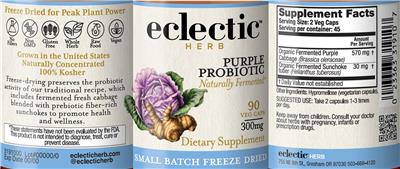
Freeze dried for peak plant power Raw food Grown in the United States Naturally concentrated
No Fillers Non GMO Gluten Free
Vegan
Naturally fermented Small batch freeze dried
Formula
Whole herb
Freeze-drying preserves the probiotic activity of our traditional recipe, which includes fermented fresh cabbage blended with prebiotic fiber-rich sunchokes to promote health and wellness.
100% Kosher
FDA Disclaimer Statement
These statements have not been evaluated by the FDA. This product is not intended to diagnose, treat, cure or prevent disease.
FDA Statement of Identity
Dietary Supplement
Suggested/Recommended/Usage/Directions
Suggested Use: Take 2 capsules 1-3 times per day.
Precautions
Keep away from children. Consult your doctor about herbs with pregnancy, infants or prescription drugs.
Consult your doctor about herbs with pregnancy, infants or prescription drugs.
General Statements
@eclecticherb
Is this label outdated? Report a formula or label change and our pharmacy team will review it.
Purple Probiotic 300 mg by Eclectic Herb label
The label scan from the NIH Dietary Supplement Label Database. Tap to enlarge.
Label images are published by the NIH Dietary Supplement Label Database for the version of this product on file. Always read your actual product label.
View the full label (PDF)The Ingredients in Purple Probiotic 300 mg by Eclectic Herb
These are the 2 active ingredients this product is made of. Select any to open its full monograph.
Serving size2 Veg Cap(s) Dosage formCapsule Servings per container45 Amounts shown are per serving.
Most supplement products combine several ingredients, and a medication can interact with the product through any one of them. Each ingredient below shows whether it has known drug interactions.
Purple Cabbage, Fermented
Interacts with325 drugs
Cabbage is a nutritious, low-calorie vegetable that is safe to eat as food and is sometimes applied to the skin as a leaf wrap for breast engorgement...
Purple Cabbage, Fermented monograph & interactionsSunchoke, Fermented
Other (inactive) ingredients: Hypromellose. These complete the product’s ingredient list but are not active constituents.
Purple Probiotic 300 mg by Eclectic Herb Drug Interactions
HelloPharmacist Interaction Report
Purple Probiotic by Eclectic Herb contains fermented purple cabbage, which has documented interactions with several medication types.
The most serious concern is with blood thinners like warfarin (anticoagulants) — cabbage is rich in vitamin K, which can reduce warfarin's ability to prevent clots if you're eating large amounts.
Read the full breakdown — every affected drug type, severity by severity
Cabbage may also affect how your body processes pain relievers and sedatives. It can speed up the clearance of acetaminophen (Tylenol), potentially making it less effective, and may reduce the effects of oxazepam (Serax), a sedative.
Additionally, cabbage might increase the risk of low blood sugar (hypoglycemia) if you're taking diabetes medications, and it may decrease levels of drugs processed through a liver pathway called glucuronidation — a broad group that includes various prescription medications.
Cabbage can also affect how your liver breaks down certain drugs via the CYP1A2 enzyme system, which may lower their effectiveness. We couldn't check the fermented sunchoke ingredient — no interaction data is on file for it.
Altogether, these interactions span 323 individual medications. Run your exact medications through the interaction checker on this page before you start.
Check your own medications below · Editorial policy · How we use AI
Want to check YOUR meds against Purple Probiotic 300 mg?
Ask about interactions with your drugs in plain English — “Can I take it with lisinopril?” — and we find you the answer in seconds, ingredient by ingredient.
Go to the checkerIngredients driving the most interactions
Individual Drug Interactions
The ingredients in Purple Probiotic 300 mg interact with 325 drugs. Click any drug to see the details.
1 of the 2 ingredients in Purple Probiotic 300 mg interact with drugs. Each result below shows which ingredient is responsible. Purple Cabbage, Fermented
AcarboseGlucobay, Prandase, Precose
How Acarbose interacts with Purple Probiotic 300 mg — through 1 ingredient. Tap an ingredient for the detail:
Purple Cabbage, FermentedAntidiabetes Drugs Moderate
Interaction Summary
Theoretically, cabbage might increase the risk of hypoglycemia when taken with antidiabetes drugs.
Read the full Purple Cabbage, Fermented + Acarbose interactionAcetaminophenChildren's Tylenol, Children's Tylenol Meltaways, Tylenol, Tylenol Ex Strength
How Acetaminophen interacts with Purple Probiotic 300 mg — through 1 ingredient. Tap an ingredient for the detail:
Purple Cabbage, FermentedCytochrome P450 1a2 (cyp1a2) Substrates, Glucuronidated Drugs +1 Moderate
Interaction Summary
Theoretically, cabbage might decrease levels of drugs metabolized by CYP1A2.
Read the full Purple Cabbage, Fermented + Acetaminophen interactionAcetaminophen, AspirinGemnisyn
How Acetaminophen, Aspirin interacts with Purple Probiotic 300 mg — through 1 ingredient. Tap an ingredient for the detail:
Purple Cabbage, FermentedGlucuronidated Drugs, Acetaminophen (tylenol, Others) +1 Moderate
Interaction Summary
Theoretically, cabbage might increase clearance and decrease the effects of drugs metabolized through glucuronide conjugation.
Read the full Purple Cabbage, Fermented + Acetaminophen, Aspirin interactionAcetaminophen, Aspirin, CaffeineExcedrin, Excedrin Extra Strength, Excedrin Migraine
How Acetaminophen, Aspirin, Caffeine interacts with Purple Probiotic 300 mg — through 1 ingredient. Tap an ingredient for the detail:
Purple Cabbage, FermentedCytochrome P450 1a2 (cyp1a2) Substrates, Glucuronidated Drugs +1 Moderate
Interaction Summary
Theoretically, cabbage might decrease levels of drugs metabolized by CYP1A2.
Read the full Purple Cabbage, Fermented + Acetaminophen, Aspirin, Caffeine interactionAcetaminophen, Brompheniramine, PhenylpropanolamineDimetapp Cold and Flu
How Acetaminophen, Brompheniramine, Phenylpropanolamine interacts with Purple Probiotic 300 mg — through 1 ingredient. Tap an ingredient for the detail:
Purple Cabbage, FermentedGlucuronidated Drugs, Acetaminophen (tylenol, Others) +1 Moderate
Interaction Summary
Theoretically, cabbage might increase clearance and decrease the effects of drugs metabolized through glucuronide conjugation.
Read the full Purple Cabbage, Fermented + Acetaminophen, Brompheniramine, Phenylpropanolamine interactionAcetaminophen, ButalbitalAxocet, Bancap, Bucet, Butex Forte, Esgic CF, Orbivan CF +5 more
How Acetaminophen, Butalbital interacts with Purple Probiotic 300 mg — through 1 ingredient. Tap an ingredient for the detail:
Purple Cabbage, FermentedCytochrome P450 1a2 (cyp1a2) Substrates, Glucuronidated Drugs +1 Moderate
Interaction Summary
Theoretically, cabbage might decrease levels of drugs metabolized by CYP1A2.
Read the full Purple Cabbage, Fermented + Acetaminophen, Butalbital interactionAcetaminophen, Butalbital, CaffeineEsgic, Esgic Plus, Fiogesic, Fioricet, Repan, Tecnal +1 more
How Acetaminophen, Butalbital, Caffeine interacts with Purple Probiotic 300 mg — through 1 ingredient. Tap an ingredient for the detail:
Purple Cabbage, FermentedGlucuronidated Drugs, Acetaminophen (tylenol, Others) +1 Moderate
Interaction Summary
Theoretically, cabbage might increase clearance and decrease the effects of drugs metabolized through glucuronide conjugation.
Read the full Purple Cabbage, Fermented + Acetaminophen, Butalbital, Caffeine interactionAcetaminophen, Butalbital, Caffeine, CodeineEsgic with Codeine, Fioricet w/ Codeine
How Acetaminophen, Butalbital, Caffeine, Codeine interacts with Purple Probiotic 300 mg — through 1 ingredient. Tap an ingredient for the detail:
Purple Cabbage, FermentedCytochrome P450 1a2 (cyp1a2) Substrates, Glucuronidated Drugs +1 Moderate
Interaction Summary
Theoretically, cabbage might decrease levels of drugs metabolized by CYP1A2.
Read the full Purple Cabbage, Fermented + Acetaminophen, Butalbital, Caffeine, Codeine interactionAcetaminophen, Butalbital, CodeineBancap w/ Codeine
How Acetaminophen, Butalbital, Codeine interacts with Purple Probiotic 300 mg — through 1 ingredient. Tap an ingredient for the detail:
Purple Cabbage, FermentedGlucuronidated Drugs, Acetaminophen (tylenol, Others) +1 Moderate
Interaction Summary
Theoretically, cabbage might increase clearance and decrease the effects of drugs metabolized through glucuronide conjugation.
Read the full Purple Cabbage, Fermented + Acetaminophen, Butalbital, Codeine interactionAcetaminophen, Butalbital, Codeine PhosphatePhrenilin #3
How Acetaminophen, Butalbital, Codeine Phosphate interacts with Purple Probiotic 300 mg — through 1 ingredient. Tap an ingredient for the detail:
Purple Cabbage, FermentedCytochrome P450 1a2 (cyp1a2) Substrates, Glucuronidated Drugs +1 Moderate
Interaction Summary
Theoretically, cabbage might decrease levels of drugs metabolized by CYP1A2.
Read the full Purple Cabbage, Fermented + Acetaminophen, Butalbital, Codeine Phosphate interactionAcetaminophen, Caffeine, Chlorpheniramine, Hydrocodone, PhenylephrineHycomine Compound
How Acetaminophen, Caffeine, Chlorpheniramine, Hydrocodone, Phenylephrine interacts with Purple Probiotic 300 mg — through 1 ingredient. Tap an ingredient for the detail:
Purple Cabbage, FermentedGlucuronidated Drugs, Acetaminophen (tylenol, Others) +1 Moderate
Interaction Summary
Theoretically, cabbage might increase clearance and decrease the effects of drugs metabolized through glucuronide conjugation.
Read the full Purple Cabbage, Fermented + Acetaminophen, Caffeine, Chlorpheniramine, Hydrocodone, Phenylephrine interactionAcetaminophen, Caffeine, CodeineGesic C15, Gesic C30, Gesic C8, Lenoltec 1, Lenoltec 2, Lenoltec 3 +1 more
How Acetaminophen, Caffeine, Codeine interacts with Purple Probiotic 300 mg — through 1 ingredient. Tap an ingredient for the detail:
Purple Cabbage, FermentedCytochrome P450 1a2 (cyp1a2) Substrates, Glucuronidated Drugs +1 Moderate
Interaction Summary
Theoretically, cabbage might decrease levels of drugs metabolized by CYP1A2.
Read the full Purple Cabbage, Fermented + Acetaminophen, Caffeine, Codeine interactionAcetaminophen, Caffeine, Codeine, SalicylamideCodalan No.1, Codalan No.2, Codalan No.3
How Acetaminophen, Caffeine, Codeine, Salicylamide interacts with Purple Probiotic 300 mg — through 1 ingredient. Tap an ingredient for the detail:
Purple Cabbage, FermentedGlucuronidated Drugs, Acetaminophen (tylenol, Others) +1 Moderate
Interaction Summary
Theoretically, cabbage might increase clearance and decrease the effects of drugs metabolized through glucuronide conjugation.
Read the full Purple Cabbage, Fermented + Acetaminophen, Caffeine, Codeine, Salicylamide interactionAcetaminophen, Caffeine, DihydrocodeineDHC Plus, Panlor DC, Panlor SS
How Acetaminophen, Caffeine, Dihydrocodeine interacts with Purple Probiotic 300 mg — through 1 ingredient. Tap an ingredient for the detail:
Purple Cabbage, FermentedCytochrome P450 1a2 (cyp1a2) Substrates, Glucuronidated Drugs +1 Moderate
Interaction Summary
Theoretically, cabbage might decrease levels of drugs metabolized by CYP1A2.
Read the full Purple Cabbage, Fermented + Acetaminophen, Caffeine, Dihydrocodeine interactionAcetaminophen, Caffeine, IsomethepteneMigralam
How Acetaminophen, Caffeine, Isometheptene interacts with Purple Probiotic 300 mg — through 1 ingredient. Tap an ingredient for the detail:
Purple Cabbage, FermentedGlucuronidated Drugs, Acetaminophen (tylenol, Others) +1 Moderate
Interaction Summary
Theoretically, cabbage might increase clearance and decrease the effects of drugs metabolized through glucuronide conjugation.
Read the full Purple Cabbage, Fermented + Acetaminophen, Caffeine, Isometheptene interactionAcetaminophen, Caffeine, PyrilamineMidol Max Strength Menstrual
How Acetaminophen, Caffeine, Pyrilamine interacts with Purple Probiotic 300 mg — through 1 ingredient. Tap an ingredient for the detail:
Purple Cabbage, FermentedCytochrome P450 1a2 (cyp1a2) Substrates, Glucuronidated Drugs +1 Moderate
Interaction Summary
Theoretically, cabbage might decrease levels of drugs metabolized by CYP1A2.
Read the full Purple Cabbage, Fermented + Acetaminophen, Caffeine, Pyrilamine interactionAcetaminophen, Chlorpheniramine Maleate, Dextromethorphan HbrVicks Formula 44M Cough, Cold & Flu Relief
How Acetaminophen, Chlorpheniramine Maleate, Dextromethorphan Hbr interacts with Purple Probiotic 300 mg — through 1 ingredient. Tap an ingredient for the detail:
Purple Cabbage, FermentedGlucuronidated Drugs, Cytochrome P450 1a2 (cyp1a2) Substrates +1 Moderate
Interaction Summary
Theoretically, cabbage might increase clearance and decrease the effects of drugs metabolized through glucuronide conjugation.
Read the full Purple Cabbage, Fermented + Acetaminophen, Chlorpheniramine Maleate, Dextromethorphan Hbr interactionAcetaminophen, Chlorpheniramine, Codeine, PhenylephrineColrex
How Acetaminophen, Chlorpheniramine, Codeine, Phenylephrine interacts with Purple Probiotic 300 mg — through 1 ingredient. Tap an ingredient for the detail:
Purple Cabbage, FermentedGlucuronidated Drugs, Acetaminophen (tylenol, Others) +1 Moderate
Interaction Summary
Theoretically, cabbage might increase clearance and decrease the effects of drugs metabolized through glucuronide conjugation.
Read the full Purple Cabbage, Fermented + Acetaminophen, Chlorpheniramine, Codeine, Phenylephrine interactionAcetaminophen, Chlorpheniramine, DextromethorphanCoricidin II Extra Strength Cold and Flu
How Acetaminophen, Chlorpheniramine, Dextromethorphan interacts with Purple Probiotic 300 mg — through 1 ingredient. Tap an ingredient for the detail:
Purple Cabbage, FermentedCytochrome P450 1a2 (cyp1a2) Substrates, Acetaminophen (tylenol, Others) +1 Moderate
Interaction Summary
Theoretically, cabbage might decrease levels of drugs metabolized by CYP1A2.
Read the full Purple Cabbage, Fermented + Acetaminophen, Chlorpheniramine, Dextromethorphan interactionAcetaminophen, Chlorpheniramine, Dextromethorphan HydrobromideCoricidin HBP Maximum Strength Flu
How Acetaminophen, Chlorpheniramine, Dextromethorphan Hydrobromide interacts with Purple Probiotic 300 mg — through 1 ingredient. Tap an ingredient for the detail:
Purple Cabbage, FermentedGlucuronidated Drugs, Cytochrome P450 1a2 (cyp1a2) Substrates +1 Moderate
Interaction Summary
Theoretically, cabbage might increase clearance and decrease the effects of drugs metabolized through glucuronide conjugation.
Read the full Purple Cabbage, Fermented + Acetaminophen, Chlorpheniramine, Dextromethorphan Hydrobromide interactionAcetaminophen, Chlorpheniramine, Dextromethorphan, PhenylpropanolamineMulti Symptom Cold Relief
How Acetaminophen, Chlorpheniramine, Dextromethorphan, Phenylpropanolamine interacts with Purple Probiotic 300 mg — through 1 ingredient. Tap an ingredient for the detail:
Purple Cabbage, FermentedGlucuronidated Drugs, Acetaminophen (tylenol, Others) +1 Moderate
Interaction Summary
Theoretically, cabbage might increase clearance and decrease the effects of drugs metabolized through glucuronide conjugation.
Read the full Purple Cabbage, Fermented + Acetaminophen, Chlorpheniramine, Dextromethorphan, Phenylpropanolamine interactionAcetaminophen, Chlorpheniramine, Dextromethorphan, PseudoephedrineChildren's Tylenol Cold Plus Cough, Tylenol Cold Ex Strength
How Acetaminophen, Chlorpheniramine, Dextromethorphan, Pseudoephedrine interacts with Purple Probiotic 300 mg — through 1 ingredient. Tap an ingredient for the detail:
Purple Cabbage, FermentedCytochrome P450 1a2 (cyp1a2) Substrates, Glucuronidated Drugs +1 Moderate
Interaction Summary
Theoretically, cabbage might decrease levels of drugs metabolized by CYP1A2.
Read the full Purple Cabbage, Fermented + Acetaminophen, Chlorpheniramine, Dextromethorphan, Pseudoephedrine interactionAcetaminophen, Chlorpheniramine, Guaifenesin, Phenylephrine, SalicylamideRhinogesic GG
How Acetaminophen, Chlorpheniramine, Guaifenesin, Phenylephrine, Salicylamide interacts with Purple Probiotic 300 mg — through 1 ingredient. Tap an ingredient for the detail:
Purple Cabbage, FermentedGlucuronidated Drugs, Acetaminophen (tylenol, Others) +1 Moderate
Interaction Summary
Theoretically, cabbage might increase clearance and decrease the effects of drugs metabolized through glucuronide conjugation.
Read the full Purple Cabbage, Fermented + Acetaminophen, Chlorpheniramine, Guaifenesin, Phenylephrine, Salicylamide interactionAcetaminophen, Chlorpheniramine, PhenylephrineAlka-Seltzer PLUS, Histex SR, Protid
How Acetaminophen, Chlorpheniramine, Phenylephrine interacts with Purple Probiotic 300 mg — through 1 ingredient. Tap an ingredient for the detail:
Purple Cabbage, FermentedCytochrome P450 1a2 (cyp1a2) Substrates, Glucuronidated Drugs +1 Moderate
Interaction Summary
Theoretically, cabbage might decrease levels of drugs metabolized by CYP1A2.
Read the full Purple Cabbage, Fermented + Acetaminophen, Chlorpheniramine, Phenylephrine interactionAcetaminophen, Chlorpheniramine, Phenylephrine, SalicylamideRhinogesic, Rhinogesic JR
How Acetaminophen, Chlorpheniramine, Phenylephrine, Salicylamide interacts with Purple Probiotic 300 mg — through 1 ingredient. Tap an ingredient for the detail:
Purple Cabbage, FermentedGlucuronidated Drugs, Acetaminophen (tylenol, Others) +1 Moderate
Interaction Summary
Theoretically, cabbage might increase clearance and decrease the effects of drugs metabolized through glucuronide conjugation.
Read the full Purple Cabbage, Fermented + Acetaminophen, Chlorpheniramine, Phenylephrine, Salicylamide interactionAcetaminophen, Chlorpheniramine, PhenylpropanolamineAlumadrine, Conex, Sinadrin Max Strength, Sinulin
How Acetaminophen, Chlorpheniramine, Phenylpropanolamine interacts with Purple Probiotic 300 mg — through 1 ingredient. Tap an ingredient for the detail:
Purple Cabbage, FermentedCytochrome P450 1a2 (cyp1a2) Substrates, Glucuronidated Drugs +1 Moderate
Interaction Summary
Theoretically, cabbage might decrease levels of drugs metabolized by CYP1A2.
Read the full Purple Cabbage, Fermented + Acetaminophen, Chlorpheniramine, Phenylpropanolamine interactionAcetaminophen, Chlorpheniramine, Phenylpropanolamine, OpiumHista-Derfule
How Acetaminophen, Chlorpheniramine, Phenylpropanolamine, Opium interacts with Purple Probiotic 300 mg — through 1 ingredient. Tap an ingredient for the detail:
Purple Cabbage, FermentedGlucuronidated Drugs, Acetaminophen (tylenol, Others) +1 Moderate
Interaction Summary
Theoretically, cabbage might increase clearance and decrease the effects of drugs metabolized through glucuronide conjugation.
Read the full Purple Cabbage, Fermented + Acetaminophen, Chlorpheniramine, Phenylpropanolamine, Opium interactionAcetaminophen, Chlorpheniramine, Phenylpropanolamine, PhenyltoloxamineNorel Plus
How Acetaminophen, Chlorpheniramine, Phenylpropanolamine, Phenyltoloxamine interacts with Purple Probiotic 300 mg — through 1 ingredient. Tap an ingredient for the detail:
Purple Cabbage, FermentedCytochrome P450 1a2 (cyp1a2) Substrates, Glucuronidated Drugs +1 Moderate
Interaction Summary
Theoretically, cabbage might decrease levels of drugs metabolized by CYP1A2.
Read the full Purple Cabbage, Fermented + Acetaminophen, Chlorpheniramine, Phenylpropanolamine, Phenyltoloxamine interactionAcetaminophen, Chlorpheniramine, PseudoephedrineAlka-Seltzer PLUS Liquid Gels, Children's Tylenol Cold, Codimal, Comtrex, Extra Strength Tylenol Allergy Sinus, Lorsin +3 more
How Acetaminophen, Chlorpheniramine, Pseudoephedrine interacts with Purple Probiotic 300 mg — through 1 ingredient. Tap an ingredient for the detail:
Purple Cabbage, FermentedGlucuronidated Drugs, Acetaminophen (tylenol, Others) +1 Moderate
Interaction Summary
Theoretically, cabbage might increase clearance and decrease the effects of drugs metabolized through glucuronide conjugation.
Read the full Purple Cabbage, Fermented + Acetaminophen, Chlorpheniramine, Pseudoephedrine interactionAcetaminophen, ChlorzoxazoneAcetazone Forte, Extra Strength Tylenol Aches & Strains, Parafon Forte
How Acetaminophen, Chlorzoxazone interacts with Purple Probiotic 300 mg — through 1 ingredient. Tap an ingredient for the detail:
Purple Cabbage, FermentedCytochrome P450 1a2 (cyp1a2) Substrates, Glucuronidated Drugs +1 Moderate
Interaction Summary
Theoretically, cabbage might decrease levels of drugs metabolized by CYP1A2.
Read the full Purple Cabbage, Fermented + Acetaminophen, Chlorzoxazone interactionEach ingredient & the kinds of drugs it affects
For each ingredient in Purple Probiotic 300 mg with known interactions, here are the types of medications it can affect. Open any type for the detail — or search your exact drug in the checker above.
Purple Cabbage, Fermented
Acetaminophen (Tylenol, Others)
Cabbage might increase clearance and reduce the effects of acetaminophen.
A small clinical study shows that daily consumption of cabbage and Brussels sprout decreases acetaminophen levels by as much as 16%, with some evidence suggesting that this effect is due to increased elimination through glucuronide conjugation.
Antidiabetes Drugs
Theoretically, cabbage might increase the risk of hypoglycemia when taken with antidiabetes drugs.
Animal and in vivo research suggests that cabbage might have hypoglycemic effects.
Cytochrome P450 1A2 (Cyp1A2) Substrates
Theoretically, cabbage might decrease levels of drugs metabolized by CYP1A2.
Some animal research suggests that cabbage or its constituent indole-3-carbinol might increase drug metabolism and elimination by stimulating CYP1A2 activity.
Glucuronidated Drugs
Theoretically, cabbage might increase clearance and decrease the effects of drugs metabolized through glucuronide conjugation.
A small clinical study shows that daily consumption of cabbage and Brussels sprout decreases levels of some drugs metabolized through glucuronide conjugation.
Oxazepam (Serax)
Cabbage might increase clearance and reduce the effects of oxazepam.
A small clinical study shows that daily consumption of cabbage and brussels sprout decreases oxazepam levels by as much as 17%, with some evidence suggesting that this effect is due to increased elimination through glucuronide conjugation.
Warfarin (Coumadin)
Theoretically, cabbage might decrease the anticoagulant effects of warfarin.
Cabbage contains vitamin K. If consumed in large quantities, cabbage might decrease the anticoagulant effects of warfarin.
Brand information
Manufacturer and brand details for Purple Probiotic 300 mg, from the product label.
Eclectic Herb
See all Eclectic Herb products- Name
- Eclectic Herb
- Street Address
- 755 NE 6th St.
- City
- Gresham
- State
- OR
- ZipCode
- 97030
- Phone Number
- 503-668-4120
- Web Address
- eclecticherb.com
Purple Probiotic 300 mg by Eclectic Herb: Common Questions
Does Purple Probiotic 300 mg by Eclectic Herb interact with any medications?
How can one product interact with so many drugs?
Where does this information come from?
Can I take this if I'm allergic to broccoli or cauliflower?
Will this help with my blood sugar or cholesterol?
Is this safe during pregnancy or breastfeeding?
What does fermented sunchoke do in this product?
Is cabbage supplement safe if I eat a lot of cabbage anyway?
Written and reviewed by the HelloPharmacist editorial staff. Our editorial policy
Not sure if Purple Probiotic 300 mg is safe with your meds?
Our pharmacists answer your medication & supplement questions — free.
Label information is sourced from the NIH Dietary Supplement Label Database and reflects the product version on file; always read your actual product label. This page is for education only and is not a substitute for professional medical advice. Confirm with your pharmacist or doctor before combining supplements and medications.
The Full Monographs Behind Purple Probiotic 300 mg’s Ingredients
Every ingredient we hold a full HelloPharmacist monograph for — uses, evidence, safety, and the complete interaction list.
Sources & How We Checked
Purple Probiotic 300 mg's label data comes from the NIH Dietary Supplement Label Database; the ingredient interaction data is from the Natural Medicines database, reviewed by our pharmacists.
- NIH Dietary Supplement Label Database (DSLD) — The official product label on file for this supplement.
- Natural Medicines (Therapeutic Research Center) — Evidence-graded clinical reference behind the ingredient interaction data.
Content is written and reviewed by licensed HelloPharmacist pharmacists. See our data sources and editorial standards for how this information is built and checked.
The 15 references behind this product’s interaction data
Every citation that drives the interaction findings for this product’s ingredients, from the evidence-graded Natural Medicines (TRC Healthcare) database. Open an ingredient to browse its citations — links open the study on PubMed or the publisher’s site.
Cabbage 15 references
- Brinker F. Herb Contraindications and Drug Interactions. 2nd ed. Sandy, OR: Eclectic Medical Publications, 1998.
- Pantuck EJ, Pantuck CB, Anderson KE, et al. Effect of brussels sprouts and cabbage on drug conjugation. Clin Pharmacol Ther 1984;35:161-9. PubMed
- Roberts KL. A comparison of chilled cabbage leaves and chilled gelpaks in reducing breast engorgement. J Hum Lact 1995;11:17-20. PubMed
- Roberts KL, Reiter M, Schuster D. A comparison of chilled and room temperature cabbage leaves in treating breast engorgement. J Hum Lact 1995;11:191-4. PubMed
- Roberts KL, Reiter M, Schuster D. Effects of cabbage leaf extract on breast engorgement. J Hum Lact 1998;14:231-6. PubMed
- Nikodem VC, Danziger D, Gebka N, et al. Do cabbage leaves prevent breast engorgement? A randomized, controlled study. Birth 1993;20:61-4. PubMed
- Balk JL. Indole-3-carbinol for cancer prevention. Altern Med Alert 2000; 3:105-7.
- He YH, Friesen MD, Ruch RJ, Schut HA. Indole-3-carbinol as a chemopreventive agent in 2-amino-1-methyl-6-phenylimidazo[4,5-b]pyridine (PhIP) carcinogenesis: inhibition of PhIP-DNA adduct formation, acceleration of PhIP metabolism, and induction of cytoch
- Platel, K. and Srinivasan, K. Plant foods in the management of diabetes mellitus: vegetables as potential hypoglycaemic agents. Nahrung 1997;41(2):68-74. PubMed
- Steinkellner, H., Rabot, S., Freywald, C., Nobis, E., Scharf, G., Chabicovsky, M., Knasmuller, S., and Kassie, F. Effects of cruciferous vegetables and their constituents on drug metabolizing enzymes involved in the bioactivation of DNA-reactive dietary c
- Dolle S, Hompes S, Lange L, Worm M. Cabbage allergy: a rare cause of food-induced anaphylaxis. Acta Derm Venereol 2013;93(4):485-6. PubMed
- Lauche R, Graf N, Cramer H, Al-Abtah J, Dobos G, Saha FJ. Efficacy of cabbage leaf wraps in the treatment of symptomatic osteoarthritis of the knee: a randomized controlled trial. Clin J Pain 2016;32(11):961-71. PubMed
- Lim AR, Song JA, Hur MH, Lee MK, Lee MS. Cabbage compression early breast care on breast engorgement in primiparous women after cesarean birth: a controlled trial. Int J Clin Exp Med 2015;8(11):21335-42.
- Milanesi N, Gola M. Irritant contact dermatitis caused by Savoy cabbage. Contact Dermatitis 2016;74(1):60-1. PubMed
- Saini P, Saini R. Cabbage leaves and breast engorgement. Indian J Public Health 2014;58(4):291-2. PubMed
Parts of this content are provided by the Therapeutic Research Center, LLC.
DISCLAIMER: Currently this does not check for drug-drug interactions. This is not an all-inclusive comprehensive list of potential interactions and is for informational purposes only. Not all interactions are known or well-reported in the scientific literature, and new interactions are continually being reported. Input is needed from a qualified healthcare provider including a pharmacist before starting any therapy. Application of clinical judgment is necessary.
© 2021 Therapeutic Research Center, LLC