
Quantum Organic Greens Ingredients & Drug Interactions
What is this page for?
First and foremost: checking Quantum Organic Greens against your medications. The heart of this page is the interaction checker and the full interaction report — how this product’s ingredients may interact with prescription and over-the-counter medicines you may be taking.
Around that, we add a pharmacist’s high-level view of the product as a whole — what’s inside, the evidence for its stated use, how transparent the label is, and what safety data exists — so you can see the full picture in one place. It’s educational information from our licensed clinical databases and the clinical staff at HelloPharmacist — not medical advice — and we don’t sell or endorse products. Our editorial policy
Quantum Organic Greens is a dietary supplement by Quantum Nutrition Labs with 7 active ingredients. Its ingredients are commonly taken for high cholesterol, heart health support, blood sugar support.Based on those ingredients, 890 medications have a known interaction with it, the most serious rated major. The ingredients most likely to interact are Cilantro, Alfalfa, Chlorella. Use the checker below to test your specific medication, or read the full HelloPharmacist Interaction Report.
Check Your Meds Against Quantum Organic Greens by Quantum Nutrition Labs
Ask about any prescription or over-the-counter medication and we check it for interactions with Quantum Organic Greens by Quantum Nutrition Labs — and tell you which ingredient is responsible.
AI summaries are generated from our interaction database for education only — always confirm with your pharmacist. How we use AI
Ask the Pharmacist
A licensed pharmacist will answer your question by email — free, usually within 24 hours.
Got it — thank you!
A licensed pharmacist will answer within 24 hours. Keep an eye on your email (worth checking spam, just in case).
HelloPharmacist Scorecard of Quantum Organic Greens by Quantum Nutrition Labs
Our pharmacy team’s full take, with four database checks built into the cards below — a summary of what is known, not a grade of the product itself.
What’s inside
Low disclosure
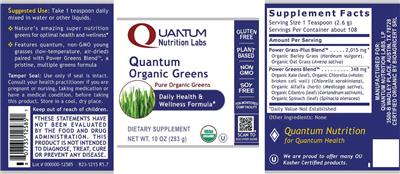
Quantum Organic Greens contains seven active ingredients: kale, chlorella, alfalfa, cilantro, spinach, barley grass, and oat grass. Two of the ingredients listed — Power Grass-Plus Blend and Power Greens Blend — are blend containers whose individual components are already counted in the seven actives above.
There are no inactive ingredients listed for this product.
Does it work?
Strong evidence
The evidence for effectiveness varies widely by ingredient. Barley grass and oat grass show the most promise — both are rated Likely Effective for cholesterol and heart disease.
Chlorella is rated Possibly Effective for pregnancy-related iron deficiency. For the other ingredients and most other claimed uses, the evidence we hold is insufficient to rate them reliably — meaning the research either hasn't been done yet or is too limited to draw firm conclusions.
That doesn't mean they don't work; it means we don't have solid data on hand.
How safe is it?
Well-documented data
Most of these ingredients are generally well tolerated when eaten as regular foods. Kale and spinach are safe during pregnancy and breastfeeding when consumed as food.
Barley grass and oat grass are also likely safe in pregnancy and breastfeeding as foods, though concentrated supplements are less studied. Alfalfa, however, is rated Possibly Unsafe in pregnancy and lactation because of its estrogen-like effects — best avoided in supplement amounts.
Chlorella is rated Possibly Safe in pregnancy but safety data is limited. Cilantro lacks pregnancy and lactation safety data on file.
Common side effects from chlorella and alfalfa include digestive upset — cramping, diarrhea, constipation, gas, and nausea. These usually happen early on.
Rare but serious reactions (like anaphylaxis) have been reported with chlorella and cilantro in sensitive individuals. Chlorella can also cause photosensitivity reactions on sun-exposed skin.
Barley contains gluten and may trigger allergic reactions or occupational asthma in sensitive people.
Meds to double-check
Major interaction found
Before you take Quantum Organic Greens, check with your pharmacist if you're on warfarin or other blood thinners; diabetes or insulin medications; blood pressure medications; birth control or hormone therapy; CNS depressants like sleep aids; immunosuppressants; photosensitizing drugs; or triclabendazole. These interactions span from Major down to Moderate severity, so it's worth a quick review of your exact meds.
The bottom line
Scorecard at a glanceFormula with limited ingredient disclosure with strong clinical evidence behind its ingredients' uses. Major medication interactions have been identified, and safety information is well characterized.
This is a whole-food green supplement with some solid evidence behind barley grass and oat grass for heart health. But it's not a simple add-on if you take blood thinners, diabetes medications, blood pressure drugs, birth control, or immunosuppressants — you need to talk it through with your pharmacist or doctor first.
Start low and go slow to watch for digestive upset.
Educational only — not medical advice; always confirm with your pharmacist. Our editorial policy · How we use AI
Assessment coverage: 7 of 7 active ingredients matched to our full ingredient reviews (monographs). Based on the product label dated Apr 24, 2025.
This Scorecard evaluates available label information, ingredient evidence, and known medication-safety considerations. It does not independently verify product identity, purity, potency, contamination, or manufacturing quality. How these ratings are computed
General information
Key facts about Quantum Organic Greens, straight from the product label.
| Brand | Quantum Nutrition Labs |
|---|---|
| Barcode (UPC) | 807735125851 |
| Net contents | 10 Ounce(s); 283 Gram(s) |
| Market status | On market |
| Date entered into DSLD | Apr 24, 2025 |
| DSLD ID | 329090 |
| Product type | Botanical |
| Supplement form | Liquid |
| Dietary claims / uses | All Other, Structure/Function |
| Intended target group(s) | Adult (18 - 50 Years), Kosher, Organic, Gluten Free |
Everything in this section is reproduced from the manufacturer’s own product label — it’s the label speaking, not HelloPharmacist. We show it so you can see exactly what the maker states; we don’t verify or endorse those statements.
Supplement Facts
The label details for Quantum Organic Greens by Quantum Nutrition Labs, sourced from the NIH Dietary Supplement Label Database.
Supplement Facts
| Ingredient | Amount | % DV |
|---|---|---|
| Kale | 0 NP | -- |
| Chlorella | 0 NP | -- |
| Alfalfa | 0 NP | -- |
| Cilantro | 0 NP | -- |
| Spinach | 0 NP | -- |
| Barley Grass | 0 NP | -- |
| Power Grass-Plus Blend | 2015 mg | -- |
| Power Greens Blend | 348 mg | -- |
| Oat Grass | 0 NP | -- |
Other ingredients: None
Tap any ingredient to jump to its full detail below.
These statements are the manufacturer’s wording, reproduced from the product label — the label is saying it, not HelloPharmacist. We don’t verify or endorse them.
Suggested/Recommended/Usage/Directions
Suggested use: Take 1 teaspoon daily mixed in water or other liquids.
Formulation
Nature's amazing super nutrition greens for optimal health and wellness
Pure organic greens
Daily health & wellness formula
Gluten free
Plant based
Non GMO Soy free
FDA-monitored CGMP Facility
USDA Organic
Certified organic by Bioagricert SRL
Formula
Features quantum, non-GMO young grasses (low-temperature, air-dried) paired with Power Greens Blend, a pristine, multiple greens formula
Pure organic greens
OU Kosher OU (Kosher) We are proud to offer many OU Kosher Certified products.
Precautions
Tamper seal: Use only if seal is intact.
Consult your health practitioner if you are pregnant or nursing, taking medication or have a medical condition, before taking this product.
Keep out of reach of children.
Storage
Store in a cool, dry place.
FDA Disclaimer Statement
These statements have not been evaluated by the Food and Drug Administration. This product is not intended to diagnose, treat, cure or prevent any disease.
FDA Statement of Identity
Dietary Supplement
General Statements
Scan to discover more
Seals/Symbols
USDA Organic OU Kosher
Brand IP Statement(s)
Quantum Nutrition for Quantum Health
Is this label outdated? Report a formula or label change and our pharmacy team will review it.
Quantum Organic Greens by Quantum Nutrition Labs label
The label scan from the NIH Dietary Supplement Label Database. Tap to enlarge.
Label images are published by the NIH Dietary Supplement Label Database for the version of this product on file. Always read your actual product label.
View the full label (PDF)The Ingredients in Quantum Organic Greens by Quantum Nutrition Labs
These are the 7 active ingredients this product is made of. Select any to open its full monograph.
Serving size2.6 Gram(s) Dosage formLiquid Servings per container108 Amounts shown are per serving.
Most supplement products combine several ingredients, and a medication can interact with the product through any one of them. Each ingredient below shows whether it has known drug interactions.
Power Grass-Plus Blend
Other (inactive) ingredients: None. These complete the product’s ingredient list but are not active constituents.
Quantum Organic Greens by Quantum Nutrition Labs Drug Interactions
HelloPharmacist Interaction Report
Quantum Organic Greens by Quantum Nutrition Labs contains seven active ingredients, and several of them interact with medications.
The most serious interaction is with warfarin (Coumadin), a blood thinner. Alfalfa, chlorella, and spinach all contain vitamin K, which can reduce how well warfarin works — alfalfa carries a Major severity rating for this interaction.
If you take warfarin, you'll need to keep your vitamin K intake consistent and let your doctor know you're using this product.
Read the full breakdown — every affected drug type, severity by severity
Additionally, four ingredients — alfalfa, cilantro, spinach, and oat grass — may lower blood sugar when taken with diabetes medications or insulin. If you're on these drugs, monitor your glucose closely; your dose might need adjusting.
Cilantro and alfalfa also theoretically increase sedation with CNS depressants (like sleep aids or anxiety medications), and cilantro may lower blood pressure when combined with blood pressure medications. Alfalfa and chlorella both carry a Moderate risk with photosensitizing drugs — medications that make your skin sensitive to sun.
Alfalfa also theoretically interferes with birth control pills and hormone therapy because of its estrogen-like compounds, and it may reduce how well immunosuppressants work.
Barley grass has one documented interaction with triclabendazole, an antiparasitic drug. Kale has no interactions documented in our data.
Altogether, these interactions span 890 individual medications.
Use the medication checker on this page to verify your exact drugs before you start.
Check your own medications below · Editorial policy · How we use AI
Want to check YOUR meds against Quantum Organic Greens?
Ask about interactions with your drugs in plain English — “Can I take it with lisinopril?” — and we find you the answer in seconds, ingredient by ingredient.
Go to the checkerIngredients driving the most interactions
Individual Drug Interactions
The ingredients in Quantum Organic Greens interact with 890 drugs. Click any drug to see the details.
6 of the 7 ingredients in Quantum Organic Greens interact with drugs. Each result below shows which ingredient is responsible. Cilantro Alfalfa Chlorella Spinach Oat Grass Barley Grass
WarfarinWarfarin
How Warfarin interacts with Quantum Organic Greens — through 3 ingredients. Tap an ingredient for the detail:
AlfalfaWarfarin (coumadin) Major
Interaction Summary
Theoretically, alfalfa might reduce the anticoagulant activity of warfarin.
Read the full Alfalfa + Warfarin interactionSpinachWarfarin (coumadin) Moderate
Interaction Summary
Spinach contains vitamin K, which can interfere with the activity of warfarin.
Read the full Spinach + Warfarin interactionChlorellaWarfarin (coumadin) Moderate
Interaction Summary
Theoretically, chlorella might reduce the clinical effects of warfarin.
Read the full Chlorella + Warfarin interactionWarfarin SodiumCoumadin, Panwarfin, Sofarin
How Warfarin Sodium interacts with Quantum Organic Greens — through 3 ingredients. Tap an ingredient for the detail:
AlfalfaWarfarin (coumadin) Major
Interaction Summary
Theoretically, alfalfa might reduce the anticoagulant activity of warfarin.
Read the full Alfalfa + Warfarin Sodium interactionChlorellaWarfarin (coumadin) Moderate
Interaction Summary
Theoretically, chlorella might reduce the clinical effects of warfarin.
Read the full Chlorella + Warfarin Sodium interactionSpinachWarfarin (coumadin) Moderate
Interaction Summary
Spinach contains vitamin K, which can interfere with the activity of warfarin.
Read the full Spinach + Warfarin Sodium interaction6-mercaptopurinePurinethol
How 6-mercaptopurine interacts with Quantum Organic Greens — through 1 ingredient. Tap an ingredient for the detail:
AlfalfaImmunosuppressants Moderate
Interaction Summary
Theoretically, alfalfa might decrease the efficacy of immunosuppressive therapy.
Read the full Alfalfa + 6-mercaptopurine interactionAbrocitinibCibinqo
How Abrocitinib interacts with Quantum Organic Greens — through 1 ingredient. Tap an ingredient for the detail:
AlfalfaImmunosuppressants Moderate
Interaction Summary
Theoretically, alfalfa might decrease the efficacy of immunosuppressive therapy.
Read the full Alfalfa + Abrocitinib interactionAcarboseGlucobay, Prandase, Precose
How Acarbose interacts with Quantum Organic Greens — through 4 ingredients. Tap an ingredient for the detail:
AlfalfaAntidiabetes Drugs Moderate
Interaction Summary
Theoretically, alfalfa might increase the risk of hypoglycemia when taken with antidiabetes drugs.
Read the full Alfalfa + Acarbose interactionCilantroAntidiabetes Drugs Moderate
Interaction Summary
Theoretically, coriander might increase the risk of hypoglycemia when taken with antidiabetes drugs.
Read the full Cilantro + Acarbose interactionSpinachAntidiabetes Drugs Moderate
Interaction Summary
There are claims that spinach leaves have hypoglycemic effects.
Read the full Spinach + Acarbose interactionOat GrassAntidiabetes Drugs Moderate
Interaction Summary
Theoretically, oats may have additive effects with antidiabetic agents and might increase the risk of hypoglycemia.
Read the full Oat Grass + Acarbose interactionAcebutololRhotral, Sectral
How Acebutolol interacts with Quantum Organic Greens — through 1 ingredient. Tap an ingredient for the detail:
CilantroAntihypertensive Drugs Moderate
Interaction Summary
Theoretically, coriander might increase the risk of hypotension when taken with antihypertensive drugs.
Read the full Cilantro + Acebutolol interactionAcepromazineAtravet
How Acepromazine interacts with Quantum Organic Greens — through 3 ingredients. Tap an ingredient for the detail:
ChlorellaPhotosensitizing Drugs Moderate
Interaction Summary
Theoretically, chlorella might have additive effects with photosensitizing drugs.
Read the full Chlorella + Acepromazine interactionAlfalfaPhotosensitizing Drugs Moderate
Interaction Summary
Theoretically, concomitant use of alfalfa with photosensitizing drugs might have additive effects.
Read the full Alfalfa + Acepromazine interactionCilantroPhotosensitizing Drugs, Cns Depressants Moderate
Interaction Summary
Theoretically, coriander might increase the risk of photosensitivity when taken with photosensitizing drugs.
Read the full Cilantro + Acepromazine interactionAcetaminophen, Brompheniramine, PhenylpropanolamineDimetapp Cold and Flu
How Acetaminophen, Brompheniramine, Phenylpropanolamine interacts with Quantum Organic Greens — through 3 ingredients. Tap an ingredient for the detail:
AlfalfaPhotosensitizing Drugs Moderate
Interaction Summary
Theoretically, concomitant use of alfalfa with photosensitizing drugs might have additive effects.
Read the full Alfalfa + Acetaminophen, Brompheniramine, Phenylpropanolamine interactionChlorellaPhotosensitizing Drugs Moderate
Interaction Summary
Theoretically, chlorella might have additive effects with photosensitizing drugs.
Read the full Chlorella + Acetaminophen, Brompheniramine, Phenylpropanolamine interactionCilantroPhotosensitizing Drugs Moderate
Interaction Summary
Theoretically, coriander might increase the risk of photosensitivity when taken with photosensitizing drugs.
Read the full Cilantro + Acetaminophen, Brompheniramine, Phenylpropanolamine interactionAcetaminophen, Butalbital, Caffeine, CodeineEsgic with Codeine, Fioricet w/ Codeine
How Acetaminophen, Butalbital, Caffeine, Codeine interacts with Quantum Organic Greens — through 1 ingredient. Tap an ingredient for the detail:
CilantroCns Depressants Moderate
Interaction Summary
Theoretically, coriander might cause additive sedative effects when taken with CNS depressants.
Read the full Cilantro + Acetaminophen, Butalbital, Caffeine, Codeine interactionAcetaminophen, Butalbital, CodeineBancap w/ Codeine
How Acetaminophen, Butalbital, Codeine interacts with Quantum Organic Greens — through 1 ingredient. Tap an ingredient for the detail:
CilantroCns Depressants Moderate
Interaction Summary
Theoretically, coriander might cause additive sedative effects when taken with CNS depressants.
Read the full Cilantro + Acetaminophen, Butalbital, Codeine interactionAcetaminophen, Butalbital, Codeine PhosphatePhrenilin #3
How Acetaminophen, Butalbital, Codeine Phosphate interacts with Quantum Organic Greens — through 1 ingredient. Tap an ingredient for the detail:
CilantroCns Depressants Moderate
Interaction Summary
Theoretically, coriander might cause additive sedative effects when taken with CNS depressants.
Read the full Cilantro + Acetaminophen, Butalbital, Codeine Phosphate interactionAcetaminophen, Caffeine, Chlorpheniramine, Hydrocodone, PhenylephrineHycomine Compound
How Acetaminophen, Caffeine, Chlorpheniramine, Hydrocodone, Phenylephrine interacts with Quantum Organic Greens — through 3 ingredients. Tap an ingredient for the detail:
CilantroCns Depressants, Photosensitizing Drugs Moderate
Interaction Summary
Theoretically, coriander might cause additive sedative effects when taken with CNS depressants.
Read the full Cilantro + Acetaminophen, Caffeine, Chlorpheniramine, Hydrocodone, Phenylephrine interactionAlfalfaPhotosensitizing Drugs Moderate
Interaction Summary
Theoretically, concomitant use of alfalfa with photosensitizing drugs might have additive effects.
Read the full Alfalfa + Acetaminophen, Caffeine, Chlorpheniramine, Hydrocodone, Phenylephrine interactionChlorellaPhotosensitizing Drugs Moderate
Interaction Summary
Theoretically, chlorella might have additive effects with photosensitizing drugs.
Read the full Chlorella + Acetaminophen, Caffeine, Chlorpheniramine, Hydrocodone, Phenylephrine interactionAcetaminophen, Caffeine, CodeineGesic C15, Gesic C30, Gesic C8, Lenoltec 1, Lenoltec 2, Lenoltec 3 +1 more
How Acetaminophen, Caffeine, Codeine interacts with Quantum Organic Greens — through 1 ingredient. Tap an ingredient for the detail:
CilantroCns Depressants Moderate
Interaction Summary
Theoretically, coriander might cause additive sedative effects when taken with CNS depressants.
Read the full Cilantro + Acetaminophen, Caffeine, Codeine interactionAcetaminophen, Caffeine, Codeine, SalicylamideCodalan No.1, Codalan No.2, Codalan No.3
How Acetaminophen, Caffeine, Codeine, Salicylamide interacts with Quantum Organic Greens — through 1 ingredient. Tap an ingredient for the detail:
CilantroCns Depressants Moderate
Interaction Summary
Theoretically, coriander might cause additive sedative effects when taken with CNS depressants.
Read the full Cilantro + Acetaminophen, Caffeine, Codeine, Salicylamide interactionAcetaminophen, Caffeine, DihydrocodeineDHC Plus, Panlor DC, Panlor SS
How Acetaminophen, Caffeine, Dihydrocodeine interacts with Quantum Organic Greens — through 1 ingredient. Tap an ingredient for the detail:
CilantroCns Depressants Moderate
Interaction Summary
Theoretically, coriander might cause additive sedative effects when taken with CNS depressants.
Read the full Cilantro + Acetaminophen, Caffeine, Dihydrocodeine interactionAcetaminophen, Chlorpheniramine Maleate, Dextromethorphan HbrVicks Formula 44M Cough, Cold & Flu Relief
How Acetaminophen, Chlorpheniramine Maleate, Dextromethorphan Hbr interacts with Quantum Organic Greens — through 3 ingredients. Tap an ingredient for the detail:
ChlorellaPhotosensitizing Drugs Moderate
Interaction Summary
Theoretically, chlorella might have additive effects with photosensitizing drugs.
Read the full Chlorella + Acetaminophen, Chlorpheniramine Maleate, Dextromethorphan Hbr interactionCilantroPhotosensitizing Drugs Moderate
Interaction Summary
Theoretically, coriander might increase the risk of photosensitivity when taken with photosensitizing drugs.
Read the full Cilantro + Acetaminophen, Chlorpheniramine Maleate, Dextromethorphan Hbr interactionAlfalfaPhotosensitizing Drugs Moderate
Interaction Summary
Theoretically, concomitant use of alfalfa with photosensitizing drugs might have additive effects.
Read the full Alfalfa + Acetaminophen, Chlorpheniramine Maleate, Dextromethorphan Hbr interactionAcetaminophen, Chlorpheniramine, Codeine, PhenylephrineColrex
How Acetaminophen, Chlorpheniramine, Codeine, Phenylephrine interacts with Quantum Organic Greens — through 3 ingredients. Tap an ingredient for the detail:
CilantroCns Depressants, Photosensitizing Drugs Moderate
Interaction Summary
Theoretically, coriander might cause additive sedative effects when taken with CNS depressants.
Read the full Cilantro + Acetaminophen, Chlorpheniramine, Codeine, Phenylephrine interactionChlorellaPhotosensitizing Drugs Moderate
Interaction Summary
Theoretically, chlorella might have additive effects with photosensitizing drugs.
Read the full Chlorella + Acetaminophen, Chlorpheniramine, Codeine, Phenylephrine interactionAlfalfaPhotosensitizing Drugs Moderate
Interaction Summary
Theoretically, concomitant use of alfalfa with photosensitizing drugs might have additive effects.
Read the full Alfalfa + Acetaminophen, Chlorpheniramine, Codeine, Phenylephrine interactionAcetaminophen, Chlorpheniramine, DextromethorphanCoricidin II Extra Strength Cold and Flu
How Acetaminophen, Chlorpheniramine, Dextromethorphan interacts with Quantum Organic Greens — through 3 ingredients. Tap an ingredient for the detail:
AlfalfaPhotosensitizing Drugs Moderate
Interaction Summary
Theoretically, concomitant use of alfalfa with photosensitizing drugs might have additive effects.
Read the full Alfalfa + Acetaminophen, Chlorpheniramine, Dextromethorphan interactionCilantroPhotosensitizing Drugs Moderate
Interaction Summary
Theoretically, coriander might increase the risk of photosensitivity when taken with photosensitizing drugs.
Read the full Cilantro + Acetaminophen, Chlorpheniramine, Dextromethorphan interactionChlorellaPhotosensitizing Drugs Moderate
Interaction Summary
Theoretically, chlorella might have additive effects with photosensitizing drugs.
Read the full Chlorella + Acetaminophen, Chlorpheniramine, Dextromethorphan interactionAcetaminophen, Chlorpheniramine, Dextromethorphan HydrobromideCoricidin HBP Maximum Strength Flu
How Acetaminophen, Chlorpheniramine, Dextromethorphan Hydrobromide interacts with Quantum Organic Greens — through 3 ingredients. Tap an ingredient for the detail:
ChlorellaPhotosensitizing Drugs Moderate
Interaction Summary
Theoretically, chlorella might have additive effects with photosensitizing drugs.
Read the full Chlorella + Acetaminophen, Chlorpheniramine, Dextromethorphan Hydrobromide interactionCilantroPhotosensitizing Drugs Moderate
Interaction Summary
Theoretically, coriander might increase the risk of photosensitivity when taken with photosensitizing drugs.
Read the full Cilantro + Acetaminophen, Chlorpheniramine, Dextromethorphan Hydrobromide interactionAlfalfaPhotosensitizing Drugs Moderate
Interaction Summary
Theoretically, concomitant use of alfalfa with photosensitizing drugs might have additive effects.
Read the full Alfalfa + Acetaminophen, Chlorpheniramine, Dextromethorphan Hydrobromide interactionAcetaminophen, Chlorpheniramine, Dextromethorphan, PhenylpropanolamineMulti Symptom Cold Relief
How Acetaminophen, Chlorpheniramine, Dextromethorphan, Phenylpropanolamine interacts with Quantum Organic Greens — through 3 ingredients. Tap an ingredient for the detail:
AlfalfaPhotosensitizing Drugs Moderate
Interaction Summary
Theoretically, concomitant use of alfalfa with photosensitizing drugs might have additive effects.
Read the full Alfalfa + Acetaminophen, Chlorpheniramine, Dextromethorphan, Phenylpropanolamine interactionChlorellaPhotosensitizing Drugs Moderate
Interaction Summary
Theoretically, chlorella might have additive effects with photosensitizing drugs.
Read the full Chlorella + Acetaminophen, Chlorpheniramine, Dextromethorphan, Phenylpropanolamine interactionCilantroPhotosensitizing Drugs Moderate
Interaction Summary
Theoretically, coriander might increase the risk of photosensitivity when taken with photosensitizing drugs.
Read the full Cilantro + Acetaminophen, Chlorpheniramine, Dextromethorphan, Phenylpropanolamine interactionAcetaminophen, Chlorpheniramine, Dextromethorphan, PseudoephedrineChildren's Tylenol Cold Plus Cough, Tylenol Cold Ex Strength
How Acetaminophen, Chlorpheniramine, Dextromethorphan, Pseudoephedrine interacts with Quantum Organic Greens — through 3 ingredients. Tap an ingredient for the detail:
CilantroPhotosensitizing Drugs Moderate
Interaction Summary
Theoretically, coriander might increase the risk of photosensitivity when taken with photosensitizing drugs.
Read the full Cilantro + Acetaminophen, Chlorpheniramine, Dextromethorphan, Pseudoephedrine interactionAlfalfaPhotosensitizing Drugs Moderate
Interaction Summary
Theoretically, concomitant use of alfalfa with photosensitizing drugs might have additive effects.
Read the full Alfalfa + Acetaminophen, Chlorpheniramine, Dextromethorphan, Pseudoephedrine interactionChlorellaPhotosensitizing Drugs Moderate
Interaction Summary
Theoretically, chlorella might have additive effects with photosensitizing drugs.
Read the full Chlorella + Acetaminophen, Chlorpheniramine, Dextromethorphan, Pseudoephedrine interactionAcetaminophen, Chlorpheniramine, Guaifenesin, Phenylephrine, SalicylamideRhinogesic GG
How Acetaminophen, Chlorpheniramine, Guaifenesin, Phenylephrine, Salicylamide interacts with Quantum Organic Greens — through 3 ingredients. Tap an ingredient for the detail:
AlfalfaPhotosensitizing Drugs Moderate
Interaction Summary
Theoretically, concomitant use of alfalfa with photosensitizing drugs might have additive effects.
Read the full Alfalfa + Acetaminophen, Chlorpheniramine, Guaifenesin, Phenylephrine, Salicylamide interactionCilantroPhotosensitizing Drugs Moderate
Interaction Summary
Theoretically, coriander might increase the risk of photosensitivity when taken with photosensitizing drugs.
Read the full Cilantro + Acetaminophen, Chlorpheniramine, Guaifenesin, Phenylephrine, Salicylamide interactionChlorellaPhotosensitizing Drugs Moderate
Interaction Summary
Theoretically, chlorella might have additive effects with photosensitizing drugs.
Read the full Chlorella + Acetaminophen, Chlorpheniramine, Guaifenesin, Phenylephrine, Salicylamide interactionAcetaminophen, Chlorpheniramine, PhenylephrineAlka-Seltzer PLUS, Histex SR, Protid
How Acetaminophen, Chlorpheniramine, Phenylephrine interacts with Quantum Organic Greens — through 3 ingredients. Tap an ingredient for the detail:
CilantroPhotosensitizing Drugs Moderate
Interaction Summary
Theoretically, coriander might increase the risk of photosensitivity when taken with photosensitizing drugs.
Read the full Cilantro + Acetaminophen, Chlorpheniramine, Phenylephrine interactionChlorellaPhotosensitizing Drugs Moderate
Interaction Summary
Theoretically, chlorella might have additive effects with photosensitizing drugs.
Read the full Chlorella + Acetaminophen, Chlorpheniramine, Phenylephrine interactionAlfalfaPhotosensitizing Drugs Moderate
Interaction Summary
Theoretically, concomitant use of alfalfa with photosensitizing drugs might have additive effects.
Read the full Alfalfa + Acetaminophen, Chlorpheniramine, Phenylephrine interactionAcetaminophen, Chlorpheniramine, Phenylephrine, SalicylamideRhinogesic, Rhinogesic JR
How Acetaminophen, Chlorpheniramine, Phenylephrine, Salicylamide interacts with Quantum Organic Greens — through 3 ingredients. Tap an ingredient for the detail:
AlfalfaPhotosensitizing Drugs Moderate
Interaction Summary
Theoretically, concomitant use of alfalfa with photosensitizing drugs might have additive effects.
Read the full Alfalfa + Acetaminophen, Chlorpheniramine, Phenylephrine, Salicylamide interactionChlorellaPhotosensitizing Drugs Moderate
Interaction Summary
Theoretically, chlorella might have additive effects with photosensitizing drugs.
Read the full Chlorella + Acetaminophen, Chlorpheniramine, Phenylephrine, Salicylamide interactionCilantroPhotosensitizing Drugs Moderate
Interaction Summary
Theoretically, coriander might increase the risk of photosensitivity when taken with photosensitizing drugs.
Read the full Cilantro + Acetaminophen, Chlorpheniramine, Phenylephrine, Salicylamide interactionAcetaminophen, Chlorpheniramine, PhenylpropanolamineAlumadrine, Conex, Sinadrin Max Strength, Sinulin
How Acetaminophen, Chlorpheniramine, Phenylpropanolamine interacts with Quantum Organic Greens — through 3 ingredients. Tap an ingredient for the detail:
AlfalfaPhotosensitizing Drugs Moderate
Interaction Summary
Theoretically, concomitant use of alfalfa with photosensitizing drugs might have additive effects.
Read the full Alfalfa + Acetaminophen, Chlorpheniramine, Phenylpropanolamine interactionChlorellaPhotosensitizing Drugs Moderate
Interaction Summary
Theoretically, chlorella might have additive effects with photosensitizing drugs.
Read the full Chlorella + Acetaminophen, Chlorpheniramine, Phenylpropanolamine interactionCilantroPhotosensitizing Drugs Moderate
Interaction Summary
Theoretically, coriander might increase the risk of photosensitivity when taken with photosensitizing drugs.
Read the full Cilantro + Acetaminophen, Chlorpheniramine, Phenylpropanolamine interactionAcetaminophen, Chlorpheniramine, Phenylpropanolamine, OpiumHista-Derfule
How Acetaminophen, Chlorpheniramine, Phenylpropanolamine, Opium interacts with Quantum Organic Greens — through 3 ingredients. Tap an ingredient for the detail:
CilantroPhotosensitizing Drugs, Cns Depressants Moderate
Interaction Summary
Theoretically, coriander might increase the risk of photosensitivity when taken with photosensitizing drugs.
Read the full Cilantro + Acetaminophen, Chlorpheniramine, Phenylpropanolamine, Opium interactionChlorellaPhotosensitizing Drugs Moderate
Interaction Summary
Theoretically, chlorella might have additive effects with photosensitizing drugs.
Read the full Chlorella + Acetaminophen, Chlorpheniramine, Phenylpropanolamine, Opium interactionAlfalfaPhotosensitizing Drugs Moderate
Interaction Summary
Theoretically, concomitant use of alfalfa with photosensitizing drugs might have additive effects.
Read the full Alfalfa + Acetaminophen, Chlorpheniramine, Phenylpropanolamine, Opium interactionAcetaminophen, Chlorpheniramine, Phenylpropanolamine, PhenyltoloxamineNorel Plus
How Acetaminophen, Chlorpheniramine, Phenylpropanolamine, Phenyltoloxamine interacts with Quantum Organic Greens — through 3 ingredients. Tap an ingredient for the detail:
AlfalfaPhotosensitizing Drugs Moderate
Interaction Summary
Theoretically, concomitant use of alfalfa with photosensitizing drugs might have additive effects.
Read the full Alfalfa + Acetaminophen, Chlorpheniramine, Phenylpropanolamine, Phenyltoloxamine interactionCilantroPhotosensitizing Drugs Moderate
Interaction Summary
Theoretically, coriander might increase the risk of photosensitivity when taken with photosensitizing drugs.
Read the full Cilantro + Acetaminophen, Chlorpheniramine, Phenylpropanolamine, Phenyltoloxamine interactionChlorellaPhotosensitizing Drugs Moderate
Interaction Summary
Theoretically, chlorella might have additive effects with photosensitizing drugs.
Read the full Chlorella + Acetaminophen, Chlorpheniramine, Phenylpropanolamine, Phenyltoloxamine interactionAcetaminophen, Chlorpheniramine, PseudoephedrineAlka-Seltzer PLUS Liquid Gels, Children's Tylenol Cold, Codimal, Comtrex, Extra Strength Tylenol Allergy Sinus, Lorsin +3 more
How Acetaminophen, Chlorpheniramine, Pseudoephedrine interacts with Quantum Organic Greens — through 3 ingredients. Tap an ingredient for the detail:
ChlorellaPhotosensitizing Drugs Moderate
Interaction Summary
Theoretically, chlorella might have additive effects with photosensitizing drugs.
Read the full Chlorella + Acetaminophen, Chlorpheniramine, Pseudoephedrine interactionAlfalfaPhotosensitizing Drugs Moderate
Interaction Summary
Theoretically, concomitant use of alfalfa with photosensitizing drugs might have additive effects.
Read the full Alfalfa + Acetaminophen, Chlorpheniramine, Pseudoephedrine interactionCilantroPhotosensitizing Drugs Moderate
Interaction Summary
Theoretically, coriander might increase the risk of photosensitivity when taken with photosensitizing drugs.
Read the full Cilantro + Acetaminophen, Chlorpheniramine, Pseudoephedrine interactionAcetaminophen, Chlorzoxazone, CodeineAcetazone Forte C8, Parafon Forte C8
How Acetaminophen, Chlorzoxazone, Codeine interacts with Quantum Organic Greens — through 1 ingredient. Tap an ingredient for the detail:
CilantroCns Depressants Moderate
Interaction Summary
Theoretically, coriander might cause additive sedative effects when taken with CNS depressants.
Read the full Cilantro + Acetaminophen, Chlorzoxazone, Codeine interactionAcetaminophen, CodeineTylenol No.3, Tylenol w/ Codeine
How Acetaminophen, Codeine interacts with Quantum Organic Greens — through 1 ingredient. Tap an ingredient for the detail:
CilantroCns Depressants Moderate
Interaction Summary
Theoretically, coriander might cause additive sedative effects when taken with CNS depressants.
Read the full Cilantro + Acetaminophen, Codeine interactionEach ingredient & the kinds of drugs it affects
For each ingredient in Quantum Organic Greens with known interactions, here are the types of medications they can affect. Open any type for the detail — or search your exact drug in the checker above.
Cilantro
Antidiabetes Drugs
Theoretically, coriander might increase the risk of hypoglycemia when taken with antidiabetes drugs.
Evidence from animal research suggests that coriander fruit and coriander extract can reduce blood glucose levels. Monitor blood glucose levels closely. Dose adjustments might be necessary.
Antihypertensive Drugs
Theoretically, coriander might increase the risk of hypotension when taken with antihypertensive drugs.
Evidence from animal research suggests that coriander fruit can lower blood pressure.
Cns Depressants
Theoretically, coriander might cause additive sedative effects when taken with CNS depressants.
Evidence from animal research suggests that coriander fruit extract has sedative effects.
Photosensitizing Drugs
Theoretically, coriander might increase the risk of photosensitivity when taken with photosensitizing drugs.
Evidence from in vitro research suggests that coriandrin, a constituent of coriander, has photosensitizing effects.
Alfalfa
Warfarin (Coumadin)
Theoretically, alfalfa might reduce the anticoagulant activity of warfarin.
Alfalfa contains a large amount of vitamin K. This could theoretically interfere with the activity of warfarin.
Antidiabetes Drugs
Theoretically, alfalfa might increase the risk of hypoglycemia when taken with antidiabetes drugs.
Animal research suggests that alfalfa decreases blood sugar in diabetic mice. Also, in one case report, a diabetic patient experienced hypoglycemia after consuming alfalfa extract. Monitor blood glucose levels closely. Dose adjustments might be necessary.
Contraceptive Drugs
Theoretically, alfalfa might interfere with the activity of contraceptive drugs.
Alfalfa contains coumestrol, a phytoestrogen, and isoflavonoids, which have estrogenic effects.
Estrogens
Theoretically, alfalfa might interfere with hormone therapy.
Alfalfa contains coumestrol, a phytoestrogen, and isoflavonoids, which have estrogenic effects.
Immunosuppressants
Theoretically, alfalfa might decrease the efficacy of immunosuppressive therapy.
In vitro research and human case reports suggest that alfalfa may have immunostimulant effects.
Photosensitizing Drugs
Theoretically, concomitant use of alfalfa with photosensitizing drugs might have additive effects.
Animal research suggests that excessive doses of alfalfa may increase photosensitivity, possibly due to its chlorophyll content. It is unclear if this effect would be clinically relevant in humans.
Chlorella
Photosensitizing Drugs
Theoretically, chlorella might have additive effects with photosensitizing drugs.
Chlorella has been reported to cause photosensitization. In five case reports, patients who had ingested chlorella exhibited swelling followed by erythematopurpuric lesions on sun-exposed areas of the body. Theoretically, concomitant use with photosensitizing drugs may exacerbate effects.
Warfarin (Coumadin)
Theoretically, chlorella might reduce the clinical effects of warfarin.
Chlorella contains significant amounts of vitamin K. There is at least one case report of warfarin therapy becoming sub-therapeutic after initiation of chlorella supplements.
Spinach
Antidiabetes Drugs
There are claims that spinach leaves have hypoglycemic effects. Evidence from clinical research suggests that consumption of a spinach-rich meal reduces post-meal blood glucose levels. Theoretically, spinach might have additive effects with antidiabetes drugs and increase the risk of hypoglycemia. Monitor blood glucose levels closely. Dose adjustments might be necessary. Some antidiabetes drugs include glimepiride (Amaryl), glyburide (DiaBeta, Glynase PresTab, Micronase), insulin, pioglitazone (Actos), rosiglitazone (Avandia), and others.
Warfarin (Coumadin)
Spinach contains vitamin K, which can interfere with the activity of warfarin.
In human research, although eating spinach with one meal does not result in coagulation test results outside the therapeutic range, daily consumption for one week necessitates dose adjustment of warfarin. Individuals using anticoagulants should consume a consistent daily amount of spinach to maintain the effect of anticoagulant therapy.
Oat Grass
Antidiabetes Drugs
Theoretically, oats may have additive effects with antidiabetic agents and might increase the risk of hypoglycemia.
Consuming oats can decrease blood glucose in patients with diabetes. In those who require insulin, taking oats 100 grams daily for 2 days reduces the insulin dose required to achieve metabolic control.
Insulin
Concomitant use of oats and insulin might increase the risk of hypoglycemia.
In patients with insulin-dependent type 2 diabetes, taking oats 100 grams daily for 2 days reduces the insulin dose required to achieve metabolic control.
Barley Grass
Triclabendazole (Egaten)
Theoretically, barley might decrease the clinical effects of triclabendazole.
Animal research suggests that a diet supplemented with barley can reduce the bioavailability of triclabendazole when taken concomitantly. This effect has not been shown in humans.
Brand information
Manufacturer and brand details for Quantum Organic Greens, from the product label.
Quantum Nutrition Labs
See all Quantum Nutrition Labs products- Name
- Quantum Nutrition Labs, LP
- Street Address
- 3500-B Wadley Place
- City
- Austin
- State
- TX
- ZipCode
- 78728
Quantum Organic Greens by Quantum Nutrition Labs: Common Questions
Does Quantum Organic Greens by Quantum Nutrition Labs interact with any medications?
How can one product interact with so many drugs?
Where does this information come from?
Is it safe to take this while I'm pregnant?
Can I take this while breastfeeding?
What does barley grass actually do?
Will this supplement upset my stomach?
Does this product contain gluten?
Can this help me lose weight?
Written and reviewed by the HelloPharmacist editorial staff. Our editorial policy
Not sure if Quantum Organic Greens is safe with your meds?
Our pharmacists answer your medication & supplement questions — free.
Label information is sourced from the NIH Dietary Supplement Label Database and reflects the product version on file; always read your actual product label. This page is for education only and is not a substitute for professional medical advice. Confirm with your pharmacist or doctor before combining supplements and medications.
The Full Monographs Behind Quantum Organic Greens’s Ingredients
Every ingredient we hold a full HelloPharmacist monograph for — uses, evidence, safety, and the complete interaction list.
Barley
Interacts with 1 drugBarley is a nutritious whole grain that is a good source of soluble fiber called beta-glucan, which has solid evidence for modestly lowering LDL ('bad') cholesterol when eaten regularly. It...
Read the full Barley monograph → Herb & supplement monographOats
Interacts with 86 drugsOats are a well-studied whole grain whose soluble fiber (beta-glucan) can help lower cholesterol and support heart health when eaten regularly. As a food, oats are safe for most people, and...
Read the full Oats monograph → Herb & supplement monographKale
Kale is a nutrient-dense leafy green vegetable that is rich in vitamins, minerals, fiber, and antioxidants. Eaten as a normal food it is very healthy for most people, but it is a whole food...
Read the full Kale monograph → Herb & supplement monographChlorella
Interacts with 337 drugsChlorella is a nutrient-rich freshwater green algae taken as a supplement for general wellness, immune support, and 'detox.' Some small studies suggest possible benefits for cholesterol, blo...
Read the full Chlorella monograph → Herb & supplement monographAlfalfa
Interacts with 583 drugsAlfalfa is a nutrient-rich legume that people use for high cholesterol, menopause symptoms, and general wellness, but solid human evidence for most of these uses is limited. It is best avoid...
Read the full Alfalfa monograph → Herb & supplement monographCoriander
Interacts with 717 drugsCoriander (also called cilantro) is a common cooking herb and spice that has long been used in traditional medicine for digestive complaints. As a food it is generally safe for most people,...
Read the full Coriander monograph → Herb & supplement monographSpinach
Interacts with 88 drugsSpinach is a nutrient-dense leafy green that is a healthy part of a balanced diet, providing vitamins, minerals, fiber, and antioxidants. While it is very safe as a food, concentrated supple...
Read the full Spinach monograph →Sources & How We Checked
Quantum Organic Greens's label data comes from the NIH Dietary Supplement Label Database; the ingredient interaction data is from the Natural Medicines database, reviewed by our pharmacists.
- NIH Dietary Supplement Label Database (DSLD) — The official product label on file for this supplement.
- Natural Medicines (Therapeutic Research Center) — Evidence-graded clinical reference behind the ingredient interaction data.
Content is written and reviewed by licensed HelloPharmacist pharmacists. See our data sources and editorial standards for how this information is built and checked.
The 93 references behind this product’s interaction data
Every citation that drives the interaction findings for this product’s ingredients, from the evidence-graded Natural Medicines (TRC Healthcare) database. Open an ingredient to browse its citations — links open the study on PubMed or the publisher’s site.
Kale 2 references
Chlorella 13 references
- Peirce A. The American Pharmaceutical Association Practical Guide to Natural Medicines. New York, NY: William Morrow and Co., 1999.
- Ng TP, Tan WC, Lee YK. Occupational asthma in a pharmacist induced by chlorella, a unicellular algae preparation. Resp Med 1994;88:555-7. PubMed
- Jitsukawa K, Suizu R, Hidano A. Chlorella photosensitization. New phytophotodermatosis. Int J Dermatol 1984;23:263-8. PubMed
- Merchant RE, Carmack CA, Wise CM. Nutritional supplementation with Chlorella pyrenoidosa for patients with fibromyalgia syndrome: a pilot study. Phytother Res 2000;14:167-73.
- Merchant RE, Rice CD, Young HF. Dietary Chlorella pyrenoidosa for patients with malignant glioma: effects on immunocompetence, quality of life, and survival. Phytother Res 1990;4:220-31.
- Halperin SA, Smith B, Nolan C, et al. Safety and immunoenhancing effect of a Chlorella-derived dietary supplement in healthy adults undergoing influenza vaccination: randomized, double-blind, placebo-controlled trial. CMAJ 2003;169:111-7..
- Ohtake, T., Negishi, K., Okamoto, K., Oka, M., Maesato, K., Moriya, H., and Kobayashi, S. Manganese-induced Parkinsonism in a patient undergoing maintenance hemodialysis. Am J Kidney Dis 2005;46(4):749-753. PubMed
- Ng, T. P., Tan, W. C., and Lee, Y. K. Occupational asthma in a pharmacist induced by Chlorella, a unicellular algae preparation. Respir.Med. 1994;88(7):555-557. PubMed
- Ohkawa, S., Yoneda, Y., Ohsumi, Y., and Tabuchi, M. [Warfarin therapy and chlorella]. Rinsho Shinkeigaku 1995;35(7):806-807.
- Azocar J, Diaz A. Efficacy and safety of chlorella supplementation in adults with chronic hepatitis C virus infection. World J Gastroenterol 2013;19(7):1085-90. PubMed
- Panahi Y, Badeli R, Karami GR, Badeli Z, Sahebkar A. A randomized controlled trial of 6-week Chlorella vulgaris supplementation in patients with major depressive disorder. Complement Ther Med 2015;23(4):598-602. PubMed
- Nakano S, Takekoshi H, Nakano M. Chlorella pyrenoidosa supplementation reduces the risk of anemia, proteinuria and edema in pregnant women. Plant Foods Hum Nutr 2010;65(1):25-30. PubMed
- Yavasoglu I, Turgutkaya A, Bolaman Z. Chlorella-induced thrombocytopenia. Sao Paulo Med J 2018;136(6):602-3. PubMed
Alfalfa 32 references
- Newall CA, Anderson LA, Philpson JD. Herbal Medicine: A Guide for Healthcare Professionals. London, UK: The Pharmaceutical Press, 1996.
- The Review of Natural Products by Facts and Comparisons. St. Louis, MO: Wolters Kluwer Co., 1999.
- Leung AY, Foster S. Encyclopedia of Common Natural Ingredients Used in Food, Drugs and Cosmetics. 2nd ed. New York, NY: John Wiley & Sons, 1996.
- Kurzer MS, Xu X. Dietary phytoestrogens. Annu Rev Nutr 1997;17:353-81. PubMed
- Farber JM, Carter AO, Varughese PV, et al. Listeriosis traced to the consumption of alfalfa tablets and soft cheese [Letter to the Editor]. N Engl J Med 1990;322:338. PubMed
- Molgaard J, von Schenck H, Olsson AG. Alfalfa seeds lower low density lipoprotein cholesterol and apolipoprotein B concentrations in patients with type II hyperlipoproteinemia. Atherosclerosis 1987;65:173-9. PubMed
- Light TD, Light JA. Acute renal transplant rejection possibly related to herbal medications. Am J Transplant 2003;3:1608-9. PubMed
- Prete PE. The mechanism of action of L-canavanine in inducing autoimmune phenomena. Arthritis Rheum 1985;28:1198-200. PubMed
- Alcocer-Varela J, Iglesias A, Llorente L, Alarcon-Segovia D. Effects of L-canavanine on T cells may explain the induction of systemic lupus erythematosus by alfalfa. Arthritis Rheum 1985;28:52-7. PubMed
- Roberts JL, Hayashi JA. Exacerbation of SLE associated with alfalfa ingestion. N Engl J Med 1983;308:1361. DOI
- Feingold, R. M. Should we fear "health foods"? Arch Intern Med 7-12-1999;159(13):1502. PubMed
- Taormina, P. J., Beuchat, L. R., and Slutsker, L. Infections associated with eating seed sprouts: an international concern. Emerg.Infect.Dis 1999;5(5):626-634. PubMed
- Backer, H. D., Mohle-Boetani, J. C., Werner, S. B., Abbott, S. L., Farrar, J., and Vugia, D. J. High incidence of extra-intestinal infections in a Salmonella Havana outbreak associated with alfalfa sprouts. Public Health Rep. 2000;115(4):339-345. PubMed
- Mohle-Boetani J, Werner B, Polumbo M, and et al. From the Centers for Disease Control and Prevention. Alfalfa sprouts-- Arizona, California, Colorado, and New Mexico, February-April, 2001. JAMA 2-6-2002;287(5):581-582.
- Howard, M. B. and Hutcheson, S. W. Growth dynamics of Salmonella enterica strains on alfalfa sprouts and in waste seed irrigation water. Appl.Environ.Microbiol. 2003;69(1):548-553.
- Winthrop, K. L., Palumbo, M. S., Farrar, J. A., Mohle-Boetani, J. C., Abbott, S., Beatty, M. E., Inami, G., and Werner, S. B. Alfalfa sprouts and Salmonella Kottbus infection: a multistate outbreak following inadequate seed disinfection with heat and chl
- Strapp, C. M., Shearer, A. E., and Joerger, R. D. Survey of retail alfalfa sprouts and mushrooms for the presence of Escherichia coil O157:H7, Salmonella, and Listeria with BAX, and evaluation of this polymerase chain reaction-based system with experimen
- Akaogi, J., Barker, T., Kuroda, Y., Nacionales, D. C., Yamasaki, Y., Stevens, B. R., Reeves, W. H., and Satoh, M. Role of non-protein amino acid L-canavanine in autoimmunity. Autoimmun.Rev 2006;5(6):429-435. PubMed
- Burden and causes of foodborne disease in Australia: Annual report of the OzFoodNet network, 2005. Commun.Dis Intell. 2006;30(3):278-300.
- Shemesh, M., Lindner, H. R., and Ayalon, N. Affinity of rabbit uterine oestradiol receptor for phyto-oestrogens and its use in a competitive protein-binding radioassay for plasma coumestrol. J Reprod.Fertil. 1972;29(1):1-9. PubMed
- Elakovich, S. D. and Hampton, J. M. Analysis of coumestrol, a phytoestrogen, in alfalfa tablets sold for human consumption. J Agric.Food Chem. 1984;32(1):173-175. PubMed
- Malinow, M. R., Bardana, E. J., Jr., Pirofsky, B., Craig, S., and McLaughlin, P. Systemic lupus erythematosus-like syndrome in monkeys fed alfalfa sprouts: role of a nonprotein amino acid. Science 4-23-1982;216(4544):415-417. PubMed
- Malinow, M. R., McLaughlin, P., and Stafford, C. Alfalfa seeds: effects on cholesterol metabolism. Experientia 5-15-1980;36(5):562-564. PubMed
- Farnsworth, N. R. Alfalfa pills and autoimmune diseases. Am J Clin Nutr. 1995;62(5):1026-1028. DOI
- Herbert, V. and Kasdan, T. S. Alfalfa, vitamin E, and autoimmune disorders. Am J Clin Nutr 1994;60(4):639-640.
- Mahon, B. E., Ponka, A., Hall, W. N., Komatsu, K., Dietrich, S. E., Siitonen, A., Cage, G., Hayes, P. S., Lambert-Fair, M. A., Bean, N. H., Griffin, P. M., and Slutsker, L. An international outbreak of Salmonella infections caused by alfalfa sprouts grow
- Gray, A. M. and Flatt, P. R. Pancreatic and extra-pancreatic effects of the traditional anti- diabetic plant, Medicago sativa (lucerne). Br J Nutr. 1997;78(2):325-334.
- Van Beneden, C. A., Keene, W. E., Strang, R. A., Werker, D. H., King, A. S., Mahon, B., Hedberg, K., Bell, A., Kelly, M. T., Balan, V. K., Mac Kenzie, W. R., and Fleming, D. Multinational outbreak of Salmonella enterica serotype Newport infections due to
- Rubenstein AH, Levin NW, and Elliott GA. Manganese-induced hypoglycemia. Lancet 1962;1348-1351.
- Kaufman W. Alfalfa seed dermatitis. JAMA 1954;155(12):1058-1059. PubMed
- Ponka A, Andersson Y, Siitonen A, and et al. Salmonella in alfalfa sprouts. Lancet 1995;345:462-463. PubMed
- Puschner B, Chen X, Read D, Affolter VK. Alfalfa hay induced primary photosensitization in horses. Vet J. 2016 May;211:32-8. PubMed
Coriander 12 references
- Brinker F. Herb Contraindications and Drug Interactions. 2nd ed. Sandy, OR: Eclectic Medical Publications, 1998.
- Swanston-Flatt SK, Day C, Bailey CJ, Flatt PR. Traditional plant treatments for diabetes. Studies in normal and streptozotocin diabetic mice. Diabetologia 1990;33:462-4. PubMed
- Gray, A. M. and Flatt, P. R. Insulin-releasing and insulin-like activity of the traditional anti-diabetic plant Coriandrum sativum (coriander). Br.J Nutr. 1999;81(3):203-209.
- Kanerva, L. and Soini, M. Occupational protein contact dermatitis from coriander. Contact Dermatitis 2001;45(6):354-355. PubMed
- Emamghoreishi, M., Khasaki, M., and Aazam, M. F. Coriandrum sativum: evaluation of its anxiolytic effect in the elevated plus-maze. J Ethnopharmacol. 1-15-2005;96(3):365-370. PubMed
- Ebo, D. G., Bridts, C. H., Mertens, M. H., and Stevens, W. J. Coriander anaphylaxis in a spice grinder with undetected occupational allergy. Acta Clin Belg. 2006;61(3):152-156. PubMed
- Eidi, M., Eidi, A., Saeidi, A., Molanaei, S., Sadeghipour, A., Bahar, M., and Bahar, K. Effect of coriander seed (Coriandrum sativum L.) ethanol extract on insulin release from pancreatic beta cells in streptozotocin-induced diabetic rats. Phytother.Res
- Jabeen, Q., Bashir, S., Lyoussi, B., and Gilani, A. H. Coriander fruit exhibits gut modulatory, blood pressure lowering and diuretic activities. J Ethnopharmacol. 2-25-2009;122(1):123-130. PubMed
- van Toorenenbergen, A. W. and Dieges, P. H. Immunoglobulin E antibodies against coriander and other spices. J Allergy Clin Immunol. 1985;76(3):477-481. PubMed
- Ashwood-Smith, M. J., Warrington, P. J., Jenkins, M., Ceska, O., and Romaniuk, P. J. Photobiological properties of a novel, naturally occurring furoisocoumarin, coriandrin. Photochem.Photobiol. 1989;50(6):745-751. PubMed
- Sastre, J., Olmo, M., Novalvos, A., Ibanez, D., and Lahoz, C. Occupational asthma due to different spices. Allergy 1996;51(2):117-120. PubMed
- Beikert FC, Anastasiadou Z, Fritzen B, Frank U, Augustin M. Topical treatment of tinea pedis using 6% coriander oil in unguentum leniens: a randomized, controlled, comparative pilot study. Dermatology. 2013;226(1):47-51. PubMed
Spinach 6 references
- Brinker F. Herb Contraindications and Drug Interactions. 2nd ed. Sandy, OR: Eclectic Medical Publications, 1998.
- Karlson, B., Leijd, B., and Hellstrom, K. On the influence of vitamin K-rich vegetables and wine on the effectiveness of warfarin treatment. Acta Med Scand. 1986;220(4):347-350. PubMed
- Roller, E., Meller, S., Homey, B., Ruzicka, T., and Neumann, N. J. [Contact dermatitis caused by spinach, hedge mustard and chives]. Hautarzt 2003;54(4):374-375.
- Schuller, A., Morisset, M., Maadi, F., Kolopp Sarda, M. N., Fremont, S., Parisot, L., Kanny, G., and Moneret-Vautrin, D. A. Occupational asthma due to allergy to spinach powder in a pasta factory. Allergy 2005;60(3):408-409. PubMed
- Gustafsson, K., Asp, N. G., Hagander, B., and Nyman, M. Satiety effects of spinach in mixed meals: comparison with other vegetables. Int.J.Food Sci.Nutr. 1995;46(4):327-334. PubMed
- Schreiber, J., Muller, E., Becker, W. M., Zabel, P., Schlaak, M., and Amthor, M. [Spinach powder-induced exogenous allergic alveolitis]. Pneumologie 1998;52(1):61-65.
Barley 15 references
- Brinker F. Herb Contraindications and Drug Interactions. 2nd ed. Sandy, OR: Eclectic Medical Publications, 1998.
- Fernandez-Anaya S, Crespo JF, Rodriguez JR, et al. Beer anaphylaxis. J Allergy Clin Immunol 1999;103:959-60.
- Lembo A, Camilleri M. Chronic constipation. N Engl J Med 2003;349:1360-8. . PubMed
- Ferre, I., Giraldez, F. J., Alvarez-Bujidos, M. L., and Mantecon, A. R. Influence of barley supplement on plasma concentration of triclabendazole metabolites in sheep. Vet.Rec. 11-22-1997;141(21):549-551. PubMed
- Curioni, A., Santucci, B., Cristaudo, A., Canistraci, C., Pietravalle, M., Simonato, B., and Giannattasio, M. Urticaria from beer: an immediate hypersensitivity reaction due to a 10- kDa protein derived from barley. Clin Exp Allergy 1999;29(3):407-413. PubMed
- Fernandez-Anaya, S., Crespo, J. F., Rodriguez, J. R., Daroca, P., Carmona, E., Herraez, L., and Lopez-Rubio, A. Beer anaphylaxis. J Allergy Clin Immunol. 1999;103(5 Pt 1):959-960.
- Cronin, E. Contact dermatitis from barley dust. Contact Dermatitis 1979;5(3):196. PubMed
- Block, G., Tse, K. S., Kijek, K., Chan, H., and Chan-Yeung, M. Baker's asthma. Studies of the cross-antigenicity between different cereal grains. Clin Allergy 1984;14(2):177-185.
- van Ketel, W. G. Immediate type allergy to malt in beer. Contact Dermatitis 1980;6(4):297-298. PubMed
- Ellis, H. J., Doyle, A. P., Day, P., Wieser, H., and Ciclitira, P. J. Demonstration of the presence of coeliac-activating gliadin-like epitopes in malted barley. Int Arch Allergy Immunol. 1994;104(3):308-310. PubMed
- Vidal, C. and Gonzalez-Quintela, A. Food-induced and occupational asthma due to barley flour. Ann Allergy Asthma Immunol. 1995;75(2):121-124.
- Gutgesell, C. and Fuchs, T. Contact urticaria from beer. Contact Dermatitis 1995;33(6):436-437. PubMed
- Baker, P. G. and Read, A. E. Oats and barley toxicity in coeliac patients. Postgrad.Med J 1976;52(607):264-268. PubMed
- Nakase, M., Usui, Y., Alvarez-Nakase, A. M., Adachi, T., Urisu, A., Nakamura, R., Aoki, N., Kitajima, K., and Matsuda, T. Cereal allergens: rice-seed allergens with structural similarity to wheat and barley allergens. Allergy 1998;53(46 Suppl):55-57. PubMed
- Pereira, F., Rafael, M., and Lacerda, M. H. Contact dermatitis from barley. Contact Dermatitis 1998;39(5):261-262. PubMed
Oats 13 references
- Cooper SG, Tracey EJ. Small-bowel obstruction caused by oat-bran bezoar. N Engl J Med 1989;320:1148-9. DOI
- Pick ME, Hawrysh ZJ, Gee MI, et al. Oat bran concentrate bread products improve long-term control of diabetes: a pilot study. J Am Diet Assoc 1996;96:1254-61. PubMed
- Braaten JT, Scott FW, Wood PJ, et al. High beta-glucan oat bran and oat gum reduce postprandial blood glucose and insulin in subjects with and without type 2 diabetes. Diabet Med 1994;11:312-8.
- Rosario PG, Gerst PH, Prakash K, Albu E. Dentureless distention: oat bran bezoars cause obstruction. J Am Geriatr Soc 1990;38:608. PubMed
- Food and Drug Administration. Food labeling: health claims: oats and coronary heart disease. Fed Regist 1996;61:296-313.
- Foulke J. FDA Allows Whole Oat Foods To Make Health Claim on Reducing the Risk of Heart Disease. FDA Talk Paper. 1997. Available at: http://www.fda.gov/bbs/topics/ANSWERS/ANS00782.html.
- Chandalia M, Garg A, Lutjohann D, et al. Beneficial effects of high dietary fiber intake in patients with type 2 diabetes mellitus. N Engl J Med 2000;342:1392-8. PubMed
- Lembo A, Camilleri M. Chronic constipation. N Engl J Med 2003;349:1360-8. . PubMed
- De Paz Arranz S, Perez Montero A, Remon LZ, Molero MI. Allergic contact urticaria to oatmeal. Allergy 2002;57:1215. . PubMed
- Delgado G, Kleber ME, Krämer BK, et al. Dietary intervention with oatmeal in patients with uncontrolled type 2 diabetes mellitus - A crossover study. Exp Clin Endocrinol Diabetes. 2019;127(9):623-629. PubMed
- Sobhan M, Hojati M, Vafaie SY, Ahmadimoghaddam D, Mohammadi Y, Mehrpooya M. The efficacy of colloidal oatmeal cream 1% as add-on therapy in the management of chronic irritant hand eczema: A double-blind study. Clin Cosmet Investig Dermatol. 2020;13:241-25
- Hou Q, Li Y, Li L, Cheng G, Sun X, Li S, Tian H. The metabolic effects of oats intake in patients with type 2 diabetes: A systematic review and meta-analysis. Nutrients. 2015;7(12):10369-87. PubMed
- González-Afonso M, Cañas JA, Sastre B, et al. A Case of Anaphylaxis After Ingestion of Oats: Research Into New Allergens. J Investig Allergol Clin Immunol 2022;32(6):506-508. PubMed
Parts of this content are provided by the Therapeutic Research Center, LLC.
DISCLAIMER: Currently this does not check for drug-drug interactions. This is not an all-inclusive comprehensive list of potential interactions and is for informational purposes only. Not all interactions are known or well-reported in the scientific literature, and new interactions are continually being reported. Input is needed from a qualified healthcare provider including a pharmacist before starting any therapy. Application of clinical judgment is necessary.
© 2021 Therapeutic Research Center, LLC