
Quina Ingredients & Drug Interactions
by Hawaii Pharm
What is this page for?
First and foremost: checking Quina against your medications. The heart of this page is the interaction checker and the full interaction report — how this product’s ingredients may interact with prescription and over-the-counter medicines you may be taking.
Around that, we add a pharmacist’s high-level view of the product as a whole — what’s inside, the evidence for its stated use, how transparent the label is, and what safety data exists — so you can see the full picture in one place. It’s educational information from our licensed clinical databases and the clinical staff at HelloPharmacist — not medical advice — and we don’t sell or endorse products. Our editorial policy
Quina is a dietary supplement by Hawaii Pharm with 1 active ingredient. Its ingredients are commonly taken for malaria (historical/traditional), fever, leg cramps and restless legs.Based on those ingredients, 492 medications have a known interaction with it, the most serious rated major. The ingredients most likely to interact are Quina Bark Extract, Dry. Use the checker below to test your specific medication, or read the full HelloPharmacist Interaction Report.
Check Your Meds Against Quina by Hawaii Pharm
Ask about any prescription or over-the-counter medication and we check it for interactions with Quina by Hawaii Pharm — and tell you which ingredient is responsible.
AI summaries are generated from our interaction database for education only — always confirm with your pharmacist. How we use AI
Ask the Pharmacist
A licensed pharmacist will answer your question by email — free, usually within 24 hours.
Got it — thank you!
A licensed pharmacist will answer within 24 hours. Keep an eye on your email (worth checking spam, just in case).
HelloPharmacist Scorecard of Quina by Hawaii Pharm
Our pharmacy team’s full take, with four database checks built into the cards below — a summary of what is known, not a grade of the product itself.
What’s inside
Full disclosure
Quina is a liquid extract containing one active ingredient: quina bark extract (dry form). The bark is a natural source of the alkaloids quinine and quinidine.
The product also contains alcohol, water, and glycerin as inactive ingredients that help preserve and formulate the liquid.
Does it work?
Not established
The evidence for quina bark isn't established in our data. The product is marketed for muscle cramps, cancer, respiratory tract infections, hemorrhoids, influenza, and malaria—but for each of these uses, the effectiveness rating is insufficient reliable evidence to rate.
That means the studies aren't yet robust enough to say whether it works.
How safe is it?
Well-documented data
Quina carries significant safety cautions. The bark is not dose-controlled, and prolonged use of high doses can cause serious side effects.
Common side effects from oral use include diarrhea, nausea, ringing in the ears, and vomiting. Rare but serious effects include irregular heartbeats (arrhythmias), QT prolongation (a heart rhythm problem), and blood disorders—quinine has been linked to life-threatening conditions like low platelet count, thrombotic thrombocytopenic purpura (a blood clotting disorder), and hemolytic uremic syndrome (which causes anemia, kidney failure, and low platelets).
Early warning signs of these blood disorders are bleeding from the gums, nose, or digestive tract, easy bruising, and small red spots on the skin. Quina is not safe in pregnancy—the safety data advises against it because quinine may harm the fetus.
It's also possibly unsafe during breastfeeding, since quinine can pass into breast milk.
Meds to double-check
Major interaction found
Before taking this product, double-check with your pharmacist if you take quinidine, quinine, or any QT interval-prolonging heart medications (Major severity). Also verify CYP2D6 substrate drugs, blood thinners (anticoagulants or antiplatelets), antacids, phenobarbital, or carbamazepine (all Moderate severity).
The medication search tool on this page can help you find your exact drugs.
The bottom line
Scorecard at a glanceFully disclosed formula with no established evidence rating for its marketed use. Major medication interactions have been identified, and safety information is well characterized.
Quina is a potent herbal extract with serious interaction potential and a narrow safety margin. You should not consider it if you take heart medications, blood thinners, anti-seizure drugs, or any CYP2D6-metabolized medications without talking to your pharmacist or doctor first.
Avoid it entirely if you're pregnant or breastfeeding. If you have no contraindications, discuss dosing and monitoring with your healthcare provider.
Educational only — not medical advice; always confirm with your pharmacist. Our editorial policy · How we use AI
Assessment coverage: 1 of 1 active ingredient matched to our full ingredient reviews (monographs). Based on the product label dated Jan 24, 2024.
This Scorecard evaluates available label information, ingredient evidence, and known medication-safety considerations. It does not independently verify product identity, purity, potency, contamination, or manufacturing quality. How these ratings are computed
General information
Key facts about Quina, straight from the product label.
| Brand | Hawaii Pharm |
|---|---|
| Barcode (UPC) | 840253643575 |
| Net contents | 4 Fluid Ounce(s); 120 mL |
| Market status | On market |
| Date entered into DSLD | Jan 24, 2024 |
| DSLD ID | 301782 |
| Product type | Botanical |
| Supplement form | Liquid |
| Dietary claims / uses | All Other, Structure/Function |
| Intended target group(s) | Adult (18 - 50 Years), Gluten Free |
Everything in this section is reproduced from the manufacturer’s own product label — it’s the label speaking, not HelloPharmacist. We show it so you can see exactly what the maker states; we don’t verify or endorse those statements.
Supplement Facts
The label details for Quina by Hawaii Pharm, sourced from the NIH Dietary Supplement Label Database.
Supplement Facts
| Ingredient | Amount | % DV |
|---|---|---|
| Quina Bark Extract, Dry | 983 mg | -- |
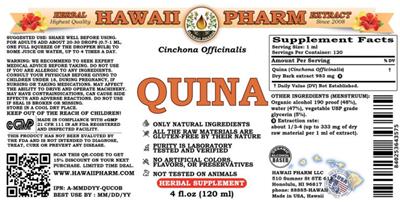
Other ingredients: Alcohol, Water, Glycerin
Tap any ingredient to jump to its full detail below.
These statements are the manufacturer’s wording, reproduced from the product label — the label is saying it, not HelloPharmacist. We don’t verify or endorse them.
Brand IP Statement(s)
Hawaii Pharm Herbal Extract Highest quality since 2008
Suggested/Recommended/Usage/Directions
Suggested use: Shake well before using. For adults add about 20-30 drops (0.7-1 mL, one full squeeze of the dropper bulb) to some juice or water, up to 4 times a day.
Precautions
Warning: We recommend to seek expert medical advice before taking.
Do not use if you are allergic to any ingredients.
Consult your physician before giving to children under 18, during pregnancy, if nursing or taking medications.
Consult your physician before giving to children under 18, during pregnancy, if nursing or taking medications.
May affect the ability to drive and operate machinery. May have contraindications, can cause side effects and adverse reactions. Do not use if seal is broken or missing.
Keep out of the reach of children!
Storage
Store in a cool dry place.
Seals/Symbols
cGMP Made in compliance with cGMP 21 CFR 111 in an FDA registered and inspected facility.
Organic Alcohol Based USA Made in United States of America
FDA Disclaimer Statement
This product has not been evaluated by the FDA and is not intended to diagnose, treat, cure or prevent any disease.
General Statements
Scan this QR-code to get 15% discount on your next purchase. Limited time deal.
Formula
Cinchona officinalis
Organic Alcohol Based
Formulation
Only natural ingredients Purity is laboratory tested and verified
All the raw materials are gluten-free by their nature No artificial colors, flavors, or preservatives
Not tested on animals
Organic Alcohol Based
Made in USA, Hawaii
FDA Statement of Identity
Herbal Supplement
Is this label outdated? Report a formula or label change and our pharmacy team will review it.
Quina by Hawaii Pharm label
The label scan from the NIH Dietary Supplement Label Database. Tap to enlarge.
Label images are published by the NIH Dietary Supplement Label Database for the version of this product on file. Always read your actual product label.
View the full label (PDF)The Ingredients in Quina by Hawaii Pharm
This is the 1 active ingredient this product is made of. Select it to open its full monograph.
Serving size0.7 mL Dosage formLiquid Servings per container120 Amounts shown are per serving.
Quina Bark Extract, Dry
Interacts with492 drugs
Cinchona bark is the natural source of quinine and has been used for centuries to treat malaria and fever, but the bark itself is not standardized and...
Quina Bark Extract, Dry monograph & interactionsOther (inactive) ingredients: Alcohol, Water, Glycerin. These complete the product’s ingredient list but are not active constituents.
Quina by Hawaii Pharm Drug Interactions
HelloPharmacist Interaction Report
Quina by Hawaii Pharm contains quina bark extract, which has documented interactions with 491 individual medications.
The most serious concern is with quinidine and quinine—drugs or drug classes the product actually contains. Taking this product with quinidine could theoretically increase its blood levels and side effects; the same applies to quinine.
Both carry a Major severity rating.
Read the full breakdown — every affected drug type, severity by severity
Several other drug types carry Moderate interactions. CYP2D6 substrates (a broad enzyme-metabolized drug group) may accumulate if you're also taking this product, because quinine in cinchona slows how your liver clears them.
QT interval-prolonging drugs—medications that affect your heart's electrical rhythm—pose an additive risk when combined with cinchona; quinine and quinidine both lengthen the QT interval, and stacking that effect can trigger dangerous heart arrhythmias. Blood thinners (anticoagulants) and antiplatelet drugs may have stronger effects and increase bleeding risk, since the alkaloids in cinchona inhibit platelet clumping.
Antacids may be less effective, and cinchona may increase side effects from phenobarbital or carbamazepine (anti-seizure medications).
Before you start this product, use the medication checker on this page to verify your exact prescriptions.
Check your own medications below · Editorial policy · How we use AI
Want to check YOUR meds against Quina?
Ask about interactions with your drugs in plain English — “Can I take it with lisinopril?” — and we find you the answer in seconds, ingredient by ingredient.
Go to the checkerIngredients driving the most interactions
Individual Drug Interactions
The ingredients in Quina interact with 492 drugs. Click any drug to see the details.
1 of the 1 ingredient in Quina interact with drugs. Each result below shows which ingredient is responsible. Quina Bark Extract, Dry
QuinidineCardioquin, Cin-Quin, Duraquin, Lin-Qin, Quinova, Quinaglute, Quinaglute Duratabs +2 more
How Quinidine interacts with Quina — through 1 ingredient. Tap an ingredient for the detail:
Quina Bark Extract, DryQt Interval-prolonging Drugs, Quinidine Major
Interaction Summary
Theoretically, taking cinchona with other QT interval-prolonging drugs might cause an additive effect and increase the risk of ventricular arrhythmias.
Read the full Quina Bark Extract, Dry + Quinidine interactionQuinineQualaquin
How Quinine interacts with Quina — through 1 ingredient. Tap an ingredient for the detail:
Quina Bark Extract, DryQuinine Major
Interaction Summary
Theoretically, taking cinchona might increase plasma levels and adverse effects of quinine.
Read the full Quina Bark Extract, Dry + Quinine interactionQuinine SulfateQuinamm, Quinine Sulfate
How Quinine Sulfate interacts with Quina — through 1 ingredient. Tap an ingredient for the detail:
Quina Bark Extract, DryQuinine Major
Interaction Summary
Theoretically, taking cinchona might increase plasma levels and adverse effects of quinine.
Read the full Quina Bark Extract, Dry + Quinine Sulfate interactionAbciximabReoPro
How Abciximab interacts with Quina — through 1 ingredient. Tap an ingredient for the detail:
Quina Bark Extract, DryAnticoagulant/antiplatelet Drugs Moderate
Interaction Summary
Theoretically, taking cinchona might increase the drug effects and risk of bleeding with anticoagulant and antiplatelet drugs.
Read the full Quina Bark Extract, Dry + Abciximab interactionAbrocitinibCibinqo
How Abrocitinib interacts with Quina — through 1 ingredient. Tap an ingredient for the detail:
Quina Bark Extract, DryAnticoagulant/antiplatelet Drugs Moderate
Interaction Summary
Theoretically, taking cinchona might increase the drug effects and risk of bleeding with anticoagulant and antiplatelet drugs.
Read the full Quina Bark Extract, Dry + Abrocitinib interactionAcenocoumarolSintrom
How Acenocoumarol interacts with Quina — through 1 ingredient. Tap an ingredient for the detail:
Quina Bark Extract, DryAnticoagulant/antiplatelet Drugs Moderate
Interaction Summary
Theoretically, taking cinchona might increase the drug effects and risk of bleeding with anticoagulant and antiplatelet drugs.
Read the full Quina Bark Extract, Dry + Acenocoumarol interactionAcetaminophen, AspirinGemnisyn
How Acetaminophen, Aspirin interacts with Quina — through 1 ingredient. Tap an ingredient for the detail:
Quina Bark Extract, DryAnticoagulant/antiplatelet Drugs Moderate
Interaction Summary
Theoretically, taking cinchona might increase the drug effects and risk of bleeding with anticoagulant and antiplatelet drugs.
Read the full Quina Bark Extract, Dry + Acetaminophen, Aspirin interactionAcetaminophen, Aspirin, CaffeineExcedrin, Excedrin Extra Strength, Excedrin Migraine
How Acetaminophen, Aspirin, Caffeine interacts with Quina — through 1 ingredient. Tap an ingredient for the detail:
Quina Bark Extract, DryAnticoagulant/antiplatelet Drugs Moderate
Interaction Summary
Theoretically, taking cinchona might increase the drug effects and risk of bleeding with anticoagulant and antiplatelet drugs.
Read the full Quina Bark Extract, Dry + Acetaminophen, Aspirin, Caffeine interactionAcetaminophen, Butalbital, Caffeine, CodeineEsgic with Codeine, Fioricet w/ Codeine
How Acetaminophen, Butalbital, Caffeine, Codeine interacts with Quina — through 1 ingredient. Tap an ingredient for the detail:
Quina Bark Extract, DryCytochrome P450 2d6 (cyp2d6) Substrates Moderate
Interaction Summary
Theoretically, taking cinchona might inhibit cytochrome P450 2D6 (CYP2D6) and increase levels of drugs metabolized by this enzyme.
Read the full Quina Bark Extract, Dry + Acetaminophen, Butalbital, Caffeine, Codeine interactionAcetaminophen, Butalbital, CodeineBancap w/ Codeine
How Acetaminophen, Butalbital, Codeine interacts with Quina — through 1 ingredient. Tap an ingredient for the detail:
Quina Bark Extract, DryCytochrome P450 2d6 (cyp2d6) Substrates Moderate
Interaction Summary
Theoretically, taking cinchona might inhibit cytochrome P450 2D6 (CYP2D6) and increase levels of drugs metabolized by this enzyme.
Read the full Quina Bark Extract, Dry + Acetaminophen, Butalbital, Codeine interactionAcetaminophen, Butalbital, Codeine PhosphatePhrenilin #3
How Acetaminophen, Butalbital, Codeine Phosphate interacts with Quina — through 1 ingredient. Tap an ingredient for the detail:
Quina Bark Extract, DryCytochrome P450 2d6 (cyp2d6) Substrates Moderate
Interaction Summary
Theoretically, taking cinchona might inhibit cytochrome P450 2D6 (CYP2D6) and increase levels of drugs metabolized by this enzyme.
Read the full Quina Bark Extract, Dry + Acetaminophen, Butalbital, Codeine Phosphate interactionAcetaminophen, Caffeine, Chlorpheniramine, Hydrocodone, PhenylephrineHycomine Compound
How Acetaminophen, Caffeine, Chlorpheniramine, Hydrocodone, Phenylephrine interacts with Quina — through 1 ingredient. Tap an ingredient for the detail:
Quina Bark Extract, DryCytochrome P450 2d6 (cyp2d6) Substrates Moderate
Interaction Summary
Theoretically, taking cinchona might inhibit cytochrome P450 2D6 (CYP2D6) and increase levels of drugs metabolized by this enzyme.
Read the full Quina Bark Extract, Dry + Acetaminophen, Caffeine, Chlorpheniramine, Hydrocodone, Phenylephrine interactionAcetaminophen, Caffeine, CodeineGesic C15, Gesic C30, Gesic C8, Lenoltec 1, Lenoltec 2, Lenoltec 3 +1 more
How Acetaminophen, Caffeine, Codeine interacts with Quina — through 1 ingredient. Tap an ingredient for the detail:
Quina Bark Extract, DryCytochrome P450 2d6 (cyp2d6) Substrates Moderate
Interaction Summary
Theoretically, taking cinchona might inhibit cytochrome P450 2D6 (CYP2D6) and increase levels of drugs metabolized by this enzyme.
Read the full Quina Bark Extract, Dry + Acetaminophen, Caffeine, Codeine interactionAcetaminophen, Caffeine, Codeine, SalicylamideCodalan No.1, Codalan No.2, Codalan No.3
How Acetaminophen, Caffeine, Codeine, Salicylamide interacts with Quina — through 1 ingredient. Tap an ingredient for the detail:
Quina Bark Extract, DryCytochrome P450 2d6 (cyp2d6) Substrates Moderate
Interaction Summary
Theoretically, taking cinchona might inhibit cytochrome P450 2D6 (CYP2D6) and increase levels of drugs metabolized by this enzyme.
Read the full Quina Bark Extract, Dry + Acetaminophen, Caffeine, Codeine, Salicylamide interactionAcetaminophen, Caffeine, DihydrocodeineDHC Plus, Panlor DC, Panlor SS
How Acetaminophen, Caffeine, Dihydrocodeine interacts with Quina — through 1 ingredient. Tap an ingredient for the detail:
Quina Bark Extract, DryCytochrome P450 2d6 (cyp2d6) Substrates Moderate
Interaction Summary
Theoretically, taking cinchona might inhibit cytochrome P450 2D6 (CYP2D6) and increase levels of drugs metabolized by this enzyme.
Read the full Quina Bark Extract, Dry + Acetaminophen, Caffeine, Dihydrocodeine interactionAcetaminophen, Chlorpheniramine Maleate, Dextromethorphan HbrVicks Formula 44M Cough, Cold & Flu Relief
How Acetaminophen, Chlorpheniramine Maleate, Dextromethorphan Hbr interacts with Quina — through 1 ingredient. Tap an ingredient for the detail:
Quina Bark Extract, DryCytochrome P450 2d6 (cyp2d6) Substrates Moderate
Interaction Summary
Theoretically, taking cinchona might inhibit cytochrome P450 2D6 (CYP2D6) and increase levels of drugs metabolized by this enzyme.
Read the full Quina Bark Extract, Dry + Acetaminophen, Chlorpheniramine Maleate, Dextromethorphan Hbr interactionAcetaminophen, Chlorpheniramine, Codeine, PhenylephrineColrex
How Acetaminophen, Chlorpheniramine, Codeine, Phenylephrine interacts with Quina — through 1 ingredient. Tap an ingredient for the detail:
Quina Bark Extract, DryCytochrome P450 2d6 (cyp2d6) Substrates Moderate
Interaction Summary
Theoretically, taking cinchona might inhibit cytochrome P450 2D6 (CYP2D6) and increase levels of drugs metabolized by this enzyme.
Read the full Quina Bark Extract, Dry + Acetaminophen, Chlorpheniramine, Codeine, Phenylephrine interactionAcetaminophen, Chlorpheniramine, DextromethorphanCoricidin II Extra Strength Cold and Flu
How Acetaminophen, Chlorpheniramine, Dextromethorphan interacts with Quina — through 1 ingredient. Tap an ingredient for the detail:
Quina Bark Extract, DryCytochrome P450 2d6 (cyp2d6) Substrates Moderate
Interaction Summary
Theoretically, taking cinchona might inhibit cytochrome P450 2D6 (CYP2D6) and increase levels of drugs metabolized by this enzyme.
Read the full Quina Bark Extract, Dry + Acetaminophen, Chlorpheniramine, Dextromethorphan interactionAcetaminophen, Chlorpheniramine, Dextromethorphan HydrobromideCoricidin HBP Maximum Strength Flu
How Acetaminophen, Chlorpheniramine, Dextromethorphan Hydrobromide interacts with Quina — through 1 ingredient. Tap an ingredient for the detail:
Quina Bark Extract, DryCytochrome P450 2d6 (cyp2d6) Substrates Moderate
Interaction Summary
Theoretically, taking cinchona might inhibit cytochrome P450 2D6 (CYP2D6) and increase levels of drugs metabolized by this enzyme.
Read the full Quina Bark Extract, Dry + Acetaminophen, Chlorpheniramine, Dextromethorphan Hydrobromide interactionAcetaminophen, Chlorpheniramine, Dextromethorphan, PhenylpropanolamineMulti Symptom Cold Relief
How Acetaminophen, Chlorpheniramine, Dextromethorphan, Phenylpropanolamine interacts with Quina — through 1 ingredient. Tap an ingredient for the detail:
Quina Bark Extract, DryCytochrome P450 2d6 (cyp2d6) Substrates Moderate
Interaction Summary
Theoretically, taking cinchona might inhibit cytochrome P450 2D6 (CYP2D6) and increase levels of drugs metabolized by this enzyme.
Read the full Quina Bark Extract, Dry + Acetaminophen, Chlorpheniramine, Dextromethorphan, Phenylpropanolamine interactionAcetaminophen, Chlorpheniramine, Dextromethorphan, PseudoephedrineChildren's Tylenol Cold Plus Cough, Tylenol Cold Ex Strength
How Acetaminophen, Chlorpheniramine, Dextromethorphan, Pseudoephedrine interacts with Quina — through 1 ingredient. Tap an ingredient for the detail:
Quina Bark Extract, DryCytochrome P450 2d6 (cyp2d6) Substrates Moderate
Interaction Summary
Theoretically, taking cinchona might inhibit cytochrome P450 2D6 (CYP2D6) and increase levels of drugs metabolized by this enzyme.
Read the full Quina Bark Extract, Dry + Acetaminophen, Chlorpheniramine, Dextromethorphan, Pseudoephedrine interactionAcetaminophen, Chlorzoxazone, CodeineAcetazone Forte C8, Parafon Forte C8
How Acetaminophen, Chlorzoxazone, Codeine interacts with Quina — through 1 ingredient. Tap an ingredient for the detail:
Quina Bark Extract, DryCytochrome P450 2d6 (cyp2d6) Substrates Moderate
Interaction Summary
Theoretically, taking cinchona might inhibit cytochrome P450 2D6 (CYP2D6) and increase levels of drugs metabolized by this enzyme.
Read the full Quina Bark Extract, Dry + Acetaminophen, Chlorzoxazone, Codeine interactionAcetaminophen, CodeineTylenol No.3, Tylenol w/ Codeine
How Acetaminophen, Codeine interacts with Quina — through 1 ingredient. Tap an ingredient for the detail:
Quina Bark Extract, DryCytochrome P450 2d6 (cyp2d6) Substrates Moderate
Interaction Summary
Theoretically, taking cinchona might inhibit cytochrome P450 2D6 (CYP2D6) and increase levels of drugs metabolized by this enzyme.
Read the full Quina Bark Extract, Dry + Acetaminophen, Codeine interactionAcetaminophen, Codeine, DoxylamineMersyndol
How Acetaminophen, Codeine, Doxylamine interacts with Quina — through 1 ingredient. Tap an ingredient for the detail:
Quina Bark Extract, DryCytochrome P450 2d6 (cyp2d6) Substrates Moderate
Interaction Summary
Theoretically, taking cinchona might inhibit cytochrome P450 2D6 (CYP2D6) and increase levels of drugs metabolized by this enzyme.
Read the full Quina Bark Extract, Dry + Acetaminophen, Codeine, Doxylamine interactionAcetaminophen, Codeine, MethocarbamolAcetaminophen, Codeine, Methocarbamol, Robaxacet 8
How Acetaminophen, Codeine, Methocarbamol interacts with Quina — through 1 ingredient. Tap an ingredient for the detail:
Quina Bark Extract, DryCytochrome P450 2d6 (cyp2d6) Substrates Moderate
Interaction Summary
Theoretically, taking cinchona might inhibit cytochrome P450 2D6 (CYP2D6) and increase levels of drugs metabolized by this enzyme.
Read the full Quina Bark Extract, Dry + Acetaminophen, Codeine, Methocarbamol interactionAcetaminophen, DextromethorphanTylenol Cough Ex Strength
How Acetaminophen, Dextromethorphan interacts with Quina — through 1 ingredient. Tap an ingredient for the detail:
Quina Bark Extract, DryCytochrome P450 2d6 (cyp2d6) Substrates Moderate
Interaction Summary
Theoretically, taking cinchona might inhibit cytochrome P450 2D6 (CYP2D6) and increase levels of drugs metabolized by this enzyme.
Read the full Quina Bark Extract, Dry + Acetaminophen, Dextromethorphan interactionAcetaminophen, Dextromethorphan, Doxylamine, PseudoephedrineVicks NyQuil
How Acetaminophen, Dextromethorphan, Doxylamine, Pseudoephedrine interacts with Quina — through 1 ingredient. Tap an ingredient for the detail:
Quina Bark Extract, DryCytochrome P450 2d6 (cyp2d6) Substrates Moderate
Interaction Summary
Theoretically, taking cinchona might inhibit cytochrome P450 2D6 (CYP2D6) and increase levels of drugs metabolized by this enzyme.
Read the full Quina Bark Extract, Dry + Acetaminophen, Dextromethorphan, Doxylamine, Pseudoephedrine interactionAcetaminophen, Dextromethorphan, Guaifenesin, PhenylephrineConar-A
How Acetaminophen, Dextromethorphan, Guaifenesin, Phenylephrine interacts with Quina — through 1 ingredient. Tap an ingredient for the detail:
Quina Bark Extract, DryCytochrome P450 2d6 (cyp2d6) Substrates Moderate
Interaction Summary
Theoretically, taking cinchona might inhibit cytochrome P450 2D6 (CYP2D6) and increase levels of drugs metabolized by this enzyme.
Read the full Quina Bark Extract, Dry + Acetaminophen, Dextromethorphan, Guaifenesin, Phenylephrine interactionAcetaminophen, Dextromethorphan, Guaifenesin, PhenylpropanolamineAnatuss
How Acetaminophen, Dextromethorphan, Guaifenesin, Phenylpropanolamine interacts with Quina — through 1 ingredient. Tap an ingredient for the detail:
Quina Bark Extract, DryCytochrome P450 2d6 (cyp2d6) Substrates Moderate
Interaction Summary
Theoretically, taking cinchona might inhibit cytochrome P450 2D6 (CYP2D6) and increase levels of drugs metabolized by this enzyme.
Read the full Quina Bark Extract, Dry + Acetaminophen, Dextromethorphan, Guaifenesin, Phenylpropanolamine interactionAcetaminophen, Dextromethorphan, Guaifenesin, PseudoephedrineRobitussin Cold, Severe Cold, Suphedrine Cold/Cough
How Acetaminophen, Dextromethorphan, Guaifenesin, Pseudoephedrine interacts with Quina — through 1 ingredient. Tap an ingredient for the detail:
Quina Bark Extract, DryCytochrome P450 2d6 (cyp2d6) Substrates Moderate
Interaction Summary
Theoretically, taking cinchona might inhibit cytochrome P450 2D6 (CYP2D6) and increase levels of drugs metabolized by this enzyme.
Read the full Quina Bark Extract, Dry + Acetaminophen, Dextromethorphan, Guaifenesin, Pseudoephedrine interactionEach ingredient & the kinds of drugs it affects
For each ingredient in Quina with known interactions, here are the types of medications it can affect. Open any type for the detail — or search your exact drug in the checker above.
Quina Bark Extract, Dry
Quinidine
Theoretically, taking cinchona might increase plasma levels and adverse effects of quinidine.
Cinchona contains quinidine.
Quinine
Theoretically, taking cinchona might increase plasma levels and adverse effects of quinine.
Cinchona contains quinine.
Antacids
Theoretically, taking cinchona might decrease the effectiveness of antacids. Theoretically, taking antacids might also increase the risk of adverse effects from cinchona.
Some research shows that taking cinchona lowers stomach acid pH. In addition, some research shows that taking antacids might increase urinary pH. Theoretically, this may increase the amount of quinidine, a constituent of cinchona, reabsorbed in the renal tubules and increase the risk of quinidine toxicity.
Anticoagulant/Antiplatelet Drugs
Theoretically, taking cinchona might increase the drug effects and risk of bleeding with anticoagulant and antiplatelet drugs.
In vitro evidence shows that the alkaloids quinine, quinidine, and cinchonine, constituents of cinchona, inhibit platelet aggregation.
Carbamazepine (Tegretol)
Theoretically, taking cinchona might increase the adverse effects of carbamazepine.
Clinical research shows that taking quinine, a constituent of cinchona, increases the peak plasma concentration and area under the curve of carbamazepine.
Cytochrome P450 2D6 (Cyp2D6) Substrates
Theoretically, taking cinchona might inhibit cytochrome P450 2D6 (CYP2D6) and increase levels of drugs metabolized by this enzyme.
Quinidine, a constituent of cinchona, inhibits CYP2D6-mediated metabolism in humans.
Digoxin (Lanoxin)
Theoretically, taking cinchona might increase serum levels of digoxin.
Quinine and quinidine, which are constituents of cinchona, decrease clearance of digoxin and increase serum digoxin levels in humans.
Phenobarbital (Luminal)
Theoretically, taking cinchona might increase the adverse effects of phenobarbital.
Clinical research shows that taking quinine, a constituent of cinchona, increases the peak plasma concentration and area under the curve of phenobarbital.
Qt Interval-Prolonging Drugs
Theoretically, taking cinchona with other QT interval-prolonging drugs might cause an additive effect and increase the risk of ventricular arrhythmias.
Quinidine and quinine, which are constituents of cinchona, prolong the QT interval.
H2-Blockers
Theoretically, taking cinchona might decrease the effectiveness of H2-blockers.
Some research shows that taking cinchona lowers stomach acid pH.
Proton Pump Inhibitors (Ppis)
Theoretically, taking cinchona might decrease the effectiveness of PPIs.
Some research shows that taking cinchona lowers stomach acid pH.
Brand information
Manufacturer and brand details for Quina, from the product label.
Hawaii Pharm
See all Hawaii Pharm products- Name
- Hawaii Pharm LLC
- Street Address
- 510 Sumner St. Ste. 613
- City
- Honolulu
- State
- HI
- ZipCode
- 96817
- Phone Number
- 888-854-2924
- Web Address
- www.hawaiipharm.com
Quina by Hawaii Pharm: Common Questions
Does Quina by Hawaii Pharm interact with any medications?
How can one product interact with so many drugs?
Where does this information come from?
Can I take Quina if I'm pregnant or breastfeeding?
What are the most common side effects?
Does Quina actually work for muscle cramps or the other uses listed?
Why is this product so risky with other medications?
What's cinchonism?
Written and reviewed by the HelloPharmacist editorial staff. Our editorial policy
Not sure if Quina is safe with your meds?
Our pharmacists answer your medication & supplement questions — free.
Label information is sourced from the NIH Dietary Supplement Label Database and reflects the product version on file; always read your actual product label. This page is for education only and is not a substitute for professional medical advice. Confirm with your pharmacist or doctor before combining supplements and medications.
The Full Monographs Behind Quina’s Ingredients
Every ingredient we hold a full HelloPharmacist monograph for — uses, evidence, safety, and the complete interaction list.
Sources & How We Checked
Quina's label data comes from the NIH Dietary Supplement Label Database; the ingredient interaction data is from the Natural Medicines database, reviewed by our pharmacists.
- NIH Dietary Supplement Label Database (DSLD) — The official product label on file for this supplement.
- Natural Medicines (Therapeutic Research Center) — Evidence-graded clinical reference behind the ingredient interaction data.
Content is written and reviewed by licensed HelloPharmacist pharmacists. See our data sources and editorial standards for how this information is built and checked.
The 15 references behind this product’s interaction data
Every citation that drives the interaction findings for this product’s ingredients, from the evidence-graded Natural Medicines (TRC Healthcare) database. Open an ingredient to browse its citations — links open the study on PubMed or the publisher’s site.
Cinchona 15 references
- The Review of Natural Products by Facts and Comparisons. St. Louis, MO: Wolters Kluwer Co., 1999.
- Wichtl MW. Herbal Drugs and Phytopharmaceuticals. Ed. N.M. Bisset. Stuttgart: Medpharm GmbH Scientific Publishers, 1994.
- Leung AY, Foster S. Encyclopedia of Common Natural Ingredients Used in Food, Drugs and Cosmetics. 2nd ed. New York, NY: John Wiley & Sons, 1996.
- McGuffin M, Hobbs C, Upton R, Goldberg A, eds. American Herbal Products Association's Botanical Safety Handbook. Boca Raton, FL: CRC Press, LLC 1997.
- Gruenwald J, Brendler T, Jaenicke C. PDR for Herbal Medicines. 1st ed. Montvale, NJ: Medical Economics Company, Inc., 1998.
- Brinker F. Herb Contraindications and Drug Interactions. 2nd ed. Sandy, OR: Eclectic Medical Publications, 1998.
- Holt GA. Food & Possible Interactions with Drugs: Revised and Expanded Ed. Chicago, IL: Precept Press, 1998.
- Hardman JG, Limbird LL, Molinoff PB, eds. Goodman and Gillman's The Pharmacological Basis of Therapeutics, 9th ed. New York, NY: McGraw-Hill, 1996.
- Hansten PD, Horn JR. Drug Interactions Analysis and Management. Vancouver, WA: Applied Therapeutics Inc., 1997 and updates.
- Amabeoku GJ, Chikuni O, Akino C, Mutetwa S. Pharmacokinetic interaction of single doses of quinine and carbamazepine, phenobarbitone and phenytoin in healthy volunteers. East Afr Med J 1993;70:90-3.
- Shah BH, Nawaz Z, Virani SS, Ali IQ, Saeed SA, Gilani AH.The inhibitory effect of cinchonine on human platelet aggregation due to blockade of calcium influx. Biochem Pharmacol 1998;56:955-60. PubMed
- US Food and Drug Administration notice: Drug products containing quinine - enforcement action dates. Docket # 2006N-0476. Federal Register 2006 (December 15);71 (241): 75557-60.
- FDA Drug Safety Communication: New risk management plan and patient medication guide for Qualaquin (quinine sulfate). 07-08-2010. https://www.fda.gov/Drugs/DrugSafety/PostmarketDrugSafetyInformationforPatientsandProviders/ucm218202 (accessed 02/18/17).
- Dooms-Goossens A, Deveylder H, Duron C, et al. Airborne contact urticaria due to cinchona. Contact Dermatitis 1986;15(4):258. PubMed
- Bramer SL, Suri A. Inhibition of CYP2D6 by quinidine and its effects on the metabolism of cilostazol. Clin Pharmacokinet. 1999;37 Suppl 2:41-51. PubMed
Parts of this content are provided by the Therapeutic Research Center, LLC.
DISCLAIMER: Currently this does not check for drug-drug interactions. This is not an all-inclusive comprehensive list of potential interactions and is for informational purposes only. Not all interactions are known or well-reported in the scientific literature, and new interactions are continually being reported. Input is needed from a qualified healthcare provider including a pharmacist before starting any therapy. Application of clinical judgment is necessary.
© 2021 Therapeutic Research Center, LLC