
Resveratrol 200 mg Ingredients & Drug Interactions
What is this page for?
First and foremost: checking Resveratrol 200 mg against your medications. The heart of this page is the interaction checker and the full interaction report — how this product’s ingredients may interact with prescription and over-the-counter medicines you may be taking.
Around that, we add a pharmacist’s high-level view of the product as a whole — what’s inside, the evidence for its stated use, how transparent the label is, and what safety data exists — so you can see the full picture in one place. It’s educational information from our licensed clinical databases and the clinical staff at HelloPharmacist — not medical advice — and we don’t sell or endorse products. Our editorial policy
Resveratrol 200 mg is a dietary supplement by Protocol For Life Balance with 2 active ingredients. Its ingredients are commonly taken for source of resveratrol, heart and circulation support, inflammation.Based on those ingredients, 1,377 medications have a known interaction with it, the most serious rated major. The ingredients most likely to interact are Red Wine Fruit Extract, Japanese Knotweed Rhizome, Root Extract. Use the checker below to test your specific medication, or read the full HelloPharmacist Interaction Report.
Check Your Meds Against Resveratrol 200 mg by Protocol For Life Balance
Ask about any prescription or over-the-counter medication and we check it for interactions with Resveratrol 200 mg by Protocol For Life Balance — and tell you which ingredient is responsible.
AI summaries are generated from our interaction database for education only — always confirm with your pharmacist. How we use AI
Ask the Pharmacist
A licensed pharmacist will answer your question by email — free, usually within 24 hours.
Got it — thank you!
A licensed pharmacist will answer within 24 hours. Keep an eye on your email (worth checking spam, just in case).
HelloPharmacist Scorecard of Resveratrol 200 mg by Protocol For Life Balance
Our pharmacy team’s full take, with four database checks built into the cards below — a summary of what is known, not a grade of the product itself.
What’s inside
Full disclosure
This supplement contains 2 active ingredients per capsule. Trans-resveratrol is a polyphenol compound that your body is meant to absorb and process, while red wine fruit extract brings resveratrol plus compounds naturally present in wine, including its alcohol content.
The inactive ingredients—hypromellose, microcrystalline cellulose, magnesium stearate, and silicon dioxide—are the capsule shell and binding agents that hold the tablet together; they're not meant to be active.
Does it work?
Moderate evidence
Trans-resveratrol is possibly effective for obesity and allergic rhinitis (hay fever), but the evidence for cardiovascular disease and high cholesterol suggests it's possibly ineffective. Red wine fruit extract shows possibly effective evidence for Helicobacter pylori infection, weak bones (osteopenia), cardiovascular disease, and diabetes.
Keep in mind these ratings reflect the current state of the research—'possibly effective' means there's some promising data, not a guarantee, and you should discuss with your doctor whether this supplement makes sense for your specific situation.
How safe is it?
Well-documented data
Trans-resveratrol is generally well tolerated at typical supplement doses, but higher doses can cause digestive upset like diarrhea and loose stools. The safety data advises against this supplement during pregnancy and breastfeeding.
Red wine fruit extract contains alcohol, which carries its own health risks and can become habit-forming; it is not safe in any amount during pregnancy and passes into breast milk, so breastfeeding individuals should avoid it or discuss timing with their doctor. Some people may react to wine's sulfite and yeast content, especially those with asthma or a history of yeast allergy.
Meds to double-check
Major interaction found
Before taking this product, double-check with your pharmacist if you take erythromycin or other antibiotics, aspirin, warfarin or other blood thinners, cisapride, cyclosporine, disulfiram, phenytoin, or flibanserin—these carry Major-severity interaction risks with the red wine extract. Additionally, if you take medications metabolized by your liver's CYP2C19, CYP1A2, CYP3A4, or CYP2E1 enzymes, or any other blood-thinning medications, resveratrol may theoretically affect how your body processes them, though this remains largely unconfirmed in humans.
The bottom line
Scorecard at a glanceFully disclosed formula with some supporting evidence for its stated purpose. Major medication interactions have been identified, and safety information is well characterized.
This product may be worth considering if you're exploring options for hay fever or weak bones under your doctor's guidance—but the red wine extract means you're getting alcohol in capsule form, so it's not appropriate during pregnancy or breastfeeding. Anyone taking medications that interact with blood thinners, certain antibiotics, anti-seizure drugs, or immune suppressants should check their specific drugs with our tool before starting.
Talk to your pharmacist about whether it fits your health picture.
Educational only — not medical advice; always confirm with your pharmacist. Our editorial policy · How we use AI
Assessment coverage: 2 of 2 active ingredients matched to our full ingredient reviews (monographs). Based on the product label dated Mar 25, 2025.
This Scorecard evaluates available label information, ingredient evidence, and known medication-safety considerations. It does not independently verify product identity, purity, potency, contamination, or manufacturing quality. How these ratings are computed
General information
Key facts about Resveratrol 200 mg, straight from the product label.
| Brand | Protocol For Life Balance |
|---|---|
| Barcode (UPC) | 707359133532 |
| Net contents | 60 Veg Capsule(s) |
| Market status | On market |
| Date entered into DSLD | Mar 25, 2025 |
| DSLD ID | 326474 |
| Product type | Botanical |
| Supplement form | Capsule |
| Dietary claims / uses | All Other, Structure/Function |
| Intended target group(s) | Vegan, Vegetarian, Adult (18 - 50 Years), Halal, Gluten Free, Dairy Free |
Everything in this section is reproduced from the manufacturer’s own product label — it’s the label speaking, not HelloPharmacist. We show it so you can see exactly what the maker states; we don’t verify or endorse those statements.
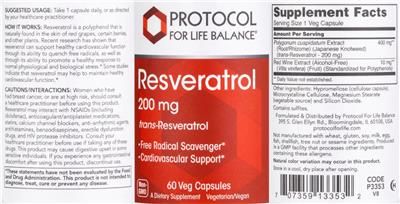
Supplement Facts
The label details for Resveratrol 200 mg by Protocol For Life Balance, sourced from the NIH Dietary Supplement Label Database.
Supplement Facts
| Ingredient | Amount | % DV |
|---|---|---|
| Trans-Resveratrol | 200 mg | -- |
| Japanese Knotweed Rhizome, Root Extract | 400 mg | -- |
| Red Wine Fruit Extract | 10 mg | -- |
Other ingredients: Hypromellose, Microcrystalline Cellulose, Magnesium Stearate, Silicon Dioxide
Tap any ingredient to jump to its full detail below.
These statements are the manufacturer’s wording, reproduced from the product label — the label is saying it, not HelloPharmacist. We don’t verify or endorse them.
Suggested/Recommended/Usage/Directions
Suggested usage: Take 1 capsule daily, or as directed by your healthcare practitioner.
Formula
How it works: Resveratrol is a polyphenol that is naturally found in the skin of red grapes, certain berries, and other plants. Recent research has shown that Resveratrol can support healthy cardiovascular function through its ability to quench free radicals, as well as through its ability to promote a healthy response to biological stress. Some studies indicate that Resveratrol may help to maintain a healthy cardiovascular function.
trans-Resveratrol Free radical scavenger
Crescent H (Halal)
Precautions
Cautions/Interactions: Women who have had breast cancer, or are at high risk, should consult a healthcare practitioner before using this product.
Resveratrol may interact with NSAIDs (including diclofenac), anticoagulant/antiplatelet medications, statins, calcium channel blockers, anti-arrhythmic agents, antihistamines, benzodiazepines, erectile dysfunction drugs, and HIV protease inhibitors. Consult your healthcare practitioner before use if taking any of these drugs.
This product may cause digestive upset in some sensitive individuals. If you experience any gastrointestinal discomfort after using this product, discontinue its use.
Contains sulfites.
Not manufactured with wheat, gluten, soy, milk, egg, fish, shellfish, tree nut or sesame ingredients. Produced in a GMP facility that processes other ingredients containing these allergens.
FDA Disclaimer Statement
These statements have not been evaluated by the Food and Drug Administration. This product is not intended to diagnose, treat, cure or prevent any disease.
Formulation
Cardiovascular support
Non-GMO
Vegetarian/Vegan
Not manufactured with wheat, gluten, soy, milk, egg, fish, shellfish, tree nut or sesame ingredients.
Natural color variation may occur in this product.
FDA Statement of Identity
A Dietary Supplement
Storage
Store in a cool, dry place after opening.
Seals/Symbols
Crescent H (Halal)
Is this label outdated? Report a formula or label change and our pharmacy team will review it.
Resveratrol 200 mg by Protocol For Life Balance label
The label scan from the NIH Dietary Supplement Label Database. Tap to enlarge.
Label images are published by the NIH Dietary Supplement Label Database for the version of this product on file. Always read your actual product label.
View the full label (PDF)The Ingredients in Resveratrol 200 mg by Protocol For Life Balance
These are the 2 active ingredients this product is made of. Select any to open its full monograph.
Serving size1 Veg Capsule(s) Dosage formCapsule Servings per container60 Amounts shown are per serving.
Most supplement products combine several ingredients, and a medication can interact with the product through any one of them. Each ingredient below shows whether it has known drug interactions.
Japanese Knotweed Rhizome, Root Extract
Interacts with826 drugs
Hu Zhang (Japanese knotweed root) is a traditional Chinese herb that is one of the richest natural sources of resveratrol and emodin. Some lab and ear...
Japanese Knotweed Rhizome, Root Extract monograph & interactionsRed Wine Fruit Extract
Interacts with926 drugs
Wine is an alcoholic beverage made from fermented grapes and is not a true dietary supplement or medicine. Despite popular claims about heart benefits...
Red Wine Fruit Extract monograph & interactionsOther (inactive) ingredients: Hypromellose, Microcrystalline Cellulose, Magnesium Stearate, Silicon Dioxide. These complete the product’s ingredient list but are not active constituents.
Resveratrol 200 mg by Protocol For Life Balance Drug Interactions
HelloPharmacist Interaction Report
Resveratrol 200 mg by Protocol For Life Balance contains two active ingredients, and one of them—red wine fruit extract—carries significant interactions with medications.
The most serious concern is a Major-severity interaction with erythromycin (an antibiotic), aspirin, warfarin (a blood thinner), cisapride, cyclosporine (an immune suppressant), disulfiram (used for alcohol dependence), phenytoin (an anti-seizure drug), and flibanserin (a sexual dysfunction medication). Red wine can raise blood alcohol levels, increase bleeding risk with aspirin, alter warfarin's effects unpredictably, reduce cyclosporine effectiveness, trigger a dangerous disulfiram reaction, lower phenytoin effectiveness, and cause severe drops in blood pressure with flibanserin.
Read the full breakdown — every affected drug type, severity by severity
The trans-resveratrol ingredient itself shows Moderate-severity interactions with several drug-metabolizing enzymes (CYP2C19, CYP1A2, CYP3A4, and CYP2E1 substrates), meaning it may theoretically raise levels of medications processed by these pathways—though this has not been confirmed in human studies except for one small study with chlorzoxazone. Trans-resveratrol also has Moderate-severity interaction potential with blood thinners (anticoagulants) and antiplatelet drugs due to its own blood-thinning effects.
Altogether, these interactions span 1,353 individual medications.
Japanese knotweed rhizome root extract is listed as a blend component; we hold no separate interaction data for it. Use the medication checker below to see if any of your specific drugs are affected by this product.
Check your own medications below · Editorial policy · How we use AI
Want to check YOUR meds against Resveratrol 200 mg?
Ask about interactions with your drugs in plain English — “Can I take it with lisinopril?” — and we find you the answer in seconds, ingredient by ingredient.
Go to the checkerIngredients driving the most interactions
Individual Drug Interactions
The ingredients in Resveratrol 200 mg interact with 1,377 drugs. Click any drug to see the details.
2 of the 2 ingredients in Resveratrol 200 mg interact with drugs. Each result below shows which ingredient is responsible. Red Wine Fruit Extract Japanese Knotweed Rhizome, Root Extract
6-mercaptopurinePurinethol
How 6-mercaptopurine interacts with Resveratrol 200 mg — through 1 ingredient. Tap an ingredient for the detail:
Red Wine Fruit ExtractHepatotoxic Drugs Major
Interaction Summary
Concomitant use of alcohol with hepatotoxic drugs may increase the risk of hepatotoxicity.
Read the full Red Wine Fruit Extract + 6-mercaptopurine interactionAbacavir Sulfate, Dolutegravir, LamivudineTriumeq
How Abacavir Sulfate, Dolutegravir, Lamivudine interacts with Resveratrol 200 mg — through 1 ingredient. Tap an ingredient for the detail:
Red Wine Fruit ExtractHepatotoxic Drugs Major
Interaction Summary
Concomitant use of alcohol with hepatotoxic drugs may increase the risk of hepatotoxicity.
Read the full Red Wine Fruit Extract + Abacavir Sulfate, Dolutegravir, Lamivudine interactionAbacavir, LamivudineEpzicom
How Abacavir, Lamivudine interacts with Resveratrol 200 mg — through 1 ingredient. Tap an ingredient for the detail:
Red Wine Fruit ExtractHepatotoxic Drugs Major
Interaction Summary
Concomitant use of alcohol with hepatotoxic drugs may increase the risk of hepatotoxicity.
Read the full Red Wine Fruit Extract + Abacavir, Lamivudine interactionAbiraterone
How Abiraterone interacts with Resveratrol 200 mg — through 3 ingredients. Tap an ingredient for the detail:
Red Wine Fruit ExtractHepatotoxic Drugs Major
Interaction Summary
Concomitant use of alcohol with hepatotoxic drugs may increase the risk of hepatotoxicity.
Read the full Red Wine Fruit Extract + Abiraterone interactionJapanese Knotweed Rhizome, Root ExtractCytochrome P450 3a4 (cyp3a4) Substrates Moderate
Interaction Summary
Theoretically, hu zhang might increase levels of drugs metabolized by CYP3A4.
Read the full Japanese Knotweed Rhizome, Root Extract + Abiraterone interactionTrans-resveratrolCytochrome P450 3a4 (cyp3a4) Substrates Moderate
Interaction Summary
Theoretically, resveratrol might increase levels of drugs metabolized by CYP3A4.
Read the full Trans-resveratrol + Abiraterone interactionAbiraterone AcetateYonsa, Zytiga
How Abiraterone Acetate interacts with Resveratrol 200 mg — through 3 ingredients. Tap an ingredient for the detail:
Red Wine Fruit ExtractHepatotoxic Drugs Major
Interaction Summary
Concomitant use of alcohol with hepatotoxic drugs may increase the risk of hepatotoxicity.
Read the full Red Wine Fruit Extract + Abiraterone Acetate interactionTrans-resveratrolCytochrome P450 3a4 (cyp3a4) Substrates Moderate
Interaction Summary
Theoretically, resveratrol might increase levels of drugs metabolized by CYP3A4.
Read the full Trans-resveratrol + Abiraterone Acetate interactionJapanese Knotweed Rhizome, Root ExtractCytochrome P450 3a4 (cyp3a4) Substrates Moderate
Interaction Summary
Theoretically, hu zhang might increase levels of drugs metabolized by CYP3A4.
Read the full Japanese Knotweed Rhizome, Root Extract + Abiraterone Acetate interactionAcarboseGlucobay, Prandase, Precose
How Acarbose interacts with Resveratrol 200 mg — through 1 ingredient. Tap an ingredient for the detail:
Red Wine Fruit ExtractHepatotoxic Drugs, Antidiabetes Drugs Major
Interaction Summary
Concomitant use of alcohol with hepatotoxic drugs may increase the risk of hepatotoxicity.
Read the full Red Wine Fruit Extract + Acarbose interactionAcebutololRhotral, Sectral
How Acebutolol interacts with Resveratrol 200 mg — through 1 ingredient. Tap an ingredient for the detail:
Red Wine Fruit ExtractHepatotoxic Drugs, Antihypertensive Drugs Major
Interaction Summary
Concomitant use of alcohol with hepatotoxic drugs may increase the risk of hepatotoxicity.
Read the full Red Wine Fruit Extract + Acebutolol interactionAcepromazineAtravet
How Acepromazine interacts with Resveratrol 200 mg — through 1 ingredient. Tap an ingredient for the detail:
Red Wine Fruit ExtractCns Depressants Major
Interaction Summary
Concomitant use may increase sedative and other adverse effects.
Read the full Red Wine Fruit Extract + Acepromazine interactionAcetaminophenChildren's Tylenol, Children's Tylenol Meltaways, Tylenol, Tylenol Ex Strength
How Acetaminophen interacts with Resveratrol 200 mg — through 3 ingredients. Tap an ingredient for the detail:
Red Wine Fruit ExtractHepatotoxic Drugs Major
Interaction Summary
Concomitant use of alcohol with hepatotoxic drugs may increase the risk of hepatotoxicity.
Read the full Red Wine Fruit Extract + Acetaminophen interactionTrans-resveratrolCytochrome P450 1a2 (cyp1a2) Substrates, Cytochrome P450 2e1 (cyp2e1) Substrates Moderate
Interaction Summary
Theoretically, resveratrol might increase levels of drugs metabolized by CYP1A2.
Read the full Trans-resveratrol + Acetaminophen interactionJapanese Knotweed Rhizome, Root ExtractCytochrome P450 2e1 (cyp2e1) Substrates, Cytochrome P450 1a2 (cyp1a2) Substrates Moderate
Interaction Summary
Theoretically, hu zhang might increase levels of drugs metabolized by CYP2E1.
Read the full Japanese Knotweed Rhizome, Root Extract + Acetaminophen interactionAcetaminophen, AspirinGemnisyn
How Acetaminophen, Aspirin interacts with Resveratrol 200 mg — through 3 ingredients. Tap an ingredient for the detail:
Red Wine Fruit ExtractHepatotoxic Drugs, Aspirin +1 Major
Interaction Summary
Concomitant use of alcohol with hepatotoxic drugs may increase the risk of hepatotoxicity.
Read the full Red Wine Fruit Extract + Acetaminophen, Aspirin interactionJapanese Knotweed Rhizome, Root ExtractCytochrome P450 1a2 (cyp1a2) Substrates, Anticoagulant/antiplatelet Drugs +1 Moderate
Interaction Summary
Theoretically, hu zhang might increase levels of drugs metabolized by CYP1A2.
Read the full Japanese Knotweed Rhizome, Root Extract + Acetaminophen, Aspirin interactionTrans-resveratrolAnticoagulant/antiplatelet Drugs, Cytochrome P450 2e1 (cyp2e1) Substrates +1 Moderate
Interaction Summary
Resveratrol may have antiplatelet effects and may increase the risk of bleeding if used with anticoagulant or antiplatelet drugs.
Read the full Trans-resveratrol + Acetaminophen, Aspirin interactionAcetaminophen, Aspirin, CaffeineExcedrin, Excedrin Extra Strength, Excedrin Migraine
How Acetaminophen, Aspirin, Caffeine interacts with Resveratrol 200 mg — through 3 ingredients. Tap an ingredient for the detail:
Red Wine Fruit ExtractNonsteroidal Anti-inflammatory Drugs (nsaids), Aspirin +1 Major
Interaction Summary
Concomitant use may increase the risk of gastrointestinal (GI) bleeding.
Read the full Red Wine Fruit Extract + Acetaminophen, Aspirin, Caffeine interactionTrans-resveratrolCytochrome P450 1a2 (cyp1a2) Substrates, Anticoagulant/antiplatelet Drugs +2 Moderate
Interaction Summary
Theoretically, resveratrol might increase levels of drugs metabolized by CYP1A2.
Read the full Trans-resveratrol + Acetaminophen, Aspirin, Caffeine interactionJapanese Knotweed Rhizome, Root ExtractAnticoagulant/antiplatelet Drugs, Cytochrome P450 1a2 (cyp1a2) Substrates +2 Moderate
Interaction Summary
Theoretically, hu zhang might increase the risk of bleeding when taken with anticoagulant or antiplatelet drugs.
Read the full Japanese Knotweed Rhizome, Root Extract + Acetaminophen, Aspirin, Caffeine interactionAcetaminophen, Brompheniramine, PhenylpropanolamineDimetapp Cold and Flu
How Acetaminophen, Brompheniramine, Phenylpropanolamine interacts with Resveratrol 200 mg — through 3 ingredients. Tap an ingredient for the detail:
Red Wine Fruit ExtractHepatotoxic Drugs Major
Interaction Summary
Concomitant use of alcohol with hepatotoxic drugs may increase the risk of hepatotoxicity.
Read the full Red Wine Fruit Extract + Acetaminophen, Brompheniramine, Phenylpropanolamine interactionJapanese Knotweed Rhizome, Root ExtractCytochrome P450 2e1 (cyp2e1) Substrates, Cytochrome P450 1a2 (cyp1a2) Substrates Moderate
Interaction Summary
Theoretically, hu zhang might increase levels of drugs metabolized by CYP2E1.
Read the full Japanese Knotweed Rhizome, Root Extract + Acetaminophen, Brompheniramine, Phenylpropanolamine interactionTrans-resveratrolCytochrome P450 2e1 (cyp2e1) Substrates, Cytochrome P450 1a2 (cyp1a2) Substrates Moderate
Interaction Summary
Resveratrol might increase levels of drugs metabolized by CYP2E1.
Read the full Trans-resveratrol + Acetaminophen, Brompheniramine, Phenylpropanolamine interactionAcetaminophen, ButalbitalAxocet, Bancap, Bucet, Butex Forte, Esgic CF, Orbivan CF +5 more
How Acetaminophen, Butalbital interacts with Resveratrol 200 mg — through 3 ingredients. Tap an ingredient for the detail:
Red Wine Fruit ExtractHepatotoxic Drugs Major
Interaction Summary
Concomitant use of alcohol with hepatotoxic drugs may increase the risk of hepatotoxicity.
Read the full Red Wine Fruit Extract + Acetaminophen, Butalbital interactionTrans-resveratrolCytochrome P450 1a2 (cyp1a2) Substrates, Cytochrome P450 2e1 (cyp2e1) Substrates Moderate
Interaction Summary
Theoretically, resveratrol might increase levels of drugs metabolized by CYP1A2.
Read the full Trans-resveratrol + Acetaminophen, Butalbital interactionJapanese Knotweed Rhizome, Root ExtractCytochrome P450 1a2 (cyp1a2) Substrates, Cytochrome P450 2e1 (cyp2e1) Substrates Moderate
Interaction Summary
Theoretically, hu zhang might increase levels of drugs metabolized by CYP1A2.
Read the full Japanese Knotweed Rhizome, Root Extract + Acetaminophen, Butalbital interactionAcetaminophen, Butalbital, CaffeineEsgic, Esgic Plus, Fiogesic, Fioricet, Repan, Tecnal +1 more
How Acetaminophen, Butalbital, Caffeine interacts with Resveratrol 200 mg — through 3 ingredients. Tap an ingredient for the detail:
Red Wine Fruit ExtractHepatotoxic Drugs Major
Interaction Summary
Concomitant use of alcohol with hepatotoxic drugs may increase the risk of hepatotoxicity.
Read the full Red Wine Fruit Extract + Acetaminophen, Butalbital, Caffeine interactionJapanese Knotweed Rhizome, Root ExtractCytochrome P450 1a2 (cyp1a2) Substrates, Cytochrome P450 3a4 (cyp3a4) Substrates +1 Moderate
Interaction Summary
Theoretically, hu zhang might increase levels of drugs metabolized by CYP1A2.
Read the full Japanese Knotweed Rhizome, Root Extract + Acetaminophen, Butalbital, Caffeine interactionTrans-resveratrolCytochrome P450 2e1 (cyp2e1) Substrates, Cytochrome P450 1a2 (cyp1a2) Substrates +1 Moderate
Interaction Summary
Resveratrol might increase levels of drugs metabolized by CYP2E1.
Read the full Trans-resveratrol + Acetaminophen, Butalbital, Caffeine interactionAcetaminophen, Butalbital, Caffeine, CodeineEsgic with Codeine, Fioricet w/ Codeine
How Acetaminophen, Butalbital, Caffeine, Codeine interacts with Resveratrol 200 mg — through 3 ingredients. Tap an ingredient for the detail:
Red Wine Fruit ExtractCns Depressants, Hepatotoxic Drugs +1 Major
Interaction Summary
Concomitant use may increase sedative and other adverse effects.
Read the full Red Wine Fruit Extract + Acetaminophen, Butalbital, Caffeine, Codeine interactionTrans-resveratrolCytochrome P450 3a4 (cyp3a4) Substrates, Cytochrome P450 2e1 (cyp2e1) Substrates +1 Moderate
Interaction Summary
Theoretically, resveratrol might increase levels of drugs metabolized by CYP3A4.
Read the full Trans-resveratrol + Acetaminophen, Butalbital, Caffeine, Codeine interactionJapanese Knotweed Rhizome, Root ExtractCytochrome P450 2e1 (cyp2e1) Substrates, Cytochrome P450 1a2 (cyp1a2) Substrates +1 Moderate
Interaction Summary
Theoretically, hu zhang might increase levels of drugs metabolized by CYP2E1.
Read the full Japanese Knotweed Rhizome, Root Extract + Acetaminophen, Butalbital, Caffeine, Codeine interactionAcetaminophen, Butalbital, CodeineBancap w/ Codeine
How Acetaminophen, Butalbital, Codeine interacts with Resveratrol 200 mg — through 3 ingredients. Tap an ingredient for the detail:
Red Wine Fruit ExtractHepatotoxic Drugs, Narcotic Drugs +1 Major
Interaction Summary
Concomitant use of alcohol with hepatotoxic drugs may increase the risk of hepatotoxicity.
Read the full Red Wine Fruit Extract + Acetaminophen, Butalbital, Codeine interactionJapanese Knotweed Rhizome, Root ExtractCytochrome P450 1a2 (cyp1a2) Substrates, Cytochrome P450 2e1 (cyp2e1) Substrates Moderate
Interaction Summary
Theoretically, hu zhang might increase levels of drugs metabolized by CYP1A2.
Read the full Japanese Knotweed Rhizome, Root Extract + Acetaminophen, Butalbital, Codeine interactionTrans-resveratrolCytochrome P450 1a2 (cyp1a2) Substrates, Cytochrome P450 2e1 (cyp2e1) Substrates Moderate
Interaction Summary
Theoretically, resveratrol might increase levels of drugs metabolized by CYP1A2.
Read the full Trans-resveratrol + Acetaminophen, Butalbital, Codeine interactionAcetaminophen, Butalbital, Codeine PhosphatePhrenilin #3
How Acetaminophen, Butalbital, Codeine Phosphate interacts with Resveratrol 200 mg — through 3 ingredients. Tap an ingredient for the detail:
Red Wine Fruit ExtractCns Depressants, Narcotic Drugs +1 Major
Interaction Summary
Concomitant use may increase sedative and other adverse effects.
Read the full Red Wine Fruit Extract + Acetaminophen, Butalbital, Codeine Phosphate interactionTrans-resveratrolCytochrome P450 1a2 (cyp1a2) Substrates, Cytochrome P450 2e1 (cyp2e1) Substrates Moderate
Interaction Summary
Theoretically, resveratrol might increase levels of drugs metabolized by CYP1A2.
Read the full Trans-resveratrol + Acetaminophen, Butalbital, Codeine Phosphate interactionJapanese Knotweed Rhizome, Root ExtractCytochrome P450 1a2 (cyp1a2) Substrates, Cytochrome P450 2e1 (cyp2e1) Substrates Moderate
Interaction Summary
Theoretically, hu zhang might increase levels of drugs metabolized by CYP1A2.
Read the full Japanese Knotweed Rhizome, Root Extract + Acetaminophen, Butalbital, Codeine Phosphate interactionAcetaminophen, Caffeine, Chlorpheniramine, Hydrocodone, PhenylephrineHycomine Compound
How Acetaminophen, Caffeine, Chlorpheniramine, Hydrocodone, Phenylephrine interacts with Resveratrol 200 mg — through 3 ingredients. Tap an ingredient for the detail:
Red Wine Fruit ExtractNarcotic Drugs, Hepatotoxic Drugs +1 Major
Interaction Summary
Concomitant use of large amounts of alcohol may decrease the metabolism of narcotic drugs.
Read the full Red Wine Fruit Extract + Acetaminophen, Caffeine, Chlorpheniramine, Hydrocodone, Phenylephrine interactionJapanese Knotweed Rhizome, Root ExtractCytochrome P450 2e1 (cyp2e1) Substrates, Cytochrome P450 1a2 (cyp1a2) Substrates +1 Moderate
Interaction Summary
Theoretically, hu zhang might increase levels of drugs metabolized by CYP2E1.
Read the full Japanese Knotweed Rhizome, Root Extract + Acetaminophen, Caffeine, Chlorpheniramine, Hydrocodone, Phenylephrine interactionTrans-resveratrolCytochrome P450 2e1 (cyp2e1) Substrates, Cytochrome P450 3a4 (cyp3a4) Substrates +1 Moderate
Interaction Summary
Resveratrol might increase levels of drugs metabolized by CYP2E1.
Read the full Trans-resveratrol + Acetaminophen, Caffeine, Chlorpheniramine, Hydrocodone, Phenylephrine interactionAcetaminophen, Caffeine, CodeineGesic C15, Gesic C30, Gesic C8, Lenoltec 1, Lenoltec 2, Lenoltec 3 +1 more
How Acetaminophen, Caffeine, Codeine interacts with Resveratrol 200 mg — through 3 ingredients. Tap an ingredient for the detail:
Red Wine Fruit ExtractCns Depressants, Hepatotoxic Drugs +1 Major
Interaction Summary
Concomitant use may increase sedative and other adverse effects.
Read the full Red Wine Fruit Extract + Acetaminophen, Caffeine, Codeine interactionTrans-resveratrolCytochrome P450 1a2 (cyp1a2) Substrates, Cytochrome P450 2e1 (cyp2e1) Substrates +1 Moderate
Interaction Summary
Theoretically, resveratrol might increase levels of drugs metabolized by CYP1A2.
Read the full Trans-resveratrol + Acetaminophen, Caffeine, Codeine interactionJapanese Knotweed Rhizome, Root ExtractCytochrome P450 1a2 (cyp1a2) Substrates, Cytochrome P450 2e1 (cyp2e1) Substrates +1 Moderate
Interaction Summary
Theoretically, hu zhang might increase levels of drugs metabolized by CYP1A2.
Read the full Japanese Knotweed Rhizome, Root Extract + Acetaminophen, Caffeine, Codeine interactionAcetaminophen, Caffeine, Codeine, SalicylamideCodalan No.1, Codalan No.2, Codalan No.3
How Acetaminophen, Caffeine, Codeine, Salicylamide interacts with Resveratrol 200 mg — through 3 ingredients. Tap an ingredient for the detail:
Red Wine Fruit ExtractNarcotic Drugs, Hepatotoxic Drugs +1 Major
Interaction Summary
Concomitant use of large amounts of alcohol may decrease the metabolism of narcotic drugs.
Read the full Red Wine Fruit Extract + Acetaminophen, Caffeine, Codeine, Salicylamide interactionJapanese Knotweed Rhizome, Root ExtractCytochrome P450 3a4 (cyp3a4) Substrates, Cytochrome P450 1a2 (cyp1a2) Substrates +1 Moderate
Interaction Summary
Theoretically, hu zhang might increase levels of drugs metabolized by CYP3A4.
Read the full Japanese Knotweed Rhizome, Root Extract + Acetaminophen, Caffeine, Codeine, Salicylamide interactionTrans-resveratrolCytochrome P450 3a4 (cyp3a4) Substrates, Cytochrome P450 1a2 (cyp1a2) Substrates +1 Moderate
Interaction Summary
Theoretically, resveratrol might increase levels of drugs metabolized by CYP3A4.
Read the full Trans-resveratrol + Acetaminophen, Caffeine, Codeine, Salicylamide interactionAcetaminophen, Caffeine, DihydrocodeineDHC Plus, Panlor DC, Panlor SS
How Acetaminophen, Caffeine, Dihydrocodeine interacts with Resveratrol 200 mg — through 3 ingredients. Tap an ingredient for the detail:
Red Wine Fruit ExtractCns Depressants, Narcotic Drugs +1 Major
Interaction Summary
Concomitant use may increase sedative and other adverse effects.
Read the full Red Wine Fruit Extract + Acetaminophen, Caffeine, Dihydrocodeine interactionTrans-resveratrolCytochrome P450 2e1 (cyp2e1) Substrates, Cytochrome P450 3a4 (cyp3a4) Substrates +1 Moderate
Interaction Summary
Resveratrol might increase levels of drugs metabolized by CYP2E1.
Read the full Trans-resveratrol + Acetaminophen, Caffeine, Dihydrocodeine interactionJapanese Knotweed Rhizome, Root ExtractCytochrome P450 2e1 (cyp2e1) Substrates, Cytochrome P450 1a2 (cyp1a2) Substrates +1 Moderate
Interaction Summary
Theoretically, hu zhang might increase levels of drugs metabolized by CYP2E1.
Read the full Japanese Knotweed Rhizome, Root Extract + Acetaminophen, Caffeine, Dihydrocodeine interactionAcetaminophen, Caffeine, IsomethepteneMigralam
How Acetaminophen, Caffeine, Isometheptene interacts with Resveratrol 200 mg — through 3 ingredients. Tap an ingredient for the detail:
Red Wine Fruit ExtractHepatotoxic Drugs Major
Interaction Summary
Concomitant use of alcohol with hepatotoxic drugs may increase the risk of hepatotoxicity.
Read the full Red Wine Fruit Extract + Acetaminophen, Caffeine, Isometheptene interactionJapanese Knotweed Rhizome, Root ExtractCytochrome P450 1a2 (cyp1a2) Substrates, Cytochrome P450 2e1 (cyp2e1) Substrates +1 Moderate
Interaction Summary
Theoretically, hu zhang might increase levels of drugs metabolized by CYP1A2.
Read the full Japanese Knotweed Rhizome, Root Extract + Acetaminophen, Caffeine, Isometheptene interactionTrans-resveratrolCytochrome P450 1a2 (cyp1a2) Substrates, Cytochrome P450 2e1 (cyp2e1) Substrates +1 Moderate
Interaction Summary
Theoretically, resveratrol might increase levels of drugs metabolized by CYP1A2.
Read the full Trans-resveratrol + Acetaminophen, Caffeine, Isometheptene interactionAcetaminophen, Caffeine, PyrilamineMidol Max Strength Menstrual
How Acetaminophen, Caffeine, Pyrilamine interacts with Resveratrol 200 mg — through 3 ingredients. Tap an ingredient for the detail:
Red Wine Fruit ExtractHepatotoxic Drugs Major
Interaction Summary
Concomitant use of alcohol with hepatotoxic drugs may increase the risk of hepatotoxicity.
Read the full Red Wine Fruit Extract + Acetaminophen, Caffeine, Pyrilamine interactionTrans-resveratrolCytochrome P450 3a4 (cyp3a4) Substrates, Cytochrome P450 1a2 (cyp1a2) Substrates +1 Moderate
Interaction Summary
Theoretically, resveratrol might increase levels of drugs metabolized by CYP3A4.
Read the full Trans-resveratrol + Acetaminophen, Caffeine, Pyrilamine interactionJapanese Knotweed Rhizome, Root ExtractCytochrome P450 3a4 (cyp3a4) Substrates, Cytochrome P450 1a2 (cyp1a2) Substrates +1 Moderate
Interaction Summary
Theoretically, hu zhang might increase levels of drugs metabolized by CYP3A4.
Read the full Japanese Knotweed Rhizome, Root Extract + Acetaminophen, Caffeine, Pyrilamine interactionAcetaminophen, Chlorpheniramine Maleate, Dextromethorphan HbrVicks Formula 44M Cough, Cold & Flu Relief
How Acetaminophen, Chlorpheniramine Maleate, Dextromethorphan Hbr interacts with Resveratrol 200 mg — through 3 ingredients. Tap an ingredient for the detail:
Red Wine Fruit ExtractHepatotoxic Drugs Major
Interaction Summary
Concomitant use of alcohol with hepatotoxic drugs may increase the risk of hepatotoxicity.
Read the full Red Wine Fruit Extract + Acetaminophen, Chlorpheniramine Maleate, Dextromethorphan Hbr interactionJapanese Knotweed Rhizome, Root ExtractCytochrome P450 2e1 (cyp2e1) Substrates, Cytochrome P450 1a2 (cyp1a2) Substrates +1 Moderate
Interaction Summary
Theoretically, hu zhang might increase levels of drugs metabolized by CYP2E1.
Read the full Japanese Knotweed Rhizome, Root Extract + Acetaminophen, Chlorpheniramine Maleate, Dextromethorphan Hbr interactionTrans-resveratrolCytochrome P450 2e1 (cyp2e1) Substrates, Cytochrome P450 1a2 (cyp1a2) Substrates +1 Moderate
Interaction Summary
Resveratrol might increase levels of drugs metabolized by CYP2E1.
Read the full Trans-resveratrol + Acetaminophen, Chlorpheniramine Maleate, Dextromethorphan Hbr interactionAcetaminophen, Chlorpheniramine, Codeine, PhenylephrineColrex
How Acetaminophen, Chlorpheniramine, Codeine, Phenylephrine interacts with Resveratrol 200 mg — through 3 ingredients. Tap an ingredient for the detail:
Red Wine Fruit ExtractCns Depressants, Narcotic Drugs +1 Major
Interaction Summary
Concomitant use may increase sedative and other adverse effects.
Read the full Red Wine Fruit Extract + Acetaminophen, Chlorpheniramine, Codeine, Phenylephrine interactionTrans-resveratrolCytochrome P450 3a4 (cyp3a4) Substrates, Cytochrome P450 1a2 (cyp1a2) Substrates +1 Moderate
Interaction Summary
Theoretically, resveratrol might increase levels of drugs metabolized by CYP3A4.
Read the full Trans-resveratrol + Acetaminophen, Chlorpheniramine, Codeine, Phenylephrine interactionJapanese Knotweed Rhizome, Root ExtractCytochrome P450 1a2 (cyp1a2) Substrates, Cytochrome P450 2e1 (cyp2e1) Substrates +1 Moderate
Interaction Summary
Theoretically, hu zhang might increase levels of drugs metabolized by CYP1A2.
Read the full Japanese Knotweed Rhizome, Root Extract + Acetaminophen, Chlorpheniramine, Codeine, Phenylephrine interactionAcetaminophen, Chlorpheniramine, DextromethorphanCoricidin II Extra Strength Cold and Flu
How Acetaminophen, Chlorpheniramine, Dextromethorphan interacts with Resveratrol 200 mg — through 3 ingredients. Tap an ingredient for the detail:
Red Wine Fruit ExtractHepatotoxic Drugs Major
Interaction Summary
Concomitant use of alcohol with hepatotoxic drugs may increase the risk of hepatotoxicity.
Read the full Red Wine Fruit Extract + Acetaminophen, Chlorpheniramine, Dextromethorphan interactionJapanese Knotweed Rhizome, Root ExtractCytochrome P450 2e1 (cyp2e1) Substrates, Cytochrome P450 3a4 (cyp3a4) Substrates +1 Moderate
Interaction Summary
Theoretically, hu zhang might increase levels of drugs metabolized by CYP2E1.
Read the full Japanese Knotweed Rhizome, Root Extract + Acetaminophen, Chlorpheniramine, Dextromethorphan interactionTrans-resveratrolCytochrome P450 2e1 (cyp2e1) Substrates, Cytochrome P450 3a4 (cyp3a4) Substrates +1 Moderate
Interaction Summary
Resveratrol might increase levels of drugs metabolized by CYP2E1.
Read the full Trans-resveratrol + Acetaminophen, Chlorpheniramine, Dextromethorphan interactionAcetaminophen, Chlorpheniramine, Dextromethorphan HydrobromideCoricidin HBP Maximum Strength Flu
How Acetaminophen, Chlorpheniramine, Dextromethorphan Hydrobromide interacts with Resveratrol 200 mg — through 3 ingredients. Tap an ingredient for the detail:
Red Wine Fruit ExtractHepatotoxic Drugs Major
Interaction Summary
Concomitant use of alcohol with hepatotoxic drugs may increase the risk of hepatotoxicity.
Read the full Red Wine Fruit Extract + Acetaminophen, Chlorpheniramine, Dextromethorphan Hydrobromide interactionTrans-resveratrolCytochrome P450 1a2 (cyp1a2) Substrates, Cytochrome P450 2e1 (cyp2e1) Substrates +1 Moderate
Interaction Summary
Theoretically, resveratrol might increase levels of drugs metabolized by CYP1A2.
Read the full Trans-resveratrol + Acetaminophen, Chlorpheniramine, Dextromethorphan Hydrobromide interactionJapanese Knotweed Rhizome, Root ExtractCytochrome P450 3a4 (cyp3a4) Substrates, Cytochrome P450 2e1 (cyp2e1) Substrates +1 Moderate
Interaction Summary
Theoretically, hu zhang might increase levels of drugs metabolized by CYP3A4.
Read the full Japanese Knotweed Rhizome, Root Extract + Acetaminophen, Chlorpheniramine, Dextromethorphan Hydrobromide interactionAcetaminophen, Chlorpheniramine, Dextromethorphan, PhenylpropanolamineMulti Symptom Cold Relief
How Acetaminophen, Chlorpheniramine, Dextromethorphan, Phenylpropanolamine interacts with Resveratrol 200 mg — through 3 ingredients. Tap an ingredient for the detail:
Red Wine Fruit ExtractHepatotoxic Drugs Major
Interaction Summary
Concomitant use of alcohol with hepatotoxic drugs may increase the risk of hepatotoxicity.
Read the full Red Wine Fruit Extract + Acetaminophen, Chlorpheniramine, Dextromethorphan, Phenylpropanolamine interactionJapanese Knotweed Rhizome, Root ExtractCytochrome P450 1a2 (cyp1a2) Substrates, Cytochrome P450 3a4 (cyp3a4) Substrates +1 Moderate
Interaction Summary
Theoretically, hu zhang might increase levels of drugs metabolized by CYP1A2.
Read the full Japanese Knotweed Rhizome, Root Extract + Acetaminophen, Chlorpheniramine, Dextromethorphan, Phenylpropanolamine interactionTrans-resveratrolCytochrome P450 1a2 (cyp1a2) Substrates, Cytochrome P450 3a4 (cyp3a4) Substrates +1 Moderate
Interaction Summary
Theoretically, resveratrol might increase levels of drugs metabolized by CYP1A2.
Read the full Trans-resveratrol + Acetaminophen, Chlorpheniramine, Dextromethorphan, Phenylpropanolamine interactionAcetaminophen, Chlorpheniramine, Dextromethorphan, PseudoephedrineChildren's Tylenol Cold Plus Cough, Tylenol Cold Ex Strength
How Acetaminophen, Chlorpheniramine, Dextromethorphan, Pseudoephedrine interacts with Resveratrol 200 mg — through 3 ingredients. Tap an ingredient for the detail:
Red Wine Fruit ExtractHepatotoxic Drugs Major
Interaction Summary
Concomitant use of alcohol with hepatotoxic drugs may increase the risk of hepatotoxicity.
Read the full Red Wine Fruit Extract + Acetaminophen, Chlorpheniramine, Dextromethorphan, Pseudoephedrine interactionTrans-resveratrolCytochrome P450 2e1 (cyp2e1) Substrates, Cytochrome P450 1a2 (cyp1a2) Substrates +1 Moderate
Interaction Summary
Resveratrol might increase levels of drugs metabolized by CYP2E1.
Read the full Trans-resveratrol + Acetaminophen, Chlorpheniramine, Dextromethorphan, Pseudoephedrine interactionJapanese Knotweed Rhizome, Root ExtractCytochrome P450 2e1 (cyp2e1) Substrates, Cytochrome P450 3a4 (cyp3a4) Substrates +1 Moderate
Interaction Summary
Theoretically, hu zhang might increase levels of drugs metabolized by CYP2E1.
Read the full Japanese Knotweed Rhizome, Root Extract + Acetaminophen, Chlorpheniramine, Dextromethorphan, Pseudoephedrine interactionAcetaminophen, Chlorpheniramine, Guaifenesin, Phenylephrine, SalicylamideRhinogesic GG
How Acetaminophen, Chlorpheniramine, Guaifenesin, Phenylephrine, Salicylamide interacts with Resveratrol 200 mg — through 3 ingredients. Tap an ingredient for the detail:
Red Wine Fruit ExtractHepatotoxic Drugs Major
Interaction Summary
Concomitant use of alcohol with hepatotoxic drugs may increase the risk of hepatotoxicity.
Read the full Red Wine Fruit Extract + Acetaminophen, Chlorpheniramine, Guaifenesin, Phenylephrine, Salicylamide interactionJapanese Knotweed Rhizome, Root ExtractCytochrome P450 2e1 (cyp2e1) Substrates, Cytochrome P450 3a4 (cyp3a4) Substrates +1 Moderate
Interaction Summary
Theoretically, hu zhang might increase levels of drugs metabolized by CYP2E1.
Read the full Japanese Knotweed Rhizome, Root Extract + Acetaminophen, Chlorpheniramine, Guaifenesin, Phenylephrine, Salicylamide interactionTrans-resveratrolCytochrome P450 2e1 (cyp2e1) Substrates, Cytochrome P450 3a4 (cyp3a4) Substrates +1 Moderate
Interaction Summary
Resveratrol might increase levels of drugs metabolized by CYP2E1.
Read the full Trans-resveratrol + Acetaminophen, Chlorpheniramine, Guaifenesin, Phenylephrine, Salicylamide interactionEach ingredient & the kinds of drugs it affects
For each ingredient in Resveratrol 200 mg with known interactions, here are the types of medications they can affect. Open any type for the detail — or search your exact drug in the checker above.
Red Wine Fruit Extract
Aspirin
Concomitant use may increase the risk of gastrointestinal (GI) bleeding.
Concomitant use of aspirin with alcohol may increase the risk of GI bleeding.
Cisapride (Propulsid)
Concomitant use may increase blood alcohol levels and adverse effects.
Concomitant use of alcohol can increase blood alcohol levels and adverse effects. Also, red wine increases plasma cisapride concentrations, possibly by reducing metabolism.
Cns Depressants
Concomitant use may increase sedative and other adverse effects.
Concomitant use of alcohol with CNS depressants can increase sedative and other adverse effects, potentially through inhibition of the metabolism of certain CNS depressants.
Cyclosporine (Neoral, Sandimmune)
Red wine can reduce the levels and clinical effects of cyclosporine.
Red wine reduces plasma cyclosporine concentrations, possibly by reducing cyclosporine absorption. There is evidence the reduction in cyclosporine AUC by red wine is less in Asians (8% to 14%) than Caucasians (35% to 36%).
Disulfiram (Antabuse)
Concomitant use may cause a disulfiram reaction.
Disulfiram can cause a disulfiram reaction when taken with alcohol. Patients taking disulfiram should not consume any alcohol.
Erythromycin
Concomitant use may increase blood alcohol levels and adverse effects.
Concomitant use of erythromycin with alcohol can increase blood alcohol levels and adverse effects.
Felodipine (Plendil)
Consumption of red wine can rapidly increase felodipine levels and adverse effects.
Red wine taken on an empty stomach can cause "dose dumping" of extended-release felodipine, possibly by changing absorption or metabolism. Red wine can delay the appearance of felodipine in plasma until 4 hours after dosing and can rapidly increase its plasma concentration, producing peak serum levels 3 to 4 times higher than when felodipine is given with water. This can cause an increase in adverse effects 5 hours after dosing.
Flibanserin (Addyi)
Concomitant use increases the risk of severe hypotension and syncope.
Alcohol use is contraindicated in patients taking flibanserin due to the risk of severe hypotension and syncope.
Hepatotoxic Drugs
Concomitant use of alcohol with hepatotoxic drugs may increase the risk of hepatotoxicity.
Concomitant use of excessive amounts of alcohol with potentially hepatotoxic drugs can increase the risk of liver damage.
Monoamine Oxidase Inhibitors (Maois)
Concomitant use may cause hypertensive crisis.
Wine contains tyramine, which is metabolized by monoamine oxidase. Concurrent use of MAOIs with tyramine-containing beverages can lead to elevated levels of tyramine in the body. This can increase the effects of tyramine, which has been reported to cause hypertension, headache, and hypertensive crisis in numerous cases. Sensitivity to tyramine can increase up to 10-fold to 100-fold in people using an MAOI.
Nonsteroidal Anti-Inflammatory Drugs (Nsaids)
Concomitant use may increase the risk of gastrointestinal (GI) bleeding.
Concomitant use of NSAIDs with alcohol may increase the risk of GI bleeding.
Phenytoin (Dilantin)
Concomitant use may decrease the effectiveness of phenytoin.
Chronic, heavy alcohol use can induce the metabolism, reducing therapeutic effectiveness of phenytoin.
Warfarin (Coumadin)
Alcohol can alter the effects of warfarin, although the exact effect depends on the nature of alcohol consumption.
Acute alcohol intoxication can decrease metabolism and increase the effects of warfarin. In contrast, chronic, heavy alcohol use can induce metabolism of warfarin, reducing therapeutic effectiveness.
Acitretin (Soriatane)
Concomitant use increases the risk of long-term teratogenic effects.
Alcohol increases the transesterification of acitretin to etretinate, which is a teratogen that can remain in the body for years after discontinuation of acitretin. Patients of reproductive potential should avoid alcohol completely while taking acitretin and at least 2 months after discontinuation.
Antidiabetes Drugs
Concomitant use may interfere with blood glucose control.
Alcohol can impair gluconeogenesis and may increase the risk of acute hypoglycemia when used concomitantly with antidiabetes drugs. However, the carbohydrates in wine may also worsen glycemic control in patients with diabetes.
Antihypertensive Drugs
Theoretically, concomitant use may interfere with blood pressure control.
Clinical research suggests that consumption of alcohol can increase both systolic and diastolic blood pressure. However, acute alcohol intoxication can also increase the risk of hypotension and additive effects with antihypertensive drugs.
Bupropion (Wellbutrin)
Theoretically, concomitant use may increase the risk of adverse effects from alcohol.
In patients taking bupropion, there have been rare reports of adverse psychiatric events or reduced alcohol tolerance. Additionally, in chronic alcohol users, abrupt discontinuation of alcohol while taking bupropion may increase the risk of seizure.
Cefamandole (Mandol)
Concomitant use may cause a disulfiram-like reaction.
Cefamandole can cause a disulfiram-like reaction when taken with alcohol.
Cefoperazone (Cefobid)
Concomitant use may cause a disulfiram-like reaction.
Cefoperazone can cause a disulfiram-like reaction when taken with alcohol.
Cetirizine (Zyrtec)
Theoretically, concomitant use might increase the risk of CNS impairment.
Cetirizine may cause somnolence in some patients. There is some concern that taking cetirizine in conjunction with alcohol might reduce alertness and impair CNS performance.
Chlorpropamide (Diabinese)
Concomitant use may cause a disulfiram-like reaction.
Chlorpropamide can cause a disulfiram-like reaction when taken with alcohol.
Citalopram (Celexa)
Theoretically, concomitant use might increase the risk of adverse effects from alcohol.
Some case reports suggest that citalopram may reduce alcohol tolerance and increase the risk of adverse effects from alcohol.
Doxycycline (Vibramycin)
Chronic alcohol use might reduce the levels and clinical effects of doxycycline.
Although acute alcohol ingestion does not seem to significantly impact the pharmacokinetics of doxycycline, chronic alcohol ingestion has been shown to significantly reduce the half-life and serum concentration of doxycycline.
Eluxadoline (Viberzi)
Chronic or excessive alcohol use might increase the risk of pancreatitis from eluxadoline.
In clinical studies, the risk of pancreatitis with eluxadoline was increased in chronic alcohol users and in those with acute intake of 3 or more alcoholic beverages daily.
Griseofulvin (Fulvicin)
Concomitant use may cause a disulfiram-like reaction.
Griseofulvin can cause a disulfiram-like reaction, including tachycardia and facial flushing, when taken with alcohol.
Japanese Knotweed Rhizome, Root Extract
Anticoagulant/Antiplatelet Drugs
Theoretically, hu zhang might increase the risk of bleeding when taken with anticoagulant or antiplatelet drugs.
Hu zhang contains the constituent resveratrol. Resveratrol seems to have antiplatelet effects.
Cytochrome P450 1A2 (Cyp1A2) Substrates
Theoretically, hu zhang might increase levels of drugs metabolized by CYP1A2.
Hu zhang contains the constituent resveratrol. In vitro research shows that resveratrol might inhibit the CYP1A2 enzyme. This interaction has not been reported in humans.
Cytochrome P450 2C19 (Cyp2C19) Substrates
Theoretically, hu zhang might increase levels of drugs metabolized by CYP2C19.
Hu zhang contains the constituent resveratrol. In vitro research shows that resveratrol might inhibit the CYP2C19 enzyme. This interaction has not been reported in humans.
Cytochrome P450 2E1 (Cyp2E1) Substrates
Theoretically, hu zhang might increase levels of drugs metabolized by CYP2E1.
Hu zhang contains the constituent resveratrol. In vitro research shows that resveratrol might inhibit the CYP2E1 enzyme. Also, a pharmacokinetic study shows that taking resveratrol 500 mg daily for 10 days prior to taking a single dose of chlorzoxazone 250 mg increases the maximum concentration of chlorzoxazone by about 54%, the area under the curve of chlorzoxazone by about 72%, and the half-life of chlorzoxazone by about 35%. Chlorzoxazone is used as a probe drug for CYP2E1.
Cytochrome P450 3A4 (Cyp3A4) Substrates
Theoretically, hu zhang might increase levels of drugs metabolized by CYP3A4.
Hu zhang contains the constituent resveratrol. In vitro research shows that resveratrol might inhibit the CYP3A4 enzyme. However, a clinical study in adults with NAFLD found that adding resveratrol 3000 mg daily for 8 weeks did not necessitate dose adjustments to any established medications metabolized by CYP3A4.
Estrogens
Theoretically, hu zhang might competitively inhibit the effects of estrogen replacement therapy.
In vitro research shows that hu zhang might have estrogenic activity.
Carbamazepine (Tegretol)
Theoretically, hu zhang might increase the effects and adverse effects of carbamazepine.
In animals, blood and tissue levels of carbamazepine were increased when given in combination with hu zhang. It is thought that increased levels of carbamazepine are due to cytochrome P450 3A4 (CYP3A4) inhibition. This interaction has not been reported in humans.
Brand information
Manufacturer and brand details for Resveratrol 200 mg, from the product label.
Protocol For Life Balance
See all Protocol For Life Balance products- Name
- Protocol For Life Balance
- Street Address
- 395 S. Glen Ellyn Rd.
- City
- Bloomingdale
- State
- IL
- ZipCode
- 60108
- Web Address
- protocolforlife.com
Resveratrol 200 mg by Protocol For Life Balance: Common Questions
Does Resveratrol 200 mg by Protocol For Life Balance interact with any medications?
How can one product interact with so many drugs?
Where does this information come from?
Is resveratrol the same as red wine extract?
Can I take this if I'm pregnant?
Will this help with my high cholesterol?
What's the most common side effect?
Is this safe if I'm breastfeeding?
What's in the capsule besides the active ingredients?
Written and reviewed by the HelloPharmacist editorial staff. Our editorial policy
Not sure if Resveratrol 200 mg is safe with your meds?
Our pharmacists answer your medication & supplement questions — free.
Label information is sourced from the NIH Dietary Supplement Label Database and reflects the product version on file; always read your actual product label. This page is for education only and is not a substitute for professional medical advice. Confirm with your pharmacist or doctor before combining supplements and medications.
The Full Monographs Behind Resveratrol 200 mg’s Ingredients
Every ingredient we hold a full HelloPharmacist monograph for — uses, evidence, safety, and the complete interaction list.
Hu Zhang
Interacts with 826 drugsHu Zhang (Japanese knotweed root) is a traditional Chinese herb that is one of the richest natural sources of resveratrol and emodin. Some lab and early human research looks interesting for...
Read the full Hu Zhang monograph → Herb & supplement monographResveratrol
Interacts with 822 drugsResveratrol is a plant compound found in red grapes, berries, and peanuts that is popular for heart health, anti-aging, and antioxidant support. While lab and animal studies are promising, s...
Read the full Resveratrol monograph → Herb & supplement monographWine
Interacts with 926 drugsWine is an alcoholic beverage made from fermented grapes and is not a true dietary supplement or medicine. Despite popular claims about heart benefits, the alcohol it contains carries real h...
Read the full Wine monograph →Sources & How We Checked
Resveratrol 200 mg's label data comes from the NIH Dietary Supplement Label Database; the ingredient interaction data is from the Natural Medicines database, reviewed by our pharmacists.
- NIH Dietary Supplement Label Database (DSLD) — The official product label on file for this supplement.
- Natural Medicines (Therapeutic Research Center) — Evidence-graded clinical reference behind the ingredient interaction data.
Content is written and reviewed by licensed HelloPharmacist pharmacists. See our data sources and editorial standards for how this information is built and checked.
The 116 references behind this product’s interaction data
Every citation that drives the interaction findings for this product’s ingredients, from the evidence-graded Natural Medicines (TRC Healthcare) database. Open an ingredient to browse its citations — links open the study on PubMed or the publisher’s site.
Resveratrol 24 references
- Soleas GJ, Diamandis EP, Goldberg DM. Resveratrol: a molecule whose time has come? And gone? Clin Biochem 1997;30:91-113.
- Pace-Asciak CR, Rounova O, Hahn SE, et al. Wines and grape juices as modulators of platelet aggregation in healthy human subjects. Clin Chim Acta 1996;246:163-82. PubMed
- Bertelli AA, Giovannini L, Bernini W, et al. Antiplatelet activity of cis-resveratrol. Drugs Exp Clin Res 1996;22:61-3.
- Pace-Asciak CR, Hahn S, Diamandis EP, et al. The red wine phenolics trans-resveratrol and quercetin block human platelet aggregation and eicosanoid synthesis: implications for protection against coronary heart disease. Clin Chim Acta 1995;235:207-19.
- Bertelli A, Bertelli AA, Gozzini A, Giovannini L. Plasma and tissue resveratrol concentrations and pharmacological activity. Drugs Exp Clin Res 1998;24:133-8.
- Bertelli AA, Giovannini L, Giannessi D, et al. Antiplatelet activity of synthetic and natural resveratrol in red wine. Int J Tissue React 1995;17:1-3.
- Piver B, Berthou F, Dreano Y, Lucas D. Inhibition of CYP3A, CYP1A and CYP2E1 activities by resveratrol and other non volatile red wine components. Toxicol Lett 2001;125:83-91. PubMed
- Chang, T. K., Chen, J., and Lee, W. B. Differential inhibition and inactivation of human CYP1 enzymes by trans-resveratrol: evidence for mechanism-based inactivation of CYP1A2. J.Pharmacol.Exp.Ther. 2001;299(3):874-882.
- Dobrydneva, Y., Williams, R. L., and Blackmore, P. F. trans-Resveratrol inhibits calcium influx in thrombin-stimulated human platelets. Br.J.Pharmacol. 1999;128(1):149-157.
- Kirk, R. I., Deitch, J. A., Wu, J. M., and Lerea, K. M. Resveratrol decreases early signaling events in washed platelets but has little effect on platalet in whole food. Blood Cells Mol.Dis. 2000;26(2):144-150.
- Zbikowska, H. M. and Olas, B. Antioxidants with carcinostatic activity (resveratrol, vitamin E and selenium) in modulation of blood platelet adhesion. J Physiol Pharmacol. 2000;51(3):513-520.
- Olas, B., Wachowicz, B., Saluk-Juszczak, J., and Zielinski, T. Effect of resveratrol, a natural polyphenolic compound, on platelet activation induced by endotoxin or thrombin. Thromb.Res 8-15-2002;107(3-4):141-145. PubMed
- Yu, C., Shin, Y. G., Kosmeder, J. W., Pezzuto, J. M., and van Breemen, R. B. Liquid chromatography/tandem mass spectrometric determination of inhibition of human cytochrome P450 isozymes by resveratrol and resveratrol-3-sulfate. Rapid Commun.Mass Spectro PubMed
- Ma, Z. H. and Ma, Q. Y. Resveratrol: a medical drug for acute pancreatitis. World J Gastroenterol. 6-7-2005;11(21):3171-3174. PubMed
- la, Porte C., Voduc, N., Zhang, G., Seguin, I., Tardiff, D., Singhal, N., and Cameron, D. W. Steady-State pharmacokinetics and tolerability of trans-resveratrol 2000 mg twice daily with food, quercetin and alcohol (ethanol) in healthy human subjects. Cli PubMed
- Brown, V. A., Patel, K. R., Viskaduraki, M., Crowell, J. A., Perloff, M., Booth, T. D., Vasilinin, G., Sen, A., Schinas, A. M., Piccirilli, G., Brown, K., Steward, W. P., Gescher, A. J., and Brenner, D. E. Repeat dose study of the cancer chemopreventive
- Pendurthi, U. R., Williams, J. T., and Rao, L. V. Resveratrol, a polyphenolic compound found in wine, inhibits tissue factor expression in vascular cells : A possible mechanism for the cardiovascular benefits associated with moderate consumption of wine. PubMed
- Chachay VS, Macdonald GA, Martin JH, Whitehead JP, O'Moore-Sullivan TM, Lee P, Franklin M, Klein K, Taylor PJ, Ferguson M, Coombes JS, Thomas GP, Cowin GJ, Kirkpatrick CM, Prins JB, Hickman IJ. Resveratrol does not benefit patients with nonalcoholic fatty
- Bedada SK, Neerati P. Resveratrol Pretreatment Affects CYP2E1 Activity of Chlorzoxazone in Healthy Human Volunteers. Phytother Res. 2016;30(3):463-8. PubMed
- Lin CT, Sun XY, Lin AX. Supplementation with high-dose trans-resveratrol improves ultrafiltration in peritoneal dialysis patients: a prospective, randomized, double-blind study. Ren Fail. 2016;38(2):214-21. PubMed
- Li Q, Yang G, Xu H, Tang S, Lee WY. Effects of resveratrol supplementation on bone quality: a systematic review and meta-analysis of randomized controlled trials. BMC Complement Med Ther 2021;21(1):214. PubMed
- McCreary MR, Schnell PM, Rhoda DA. Randomized double-blind placebo-controlled proof-of-concept trial of resveratrol for outpatient treatment of mild coronavirus disease (COVID-19). Sci Rep 2022;12(1):10978. PubMed
- Abdelhaleem IA, Brakat AM, Adayel HM, Asla MM, Rizk MA, Aboalfetoh AY. The effects of resveratrol on glycemic control and cardiometabolic parameters in patients with T2DM: A systematic review and meta-analysis. Med Clin (Barc) 2022;158(12):576-585. PubMed
- Badaoui A. Allergic contact dermatitis to resveratrol and Scutellaria baicalensis root extract in a cosmetic product. Contact Dermatitis 2022.
Hu Zhang 19 references
- Pace-Asciak CR, Rounova O, Hahn SE, et al. Wines and grape juices as modulators of platelet aggregation in healthy human subjects. Clin Chim Acta 1996;246:163-82. PubMed
- Bertelli AA, Giovannini L, Bernini W, et al. Antiplatelet activity of cis-resveratrol. Drugs Exp Clin Res 1996;22:61-3.
- Pace-Asciak CR, Hahn S, Diamandis EP, et al. The red wine phenolics trans-resveratrol and quercetin block human platelet aggregation and eicosanoid synthesis: implications for protection against coronary heart disease. Clin Chim Acta 1995;235:207-19.
- Bertelli A, Bertelli AA, Gozzini A, Giovannini L. Plasma and tissue resveratrol concentrations and pharmacological activity. Drugs Exp Clin Res 1998;24:133-8.
- Bertelli AA, Giovannini L, Giannessi D, et al. Antiplatelet activity of synthetic and natural resveratrol in red wine. Int J Tissue React 1995;17:1-3.
- Piver B, Berthou F, Dreano Y, Lucas D. Inhibition of CYP3A, CYP1A and CYP2E1 activities by resveratrol and other non volatile red wine components. Toxicol Lett 2001;125:83-91. PubMed
- Matsuda H, Shimoda H, Morikawa T, Yoshikawa M. Phytoestrogens from the roots of Polygonum cuspidatum (Polygonaceae): structure-requirement of hydroxyanthraquinones for estrogenic activity. Bioorg Med Chem Lett 2001;11:1839-42. PubMed
- Zhang CZ, Wang SX, Zhang Y, et al. In vitro estrogenic activities of Chinese medicinal plants traditionally used for the management of menopausal symptoms. J Ethnopharmacol 2005;98:295-300. PubMed
- Chang, T. K., Chen, J., and Lee, W. B. Differential inhibition and inactivation of human CYP1 enzymes by trans-resveratrol: evidence for mechanism-based inactivation of CYP1A2. J.Pharmacol.Exp.Ther. 2001;299(3):874-882.
- Dobrydneva, Y., Williams, R. L., and Blackmore, P. F. trans-Resveratrol inhibits calcium influx in thrombin-stimulated human platelets. Br.J.Pharmacol. 1999;128(1):149-157.
- Kirk, R. I., Deitch, J. A., Wu, J. M., and Lerea, K. M. Resveratrol decreases early signaling events in washed platelets but has little effect on platalet in whole food. Blood Cells Mol.Dis. 2000;26(2):144-150.
- Zbikowska, H. M. and Olas, B. Antioxidants with carcinostatic activity (resveratrol, vitamin E and selenium) in modulation of blood platelet adhesion. J Physiol Pharmacol. 2000;51(3):513-520.
- Olas, B., Wachowicz, B., Saluk-Juszczak, J., and Zielinski, T. Effect of resveratrol, a natural polyphenolic compound, on platelet activation induced by endotoxin or thrombin. Thromb.Res 8-15-2002;107(3-4):141-145. PubMed
- Yu, C., Shin, Y. G., Kosmeder, J. W., Pezzuto, J. M., and van Breemen, R. B. Liquid chromatography/tandem mass spectrometric determination of inhibition of human cytochrome P450 isozymes by resveratrol and resveratrol-3-sulfate. Rapid Commun.Mass Spectro PubMed
- Ma, Z. H. and Ma, Q. Y. Resveratrol: a medical drug for acute pancreatitis. World J Gastroenterol. 6-7-2005;11(21):3171-3174. PubMed
- Pendurthi, U. R., Williams, J. T., and Rao, L. V. Resveratrol, a polyphenolic compound found in wine, inhibits tissue factor expression in vascular cells : A possible mechanism for the cardiovascular benefits associated with moderate consumption of wine. PubMed
- Chachay VS, Macdonald GA, Martin JH, Whitehead JP, O'Moore-Sullivan TM, Lee P, Franklin M, Klein K, Taylor PJ, Ferguson M, Coombes JS, Thomas GP, Cowin GJ, Kirkpatrick CM, Prins JB, Hickman IJ. Resveratrol does not benefit patients with nonalcoholic fatty
- Bedada SK, Neerati P. Resveratrol Pretreatment Affects CYP2E1 Activity of Chlorzoxazone in Healthy Human Volunteers. Phytother Res. 2016;30(3):463-8. PubMed
- Chi YC, Lin SP, Hou YC. A new herb-drug interaction of Polygonum cuspidatum, a resveratrol-rich nutraceutical, with carbamazepine in rats. Toxicol Appl Pharmacol 2012;263(3):315-22. PubMed
Wine 73 references
- Burnham TH, ed. Drug Facts and Comparisons, Updated Monthly. Facts and Comparisons, St. Louis, MO.
- Hart CL, Smith GD, Hole DJ, Hawthorne VM. Alcohol consumption and mortality from all causes, coronary heart disease, and stroke: results from a prospective cohort study of Scottish men with 21 years of follow up. BMJ 1999;318:1725-9. PubMed
- Offman EM, Freeman DJ, Dresser GK, et al. Cisapride interaction with grapefruit juice and red wine. Clin Pharmacol Ther 2000;67:110 (abstract PI-83).
- Tsunoda SM, Christians U, Velez RL, et al. Red wine (RW) effects on cyclosporine (CyA) metabolites. Clin Pharmacol Ther 2000;67:150 (abstract PIII-35).
- Tsunoda SM, Harris RZ, Velez RL, et al. Red wine (RW) effects on cyclosporine (CyA) Pharmacokinetics. Clin Pharmacol Ther 1998;65:159 (abstract PII-51). DOI
- Pearson TA. Alcohol and heart disease. Circulation 1996;94:3023-5. PubMed
- Fraser AG. Pharmacokinetic interactions between alcohol and other drugs. Clin Pharmacokinet 1997;33:79-90. PubMed
- Stampfer MJ, Colditz GA, Willett WC, et al. A prospective study of moderate alcohol consumption and the risk of coronary disease and stroke in women. N Engl J Med 1988;319:267-73. PubMed
- Vally H, de Klerk N, Thompson PJ. Alcoholic drinks: important triggers for asthma. J Allergy Clin Immunol 2000;105:462-7. PubMed
- Thun MJ, Peto R, Lopez AD, et al. Alcohol consumption and mortality among middle-aged and elderly US adults. N Engl J Med 1997;337:1705-14.
- Goldberg I, Mosca L, Piano MR, Fisher EA. AHA Science Advisory: Wine and your heart: a science advisory for healthcare professionals from the Nutrition Committee, Council on Epidemiology and Prevention, and Council on Cardiovascular Nursing of the America
- Michaud DS, Giovannucci E, Willett WC, et al. Coffee and alcohol consumption and risk of pancreatic cancer in two prospective United States cohorts. Cancer Epidemiol Biomarkers Prev 2001;10:429-37.
- Dufour MC. If you drink alcoholic beverages do so in moderation: what does this mean? J Nutr 2001;131:552S-61S. PubMed
- Thadhani R, Camargo CA, Stampfer MJ, et al. Prospective study of moderate alcohol consumption and risk of hypertension in young women. Arch Intern Med 2002;162:569-74. PubMed
- Mukamal KJ, Longstreth WT, Mittleman MA. Alcohol consumption and subclinical findings on magnetic resonance imaging of the brain in older adults: the cardiovascular health study. Stroke 2001;32:1939-46. PubMed
- Bosetti C, La Vecchia C, Negri E, Franceschi S. Wine and other types of alcoholic beverages and the risk of esophageal cancer. Eur J Clin Nutr 2000;54:918-20. PubMed
- Singletary KW, Gapstur SM. Alcohol and breast cancer: review of epidemiologic and experimental evidence and potential mechanisms. JAMA 2001;286:2143-51. PubMed
- Tsunoda SM, Harris RZ, Christians U, et al. Red wine decreases cyclosporine bioavailabity. Clin Pharmacol Ther 2001;70:462-7.
- Bosetti C, La Vecchia C, Negri E, Franceschi S. Wine and other types of alcoholic beverages and the risk of esophageal cancer. Eur J Clin Nutr 2000;54:918-20. PubMed
- Kato H, Yoshikawa M, Miyazaki T, et al. Expression of p53 protein related to smoking and alcoholic beverage drinking habits in patients with esophageal cancers. Cancer Lett 2001;167:65-72. PubMed
- Singletary KW, Gapstur SM. Alcohol and breast cancer: review of epidemiologic and experimental evidence and potential mechanisms. JAMA 2001;286:2143-51. PubMed
- Duncan BB, Chambless LE, Schmidt MI, et al. Association of the waist-to-hip ratio is different with wine than with beer or hard liquor consumption. Am J Epidemiol 1995;142:1034-8. DOI
- Bobak M, Skodova Z, Marmot M. Beer and obesity: a cross-sectional study. Eur J Clin Nutr 2003;57:1250-53. PubMed
- Koh-Banerjee P, Chu N, Spiegelman D, et al. Prospective study of the association of changes in dietary intake, physicial activity, alcohol consumption, and smoking with 9-y gain in waist circumference among 16 587 US men. Am J Clin Nutr 2003;78:719-27..
- Mennella J. Alcohol's effect on lactation. Alcohol Res Health 2001;25:230-4.
- Bailey DG, Dresser GK, Bend JR. Bergamottin, lime juice, and red wine as inhibitors of cytochrome P450 3A4 activity: comparison with grapefruit juice. Clin Pharmacol Ther 2003;73:529-37. PubMed
- Launoy, G., Milan, C., Day, N. E., Faivre, J., Pienkowski, P., and Gignoux, M. Oesophageal cancer in France: potential importance of hot alcoholic drinks. Int J Cancer 6-11-1997;71(6):917-923. DOI
- Lijinsky, W. N-Nitroso compounds in the diet. Mutat.Res 7-15-1999;443(1-2):129-138. PubMed
- Seiler, C. [Alcohol, the heart and cardiovascular system]. Ther Umsch. 2000;57(4):200-204.
- Altieri, A., Bosetti, C., Gallus, S., Franceschi, S., Dal, Maso L., Talamini, R., Levi, F., Negri, E., Rodriguez, T., and La, Vecchia C. Wine, beer and spirits and risk of oral and pharyngeal cancer: a case-control study from Italy and Switzerland. Oral PubMed
- Bode, C. and Bode, J. C. Alcohol's role in gastrointestinal tract disorders. Alcohol Health Res World 1997;21(1):76-83.
- Zilkens, R. R., Burke, V., Hodgson, J. M., Barden, A., Beilin, L. J., and Puddey, I. B. Red wine and beer elevate blood pressure in normotensive men. Hypertension 2005;45(5):874-879. PubMed
- Mukamal, K. J., Maclure, M., Muller, J. E., and Mittleman, M. A. Binge drinking and mortality after acute myocardial infarction. Circulation 12-20-2005;112(25):3839-3845. PubMed
- Pehl, C., Wendl, B., and Pfeiffer, A. White wine and beer induce gastro-oesophageal reflux in patients with reflux disease. Aliment.Pharmacol Ther 6-1-2006;23(11):1581-1586. PubMed
- Chao, C. Associations between beer, wine, and liquor consumption and lung cancer risk: a meta-analysis. Cancer Epidemiol Biomarkers Prev 2007;16(11):2436-2447. PubMed
- Bushman, B. J. and Cooper, H. M. Effects of alcohol on human aggression: an integrative research review. Psychol.Bull 1990;107(3):341-354.
- Carstensen, J. M., Bygren, L. O., and Hatschek, T. Cancer incidence among Swedish brewery workers. Int J Cancer 3-15-1990;45(3):393-396. PubMed
- Potter, J. F., Watson, R. D., Skan, W., and Beevers, D. G. The pressor and metabolic effects of alcohol in normotensive subjects. Hypertension 1986;8(7):625-631. PubMed
- Puddey, I. B., Beilin, L. J., Vandongen, R., Rouse, I. L., and Rogers, P. Evidence for a direct effect of alcohol consumption on blood pressure in normotensive men. A randomized controlled trial. Hypertension 1985;7(5):707-713. PubMed
- Puddey, I. B., Beilin, L. J., Vandongen, R., and Rouse, I. L. A randomized controlled trial of the effect of alcohol consumption on blood pressure. Clin Exp Pharmacol Physiol 1985;12(3):257-261. PubMed
- Wellmann, K. F. ["Biere au cobalt". Remarks on the "Quebec myocardosis of beer drinker"]. Dtsch.Med Wochenschr. 3-15-1968;93(11):500-501.
- Bechetoille, A., Ebran, J. M., Allain, P., and Mauras, Y. [Therapeutic affect of zinc sulfate on central scotoma due to optic neuropathy of alcohol and tobacco abuse]. J Fr.Ophtalmol. 1983;6(3):237-242.
- Balazs, T. and Herman, E. H. Toxic cardiomyopathies. Ann Clin Lab Sci 1976;6(6):467-476.
- Lauwerys, R. and Lison, D. Health risks associated with cobalt exposure--an overview. Sci Total Environ 6-30-1994;150(1-3):1-6. PubMed
- Goldbohm, R. A., Van den Brandt, P. A., Van, 't, V, Dorant, E., Sturmans, F., and Hermus, R. J. Prospective study on alcohol consumption and the risk of cancer of the colon and rectum in the Netherlands. Cancer Causes Control 1994;5(2):95-104. PubMed
- Anderson, P., Cremona, A., Paton, A., Turner, C., and Wallace, P. The risk of alcohol. Addiction 1993;88(11):1493-1508.
- Leira, R. and Rodriguez, R. [Diet and migraine]. Rev Neurol. 1996;24(129):534-538.
- Glynn, S. A., Albanes, D., Pietinen, P., Brown, C. C., Rautalahti, M., Tangrea, J. A., Taylor, P. R., and Virtamo, J. Alcohol consumption and risk of colorectal cancer in a cohort of Finnish men. Cancer Causes Control 1996;7(2):214-223. PubMed
- Ferraroni, M., Decarli, A., Franceschi, S., and La, Vecchia C. Alcohol consumption and risk of breast cancer: a multicentre Italian case-control study. Eur J Cancer 1998;34(9):1403-1409. PubMed
- Chen JY, Zhu HC, Guo Q, et al. Dose-Dependent Associations between Wine Drinking and Breast Cancer Risk - Meta-Analysis Findings. Asian Pac J Cancer Prev. 2016;17(3):1221-33. PubMed
- Miura K, Zens MS, Peart T, et al. Alcohol consumption and risk of melanoma among women: pooled analysis of eight case-control studies. Arch Dermatol Res. 2015;307(9):819-28. PubMed
- Rivera A, Nan H, Li T, Qureshi A, Cho E. Alcohol Intake and Risk of Incident Melanoma: A Pooled Analysis of Three Prospective Studies in the United States. Cancer Epidemiol Biomarkers Prev. 2016;25(12):1550-1558. PubMed
- Shufelt C, Merz CN, Yang Y, et al. Red versus white wine as a nutritional aromatase inhibitor in premenopausal women: a pilot study. J Womens Health (Larchmt). 2012;21(3):281-4. PubMed
- VanDenBerg CM, Blob LF, Kemper EM, Azzaro AJ. Tyramine pharmacokinetics and reduced bioavailability with food. J Clin Pharmacol. 2003;43(6):604-9. DOI
- Peet M, Yates RA, Carroll JA, Middlemiss DN. The interaction of tyramine with a single dose of tranylcypromine in healthy volunteers. Br J Clin Pharmacol. 1981;11(2):212-4. PubMed
- Rapaport MH. Dietary restrictions and drug interactions with monoamine oxidase inhibitors: the state of the art. J Clin Psychiatry. 2007;68 Suppl 8:42-6.
- Miraghajani M, Momenyan S, Arab A, Hasanpour Dehkordi A, Symonds ME. Blueberry and cardiovascular disease risk factors: a systematic review and meta-analysis of randomized controlled trials. Complement Ther Med 2020;53:102389. PubMed
- German-Sanchez A, Alonso-Llamazares A, Garcia-Gonzalez F, Matala-Ahmed B, Bartolome-Zavala B, Antepara-Ercoreca I. Allergy to beer and wine caused by Saccharomyces cerevisiae in a patient sensitized to fungi. J Investig Allergol Clin Immunol 2021. PubMed
- Glucophage XR (metformin) prescribing information. Bristol-Myers Squibb Company. Princeton, NJ, May 2018. Available at: https://www.accessdata.fda.gov/drugsatfda_docs/label/2018/020357s034,021202s018lbl.pdf
- Solosec (secnidazole) prescribing information. Lupin Pharmaceuticals, Inc. Baltimore, MD, January 2022. Available at: https://www.accessdata.fda.gov/drugsatfda_docs/label/2022/209363Orig1s014s016lbl.pdf
- Tindamax (tinidazole) prescribing information. Mission Pharmaceutical Company. San Antonio, TX, December 2021. Available at: https://www.accessdata.fda.gov/drugsatfda_docs/label/2021/021618s008lbl.pdf
- Mergenhagen KA, Wattengel BA, Skelly MK, Clark CM, Russo TA. Fact versus Fiction: a Review of the Evidence behind Alcohol and Antibiotic Interactions. Antimicrob Agents Chemother. 2020;64(3):e02167-19. PubMed
- Flagyl (metronidazole) prescribing information. Pfizer Labs. New York, NY, December 2021. Available at: https://www.accessdata.fda.gov/drugsatfda_docs/label/2021/012623s069lbl.pdf
- Workowski KA, Bachmann LH, Chan PA, et al. Sexually transmitted infections treatment guidelines, 2021. MMWR Recomm Rep. 2021;70(4):1-187. PubMed
- Flagyl (metronidazole) prescribing information [CANADA]. Odan Labs. Pointe-Claire, QC H9R 2Y6. January 2018. Available at: https://pdf.hres.ca/dpd_pm/00044072.PDF
- Addyi (flibanserin) prescribing information. Sprout Pharmaceuticals, Inc. Raleigh, NC, September 2021. Available at: https://www.accessdata.fda.gov/drugsatfda_docs/label/2021/022526s010lbl.pdf
- Soriatane (Acitretin) prescribing information. Stiefl Laboratories, Inc. Research Triangle Park, NC, September 2017. Available at: https://www.accessdata.fda.gov/drugsatfda_docs/label/2017/019821s028lbl.pdf
- Viberzi (Eluxadoline) prescribing information. Allergan USA, Inc. Irvine, CA, June 2020. Available at: https://www.accessdata.fda.gov/drugsatfda_docs/label/2020/206940s007lbl.pdf
- Chantix (Varenicline) prescribing information. Pfizer Labs, Inc. New York, NY, February 2019. Available at: https://www.accessdata.fda.gov/drugsatfda_docs/label/2019/021928s048lbl.pdf
- Zyrtec (Cetirizine) prescribing information. Pfizer Labs, Inc. New York, NY, October 2002. Available at: https://www.accessdata.fda.gov/drugsatfda_docs/label/2002/19835s15,%2020346s8lbl.pdf
- Wellbutrin XL (Bupropion) prescribing information. GlaxoSmithKline LLC. Research Triangle Park, NC, March 2022. Available at: https://www.accessdata.fda.gov/drugsatfda_docs/label/2022/021515s044lbl.pdf
- Fetzima (Levomilnacipran) prescribing information. Allergan USA, Inc. Madison, NJ, September 2021. Available at: https://www.accessdata.fda.gov/drugsatfda_docs/label/2021/204168s007lbl.pdf
- Xyzal (Levocetirizine) prescribing information. UCB, Inc. April 2019. Available at: https://www.accessdata.fda.gov/drugsatfda_docs/label/2019/022064s038,022157s020lbl.pdf
Parts of this content are provided by the Therapeutic Research Center, LLC.
DISCLAIMER: Currently this does not check for drug-drug interactions. This is not an all-inclusive comprehensive list of potential interactions and is for informational purposes only. Not all interactions are known or well-reported in the scientific literature, and new interactions are continually being reported. Input is needed from a qualified healthcare provider including a pharmacist before starting any therapy. Application of clinical judgment is necessary.
© 2021 Therapeutic Research Center, LLC