
St. John's Bread Mint Flavor Ingredients & Drug Interactions
by TerraVita
What is this page for?
First and foremost: checking St. John's Bread Mint Flavor against your medications. The heart of this page is the interaction checker and the full interaction report — how this product’s ingredients may interact with prescription and over-the-counter medicines you may be taking.
Around that, we add a pharmacist’s high-level view of the product as a whole — what’s inside, the evidence for its stated use, how transparent the label is, and what safety data exists — so you can see the full picture in one place. It’s educational information from our licensed clinical databases and the clinical staff at HelloPharmacist — not medical advice — and we don’t sell or endorse products. Our editorial policy
St. John's Bread Mint Flavor is a dietary supplement by TerraVita with 1 active ingredient. Its ingredients are commonly taken for diarrhea (especially in children), cocoa/chocolate substitute, digestive upset.Based on those ingredients, 2,022 medications have a known interaction with it, the most serious rated minor. The ingredients most likely to interact are St. John's Bread Bean Pod Glycerite Liquid Extract. Use the checker below to test your specific medication, or read the full HelloPharmacist Interaction Report.
Check Your Meds Against St. John's Bread Mint Flavor by TerraVita
Ask about any prescription or over-the-counter medication and we check it for interactions with St. John's Bread Mint Flavor by TerraVita — and tell you which ingredient is responsible.
AI summaries are generated from our interaction database for education only — always confirm with your pharmacist. How we use AI
Ask the Pharmacist
A licensed pharmacist will answer your question by email — free, usually within 24 hours.
Got it — thank you!
A licensed pharmacist will answer within 24 hours. Keep an eye on your email (worth checking spam, just in case).
HelloPharmacist Scorecard of St. John's Bread Mint Flavor by TerraVita
Our pharmacy team’s full take, with four database checks built into the cards below — a summary of what is known, not a grade of the product itself.
What’s inside
Full disclosure
This product contains one active ingredient: a carob bean pod glycerite liquid extract, which is carob in concentrated liquid form. Carob comes from the pod of a Mediterranean tree and has been used in food and folk medicine for centuries.
The inactive ingredients are glycerin (a sweetener and preservative) and mint flavor.
Does it work?
Moderate evidence
Carob is possibly effective for diarrhea based on the evidence we have. For athletic performance, diabetes, and familial high cholesterol (a genetic condition affecting cholesterol levels), the evidence isn't strong enough to say whether it works.
If you're considering this product for one of those conditions, talk it over with your doctor or pharmacist about whether the evidence supports it for your situation.
How safe is it?
Well-documented data
Carob is widely eaten as a food and is generally considered safe in normal food amounts. However, concentrated supplement doses like this one haven't been studied much, so use caution—especially if you're trying a higher dose than you'd get from eating carob-containing foods.
Rare allergic reactions and digestive problems (including serious ones in premature infants given carob-thickened formula) have been reported, though these are not common. Pregnancy and lactation safety data for this supplement is not on file.
Meds to double-check
Minor interactions only
Before taking this product, check with your doctor or pharmacist if you take any oral medications regularly. Carob can reduce how well your body absorbs them, so timing your doses matters.
Space this supplement at least 30–60 minutes away from your medications to keep them working as intended.
The bottom line
Scorecard at a glanceFully disclosed formula with some supporting evidence behind its ingredients' uses. Only minor medication interactions are documented, and safety information is well characterized.
This product may work for diarrhea, but evidence for other uses is lacking. The minor interaction with oral medications is manageable if you space doses 30–60 minutes apart.
Before starting, check your current medications with your doctor or pharmacist, especially if you take many pills—and let them know if you're pregnant, breastfeeding, or have a history of food allergies.
Educational only — not medical advice; always confirm with your pharmacist. Our editorial policy · How we use AI
Assessment coverage: 1 of 1 active ingredient matched to our full ingredient reviews (monographs). Based on the product label dated Dec 13, 2022.
This Scorecard evaluates available label information, ingredient evidence, and known medication-safety considerations. It does not independently verify product identity, purity, potency, contamination, or manufacturing quality. How these ratings are computed
General information
Key facts about St. John's Bread Mint Flavor, straight from the product label.
Everything in this section is reproduced from the manufacturer’s own product label — it’s the label speaking, not HelloPharmacist. We show it so you can see exactly what the maker states; we don’t verify or endorse those statements.
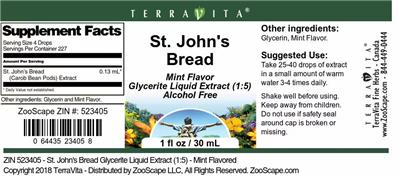
Supplement Facts
The label details for St. John's Bread Mint Flavor by TerraVita, sourced from the NIH Dietary Supplement Label Database.
Supplement Facts
| Ingredient | Amount | % DV |
|---|---|---|
| St. John's Bread Bean Pod Glycerite Liquid Extract | 0.13 mL | -- |
Other ingredients: Glycerin, Mint Flavor
Tap any ingredient to jump to its full detail below.
These statements are the manufacturer’s wording, reproduced from the product label — the label is saying it, not HelloPharmacist. We don’t verify or endorse them.
Brand IP Statement(s)
Copyright 2018 TerraVita - Distributed by ZooScape LLC, All Rights Reserved.
Formula
Glycerite liquid extract (1:5) Mint flavored
Formulation
Alcohol free
Suggested/Recommended/Usage/Directions
Suggested Use: Take 25-40 drops of extract in a small amount of warm water 3-4 times daily. Shake well before using.
Precautions
Keep away from children.
Do not use if safety seal around cap is broken or missing.
Is this label outdated? Report a formula or label change and our pharmacy team will review it.
St. John's Bread Mint Flavor by TerraVita label
The label scan from the NIH Dietary Supplement Label Database. Tap to enlarge.
Label images are published by the NIH Dietary Supplement Label Database for the version of this product on file. Always read your actual product label.
View the full label (PDF)The Ingredients in St. John's Bread Mint Flavor by TerraVita
This is the 1 active ingredient this product is made of. Select it to open its full monograph.
Serving size25 Drop(s) Dosage formLiquid Servings per container227 Amounts shown are per serving.
St. John's Bread Bean Pod Glycerite Liquid Extract
Interacts with2,022 drugs
Carob is a Mediterranean tree whose pods are widely used as a caffeine-free, naturally sweet cocoa alternative and as a thickener (carob gum). It is m...
St. John's Bread Bean Pod Glycerite Liquid Extract monograph & interactionsOther (inactive) ingredients: Glycerin, Mint Flavor. These complete the product’s ingredient list but are not active constituents.
St. John's Bread Mint Flavor by TerraVita Drug Interactions
HelloPharmacist Interaction Report
St.
John's Bread Mint Flavor by TerraVita contains carob, which has a documented minor interaction with oral drugs. Laboratory research shows that carob can reduce how well your body absorbs certain oral medications.
To minimize this effect, take your oral drugs 30–60 minutes before or after this supplement.
Read the full breakdown — every affected drug type, severity by severity
The interaction is thought to work through carob's ability to interfere with absorption in the digestive tract—the same mechanism that also reduces how much of certain minerals your body takes in from food. Altogether, these interactions span 2,023 individual medications.
Because carob is a food ingredient used in many common products, the risk is generally considered low when you're spacing doses properly, but timing matters.
Check your own medications below · Editorial policy · How we use AI
Want to check YOUR meds against St. John's Bread Mint Flavor?
Ask about interactions with your drugs in plain English — “Can I take it with lisinopril?” — and we find you the answer in seconds, ingredient by ingredient.
Go to the checkerIngredients driving the most interactions
Individual Drug Interactions
The ingredients in St. John's Bread Mint Flavor interact with 2,022 drugs. Click any drug to see the details.
1 of the 1 ingredient in St. John's Bread Mint Flavor interact with drugs. Each result below shows which ingredient is responsible. St. John's Bread Bean Pod Glycerite Liquid Extract
"phentolamineOraVerse, Rogitine, Ryzumvi
How "phentolamine interacts with St. John's Bread Mint Flavor — through 1 ingredient. Tap an ingredient for the detail:
St. John's Bread Bean Pod Glycerite Liquid ExtractOral Drugs Minor
Interaction Summary
Theoretically, carob might also impair the absorption of oral drugs.
Read the full St. John's Bread Bean Pod Glycerite Liquid Extract + "phentolamine interaction6-mercaptopurinePurinethol
How 6-mercaptopurine interacts with St. John's Bread Mint Flavor — through 1 ingredient. Tap an ingredient for the detail:
St. John's Bread Bean Pod Glycerite Liquid ExtractOral Drugs Minor
Interaction Summary
Theoretically, carob might also impair the absorption of oral drugs.
Read the full St. John's Bread Bean Pod Glycerite Liquid Extract + 6-mercaptopurine interactionAbacavirZiagen
How Abacavir interacts with St. John's Bread Mint Flavor — through 1 ingredient. Tap an ingredient for the detail:
St. John's Bread Bean Pod Glycerite Liquid ExtractOral Drugs Minor
Interaction Summary
Theoretically, carob might also impair the absorption of oral drugs.
Read the full St. John's Bread Bean Pod Glycerite Liquid Extract + Abacavir interactionAbacavir Sulfate, Dolutegravir, LamivudineTriumeq
How Abacavir Sulfate, Dolutegravir, Lamivudine interacts with St. John's Bread Mint Flavor — through 1 ingredient. Tap an ingredient for the detail:
St. John's Bread Bean Pod Glycerite Liquid ExtractOral Drugs Minor
Interaction Summary
Theoretically, carob might also impair the absorption of oral drugs.
Read the full St. John's Bread Bean Pod Glycerite Liquid Extract + Abacavir Sulfate, Dolutegravir, Lamivudine interactionAbacavir, LamivudineEpzicom
How Abacavir, Lamivudine interacts with St. John's Bread Mint Flavor — through 1 ingredient. Tap an ingredient for the detail:
St. John's Bread Bean Pod Glycerite Liquid ExtractOral Drugs Minor
Interaction Summary
Theoretically, carob might also impair the absorption of oral drugs.
Read the full St. John's Bread Bean Pod Glycerite Liquid Extract + Abacavir, Lamivudine interactionAbciximabReoPro
How Abciximab interacts with St. John's Bread Mint Flavor — through 1 ingredient. Tap an ingredient for the detail:
St. John's Bread Bean Pod Glycerite Liquid ExtractOral Drugs Minor
Interaction Summary
Theoretically, carob might also impair the absorption of oral drugs.
Read the full St. John's Bread Bean Pod Glycerite Liquid Extract + Abciximab interactionAbemaciclibVerzenio
How Abemaciclib interacts with St. John's Bread Mint Flavor — through 1 ingredient. Tap an ingredient for the detail:
St. John's Bread Bean Pod Glycerite Liquid ExtractOral Drugs Minor
Interaction Summary
Theoretically, carob might also impair the absorption of oral drugs.
Read the full St. John's Bread Bean Pod Glycerite Liquid Extract + Abemaciclib interactionAbiraterone
How Abiraterone interacts with St. John's Bread Mint Flavor — through 1 ingredient. Tap an ingredient for the detail:
St. John's Bread Bean Pod Glycerite Liquid ExtractOral Drugs Minor
Interaction Summary
Theoretically, carob might also impair the absorption of oral drugs.
Read the full St. John's Bread Bean Pod Glycerite Liquid Extract + Abiraterone interactionAbiraterone AcetateYonsa, Zytiga
How Abiraterone Acetate interacts with St. John's Bread Mint Flavor — through 1 ingredient. Tap an ingredient for the detail:
St. John's Bread Bean Pod Glycerite Liquid ExtractOral Drugs Minor
Interaction Summary
Theoretically, carob might also impair the absorption of oral drugs.
Read the full St. John's Bread Bean Pod Glycerite Liquid Extract + Abiraterone Acetate interactionAbrocitinibCibinqo
How Abrocitinib interacts with St. John's Bread Mint Flavor — through 1 ingredient. Tap an ingredient for the detail:
St. John's Bread Bean Pod Glycerite Liquid ExtractOral Drugs Minor
Interaction Summary
Theoretically, carob might also impair the absorption of oral drugs.
Read the full St. John's Bread Bean Pod Glycerite Liquid Extract + Abrocitinib interactionAcalabrutinibCalquence
How Acalabrutinib interacts with St. John's Bread Mint Flavor — through 1 ingredient. Tap an ingredient for the detail:
St. John's Bread Bean Pod Glycerite Liquid ExtractOral Drugs Minor
Interaction Summary
Theoretically, carob might also impair the absorption of oral drugs.
Read the full St. John's Bread Bean Pod Glycerite Liquid Extract + Acalabrutinib interactionAcamprosateCampral
How Acamprosate interacts with St. John's Bread Mint Flavor — through 1 ingredient. Tap an ingredient for the detail:
St. John's Bread Bean Pod Glycerite Liquid ExtractOral Drugs Minor
Interaction Summary
Theoretically, carob might also impair the absorption of oral drugs.
Read the full St. John's Bread Bean Pod Glycerite Liquid Extract + Acamprosate interactionAcarboseGlucobay, Prandase, Precose
How Acarbose interacts with St. John's Bread Mint Flavor — through 1 ingredient. Tap an ingredient for the detail:
St. John's Bread Bean Pod Glycerite Liquid ExtractOral Drugs Minor
Interaction Summary
Theoretically, carob might also impair the absorption of oral drugs.
Read the full St. John's Bread Bean Pod Glycerite Liquid Extract + Acarbose interactionAcebutololRhotral, Sectral
How Acebutolol interacts with St. John's Bread Mint Flavor — through 1 ingredient. Tap an ingredient for the detail:
St. John's Bread Bean Pod Glycerite Liquid ExtractOral Drugs Minor
Interaction Summary
Theoretically, carob might also impair the absorption of oral drugs.
Read the full St. John's Bread Bean Pod Glycerite Liquid Extract + Acebutolol interactionAcenocoumarolSintrom
How Acenocoumarol interacts with St. John's Bread Mint Flavor — through 1 ingredient. Tap an ingredient for the detail:
St. John's Bread Bean Pod Glycerite Liquid ExtractOral Drugs Minor
Interaction Summary
Theoretically, carob might also impair the absorption of oral drugs.
Read the full St. John's Bread Bean Pod Glycerite Liquid Extract + Acenocoumarol interactionAcepromazineAtravet
How Acepromazine interacts with St. John's Bread Mint Flavor — through 1 ingredient. Tap an ingredient for the detail:
St. John's Bread Bean Pod Glycerite Liquid ExtractOral Drugs Minor
Interaction Summary
Theoretically, carob might also impair the absorption of oral drugs.
Read the full St. John's Bread Bean Pod Glycerite Liquid Extract + Acepromazine interactionAcetaminophenChildren's Tylenol, Children's Tylenol Meltaways, Tylenol, Tylenol Ex Strength
How Acetaminophen interacts with St. John's Bread Mint Flavor — through 1 ingredient. Tap an ingredient for the detail:
St. John's Bread Bean Pod Glycerite Liquid ExtractOral Drugs Minor
Interaction Summary
Theoretically, carob might also impair the absorption of oral drugs.
Read the full St. John's Bread Bean Pod Glycerite Liquid Extract + Acetaminophen interactionAcetaminophen, AspirinGemnisyn
How Acetaminophen, Aspirin interacts with St. John's Bread Mint Flavor — through 1 ingredient. Tap an ingredient for the detail:
St. John's Bread Bean Pod Glycerite Liquid ExtractOral Drugs Minor
Interaction Summary
Theoretically, carob might also impair the absorption of oral drugs.
Read the full St. John's Bread Bean Pod Glycerite Liquid Extract + Acetaminophen, Aspirin interactionAcetaminophen, Aspirin, CaffeineExcedrin, Excedrin Extra Strength, Excedrin Migraine
How Acetaminophen, Aspirin, Caffeine interacts with St. John's Bread Mint Flavor — through 1 ingredient. Tap an ingredient for the detail:
St. John's Bread Bean Pod Glycerite Liquid ExtractOral Drugs Minor
Interaction Summary
Theoretically, carob might also impair the absorption of oral drugs.
Read the full St. John's Bread Bean Pod Glycerite Liquid Extract + Acetaminophen, Aspirin, Caffeine interactionAcetaminophen, Brompheniramine, PhenylpropanolamineDimetapp Cold and Flu
How Acetaminophen, Brompheniramine, Phenylpropanolamine interacts with St. John's Bread Mint Flavor — through 1 ingredient. Tap an ingredient for the detail:
St. John's Bread Bean Pod Glycerite Liquid ExtractOral Drugs Minor
Interaction Summary
Theoretically, carob might also impair the absorption of oral drugs.
Read the full St. John's Bread Bean Pod Glycerite Liquid Extract + Acetaminophen, Brompheniramine, Phenylpropanolamine interactionAcetaminophen, ButalbitalAxocet, Bancap, Bucet, Butex Forte, Esgic CF, Orbivan CF +5 more
How Acetaminophen, Butalbital interacts with St. John's Bread Mint Flavor — through 1 ingredient. Tap an ingredient for the detail:
St. John's Bread Bean Pod Glycerite Liquid ExtractOral Drugs Minor
Interaction Summary
Theoretically, carob might also impair the absorption of oral drugs.
Read the full St. John's Bread Bean Pod Glycerite Liquid Extract + Acetaminophen, Butalbital interactionAcetaminophen, Butalbital, CaffeineEsgic, Esgic Plus, Fiogesic, Fioricet, Repan, Tecnal +1 more
How Acetaminophen, Butalbital, Caffeine interacts with St. John's Bread Mint Flavor — through 1 ingredient. Tap an ingredient for the detail:
St. John's Bread Bean Pod Glycerite Liquid ExtractOral Drugs Minor
Interaction Summary
Theoretically, carob might also impair the absorption of oral drugs.
Read the full St. John's Bread Bean Pod Glycerite Liquid Extract + Acetaminophen, Butalbital, Caffeine interactionAcetaminophen, Butalbital, Caffeine, CodeineEsgic with Codeine, Fioricet w/ Codeine
How Acetaminophen, Butalbital, Caffeine, Codeine interacts with St. John's Bread Mint Flavor — through 1 ingredient. Tap an ingredient for the detail:
St. John's Bread Bean Pod Glycerite Liquid ExtractOral Drugs Minor
Interaction Summary
Theoretically, carob might also impair the absorption of oral drugs.
Read the full St. John's Bread Bean Pod Glycerite Liquid Extract + Acetaminophen, Butalbital, Caffeine, Codeine interactionAcetaminophen, Butalbital, CodeineBancap w/ Codeine
How Acetaminophen, Butalbital, Codeine interacts with St. John's Bread Mint Flavor — through 1 ingredient. Tap an ingredient for the detail:
St. John's Bread Bean Pod Glycerite Liquid ExtractOral Drugs Minor
Interaction Summary
Theoretically, carob might also impair the absorption of oral drugs.
Read the full St. John's Bread Bean Pod Glycerite Liquid Extract + Acetaminophen, Butalbital, Codeine interactionAcetaminophen, Butalbital, Codeine PhosphatePhrenilin #3
How Acetaminophen, Butalbital, Codeine Phosphate interacts with St. John's Bread Mint Flavor — through 1 ingredient. Tap an ingredient for the detail:
St. John's Bread Bean Pod Glycerite Liquid ExtractOral Drugs Minor
Interaction Summary
Theoretically, carob might also impair the absorption of oral drugs.
Read the full St. John's Bread Bean Pod Glycerite Liquid Extract + Acetaminophen, Butalbital, Codeine Phosphate interactionAcetaminophen, Caffeine, Chlorpheniramine, Hydrocodone, PhenylephrineHycomine Compound
How Acetaminophen, Caffeine, Chlorpheniramine, Hydrocodone, Phenylephrine interacts with St. John's Bread Mint Flavor — through 1 ingredient. Tap an ingredient for the detail:
St. John's Bread Bean Pod Glycerite Liquid ExtractOral Drugs Minor
Interaction Summary
Theoretically, carob might also impair the absorption of oral drugs.
Read the full St. John's Bread Bean Pod Glycerite Liquid Extract + Acetaminophen, Caffeine, Chlorpheniramine, Hydrocodone, Phenylephrine interactionAcetaminophen, Caffeine, CodeineGesic C15, Gesic C30, Gesic C8, Lenoltec 1, Lenoltec 2, Lenoltec 3 +1 more
How Acetaminophen, Caffeine, Codeine interacts with St. John's Bread Mint Flavor — through 1 ingredient. Tap an ingredient for the detail:
St. John's Bread Bean Pod Glycerite Liquid ExtractOral Drugs Minor
Interaction Summary
Theoretically, carob might also impair the absorption of oral drugs.
Read the full St. John's Bread Bean Pod Glycerite Liquid Extract + Acetaminophen, Caffeine, Codeine interactionAcetaminophen, Caffeine, Codeine, SalicylamideCodalan No.1, Codalan No.2, Codalan No.3
How Acetaminophen, Caffeine, Codeine, Salicylamide interacts with St. John's Bread Mint Flavor — through 1 ingredient. Tap an ingredient for the detail:
St. John's Bread Bean Pod Glycerite Liquid ExtractOral Drugs Minor
Interaction Summary
Theoretically, carob might also impair the absorption of oral drugs.
Read the full St. John's Bread Bean Pod Glycerite Liquid Extract + Acetaminophen, Caffeine, Codeine, Salicylamide interactionAcetaminophen, Caffeine, DihydrocodeineDHC Plus, Panlor DC, Panlor SS
How Acetaminophen, Caffeine, Dihydrocodeine interacts with St. John's Bread Mint Flavor — through 1 ingredient. Tap an ingredient for the detail:
St. John's Bread Bean Pod Glycerite Liquid ExtractOral Drugs Minor
Interaction Summary
Theoretically, carob might also impair the absorption of oral drugs.
Read the full St. John's Bread Bean Pod Glycerite Liquid Extract + Acetaminophen, Caffeine, Dihydrocodeine interactionAcetaminophen, Caffeine, IsomethepteneMigralam
How Acetaminophen, Caffeine, Isometheptene interacts with St. John's Bread Mint Flavor — through 1 ingredient. Tap an ingredient for the detail:
St. John's Bread Bean Pod Glycerite Liquid ExtractOral Drugs Minor
Interaction Summary
Theoretically, carob might also impair the absorption of oral drugs.
Read the full St. John's Bread Bean Pod Glycerite Liquid Extract + Acetaminophen, Caffeine, Isometheptene interactionEach ingredient & the kinds of drugs it affects
For each ingredient in St. John's Bread Mint Flavor with known interactions, here are the types of medications it can affect. Open any type for the detail — or search your exact drug in the checker above.
St. John's Bread Bean Pod Glycerite Liquid Extract
Oral Drugs
Theoretically, carob might also impair the absorption of oral drugs.
Laboratory research shows that carob, when consumed as part of the diet or used as a thickening agent in infant formula, reduces the absorption of certain minerals. Take carob 30-60 minutes after oral medications.
Brand information
Manufacturer and brand details for St. John's Bread Mint Flavor, from the product label.
TerraVita
See all TerraVita products- Name
- ZooScape LLC
- Phone Number
- 844-449-0444
- Web Address
- www.ZooScape.com
St. John's Bread Mint Flavor by TerraVita: Common Questions
Does St. John's Bread Mint Flavor by TerraVita interact with any medications?
How can one product interact with so many drugs?
Where does this information come from?
Will this really affect my medications?
Is carob actually safe as a supplement?
Can I take this while pregnant or nursing?
What is carob, and why would I take it?
Can I use this for diarrhea?
Written and reviewed by the HelloPharmacist editorial staff. Our editorial policy
Not sure if St. John's Bread Mint Flavor is safe with your meds?
Our pharmacists answer your medication & supplement questions — free.
Label information is sourced from the NIH Dietary Supplement Label Database and reflects the product version on file; always read your actual product label. This page is for education only and is not a substitute for professional medical advice. Confirm with your pharmacist or doctor before combining supplements and medications.
The Full Monographs Behind St. John's Bread Mint Flavor’s Ingredients
Every ingredient we hold a full HelloPharmacist monograph for — uses, evidence, safety, and the complete interaction list.
Sources & How We Checked
St. John's Bread Mint Flavor's label data comes from the NIH Dietary Supplement Label Database; the ingredient interaction data is from the Natural Medicines database, reviewed by our pharmacists.
- NIH Dietary Supplement Label Database (DSLD) — The official product label on file for this supplement.
- Natural Medicines (Therapeutic Research Center) — Evidence-graded clinical reference behind the ingredient interaction data.
Content is written and reviewed by licensed HelloPharmacist pharmacists. See our data sources and editorial standards for how this information is built and checked.
The 9 references behind this product’s interaction data
Every citation that drives the interaction findings for this product’s ingredients, from the evidence-graded Natural Medicines (TRC Healthcare) database. Open an ingredient to browse its citations — links open the study on PubMed or the publisher’s site.
Carob 9 references
- Savino, F., Muratore, M. C., Silvestro, L., Oggero, R., and Mostert, M. Allergy to carob gum in an infant. J.Pediatr.Gastroenterol.Nutr. 1999;29(4):475-476. DOI
- Bosscher, D., Caillie-Bertrand, M., and Deelstra, H. Effect of thickening agents, based on soluble dietary fiber, on the availability of calcium, iron, and zinc from infant formulas. Nutrition 2001;17(7-8):614-618. PubMed
- van, der Brempt, X, Ledent, C., and Mairesse, M. Rhinitis and asthma caused by occupational exposure to carob bean flour. J.Allergy Clin.Immunol. 1992;90(6 Pt 1):1008-1010. PubMed
- Clarke, P. and Robinson, M. J. Thickening milk feeds may cause necrotising enterocolitis. Arch Dis.Child Fetal Neonatal Ed 2004;89(3):F280. PubMed
- Harmuth-Hoene, A. E. and Schelenz, R. Effect of dietary fiber on mineral absorption in growing rats. J Nutr 1980;110(9):1774-1784. PubMed
- Scoditti, A., Peluso, P., Pezzuto, R., Giordano, T., and Melica, A. Asthma to carob bean flour. Ann.Allergy Asthma Immunol. 1996;77(1):81. PubMed
- Komericki P, Kränke B. Immediate hypersensitivity to carob pods. Contact Dermatitis. 2009;61(4):239-40. PubMed
- Bosscher D, Van Caillie-Bertrand M, Van Cauwenbergh R, Deelstra H. Availabilities of calcium, iron, and zinc from dairy infant formulas is affected by soluble dietary fibers and modified starch fractions. Nutrition. 2003;19(7-8):641-5. PubMed
- Jedrzejczyk M, Bartnik K, Funkowicz M, Toporowska-Kowalska E. FPIES Induced by Locust Bean Gum in an Infant. J Investig Allergol Clin Immunol. 2020;30(3):197-199. PubMed
Parts of this content are provided by the Therapeutic Research Center, LLC.
DISCLAIMER: Currently this does not check for drug-drug interactions. This is not an all-inclusive comprehensive list of potential interactions and is for informational purposes only. Not all interactions are known or well-reported in the scientific literature, and new interactions are continually being reported. Input is needed from a qualified healthcare provider including a pharmacist before starting any therapy. Application of clinical judgment is necessary.
© 2021 Therapeutic Research Center, LLC