
Stone Breaker Ingredients & Drug Interactions
by Herb Pharm
What is this page for?
First and foremost: checking Stone Breaker against your medications. The heart of this page is the interaction checker and the full interaction report — how this product’s ingredients may interact with prescription and over-the-counter medicines you may be taking.
Around that, we add a pharmacist’s high-level view of the product as a whole — what’s inside, the evidence for its stated use, how transparent the label is, and what safety data exists — so you can see the full picture in one place. It’s educational information from our licensed clinical databases and the clinical staff at HelloPharmacist — not medical advice — and we don’t sell or endorse products. Our editorial policy
Stone Breaker is a dietary supplement by Herb Pharm with 5 active ingredients. Its ingredients are commonly taken for kidney stones, gallstones, liver support.Based on those ingredients, 1,266 medications have a known interaction with it, the most serious rated moderate. The ingredients most likely to interact are Chanca Piedra Aerial Parts Extract, Khella Seed Extract, Juniper Berry Extract. Use the checker below to test your specific medication, or read the full HelloPharmacist Interaction Report.
Check Your Meds Against Stone Breaker by Herb Pharm
Ask about any prescription or over-the-counter medication and we check it for interactions with Stone Breaker by Herb Pharm — and tell you which ingredient is responsible.
AI summaries are generated from our interaction database for education only — always confirm with your pharmacist. How we use AI
Ask the Pharmacist
A licensed pharmacist will answer your question by email — free, usually within 24 hours.
Got it — thank you!
A licensed pharmacist will answer within 24 hours. Keep an eye on your email (worth checking spam, just in case).
HelloPharmacist Scorecard of Stone Breaker by Herb Pharm
Our pharmacy team’s full take, with four database checks built into the cards below — a summary of what is known, not a grade of the product itself.
What’s inside
Low disclosure
Stone Breaker contains five active herbal extracts in a liquid base of cane alcohol and distilled water. The main ingredients are chanca piedra (the aerial parts), burdock seed, juniper berry, khella seed, and hydrangea root — each added for traditional uses in supporting kidney and urinary health, though their effectiveness varies.
Does it work?
Moderate evidence
The evidence we hold shows chanca piedra is possibly effective for kidney stones; that's the main claim behind this product. For the other conditions in our data — hepatitis B (rated likely ineffective for chanca piedra), and various others like benign prostate enlargement and anemia — the evidence is insufficient or the ingredient hasn't been studied.
The effectiveness of burdock, juniper, khella, and hydrangea for any of their traditional uses isn't established in the data we hold.
How safe is it?
Well-documented data
Chanca piedra, burdock, juniper, and khella are generally tolerated in the short term, though thorough safety testing is limited for each. The main side effects reported with chanca piedra are abdominal pain, nausea, and vomiting; burdock is well tolerated as a food but rare allergic reactions including anaphylaxis have been noted; juniper may irritate the kidneys with long-term or high-dose use; khella can cause nausea, dizziness, constipation, headache, and in some cases elevated liver enzymes and photosensitivity.
Hydrangea may cause dizziness, tightness in the chest, or gastroenteritis. Pregnancy and breastfeeding safety data are insufficient or advise against use — chanca piedra is rated possibly unsafe in pregnancy; juniper is rated unsafe; khella is rated likely unsafe; and burdock, juniper, khella, and hydrangea should be avoided while breastfeeding.
Meds to double-check
Moderate interaction found
Check with your pharmacist if you take blood thinners or antiplatelet drugs like warfarin or aspirin (Moderate risk of bleeding). Also double-check diabetes medications, water pills (diuretics), lithium, norepinephrine, digoxin, liver-metabolized drugs, light-sensitizing antibiotics (such as quinolones or tetracyclines), and any drug that affects the liver.
No interactions are documented in our data for hydrangea beyond lithium.
The bottom line
Scorecard at a glanceFormula with limited ingredient disclosure with some supporting evidence for its stated purpose. Moderate medication interactions have been identified, and safety information is well characterized.
Stone Breaker may appeal to someone looking for herbal support for kidney stones, since chanca piedra shows some promise there. However, if you take blood thinners, diabetes medications, diuretics, lithium, heart medications, or light-sensitive antibiotics, you need to check this with your pharmacist first.
Avoid during pregnancy and while breastfeeding. Talk to your pharmacist before starting, especially if you're on any prescription medication.
Educational only — not medical advice; always confirm with your pharmacist. Our editorial policy · How we use AI
Assessment coverage: 5 of 5 active ingredients matched to our full ingredient reviews (monographs). Based on the product label dated Aug 22, 2025.
This Scorecard evaluates available label information, ingredient evidence, and known medication-safety considerations. It does not independently verify product identity, purity, potency, contamination, or manufacturing quality. How these ratings are computed
General information
Key facts about Stone Breaker, straight from the product label.
| Brand | Herb Pharm |
|---|---|
| Barcode (UPC) | 090900000309 |
| Net contents | 1 Fluid Ounce(s); 30 mL |
| Market status | On market |
| Date entered into DSLD | Aug 22, 2025 |
| DSLD ID | 336576 |
| Product type | Botanical |
| Supplement form | Liquid |
| Dietary claims / uses | All Other, Structure/Function |
| Intended target group(s) | Adult (18 - 50 Years), Gluten Free |
Everything in this section is reproduced from the manufacturer’s own product label — it’s the label speaking, not HelloPharmacist. We show it so you can see exactly what the maker states; we don’t verify or endorse those statements.
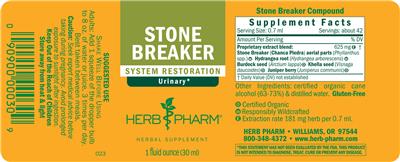
Supplement Facts
The label details for Stone Breaker by Herb Pharm, sourced from the NIH Dietary Supplement Label Database.
Supplement Facts
| Ingredient | Amount | % DV |
|---|---|---|
| Proprietary Extract Blend | 625 mg | -- |
| Chanca Piedra Aerial Parts Extract | 0 NP | -- |
| Burdock Seed Extract | 0 NP | -- |
| Juniper Berry Extract | 0 NP | -- |
| Khella Seed Extract | 0 NP | -- |
| Hydrangea Root Extract | 0 NP | -- |
Other ingredients: Cane Alcohol, Water, Distilled
Tap any ingredient to jump to its full detail below.
These statements are the manufacturer’s wording, reproduced from the product label — the label is saying it, not HelloPharmacist. We don’t verify or endorse them.
Suggested/Recommended/Usage/Directions
Suggested use Shake well before using Adults: Add 1 squeeze of the dropper bulb to 8 oz. of water or juice, 3 times per day. Best taken between meals.
Precautions
Caution: Seek expert medical advice before taking during pregnancy.
Keep out of the reach of children
Storage
Store away from heat & light
Formulation
System restoration Urinary
Gluten-free
FDA Statement of Identity
Herbal Supplement
Formula
Stone breaker compound
FDA Disclaimer Statement
This statement has not been evaluated by the FDA. This product is not intended to diagnose, treat, cure or prevent any disease.
Is this label outdated? Report a formula or label change and our pharmacy team will review it.
Stone Breaker by Herb Pharm label
The label scan from the NIH Dietary Supplement Label Database. Tap to enlarge.
Label images are published by the NIH Dietary Supplement Label Database for the version of this product on file. Always read your actual product label.
View the full label (PDF)The Ingredients in Stone Breaker by Herb Pharm
These are the 5 active ingredients this product is made of. Select any to open its full monograph.
Serving size0.7 mL Dosage formLiquid Servings per container42 Amounts shown are per serving.
Most supplement products combine several ingredients, and a medication can interact with the product through any one of them. Each ingredient below shows whether it has known drug interactions.
Proprietary Extract Blend
Other (inactive) ingredients: Cane Alcohol, Water, Distilled. These complete the product’s ingredient list but are not active constituents.
Stone Breaker by Herb Pharm Drug Interactions
HelloPharmacist Interaction Report
Stone Breaker by Herb Pharm is a five-ingredient herbal liquid with documented interactions spanning multiple medication types.
The most serious concern is chanca piedra, which theoretically increases bleeding risk when combined with blood thinners and antiplatelet drugs (such as warfarin or aspirin) — this is rated Moderate severity and stems from lab evidence that one of chanca piedra's compounds can slow blood clotting, though no human cases have been reported.
Read the full breakdown — every affected drug type, severity by severity
Chanca piedra also interacts with water pills (diuretics), lithium, norepinephrine (a heart medication), and a large class of liver-metabolized drugs called CYP1A2 and CYP3A4 substrates — all Moderate severity. Burdock seed theoretically increases bleeding risk alongside blood thinners.
Juniper berry may add to the blood-sugar-lowering effect of diabetes medications (Moderate) and may interact with diuretics and lithium (both Minor). Khella seed theoretically worsens photosensitivity with certain antibiotics and other light-sensitizing drugs, and may reduce the effect of digoxin (a heart medication), both Moderate.
Hydrangea root may increase lithium levels if you take that medication (Moderate).
Additionally, we could not check burdock seed for a complete interaction profile beyond blood thinners; the facts we hold are limited to that category. Altogether, these interactions span 1,246 individual medications.
Check your exact prescriptions and over-the-counter drugs with the tool on this page before starting.
Check your own medications below · Editorial policy · How we use AI
Want to check YOUR meds against Stone Breaker?
Ask about interactions with your drugs in plain English — “Can I take it with lisinopril?” — and we find you the answer in seconds, ingredient by ingredient.
Go to the checkerIngredients driving the most interactions
Individual Drug Interactions
The ingredients in Stone Breaker interact with 1,266 drugs. Click any drug to see the details.
5 of the 5 ingredients in Stone Breaker interact with drugs. Each result below shows which ingredient is responsible. Chanca Piedra Aerial Parts Extract Khella Seed Extract Juniper Berry Extract Burdock Seed Extract Hydrangea Root Extract
Acetaminophen, Chlorpheniramine, Codeine, PhenylephrineColrex
How Acetaminophen, Chlorpheniramine, Codeine, Phenylephrine interacts with Stone Breaker — through 2 ingredients. Tap an ingredient for the detail:
Chanca Piedra Aerial Parts ExtractCytochrome P450 3a4 (cyp3a4) Substrates, Cytochrome P450 1a2 (cyp1a2) Substrates Moderate
Interaction Summary
Theoretically, use of chanca piedra might increase the levels and clinical effects of CYP3A4 substrates.
Read the full Chanca Piedra Aerial Parts Extract + Acetaminophen, Chlorpheniramine, Codeine, Phenylephrine interactionKhella Seed ExtractHepatotoxic Drugs, Photosensitizing Drugs Moderate
Interaction Summary
Theoretically, khella might have additive adverse effects on the liver when used with hepatotoxic drugs.
Read the full Khella Seed Extract + Acetaminophen, Chlorpheniramine, Codeine, Phenylephrine interactionAcetaminophen, Chlorpheniramine, DextromethorphanCoricidin II Extra Strength Cold and Flu
How Acetaminophen, Chlorpheniramine, Dextromethorphan interacts with Stone Breaker — through 2 ingredients. Tap an ingredient for the detail:
Chanca Piedra Aerial Parts ExtractCytochrome P450 1a2 (cyp1a2) Substrates, Cytochrome P450 3a4 (cyp3a4) Substrates Moderate
Interaction Summary
Theoretically, chanca piedra might reduce the levels and clinical effects of CYP1A2 substrates.
Read the full Chanca Piedra Aerial Parts Extract + Acetaminophen, Chlorpheniramine, Dextromethorphan interactionKhella Seed ExtractPhotosensitizing Drugs, Hepatotoxic Drugs Moderate
Interaction Summary
Theoretically, concomitant use might result in increased photosensitivity.
Read the full Khella Seed Extract + Acetaminophen, Chlorpheniramine, Dextromethorphan interactionAcetaminophen, Chlorpheniramine, Dextromethorphan HydrobromideCoricidin HBP Maximum Strength Flu
How Acetaminophen, Chlorpheniramine, Dextromethorphan Hydrobromide interacts with Stone Breaker — through 2 ingredients. Tap an ingredient for the detail:
Khella Seed ExtractHepatotoxic Drugs, Photosensitizing Drugs Moderate
Interaction Summary
Theoretically, khella might have additive adverse effects on the liver when used with hepatotoxic drugs.
Read the full Khella Seed Extract + Acetaminophen, Chlorpheniramine, Dextromethorphan Hydrobromide interactionChanca Piedra Aerial Parts ExtractCytochrome P450 1a2 (cyp1a2) Substrates, Cytochrome P450 3a4 (cyp3a4) Substrates Moderate
Interaction Summary
Theoretically, chanca piedra might reduce the levels and clinical effects of CYP1A2 substrates.
Read the full Chanca Piedra Aerial Parts Extract + Acetaminophen, Chlorpheniramine, Dextromethorphan Hydrobromide interactionAcetaminophen, Chlorpheniramine, Dextromethorphan, PhenylpropanolamineMulti Symptom Cold Relief
How Acetaminophen, Chlorpheniramine, Dextromethorphan, Phenylpropanolamine interacts with Stone Breaker — through 2 ingredients. Tap an ingredient for the detail:
Khella Seed ExtractPhotosensitizing Drugs, Hepatotoxic Drugs Moderate
Interaction Summary
Theoretically, concomitant use might result in increased photosensitivity.
Read the full Khella Seed Extract + Acetaminophen, Chlorpheniramine, Dextromethorphan, Phenylpropanolamine interactionChanca Piedra Aerial Parts ExtractCytochrome P450 1a2 (cyp1a2) Substrates, Cytochrome P450 3a4 (cyp3a4) Substrates Moderate
Interaction Summary
Theoretically, chanca piedra might reduce the levels and clinical effects of CYP1A2 substrates.
Read the full Chanca Piedra Aerial Parts Extract + Acetaminophen, Chlorpheniramine, Dextromethorphan, Phenylpropanolamine interactionAcetaminophen, Chlorpheniramine, Dextromethorphan, PseudoephedrineChildren's Tylenol Cold Plus Cough, Tylenol Cold Ex Strength
How Acetaminophen, Chlorpheniramine, Dextromethorphan, Pseudoephedrine interacts with Stone Breaker — through 2 ingredients. Tap an ingredient for the detail:
Chanca Piedra Aerial Parts ExtractCytochrome P450 3a4 (cyp3a4) Substrates, Cytochrome P450 1a2 (cyp1a2) Substrates Moderate
Interaction Summary
Theoretically, use of chanca piedra might increase the levels and clinical effects of CYP3A4 substrates.
Read the full Chanca Piedra Aerial Parts Extract + Acetaminophen, Chlorpheniramine, Dextromethorphan, Pseudoephedrine interactionKhella Seed ExtractPhotosensitizing Drugs, Hepatotoxic Drugs Moderate
Interaction Summary
Theoretically, concomitant use might result in increased photosensitivity.
Read the full Khella Seed Extract + Acetaminophen, Chlorpheniramine, Dextromethorphan, Pseudoephedrine interactionAcetaminophen, Chlorpheniramine, Guaifenesin, Phenylephrine, SalicylamideRhinogesic GG
How Acetaminophen, Chlorpheniramine, Guaifenesin, Phenylephrine, Salicylamide interacts with Stone Breaker — through 2 ingredients. Tap an ingredient for the detail:
Chanca Piedra Aerial Parts ExtractCytochrome P450 3a4 (cyp3a4) Substrates, Cytochrome P450 1a2 (cyp1a2) Substrates Moderate
Interaction Summary
Theoretically, use of chanca piedra might increase the levels and clinical effects of CYP3A4 substrates.
Read the full Chanca Piedra Aerial Parts Extract + Acetaminophen, Chlorpheniramine, Guaifenesin, Phenylephrine, Salicylamide interactionKhella Seed ExtractHepatotoxic Drugs, Photosensitizing Drugs Moderate
Interaction Summary
Theoretically, khella might have additive adverse effects on the liver when used with hepatotoxic drugs.
Read the full Khella Seed Extract + Acetaminophen, Chlorpheniramine, Guaifenesin, Phenylephrine, Salicylamide interactionAcetaminophen, Chlorpheniramine, PhenylephrineAlka-Seltzer PLUS, Histex SR, Protid
How Acetaminophen, Chlorpheniramine, Phenylephrine interacts with Stone Breaker — through 2 ingredients. Tap an ingredient for the detail:
Chanca Piedra Aerial Parts ExtractCytochrome P450 3a4 (cyp3a4) Substrates, Cytochrome P450 1a2 (cyp1a2) Substrates Moderate
Interaction Summary
Theoretically, use of chanca piedra might increase the levels and clinical effects of CYP3A4 substrates.
Read the full Chanca Piedra Aerial Parts Extract + Acetaminophen, Chlorpheniramine, Phenylephrine interactionKhella Seed ExtractHepatotoxic Drugs, Photosensitizing Drugs Moderate
Interaction Summary
Theoretically, khella might have additive adverse effects on the liver when used with hepatotoxic drugs.
Read the full Khella Seed Extract + Acetaminophen, Chlorpheniramine, Phenylephrine interactionAcetaminophen, Chlorpheniramine, Phenylephrine, SalicylamideRhinogesic, Rhinogesic JR
How Acetaminophen, Chlorpheniramine, Phenylephrine, Salicylamide interacts with Stone Breaker — through 2 ingredients. Tap an ingredient for the detail:
Chanca Piedra Aerial Parts ExtractCytochrome P450 1a2 (cyp1a2) Substrates, Cytochrome P450 3a4 (cyp3a4) Substrates Moderate
Interaction Summary
Theoretically, chanca piedra might reduce the levels and clinical effects of CYP1A2 substrates.
Read the full Chanca Piedra Aerial Parts Extract + Acetaminophen, Chlorpheniramine, Phenylephrine, Salicylamide interactionKhella Seed ExtractPhotosensitizing Drugs, Hepatotoxic Drugs Moderate
Interaction Summary
Theoretically, concomitant use might result in increased photosensitivity.
Read the full Khella Seed Extract + Acetaminophen, Chlorpheniramine, Phenylephrine, Salicylamide interactionAcetaminophen, Chlorpheniramine, PhenylpropanolamineAlumadrine, Conex, Sinadrin Max Strength, Sinulin
How Acetaminophen, Chlorpheniramine, Phenylpropanolamine interacts with Stone Breaker — through 2 ingredients. Tap an ingredient for the detail:
Chanca Piedra Aerial Parts ExtractCytochrome P450 3a4 (cyp3a4) Substrates, Cytochrome P450 1a2 (cyp1a2) Substrates Moderate
Interaction Summary
Theoretically, use of chanca piedra might increase the levels and clinical effects of CYP3A4 substrates.
Read the full Chanca Piedra Aerial Parts Extract + Acetaminophen, Chlorpheniramine, Phenylpropanolamine interactionKhella Seed ExtractPhotosensitizing Drugs, Hepatotoxic Drugs Moderate
Interaction Summary
Theoretically, concomitant use might result in increased photosensitivity.
Read the full Khella Seed Extract + Acetaminophen, Chlorpheniramine, Phenylpropanolamine interactionAcetaminophen, Chlorpheniramine, Phenylpropanolamine, OpiumHista-Derfule
How Acetaminophen, Chlorpheniramine, Phenylpropanolamine, Opium interacts with Stone Breaker — through 2 ingredients. Tap an ingredient for the detail:
Khella Seed ExtractHepatotoxic Drugs, Photosensitizing Drugs Moderate
Interaction Summary
Theoretically, khella might have additive adverse effects on the liver when used with hepatotoxic drugs.
Read the full Khella Seed Extract + Acetaminophen, Chlorpheniramine, Phenylpropanolamine, Opium interactionChanca Piedra Aerial Parts ExtractCytochrome P450 3a4 (cyp3a4) Substrates, Cytochrome P450 1a2 (cyp1a2) Substrates Moderate
Interaction Summary
Theoretically, use of chanca piedra might increase the levels and clinical effects of CYP3A4 substrates.
Read the full Chanca Piedra Aerial Parts Extract + Acetaminophen, Chlorpheniramine, Phenylpropanolamine, Opium interactionAcetaminophen, Chlorpheniramine, Phenylpropanolamine, PhenyltoloxamineNorel Plus
How Acetaminophen, Chlorpheniramine, Phenylpropanolamine, Phenyltoloxamine interacts with Stone Breaker — through 2 ingredients. Tap an ingredient for the detail:
Chanca Piedra Aerial Parts ExtractCytochrome P450 1a2 (cyp1a2) Substrates, Cytochrome P450 3a4 (cyp3a4) Substrates Moderate
Interaction Summary
Theoretically, chanca piedra might reduce the levels and clinical effects of CYP1A2 substrates.
Read the full Chanca Piedra Aerial Parts Extract + Acetaminophen, Chlorpheniramine, Phenylpropanolamine, Phenyltoloxamine interactionKhella Seed ExtractHepatotoxic Drugs, Photosensitizing Drugs Moderate
Interaction Summary
Theoretically, khella might have additive adverse effects on the liver when used with hepatotoxic drugs.
Read the full Khella Seed Extract + Acetaminophen, Chlorpheniramine, Phenylpropanolamine, Phenyltoloxamine interactionAcetaminophen, Chlorpheniramine, PseudoephedrineAlka-Seltzer PLUS Liquid Gels, Children's Tylenol Cold, Codimal, Comtrex, Extra Strength Tylenol Allergy Sinus, Lorsin +3 more
How Acetaminophen, Chlorpheniramine, Pseudoephedrine interacts with Stone Breaker — through 2 ingredients. Tap an ingredient for the detail:
Chanca Piedra Aerial Parts ExtractCytochrome P450 3a4 (cyp3a4) Substrates, Cytochrome P450 1a2 (cyp1a2) Substrates Moderate
Interaction Summary
Theoretically, use of chanca piedra might increase the levels and clinical effects of CYP3A4 substrates.
Read the full Chanca Piedra Aerial Parts Extract + Acetaminophen, Chlorpheniramine, Pseudoephedrine interactionKhella Seed ExtractPhotosensitizing Drugs, Hepatotoxic Drugs Moderate
Interaction Summary
Theoretically, concomitant use might result in increased photosensitivity.
Read the full Khella Seed Extract + Acetaminophen, Chlorpheniramine, Pseudoephedrine interactionAcetaminophen, ChlorzoxazoneAcetazone Forte, Extra Strength Tylenol Aches & Strains, Parafon Forte
How Acetaminophen, Chlorzoxazone interacts with Stone Breaker — through 2 ingredients. Tap an ingredient for the detail:
Khella Seed ExtractHepatotoxic Drugs Moderate
Interaction Summary
Theoretically, khella might have additive adverse effects on the liver when used with hepatotoxic drugs.
Read the full Khella Seed Extract + Acetaminophen, Chlorzoxazone interactionChanca Piedra Aerial Parts ExtractCytochrome P450 1a2 (cyp1a2) Substrates Moderate
Interaction Summary
Theoretically, chanca piedra might reduce the levels and clinical effects of CYP1A2 substrates.
Read the full Chanca Piedra Aerial Parts Extract + Acetaminophen, Chlorzoxazone interactionAcetaminophen, Chlorzoxazone, CodeineAcetazone Forte C8, Parafon Forte C8
How Acetaminophen, Chlorzoxazone, Codeine interacts with Stone Breaker — through 2 ingredients. Tap an ingredient for the detail:
Chanca Piedra Aerial Parts ExtractCytochrome P450 1a2 (cyp1a2) Substrates Moderate
Interaction Summary
Theoretically, chanca piedra might reduce the levels and clinical effects of CYP1A2 substrates.
Read the full Chanca Piedra Aerial Parts Extract + Acetaminophen, Chlorzoxazone, Codeine interactionKhella Seed ExtractHepatotoxic Drugs Moderate
Interaction Summary
Theoretically, khella might have additive adverse effects on the liver when used with hepatotoxic drugs.
Read the full Khella Seed Extract + Acetaminophen, Chlorzoxazone, Codeine interactionAcetaminophen, CodeineTylenol No.3, Tylenol w/ Codeine
How Acetaminophen, Codeine interacts with Stone Breaker — through 2 ingredients. Tap an ingredient for the detail:
Khella Seed ExtractHepatotoxic Drugs Moderate
Interaction Summary
Theoretically, khella might have additive adverse effects on the liver when used with hepatotoxic drugs.
Read the full Khella Seed Extract + Acetaminophen, Codeine interactionChanca Piedra Aerial Parts ExtractCytochrome P450 1a2 (cyp1a2) Substrates Moderate
Interaction Summary
Theoretically, chanca piedra might reduce the levels and clinical effects of CYP1A2 substrates.
Read the full Chanca Piedra Aerial Parts Extract + Acetaminophen, Codeine interactionAcetaminophen, Codeine, DoxylamineMersyndol
How Acetaminophen, Codeine, Doxylamine interacts with Stone Breaker — through 2 ingredients. Tap an ingredient for the detail:
Chanca Piedra Aerial Parts ExtractCytochrome P450 1a2 (cyp1a2) Substrates Moderate
Interaction Summary
Theoretically, chanca piedra might reduce the levels and clinical effects of CYP1A2 substrates.
Read the full Chanca Piedra Aerial Parts Extract + Acetaminophen, Codeine, Doxylamine interactionKhella Seed ExtractHepatotoxic Drugs Moderate
Interaction Summary
Theoretically, khella might have additive adverse effects on the liver when used with hepatotoxic drugs.
Read the full Khella Seed Extract + Acetaminophen, Codeine, Doxylamine interactionAcetaminophen, Codeine, MethocarbamolAcetaminophen, Codeine, Methocarbamol, Robaxacet 8
How Acetaminophen, Codeine, Methocarbamol interacts with Stone Breaker — through 2 ingredients. Tap an ingredient for the detail:
Khella Seed ExtractHepatotoxic Drugs Moderate
Interaction Summary
Theoretically, khella might have additive adverse effects on the liver when used with hepatotoxic drugs.
Read the full Khella Seed Extract + Acetaminophen, Codeine, Methocarbamol interactionChanca Piedra Aerial Parts ExtractCytochrome P450 1a2 (cyp1a2) Substrates Moderate
Interaction Summary
Theoretically, chanca piedra might reduce the levels and clinical effects of CYP1A2 substrates.
Read the full Chanca Piedra Aerial Parts Extract + Acetaminophen, Codeine, Methocarbamol interactionAcetaminophen, Dexbrompheniramine, PseudoephedrineSinadrin Plus
How Acetaminophen, Dexbrompheniramine, Pseudoephedrine interacts with Stone Breaker — through 2 ingredients. Tap an ingredient for the detail:
Chanca Piedra Aerial Parts ExtractCytochrome P450 1a2 (cyp1a2) Substrates Moderate
Interaction Summary
Theoretically, chanca piedra might reduce the levels and clinical effects of CYP1A2 substrates.
Read the full Chanca Piedra Aerial Parts Extract + Acetaminophen, Dexbrompheniramine, Pseudoephedrine interactionKhella Seed ExtractHepatotoxic Drugs, Photosensitizing Drugs Moderate
Interaction Summary
Theoretically, khella might have additive adverse effects on the liver when used with hepatotoxic drugs.
Read the full Khella Seed Extract + Acetaminophen, Dexbrompheniramine, Pseudoephedrine interactionAcetaminophen, DextromethorphanTylenol Cough Ex Strength
How Acetaminophen, Dextromethorphan interacts with Stone Breaker — through 2 ingredients. Tap an ingredient for the detail:
Chanca Piedra Aerial Parts ExtractCytochrome P450 3a4 (cyp3a4) Substrates, Cytochrome P450 1a2 (cyp1a2) Substrates Moderate
Interaction Summary
Theoretically, use of chanca piedra might increase the levels and clinical effects of CYP3A4 substrates.
Read the full Chanca Piedra Aerial Parts Extract + Acetaminophen, Dextromethorphan interactionKhella Seed ExtractHepatotoxic Drugs Moderate
Interaction Summary
Theoretically, khella might have additive adverse effects on the liver when used with hepatotoxic drugs.
Read the full Khella Seed Extract + Acetaminophen, Dextromethorphan interactionAcetaminophen, Dextromethorphan, Doxylamine, PseudoephedrineVicks NyQuil
How Acetaminophen, Dextromethorphan, Doxylamine, Pseudoephedrine interacts with Stone Breaker — through 2 ingredients. Tap an ingredient for the detail:
Khella Seed ExtractHepatotoxic Drugs Moderate
Interaction Summary
Theoretically, khella might have additive adverse effects on the liver when used with hepatotoxic drugs.
Read the full Khella Seed Extract + Acetaminophen, Dextromethorphan, Doxylamine, Pseudoephedrine interactionChanca Piedra Aerial Parts ExtractCytochrome P450 3a4 (cyp3a4) Substrates, Cytochrome P450 1a2 (cyp1a2) Substrates Moderate
Interaction Summary
Theoretically, use of chanca piedra might increase the levels and clinical effects of CYP3A4 substrates.
Read the full Chanca Piedra Aerial Parts Extract + Acetaminophen, Dextromethorphan, Doxylamine, Pseudoephedrine interactionAcetaminophen, Dextromethorphan, Guaifenesin, PhenylephrineConar-A
How Acetaminophen, Dextromethorphan, Guaifenesin, Phenylephrine interacts with Stone Breaker — through 2 ingredients. Tap an ingredient for the detail:
Chanca Piedra Aerial Parts ExtractCytochrome P450 1a2 (cyp1a2) Substrates, Cytochrome P450 3a4 (cyp3a4) Substrates Moderate
Interaction Summary
Theoretically, chanca piedra might reduce the levels and clinical effects of CYP1A2 substrates.
Read the full Chanca Piedra Aerial Parts Extract + Acetaminophen, Dextromethorphan, Guaifenesin, Phenylephrine interactionKhella Seed ExtractHepatotoxic Drugs Moderate
Interaction Summary
Theoretically, khella might have additive adverse effects on the liver when used with hepatotoxic drugs.
Read the full Khella Seed Extract + Acetaminophen, Dextromethorphan, Guaifenesin, Phenylephrine interactionAcetaminophen, Dextromethorphan, Guaifenesin, PhenylpropanolamineAnatuss
How Acetaminophen, Dextromethorphan, Guaifenesin, Phenylpropanolamine interacts with Stone Breaker — through 2 ingredients. Tap an ingredient for the detail:
Chanca Piedra Aerial Parts ExtractCytochrome P450 1a2 (cyp1a2) Substrates, Cytochrome P450 3a4 (cyp3a4) Substrates Moderate
Interaction Summary
Theoretically, chanca piedra might reduce the levels and clinical effects of CYP1A2 substrates.
Read the full Chanca Piedra Aerial Parts Extract + Acetaminophen, Dextromethorphan, Guaifenesin, Phenylpropanolamine interactionKhella Seed ExtractHepatotoxic Drugs Moderate
Interaction Summary
Theoretically, khella might have additive adverse effects on the liver when used with hepatotoxic drugs.
Read the full Khella Seed Extract + Acetaminophen, Dextromethorphan, Guaifenesin, Phenylpropanolamine interactionAcetaminophen, Dextromethorphan, Guaifenesin, PseudoephedrineRobitussin Cold, Severe Cold, Suphedrine Cold/Cough
How Acetaminophen, Dextromethorphan, Guaifenesin, Pseudoephedrine interacts with Stone Breaker — through 2 ingredients. Tap an ingredient for the detail:
Khella Seed ExtractHepatotoxic Drugs Moderate
Interaction Summary
Theoretically, khella might have additive adverse effects on the liver when used with hepatotoxic drugs.
Read the full Khella Seed Extract + Acetaminophen, Dextromethorphan, Guaifenesin, Pseudoephedrine interactionChanca Piedra Aerial Parts ExtractCytochrome P450 3a4 (cyp3a4) Substrates, Cytochrome P450 1a2 (cyp1a2) Substrates Moderate
Interaction Summary
Theoretically, use of chanca piedra might increase the levels and clinical effects of CYP3A4 substrates.
Read the full Chanca Piedra Aerial Parts Extract + Acetaminophen, Dextromethorphan, Guaifenesin, Pseudoephedrine interactionAcetaminophen, Dextromethorphan, Phenylpropanolamine, PyrilamineTheracaps
How Acetaminophen, Dextromethorphan, Phenylpropanolamine, Pyrilamine interacts with Stone Breaker — through 2 ingredients. Tap an ingredient for the detail:
Chanca Piedra Aerial Parts ExtractCytochrome P450 1a2 (cyp1a2) Substrates, Cytochrome P450 3a4 (cyp3a4) Substrates Moderate
Interaction Summary
Theoretically, chanca piedra might reduce the levels and clinical effects of CYP1A2 substrates.
Read the full Chanca Piedra Aerial Parts Extract + Acetaminophen, Dextromethorphan, Phenylpropanolamine, Pyrilamine interactionKhella Seed ExtractHepatotoxic Drugs Moderate
Interaction Summary
Theoretically, khella might have additive adverse effects on the liver when used with hepatotoxic drugs.
Read the full Khella Seed Extract + Acetaminophen, Dextromethorphan, Phenylpropanolamine, Pyrilamine interactionAcetaminophen, Dextromethorphan, PseudoephedrineAlka-Seltzer PLUS Flu Liquid Gels, Non Aspirin Cold Caps, Tylenol Cold, Tylenol Flu Daytime Ex Strength, Tylenol Flu Ex Strength
How Acetaminophen, Dextromethorphan, Pseudoephedrine interacts with Stone Breaker — through 2 ingredients. Tap an ingredient for the detail:
Khella Seed ExtractHepatotoxic Drugs Moderate
Interaction Summary
Theoretically, khella might have additive adverse effects on the liver when used with hepatotoxic drugs.
Read the full Khella Seed Extract + Acetaminophen, Dextromethorphan, Pseudoephedrine interactionChanca Piedra Aerial Parts ExtractCytochrome P450 3a4 (cyp3a4) Substrates, Cytochrome P450 1a2 (cyp1a2) Substrates Moderate
Interaction Summary
Theoretically, use of chanca piedra might increase the levels and clinical effects of CYP3A4 substrates.
Read the full Chanca Piedra Aerial Parts Extract + Acetaminophen, Dextromethorphan, Pseudoephedrine interactionAcetaminophen, Dichloralantipyrine, IsomethepteneAmidrine, Midchlor, Migquin, Migratine
How Acetaminophen, Dichloralantipyrine, Isometheptene interacts with Stone Breaker — through 2 ingredients. Tap an ingredient for the detail:
Chanca Piedra Aerial Parts ExtractCytochrome P450 1a2 (cyp1a2) Substrates Moderate
Interaction Summary
Theoretically, chanca piedra might reduce the levels and clinical effects of CYP1A2 substrates.
Read the full Chanca Piedra Aerial Parts Extract + Acetaminophen, Dichloralantipyrine, Isometheptene interactionKhella Seed ExtractHepatotoxic Drugs Moderate
Interaction Summary
Theoretically, khella might have additive adverse effects on the liver when used with hepatotoxic drugs.
Read the full Khella Seed Extract + Acetaminophen, Dichloralantipyrine, Isometheptene interactionAcetaminophen, Dichloralphenazone, IsomethepteneMidrin
How Acetaminophen, Dichloralphenazone, Isometheptene interacts with Stone Breaker — through 2 ingredients. Tap an ingredient for the detail:
Khella Seed ExtractHepatotoxic Drugs Moderate
Interaction Summary
Theoretically, khella might have additive adverse effects on the liver when used with hepatotoxic drugs.
Read the full Khella Seed Extract + Acetaminophen, Dichloralphenazone, Isometheptene interactionChanca Piedra Aerial Parts ExtractCytochrome P450 1a2 (cyp1a2) Substrates Moderate
Interaction Summary
Theoretically, chanca piedra might reduce the levels and clinical effects of CYP1A2 substrates.
Read the full Chanca Piedra Aerial Parts Extract + Acetaminophen, Dichloralphenazone, Isometheptene interactionAcetaminophen, Dichlorophenazone, IsometheptaneIsocom
How Acetaminophen, Dichlorophenazone, Isometheptane interacts with Stone Breaker — through 2 ingredients. Tap an ingredient for the detail:
Chanca Piedra Aerial Parts ExtractCytochrome P450 1a2 (cyp1a2) Substrates Moderate
Interaction Summary
Theoretically, chanca piedra might reduce the levels and clinical effects of CYP1A2 substrates.
Read the full Chanca Piedra Aerial Parts Extract + Acetaminophen, Dichlorophenazone, Isometheptane interactionKhella Seed ExtractHepatotoxic Drugs Moderate
Interaction Summary
Theoretically, khella might have additive adverse effects on the liver when used with hepatotoxic drugs.
Read the full Khella Seed Extract + Acetaminophen, Dichlorophenazone, Isometheptane interactionAcetaminophen, DiphenhydramineTylenol PM, Tylenol PM Ex Strength
How Acetaminophen, Diphenhydramine interacts with Stone Breaker — through 2 ingredients. Tap an ingredient for the detail:
Khella Seed ExtractHepatotoxic Drugs, Photosensitizing Drugs Moderate
Interaction Summary
Theoretically, khella might have additive adverse effects on the liver when used with hepatotoxic drugs.
Read the full Khella Seed Extract + Acetaminophen, Diphenhydramine interactionChanca Piedra Aerial Parts ExtractCytochrome P450 1a2 (cyp1a2) Substrates Moderate
Interaction Summary
Theoretically, chanca piedra might reduce the levels and clinical effects of CYP1A2 substrates.
Read the full Chanca Piedra Aerial Parts Extract + Acetaminophen, Diphenhydramine interactionAcetaminophen, Diphenhydramine, PseudoephedrineChildren's Tylenol Allergy, Cold Control, Contac Night Allergy Relief
How Acetaminophen, Diphenhydramine, Pseudoephedrine interacts with Stone Breaker — through 2 ingredients. Tap an ingredient for the detail:
Chanca Piedra Aerial Parts ExtractCytochrome P450 1a2 (cyp1a2) Substrates Moderate
Interaction Summary
Theoretically, chanca piedra might reduce the levels and clinical effects of CYP1A2 substrates.
Read the full Chanca Piedra Aerial Parts Extract + Acetaminophen, Diphenhydramine, Pseudoephedrine interactionKhella Seed ExtractHepatotoxic Drugs, Photosensitizing Drugs Moderate
Interaction Summary
Theoretically, khella might have additive adverse effects on the liver when used with hepatotoxic drugs.
Read the full Khella Seed Extract + Acetaminophen, Diphenhydramine, Pseudoephedrine interactionEach ingredient & the kinds of drugs it affects
For each ingredient in Stone Breaker with known interactions, here are the types of medications they can affect. Open any type for the detail — or search your exact drug in the checker above.
Chanca Piedra Aerial Parts Extract
Anticoagulant/Antiplatelet Drugs
Theoretically, chanca piedra might increase the risk of bleeding when used concomitantly with anticoagulant/antiplatelet drugs.
In vitro research suggests that methyl brevifolincarboxylate, a constituent isolated from chanca piedra, can inhibit platelet aggregation. This effect has not been reported in humans.
Cytochrome P450 1A2 (Cyp1A2) Substrates
Theoretically, chanca piedra might reduce the levels and clinical effects of CYP1A2 substrates.
In vitro research shows that chanca piedra extract increases CYP1A2 activity. Theoretically, chanca piedra might increase metabolism of CYP1A2 substrates and lower serum concentrations. This interaction has not been reported in humans.
Cytochrome P450 3A4 (Cyp3A4) Substrates
Theoretically, use of chanca piedra might increase the levels and clinical effects of CYP3A4 substrates.
In vitro research shows that chanca piedra extract inhibits CYP3A4. Theoretically, chanca piedra might increase the levels of CYP3A4 substrates. This interaction has not been reported in humans.
Diuretic Drugs
Theoretically, concomitant use of chanca piedra with diuretics might increase diuresis.
Some preliminary clinical research in adults with hypertension shows that chanca piedra has diuretic properties. However, higher quality research in adults with kidney stones shows taking chanca piedra does not increase urine volume when compared with placebo. Until more is known, use cautiously in patients taking diuretic drugs.
Lithium
Theoretically, chanca piedra might reduce excretion and increase levels of lithium.
Some preliminary clinical research in adults with hypertension shows that chanca piedra has diuretic properties. However, higher quality research in adults with kidney stones shows that taking chanca piedra does not increase urine volume when compared with placebo. Until more is known, use cautiously in patients taking lithium. The dose of lithium might need to be decreased.
Norepinephrine (Levophed)
Theoretically, chanca piedra may reduce the effects of norepinephrine.
Animal research suggests that methyl brevifolincarboxylate, a constituent isolated from chanca piedra, can reverse blood vessel contraction caused by norepinephrine.
Antidiabetes Drugs
Theoretically, concomitant use with antidiabetes drugs might affect glucose control and increase the risk of hypoglycemia.
Animal research suggests that chanca piedra can have hypoglycemic effects. However, a small clinical study in adults with diabetes shows that chanca piedra extract 25 grams orally daily for 1 week does not lower fasting or postprandial blood glucose levels.
Antihypertensive Drugs
Theoretically, concomitant use of chanca piedra with antihypertensive drugs might have additive blood pressure lowering effects.
Animal research suggests that chanca piedra can decrease blood pressure. However, this effect was not observed in most hypertensive patients treated with chanca piedra for 10 days.
Khella Seed Extract
Digoxin (Lanoxin)
Theoretically, khella might decrease the effectiveness of cardiac glycosides like digoxin. The khella constituent visnadin has negative inotropic effects that might counter the effects of cardiac glycosides.
Hepatotoxic Drugs
Theoretically, khella might have additive adverse effects on the liver when used with hepatotoxic drugs. Khella can increase liver transaminases. Some drugs that can adversely affect the liver include acetaminophen (Tylenol), amiodarone (Cordarone), carbamazepine (Tegretol), isoniazid (INH), methotrexate (Rheumatrex), methyldopa (Aldomet), and many others.
Photosensitizing Drugs
Theoretically, concomitant use might result in increased photosensitivity. Khella constituents can cause photosensitivity. Some drugs that cause photosensitivity include amitriptyline (Elavil), quinolones (Ciprofloxacin, others), sulfa drugs (Septra, Bactrim, others), and tetracycline.
Juniper Berry Extract
Antidiabetes Drugs
Theoretically, taking juniper berry with antidiabetes medications might cause additive hypoglycemia.
Animal research shows that juniper berry can lower blood glucose.
Diuretic Drugs
Theoretically, juniper berry might increase the risk of adverse effects from diuretic drugs.
Juniper berry is thought to have mild diuretic effects.
Lithium
Theoretically, juniper berry might reduce lithium excretion and increase serum levels of lithium.
Juniper berry is thought to have mild diuretic effects.
Burdock Seed Extract
Anticoagulant/Antiplatelet Drugs
Theoretically, taking burdock with anticoagulant or antiplatelet drugs might increase the risk of bleeding.
In vitro research shows that lignans from burdock reduce rabbit platelet aggregation by inhibiting platelet activating factor. This interaction has not been reported in humans.
Hydrangea Root Extract
Lithium
Hydrangea is thought to have diuretic properties. Theoretically, due to these potential diuretic effects, hydrangea might reduce excretion and increase levels of lithium. The dose of lithium might need to be decreased.
Brand information
Manufacturer and brand details for Stone Breaker, from the product label.
Herb Pharm
See all Herb Pharm products- Name
- Herb Pharm
- City
- Williams
- State
- OR
- ZipCode
- 97544
- Phone Number
- 800-348-4372
- Web Address
- www.herb-pharm.com
Stone Breaker by Herb Pharm: Common Questions
Does Stone Breaker by Herb Pharm interact with any medications?
How can one product interact with so many drugs?
Where does this information come from?
Will Stone Breaker actually help me pass a kidney stone?
Can I take this while I'm pregnant or breastfeeding?
What are the most common side effects?
I'm on a water pill for blood pressure — is this safe?
Does this product have any fillers or other stuff in it?
Can I take this long-term?
Written and reviewed by the HelloPharmacist editorial staff. Our editorial policy
Not sure if Stone Breaker is safe with your meds?
Our pharmacists answer your medication & supplement questions — free.
Label information is sourced from the NIH Dietary Supplement Label Database and reflects the product version on file; always read your actual product label. This page is for education only and is not a substitute for professional medical advice. Confirm with your pharmacist or doctor before combining supplements and medications.
The Full Monographs Behind Stone Breaker’s Ingredients
Every ingredient we hold a full HelloPharmacist monograph for — uses, evidence, safety, and the complete interaction list.
Chanca Piedra
Interacts with 1,020 drugsChanca piedra is a tropical herb traditionally used as a 'stone breaker' for kidney and gallstones, and for liver and urinary health. Human evidence for these uses is limited and mostly smal...
Read the full Chanca Piedra monograph → Herb & supplement monographBurdock
Interacts with 122 drugsBurdock is a traditional herb most often used for skin problems and as a so-called 'blood purifier,' but high-quality human studies are lacking and most claims are not well proven. It is wid...
Read the full Burdock monograph → Herb & supplement monographJuniper
Interacts with 162 drugsJuniper berry is a traditional herb best known for flavoring gin and for its folk use as a diuretic and digestive aid. Solid human evidence for its health benefits is limited, and it can irr...
Read the full Juniper monograph → Herb & supplement monographKhella
Interacts with 618 drugsKhella is a Mediterranean herb whose seeds contain compounds like khellin that may relax smooth muscle in the airways and blood vessels. While it has a long history of traditional use for br...
Read the full Khella monograph → Herb & supplement monographHydrangea
Interacts with 1 drugHydrangea root has a long history in folk medicine, mainly for urinary and kidney stone complaints, but there is very little modern human research to confirm it works for any condition. Beca...
Read the full Hydrangea monograph →Sources & How We Checked
Stone Breaker's label data comes from the NIH Dietary Supplement Label Database; the ingredient interaction data is from the Natural Medicines database, reviewed by our pharmacists.
- NIH Dietary Supplement Label Database (DSLD) — The official product label on file for this supplement.
- Natural Medicines (Therapeutic Research Center) — Evidence-graded clinical reference behind the ingredient interaction data.
Content is written and reviewed by licensed HelloPharmacist pharmacists. See our data sources and editorial standards for how this information is built and checked.
The 47 references behind this product’s interaction data
Every citation that drives the interaction findings for this product’s ingredients, from the evidence-graded Natural Medicines (TRC Healthcare) database. Open an ingredient to browse its citations — links open the study on PubMed or the publisher’s site.
Chanca Piedra 18 references
- Brinker F. Herb Contraindications and Drug Interactions. 2nd ed. Sandy, OR: Eclectic Medical Publications, 1998.
- Srividya N, Periwal S. Diuretic, hypotensive and hypoglycaemic effect of Phyllanthus amarus. Indian J Exp Biol 1995; 33:861-4.
- Rao, M. V. and Alice, K. M. Contraceptive effects of Phyllanthus amarus in female mice. Phytother.Res 2001;15(3):265-267.
- Moshi, M. J., Lutale, J. J., Rimoy, G. H., Abbas, Z. G., Josiah, R. M., and Swai, A. B. The effect of Phyllanthus amarus aqueous extract on blood glucose in non-insulin dependent diabetic patients. Phytother.Res 2001;15(7):577-580.
- Nishiura, J. L., Campos, A. H., Boim, M. A., Heilberg, I. P., and Schor, N. Phyllanthus niruri normalizes elevated urinary calcium levels in calcium stone forming (CSF) patients. Urol.Res 2004;32(5):362-366. PubMed
- Iizuka, T., Moriyama, H., and Nagai, M. Vasorelaxant effects of methyl brevifolincarboxylate from the leaves of Phyllanthus niruri. Biol.Pharm.Bull. 2006;29(1):177-179. PubMed
- Adeneye, A. A., Amole, O. O., and Adeneye, A. K. Hypoglycemic and hypocholesterolemic activities of the aqueous leaf and seed extract of Phyllanthus amarus in mice. Fitoterapia 2006;77(7-8):511-514. PubMed
- Iizuka, T., Nagai, M., Taniguchi, A., Moriyama, H., and Hoshi, K. Inhibitory effects of methyl brevifolincarboxylate isolated from Phyllanthus niruri L. on platelet aggregation. Biol.Pharm.Bull. 2007;30(2):382-384. PubMed
- Amaechina, F. C. and Omogbai, E. K. Hypotensive effect of aqueous extract of the leaves of Phyllanthus amarus Schum and Thonn (Euphorbiaceae). Acta Pol.Pharm. 2007;64(6):547-552.
- Okoli, C. O., Obidike, I. C., Ezike, A. C., Akah, P. A., and Salawu, O. A. Studies on the possible mechanisms of antidiabetic activity of extract of aerial parts of Phyllanthus niruri. Pharm.Biol. 2011;49(3):248-255.
- Moshi MJ, Uiso FC Mahunnah RL et al. A study of the effect of Phyllanthus amarus extracts on blood glucose in rabbits. International Journal of Pharmacognosy 1997;35(3):167-173. DOI
- Kumar NG, Nair AN Raghunandanan VR et al. Hypoglycaemic effect of Phyllanthus niruri leaves in rabbits. Kerala Journal of Veterinary Science 1989;20(1):77-80.
- Navarro M, Coussio J Hnatyszyn O et al. Hypoglycemic Effect of an Aqueous Extract of Phyllanthus sellowianus ("sarandi blanco") in C57BL/Ks mice. Acta Farmaceutica Bonaerense 2004;23:520-523.
- Etta HE, Udoh PB Asuquo BO et al. Effect of Phyllanthus amarus on breeding efficiency of female albino rats. Global Journal of Agricultural Sciences 2007;215-217. DOI
- Etta H. Effects of Phyllanthus amarus on litter traits in albino rats. Scientific Research and Essays 2008;370-372.
- Pucci ND, Marchini GS, Mazzucchi E, et al. Effect of phyllanthus niruri on metabolic parameters of patients with kidney stone: a perspective for disease prevention. Int Braz J Urol 2018;44(4):758-64. PubMed
- Sowjanya K, Girish C, Bammigatti C, Prasanna Lakshmi NC. Efficacy of Phyllanthus niruri on improving liver functions in patients with alcoholic hepatitis: A double-blind randomized controlled trial. Indian J Pharmacol 2021;53(6):448-456. PubMed
- Husain I, Abdulrahman B, Dale OR, et al. Interaction of Phyllanthus amarus extract and its lignans with human xenobiotic receptors, drug metabolizing enzymes and drug transporters. J Ethnopharmacol 2025;339:119142. PubMed
Burdock 11 references
- Iwakami S, Wu JB, Ebizuka Y, Sankawa U. Platelet activating factor (PAF) antagonists contained in medicinal plants: lignans and sesquiterpenes. Chem Pharm Bull (Tokyo) 1992;40:1196-8. PubMed
- Sasaki Y, Kimura Y, Tsunoda T, Tagami H. Anaphylaxis due to burdock. Int J Dermatol 2003;42:472-3. PubMed
- Rhoads PM, Tong TG, Banner W Jr, Anderson R. Anticholinergic poisonings associated with commercial burdock root tea. J Toxicol Clin Toxicol 1984-85;22:581-4. PubMed
- Rodriguez P, Blanco J, Juste S, et al. Allergic contact dermatitis due to burdock (Arctium lappa). Contact Dermatitis 1995;33:134-5.
- Kassler, W. J., Blanc, P., and Greenblatt, R. The use of medicinal herbs by human immunodeficiency virus-infected patients. Arch Intern Med 1991;151(11):2281-2288. DOI
- Chan, Y. S., Cheng, L. N., Wu, J. H., Chan, E., Kwan, Y. W., Lee, S. M., Leung, G. P., Yu, P. H., and Chan, S. W. A review of the pharmacological effects of Arctium lappa (burdock). Inflammopharmacology. 2011;19(5):245-254. PubMed
- Breed, F. B. and Kuwabara, T. Burdock ophthalmia. Arch Ophthalmol 1966;75(1):16-20.
- Bryson, P. D., Watanabe, A. S., Rumack, B. H., and Murphy, R. C. Burdock root tea poisoning. Case report involving a commercial preparation. JAMA 5-19-1978;239(20):2157. DOI
- <p>Fletcher GF<span>, </span>Cantwell JD. Burdock root tea poisoning. JAMA <span>1978 Oct 6;240(15):1586.</span></p> DOI
- Latif A, Fichadiya H, Abid F, Capo G. Herbal Teas and Thrombocytopenia: A Curious Case of Yellow Dock and Burdock-Induced Thrombocytopenia. Eur J Case Rep Intern Med 2022;9(3):003247. PubMed
- Niazi B, Ahmed K, Ahmed M, Ali S, Song K, Elias S. Drug-Induced Liver Injury from Herbal Liver Detoxification Tea. Case Rep Gastroenterol 2022;16(3):612-617. PubMed
Juniper 7 references
- Newall CA, Anderson LA, Philpson JD. Herbal Medicine: A Guide for Healthcare Professionals. London, UK: The Pharmaceutical Press, 1996.
- The Review of Natural Products by Facts and Comparisons. St. Louis, MO: Wolters Kluwer Co., 1999.
- Brinker F. Herb Contraindications and Drug Interactions. 2nd ed. Sandy, OR: Eclectic Medical Publications, 1998.
- Robbers JE, Tyler VE. Tyler's Herbs of Choice: The Therapeutic Use of Phytomedicinals. New York, NY: The Haworth Herbal Press, 1999.
- Sanchez de Medina F, Gamez MJ, Jimenez I, et al. Hypoglycemic activity of juniper "berries." Planta Med 1994;60:197-200. PubMed
- Swanston-Flatt SK, Day C, Bailey CJ, Flatt PR. Traditional plant treatments for diabetes. Studies in normal and streptozotocin diabetic mice. Diabetologia 1990;33:462-4. PubMed
- Tammaro A, Adebanjo GAR, Chello C, et al. Bullous dermatitis caused by common juniper. Contact Dermatitis. 2020. PubMed
Khella 10 references
- Blumenthal M, ed. The Complete German Commission E Monographs: Therapeutic Guide to Herbal Medicines. Trans. S. Klein. Boston, MA: American Botanical Council, 1998.
- Brinker F. Herb Contraindications and Drug Interactions. 2nd ed. Sandy, OR: Eclectic Medical Publications, 1998.
- Abdel-Fattah A, Aboul-Enein MN, Wassel GM, El-Menshawi BS. An approach to the treatment of vitiligo by khellin. Dermatologica 1982;165:136-40. PubMed
- Duarte J, Torres AI, Zarzuelo A. Cardiovascular effects of visnagin on rats. Planta Med 2000;66:35-9. PubMed
- Abdel-Fattah A, Aboul-Enein MN, Wassel G, El-Menshawi B. Preliminary report on the therapeutic effect of khellin in psoriasis. Dermatologica 1983;167:109-10. PubMed
- Ossenkoppele PM, van der Sluis WG, van Vloten WA. [Phototoxic dermatitis following the use of Ammi majus fruit for vitiligo]. Ned Tijdschr Geneeskd 1991;135:478-80.
- Harvengt C, Desager JP. HDL-cholesterol increase in normolipaemic subjects on khellin: a pilot study. Int J Clin Pharmacol Res 1983;3:363-6.
- Dr. Duke's Phytochemical and Ethnobotanical Databases. Available at: http://www.ars-grin.gov/duke/.
- de Leeuw J, van der BN, Maierhofer G, et al. A case study to evaluate the treatment of vitiligo with khellin encapsulated in L-phenylalanin stabilized phosphatidylcholine liposomes in combination with ultraviolet light therapy. Eur J Dermatol 2003;13(5):
- Orecchia G, Perfetti L. Photochemotherapy with topical khellin and sunlight in vitiligo. Dermatology 1992;184(2):120-123. PubMed
Hydrangea 1 reference
- Newall CA, Anderson LA, Philpson JD. Herbal Medicine: A Guide for Healthcare Professionals. London, UK: The Pharmaceutical Press, 1996.
Parts of this content are provided by the Therapeutic Research Center, LLC.
DISCLAIMER: Currently this does not check for drug-drug interactions. This is not an all-inclusive comprehensive list of potential interactions and is for informational purposes only. Not all interactions are known or well-reported in the scientific literature, and new interactions are continually being reported. Input is needed from a qualified healthcare provider including a pharmacist before starting any therapy. Application of clinical judgment is necessary.
© 2021 Therapeutic Research Center, LLC