
Virasara Ingredients & Drug Interactions
by EuroMedica
What is this page for?
First and foremost: checking Virasara against your medications. The heart of this page is the interaction checker and the full interaction report — how this product’s ingredients may interact with prescription and over-the-counter medicines you may be taking.
Around that, we add a pharmacist’s high-level view of the product as a whole — what’s inside, the evidence for its stated use, how transparent the label is, and what safety data exists — so you can see the full picture in one place. It’s educational information from our licensed clinical databases and the clinical staff at HelloPharmacist — not medical advice — and we don’t sell or endorse products. Our editorial policy
Virasara is a dietary supplement by EuroMedica with 4 active ingredients. Its ingredients are commonly taken for cough and respiratory congestion, sore throat, digestive upset.Based on those ingredients, 918 medications have a known interaction with it, the most serious rated moderate. The ingredients most likely to interact are Thyme (Thymus satureioides) flower oil, Ravintsara (Cinnamomum camphora) leaf oil, Bay Laurel (Laurus nobilis) leaf oil. Use the checker below to test your specific medication, or read the full HelloPharmacist Interaction Report.
Check Your Meds Against Virasara by EuroMedica
Ask about any prescription or over-the-counter medication and we check it for interactions with Virasara by EuroMedica — and tell you which ingredient is responsible.
AI summaries are generated from our interaction database for education only — always confirm with your pharmacist. How we use AI
Ask the Pharmacist
A licensed pharmacist will answer your question by email — free, usually within 24 hours.
Got it — thank you!
A licensed pharmacist will answer within 24 hours. Keep an eye on your email (worth checking spam, just in case).
HelloPharmacist Scorecard of Virasara by EuroMedica
Four independent checks of what is known — a summary of the available information, not a grade of the product itself.
By FDA rules, dietary supplements can’t claim to treat, cure, or prevent disease — so labels speak in careful marketing language. We discern each product’s intended use from its name, label claims, and label statements, then grade the clinical evidence for that use. How these ratings are computed
The stated purpose hasn't been mapped to our evidence data yet.
Why this rating?
- We haven't mapped this product's purpose to our evidence data yet — it'll be graded on the next content refresh.
Most active ingredients don't disclose an individual amount — you can't tell how much of each you're getting.
Why this rating?
- The label discloses an exact amount for 0 of its 4 active ingredients.
- “Proprietary Formula” is a proprietary blend — the label gives one combined amount (200 mg) without saying how much of each component you get.
The most serious documented interaction for these ingredients is Moderate. Check your medications for a personalized result.
Why this rating?
- 3 of the 4 matched ingredients can interact with medications — Bay Leaf, Camphor, Thyme.
- The most serious interaction on file is rated Moderate.
- Some involve high-stakes drug classes: anticoagulant / antiplatelet drugs; diabetes medications.
- For scale: 919 individual medications appear in the full list. A big number alone doesn't make a product dangerous — what matters is whether YOUR medication is on it, so run yours through the interaction checker on this page.
Adverse-effect, pregnancy, and general safety data are on file for most of these ingredients.
Why this rating?
- We hold adverse-effect (side-effect) data for 4 of the 4 matched ingredients.
- Pregnancy & breastfeeding safety ratings cover 4 of 4.
- General safety write-ups exist for 4 of 4.
- Remember: this measures how much safety information exists. Thin data is not the same as being safe.
HelloPharmacist summaryFormula with limited ingredient disclosure with no assessable stated purpose. Moderate medication interactions have been identified, and safety information is well characterized.
Assessment coverage: 4 of 4 active ingredients matched to our full ingredient reviews (monographs). Based on the product label dated Oct 22, 2015.
This Scorecard evaluates available label information, ingredient evidence, and known medication-safety considerations. It does not independently verify product identity, purity, potency, contamination, or manufacturing quality. How these ratings are computed
General information
Key facts about Virasara, straight from the product label.
| Brand | EuroMedica |
|---|---|
| Barcode (UPC) | 367703803230 |
| Net contents | 30 Softgel(s) |
| Market status | Off market |
| Date entered into DSLD | Oct 22, 2015 |
| DSLD ID | 52963 |
| Product type | Botanical |
| Supplement form | Softgel Capsule |
| Dietary claims / uses | All Other, Structure/Function |
| Intended target group(s) | Adult (18 - 50 Years), Gluten Free, Dairy Free, Sugar Free |
Everything in this section is reproduced from the manufacturer’s own product label — it’s the label speaking, not HelloPharmacist. We show it so you can see exactly what the maker states; we don’t verify or endorse those statements.
Supplement Facts
The label details for Virasara by EuroMedica, sourced from the NIH Dietary Supplement Label Database.
Supplement Facts
| Ingredient | Amount | % DV |
|---|---|---|
| Proprietary Formula | 200 mg | -- |
| Thyme (Thymus satureioides) flower oil | 0 NP | -- |
| Ravintsara (Cinnamomum camphora) leaf oil | 0 NP | -- |
| Myrtle (Myrtus communis) leaf oil | 0 NP | -- |
| Bay Laurel (Laurus nobilis) leaf oil | 0 NP | -- |
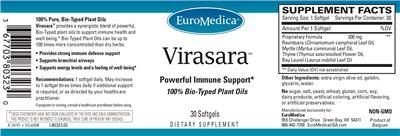
Other ingredients: extra virgin olive oil, Gelatin, Glycerin, Water
Tap any ingredient to jump to its full detail below.
These statements are the manufacturer’s wording, reproduced from the product label — the label is saying it, not HelloPharmacist. We don’t verify or endorse them.
General Statements
100% Pure, Bio-Typed Plant Oils
Bio-Typed Plant Oils can be up to 100 times more concentrated than dry herbs.
- Provides strong immune defense support - Supports bronchial airways - Supports energy levels and a feeling of well-being*
Powerful Immune Support
100% Bio-Typed Plant Oils
Product of Belgium
Brand IP Statement(s)
Virasara provides a synergistic blend of powerful, Bio-Typed plant oils to support immune health and well-being.
Suggested/Recommended/Usage/Directions
Recommendations: 1 softgel daily. May increase to 1 softgel three times daily if additional support is required, or as directed by your healthcare practitioner.
Precautions
If pregnant or nursing, consult a health care practitioner before using.
FDA Disclaimer Statement
THESE STATEMENTS HAVE NOT BEEN EVALUATED BY THE FOOD AND DRUG ADMINISTRATION. THIS PRODUCT IS NOT INTENDED TO DIAGNOSE, TREAT, CURE OR PREVENT ANY DISEASE.
General
JC 34 91 + 3(5,6)EM L80323.03
FDA Statement of Identity
DIETARY SUPPLEMENT
Formulation
No sugar, salt, yeast, wheat, gluten, corn, soy, dairy products, artificial coloring, artificial flavoring, or artificial preservatives.
Non-GMO
Is this label outdated? Report a formula or label change and our pharmacy team will review it.
Virasara by EuroMedica label
The label scan from the NIH Dietary Supplement Label Database. Tap to enlarge.
Label images are published by the NIH Dietary Supplement Label Database for the version of this product on file. Always read your actual product label.
View the full label (PDF)The Ingredients in Virasara by EuroMedica
These are the 4 active ingredients this product is made of. Select any to open its full monograph.
Serving size1 Softgel(s) Dosage formSoftgel Capsule Servings per container30 Amounts shown are per serving.
Most supplement products combine several ingredients, and a medication can interact with the product through any one of them. Each ingredient below shows whether it has known drug interactions.
Other (inactive) ingredients: Extra virgin olive oil, Gelatin, Glycerin, Water. These complete the product’s ingredient list but are not active constituents.
Virasara by EuroMedica Drug Interactions
Virasara contains 4 ingredients, and 3 of them have known drug interactions. Altogether they interact with 918 medications. Here’s the picture, then you can look up your own drug.
Want to check YOUR meds against Virasara?
Ask about interactions with your drugs in plain English — “Can I take it with lisinopril?” — and we find you the answer in seconds, ingredient by ingredient.
Go to the checkerIngredients driving the most interactions
Individual Drug Interactions
The ingredients in Virasara interact with 918 drugs. Click any drug to see the details.
3 of the 4 ingredients in Virasara interact with drugs. Each result below shows which ingredient is responsible. Thyme (Thymus satureioides) flower oil Ravintsara (Cinnamomum camphora) leaf oil Bay Laurel (Laurus nobilis) leaf oil
6-mercaptopurinePurinethol
How 6-mercaptopurine interacts with Virasara — through 1 ingredient. Tap an ingredient for the detail:
Ravintsara (cinnamomum Camphora) Leaf OilHepatotoxic Drugs Moderate
Interaction Summary
Theoretically, concomitant use of camphor with other hepatotoxic drugs might increase the risk of liver damage.
Read the full Ravintsara (cinnamomum Camphora) Leaf Oil + 6-mercaptopurine interactionAbacavir Sulfate, Dolutegravir, LamivudineTriumeq
How Abacavir Sulfate, Dolutegravir, Lamivudine interacts with Virasara — through 1 ingredient. Tap an ingredient for the detail:
Ravintsara (cinnamomum Camphora) Leaf OilHepatotoxic Drugs Moderate
Interaction Summary
Theoretically, concomitant use of camphor with other hepatotoxic drugs might increase the risk of liver damage.
Read the full Ravintsara (cinnamomum Camphora) Leaf Oil + Abacavir Sulfate, Dolutegravir, Lamivudine interactionAbacavir, LamivudineEpzicom
How Abacavir, Lamivudine interacts with Virasara — through 1 ingredient. Tap an ingredient for the detail:
Ravintsara (cinnamomum Camphora) Leaf OilHepatotoxic Drugs Moderate
Interaction Summary
Theoretically, concomitant use of camphor with other hepatotoxic drugs might increase the risk of liver damage.
Read the full Ravintsara (cinnamomum Camphora) Leaf Oil + Abacavir, Lamivudine interactionAbciximabReoPro
How Abciximab interacts with Virasara — through 1 ingredient. Tap an ingredient for the detail:
Thyme (thymus Satureioides) Flower OilAnticoagulant/antiplatelet Drugs Moderate
Interaction Summary
Theoretically, thyme leaf extract might have additive effects with anticoagulant or antiplatelet drugs.
Read the full Thyme (thymus Satureioides) Flower Oil + Abciximab interactionAbiraterone
How Abiraterone interacts with Virasara — through 1 ingredient. Tap an ingredient for the detail:
Ravintsara (cinnamomum Camphora) Leaf OilHepatotoxic Drugs Moderate
Interaction Summary
Theoretically, concomitant use of camphor with other hepatotoxic drugs might increase the risk of liver damage.
Read the full Ravintsara (cinnamomum Camphora) Leaf Oil + Abiraterone interactionAbiraterone AcetateYonsa, Zytiga
How Abiraterone Acetate interacts with Virasara — through 1 ingredient. Tap an ingredient for the detail:
Ravintsara (cinnamomum Camphora) Leaf OilHepatotoxic Drugs Moderate
Interaction Summary
Theoretically, concomitant use of camphor with other hepatotoxic drugs might increase the risk of liver damage.
Read the full Ravintsara (cinnamomum Camphora) Leaf Oil + Abiraterone Acetate interactionAbrocitinibCibinqo
How Abrocitinib interacts with Virasara — through 1 ingredient. Tap an ingredient for the detail:
Thyme (thymus Satureioides) Flower OilAnticoagulant/antiplatelet Drugs Moderate
Interaction Summary
Theoretically, thyme leaf extract might have additive effects with anticoagulant or antiplatelet drugs.
Read the full Thyme (thymus Satureioides) Flower Oil + Abrocitinib interactionAcarboseGlucobay, Prandase, Precose
How Acarbose interacts with Virasara — through 2 ingredients. Tap an ingredient for the detail:
Bay Laurel (laurus Nobilis) Leaf OilAntidiabetes Drugs Moderate
Interaction Summary
Concomitant use of bay leaf with antidiabetes drugs might increase the risk of hypoglycemia.
Read the full Bay Laurel (laurus Nobilis) Leaf Oil + Acarbose interactionRavintsara (cinnamomum Camphora) Leaf OilHepatotoxic Drugs Moderate
Interaction Summary
Theoretically, concomitant use of camphor with other hepatotoxic drugs might increase the risk of liver damage.
Read the full Ravintsara (cinnamomum Camphora) Leaf Oil + Acarbose interactionAcebutololRhotral, Sectral
How Acebutolol interacts with Virasara — through 1 ingredient. Tap an ingredient for the detail:
Ravintsara (cinnamomum Camphora) Leaf OilHepatotoxic Drugs Moderate
Interaction Summary
Theoretically, concomitant use of camphor with other hepatotoxic drugs might increase the risk of liver damage.
Read the full Ravintsara (cinnamomum Camphora) Leaf Oil + Acebutolol interactionAcenocoumarolSintrom
How Acenocoumarol interacts with Virasara — through 1 ingredient. Tap an ingredient for the detail:
Thyme (thymus Satureioides) Flower OilAnticoagulant/antiplatelet Drugs Moderate
Interaction Summary
Theoretically, thyme leaf extract might have additive effects with anticoagulant or antiplatelet drugs.
Read the full Thyme (thymus Satureioides) Flower Oil + Acenocoumarol interactionAcepromazineAtravet
How Acepromazine interacts with Virasara — through 2 ingredients. Tap an ingredient for the detail:
Bay Laurel (laurus Nobilis) Leaf OilCns Depressants Moderate
Interaction Summary
Theoretically, taking bay leaf in large amounts may enhance the therapeutic and adverse effects of sedatives.
Read the full Bay Laurel (laurus Nobilis) Leaf Oil + Acepromazine interactionThyme (thymus Satureioides) Flower OilAnticholinergic Drugs Moderate
Interaction Summary
Theoretically, concurrent use of anticholinergic drugs and thyme essential oil might reduce the effects of anticholinergic drugs.
Read the full Thyme (thymus Satureioides) Flower Oil + Acepromazine interactionAcetaminophenChildren's Tylenol, Children's Tylenol Meltaways, Tylenol, Tylenol Ex Strength
How Acetaminophen interacts with Virasara — through 1 ingredient. Tap an ingredient for the detail:
Ravintsara (cinnamomum Camphora) Leaf OilHepatotoxic Drugs Moderate
Interaction Summary
Theoretically, concomitant use of camphor with other hepatotoxic drugs might increase the risk of liver damage.
Read the full Ravintsara (cinnamomum Camphora) Leaf Oil + Acetaminophen interactionAcetaminophen, AspirinGemnisyn
How Acetaminophen, Aspirin interacts with Virasara — through 2 ingredients. Tap an ingredient for the detail:
Thyme (thymus Satureioides) Flower OilAnticoagulant/antiplatelet Drugs Moderate
Interaction Summary
Theoretically, thyme leaf extract might have additive effects with anticoagulant or antiplatelet drugs.
Read the full Thyme (thymus Satureioides) Flower Oil + Acetaminophen, Aspirin interactionRavintsara (cinnamomum Camphora) Leaf OilHepatotoxic Drugs Moderate
Interaction Summary
Theoretically, concomitant use of camphor with other hepatotoxic drugs might increase the risk of liver damage.
Read the full Ravintsara (cinnamomum Camphora) Leaf Oil + Acetaminophen, Aspirin interactionAcetaminophen, Aspirin, CaffeineExcedrin, Excedrin Extra Strength, Excedrin Migraine
How Acetaminophen, Aspirin, Caffeine interacts with Virasara — through 2 ingredients. Tap an ingredient for the detail:
Thyme (thymus Satureioides) Flower OilAnticoagulant/antiplatelet Drugs Moderate
Interaction Summary
Theoretically, thyme leaf extract might have additive effects with anticoagulant or antiplatelet drugs.
Read the full Thyme (thymus Satureioides) Flower Oil + Acetaminophen, Aspirin, Caffeine interactionRavintsara (cinnamomum Camphora) Leaf OilHepatotoxic Drugs Moderate
Interaction Summary
Theoretically, concomitant use of camphor with other hepatotoxic drugs might increase the risk of liver damage.
Read the full Ravintsara (cinnamomum Camphora) Leaf Oil + Acetaminophen, Aspirin, Caffeine interactionAcetaminophen, Brompheniramine, PhenylpropanolamineDimetapp Cold and Flu
How Acetaminophen, Brompheniramine, Phenylpropanolamine interacts with Virasara — through 1 ingredient. Tap an ingredient for the detail:
Ravintsara (cinnamomum Camphora) Leaf OilHepatotoxic Drugs Moderate
Interaction Summary
Theoretically, concomitant use of camphor with other hepatotoxic drugs might increase the risk of liver damage.
Read the full Ravintsara (cinnamomum Camphora) Leaf Oil + Acetaminophen, Brompheniramine, Phenylpropanolamine interactionAcetaminophen, ButalbitalAxocet, Bancap, Bucet, Butex Forte, Esgic CF, Orbivan CF +5 more
How Acetaminophen, Butalbital interacts with Virasara — through 1 ingredient. Tap an ingredient for the detail:
Ravintsara (cinnamomum Camphora) Leaf OilHepatotoxic Drugs Moderate
Interaction Summary
Theoretically, concomitant use of camphor with other hepatotoxic drugs might increase the risk of liver damage.
Read the full Ravintsara (cinnamomum Camphora) Leaf Oil + Acetaminophen, Butalbital interactionAcetaminophen, Butalbital, CaffeineEsgic, Esgic Plus, Fiogesic, Fioricet, Repan, Tecnal +1 more
How Acetaminophen, Butalbital, Caffeine interacts with Virasara — through 1 ingredient. Tap an ingredient for the detail:
Ravintsara (cinnamomum Camphora) Leaf OilHepatotoxic Drugs Moderate
Interaction Summary
Theoretically, concomitant use of camphor with other hepatotoxic drugs might increase the risk of liver damage.
Read the full Ravintsara (cinnamomum Camphora) Leaf Oil + Acetaminophen, Butalbital, Caffeine interactionAcetaminophen, Butalbital, Caffeine, CodeineEsgic with Codeine, Fioricet w/ Codeine
How Acetaminophen, Butalbital, Caffeine, Codeine interacts with Virasara — through 2 ingredients. Tap an ingredient for the detail:
Ravintsara (cinnamomum Camphora) Leaf OilHepatotoxic Drugs Moderate
Interaction Summary
Theoretically, concomitant use of camphor with other hepatotoxic drugs might increase the risk of liver damage.
Read the full Ravintsara (cinnamomum Camphora) Leaf Oil + Acetaminophen, Butalbital, Caffeine, Codeine interactionBay Laurel (laurus Nobilis) Leaf OilNarcotic Drugs, Cns Depressants Moderate
Interaction Summary
Theoretically, taking bay leaf in large amounts may enhance the therapeutic and adverse effects of narcotics.
Read the full Bay Laurel (laurus Nobilis) Leaf Oil + Acetaminophen, Butalbital, Caffeine, Codeine interactionAcetaminophen, Butalbital, CodeineBancap w/ Codeine
How Acetaminophen, Butalbital, Codeine interacts with Virasara — through 2 ingredients. Tap an ingredient for the detail:
Bay Laurel (laurus Nobilis) Leaf OilCns Depressants, Narcotic Drugs Moderate
Interaction Summary
Theoretically, taking bay leaf in large amounts may enhance the therapeutic and adverse effects of sedatives.
Read the full Bay Laurel (laurus Nobilis) Leaf Oil + Acetaminophen, Butalbital, Codeine interactionRavintsara (cinnamomum Camphora) Leaf OilHepatotoxic Drugs Moderate
Interaction Summary
Theoretically, concomitant use of camphor with other hepatotoxic drugs might increase the risk of liver damage.
Read the full Ravintsara (cinnamomum Camphora) Leaf Oil + Acetaminophen, Butalbital, Codeine interactionAcetaminophen, Butalbital, Codeine PhosphatePhrenilin #3
How Acetaminophen, Butalbital, Codeine Phosphate interacts with Virasara — through 2 ingredients. Tap an ingredient for the detail:
Bay Laurel (laurus Nobilis) Leaf OilNarcotic Drugs, Cns Depressants Moderate
Interaction Summary
Theoretically, taking bay leaf in large amounts may enhance the therapeutic and adverse effects of narcotics.
Read the full Bay Laurel (laurus Nobilis) Leaf Oil + Acetaminophen, Butalbital, Codeine Phosphate interactionRavintsara (cinnamomum Camphora) Leaf OilHepatotoxic Drugs Moderate
Interaction Summary
Theoretically, concomitant use of camphor with other hepatotoxic drugs might increase the risk of liver damage.
Read the full Ravintsara (cinnamomum Camphora) Leaf Oil + Acetaminophen, Butalbital, Codeine Phosphate interactionAcetaminophen, Caffeine, Chlorpheniramine, Hydrocodone, PhenylephrineHycomine Compound
How Acetaminophen, Caffeine, Chlorpheniramine, Hydrocodone, Phenylephrine interacts with Virasara — through 3 ingredients. Tap an ingredient for the detail:
Bay Laurel (laurus Nobilis) Leaf OilNarcotic Drugs, Cns Depressants Moderate
Interaction Summary
Theoretically, taking bay leaf in large amounts may enhance the therapeutic and adverse effects of narcotics.
Read the full Bay Laurel (laurus Nobilis) Leaf Oil + Acetaminophen, Caffeine, Chlorpheniramine, Hydrocodone, Phenylephrine interactionRavintsara (cinnamomum Camphora) Leaf OilHepatotoxic Drugs Moderate
Interaction Summary
Theoretically, concomitant use of camphor with other hepatotoxic drugs might increase the risk of liver damage.
Read the full Ravintsara (cinnamomum Camphora) Leaf Oil + Acetaminophen, Caffeine, Chlorpheniramine, Hydrocodone, Phenylephrine interactionThyme (thymus Satureioides) Flower OilAnticholinergic Drugs Moderate
Interaction Summary
Theoretically, concurrent use of anticholinergic drugs and thyme essential oil might reduce the effects of anticholinergic drugs.
Read the full Thyme (thymus Satureioides) Flower Oil + Acetaminophen, Caffeine, Chlorpheniramine, Hydrocodone, Phenylephrine interactionAcetaminophen, Caffeine, CodeineGesic C15, Gesic C30, Gesic C8, Lenoltec 1, Lenoltec 2, Lenoltec 3 +1 more
How Acetaminophen, Caffeine, Codeine interacts with Virasara — through 2 ingredients. Tap an ingredient for the detail:
Bay Laurel (laurus Nobilis) Leaf OilCns Depressants, Narcotic Drugs Moderate
Interaction Summary
Theoretically, taking bay leaf in large amounts may enhance the therapeutic and adverse effects of sedatives.
Read the full Bay Laurel (laurus Nobilis) Leaf Oil + Acetaminophen, Caffeine, Codeine interactionRavintsara (cinnamomum Camphora) Leaf OilHepatotoxic Drugs Moderate
Interaction Summary
Theoretically, concomitant use of camphor with other hepatotoxic drugs might increase the risk of liver damage.
Read the full Ravintsara (cinnamomum Camphora) Leaf Oil + Acetaminophen, Caffeine, Codeine interactionAcetaminophen, Caffeine, Codeine, SalicylamideCodalan No.1, Codalan No.2, Codalan No.3
How Acetaminophen, Caffeine, Codeine, Salicylamide interacts with Virasara — through 2 ingredients. Tap an ingredient for the detail:
Bay Laurel (laurus Nobilis) Leaf OilNarcotic Drugs, Cns Depressants Moderate
Interaction Summary
Theoretically, taking bay leaf in large amounts may enhance the therapeutic and adverse effects of narcotics.
Read the full Bay Laurel (laurus Nobilis) Leaf Oil + Acetaminophen, Caffeine, Codeine, Salicylamide interactionRavintsara (cinnamomum Camphora) Leaf OilHepatotoxic Drugs Moderate
Interaction Summary
Theoretically, concomitant use of camphor with other hepatotoxic drugs might increase the risk of liver damage.
Read the full Ravintsara (cinnamomum Camphora) Leaf Oil + Acetaminophen, Caffeine, Codeine, Salicylamide interactionAcetaminophen, Caffeine, DihydrocodeineDHC Plus, Panlor DC, Panlor SS
How Acetaminophen, Caffeine, Dihydrocodeine interacts with Virasara — through 2 ingredients. Tap an ingredient for the detail:
Ravintsara (cinnamomum Camphora) Leaf OilHepatotoxic Drugs Moderate
Interaction Summary
Theoretically, concomitant use of camphor with other hepatotoxic drugs might increase the risk of liver damage.
Read the full Ravintsara (cinnamomum Camphora) Leaf Oil + Acetaminophen, Caffeine, Dihydrocodeine interactionBay Laurel (laurus Nobilis) Leaf OilCns Depressants, Narcotic Drugs Moderate
Interaction Summary
Theoretically, taking bay leaf in large amounts may enhance the therapeutic and adverse effects of sedatives.
Read the full Bay Laurel (laurus Nobilis) Leaf Oil + Acetaminophen, Caffeine, Dihydrocodeine interactionAcetaminophen, Caffeine, IsomethepteneMigralam
How Acetaminophen, Caffeine, Isometheptene interacts with Virasara — through 1 ingredient. Tap an ingredient for the detail:
Ravintsara (cinnamomum Camphora) Leaf OilHepatotoxic Drugs Moderate
Interaction Summary
Theoretically, concomitant use of camphor with other hepatotoxic drugs might increase the risk of liver damage.
Read the full Ravintsara (cinnamomum Camphora) Leaf Oil + Acetaminophen, Caffeine, Isometheptene interactionAcetaminophen, Caffeine, PyrilamineMidol Max Strength Menstrual
How Acetaminophen, Caffeine, Pyrilamine interacts with Virasara — through 2 ingredients. Tap an ingredient for the detail:
Ravintsara (cinnamomum Camphora) Leaf OilHepatotoxic Drugs Moderate
Interaction Summary
Theoretically, concomitant use of camphor with other hepatotoxic drugs might increase the risk of liver damage.
Read the full Ravintsara (cinnamomum Camphora) Leaf Oil + Acetaminophen, Caffeine, Pyrilamine interactionThyme (thymus Satureioides) Flower OilAnticholinergic Drugs Moderate
Interaction Summary
Theoretically, concurrent use of anticholinergic drugs and thyme essential oil might reduce the effects of anticholinergic drugs.
Read the full Thyme (thymus Satureioides) Flower Oil + Acetaminophen, Caffeine, Pyrilamine interactionAcetaminophen, Chlorpheniramine Maleate, Dextromethorphan HbrVicks Formula 44M Cough, Cold & Flu Relief
How Acetaminophen, Chlorpheniramine Maleate, Dextromethorphan Hbr interacts with Virasara — through 2 ingredients. Tap an ingredient for the detail:
Thyme (thymus Satureioides) Flower OilAnticholinergic Drugs Moderate
Interaction Summary
Theoretically, concurrent use of anticholinergic drugs and thyme essential oil might reduce the effects of anticholinergic drugs.
Read the full Thyme (thymus Satureioides) Flower Oil + Acetaminophen, Chlorpheniramine Maleate, Dextromethorphan Hbr interactionRavintsara (cinnamomum Camphora) Leaf OilHepatotoxic Drugs Moderate
Interaction Summary
Theoretically, concomitant use of camphor with other hepatotoxic drugs might increase the risk of liver damage.
Read the full Ravintsara (cinnamomum Camphora) Leaf Oil + Acetaminophen, Chlorpheniramine Maleate, Dextromethorphan Hbr interactionAcetaminophen, Chlorpheniramine, Codeine, PhenylephrineColrex
How Acetaminophen, Chlorpheniramine, Codeine, Phenylephrine interacts with Virasara — through 3 ingredients. Tap an ingredient for the detail:
Ravintsara (cinnamomum Camphora) Leaf OilHepatotoxic Drugs Moderate
Interaction Summary
Theoretically, concomitant use of camphor with other hepatotoxic drugs might increase the risk of liver damage.
Read the full Ravintsara (cinnamomum Camphora) Leaf Oil + Acetaminophen, Chlorpheniramine, Codeine, Phenylephrine interactionBay Laurel (laurus Nobilis) Leaf OilNarcotic Drugs, Cns Depressants Moderate
Interaction Summary
Theoretically, taking bay leaf in large amounts may enhance the therapeutic and adverse effects of narcotics.
Read the full Bay Laurel (laurus Nobilis) Leaf Oil + Acetaminophen, Chlorpheniramine, Codeine, Phenylephrine interactionThyme (thymus Satureioides) Flower OilAnticholinergic Drugs Moderate
Interaction Summary
Theoretically, concurrent use of anticholinergic drugs and thyme essential oil might reduce the effects of anticholinergic drugs.
Read the full Thyme (thymus Satureioides) Flower Oil + Acetaminophen, Chlorpheniramine, Codeine, Phenylephrine interactionAcetaminophen, Chlorpheniramine, DextromethorphanCoricidin II Extra Strength Cold and Flu
How Acetaminophen, Chlorpheniramine, Dextromethorphan interacts with Virasara — through 2 ingredients. Tap an ingredient for the detail:
Thyme (thymus Satureioides) Flower OilAnticholinergic Drugs Moderate
Interaction Summary
Theoretically, concurrent use of anticholinergic drugs and thyme essential oil might reduce the effects of anticholinergic drugs.
Read the full Thyme (thymus Satureioides) Flower Oil + Acetaminophen, Chlorpheniramine, Dextromethorphan interactionRavintsara (cinnamomum Camphora) Leaf OilHepatotoxic Drugs Moderate
Interaction Summary
Theoretically, concomitant use of camphor with other hepatotoxic drugs might increase the risk of liver damage.
Read the full Ravintsara (cinnamomum Camphora) Leaf Oil + Acetaminophen, Chlorpheniramine, Dextromethorphan interactionAcetaminophen, Chlorpheniramine, Dextromethorphan HydrobromideCoricidin HBP Maximum Strength Flu
How Acetaminophen, Chlorpheniramine, Dextromethorphan Hydrobromide interacts with Virasara — through 2 ingredients. Tap an ingredient for the detail:
Ravintsara (cinnamomum Camphora) Leaf OilHepatotoxic Drugs Moderate
Interaction Summary
Theoretically, concomitant use of camphor with other hepatotoxic drugs might increase the risk of liver damage.
Read the full Ravintsara (cinnamomum Camphora) Leaf Oil + Acetaminophen, Chlorpheniramine, Dextromethorphan Hydrobromide interactionThyme (thymus Satureioides) Flower OilAnticholinergic Drugs Moderate
Interaction Summary
Theoretically, concurrent use of anticholinergic drugs and thyme essential oil might reduce the effects of anticholinergic drugs.
Read the full Thyme (thymus Satureioides) Flower Oil + Acetaminophen, Chlorpheniramine, Dextromethorphan Hydrobromide interactionEach ingredient & the kinds of drugs it affects
For each ingredient in Virasara with known interactions, here are the types of medications they can affect. Open any type for the detail — or search your exact drug in the checker above.
Thyme (Thymus satureioides) flower oil
Anticholinergic Drugs
Theoretically, concurrent use of anticholinergic drugs and thyme essential oil might reduce the effects of anticholinergic drugs.
In vitro evidence suggests that thyme essential oil and specific essential oil constituents like thymohydroquinone and carvacrol can inhibit acetylcholinesterase (AChE). However, this effect has not been observed in humans.
Anticoagulant/Antiplatelet Drugs
Theoretically, thyme leaf extract might have additive effects with anticoagulant or antiplatelet drugs.
In vitro and animal research suggests that thyme leaf extract has antiplatelet effects. However, this effect has not been observed in humans.
Cholinergic Drugs
Theoretically, concurrent use of cholinergic drugs and thyme essential oil might cause additive cholinergic effects.
In vitro evidence suggests that thyme essential oil and specific essential oil constituents like thymohydroquinone and carvacrol can inhibit acetylcholinesterase (AChE). However, this effect has not been observed in humans.
Estrogens
Theoretically, thyme might competitively inhibit the effects of estrogen replacement therapy.
In vitro research shows that thyme has estrogen receptor-binding activity and phytoestrogen content. However, this effect has not been observed in humans.
Ravintsara (Cinnamomum camphora) leaf oil
Hepatotoxic Drugs
Theoretically, concomitant use of camphor with other hepatotoxic drugs might increase the risk of liver damage.
There have been a few case reports of transient elevations in liver enzymes in adults after oral or topical use of camphor. There has also been one case of hepatotoxicity in an infant after topical camphor use.
Bay Laurel (Laurus nobilis) leaf oil
Antidiabetes Drugs
Concomitant use of bay leaf with antidiabetes drugs might increase the risk of hypoglycemia.
Preliminary clinical research shows that bay leaf can lower blood glucose levels in patients with diabetes who are already taking antidiabetes medication. Advise patients to monitor glucose levels closely. Dose adjustments may be necessary.
Cns Depressants
Theoretically, taking bay leaf in large amounts may enhance the therapeutic and adverse effects of sedatives.
Bay leaf contains methyl eugenol. Animal research shows that methyl eugenol has sedative properties. Avoid concomitant use.
Narcotic Drugs
Theoretically, taking bay leaf in large amounts may enhance the therapeutic and adverse effects of narcotics. Avoid concomitant use.
Brand information
Manufacturer and brand details for Virasara, from the product label.
EuroMedica
See all EuroMedica products- Name
- EuroMedica
- Street Address
- 955 Challenger Dr.
- City
- Green Bay
- State
- WI
- ZipCode
- 54311
- Phone Number
- 866-842-7256
- Web Address
- www.EuroMedicaUSA.com
Virasara by EuroMedica: Common Questions
Does Virasara by EuroMedica interact with any medications?
How can one product interact with so many drugs?
Where does this information come from?
Written and reviewed by the HelloPharmacist editorial staff. Our editorial policy
Not sure if Virasara is safe with your meds?
Our pharmacists answer your medication & supplement questions — free.
Label information is sourced from the NIH Dietary Supplement Label Database and reflects the product version on file; always read your actual product label. This page is for education only and is not a substitute for professional medical advice. Confirm with your pharmacist or doctor before combining supplements and medications.
The Full Monographs Behind Virasara’s Ingredients
Every ingredient we hold a full HelloPharmacist monograph for — uses, evidence, safety, and the complete interaction list.
Thyme
Interacts with 379 drugsThyme is a common kitchen herb that has long been used for coughs, sore throats, and digestive complaints. It is generally safe in the amounts found in food, and some cough products that com...
Read the full Thyme monograph → Herb & supplement monographCamphor
Interacts with 372 drugsCamphor is a strong-smelling compound from the camphor tree (or made synthetically) that is used in many topical rub-on products for muscle aches, itching, and chest congestion. It can be he...
Read the full Camphor monograph → Herb & supplement monographMyrtle
Myrtle (Myrtus communis) is a Mediterranean shrub used traditionally for respiratory, digestive, and skin complaints. Modern research is mostly limited to laboratory and small studies, so it...
Read the full Myrtle monograph → Herb & supplement monographBay Leaf
Interacts with 335 drugsBay leaf is a common culinary herb that is safe in the small amounts used in cooking. Some people take it for digestion, blood sugar, or colds, but strong human evidence for these uses is la...
Read the full Bay Leaf monograph →Sources & How We Checked
Virasara's label data comes from the NIH Dietary Supplement Label Database; the ingredient interaction data is from the Natural Medicines database, reviewed by our pharmacists.
- NIH Dietary Supplement Label Database (DSLD) — The official product label on file for this supplement.
- Natural Medicines (Therapeutic Research Center) — Evidence-graded clinical reference behind the ingredient interaction data.
Content is written and reviewed by licensed HelloPharmacist pharmacists. See our data sources and editorial standards for how this information is built and checked.
The 48 references behind this product’s interaction data
Every citation that drives the interaction findings for this product’s ingredients, from the evidence-graded Natural Medicines (TRC Healthcare) database. Open an ingredient to browse its citations — links open the study on PubMed or the publisher’s site.
Thyme 18 references
- Zava DT, Dollbaum CM, Blen M. Estrogen and progestin bioactivity of foods, herbs, and spices. Proc Soc Exp Biol Med 1998;217:369-78. PubMed
- Electronic Code of Federal Regulations. Title 21. Part 182 -- Substances Generally Recognized As Safe. Available at: https://www.accessdata.fda.gov/scripts/cdrh/cfdocs/cfcfr/CFRSearch.cfm?CFRPart=182
- Okazaki K, Kawazoe K, Takaishi Y. Human platelet aggregation inhibitors from thyme (Thymus vulgaris L.). Phytother Res 2002;16:398-9. .
- Spiewak R, Skorska C, Dutkiewicz J. Occupational airborne contact dermatitis caused by thyme dust. Contact Dermatitis 2001;44:235-9. . PubMed
- Ernst E, Marz R, Sieder C. A controlled multi-centre study of herbal versus synthetic secretolytic drugs for acute bronchitis. Phytomedicine 1997;4:287-93. PubMed
- Yamamoto J, Yamada K, Naemura A, et al. Testing various herbs for antithrombotic effect. Nutrition 2005;21(5):580-7. PubMed
- Tognolini, M., Barocelli, E., Ballabeni, V., Bruni, R., Bianchi, A., Chiavarini, M., and Impicciatore, M. Comparative screening of plant essential oils: phenylpropanoid moiety as basic core for antiplatelet activity. Life Sci. 2-23-2006;78(13):1419-1432. PubMed
- Mackiewicz, B., Skorska, C., Dutkiewicz, J., Michnar, M., Milanowski, J., Prazmo, Z., Krysinska-Traczyk, E., and Cisak, E. Allergic alveolitis due to herb dust exposure. Ann Agric Environ Med 1999;6(2):167-170.
- Martinez-Gonzalez, M. C., Goday Bujan, J. J., Martinez, Gomez W., and Fonseca, Capdevila E. Concomitant allergic contact dermatitis due to Rosmarinus officinalis (rosemary) and Thymus vulgaris (thyme). Contact Dermatitis 2007;56(1):49-50.
- Jukic, M., Politeo, O., Maksimovic, M., Milos, M., and Milos, M. In vitro acetylcholinesterase inhibitory properties of thymol, carvacrol and their derivatives thymoquinone and thymohydroquinone. Phytother.Res 2007;21(3):259-261.
- Marzian, O. [Treatment of acute bronchitis in children and adolescents. Non-interventional postmarketing surveillance study confirms the benefit and safety of a syrup made of extracts from thyme and ivy leaves]. MMW.Fortschr.Med 6-28-2007;149(27-28 Suppl
- Cuzzolin, L. and Benoni, G. Attitudes and knowledge toward natural products safety in the pharmacy setting: an Italian study. Phytother.Res 2009;23(7):1018-1023. PubMed
- Berova, N., Stransky, L., and Krasteva, M. Studies on contact dermatitis in stomatological staff. Dermatol.Monatsschr. 1990;176(1):15-18.
- Smeenk, G., Kerckhoffs, H. P., and Schreurs, P. H. Contact allergy to a reaction product in Hirudoid cream: an example of compound allergy. Br.J Dermatol. 1987;116(2):223-231.
- Le Roy, R., Grosshans, E., and Foussereau, J. [Investigation of contact allergies in 100 cases of ulcus cruris (author's transl)]. Derm.Beruf.Umwelt. 1981;29(6):168-170.
- Lorenzi, S., Placucci, F., Vincenzi, C., Bardazzi, F., and Tosti, A. Allergic contact dermatitis due to thymol. Contact Dermatitis 1995;33(6):439-440. PubMed
- Bahadoran P, Rokni FK, Fahami F. Investigating the therapeutic effect of vaginal cream containing garlic and thyme compared to clotrimazole cream for the treatment of mycotic vaginitis. Iran J Nurs Midwifery Res 2010;15(Suppl 1):343-9.
- Erol S, Aydin B, Dilli D, Okumus N, Zenciroglu A, Gündüz M. An interesting newborn case of fructose 1-6 diphosphatase deficiency triggered after thyme juice ingestion. Clin Lab. 2014;60(1):151-3. PubMed
Camphor 20 references
- Uc A, Bishop WP, Sanders KD. Camphor hepatotoxicity. South Med J 2000;93:596-8. DOI
- Love JN, Sammon M, Smereck J. Are one or two dangerous? Camphor exposure in toddlers. J Emerg Med 2004;27:49-54.. PubMed
- Ruha AM, Graeme KA, Field A. Late seizure following ingestion of Vicks VapoRub. Acad Emerg Med 2003;10:691. . PubMed
- Gouin S, Patel H. Unusual cause of seizure. Pediatr Emerg Care 1996;12:298-300. DOI
- Ernst E. Adverse effects of herbal drugs in dermatology. Br J Dermatol 2000;143:923-9. PubMed
- Fung AE, Oxford KW. Microwave-superheated Vics Vapo Rub: an ocular public health danger. Am J Ophthalmol 2004;137:379-80. PubMed
- Emery, D. P. and Corban, J. G. Camphor toxicity. J.Paediatr.Child Health 1999;35(1):105-106.
- Rampini, S. K., Schneemann, M., Rentsch, K., and Bachli, E. B. Camphor intoxication after cao gio (coin rubbing). JAMA 7-3-2002;288(1):45.
- SMITH, A. G. and MARGOLIS, G. Camphor poisoning; anatomical and pharmacologic study; report of a fatal case; experimental investigation of protective action of barbiturate. Am.J.Pathol. 1954;30(5):857-869.
- Ragucci, K. R., Trangmar, P. R., Bigby, J. G., and Detar, T. D. Camphor ingestion in a 10-year-old male. South.Med.J. 2007;100(2):204-207. PubMed
- Agarwal, A. and Malhotra, H. S. Camphor ingestion: an unusual cause of seizure. J.Assoc.Physicians India 2008;56:123-124.
- Weiss, J. and Catalano, P. Camphorated oil intoxication during pregnancy. Pediatrics 1973;52(5):713-714. DOI
- Vasey, R. H. and Karayannopoulos, S. J. Camphorated oil. Br.Med.J. 1-8-1972;1(5792):112.
- Mascie-Taylor, B. H., Widdop, B., and Davison, A. M. Camphor intoxication treated by charcoal haemoperfusion. Postgrad.Med.J. 1981;57(673):725-726. PubMed
- Theis, J. G. and Koren, G. Camphorated oil: still endangering the lives of Canadian children. CMAJ. 6-1-1995;152(11):1821-1824.
- Skoglund, R. R., Ware, L. L., Jr., and Schanberger, J. E. Prolonged seizures due to contact and inhalation exposure to camphor. A case report. Clin.Pediatr.(Phila) 1977;16(10):901-902. PubMed
- Cordoba Torres IT, Marino-Nieto J, Barkin HB, Fort AC, Cobas M. Vicks VapoRub intoxication: an unusual presentation of multiorgan failure. J Clin Anesth 2018;48:46-7. PubMed
- Rahimi M, Shokri F, Hassanian-Moghaddam H, et al. Severe camphor poisoning, a seven-year observational study. Environ Toxicol Pharmacol 2017;52:8-13. PubMed
- Mathew T, John SK, Kamath V, et al. Essential oil related seizures (EORS): A multi-center prospective study on essential oils and seizures in adults. Epilepsy Res. 2021;173:106626. PubMed
- Camphor (synthetic): Immediately Dangerous to Life or Health Concentrations (IDLH). National Institute for Occupational Safety and Health. 1994. https://www.cdc.gov/niosh/idlh/76222.html. Assessed 5/6/2021.
Myrtle 3 references
- Gruenwald J, Brendler T, Jaenicke C. PDR for Herbal Medicines. 1st ed. Montvale, NJ: Medical Economics Company, Inc., 1998.
- Salmanian M, Shirbeigi L, Hashem-Dabaghian F, et al. The Effects of Myrtle (Myrtus communis) and Clindamycin Topical Solution in the Treatment of Mild to Moderate Acne Vulgaris: A Comparative Split-Face Study. J Pharmacopuncture 2020;23(4):220-229.
- Paknejad MS, Eftekhari K, Rahimi R, Vigeh M, Naghizadeh A, Karimi M. Myrtle (Myrtus communis L.) fruit syrup for gastroesophageal reflux disease in children: A double-blind randomized clinical trial. Phytother Res 2021;35(11):6369-6376.
Bay Leaf 7 references
- Leung AY, Foster S. Encyclopedia of Common Natural Ingredients Used in Food, Drugs and Cosmetics. 2nd ed. New York, NY: John Wiley & Sons, 1996.
- Cartier LC, Lehrer A, Malo JL. Occupational asthma caused by aromatic herbs. Allergy 1996;51:647-9. DOI
- Adisen E, Onder M. Allergic contact dermatitis from Laurus nobilis oil induced by massage. Contact Dermatitis 2007;56:360-1.
- Ozden, M. G., Oztas, P., Oztas, M. O., and Onder, M. Allergic contact dermatitis from Laurus nobilis (laurel) oil. Contact Dermatitis 2001;45(3):178. PubMed
- Khan, A., Zaman, G., and Anderson, R. A. Bay leaves improve glucose and lipid profile of people with type 2 diabetes. J Clin Biochem.Nutr. 2009;44(1):52-56. PubMed
- Cheminat, A., Stampf, J. L., and Benezra, C. Allergic contact dermatitis to laurel (Laurus nobilis L.): isolation and identification of haptens. Arch Dermatol Res 1984;276(3):178-181. PubMed
- Vassileva S, Darlenski R. Bay leaf phytodermatitis. Contact Dermatitis. 2020 Nov 15. PubMed
Parts of this content are provided by the Therapeutic Research Center, LLC.
DISCLAIMER: Currently this does not check for drug-drug interactions. This is not an all-inclusive comprehensive list of potential interactions and is for informational purposes only. Not all interactions are known or well-reported in the scientific literature, and new interactions are continually being reported. Input is needed from a qualified healthcare provider including a pharmacist before starting any therapy. Application of clinical judgment is necessary.
© 2021 Therapeutic Research Center, LLC