
Vision by Performance Lab Ingredients, Side Effects and Drug Interactions
Dietary Supplement Capsule Other Combinations
UPC 6 17401 62506 2 Match it to the barcode on your bottle

Medically reviewed by Dr. Brian Staiger, PharmD, BCPS
Also reviewed by the HelloPharmacist Editorial Team
Updated Details about this page
- Label on file from the NIH Dietary Supplement Label Database, dated Jun 25, 2025.
- The interaction, evidence and safety records come from the Natural Medicines database, which we license, read against this label by our own system; the pharmacy team’s sections are written from those records.
- Dr. Brian Staiger, PharmD, BCPS, is a clinical pharmacist and pharmacotherapy specialist.
- Editorial policy Our sources
AI is used only to summarize verified clinical information, never the open internet. Our AI policy
Summary: The HelloPharmacist Team’s Take
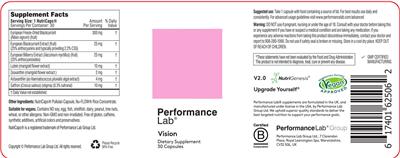
- Form
- Capsule
- Serving Size
- 1 NutriCap
- Servings
- 30 per container
- Container Holds
- 30 Capsules
What’s in it, whether it interacts with your drugs, its side effects, whether it works, and what our pharmacists would want you to know before you start it.
- What is Vision?A supplement from Performance Lab with seven active ingredients, in capsule form.
- Active Ingredients Black Currant, Freeze-Dried 300 mgBlack Currant Fruit Extract 25 mgBilberry Fruit Extract 25 mgLutein 10 mgZeaxanthin 2 mgAstaxanthin 4 mgSaffron 10 mg Seven active ingredients. Each one can interact with drugs or cause side effects on its own, so we check every one. The full Supplement Facts
- Drug Interactions 1,139 drugs have a documented interaction with this supplement; the most serious is rated moderate. Of those, 745 are single drugs and 394 are combination products (two or more drugs in one), each listed under its own name. Ask your pharmacist first if you take a drug in any of these categories, the most serious of the 10 on record:
- Moderate · 645 drugs
- Moderate · 248 drugs
- Moderate · 172 drugs
- Moderate · 122 drugs
- Possible Side EffectsStomach upset 3 ingredientsNauseaMild gas or bloatingDigestive discomfortChanges in stoolDry mouth +4 moreCombined from four of its seven active ingredients. Not studied in this exact product.
- Well documented Why
Does Vision work?
What It Is Marketed For
Vision and eye health
From the claims on the product’s label.
The Closest Use the Research Grades
Lutein
Some studies support it, but the evidence isn’t conclusive.
Its ingredients have research behind other uses too:
- Lutein
- Zeaxanthin
These grades are for each ingredient, not this exact product, and never a promise it will work for you.
What the research says- Full Why
- AllergensNone of its ingredient names point to a major food allergen
- Barcode (UPC)6 17401 62506 2Match it to the barcode on your bottle to be sure this is your product. Not your product? Search for it here
Who Might Consider It
- People looking for vision and eye health, which is what it is marketed for. The closest use the research grades is age-related macular degeneration (AMD), rated Possibly Effective.
- People who want it for cataracts or age-related macular degeneration (AMD): the other uses with research behind them. See each grade
- Vision may appeal to adults interested in eye-focused plant pigments, though the ingredient ratings are mixed.
Who Should Be Careful
- If you take blood thinners, diabetes medicines, sedatives, blood pressure medicines, or phenothiazines, be careful and talk it over with your own doctor or pharmacist first.
- If you are pregnant or breastfeeding, saffron is rated Likely Unsafe in pregnancy, so talk it over with your own doctor or pharmacist before starting.
More Before You Take It Show both answersHide Pregnancy and Breastfeeding The Label’s Directions
-
Pregnant or breastfeeding?
- Pregnancy Saffron
- ! When used orally in amounts exceeding those commonly found in foods.
- Breastfeeding Saffron
- Insufficient reliable information available; avoid using.
- Pregnancy and Breastfeeding Black Currant
- Insufficient reliable information available; avoid using.
- Pregnancy and Breastfeeding Astaxanthin
- Insufficient reliable information available; avoid using in amounts greater than those typically found in foods.
-
How does the label say to take it?
“Suggested use: Take 1 capsule a day with food containing source of fat.”
The maker’s words. Your pharmacist or doctor may advise differently.
Everything the label says
From the label dated Jun 25, 2025: all seven of its active ingredients were checked against our records. A summary of what is known, not a grade or a test of the product. How these ratings are computed
Ask Anything About This Supplement
Name a drug you take, or ask about side effects, ingredients or pregnancy.
AI answers come from this label and our own records, never the open internet. AI can make mistakes, so always check with your doctor or pharmacist. How we use AI
Ask the Pharmacist
A licensed pharmacist will answer your question by email — free, as soon as they can.
Got it — thank you!
A licensed pharmacist will answer as soon as they can. Keep an eye on your email (worth checking spam, just in case).
What’s Inside Vision by Performance Lab
Seven Active Ingredients, Each Checked on Its Own
A supplement is often several ingredients in one bottle, and each one can interact with drugs or cause side effects on its own. We check every one of them against our records.
- Black Currant, Freeze-DriedDrug interactions on record, most serious: Moderate
- Black Currant Fruit ExtractDrug interactions on record, most serious: Moderate
- Bilberry Fruit ExtractDrug interactions on record, most serious: Moderate
- LuteinNo drug interactions on record
- ZeaxanthinDrug interactions on record, most serious: Moderate
- AstaxanthinDrug interactions on record, most serious: Moderate
- SaffronDrug interactions on record, most serious: Moderate
Why this rating?
The label gives an exact amount for every one of its seven active ingredients, so you know how much of each you get in each serving. This rates what the label tells you, not the quality of the product.
Supplement Facts
| Amount Per Serving | % Daily Value | |
|---|---|---|
| Black Currant, Freeze-Dried | 300 mg | † |
| Black Currant Fruit Extract | 25 mg | † |
| Bilberry Fruit Extract | 25 mg | † |
| Lutein | 10 mg | † |
| Zeaxanthin | 2 mg | † |
| Astaxanthin | 4 mg | † |
| Saffron | 10 mg | † |
Other ingredients: Pullulan, Nu-Flow
† Daily Value not established.
Daily Values for adults and children 4 or more years of age.
As the label prints it, from the NIH Dietary Supplement Label Database.
Each Ingredient and Its Drug Interactions
Tap one for more about it and its full guide. A drug can interact with this supplement through any one of them.
Vision contains seven active ingredients: lutein, zeaxanthin, and astaxanthin, which are plant pigments, plus freeze-dried black currant, black currant fruit extract, bilberry fruit extract, and saffron.
- Most of the actives are pigments, and the rest are berry extracts and a spice.
-
Black Currant, Freeze-Dried 300 mg Interacts with 140 drugs
Black currant is a nutritious berry that is rich in vitamin C and antioxidants, and its seed oil contains the omega-6 fatty acid GLA.
- While it is enjoyed safely as a food and is popular as a supplement, solid human evidence for most health claims is still limited.
- Talk with your pharmacist or doctor before using concentrated supplements, especially if you are pregnant, nursing, or have a medical condition.
The full Black Currant guide: uses, dosage and safety Every Black Currant drug interaction
-
Black Currant Fruit Extract 25 mg Interacts with 140 drugs
Form on the label: Anthocyanin, Cyanidin 3-Glucoside
Black currant is a nutritious berry that is rich in vitamin C and antioxidants, and its seed oil contains the omega-6 fatty acid GLA.
- While it is enjoyed safely as a food and is popular as a supplement, solid human evidence for most health claims is still limited.
- Talk with your pharmacist or doctor before using concentrated supplements, especially if you are pregnant, nursing, or have a medical condition.
The full Black Currant guide: uses, dosage and safety Every Black Currant drug interaction
-
Bilberry Fruit Extract 25 mg Interacts with 275 drugs
Form on the label: Anthocyanosides
Bilberry is a blueberry-like fruit rich in antioxidant plant compounds called anthocyanins, and it has a long history of traditional use for eye health, circulation, and mild diarrhea.
- While it is generally well tolerated as a food and supplement, strong scientific proof for most health claims is limited.
- Talk with your pharmacist or doctor before using bilberry supplements, especially if you are pregnant, breastfeeding, or have a health condition.
The full Bilberry guide: uses, dosage and safety Every Bilberry drug interaction
-
Lutein 10 mg No known drug interactions
Form on the label: Marigold Flower Extract
Lutein is a plant-based antioxidant pigment that concentrates in the eye, and the best evidence suggests it (often combined with zeaxanthin) may help slow progression of age-related macular degeneration in certain people.
- For most other eye and health claims, the evidence is limited or mixed.
- It is generally well tolerated, but talk to your pharmacist or doctor before starting it, especially during pregnancy or breastfeeding.
-
Zeaxanthin 2 mg Interacts with 86 drugs
Form on the label: Marigold Flower Extract
Zeaxanthin is a carotenoid pigment that, along with lutein, concentrates in the macula of the eye and may help support long-term eye health.
- The strongest evidence relates to slowing progression of advanced age-related macular degeneration when combined with other nutrients, while many other uses remain unproven.
- It is generally well tolerated, but talk to your pharmacist or doctor before starting any supplement.
The full Zeaxanthin guide: uses, dosage and safety Every Zeaxanthin drug interaction
-
Astaxanthin 4 mg Interacts with 673 drugs
Form on the label: Haematococcus pluvialis Algae Extract
Astaxanthin is a reddish carotenoid pigment with strong antioxidant activity in the lab, and it is widely promoted for skin, eye, heart, and exercise benefits.
- Early human studies are promising for a few uses, but the overall evidence is still limited and not strong enough to make firm claims.
- It appears generally well tolerated at typical supplement doses, but talk with your pharmacist or doctor before starting it.
The full Astaxanthin guide: uses, dosage and safety Every Astaxanthin drug interaction
-
Saffron 10 mg Interacts with 612 drugs
Form on the label: Safranal
Saffron is a costly spice that has shown promise in early studies for mild-to-moderate depression and some mood and PMS symptoms, but most research uses small trials, so results are not definitive.
- It is generally well tolerated in food and small supplement amounts, but high doses can be harmful and it should be avoided in pregnancy.
- Talk to your pharmacist or doctor before using saffron supplements.
The full Saffron guide: uses, dosage and safety Every Saffron drug interaction
Other Ingredients (Inactive)
The capsule or tablet itself, fillers, coatings and flavors. Not part of the drug interaction check; the allergen check below reads them.
- Pullulan
- Nu-Flow
Allergens in Vision
None of its ingredient names point to a major food allergen.
Not named in the ingredients
- Milk
- Egg
- Fish
- Shellfish
- Tree nuts
- Peanuts
- Wheat or other gluten grains
- Soy
- Sesame
- Made without, the label says“Contains no soy, egg, fish, shellfish, dairy, peanuts, tree nuts, wheat, or other allergens. Non-GMO and non-irradiated. Free of gluten, caffeine, synthetic additives, artificial colors and preservatives. · BPA free”
- Made without, the label says“Vegan Approved · Vegetarian Society”
From the label text and ingredient names on file; we do not test products. With a serious allergy, check your bottle and ask the maker or your pharmacist.
What the Label Says
The maker’s own words, from the label. We do not verify or endorse them.
- Formulation
-
“Suitable for vegans.”
“Contains no soy, egg, fish, shellfish, dairy, peanuts, tree nuts, wheat, or other allergens. Non-GMO and non-irradiated. Free of gluten, caffeine, synthetic additives, artificial colors and preservatives. BPA free”
4 more from the label
“GMP Certified Manufacturing”
“Vegan Approved Vegetarian Society”
“Performance Lab supplements are formulated in the UK, and manufactured under license in the USA, by Performance Lab Group Ltd. We uphold superior quality standards to deliver the best targeted nutrition to support your performance goals.”
“NutriGenesis”
- Brand IP Statement(s)
-
“NutriCaps are registered trademarks of Performance Lab Group Ltd. Copyright Performance Lab Ltd. All rights reserved.”
“Performance Lab Upgrade Yourself”
- General statements
-
“Please recycle”
“For advanced usage guidelines visit www.performancelab.com/advanced”
- FDA Statement of Identity
-
“Dietary Supplement”
- Storage
-
“Store in a cool dry place.”
- Seals and symbols
-
“Vegan Approved Vegetarian Society”
“Certified B Corporation”
The Vision Label on File
The label scan on file at the NIH Dietary Supplement Label Database, dated June 2025. Always read the label on the bottle you have.
Product Facts
- Brand
- Performance Lab
- Barcode (UPC)
- 617401625062
- Net contents
- 30 Capsules
- Market status
- On market
- Date entered into DSLD
- Jun 25, 2025
- DSLD ID
- 331706
- Product type
- Other Combinations
- Supplement form
- Capsule
- Dietary claims / uses
- All Other, Structure/Function
- Intended target group(s)
- Vegan, Vegetarian, Adult (18 - 50 Years), Women (not pregnant or lactating), Gluten Free, Dairy Free
Is this label outdated? Report a formula or label change and our pharmacy team will review it.
Vision by Performance Lab Side Effects
Why this rating?
We look for three kinds of safety information on each ingredient: side effects reported in studies, a pregnancy and breastfeeding rating, and a safety write-up from our pharmacy team. Of the six ingredients we could check, five have side-effect reports, all six have a pregnancy rating and all six have a safety write-up.
So this rates how much is known, not whether Vision is right for you.
Reported with six of its ingredients
- Most often
- Stomach upset, nausea, mild gas or bloating, digestive discomfort, changes in stool and dry mouth
- !Rare but serious
- Severe allergic reaction See details
HelloPharmacist Team Summary: Vision by Performance Lab Side Effects
If you start Vision, the side effects you are most likely to notice are upset stomach, gas, or diarrhea from the black currant ingredients, and changes in stool color from astaxanthin.
- Dizziness has been reported with saffron, so see how it affects you before driving.
- Serious side effects are rare, but allergic reactions are possible, and if you notice a severe reaction, call your doctor right away.
- Pregnant or breastfeeding people, and anyone taking blood thinners or diabetes medicines, should talk with their own doctor or pharmacist before starting.
Side Effects, Ingredient by Ingredient
A supplement’s side effects come from its ingredients. Here is what is reported with each one.
Black Currant
Most reported
- Upset stomach, gas, or diarrhea, particularly with the seed oil.
- Mild gas or bloating.
- Allergic reactions in people sensitive to the plant (rare).
Bilberry
Most reported
- Stomach upset
- Digestive discomfort
Astaxanthin
Most reported
- Stomach upset
- Changes in stool
Saffron
Most reported
- Nausea
- Dry mouth
- Headache
- Dizziness
Vision Warnings: Who Should Be Careful
Vision has seven active ingredients, and each can carry warnings of its own. We checked all seven, and each warning below names the ingredient it comes from. If any of these apply to you, talk to your doctor or pharmacist before you start it.
- Black Currant2 warnings below
- Bilberry2 warnings below
- Lutein1 warning below
- Zeaxanthin3 warnings below
- Astaxanthin2 warnings below
- Saffron2 warnings below
-
Bleeding Problems or Surgery
- BilberryPeople with bleeding disorders, those scheduled for surgery, or people with diabetes should be cautious and speak with a healthcare provider, since bilberry may affect bleeding or blood sugar.
- SaffronThose with low blood pressure or bleeding disorders should also check with a healthcare provider first.
-
Mental Health Conditions
- SaffronPeople with bipolar disorder should be cautious, since saffron may affect mood.
-
Allergies
- AstaxanthinPeople who are allergic to seafood or to algae products should be cautious, especially with products made from krill or other marine sources.
-
If You Take Other Drugs
- Black CurrantAlways tell your pharmacist or doctor about any supplements you are taking, especially if you have a health condition or take prescription medicines.
- AstaxanthinIf you have a medical condition or take prescription medicines, check with your pharmacist or doctor first.
-
Other Cautions
- Black CurrantConcentrated supplements, such as seed oil capsules and leaf extracts, are less well studied, so it is wise to use caution.
- BilberryBilberry leaf products, especially in high doses or used long-term, are not recommended because of possible toxicity.
- LuteinIf you have an eye condition, do not use lutein as a replacement for proper medical care.
- ZeaxanthinPeople who smoke or have smoked should be careful with high-dose carotenoid supplements in general, because some research with a different carotenoid (beta-carotene) raised concerns about lung cancer risk in smokers.
Show 2 more
- ZeaxanthinIf you smoke, talk to your doctor or pharmacist before taking carotenoid supplements.
- ZeaxanthinTo be safe, it is best to use caution and check with your healthcare provider before taking a supplement.
-
What the Label Warns
- “Warning: Do not use if pregnant, nursing or under the age of 18. Consult with your doctor before taking this or any supplement if you have or suspect a medical condition and are taking any medication.”
- “Warning: Do not use if pregnant, nursing or under the age of 18. Keep out of reach of children.”
- “If you experience any adverse reactions from taking this product discontinue immediately, contact your doctor and report to 908-280-1066. Do not use if safety seal is broken or missing.”
The maker’s wording, from the product label.
-
Pregnant or Breastfeeding
Each ingredient’s rating for pregnancy and for breastfeeding, and what it covers.
Pregnancy
-
When used orally in amounts exceeding those commonly found in foods.
Larger amounts of saffron have uterine stimulant and abortifacient effects; avoid using.
Breastfeeding
-
Insufficient reliable information available; avoid using.
Pregnancy and Breastfeeding The record rates both the same
-
Insufficient reliable information available; avoid using.
Show 4 more ingredients
Pregnancy and Breastfeeding The record rates both the same
-
Insufficient reliable information available; avoid using in amounts greater than those typically found in foods.
Pregnancy and Breastfeeding The record rates both the same
-
When used orally in the amounts commonly found in foods.
However, there is insufficient reliable information available about the safety of bilberry when used in medicinal amounts during pregnancy and lactation; avoid using.
Pregnancy and Breastfeeding The record rates both the same
-
When used orally and appropriately in amounts found in foods.
The high end of dietary lutein intake ranges from 6.9-11.7 mg/day.
Pregnancy and Breastfeeding The record rates both the same
-
When used orally and appropriately in amounts found in foods.
Zeaxanthin is found in breast milk and levels correlate with infant status.
2 more points on this rating
- Supplementation during pregnancy increases zeaxanthin levels in cord blood and infant skin.
- There is insufficient reliable information available about the safety of supplemental zeaxanthin.
Our pharmacy team’s notes
- In pregnancy, lutein, zeaxanthin, and bilberry are rated Likely Safe, while saffron is rated Likely Unsafe and our safety data advises against it.
- For Astaxanthin, our pharmacists advise avoiding it during pregnancy and breastfeeding, and we have no pregnancy or breastfeeding information for the black currant ingredients.
- Lutein and zeaxanthin have limited data at supplement doses while breastfeeding, so talk with your own doctor or pharmacist for personalized advice.
Ratings and the words beside them are from the Natural Medicines database, which we license.
-
Rare but Serious Side Effects
-
!
Black Currant
Serious side effects are uncommon.
-
!
Bilberry
As with any supplement, allergic reactions are possible.
-
!
Lutein
Serious side effects are rare.
-
!
Zeaxanthin
Zeaxanthin is usually well tolerated, and serious side effects are uncommon at typical supplement amounts.
-
!
Astaxanthin
Serious side effects are rare in the available research.
-
!
Saffron
Very large amounts (well above typical supplement doses) can be toxic and may cause vomiting, bleeding, yellowing of the skin, and other serious effects.
Orally: Anaphylaxis.
When to get help: a serious allergic reaction, with trouble breathing or swelling of the face, lips or throat, needs emergency care: call 911. For any other side effect that worries you, call your doctor or pharmacist.
These reports describe each ingredient, not studies of this exact product. Not medical advice: a side effect you notice after starting a supplement is worth a word with your pharmacist or doctor.
Vision by Performance Lab Drug Interactions
We checked all seven active ingredients in this supplement against every drug in our records. A drug can interact with it through any one of them.
A moderate interaction on record
2 of 3, on a scale from Minor or none to Major.Why this rating?
We rate this by the most serious interaction on record, not by how many there are. For Bilberry, Saffron, Astaxanthin, Black Currant and Zeaxanthin, the most serious is rated moderate, which means it calls for caution, and sometimes monitoring or a change in timing or dose. Some involve kinds of drugs where a small change can matter, such as blood thinners and diabetes drugs.
1,140 drugs are on the full list. What matters is whether one you take is on it, so check yours with the interaction checker on this page.
Five of its seven active ingredients have drug interactions on record: Black Currant, Bilberry, Zeaxanthin, Astaxanthin and Saffron. We have no interaction records for Lutein.
- Interacts with
- 140 drugs
- Most serious
- Moderate
- The most serious interaction we list is a higher bleeding risk with blood thinners (anticoagulants and antiplatelet drugs) from the black currant ingredients, rated Moderate.
- Black currant ingredients may raise seizure concern with phenothiazines, a class of medications, rated Moderate.
- Interacts with
- 275 drugs
- Most serious
- Moderate
- Bilberry may also reduce the effectiveness of erlotinib (Tarceva), rated Moderate, though that evidence comes from lab research.
- Interacts with
- 612 drugs
- Most serious
- Moderate
- Saffron may add to sedatives (CNS depressants), causing additive drowsiness, and to blood pressure medicines (antihypertensive drugs), causing additive blood pressure lowering, each rated Moderate.
Show two more ingredients
- Interacts with
- 673 drugs
- Most serious
- Moderate
- Most of its records involve Cytochrome P450 3A4 (CYP3A4) Substrates and Cytochrome P450 2B6 (CYP2B6) Substrates.
- Interacts with
- 86 drugs
- Most serious
- Moderate
- Most of its records involve Antidiabetes Drugs.
From the HelloPharmacist Team
Here is how the interactions add up across the whole label.
- Vision by Performance Lab can interact with several medications, through astaxanthin, zeaxanthin, both black currant ingredients, bilberry fruit extract, and saffron.
- Diabetes medicines (antidiabetes drugs) may combine with zeaxanthin, bilberry, and saffron to raise the risk of low blood sugar (hypoglycemia), rated Moderate.
- Several liver-enzyme interactions are also rated Moderate.
Summarized by the HelloPharmacist pharmacy team from the interaction records below. How it is written How we use AI
Why Vision Interacts, Ingredient by Ingredient
A product interacts through its ingredients. Each card: how many drugs, the most serious rating, and the kinds of drugs it affects most (tap a kind for what it means).
The ingredients driving the most interactions
-
Astaxanthin 673 drugs
Most serious: Moderate2 interaction records on file
The kinds of drugs it affects most
- 645 drugs
- 41 drugs
Every Astaxanthin drug interaction, 2 records The Astaxanthin records cite 4 references, listed in the Astaxanthin guide.
-
Saffron 612 drugs
Most serious: Moderate5 interaction records on file
The kinds of drugs it affects most
- 248 drugs
- 172 drugs
- 122 drugs
- 86 drugs
Every Saffron drug interaction, 5 records The Saffron records cite 29 references, listed in the Saffron guide.
-
Bilberry Fruit Extract 275 drugs
Most serious: Moderate4 interaction records on file
The kinds of drugs it affects most
- 122 drugs
- 86 drugs
- 70 drugs
- Erlotinib (Tarceva) 1 drug
Every Bilberry drug interaction, 4 records The Bilberry records cite 14 references, listed in the Bilberry guide.
-
Black Currant, Freeze-Dried 140 drugs
Most serious: Moderate2 interaction records on file
The kinds of drugs it affects most
- 122 drugs
- Phenothiazines 18 drugs
Every Black Currant drug interaction, 2 records The Black Currant records cite 6 references, listed in the Black Currant guide.
-
Zeaxanthin 86 drugs
Most serious: Moderate1 interaction record on file
The kinds of drugs it affects most
- 86 drugs
Every Zeaxanthin drug interaction, 1 record The Zeaxanthin records cite 5 references, listed in the Zeaxanthin guide.
The Breakdown by Severity
Each drug counted once, at its most serious rating. Tap a tile to list those drugs.
- 0 Major None found
- 1,139
- 0 Minor None found
Find Your Drug
Type a drug or brand name to see whether it is on the list.
- Only drugs with a documented interaction are listed, the most serious first.
- A drug with no known interaction is not listed, but searching its name tells you so.
- Open a drug to see which ingredient is responsible. Of those, 745 are single drugs and 394 are combination products (two or more drugs in one), each listed under its own name.
-
Belladonna Alkaloids, Chlorpheniramine, Phenylephrine, and PhenylpropanolamineRespa ARM Moderate
The ingredient responsible:
-
Astaxanthin Moderate Belladonna Alkaloids, Chlorpheniramine, Phenylephrine, and Phenylpropanolamine is in the Cytochrome P450 3A4 (CYP3A4) Substrates category.
Theoretically, astaxanthin may decrease levels of drugs metabolized by CYP3A4.
The full Astaxanthin + Belladonna Alkaloids, Chlorpheniramine, Phenylephrine, and Phenylpropanolamine interaction
-
-
Carbetapentane, Chlorpheniramine, and PhenylephrineRicotuss Moderate
The ingredient responsible:
-
Astaxanthin Moderate Carbetapentane, Chlorpheniramine, and Phenylephrine is in the Cytochrome P450 3A4 (CYP3A4) Substrates category.
Theoretically, astaxanthin may decrease levels of drugs metabolized by CYP3A4.
The full Astaxanthin + Carbetapentane, Chlorpheniramine, and Phenylephrine interaction
-
-
Hydrocodone, Pseudoephedrine, and ChlorpheniramineZutripro Moderate
The 2 ingredients responsible:
-
Saffron Moderate Hydrocodone, Pseudoephedrine, and Chlorpheniramine is in the CNS Depressants category.
Theoretically, concomitant use of saffron and CNS depressants might have additive sedative effects.
The full Saffron + Hydrocodone, Pseudoephedrine, and Chlorpheniramine interaction -
Astaxanthin Moderate Hydrocodone, Pseudoephedrine, and Chlorpheniramine is in the Cytochrome P450 3A4 (CYP3A4) Substrates category.
Theoretically, astaxanthin may decrease levels of drugs metabolized by CYP3A4.
The full Astaxanthin + Hydrocodone, Pseudoephedrine, and Chlorpheniramine interaction
-
-
Macitentan and TadalafilOpsynvi Moderate
The 2 ingredients responsible:
-
Astaxanthin Moderate Macitentan and Tadalafil is in the Cytochrome P450 3A4 (CYP3A4) Substrates category.
Theoretically, astaxanthin may decrease levels of drugs metabolized by CYP3A4.
The full Astaxanthin + Macitentan and Tadalafil interaction -
Saffron Moderate Macitentan and Tadalafil is in the Antihypertensive Drugs category.
Theoretically, concomitant use of saffron with antihypertensive drugs might have additive effects.
The full Saffron + Macitentan and Tadalafil interaction
-
-
Diphenhydramine and PseudoephedrineActifed Allergy Moderate
The ingredient responsible:
-
Saffron Moderate Diphenhydramine and Pseudoephedrine is in the CNS Depressants category.
Theoretically, concomitant use of saffron and CNS depressants might have additive sedative effects.
The full Saffron + Diphenhydramine and Pseudoephedrine interaction
-
-
Atenolol and ChlorthalidoneTenoretic Moderate
The ingredient responsible:
-
Saffron Moderate Atenolol and Chlorthalidone is in the Antihypertensive Drugs category.
Theoretically, concomitant use of saffron with antihypertensive drugs might have additive effects.
The full Saffron + Atenolol and Chlorthalidone interaction
-
-
Erythromycin Ethylsuccinate and SulfisoxazolePediazole Moderate
The ingredient responsible:
-
Astaxanthin Moderate Erythromycin Ethylsuccinate and Sulfisoxazole is in the Cytochrome P450 3A4 (CYP3A4) Substrates category.
Theoretically, astaxanthin may decrease levels of drugs metabolized by CYP3A4.
The full Astaxanthin + Erythromycin Ethylsuccinate and Sulfisoxazole interaction
-
-
Dasabuvir Sodium, Ombitasvir, Paritaprevir, and RitonavirViekira XR Moderate
The ingredient responsible:
-
Astaxanthin Moderate Dasabuvir Sodium, Ombitasvir, Paritaprevir, and Ritonavir is in the Cytochrome P450 3A4 (CYP3A4) Substrates category.
Theoretically, astaxanthin may decrease levels of drugs metabolized by CYP3A4.
The full Astaxanthin + Dasabuvir Sodium, Ombitasvir, Paritaprevir, and Ritonavir interaction
-
-
Chlorpheniramine Tannate, Phenylephrine Tannate, and Pyrilamine TannateHistatan, R Tannamine, R-Tannate, Rhinatate, Tri Tannate and 2 more Moderate
The ingredient responsible:
-
Astaxanthin Moderate Chlorpheniramine Tannate, Phenylephrine Tannate, and Pyrilamine Tannate is in the Cytochrome P450 3A4 (CYP3A4) Substrates category.
Theoretically, astaxanthin may decrease levels of drugs metabolized by CYP3A4.
The full Astaxanthin + Chlorpheniramine Tannate, Phenylephrine Tannate, and Pyrilamine Tannate interaction
-
-
Aspirin and MeprobamateMicrainin Moderate
The 3 ingredients responsible:
-
Black Currant Fruit Extract Moderate Aspirin and Meprobamate is in the Anticoagulant/Antiplatelet Drugs category.
Theoretically, black currant seed oil might increase the risk of bleeding if used in combination with anticoagulant or antiplatelet drugs.
The full Black Currant Fruit Extract + Aspirin and Meprobamate interaction -
Saffron Moderate Aspirin and Meprobamate is in the Anticoagulant/Antiplatelet Drugs category.
Saffron might increase the risk of bleeding when taken with anticoagulant or antiplatelet drugs.
The full Saffron + Aspirin and Meprobamate interaction -
Bilberry Fruit Extract Moderate Aspirin and Meprobamate is in the Anticoagulant/Antiplatelet Drugs category.
Theoretically, bilberry fruit extract might increase the risk of bleeding when taken with anticoagulant or antiplatelet drugs.
The full Bilberry Fruit Extract + Aspirin and Meprobamate interaction
-
-
Bellafoline, Caffeine, Ergotamine Tartrate, and PentobarbitalCafergot PB Moderate
The 2 ingredients responsible:
-
Saffron Moderate Bellafoline, Caffeine, Ergotamine Tartrate, and Pentobarbital is in these CNS Depressants, Caffeine categories.
Theoretically, concomitant use of saffron and CNS depressants might have additive sedative effects.
The full Saffron + Bellafoline, Caffeine, Ergotamine Tartrate, and Pentobarbital interaction -
Astaxanthin Moderate Bellafoline, Caffeine, Ergotamine Tartrate, and Pentobarbital is in the Cytochrome P450 3A4 (CYP3A4) Substrates category.
Theoretically, astaxanthin may decrease levels of drugs metabolized by CYP3A4.
The full Astaxanthin + Bellafoline, Caffeine, Ergotamine Tartrate, and Pentobarbital interaction
-
-
Ethinyl Estradiol and Ethynodiol DiacetateDemulen 1/35, Demulen 1/50, Demulen Compack, Kelnor 1/35, Zovia and 2 more Moderate
The ingredient responsible:
-
Astaxanthin Moderate Ethinyl Estradiol and Ethynodiol Diacetate is in the Cytochrome P450 3A4 (CYP3A4) Substrates category.
Theoretically, astaxanthin may decrease levels of drugs metabolized by CYP3A4.
The full Astaxanthin + Ethinyl Estradiol and Ethynodiol Diacetate interaction
-
-
Chlorpheniramine, Methscopolamine, and PhenylephrineAH Chew, DA, DA II, Dallergy, Dallergy ER and 10 more Moderate
The ingredient responsible:
-
Astaxanthin Moderate Chlorpheniramine, Methscopolamine, and Phenylephrine is in the Cytochrome P450 3A4 (CYP3A4) Substrates category.
Theoretically, astaxanthin may decrease levels of drugs metabolized by CYP3A4.
The full Astaxanthin + Chlorpheniramine, Methscopolamine, and Phenylephrine interaction
-
-
Acetaminophen, Phenylpropanolamine, and PhenyltoloxamineSinubid Moderate
The ingredient responsible:
-
Bilberry Fruit Extract Moderate Acetaminophen, Phenylpropanolamine, and Phenyltoloxamine is in the Cytochrome P450 2E1 (CYP2E1) Substrates category.
Theoretically, bilberry fruit extract might decrease levels of drugs metabolized by CYP2E1.
The full Bilberry Fruit Extract + Acetaminophen, Phenylpropanolamine, and Phenyltoloxamine interaction
-
-
Acetaminophen and ButalbitalAxocet, Bancap, Bucet, Butex Forte, Esgic CF and 6 more Moderate
The ingredient responsible:
-
Bilberry Fruit Extract Moderate Acetaminophen and Butalbital is in the Cytochrome P450 2E1 (CYP2E1) Substrates category.
Theoretically, bilberry fruit extract might decrease levels of drugs metabolized by CYP2E1.
The full Bilberry Fruit Extract + Acetaminophen and Butalbital interaction
-
-
Buprenorphine Hydrochloride and Naloxone HydrochlorideBunavail Moderate
The 2 ingredients responsible:
-
Saffron Moderate Buprenorphine Hydrochloride and Naloxone Hydrochloride is in the CNS Depressants category.
Theoretically, concomitant use of saffron and CNS depressants might have additive sedative effects.
The full Saffron + Buprenorphine Hydrochloride and Naloxone Hydrochloride interaction -
Astaxanthin Moderate Buprenorphine Hydrochloride and Naloxone Hydrochloride is in the Cytochrome P450 3A4 (CYP3A4) Substrates category.
Theoretically, astaxanthin may decrease levels of drugs metabolized by CYP3A4.
The full Astaxanthin + Buprenorphine Hydrochloride and Naloxone Hydrochloride interaction
-
-
Belladonna, Ergotamine Tartrate, and Phenobarbital Moderate
The 2 ingredients responsible:
-
Saffron Moderate Belladonna, Ergotamine Tartrate, and Phenobarbital is in the CNS Depressants category.
Theoretically, concomitant use of saffron and CNS depressants might have additive sedative effects.
The full Saffron + Belladonna, Ergotamine Tartrate, and Phenobarbital interaction -
Astaxanthin Moderate Belladonna, Ergotamine Tartrate, and Phenobarbital is in these Cytochrome P450 3A4 (CYP3A4) Substrates, Cytochrome P450 2B6 (CYP2B6) Substrates categories.
Theoretically, astaxanthin may decrease levels of drugs metabolized by CYP3A4.
The full Astaxanthin + Belladonna, Ergotamine Tartrate, and Phenobarbital interaction
-
-
Sitagliptin and MetforminZituvimet Moderate
The 3 ingredients responsible:
-
Zeaxanthin Moderate Sitagliptin and Metformin is in the Antidiabetes Drugs category.
Theoretically, taking zeaxanthin with antidiabetes drugs might increase the risk of hypoglycemia.
The full Zeaxanthin + Sitagliptin and Metformin interaction -
Saffron Moderate Sitagliptin and Metformin is in the Antidiabetes Drugs category.
Theoretically, concomitant use of saffron with antidiabetes drugs might increase the risk of hypoglycemia.
The full Saffron + Sitagliptin and Metformin interaction -
Bilberry Fruit Extract Moderate Sitagliptin and Metformin is in the Antidiabetes Drugs category.
Theoretically, bilberry leaf or fruit extract may increase the risk of hypoglycemia when taken with antidiabetes drugs.
The full Bilberry Fruit Extract + Sitagliptin and Metformin interaction
-
-
Guaifenesin and Hydrocodone BitartrateFlowtuss, Obredon Moderate
The 2 ingredients responsible:
-
Astaxanthin Moderate Guaifenesin and Hydrocodone Bitartrate is in the Cytochrome P450 3A4 (CYP3A4) Substrates category.
Theoretically, astaxanthin may decrease levels of drugs metabolized by CYP3A4.
The full Astaxanthin + Guaifenesin and Hydrocodone Bitartrate interaction -
Saffron Moderate Guaifenesin and Hydrocodone Bitartrate is in the CNS Depressants category.
Theoretically, concomitant use of saffron and CNS depressants might have additive sedative effects.
The full Saffron + Guaifenesin and Hydrocodone Bitartrate interaction
-
-
Acetaminophen, Phenyltoloxamine, and SalicylamideLobac Moderate
The ingredient responsible:
-
Bilberry Fruit Extract Moderate Acetaminophen, Phenyltoloxamine, and Salicylamide is in the Cytochrome P450 2E1 (CYP2E1) Substrates category.
Theoretically, bilberry fruit extract might decrease levels of drugs metabolized by CYP2E1.
The full Bilberry Fruit Extract + Acetaminophen, Phenyltoloxamine, and Salicylamide interaction
-
-
Trandolapril and VerapamilTarka Moderate
The 2 ingredients responsible:
-
Saffron Moderate Trandolapril and Verapamil is in the Antihypertensive Drugs category.
Theoretically, concomitant use of saffron with antihypertensive drugs might have additive effects.
The full Saffron + Trandolapril and Verapamil interaction -
Astaxanthin Moderate Trandolapril and Verapamil is in the Cytochrome P450 3A4 (CYP3A4) Substrates category.
Theoretically, astaxanthin may decrease levels of drugs metabolized by CYP3A4.
The full Astaxanthin + Trandolapril and Verapamil interaction
-
-
Fluticasone Furoate, Umeclidinium, and VilanterolTrelegy Ellipta Moderate
The ingredient responsible:
-
Astaxanthin Moderate Fluticasone Furoate, Umeclidinium, and Vilanterol is in the Cytochrome P450 3A4 (CYP3A4) Substrates category.
Theoretically, astaxanthin may decrease levels of drugs metabolized by CYP3A4.
The full Astaxanthin + Fluticasone Furoate, Umeclidinium, and Vilanterol interaction
-
-
Codeine Phosphate, Pseudoephedrine, and TriprolidineCoActifed Moderate
The ingredient responsible:
-
Saffron Moderate Codeine Phosphate, Pseudoephedrine, and Triprolidine is in the CNS Depressants category.
Theoretically, concomitant use of saffron and CNS depressants might have additive sedative effects.
The full Saffron + Codeine Phosphate, Pseudoephedrine, and Triprolidine interaction
-
-
Benazepril and HydrochlorothiazideLotensin HCT Moderate
The ingredient responsible:
-
Saffron Moderate Benazepril and Hydrochlorothiazide is in the Antihypertensive Drugs category.
Theoretically, concomitant use of saffron with antihypertensive drugs might have additive effects.
The full Saffron + Benazepril and Hydrochlorothiazide interaction
-
-
Acetaminophen, Dichloralantipyrine, and IsomethepteneAmidrine, Midchlor, Migquin, Migratine Moderate
The 2 ingredients responsible:
-
Bilberry Fruit Extract Moderate Acetaminophen, Dichloralantipyrine, and Isometheptene is in the Cytochrome P450 2E1 (CYP2E1) Substrates category.
Theoretically, bilberry fruit extract might decrease levels of drugs metabolized by CYP2E1.
The full Bilberry Fruit Extract + Acetaminophen, Dichloralantipyrine, and Isometheptene interaction -
Saffron Moderate Acetaminophen, Dichloralantipyrine, and Isometheptene is in the CNS Depressants category.
Theoretically, concomitant use of saffron and CNS depressants might have additive sedative effects.
The full Saffron + Acetaminophen, Dichloralantipyrine, and Isometheptene interaction
-
-
Chlorpheniramine, Phenylephrine, and PyrilamineTanamine Moderate
The ingredient responsible:
-
Astaxanthin Moderate Chlorpheniramine, Phenylephrine, and Pyrilamine is in the Cytochrome P450 3A4 (CYP3A4) Substrates category.
Theoretically, astaxanthin may decrease levels of drugs metabolized by CYP3A4.
The full Astaxanthin + Chlorpheniramine, Phenylephrine, and Pyrilamine interaction
-
-
Deserpidine and HydrochlorothiazideOreticyl, Oreticyl Forte Moderate
The ingredient responsible:
-
Saffron Moderate Deserpidine and Hydrochlorothiazide is in the Antihypertensive Drugs category.
Theoretically, concomitant use of saffron with antihypertensive drugs might have additive effects.
The full Saffron + Deserpidine and Hydrochlorothiazide interaction
-
-
Conjugated Estrogens and Medroxyprogesterone AcetatePremplus, Prempro Moderate
The ingredient responsible:
-
Astaxanthin Moderate Conjugated Estrogens and Medroxyprogesterone Acetate is in the Cytochrome P450 3A4 (CYP3A4) Substrates category.
Theoretically, astaxanthin may decrease levels of drugs metabolized by CYP3A4.
The full Astaxanthin + Conjugated Estrogens and Medroxyprogesterone Acetate interaction
-
-
Reserpine and TrichlormethiazideMetatensin #2, Metatensin #4, Naquival Moderate
The ingredient responsible:
-
Saffron Moderate Reserpine and Trichlormethiazide is in the Antihypertensive Drugs category.
Theoretically, concomitant use of saffron with antihypertensive drugs might have additive effects.
The full Saffron + Reserpine and Trichlormethiazide interaction
-
-
Hydrochlorothiazide and MoexiprilUniretic Moderate
The ingredient responsible:
-
Saffron Moderate Hydrochlorothiazide and Moexipril is in the Antihypertensive Drugs category.
Theoretically, concomitant use of saffron with antihypertensive drugs might have additive effects.
The full Saffron + Hydrochlorothiazide and Moexipril interaction
-
Does It Work? Vision by Performance Lab
How it rates in the research so far, then each ingredient on its own. A grade is the research so far, never an endorsement.
What It Is Marketed For
Vision and eye health
From the claims on the product’s label.
Closest match for what it is marketed for
Lutein for age-related macular degeneration (AMD)
Some studies support it, but the evidence isn’t conclusive.
One use we did not count
- Retinopathy of prematurity: it is treated by a doctor or in a hospital.
Our pharmacy team’s notes on this supplement
- Ratings are for individual ingredients, not for Vision as a whole.
- Lutein is rated possibly effective for age-related macular degeneration (AMD) and cataracts, and zeaxanthin is rated possibly effective for AMD.
- Lutein is rated possibly ineffective for necrotizing enterocolitis, intraventricular hemorrhage, retinitis pigmentosa, and bronchopulmonary dysplasia, and bilberry fruit extract is rated possibly ineffective for night vision.
- Most other ratings in the product, including those for astaxanthin and both black currant ingredients, are insufficient reliable evidence to rate, so the evidence isn't established.
The Evidence, Ingredient by Ingredient
Each card holds our notes on one ingredient, then its uses graded effective, likely effective or possibly effective.
Black Currant
From our Black Currant guide
- Black currant is used for many purposes, but for most of them the human evidence is limited or preliminary.
- It is fair to say that more good-quality studies are needed before we can call it "proven" for any specific condition.
No use is graded effective, likely effective or possibly effective for it yet.
Every graded use, in the Black Currant guideBilberry
From our Bilberry guide
- Bilberry is best known for its traditional use in supporting eye and vision health, including night vision.
- However, well-designed human studies have not clearly proven that it improves night vision or prevents eye disease.
No use is graded effective, likely effective or possibly effective for it yet.
Every graded use, in the Bilberry guideLutein
From our Lutein guide
- Lutein is most studied for eye health.
- The strongest evidence comes from large studies on age-related macular degeneration (AMD), where lutein and zeaxanthin were part of supplement formulas that may help slow progression in people who already have a certain stage of the disease.
Research suggests a benefit for
- Age-related macular degeneration (AMD) (the use on its label) and cataracts
Saffron
From our Saffron guide
- Saffron is most studied for mood and mental health.
- Several small clinical trials suggest that saffron supplements may help with mild-to-moderate depression, and some studies have compared it to standard antidepressants.
Not counted here: one graded use is for a condition treated by a doctor or in a hospital (Alzheimer disease).
Every graded use, in the Saffron guideAstaxanthin
From our Astaxanthin guide
- Astaxanthin is a strong antioxidant in laboratory tests, but lab activity does not always translate into real benefits in people.
- For most uses, the human evidence is limited or mixed.
No use is graded effective, likely effective or possibly effective for it yet.
Every graded use, in the Astaxanthin guideZeaxanthin
From our Zeaxanthin guide
- The best-studied use of zeaxanthin is for age-related macular degeneration (AMD).
- Large eye-health research projects have tested zeaxanthin together with lutein and other nutrients (like vitamins C and E, zinc, and copper).
Research suggests a benefit for
- Age-related macular degeneration (AMD)
The grades are the Natural Medicines database’s, which we license; tap a grade for what it means. They are about each ingredient, not this exact product.
About Performance Lab
Manufacturer and brand details for Vision, from the product label.
Performance Lab has 22 products in our supplement database, 21 of them on the market, with labels on file since 2020. Our database is built from the NIH’s Dietary Supplement Label Database and our pharmacy team’s own additions, so it covers the labels filed there, not every product the brand sells.
- Name
- Performance Lab Group Ltd.
- Street Address
- 7 Clarendon Place
- City
- Royal Leamington Spa
- State
- Warwickshire
- ZipCode
- CV32 5QL
- Phone Number
- 908-280-1066
Vision by Performance Lab: Common Questions
Does Vision by Performance Lab interact with any drugs?
What are the side effects of Vision by Performance Lab?
Who should be careful taking Vision by Performance Lab?
Can Vision by Performance Lab affect the liver?
Can Vision by Performance Lab affect the kidneys?
Does Vision by Performance Lab contain any common allergens?
Is Vision by Performance Lab gluten free?
How can Vision by Performance Lab interact with so many drugs?
Where does the information about Vision by Performance Lab come from?
Can I take Vision by Performance Lab while pregnant?
Does lutein help my eyes?
Does saffron help with Alzheimer disease?
Is bilberry in Vision by Performance Lab effective for night vision?
Written and reviewed by the HelloPharmacist Editorial Team. Our editorial policy
Still Have a Question About Vision?
Our pharmacists answer drug and supplement questions, free, by email.
Label information is sourced from the NIH Dietary Supplement Label Database and reflects the product version on file; always read your actual product label. This page is for education only and is not a substitute for professional medical advice. Confirm with your pharmacist or doctor before combining supplements and drugs.
Who Reviews This Page
The pharmacist behind it, and how it is checked.
Dr. Brian Staiger, PharmD, BCPS
Clinical pharmacist and founder of HelloPharmacist
A licensed pharmacist for more than 13 years, he built the system behind this page: it reads the label on file, matches each active ingredient to its record in the Natural Medicines database, checks those records against every drug we cover, and our pharmacy team writes the take and the interaction summary from those records.
- 13+ Years in PharmacyRetail and clinical pharmacy, medication safety and healthcare administration.
- Board Certified (BCPS)A pharmacotherapy specialist, certified by the Board of Pharmacy Specialties.
- Herbalist TrainingCertificates in medical ethnobotany, for the herbs and supplements people take.
Where This Page Comes From
Vision’s label data comes from the NIH Dietary Supplement Label Database; the ingredient interaction data is from the Natural Medicines database, reviewed by our pharmacists.
- NIH Dietary Supplement Label Database (DSLD)
- The official product label on file for this supplement.
- Natural Medicines (Therapeutic Research Center)
- The evidence-graded clinical reference behind the ingredient interaction, evidence and safety records, which we license.
- HelloPharmacist Editorial Team
- Content is reviewed by the HelloPharmacist Editorial Team, the pharmacists on our staff and those we contract. See our data sources and editorial standards for how this information is built and checked.
- The Pharmacy Team’s Take and Summaries
- Generated from HelloPharmacist’s pharmacist-curated databases and editorial rules. Clinical methodology reviewed by Dr. Brian Staiger, PharmD, BCPS. Last generated Oct 31, 2026. How we use AI
- The ratings in the Quick Summary
- They summarize available label information, ingredient evidence and known drug-safety records: a summary of what is known, not a grade of the product itself. They do not verify product identity, purity, potency, contamination or manufacturing quality. How these ratings are computed
The References Behind the Interaction Records
Every citation the ingredients’ records rest on is listed in that ingredient’s guide, in context: Black Currant, 6 references; Bilberry, 14 references; Lutein, 2 references; Zeaxanthin, 5 references; Astaxanthin, 4 references; Saffron, 29 references .
Parts of this content are provided by the Therapeutic Research Center, LLC.
DISCLAIMER: Currently this does not check for drug-drug interactions. This is not an all-inclusive comprehensive list of potential interactions and is for informational purposes only. Not all interactions are known or well-reported in the scientific literature, and new interactions are continually being reported. Input is needed from a qualified healthcare provider including a pharmacist before starting any therapy. Application of clinical judgment is necessary.
© 2021 Therapeutic Research Center, LLC
Keep Exploring
- Supplement interaction checkerCheck any supplement or product against your drugs
- Drug–drug interactionsCheck two or more of your drugs against each other
- Browse drugs A to ZEvery drug we have checked against herbs and supplements
- NDC and pricing lookupFind a drug’s NDCs, packaging and costs
- Ask a pharmacistA free, personal answer from our licensed team