
Amyvid Florbetapir F 18 51 mCi/mL Injection, Solution — NDC 0002-1200-50 (Billing 00002-1200-50)
This is a package of Amyvid Florbetapir F 18 51 mCi/mL Injection, Solution from Eli Lilly and Company, marketed since Jun 2012 and currently FDA-listed.
Identity & classification
Regulatory identifiers FDA, NLM and CMS codes for this package
Drug-database identifiers Medi-Span GPI and First Databank GCN / HICL / AHFS classification
- GSN (GCN sequence number): 069224
- GCN: 32177
- HICL (First Databank): 039020
- AHFS class code: 78:00.00.00
Where does this data come from?
- FDA openFDA NDC Directory · synced Oct 1, 2026
- FDA label on DailyMed · label index refreshed Oct 1, 2026
- RxNorm (NLM RxNav) · catalog refreshed Oct 1, 2026
- Medi-Span GPI (licensed)
- First Databank (licensed) · refreshed Oct 1, 2026
Clinical
Patient education
Supplement & herbal interactions
Where does this data come from?
- MedlinePlus (NLM) · refreshed Oct 1, 2026
- FDA label on DailyMed · label index refreshed Oct 1, 2026
Ask a licensed pharmacist directly — free, answered by our team.
Pricing
A drug doesn't have one price. Each row is a different public payment system, and none is what you'd pay at the counter — that depends on your insurance. The ⓘ on each row explains what it measures.
| Price system | Per mL | Per package |
|---|---|---|
| Retail pharmacies payNADAC · weekly | Not in the retail survey — common for institutional, discontinued, or low-volume packs. | |
| Medicaid paysCMS SDUD · 12 mo | No recent Medicaid claims on file for this NDC — rare and low-volume NDCs are suppressed in the public data. | |
| Medicare drug plans payPart D · quarterly | No Part D plan price is available for this NDC in our data. | |
Where does this data come from?
- CMS NADAC weekly file
- CMS ASP pricing files · refreshed Sep 20, 2026
- CMS Medicaid State Drug Utilization Data · refreshed Oct 3, 2026
- CMS Part D plan pricing files · refreshed Sep 24, 2026
- VA National Acquisition Center price file
Packaging — all sizes for this product
| Package NDC | Description | Marketing start | Marketing end | Status |
|---|---|---|---|---|
| 00002-1200-30 0002-1200-30 Main listing | 1 VIAL, MULTI-DOSE in 1 CAN / 30 mL in 1 VIAL, MULTI-DOSE | 2012-06-01 | — | Active |
| 00002-1200-50 You're viewing this | 1 VIAL, MULTI-DOSE in 1 CAN / 50 mL in 1 VIAL, MULTI-DOSE | 2012-06-01 | — | Active |
| 00002-1200-48 0002-1200-48 | 1 VIAL, MULTI-DOSE in 1 CAN / 100 mL in 1 VIAL, MULTI-DOSE | 2023-05-22 | — | Active |
Pack size FAQ
What quantity is in this package?
What NDC number is used to bill for this package of Amyvid Florbetapir F 18 51 mCi/mL Injection, Solution?
Therapeutic equivalents
| Product | Labeler | Pack | NADAC/unit | TE | Status | Price vs. this |
|---|---|---|---|---|---|---|
| Amyvid 51 mCi/mLthis 00002-1200-50 | Eli | 1 vial | — | — | FDA listed | — |
Where does this data come from?
- FDA openFDA NDC Directory · synced Oct 1, 2026
- FDA Orange Book · refreshed Oct 3, 2026
- CMS NADAC weekly file
Availability & generic status
We did not find an FDA-approved generic match for this exact strength, form and route. Patent/protection dates below may affect future generic timing.
Why the date isn’t exact: Generic timing can change because patents may be challenged, settled, licensed, added, removed, or worked around with a narrower label — and FDA approval does not always mean a pharmacy can get the generic today.
🛈 What do these terms mean?
- Patent
- Legal protection listed in the Orange Book that may delay generic approval or launch. Issued by the U.S. Patent & Trademark Office.
- Substance patent
- Covers the active drug molecule itself — the hardest to design around. A generic generally can’t launch until it expires.
- Formulation (product) patent
- Covers a specific formulation or dosage form. A generic can sometimes work around it with a different formulation.
- Method-of-use patent
- A patent covering one specific approved use of the drug — not necessarily the whole molecule. A generic can sometimes launch with a “skinny label” that carves out the protected use and keeps the others.
- Skinny label
- A generic label that omits a still-patented use when the FDA allows it — letting a generic reach the market for the unprotected uses.
- Exclusivity
- FDA-granted marketing protection, separate from patents — e.g. 5-yr new chemical entity, 7-yr orphan drug, or a +6-month pediatric extension.
- Paragraph IV
- A generic applicant’s formal challenge to a listed patent. It can potentially lead to earlier generic entry, but often involves litigation or a settlement.
- RLD / RS
- Reference Listed Drug — the brand product the FDA uses as the reference for generic applications. Reference Standard — the product the FDA expects generics to compare against in bioequivalence testing.
- TE / AB rating
- FDA therapeutic-equivalence rating. An AB rating generally means the FDA considers a generic therapeutically equivalent to — and substitutable for — the brand.
- LOE (loss of exclusivity)
- The latest patent or exclusivity currently listed — the loss-of-exclusivity / latest-listed-protection date shown on this page. Paragraph-IV challenges and settlements can move the real date earlier; FDA approval and a manufacturer’s decision to market can move it later.
Built from the FDA Orange Book. The bars above are scaled to each protection’s expiry; the red LOE marker is the last one to lapse.
| Patent | Type | Use code | Expires |
|---|---|---|---|
| US 8506929 ↗ | Drug substance | U-4217 | Apr 30, 2027 |
| US 7687052 ↗ | Drug substance | U-4217 | Apr 30, 2027 |
| US 7687052 ↗ | Drug substance | U-4217 | Apr 30, 2027 |
| US 7687052 ↗ | Drug substance | U-4217 | Apr 30, 2027 |
| US 7687052 ↗ | Drug substance | U-4217 | Apr 30, 2027 |
| US 8506929 ↗ | Drug substance | U-4217 | Apr 30, 2027 |
| US 8506929 ↗ | Drug substance | U-4217 | Apr 30, 2027 |
| US 8506929 ↗ | Drug substance | U-4217 | Apr 30, 2027 |
Is there a generic version of AMYVID VIAL?
The FDA approved a generic — why can’t I get it at my pharmacy yet?
Why do different websites show different generic release dates?
What does “FDA listed” mean?
What does a patent or protection date mean here?
What does “current Orange Book estimate” mean?
Can a generic come out before the last patent expires?
Can a generic come out after the listed dates?
What is the difference between patents and exclusivity?
Why are there multiple patent dates?
Where does this data come from?
- FDA Orange Book · refreshed Oct 3, 2026
Inactive Ingredients / Excipients
Inactive ingredients, also called excipients, are components of the drug product other than the active ingredient. They may include fillers, dyes, coatings, preservatives, flavors, or other formulation ingredients.
💡 Tap an ingredient (hover on desktop) to see what it is and why it’s used.
-
78.9 mg / 1 mL
UNII 3K9958V90M
A liquid solvent derived from fermentation or chemical synthesis. In medicines, alcohol dissolves active ingredients, helps preserve the product, and improves how the body absorbs certain drugs.
-
4.5 mg / 1 mL
UNII S033EH8359
Sodium ascorbate is a salt form of vitamin C. It serves as an antioxidant to prevent degradation of other ingredients and as a pH buffer to maintain stable acidity in the medicine.
-
8.1 mg / 1 mL
UNII 451W47IQ8X
Sodium chloride is common table salt. It's used in medicines as a buffer to maintain proper pH, as a filler to add bulk, or to adjust the osmotic balance in liquid formulations.
3 inactive ingredients listed in the exact product block matched to this NDC.
Where does this data come from?
ingredient classCode="IACT" elements from the exact product block matched by this NDC. Label-section narrative from DailyMed / the openFDA label index is shown separately when available.- FDA label on DailyMed · label index refreshed Oct 1, 2026
- FDA openFDA NDC Directory · synced Oct 1, 2026
Inactive ingredient FAQ
Are inactive ingredients the same for every manufacturer?
Why might an inactive ingredient be missing?
Can inactive ingredients matter?
Manufacturer & labeler
Where does this data come from?
- FDA openFDA NDC Directory · synced Oct 1, 2026
- Drugs@FDA
Full prescribing information FDA SPL
🎯 Indications and Usage ▾
1 INDICATIONS AND USAGE AMYVID is indicated for positron emission tomography (PET) of the brain to estimate amyloid beta neuritic plaque density in adults with cognitive impairment for: Evaluation of Alzheimer's disease (AD) and other causes of cognitive decline Selection of patients who are indicated for amyloid beta-directed therapy as described in the prescribing information of the therapeutic products AMYVID is a radioactive diagnostic drug indicated for positron emission tomography (PET) of the brain to estimate amyloid beta neuritic plaque density in adults with cognitive impairment for: Evaluation of Alzheimer's disease (AD) and other causes of cognitive decline Selection of patients who are indicated for amyloid beta-directed therapy as described in the prescribing information of the therapeutic products ( 1 )
⏱️ Dosage and Administration ▾
2 DOSAGE AND ADMINISTRATION The recommended amount of radioactivity is 370 MBq (10 mCi) administered as a single intravenous bolus in a total volume of up to 10 mL. ( 2.2 ) Follow the injection with an intravenous flush of approximately 10 mL of 0.9% sodium chloride injection. ( 2.2 ) Obtain 10-minute PET images starting approximately 30 minutes to 50 minutes after drug administration.
( 2.3 ) See full prescribing information for image interpretation and radiation dosimetry. ( 2.4 , 2.5 )
2.1Radiation Safety - Drug Handling Handle AMYVID with appropriate safety measures to minimize radiation exposure during administration [see Warnings and Precautions ( 5.2 )] . Use waterproof gloves and effective radiation shielding, including syringe shields when handling and administering AMYVID. Radiopharmaceuticals, including AMYVID, should be used by or under the control of healthcare providers who are qualified by specific training and experience in the safe use and handling of radionuclides, and whose experience and training have been approved by the appropriate governmental agency authorized to license the use of radionuclides.
2.2Recommended Dosage and Administration Instructions Recommended Dosage The recommended amount of radioactivity of AMYVID is 370 MBq (10 mCi) in a total volume of up to 10 mL, administered as a single intravenous bolus. The maximum mass dose is 50 mcg. Follow the injection with an intravenous flush of approximately 10 mL of 0.9% sodium chloride injection.
Patient Preparation Instruct patients to hydrate before and after AMYVID administration and to void following AMYVID administration before imaging and frequently thereafter [see Warnings and Precautions ( 5.2 )] . Administration Use aseptic technique and radiation shielding when withdrawing and administering AMYVID. Visually inspect AMYVID for particulate matter and discoloration prior to administration.
Do not use AMYVID if it contains particulate matter or if it is discolored. Do not dilute AMYVID. Assay the dose in a dose calibrator prior to administration.
Inject AMYVID through a short intravenous catheter (approximately 1.5 inches or less) to minimize the potential for adsorption of the drug to the catheter. Portions of the AMYVID dose may adhere to longer catheters. Dispose of unused product in a safe manner in compliance with applicable regulations.
2.3Image Acquisition Instructions Position the patient supine with the head positioned to center the brain, including the cerebellum, in the PET scanner field of view. Tape or other flexible head restraints may be employed to reduce head movement. Acquire 10-minute PET images starting 30 minutes to 50 minutes after AMYVID administration. Image reconstruction should include attenuation correction with resulting transaxial pixel sizes between 2 mm and 3 mm.
2.4Image Display and Interpretation Image Display Display images in the transaxial orientation with access as needed to the sagittal and coronal planes. In reviewing the images, include all transaxial slices of the brain using a black-white scale set to the maximum intensity of all the brain pixels. Initially locate the brain slice with the highest levels of image contrast (highest signal intensity) and adjust the contrast appropriately.
Start image interpretation by displaying slices sequentially from the bottom of the brain to the top. Periodically refer to the sagittal and coronal plane image display as needed to better define the signal intensity and to ensure that the entire brain is displayed. Visual Assessment AMYVID images should be interpreted only by readers who successfully complete the training program provided by the manufacturer.
Perform image interpretation independently of the patient's clinical features, relying on the recognition of unique image features. Interpret AMYVID images based upon the distribution of signal intensity within the cerebral cortex by comparing the signal intensity in the cortical gray matter and the adjacent whit… [Excerpted — this section continues on DailyMed.]
💊 Dosage Forms and Strengths ▾
3 DOSAGE FORMS AND STRENGTHS Injection: 500 MBq/mL to 1,900 MBq/mL (13.5 mCi/mL to 51 mCi/mL) of florbetapir F 18 in up to 100 mL volume at end of synthesis (EOS) as a clear, colorless solution in a multiple-dose vial. Injection: 500 MBq/mL to 1,900 MBq/mL (13.5 mCi/mL to 51 mCi/mL) of florbetapir F 18 in up to 100 mL volume at end of synthesis in a multiple-dose vial ( 3 )
⛔ Contraindications ▾
4 CONTRAINDICATIONS None. None ( 4 )
⚠️ Warnings and Cautions ▾
5 WARNINGS AND PRECAUTIONS Risk of Image Misinterpretation and Other Errors: Image interpretation errors have been observed. ( 5.1 ) Radiation Risk: AMYVID contributes to a patient's long-term cumulative radiation exposure. Ensure safe drug handling to protect patients and health care providers from unintentional radiation exposure. Advise patients to hydrate before and after administration and to void frequently after administration. ( 2.1 , 2.2 , 5.2 )
5.1Risk of Image Misinterpretation and Other Errors Errors may occur in the estimation of brain amyloid beta neuritic plaque density during AMYVID image interpretation [see Clinical Studies ( 14 )]. The use of clinical information in the interpretation of AMYVID images has not been evaluated and may lead to an inaccurate assessment. Extensive brain atrophy as well as motion artifacts that distort the image may limit the ability to distinguish gray and white matter on an AMYVID scan.
Perform image interpretation independently of the patient's clinical information. For cases where there is uncertainty as to the location of cortical signal, use co-registered anatomical imaging to improve localization of signal [see Dosage and Administration ( 2.4 )].
5.2Radiation Risk AMYVID contributes to a patient's overall long-term cumulative radiation exposure. Long-term cumulative radiation exposure is associated with an increased risk of cancer. Ensure safe drug handling to protect patients and health care providers from unintentional radiation exposure. Advise patients to hydrate before and after administration and to void frequently after administration [see Dosage and Administration ( 2.1 , 2.2 )] .
🤒 Adverse Reactions ▾
6 ADVERSE REACTIONS Most common adverse reactions (incidence ≥ 0.4%) were headache, musculoskeletal pain, increased blood pressure, nausea, fatigue, injection site reaction, anxiety, back pain, claustrophobia, dizziness, feeling cold, insomnia, and neck pain. ( 6.1 ) To report SUSPECTED ADVERSE REACTIONS, contact Eli Lilly and Company at 1-800-545-5979 or FDA at 1-800-FDA-1088 or www.fda.gov/medwatch .
6.1Clinical Trials Experience Because clinical trials are conducted under widely varying conditions, adverse reaction rates observed in the clinical trials of a drug cannot be directly compared to rates in the clinical trials of another drug and may not reflect the rates observed in clinical practice. The safety of AMYVID was evaluated in 555 adult subjects who received AMYVID by intravenous injection in clinical trials. Table 2 shows adverse reactions reported in ≥ 0.4% of subjects from the clinical trials.
Table 2: Adverse Reactions Reported in ≥ 0.4% of Adult Subjects Who Received AMYVID in Clinical Trials a Includes the terms blood pressure increased and hypertension. b Includes the terms injection site hemorrhage, injection site irritation, and injection site pain. c Includes the terms feeling cold and chills. Adverse Reaction AMYVID N=555 % Headache
1.8 Musculoskeletal pain
0.7 Blood pressure increased a
0.7 Nausea
0.7 Fatigue
0.5 Injection site reaction b
0.5 Anxiety
0.4 Back pain
0.4 Claustrophobia
0.4 Dizziness
0.4 Feeling cold c
0.4 Insomnia
0.4 Neck pain
0.4Adverse reactions that occurred in <0.4% of subjects included infusion site rash, dysgeusia, pruritus, urticaria, and flushing.
👥 Use in Specific Populations ▾
8 USE IN SPECIFIC POPULATIONS Lactation: Temporarily discontinue breastfeeding. A lactating woman should pump and discard breast milk for 24 hours after AMYVID administration. ( 8.2 )
8.1Pregnancy Risk Summary There are no available data on AMYVID use in pregnant women to evaluate for a drug-associated risk of major birth defects, miscarriage, or adverse maternal or fetal outcomes. Animal reproduction studies have not been conducted with florbetapir F 18 to evaluate its effect on female reproduction and embryo-fetal development. All radiopharmaceuticals, including AMYVID, have the potential to cause fetal harm depending on the stage of fetal development and the magnitude of the radiation dose.
If considering AMYVID administration to a pregnant woman, inform the patient about the potential for adverse pregnancy outcomes based on the radiation dose from the drug and the gestational timing of exposure. The background risk of major birth defects and miscarriage for the indicated population is unknown. All pregnancies have a background risk of birth defect, loss, or other adverse outcomes.
In the U.S. general population, the estimated background risk of major birth defects and miscarriage in clinically recognized pregnancies is 2% to 4% and 15% to 20%, respectively.
8.2Lactation Risk Summary There are no data on the presence of florbetapir F 18 in human milk, the effects on the breastfed infant, or effects on milk production. Lactation studies have not been conducted in animals. Exposure of AMYVID to a breastfed infant can be minimized by temporary discontinuation of breastfeeding ( see Clinical Considerations ).
The developmental and health benefits of breastfeeding should be considered along with the mother's clinical need for AMYVID and any potential adverse effects on the breastfed child from AMYVID or from the underlying maternal condition. Clinical Considerations To decrease radiation exposure to the breastfed infant, advise a lactating woman to pump and discard breast milk for 24 hours (>10 half-lives of radioactive decay for the F 18 isotope) following administration of AMYVID.
8.4Pediatric Use The safety and effectiveness of AMYVID have not been established in pediatric patients.
8.5Geriatric Use Of the 496 patients in clinical studies of AMYVID, 307 patients were 65 years of age and older, while 203 patients were 75 years of age and older. No overall differences in safety or effectiveness were observed between patients 65 years of age and older and younger adult patients.
🤰 Pregnancy ▾
8.1Pregnancy Risk Summary There are no available data on AMYVID use in pregnant women to evaluate for a drug-associated risk of major birth defects, miscarriage, or adverse maternal or fetal outcomes. Animal reproduction studies have not been conducted with florbetapir F 18 to evaluate its effect on female reproduction and embryo-fetal development. All radiopharmaceuticals, including AMYVID, have the potential to cause fetal harm depending on the stage of fetal development and the magnitude of the radiation dose.
If considering AMYVID administration to a pregnant woman, inform the patient about the potential for adverse pregnancy outcomes based on the radiation dose from the drug and the gestational timing of exposure. The background risk of major birth defects and miscarriage for the indicated population is unknown. All pregnancies have a background risk of birth defect, loss, or other adverse outcomes.
In the U.S. general population, the estimated background risk of major birth defects and miscarriage in clinically recognized pregnancies is 2% to 4% and 15% to 20%, respectively.
🧒 Pediatric Use ▾
8.4Pediatric Use The safety and effectiveness of AMYVID have not been established in pediatric patients.
🧓 Geriatric Use ▾
8.5Geriatric Use Of the 496 patients in clinical studies of AMYVID, 307 patients were 65 years of age and older, while 203 patients were 75 years of age and older. No overall differences in safety or effectiveness were observed between patients 65 years of age and older and younger adult patients.
🆘 Overdosage ▾
10 OVERDOSAGE In the event of administration of a radiation overdose with AMYVID, hydration and frequent urination should be encouraged to minimize radiation exposure to the patient.
🧬 Clinical Pharmacology ▾
12 CLINICAL PHARMACOLOGY
12.1Mechanism of Action Florbetapir F 18 binds to amyloid beta plaques and the F 18 isotope produces a positron signal that is detected by a PET scanner. In in vitro binding studies using postmortem human brain homogenates containing amyloid beta plaques, the dissociation constant (Kd) for florbetapir was 3.7 ± 0.3 nM. The binding of florbetapir F 18 to amyloid beta aggregates was demonstrated in postmortem human brain sections using autoradiographic methods, thioflavin S and traditional silver staining correlation studies as well as immunohistochemistry (monoclonal antibody to amyloid beta) correlation studies.
Florbetapir binding to tau protein and a battery of neuroreceptors was not detected in in vitro studies.
12.2Pharmacodynamics Following intravenous injection, florbetapir F 18 diffuses across the human blood-brain barrier and produces a signal intensity detectable throughout the brain. Subsequently, cerebral perfusion decreases the brain florbetapir F 18 content, with differential retention of the drug in areas that contain amyloid beta aggregates compared to areas that lack the aggregates. The time-activity curves for florbetapir F 18 in the brain of subjects with positive scans show continual signal increases from time zero through 30 minutes post-administration, with stable values thereafter up to at least 90 minutes post-injection.
Differences in signal intensity between brain regions showing specific and non-specific florbetapir F 18 uptake form the basis for the image interpretation method [see Dosage and Administration ( 2.4 )] . The test-retest distribution of florbetapir F 18 was evaluated in 21 subjects (11 with probable AD and 10 healthy subjects) who underwent two administrations of florbetapir F 18 (followed by PET scans) separated by a time period of 2 to 30 days. Images were shown to maintain signal distribution reproducibility when evaluated qualitatively (by a reader blinded to image time points) as well as quantitatively using an automated assessment of standardized uptake value ratio (SUVR) in pre-specified brain regions.
A comparison of a 10-minute versus a 20-minute image acquisition time showed no difference in the mean cortical to cerebellar SUVR results obtained.
12.3Pharmacokinetics Following intravenous administration of 370 MBq (10 mCi) of AMYVID in healthy subjects, florbetapir F 18 was distributed throughout the body with less than 5% of the injected F 18 radioactivity present in the blood by 20 minutes following administration, and less than 2% present by 45 minutes after administration. The F 18 in circulation during the 30-minute to 90-minute imaging window was principally in the form of polar florbetapir metabolites. Whole body scanning following the intravenous injection showed accumulation of radioactivity in the liver within 4 minutes post-injection, followed by elimination of the radioactivity primarily through the biliary/gastrointestinal tract.
Some radioactivity is detected in the bladder. Essentially all radioactivity collected in the urine was present as polar metabolites of florbetapir F 18. Drug Interaction Studies Clinical In patients with probable AD, mean cortical SUVR did not differ between patients taking or not taking donepezil, galantamine, or memantine.
In vitro Effect of acetylcholinesterase inhibitors: donepezil, galantamine, and tacrine did not alter florbetapir F 18 binding to its target. Effect of amyloid beta-directed therapy: donanemab and lecanemab did not alter florbetapir F 18 binding to its target.
🧬 Mechanism of Action ▾
12.1Mechanism of Action Florbetapir F 18 binds to amyloid beta plaques and the F 18 isotope produces a positron signal that is detected by a PET scanner. In in vitro binding studies using postmortem human brain homogenates containing amyloid beta plaques, the dissociation constant (Kd) for florbetapir was 3.7 ± 0.3 nM. The binding of florbetapir F 18 to amyloid beta aggregates was demonstrated in postmortem human brain sections using autoradiographic methods, thioflavin S and traditional silver staining correlation studies as well as immunohistochemistry (monoclonal antibody to amyloid beta) correlation studies.
Florbetapir binding to tau protein and a battery of neuroreceptors was not detected in in vitro studies.
📦 How Supplied / Storage and Handling ▾
16 HOW SUPPLIED/STORAGE AND HANDLING How Supplied AMYVID (florbetapir F 18 injection) is a clear, colorless solution supplied in a shielded multiple-dose vial available as: Concentration @ EOS Volume Vial Size NDC 500 MBq/mL to 1,900 MBq/mL (13.5 mCi/mL to 51 mCi/mL) 10 mL to 50 mL 50 mL 0002-1200-50 500 MBq/mL to 1,900 MBq/mL (13.5 mCi/mL to 51 mCi/mL) 10 mL to 100 mL 100 mL 0002-1200-48 Storage and Handling Store AMYVID in the original container with radiation shielding at 25ºC (77°F); excursions permitted to 15ºC to 30ºC (59°F to 86°F) [see USP Controlled Room Temperature].
AMYVID does not contain a preservative. Do not use after the expiration date and time provided on the container label. AMYVID multiple-dose vial expires 10 hours after EOS.
Dispose of unused product in accordance with all federal, state, and local laws and institutional requirements. This preparation is for use by persons under license by the Nuclear Regulatory Commission or the relevant regulatory authority of an Agreement State.
📋 Description ▾
11 DESCRIPTION
11.1Drug Characteristics AMYVID (florbetapir F 18 injection) is a radioactive diagnostic drug for intravenous use. Chemically, florbetapir F 18 is (E)-4-(2-(6-(2-(2-(2[ 18 F] fluoroethoxy)ethoxy)ethoxy)pyridine-3-yl)vinyl)-N-methylbenzamine. The molecular weight is 359 and the structural formula is: AMYVID is a sterile, non-pyrogenic clear, colorless solution.
Each mL contains 0.1 mcg to 19 mcg of florbetapir and 500 MBq to 1,900 MBq (13.5 mCi to 51 mCi) of florbetapir F 18 at EOS and the following inactive ingredients: 4.5 mg sodium ascorbate and 0.1 mL dehydrated alcohol in 0.9% sodium chloride injection. The pH of the solution is between 5.5 and 8.0. Structural Formula
11.2Nuclear Physical Characteristics Fluorine-18 (F 18) decays by positron (β + ) emission to oxygen-18 and has a physical half-life of 109.8 minutes. The principal photons useful for diagnostic imaging are the coincident pair of 511 keV gamma photons, resulting from the interaction of the emitted positron with an electron ( Table 3 ). Table 3: Principal Radiation Produced from Decay of Fluorine-18 Radiation Energy Level (keV) Abundance (%) Positron 249.8
96.9Gamma 511 193.5 The point source air-kerma coefficient for F 18 is 3.74E -17 Gy m 2 /(Bq s); this coefficient was formerly defined as the specific gamma-ray constant of
5.7R/hr/mCi at 1 cm. The first half-value thickness of lead (Pb) for F 18 gamma rays is approximately 6 mm. The relative reduction of radiation emitted by F 18 that results from various thicknesses of lead shielding is shown in Table 4 .
The use of ~8 cm of Pb will decrease the radiation transmission (i.e., exposure) by a factor of about 10,000. Table 4: Radiation Attenuation of 511 keV Gamma Rays by Lead Shielding Shield Thickness cm of Lead (Pb) Coefficient of Attenuation 0.6 0.5 2 0.1 4 0.01 6 0.001 8 0.0001 For use in correcting for physical decay of this radionuclide, the fractions remaining at selected intervals after calibration are shown in Table 5 . Table 5: Physical Decay Chart for Fluorine-18 Minutes Fraction Remaining 0 1.00 15 0.909 30 0.826 60 0.683 110 0.500 220 0.250 440 0.060
💬 Information for Patients ▾
17 PATIENT COUNSELING INFORMATION Radiation Risk Advise patients of the radiation risk of AMYVID. Instruct patients to drink water to ensure adequate hydration prior to administration of AMYVID and to continue drinking and voiding frequently following administration to reduce radiation exposure [see Warnings and Precautions ( 5.2 )] . Pregnancy Inform pregnant women of the potential risks of fetal exposure to radiation doses with AMYVID [see Use in Specific Populations ( 8.1 )] .
Lactation Advise a lactating woman to temporarily discontinue breastfeeding and to pump and discard breast milk for 24 hours (>10 half-lives of radioactive decay for the F 18 isotope) after AMYVID administration to minimize radiation exposure to the breastfed infant [see Use in Specific Populations ( 8.2 )] . Marketed by Lilly USA, LLC Indianapolis, IN 46285 USA Copyright © 2012, 2025, Eli Lilly and Company. All rights reserved.
AMV-0005-USPI-20250709
🧬 Pharmacokinetics ▾
12.3Pharmacokinetics Following intravenous administration of 370 MBq (10 mCi) of AMYVID in healthy subjects, florbetapir F 18 was distributed throughout the body with less than 5% of the injected F 18 radioactivity present in the blood by 20 minutes following administration, and less than 2% present by 45 minutes after administration. The F 18 in circulation during the 30-minute to 90-minute imaging window was principally in the form of polar florbetapir metabolites. Whole body scanning following the intravenous injection showed accumulation of radioactivity in the liver within 4 minutes post-injection, followed by elimination of the radioactivity primarily through the biliary/gastrointestinal tract.
Some radioactivity is detected in the bladder. Essentially all radioactivity collected in the urine was present as polar metabolites of florbetapir F 18. Drug Interaction Studies Clinical In patients with probable AD, mean cortical SUVR did not differ between patients taking or not taking donepezil, galantamine, or memantine.
In vitro Effect of acetylcholinesterase inhibitors: donepezil, galantamine, and tacrine did not alter florbetapir F 18 binding to its target. Effect of amyloid beta-directed therapy: donanemab and lecanemab did not alter florbetapir F 18 binding to its target.
🧬 Pharmacodynamics ▾
12.2Pharmacodynamics Following intravenous injection, florbetapir F 18 diffuses across the human blood-brain barrier and produces a signal intensity detectable throughout the brain. Subsequently, cerebral perfusion decreases the brain florbetapir F 18 content, with differential retention of the drug in areas that contain amyloid beta aggregates compared to areas that lack the aggregates. The time-activity curves for florbetapir F 18 in the brain of subjects with positive scans show continual signal increases from time zero through 30 minutes post-administration, with stable values thereafter up to at least 90 minutes post-injection.
Differences in signal intensity between brain regions showing specific and non-specific florbetapir F 18 uptake form the basis for the image interpretation method [see Dosage and Administration ( 2.4 )] . The test-retest distribution of florbetapir F 18 was evaluated in 21 subjects (11 with probable AD and 10 healthy subjects) who underwent two administrations of florbetapir F 18 (followed by PET scans) separated by a time period of 2 to 30 days. Images were shown to maintain signal distribution reproducibility when evaluated qualitatively (by a reader blinded to image time points) as well as quantitatively using an automated assessment of standardized uptake value ratio (SUVR) in pre-specified brain regions.
A comparison of a 10-minute versus a 20-minute image acquisition time showed no difference in the mean cortical to cerebellar SUVR results obtained.
🔬 Clinical Studies ▾
14 CLINICAL STUDIES
14.1Evaluation of AD and Other Causes of Cognitive Decline The effectiveness of AMYVID was evaluated in two single-arm clinical studies (i.e., Studies 1 and 2) in subjects with a range of cognitive function, including some terminally ill subjects who had agreed to participate in a postmortem brain donation program as well as healthy subjects. Subjects underwent an AMYVID injection and scan. The images were interpreted using a clinically applicable binary image interpretation method (negative or positive) by five independent readers who were blinded to all clinical information [see Dosage and Administration ( 2.3 , 2.4 )] .
Image interpretations used co-registration with CT scans when PET scans were performed on dual PET-CT scanners. Before image interpretation, all readers underwent special training on image interpretation: in-person training or electronic media training. The neuritic plaque density in both studies was determined using an algorithm in which microscopic measures of highest plaque density within a brain region were averaged to produce an estimate of global neuritic plaque density.
The global neuritic plaque density was categorized in the same manner as that for a region ( Table 6 ), where plaques were counted on slides with modified Bielschowsky silver stained tissue sections. To determine the agreement between the in vivo AMYVID image results and the postmortem amyloid beta neuritic plaque density, AMYVID results (negative or positive) were pre-specified to correspond to specific histopathology-derived plaque density scores, based upon a modification of the Consortium to Establish a Registry for Alzheimer's Disease (CERAD) criteria, which use neuritic plaque counts as a necessary pathological feature of AD.
Table 6: Categorization of Histopathology and AMYVID PET Read Histopathology Categorization AMYVID PET Read Neuritic Plaque Counts CERAD Score <1 none Negative 1 - 5 sparse 6 - 19 moderate Positive 20+ frequent Study 1 evaluated performance characteristics (sensitivity and specificity) in terminally ill subjects by comparing premortem AMYVID scans to a postmortem truth standard of amyloid beta neuritic plaque density. A total of 59 subjects underwent autopsy after being dosed with AMYVID and imaged. The mean age was 79 years (range 47 to 103 years), half were females, and most were White (93%).
A total of 29 subjects had an AD clinical diagnosis, 13 had another type of dementing disorder, 5 had mild cognitive impairment (MCI), and 12 had no cognitive impairment. The time interval between the AMYVID scan and death was less than one year for 46 subjects and between one and two years for 13 subjects. At autopsy, the global brain neuritic plaque density category (CERAD score as in Table 6 ) was: frequent (n=30); moderate (n=9); sparse (n=5); and none (n=15).
Study 2 evaluated inter-reader and intra-reader reproducibility of image interpretation using images from 59 subjects with a truth standard (same subjects as in Study 1) and 92 subjects without a truth standard (52 subjects with MCI, 20 subjects with AD, and 20 healthy subjects). Intra-reader reproducibility was assessed with images from 33 subjects (22%). Among the 151 subjects, the mean age was 75 years (range 47 to 103 years), half were females, and most were White (93%).
Among all subjects who underwent autopsy within two years (n=59; 39 positive and 20 negative based on histopathology), the sensitivity using the majority interpretation of the readers trained in-person (Study 1) was 92% (95% CI: 78%, 98%) and specificity was 100% (95% CI: 80%, 100%). The median (and range) of correct, false negative, and false positive reads were 55 (45, 56), 3 (2, 12), 1 (0, 2), respectively, for in-person training; and were 51 (46 to 54), 7 (3 to 12), 1 (1 to 2), respectively, for electronic media training.
Table 7 shows the inter-reader reproducibility results among readers who underwent electronic media training (Study 2) for various groups of su… [Excerpted — this section continues on DailyMed.]
🧪 Nonclinical Toxicology ▾
13 NONCLINICAL TOXICOLOGY
13.1Carcinogenesis, Mutagenesis, Impairment of Fertility Animal studies to assess the carcinogenicity or reproductive toxicity potential of florbetapir F 18 have not been conducted. Mutagenesis In an in vitro bacterial reverse mutation assay (Ames test), increases in the number of revertant colonies were observed in 2 of the 5 strains exposed to 19 F-AV-45, the non-radioactive form of florbetapir F 18. In a chromosomal aberration in vitro study with cultured human peripheral lymphocytes, 19 F-AV-45 did not increase the percentage of cells with structural aberrations with 3-hour exposure with or without activation; however, 22-hour exposure produced a statistically significant increase in structural aberrations at all tested concentrations.
Potential in vivo genotoxicity of 19 F-AV-45 was evaluated in a rat micronucleus study. In this assay, 19 F-AV-45 did not increase the number of micronucleated polychromatic erythrocytes at the highest achievable dose level, 372 mcg/kg/day, when given twice daily for 3 consecutive days.
📄 Carcinogenesis, Mutagenesis, Impairment of Fertility ▾
13.1Carcinogenesis, Mutagenesis, Impairment of Fertility Animal studies to assess the carcinogenicity or reproductive toxicity potential of florbetapir F 18 have not been conducted. Mutagenesis In an in vitro bacterial reverse mutation assay (Ames test), increases in the number of revertant colonies were observed in 2 of the 5 strains exposed to 19 F-AV-45, the non-radioactive form of florbetapir F 18. In a chromosomal aberration in vitro study with cultured human peripheral lymphocytes, 19 F-AV-45 did not increase the percentage of cells with structural aberrations with 3-hour exposure with or without activation; however, 22-hour exposure produced a statistically significant increase in structural aberrations at all tested concentrations.
Potential in vivo genotoxicity of 19 F-AV-45 was evaluated in a rat micronucleus study. In this assay, 19 F-AV-45 did not increase the number of micronucleated polychromatic erythrocytes at the highest achievable dose level, 372 mcg/kg/day, when given twice daily for 3 consecutive days.
📄 Recent Major Changes ▾
Indications and Usage ( 1 ) 6/2025 Dosage and Administration, Image Display and Interpretation ( 2.4 ) 6/2025
📄 Package Label / Principal Display Panel ▾
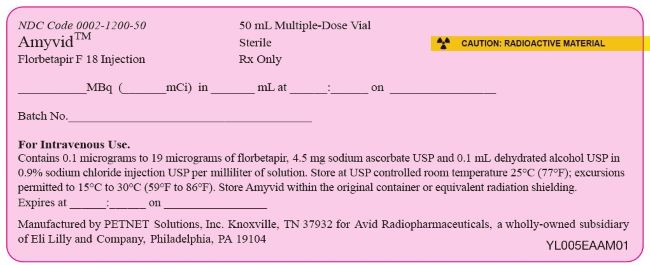
PACKAGE LABEL – Amyvid 50 mL PETNET Label NDC Code 0002-1200-50 50 mL Multiple-Dose Vial Sterile Rx only ☢ CAUTION: RADIOACTIVE MATERIAL Amyvid TM Florbetapir F 18 Injection ____MBq (____mCi) in ____mL at ____:____ on ____ Batch No. ________________ For Intravenous Use. Contains 0.1 to 19 micrograms of florbetapir, 4.5 mg sodium ascorbate USP and 0.1 mL dehydrated alcohol USP in 0.9% sodium chloride injection USP per milliliter of solution. Store at USP controlled room temperature 25ºC (77ºF); excursions permitted to 15ºC to 30ºC (59ºF to 86ºF).
Stopre Amyvid within the original container or eqivalent radiation shielding. Expires at ____:____ on ______________ Manufactured by PETNET Solutions, Inc. Knoxville, TN 37932 for Avid Radiopharmaceuticals, a wholly-owned subsidiary of Eli Lilly and Company, Philadelphia, PA 19104 Amyvid 50mL Container Label
Reported adverse events (FAERS)
Top reported reactions
Age at onset
Reporter sex
Serious outcomes
Where does this data come from?
About this NDC listing & data coverage
What data is (and isn’t) available for this NDC — tap to expand
| NDC identity (package / product / labeler codes) | ✓ Available |
| Labeler | ✓ Available |
| Product & package description | ✓ Available |
| Marketing category & status | ✓ Available |
| Active ingredient / dosage form / route | ✓ Available |
| FDA label (SPL via DailyMed) | ✓ Available |
| Package photos | ✓ Available |
| Inactive ingredients (structured) | ✓ Available |
| NADAC pharmacy acquisition price (CMS) | — Not published for this NDC CMS publishes NADAC only for NDCs reported in its retail-pharmacy survey. |
| Orange Book / therapeutic-equivalence data | ✓ Available |
| HCPCS J-code billing crosswalk | — Not published for this NDC Most self-administered / retail products have no J-code — that is normal. |
| Medicaid utilization (CMS SDUD) | — Not published for this NDC CMS reports utilization only for NDCs with Medicaid claims above its privacy threshold. |