
NDC 00005-0100-02: Trumenba meningococcal group B vaccine 60 mcg/.5mL; 60 mcg/.5mL Injection, Suspension, 1 syringe
This is a package of 1 syringe of Trumenba meningococcal group B vaccine 60 mcg/.5mL; 60 mcg/.5mL Injection, Suspension from Wyeth Pharmaceutical Division of Wyeth Holdings LLC, first listed with the FDA Nov 2014 and currently FDA-listed. It is the main listing for this product, which comes in 3 package sizes.
NDC Database Record
One package, one record: these facts belong to NDC 0005-0100-02 alone.
- Record
- FDA NDC Directory package listing · Vaccine
- Code segments
- 0005 labeler · 0100 product · 02 package
- Listing certified through
- Dec 31, 2027
- Barcode (UPC-A, from the NDC)
- 3 0005010002 7
- FDA record last changed
- Oct 24, 2026
Identity & Classification
Regulatory identifiers FDA, NLM and CMS codes for this package
Drug-database identifiers Medi-Span GPI and First Databank GCN / HICL / AHFS classification
- GPI-14 (Medi-Span): 1720004012E610
Where does this data come from?
- FDA openFDA NDC Directory · synced Nov 26, 2026
- FDA label on DailyMed · label index refreshed Nov 26, 2026
- RxNorm (NLM RxNav) · catalog refreshed Nov 26, 2026
- Medi-Span GPI (licensed)
- First Databank (licensed) · refreshed Nov 26, 2026
Clinical
Patient education
Supplement & herbal interactions
Where does this data come from?
- MedlinePlus (NLM) · refreshed Nov 26, 2026
- FDA label on DailyMed · label index refreshed Nov 26, 2026
Ask a licensed pharmacist directly — free, answered by our team.
Pricing
A drug doesn't have one price. Each row is a different public payment system, and none is what you'd pay at the counter — that depends on your insurance. The ⓘ on each row explains what it measures.
| Price system | Per mL | Per package |
|---|---|---|
| Retail pharmacies payNADAC · weekly | Not in the retail survey — common for institutional, discontinued, or low-volume packs. | |
| Medicaid paysCMS SDUD · 12 mo | No recent Medicaid claims on file for this NDC — rare and low-volume NDCs are suppressed in the public data. | |
| Medicare drug plans payPart D · quarterly | No Part D plan price is available for this NDC in our data. | |
Where does this data come from?
- CMS NADAC weekly file
- CMS ASP pricing files · refreshed Nov 20, 2026
- CMS Medicaid State Drug Utilization Data · refreshed Nov 28, 2026
- CMS Part D plan pricing files · refreshed Nov 24, 2026
- VA National Acquisition Center price file
Packaging — All Sizes for This Product
| Package NDC | Description | Marketing start | Marketing end | Status |
|---|---|---|---|---|
| 00005-0100-02 You're viewing this Main listing | 1 SYRINGE in 1 CARTON / .5 mL in 1 SYRINGE Inner NDC 0005-0100-01 · each syringe (.5 mL) | 2014-11-05 | — | Active |
| 00005-0100-05 0005-0100-05 | 5 SYRINGE in 1 CARTON / .5 mL in 1 SYRINGE Inner NDC 0005-0100-01 · each syringe (.5 mL) | 2014-11-05 | — | Active |
| 00005-0100-10 0005-0100-10 | 10 SYRINGE in 1 CARTON / .5 mL in 1 SYRINGE Inner NDC 0005-0100-01 · each syringe (.5 mL) | 2014-11-05 | — | Active |
Pack size FAQ
What quantity is in this package?
How does this package differ from NDC 00005-0100-05?
What NDC number is used to bill for this package of Trumenba meningococcal group B vaccine 60 mcg/.5mL; 60 mcg/.5mL Injection, Suspension?
Therapeutic Equivalents
| Product | Labeler | Pack | NADAC/unit | TE | Status | Price vs. this |
|---|---|---|---|---|---|---|
| Trumenba 60 ug/.5mL; 60 ug/.5mLthis 00005-0100-02 | Wyeth | 1 syringe | — | — | FDA listed | — |
Where does this data come from?
- FDA openFDA NDC Directory · synced Nov 26, 2026
- FDA Purple Book · refreshed Nov 5, 2026
- CMS NADAC weekly file
Availability & Biosimilar Status
Biologics have no small-molecule generics; biosimilar competition is tracked in the FDA Purple Book.
Why the date isn’t exact: Biosimilar timing can change because patents may be challenged, settled, licensed, added or removed, and litigation can move the real date earlier or later.
What do these terms mean?
- Biologic patent
- A patent the reference product’s maker has publicly listed. A biosimilar generally can’t launch until these expire — unless they’re invalidated or resolved in a settlement.
- Reference-product exclusivity
- A flat 12 years of FDA market protection from the biologic’s first licensure (the BPCIA). No biosimilar can be licensed before it ends, regardless of patents.
- Interchangeable exclusivity
- The first interchangeable biosimilar can earn a period as the only interchangeable version (pharmacists can substitute it without the prescriber).
- Earliest biosimilar (LOE)
- The latest of all the dates above — the soonest a biosimilar can realistically reach the market. Litigation and settlements can move it earlier.
Biologics have no small-molecule “generics” — competition comes from FDA-licensed biosimilars, tracked in the FDA Purple Book.
| Code | What it grants | Expires |
|---|---|---|
| RefProduct | Reference-product exclusivity (12-year, BPCIA) — no biosimilar can be licensed before this date | Oct 29, 2026 |
Is there a biosimilar for this drug?
Why do different websites show different biosimilar dates?
Can a biosimilar launch before the last patent expires?
What does “current Purple Book estimate” mean?
What does “FDA listed” mean?
What does a patent or protection date mean here?
Where does this data come from?
- FDA Purple Book · refreshed Nov 5, 2026
Inactive Ingredients / Excipients
Inactive ingredients, also called excipients, are components of the drug product other than the active ingredient. They may include fillers, dyes, coatings, preservatives, flavors, or other formulation ingredients.
Tap an ingredient (hover on desktop) to see what it is and why it’s used.
-
0.25 mg / 0.5 mL
UNII F92V3S521O
Aluminum phosphate is an inorganic salt used in medications as a buffer and absorbent. It helps stabilize the product's pH and can absorb moisture or other substances in the formulation.
-
UNII 4QD397987E
An amino acid used as a buffer and stabilizer in medications. It helps maintain the pH balance and protects the active drug from breaking down during storage and use.
-
0.018 mg / 0.5 mL
UNII 6OZP39ZG8H
Polysorbate 80 is a synthetic emulsifier derived from sorbitol and oleic acid. It helps mix oil and water-based ingredients together in medications and improves how the product disperses in the body.
-
UNII 451W47IQ8X
Sodium chloride is common table salt. It's used in medicines as a buffer to maintain proper pH, as a filler to add bulk, or to adjust the osmotic balance in liquid formulations.
-
UNII 059QF0KO0R
Water is a liquid solvent that dissolves and mixes ingredients together in liquid medicines, syrups, and injections. It helps distribute the active drug evenly throughout the product.
5 inactive ingredients listed in the exact product block matched to this NDC.
Where does this data come from?
ingredient classCode="IACT" elements from the exact product block matched by this NDC. Label-section narrative from DailyMed / the openFDA label index is shown separately when available.- FDA label on DailyMed · label index refreshed Nov 26, 2026
- FDA openFDA NDC Directory · synced Nov 26, 2026
Inactive ingredient FAQ
Are inactive ingredients the same for every manufacturer?
Why might an inactive ingredient be missing?
Can inactive ingredients matter?
Manufacturer & Labeler
More NDCs from Wyeth Pharmaceutical Division of Wyeth Holdings... labeler code 00005
Where does this data come from?
- FDA openFDA NDC Directory · synced Nov 26, 2026
- Drugs@FDA
Full FDA Label FDA SPL
Indications and Usage
1 INDICATIONS AND USAGE Trumenba is indicated for active immunization to prevent invasive disease caused by Neisseria meningitidis serogroup B. Trumenba is approved for use in individuals 10 through 25 years of age. Trumenba is indicated for active immunization to prevent invasive disease caused by Neisseria meningitidis serogroup B. Trumenba is approved for use in individuals 10 through 25 years of age. ( 1 )
Dosage and Administration
2 DOSAGE AND ADMINISTRATION For intramuscular use only. ▪ For intramuscular use only. ( 2 ) ▪ Two-dose schedule: Administer a dose (0.5 mL) at 0 and 6 months. If the second dose is administered earlier than 6 months after the first dose, a third dose should be administered at least 4 months after the second dose. ( 2.1 ) ▪ Three-dose schedule: Administer a dose (0.5 mL) at 0, 1–2, and 6 months. ( 2.1 )
2.1Dose and Schedule Two-dose schedule: Administer a dose (0.5 mL) at 0 and 6 months. If the second dose is administered earlier than 6 months after the first dose, a third dose should be administered at least 4 months after the second dose. Three-dose schedule: Administer a dose (0.5 mL) at 0, 1–2, and 6 months. The choice of dosing schedule may depend on the risk of exposure and the patient's susceptibility to meningococcal serogroup B disease.
2.2Administration Shake syringe vigorously to ensure that a homogenous white suspension of Trumenba is obtained. Do not use the vaccine if it cannot be re-suspended. Parenteral drug products should be inspected visually for particulate matter and discoloration prior to administration, whenever solution and container permit.
Do not use if particulate matter or discoloration is found. Inject each 0.5 mL dose intramuscularly, using a sterile needle attached to the supplied prefilled syringe. The preferred site for injection is the deltoid muscle of the upper arm.
Do not mix Trumenba with any other vaccine in the same syringe.
2.3Use of Trumenba with other Meningococcal Group B Vaccines Data are not available on the safety and effectiveness of using Trumenba and other meningococcal group B vaccines interchangeably to complete the vaccination series.
Dosage Forms and Strengths
3 DOSAGE FORMS AND STRENGTHS Trumenba is a suspension for intramuscular injection in 0.5 mL single-dose prefilled syringe. Suspension for intramuscular injection in 0.5 mL single-dose prefilled syringe. ( 3 )
Contraindications
4 CONTRAINDICATIONS Severe allergic reaction (e.g. anaphylaxis) to any component of Trumenba [see Description (11) ] . Severe allergic reaction (e.g., anaphylaxis) to any component of Trumenba. ( 4 )
Warnings and Cautions
5 WARNINGS AND PRECAUTIONS Syncope (fainting) can occur in association with administration of injectable vaccines, including Trumenba. Procedures should be in place to avoid injury from fainting. ( 5.4 )
5.1Management of Allergic Reactions Epinephrine and other appropriate agents used to manage immediate allergic reactions must be immediately available should an acute anaphylactic reaction occur following administration of Trumenba.
5.2Altered Immunocompetence Reduced Immune Response Some individuals with altered immunocompetence may have reduced immune responses to Trumenba. Complement Deficiency Persons with certain complement deficiencies and persons receiving treatment that inhibits terminal complement activation (for example, eculizumab) are at increased risk for invasive disease caused by N. meningitidis serogroup B even if they develop antibodies following vaccination with Trumenba [see Clinical Pharmacology (12) ] .
5.3Limitation of Vaccine Effectiveness Vaccination with Trumenba may not protect all vaccine recipients against N. meningitidis serogroup B infections.
5.4Syncope Syncope (fainting) can occur in association with administration of injectable vaccines, including Trumenba. Procedures should be in place to avoid injury from fainting.
Adverse Reactions
6 ADVERSE REACTIONS In clinical studies, the most common solicited adverse reactions in adolescents and young adults were pain at the injection site (≥85%), fatigue (≥60%), headache (≥55%), and muscle pain (≥35%). The most common solicited adverse reactions in adolescents and young adults were pain at the injection site (≥85%), fatigue (≥60%), headache (≥55%), and muscle pain (≥35%). ( 6 ) To report SUSPECTED ADVERSE REACTIONS, contact Pfizer Inc. at 1-800-438-1985 or VAERS at 1-800-822-7967 or http://vaers.hhs.gov .
6.1Clinical Trials Experience Because clinical trials are conducted under widely varying conditions, adverse reaction rates observed in the clinical trials of a vaccine cannot be directly compared to rates in the clinical trials of another vaccine and may not reflect the rates observed in clinical practice. The safety of Trumenba was evaluated in 16,284 subjects 10 through 25 years of age in 12 clinical studies (9 randomized controlled and 3 supportive non-controlled studies) conducted in the U.S., Europe, Canada, Chile, and Australia.
A total of 11,991 subjects 10 through 18 years of age, and 4,293 subjects 19 through 25 years of age received at least one dose of Trumenba. A total of 5,501 subjects 10 through 25 years of age in the control groups received saline placebo and/or one of the following vaccine(s): Human Papillomavirus Quadrivalent (Types 6, 11, 16, and 18) Vaccine, Recombinant (HPV4) (Merck & Co., Inc.); Tetanus Toxoid, Reduced Diphtheria Toxoid and Acellular Pertussis Vaccine Adsorbed (Tdap) (Sanofi Pasteur Ltd.); Meningococcal (Serogroups A, C, Y and W-135) Polysaccharide Diphtheria Toxoid Conjugate Vaccine (MenACWY) (Sanofi Pasteur Inc.); a non-U.S. licensed reduced diphtheria toxoid, tetanus toxoid, acellular pertussis and inactivated polio virus vaccine (dTaP-IPV) (Sanofi Pasteur, Inc.); Hepatitis A Vaccine (HAV) (GlaxoSmithKline Biologicals).
The safety evaluation in the clinical studies included an assessment of: (1) solicited local and systemic reactions, and use of antipyretic medication after each vaccination in an electronic diary maintained by the subject or the subject's parent/legal guardian and (2) spontaneous reports of adverse events (AEs), including serious adverse events (SAEs), throughout the study (day of vaccination through 1 month or 6 months after the last vaccination, depending on the study and safety parameter). In controlled studies, demographic characteristics were generally similar with regard to gender, race, and ethnicity among subjects who received Trumenba and those who received control.
Among participants in clinical trials B1971009 (Study 1009), B1971016 (Study 1016), and B1971057 (Study 1057), 41.3% to 51.5% were male, 76.1% to 87.3% were White, 8.1% to 20.8% were Black or African-American, <2% were Asian, and 5.8% to 17.1% were Hispanic/Latino. Solicited Local and Systemic Adverse Reactions Study 1057 was a randomized, observer-blinded, multicenter trial in the U.S. and Europe. In this study, 1057 subjects 10 through 25 years of age received at least 1 dose of Trumenba on a 0- and 6-month schedule.
Trumenba was co-administered with Meningococcal (Groups A, C, Y, W-135) Oligosaccharide Diphtheria CRM 197 Conjugate Vaccine (MenACWY) (GSK Vaccines, SRL) for the first dose. Study 1009 was a randomized, active-controlled, observer-blinded, multicenter trial in the U.S., Canada, and Europe in which 2,693 subjects 10 through 18 years of age received at least 1 dose of Trumenba on a 0-, 2-, and 6- month schedule. A control group (n=897) received HAV at 0 and 6 months, and saline at 2 months.
Study 1016 was a randomized, placebo-controlled, observer-blinded, multicenter trial in the U.S., Canada, and Europe in which 2,471 subjects 18 through 25 years of age received at least 1 dose of Trumenba and 822 subjects received saline on a 0-, 2,- and 6- month schedule. Local adverse reactions at the injection site were assessed in the three studies. Tables 1, 2, and 3 present the… [Excerpted — this section continues on DailyMed.]
Drug Interactions
7 DRUG INTERACTIONS In clinical trials, Trumenba was administered concomitantly with HPV4 in adolescents 11 through 17 years of age and with MenACWY and Tdap in adolescents 10 through 12 years of age [see Clinical Studies (14) and Adverse Reactions (6) ] .
Use in Specific Populations
8 USE IN SPECIFIC POPULATIONS Pediatric Use: Safety and effectiveness have not been established in children <10 years of age. In a clinical study, 90% of infants <12 months of age who were vaccinated with a reduced dosage formulation had fever. ( 8.4 )
8.1Pregnancy Risk Summary All pregnancies have a risk of birth defect, loss, or other adverse outcomes. In the U.S. general population, the estimated background risk of major birth defects and miscarriage in clinically recognized pregnancies is 2% to 4% and 15% to 20%, respectively. There are no adequate and well-controlled studies of Trumenba in pregnant women.
Available human data on Trumenba administered to pregnant women are insufficient to inform vaccine-associated risks in pregnancy. Two developmental toxicity studies were performed in female rabbits administered Trumenba prior to mating and during gestation. The dose was 0.5 mL at each occasion (a single human dose is 0.5 mL).
These studies revealed no evidence of harm to the fetus or offspring (until weaning) due to Trumenba [see Animal Data ]. Animal Data Two developmental toxicity studies were performed in female rabbits. Animals were administered Trumenba by intramuscular injection 17 days and 4 days prior to mating and on gestation Days 10 and 24.
The dose was 0.5 mL at each occasion (a single human dose is 0.5 mL). No adverse effects on pre-weaning development up to post-natal day 21 were observed. There were no fetal malformations or variations observed due to the vaccine.
8.2Lactation Risk Summary Available data are not sufficient to assess the effects of Trumenba on the breastfed infant or on milk production/excretion. The developmental and health benefits of breastfeeding should be considered along with the mother's clinical need for Trumenba and any potential adverse effects on the breastfed child from Trumenba or from the underlying maternal condition. For preventive vaccines, the underlying maternal condition is susceptibility to disease prevented by the vaccine.
8.4Pediatric Use Safety and effectiveness have not been established in children <10 years of age. In a clinical study, 90% of infants <12 months of age who were vaccinated with a reduced dosage formulation had fever. Clinical data strongly suggest that a two-dose regimen of Trumenba would be ineffective in children 1 to <10 years of age.
8.5Geriatric Use Safety and effectiveness of Trumenba in adults >65 years of age have not been established.
Pregnancy
8.1Pregnancy Risk Summary All pregnancies have a risk of birth defect, loss, or other adverse outcomes. In the U.S. general population, the estimated background risk of major birth defects and miscarriage in clinically recognized pregnancies is 2% to 4% and 15% to 20%, respectively. There are no adequate and well-controlled studies of Trumenba in pregnant women.
Available human data on Trumenba administered to pregnant women are insufficient to inform vaccine-associated risks in pregnancy. Two developmental toxicity studies were performed in female rabbits administered Trumenba prior to mating and during gestation. The dose was 0.5 mL at each occasion (a single human dose is 0.5 mL).
These studies revealed no evidence of harm to the fetus or offspring (until weaning) due to Trumenba [see Animal Data ]. Animal Data Two developmental toxicity studies were performed in female rabbits. Animals were administered Trumenba by intramuscular injection 17 days and 4 days prior to mating and on gestation Days 10 and 24.
The dose was 0.5 mL at each occasion (a single human dose is 0.5 mL). No adverse effects on pre-weaning development up to post-natal day 21 were observed. There were no fetal malformations or variations observed due to the vaccine.
Pediatric Use
8.4Pediatric Use Safety and effectiveness have not been established in children <10 years of age. In a clinical study, 90% of infants <12 months of age who were vaccinated with a reduced dosage formulation had fever. Clinical data strongly suggest that a two-dose regimen of Trumenba would be ineffective in children 1 to <10 years of age.
Geriatric Use
8.5Geriatric Use Safety and effectiveness of Trumenba in adults >65 years of age have not been established.
Clinical Pharmacology
12 CLINICAL PHARMACOLOGY
12.1Mechanism of Action Protection against invasive meningococcal disease is conferred mainly by complement-mediated antibody-dependent killing of N. meningitidis . The effectiveness of Trumenba was assessed by measuring serum bactericidal activity using human complement (hSBA). fHbp is one of many proteins found on the surface of meningococci and contributes to the ability of the bacterium to avoid host defenses. fHbps can be categorized into two immunologically distinct subfamilies, A and B. 1 The susceptibility of serogroup B meningococci to complement-mediated antibody-dependent killing following vaccination with Trumenba is dependent on both the antigenic similarity of the bacterial and vaccine fHbps, as well as the amount of fHbp expressed on the surface of the invading meningococci.
Mechanism of Action
12.1Mechanism of Action Protection against invasive meningococcal disease is conferred mainly by complement-mediated antibody-dependent killing of N. meningitidis . The effectiveness of Trumenba was assessed by measuring serum bactericidal activity using human complement (hSBA). fHbp is one of many proteins found on the surface of meningococci and contributes to the ability of the bacterium to avoid host defenses. fHbps can be categorized into two immunologically distinct subfamilies, A and B. 1 The susceptibility of serogroup B meningococci to complement-mediated antibody-dependent killing following vaccination with Trumenba is dependent on both the antigenic similarity of the bacterial and vaccine fHbps, as well as the amount of fHbp expressed on the surface of the invading meningococci.
How Supplied / Storage and Handling
16 HOW SUPPLIED/STORAGE AND HANDLING
16.1How Supplied Trumenba is supplied in the following strengths and package configurations: Prefilled Syringe, 1 Dose (10 per package) – NDC 0005-0100-10. Prefilled Syringe, 1 Dose (5 per package) – NDC 0005-0100-05. After shipping, Trumenba may arrive at temperatures between 2°C to 25°C (36°F to 77°F). The tip cap and rubber plunger of the prefilled syringe are not made with natural rubber latex.
16.2Storage and Handling Upon receipt, store refrigerated at 2°C to 8°C (36°F to 46°F). Store syringes in the refrigerator horizontally (laying flat on the shelf) to minimize the re-dispersion time. Do not freeze. Discard if the vaccine has been frozen.
16.1How Supplied Trumenba is supplied in the following strengths and package configurations: Prefilled Syringe, 1 Dose (10 per package) – NDC 0005-0100-10. Prefilled Syringe, 1 Dose (5 per package) – NDC 0005-0100-05. After shipping, Trumenba may arrive at temperatures between 2°C to 25°C (36°F to 77°F). The tip cap and rubber plunger of the prefilled syringe are not made with natural rubber latex.
Storage and Handling
16.2Storage and Handling Upon receipt, store refrigerated at 2°C to 8°C (36°F to 46°F). Store syringes in the refrigerator horizontally (laying flat on the shelf) to minimize the re-dispersion time. Do not freeze. Discard if the vaccine has been frozen.
Description
11 DESCRIPTION Trumenba is a sterile suspension composed of two recombinant lipidated factor H binding protein (fHbp) variants from N. meningitidis serogroup B, one from fHbp subfamily A and one from subfamily B (A05 and B01, respectively). 1 The proteins are individually produced in E. coli . Production strains are grown in defined fermentation growth media to a specific density.
The recombinant proteins are extracted from the production strains and purified through a series of column chromatography steps. Polysorbate 80 (PS80) is added to the drug substances and is present in the final drug product. Each 0.5 mL dose contains 60 micrograms of each fHbp variant (total of 120 micrograms of protein), 0.018 mg of PS80 and 0.25 mg of Al 3+ as AlPO 4 in 10 mM histidine buffered saline at pH 6.0.
Information for Patients
17 PATIENT COUNSELING INFORMATION Prior to administration of this vaccine, the healthcare professional should inform the individual, parent, guardian, or other responsible adult of the following: • The importance of completing the immunization series. • Report any suspected adverse reactions to a healthcare professional. Provide the Vaccine Information Statements, which are available free of charge at the Centers for Disease Control and Prevention (CDC) website ( www.cdc.gov/vaccines ). U.S.
Govt. License No. 3 LAB-0722-12.0 Logo
Clinical Studies
14 CLINICAL STUDIES The immunogenicity of Trumenba described in this section is based on results from four clinical studies: • Following the two-dose schedule (0 and 6 months) in subjects 10 through 25 years of age in the U.S. and Europe (Study 1057); • Following the three-dose schedule (0, 2, and 6 months) in subjects 10 through 25 years of age in the U.S., Canada, and Europe (Studies 1009 and 1016); and • Following the two-dose (0 and 6 months) and three-dose schedules (0, 1–2, and 6 months) in subjects 11 through 18 years of age in Europe (Study 1012).
Serum bactericidal antibodies were measured with hSBA assays that used each of four meningococcal serogroup B strains. These four primary test strains express fHbp variants representing the two subfamilies (A and B) of meningococcal serogroup B strains causing invasive disease in the U.S. and Europe. The studies assessed the proportions of subjects with a 4-fold or greater increase in hSBA titer for each of the four primary strains.
The studies also assessed the composite response to the four primary strains combined (proportion of subjects who achieved a hSBA titer greater than or equal to 1:8 [three strains] and 1:16 [one strain]). To assess the effectiveness of the two- and three-dose schedules of Trumenba against diverse meningococcal serogroup B strains, the proportion of subjects achieving a defined hSBA titer (≥LLOQ) following completion of the two- or three-dose series was evaluated against a panel of 10 additional strains, each expressing a different fHbp variant.
14.1Immunogenicity The hSBA responses to each of the primary strains observed after the second dose of Trumenba in Study 1057 are presented in Table 7. Table 7: Percentages of Subjects 10 through 25 Years of Age With ≥4-fold Rise in hSBA Titer and Composite Response Following Administration of Trumenba on a 0-and 6-Month Schedule for Four Primary Strains (Study 1057) Evaluable immunogenicity population. , Study 1057: NCT03135834. Abbreviations: CI=confidence interval; fHbp=factor H binding protein; hSBA=serum bactericidal assay using human complement; LLOQ=lower limit of quantitation; LOD=limit of detection.
Note: LLOQ = 1:16 for A22; 1:8 for A56, B24, and B44. Note: The 4-fold increase is defined as follows: (1) For subjects with a baseline hSBA titer <1:4, a response is defined as an hSBA titer ≥1:16. (2) For subjects with a baseline hSBA titer ≥ LOD and < LLOQ, a response is defined as an hSBA titer ≥4 times the LLOQ.
(3) For subjects with a baseline hSBA titer ≥ LLOQ, a response is defined as an hSBA titer ≥4 times the baseline titer. Note: Pre-specified criteria for assessment of hSBA responses (4-fold rise in titer to each primary test strain, and titer above LLOQ for all four primary test strains) among subjects in the U.S. and Europe were met in this study for all test strains except strain A22. Pre-specified criteria for the lower bound of the 95% CI for 4-fold rise in titer were set at 75%, 85%, 55%, and 60%, respectively, for A22, A56, B24, and B44, and 65% for the composite hSBA response for all four primary test strains. fHbp Variant For the second dose, serum was obtained approximately 1 month after vaccination.
N For ≥ 4-fold increase, N=number of subjects with valid and determinate hSBA titers for the given strain at both the specified time point and baseline. For composite hSBA response, N=number of subjects with valid and determinate hSBA results on all 4 strains at the given time point. U.S. subjects constituted approximately 80% of the total subjects evaluated for immunogenicity. % (95% CI) Exact 2-sided confidence interval (Clopper-Pearson method) based upon the observed proportion of subjects. ≥4-Fold Increase PMB80 (A22) Dose 2 827 73.8 (70.6, 76.7) PMB2001 (A56) Dose 2 823 95.0 (93.3, 96.4) PMB2948 (B24) Dose 2 835 67.4 (64.1, 70.6) PMB2707 (B44) Dose 2 850 86.4 (83.9, 88.6) Composite hSBA Response Composite response = hSBA ≥ LLOQ for all 4 primary meningococcal B strains.
Before Do… [Excerpted — this section continues on DailyMed.]
Nonclinical Toxicology
13 NONCLINICAL TOXICOLOGY Trumenba has not been evaluated for carcinogenic or mutagenic potential or impairment of fertility in males. Vaccination of female rabbits with Trumenba had no effect on fertility [see Pregnancy (8.1) ] .
References
15 REFERENCES 1. Wang X, et al. Prevalence and genetic diversity of candidate vaccine antigens among invasive Neisseria meningitidis isolates in the U.S. Vaccine 2011; 29:4739–4744.
Package Label / Principal Display Panel
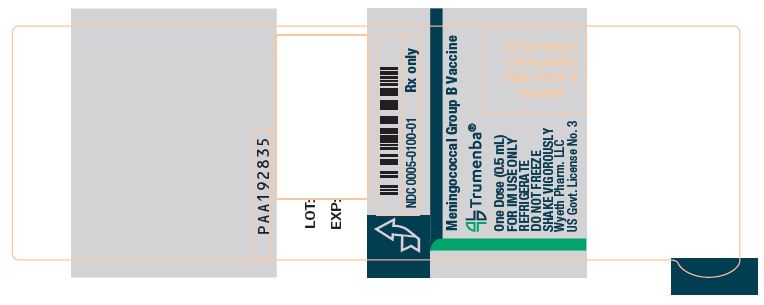
PRINCIPAL DISPLAY PANEL - 0.5 mL Syringe Label NDC 0005-0100-01 Rx only Meningococcal Group B Vaccine Trumenba ® One Dose (0.5 mL) FOR IM USE ONLY REFRIGERATE DO NOT FREEZE SHAKE VIGOROUSLY Wyeth Pharm. LLC US Govt. License No. 3 PRINCIPAL DISPLAY PANEL - 0.5 mL Syringe Label
PRINCIPAL DISPLAY PANEL - 5 - 0.5 mL Syringe Carton NDC 0005-0100-05 Meningococcal Group B Vaccine Trumenba ® For use in individuals 10 through 25 years of age 5 One-Dose (0.5 mL) Prefilled Syringes FOR INTRAMUSCULAR USE ONLY Pfizer Rx only PRINCIPAL DISPLAY PANEL - 5 - 0.5 mL Syringe Carton
PRINCIPAL DISPLAY PANEL - 10 - 0.5 mL Syringe Carton NDC 0005-0100-10 Meningococcal Group B Vaccine Trumenba ® For use in individuals 10 through 25 years of age 10 One-Dose (0.5 mL) Prefilled Syringes FOR INTRAMUSCULAR USE ONLY Pfizer Rx only PRINCIPAL DISPLAY PANEL - 10 - 0.5 mL Syringe Carton
Medicare Part D Spend CMS · Part D · 2026 (Q1)
About This NDC Listing & Data Coverage
What data is (and isn’t) available for this NDC — tap to expand
| NDC identity (package / product / labeler codes) | Available |
| Labeler | Available |
| Product & package description | Available |
| Marketing category & status | Available |
| Active ingredient / dosage form / route | Available |
| FDA label (SPL via DailyMed) | Available |
| Package photos | Available |
| Inactive ingredients (structured) | Available |
| NADAC pharmacy acquisition price (CMS) | — Not published for this NDC CMS publishes NADAC only for NDCs reported in its retail-pharmacy survey. |
| Orange Book / therapeutic-equivalence data | Available |
| HCPCS J-code billing crosswalk | — Not published for this NDC Most self-administered / retail products have no J-code — that is normal. |
| Medicaid utilization (CMS SDUD) | — Not published for this NDC CMS reports utilization only for NDCs with Medicaid claims above its privacy threshold. |