Therapeutic class — broad (HIC1)Ear/Eye/Nose/Rectum/Topical/Vagina/Other
HIC2 codeQ6
Therapeutic class — intermediate (HIC2)Ophthalmic Preparations
HIC3 codeQ6Y
Therapeutic class — specific (HIC3)Eye Preparations, Miscellaneous (Otc)
AHFS code52:92.00.00
AHFS classEent Drugs, Miscellaneous
FDB label nameREFRESH LACRI-LUBE OINTMENT
FDB brand nameRefresh Lacri-Lube
Legend statusO — Over-the-counter (OTC) drug or device
Why two NDCs?
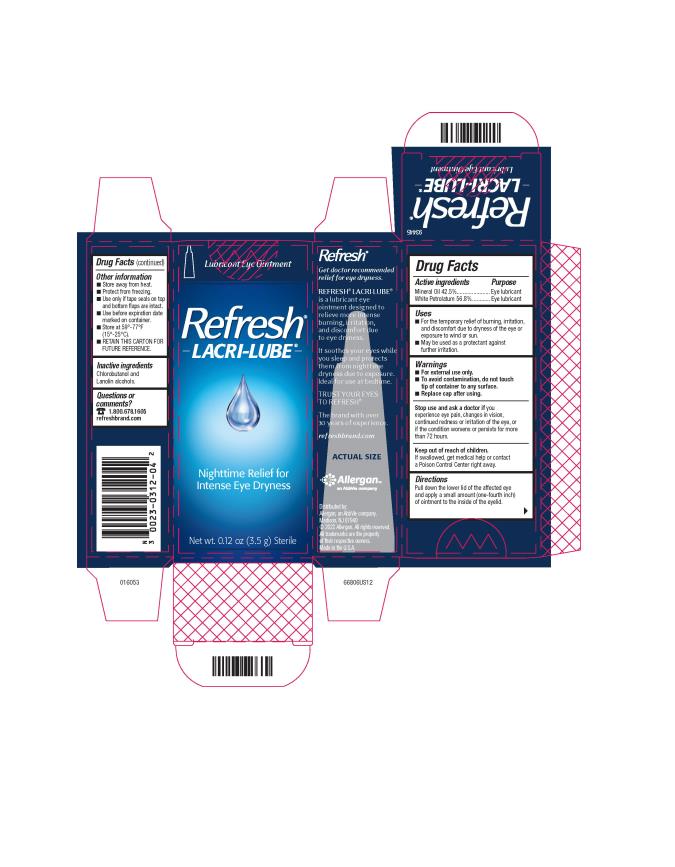
The FDA registers this code as 0023-0312-04 — a 4-4-2 layout, and that's what's printed on the package and shown on DailyMed. For insurance claims, every NDC is standardized to a uniform 11-digit 5-4-2 format by adding a zero to the labeler segment → 00023-0312-04. Same drug, same package — only the format differs.
Where does this data come from?
Identifiers from the FDA openFDA NDC Directory and Structured Product Labeling; RxCUI from RxNorm (NLM); GPI from Medi-Span; GCN / HIC / AHFS / legend from First Databank.
🏷️RxNorm drug class
This medicine belongs to the Softeners, emollients class.
Drug family (ATC)Softeners, emollients
Where does this data come from?
Therapeutic classes from RxNorm RxClass (U.S. National Library of Medicine) — Established Pharmacologic Class (FDA), ATC drug family (WHO) and mechanism of action, matched by this product’s RxCUI.
The labeler markets the product; the application holder owns the FDA approval. They’re often the same company but can differ (e.g. a repackager or an authorized generic). A mailing address / phone appears here when the manufacturer includes it in the product’s FDA label (not all do).
Where does this data come from?
Labeler, application holder and registered establishment from the FDA openFDA NDC Directory and Drugs@FDA; address/contact from the product’s FDA label.
🩺 Clinical
Label name REFRESH LACRI-LUBE OINTMENTIngredient Mineral Oil/Petrolatum,White
🧪 What is this product?
Refresh Lacri-Lube is an over-the-counter eye ointment containing mineral oil and petrolatum. Both ingredients function as lubricants and emollients, and are typically used to coat and protect the eye surface. This product is commonly applied to the eye to help relieve dryness and irritation by forming a protective barrier on the cornea and conjunctiva.
Plain-language summary from MedlinePlus (U.S. National Library of Medicine); supplement & herbal interactions and nutrient depletion data from the Natural Medicines database; our full guide is HelloPharmacist editorial content.
💬 Questions about mineral oil, petrolatum?
Ask a licensed pharmacist directly — free, answered by our team.
Inactive ingredients, also called excipients, are components of the drug product
other than the active ingredient. They may include fillers, dyes, coatings, preservatives, flavors,
or other formulation ingredients.
💡 Tap an ingredient (hover on desktop) to see what it is and why it’s used.
UNII HM4YQM8WRC
Chlorobutanol is a colorless crystalline chemical used as a preservative in medicines. It prevents bacterial and fungal growth to maintain product safety and shelf life.
UNII 884C3FA9HE
Lanolin alcohol is a waxy substance derived from sheep's wool. It functions as an emollient and emulsifier in medicines, helping blend oil and water-based ingredients while softening the product's texture.
2 inactive ingredients listed in the exact product block matched to this NDC.
The official label also statesChlorobutanol and Lanolin alcohols.
Label-section wording can be broader than the structured product block and may mention additional formulation ingredients.
Where does this data come from?
Data sourced from official FDA Structured Product Labeling (SPL) via DailyMed — ingredient classCode="IACT" elements from the exact product block matched by this NDC. Label-section narrative from DailyMed / the openFDA label index is shown separately when available.
Inactive ingredient FAQ
Are inactive ingredients the same for every manufacturer?
No. Inactive ingredients can differ by manufacturer, dosage form, strength, and package / product version.
Why might an inactive ingredient be missing?
Some SPLs do not provide a complete structured inactive-ingredient list, and older or unusual labels may only include the information in narrative text.
Can inactive ingredients matter?
Yes. They can matter for allergies, intolerances, dyes, gluten / lactose concerns, preservatives, and formulation differences — but confirm with a pharmacist or the manufacturer when it’s clinically important.
💲 Pricing
A drug doesn't have one price. Each row is a different public payment system, and none is what you'd pay at the counter — that depends on your insurance. The ⓘ on each row explains what it measures.
Price system
Per g
Per package
Retail pharmacies payNADAC · weekly
$2.788
$9.76 / 3.5 g
Medicaid paysCMS SDUD · 12 mo
$4.97
$17.41 / 3.5 g
Medicare drug plans payPart D · quarterly
No Part D plan price is available for this NDC in our data.
NADAC price history (per g) — tap or hover for the price & month
Flat over the last 5 months.
Where does this data come from?
NADAC (National Average Drug Acquisition Cost) is the CMS weekly pharmacy-acquisition-cost survey — what pharmacies pay. ASP (Average Sales Price) is the CMS Medicare Part B drug-payment file, published quarterly. Medicaid pays is computed by us from CMS State Drug Utilization Data (total reimbursed ÷ units, trailing 12 months) — gross of rebates and inclusive of dispensing fees, so it reflects what Medicaid paid, not an acquisition cost. Medicare drug plans pay is the median negotiated point-of-sale unit cost across plans listing this NDC in the CMS quarterly Prescription Drug Plan pricing files, before rebates. The VA pays is the federal contract price (FSS, and the statutory Big 4 ceiling where listed) from the VA National Acquisition Center pharmaceutical price file. All are free public government data; each measures a different payer, so the figures are not directly comparable.
About this product: other versions of the same ingredient, strength and form are listed above, least expensive first, with FDA equivalence ratings where available.
Where does this data come from?
Equivalents are other NDCs of the same ingredient, form and route from the openFDA NDC Directory, ranked least-expensive-first by NADAC. Therapeutic-equivalence (AB) ratings come from the FDA Orange Book; biologics use the FDA Purple Book for biosimilar & interchangeable status.
⏳ Availability & generic status
🏛️
1977
On the market since
Dec 1977
📍
2026
Currently FDA-listed
49 years listed
🔒
·
No generic listed yet
brand only
ℹ️No FDA-approved generic found
We did not find an FDA-approved generic match for this exact strength, form and route.
Where does this data come from?
Patents and exclusivity from the FDA Orange Book (small-molecule drugs), refreshed from public FDA data. Generic launch timing is an estimate, not a guarantee.
🗺️ Medicaid utilization & spend
📍 This exact package only: Medicaid data is reported per full 11-digit NDC — labeler, product and pack size — so every number here is for 00023-0312-04, not the drug overall. Other pack sizes report separately.
💊 Pharmacy benefit only: These are Medicaid outpatient pharmacy claims, billed by NDC. They exclude the medical benefit — clinic- or hospital-administered drugs billed under HCPCS J-codes — so drugs used mostly that way (e.g. Avastin, Lucentis, Keytruda) can look low or missing here. That’s expected, not an error.
📅 Q1 2025 – Q1 2026 · 5 quarters of data
ⓘ The newest quarter is usually incomplete when first published; states restate recent quarters in later CMS releases, so the latest figures typically revise upward. State coverage-policy changes can also shift quarter-to-quarter totals.
Prescriptions last 4 qtrs
34.9K
Units reimbursed last 4 qtrs
132.8K
Gross reimbursed last 4 qtrs
$660.6K
Avg / prescription
$18.93
Avg / unit
$4.9736
Latest quarter Q1 2026
8KRx
Medicaid pays / g
$4.9736
gross reimbursed
vs
NADAC / g
$2.7881
acquisition cost
=
Spread
+$2.1855
+78% vs cost
What Medicaid paid per g (before rebates; includes the pharmacy’s dispensing fee) compared with NADAC — the average price pharmacies pay to buy the drug. A positive spread means Medicaid reimbursed more than the purchase price, before manufacturer rebates.
Fee-for-service vs managed care ⓘ
91% FFS
Fee-for-service · 31,869 Rx Managed care · 3,039 Rx
State Medicaid map
Units reimbursed · per 100k residents
2.0570
gray = no data reported ⓘ
Colors are per 100,000 residents, so big states don’t automatically dominate. Tap or hover a state for its actual totals.
Tap or hover a state
…for its Medicaid breakdown
Prescriptions—
Units—
Reimbursed—
🏆 Top states by units · per 100k residents
1New York570 /100k
2Minnesota44.4 /100k
3New Mexico41.2 /100k
4Michigan31.2 /100k
5Indiana20.5 /100k
6Wisconsin20.2 /100k
7Missouri17.9 /100k
8New Jersey17.3 /100k
National units — by quarter
💵 About the dollar figures: “reimbursed” is what Medicaid paid pharmacies before confidential manufacturer rebates, so the program’s real net cost is lower than these numbers. Fee-for-service and managed-care claims are combined unless split above. Source: CMS State Drug Utilization Data; per-100k rates use 2023 Census population estimates.
💊 Medicaid utilization by pack size
Medicaid (SDUD) totals over the four most recent reported quarters for every package size of this drug — handy when a specific package (e.g. a starter/titration pack) carries little or no Medicaid volume on its own.
In Medicaid, this is the most-dispensed pack of this product — about 100% of fills over the last four reported quarters. See all packs ↓
Pack size FAQ
What quantity is in NDC 00023-0312-04?
NDC 00023-0312-04 contains 1 tube — 1 tube in 1 carton / 3.5 g in 1 tube.
What NDC number is used to bill for this package of REFRESH LACRI-LUBE mineral oil, petrolatum 425 mg/g; 568 mg/g Ointment?
Bill NDC 00023-0312-04 — the 11-digit billing format is 00023031204. Pharmacy and medical claims use the 11-digit form; the FDA label may print a shorter form of the same code.
Prices are the latest CMS NADAC pharmacy acquisition cost per NDC; per-pack figures are per-unit × pack quantity, shown only when the pack is denominated in the same measure NADAC prices.
📄 FDA label — Drug Facts FDA SPL
The complete FDA label for this product — the official Drug Facts labeling, verbatim, section by section. Jump with a chip, search within the label, or expand everything.
Uses For the temporary relief of burning, irritation, and discomfort due to dryness of the eye or exposure to wind or sun. May be used as a protectant against further irritation.
⏱️Dosage and Administration25 words▾
Directions Pull down the lower lid of the affected eye and apply a small amount (one-fourth inch) of ointment to the inside of the eyelid.
⚠️Warnings73 words▾
Warnings For external use only. To avoid contamination, do not touch tip of container to any surface. Replace cap after using. Stop use and ask a doctor if you experience eye pain, changes in vision, continued redness or irritation of the eye, or if the condition worsens or persists for more than 72 hours. Keep out of reach of children. If swallowed, get medical help or contact a Poison Control Center right away.
🧪Active Ingredient8 words▾
Active ingredients Mineral Oil 42.5% White Petrolatum 56.8%
🧪Inactive Ingredients6 words▾
Inactive ingredients Chlorobutanol and Lanolin alcohols.
🎯Purpose5 words▾
Purpose Eye lubricant Eye lubricant
No label section mentions that — try another word, or open the full label on DailyMed below.
Source: FDA Structured Product Labeling, mirrored from DailyMed / openFDA.
Prefer the government’s original formatting? View this label on DailyMed ↗
For educational and professional reference only — not medical advice. Pricing reflects published
NADAC and CMS ASP (free public data) and may differ from your acquisition cost; always verify before billing or dispensing.