
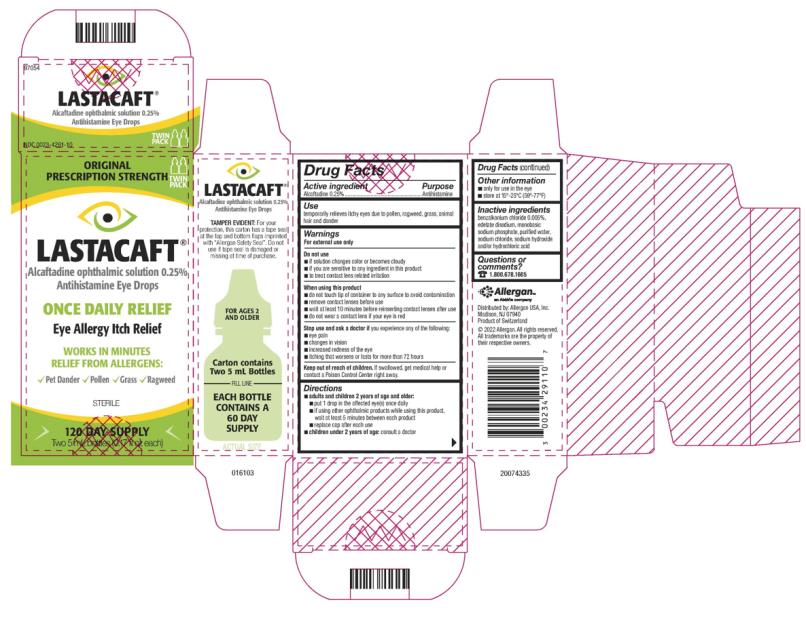
LASTACAFT alcaftadine 2.5 mg/mL Solution/ Drops — NDC 0023-4291-06 (Billing 00023-4291-06)
This is a package of LASTACAFT alcaftadine 2.5 mg/mL Solution/ Drops from Allergan, Inc., marketed since Dec 2021 and currently FDA-listed.
NDC database record
One package, one record: these facts belong to NDC 0023-4291-06 alone.
- Record
- FDA NDC Directory package listing · Human OTC drug
- Code segments
- 0023 labeler · 4291 product · 06 package
- Package marketed since
- Dec 1, 2021
- Sample package
- No — commercial package
- Listing certified through
- Dec 31, 2026
- Barcode (UPC-A, from the NDC)
- 3 0023429106 0
- FDA record last changed
- Jul 24, 2026
Identity & classification
Regulatory identifiers FDA, NLM and CMS codes for this package
Drug-database identifiers Medi-Span GPI and First Databank GCN / HICL / AHFS classification
- GSN (GCN sequence number): 066954
- GCN: 29389
- GPI-14 (Medi-Span): 86802004002020
- HICL (First Databank): 037330
- AHFS class code: 04:08.00.00
- RxCUI (RxNorm): 1000085
Where does this data come from?
- FDA openFDA NDC Directory · synced Oct 8, 2026
- FDA label on DailyMed · label index refreshed Oct 8, 2026
- RxNorm (NLM RxNav) · catalog refreshed Oct 1, 2026
- Medi-Span GPI (licensed)
- First Databank (licensed) · refreshed Oct 8, 2026
RxNorm drug class
This medicine belongs to the Histamine-1 Receptor Antagonist class.
Where does this data come from?
- RxClass (NLM) · catalog refreshed Oct 1, 2026
Clinical
Ophthalmic alcaftadine is used to relieve the itching of allergic pinkeye. Alcaftadine is in a class of medications called antihistamines. It works by blocking histamine, a substance in the body that causes allergic symptoms.
Read the full MedlinePlus article ↗- Lastacaft helps prevent itching in your eyes caused by eye allergies — specifically allergic conjunctivitis. It blocks the histamine receptors in your eyes and also stops allergy c...
- What exactly does Lastacaft do for my eyes?
- No — you need to wait at least 10 minutes after using Lastacaft before putting your lenses back in. That's because the preservative in the drops can be absorbed by soft contact len...
- Can I put my contact lenses back in right after using the drops?
Patient education
Supplement & herbal interactions
Where does this data come from?
- MedlinePlus (NLM) · refreshed Oct 8, 2026
- FDA label on DailyMed · label index refreshed Oct 8, 2026
Ask a licensed pharmacist directly — free, answered by our team.
Pricing
A drug doesn't have one price. Each row is a different public payment system, and none is what you'd pay at the counter — that depends on your insurance. The ⓘ on each row explains what it measures.
| Price system | Per mL | Per package |
|---|---|---|
| Retail pharmacies payNADAC · weekly | Not in the retail survey — common for institutional, discontinued, or low-volume packs. | |
| Medicaid paysCMS SDUD · 12 mo | No recent Medicaid claims on file for this NDC — rare and low-volume NDCs are suppressed in the public data. | |
| Medicare drug plans payPart D · quarterly | No Part D plan price is available for this NDC in our data. | |
Where does this data come from?
- CMS NADAC weekly file
- CMS ASP pricing files · refreshed Sep 20, 2026
- CMS Medicaid State Drug Utilization Data · refreshed Oct 8, 2026
- CMS Part D plan pricing files · refreshed Sep 24, 2026
- VA National Acquisition Center price file
Packaging — all sizes for this product
| Package NDC | Description | Per unit | Per pack | Marketing start | Marketing end | Status |
|---|---|---|---|---|---|---|
| 00023-4291-01 0023-4291-01 | 1 BOTTLE, PLASTIC in 1 CARTON / 1 mL in 1 BOTTLE, PLASTIC Sample | — | — | 2021-12-01 | — | Active |
| 00023-4291-05 0023-4291-05 Main listing | 1 BOTTLE, PLASTIC in 1 CARTON / 5 mL in 1 BOTTLE, PLASTIC | $2.83 / mL | $14.17 | 2021-12-01 | — | Active |
| 00023-4291-06 You're viewing this | 1 BOTTLE, PLASTIC in 1 CARTON / 5 mL in 1 BOTTLE, PLASTIC | — | — | 2021-12-01 | — | Active |
| 00023-4291-07 0023-4291-07 | 2 BOTTLE, PLASTIC in 1 CARTON / 5 mL in 1 BOTTLE, PLASTIC | — | — | 2021-12-01 | — | Active |
| 00023-4291-10 0023-4291-10 | 2 BOTTLE, PLASTIC in 1 CARTON / 5 mL in 1 BOTTLE, PLASTIC | — | — | 2021-12-01 | — | Active |
This pack shows little to no recent Medicaid volume — a different pack size carries most fills. See all packs ↓
Pack size FAQ
What quantity is in this package?
What NDC number is used to bill for this package of LASTACAFT alcaftadine 2.5 mg/mL Solution/ Drops?
Prices are the latest CMS NADAC pharmacy acquisition cost per NDC; per-pack figures are per-unit × pack quantity, shown only when the pack is denominated in the same measure NADAC prices.
Therapeutic equivalents
| Product | Labeler | Pack | NADAC/unit | TE | Status | Price vs. this |
|---|---|---|---|---|---|---|
| Lastacaft 2.5 mg/mL 00023-4290-01 | Allergan, | 1 bottle | — | — | FDA listed | — |
| Lastacaft 2.5 mg/mLthis 00023-4291-06 | Allergan, | 1 bottle | — | — | FDA listed | — |
| Alcaftadine 2.5 mg/mL 58602-0605-40 | Aurohealth | 1 bottle | — | — | FDA listed | — |
| alcaftadine 2.5 mg/mL 62332-0147-03 | Alembic | 1 bottle | — | — | FDA listed | — |
| Alcaftadine 2.5 mg/mL 68083-0649-01 | Gland | 1 bottle | — | — | FDA listed | — |
Where does this data come from?
- FDA openFDA NDC Directory · synced Oct 8, 2026
- FDA Orange Book · refreshed Oct 3, 2026
- CMS NADAC weekly file
Availability & generic status
The FDA lists approved generic versions of this medicine, but that does not always mean a pharmacy can get one today. Patent rules, launch agreements, supply and pricing can affect when generics actually arrive.
Why the date isn’t exact: Generic timing can change because patents may be challenged, settled, licensed, added, removed, or worked around with a narrower label — and FDA approval does not always mean a pharmacy can get the generic today.
🛈 What do these terms mean?
- Patent
- Legal protection listed in the Orange Book that may delay generic approval or launch. Issued by the U.S. Patent & Trademark Office.
- Substance patent
- Covers the active drug molecule itself — the hardest to design around. A generic generally can’t launch until it expires.
- Formulation (product) patent
- Covers a specific formulation or dosage form. A generic can sometimes work around it with a different formulation.
- Method-of-use patent
- A patent covering one specific approved use of the drug — not necessarily the whole molecule. A generic can sometimes launch with a “skinny label” that carves out the protected use and keeps the others.
- Skinny label
- A generic label that omits a still-patented use when the FDA allows it — letting a generic reach the market for the unprotected uses.
- Exclusivity
- FDA-granted marketing protection, separate from patents — e.g. 5-yr new chemical entity, 7-yr orphan drug, or a +6-month pediatric extension.
- Paragraph IV
- A generic applicant’s formal challenge to a listed patent. It can potentially lead to earlier generic entry, but often involves litigation or a settlement.
- RLD / RS
- Reference Listed Drug — the brand product the FDA uses as the reference for generic applications. Reference Standard — the product the FDA expects generics to compare against in bioequivalence testing.
- TE / AB rating
- FDA therapeutic-equivalence rating. An AB rating generally means the FDA considers a generic therapeutically equivalent to — and substitutable for — the brand.
- LOE (loss of exclusivity)
- The latest patent or exclusivity currently listed — the loss-of-exclusivity / latest-listed-protection date shown on this page. Paragraph-IV challenges and settlements can move the real date earlier; FDA approval and a manufacturer’s decision to market can move it later.
Built from the FDA Orange Book. The bars above are scaled to each protection’s expiry; the red LOE marker is the last one to lapse.
| Patent | Type | Use code | Expires |
|---|---|---|---|
| US 8664215 ↗ | Method of use | U-3267 | Dec 23, 2027 |
| US 10617695 ↗ | Method of use | U-3267 | Mar 19, 2027 |
Is there a generic version of LASTACAFT ONCE DAILY 0.25% DRP?
The FDA approved a generic — why can’t I get it at my pharmacy yet?
Why do different websites show different generic release dates?
What does “FDA listed” mean?
What does a patent or protection date mean here?
What does “current Orange Book estimate” mean?
Can a generic come out before the last patent expires?
Can a generic come out after the listed dates?
What is the difference between patents and exclusivity?
Why are there multiple patent dates?
Where does this data come from?
- FDA Orange Book · refreshed Oct 3, 2026
Inactive Ingredients / Excipients
Inactive ingredients, also called excipients, are components of the drug product other than the active ingredient. They may include fillers, dyes, coatings, preservatives, flavors, or other formulation ingredients.
🧪 Avoiding an ingredient? See Alcaftadine Ophthalmic inactive ingredients by manufacturer: every current product's list side by side, so you can ask your pharmacy for the version that does not list it.
💡 Tap an ingredient (hover on desktop) to see what it is and why it’s used.
-
UNII F5UM2KM3W7
Benzalkonium chloride is a chemical compound that works as a preservative and antimicrobial agent in medications. It prevents bacterial and fungal growth in liquid formulations to keep the product safe during storage and use.
-
UNII 7FLD91C86K
Edetate disodium is a chemical compound that binds and removes certain metal ions. In medicines, it acts as a preservative and stabilizer by preventing metals like calcium from interfering with the product's shelf life and consistency.
-
UNII QTT17582CB
A strong acid used to adjust and maintain the proper pH level in liquid medicines, ensuring stability and preventing breakdown of active ingredients.
-
UNII 451W47IQ8X
Sodium chloride is common table salt. It's used in medicines as a buffer to maintain proper pH, as a filler to add bulk, or to adjust the osmotic balance in liquid formulations.
-
UNII 55X04QC32I
A strong alkaline chemical used to adjust and maintain the pH balance of liquid medicines. It helps keep the medicine stable and ensures it stays effective during storage.
-
UNII 3980JIH2SW
A salt form of phosphoric acid that acts as a buffer and pH adjuster in medicines. It helps keep the product at the correct acidity level for stability and effectiveness.
-
UNII 059QF0KO0R
Water is a liquid solvent that dissolves and mixes ingredients together in liquid medicines, syrups, and injections. It helps distribute the active drug evenly throughout the product.
7 inactive ingredients listed in the exact product block matched to this NDC.
Label-section wording can be broader than the structured product block and may mention additional formulation ingredients.
Where does this data come from?
ingredient classCode="IACT" elements from the exact product block matched by this NDC. Label-section narrative from DailyMed / the openFDA label index is shown separately when available.- FDA label on DailyMed · label index refreshed Oct 8, 2026
- FDA openFDA NDC Directory · synced Oct 8, 2026
Inactive ingredient FAQ
Are inactive ingredients the same for every manufacturer?
Why might an inactive ingredient be missing?
Can inactive ingredients matter?
Manufacturer & labeler
More NDCs from Allergan, Inc. labeler code 00023
- Refresh Relieva PF Xtra Carboxymethylcellulose Sodium and Glycerin 5 mg/mL; 9 mg/mL Solution/ Drops NDC 0023-3782-10
- BOTOX Cosmetic onabotulinumtoxinA 50 [USP'U]/1 Injection, Powder, Lyophilized, For Solution NDC 0023-3919-50
- BOTOX onabotulinumtoxinA 200 [USP'U]/1 Injection, Powder, Lyophilized, For Solution NDC 0023-3921-02
- Refresh Optive Mega-3 PF carboxymethylcellulose sodium, Glycerin, Polysorbate 80 5 mg/mL; 10 mg/mL; 80 5 mg/mL Solution/ Drops NDC 0023-3988-05
- REFRESH Optive Mega-3 Carboxymethylcellulose sodium, Glycerin and Polysorbate 80 5 mg/mL; 10 mg/mL; 80 5 mg/mL Solution/ Drops NDC 0023-4230-70
- LASTACAFT alcaftadine 2.5 mg/mL Solution/ Drops NDC 0023-4290-01
- REFRESH OPTIVE Advanced carboxymethylcellulose sodium, glycerin, and polysorbate 80 5 mg/mL; 10 mg/mL; 80 5 mg/mL Solution/ Drops NDC 0023-4307-02
- REFRESH OPTIVE Advanced carboxymethylcellulose sodium, glycerin, polysorbate 80 5 mg/mL; 10 mg/mL; 80 5 mg/mL Solution/ Drops NDC 0023-4491-05
- Refresh RELIEVA PF Carboxymethylcellulose sodium and Glycerin 5 mg/mL; 10 mg/mL Solution/ Drops NDC 0023-4515-30
- REFRESH CELLUVISC carboxymethylcellulose sodium 10 mg/mL Gel NDC 0023-4554-05
- SKIN MEDICA Purifying Foaming Wash salicylic acid 20 mg/mL Liquid NDC 0023-4948-05
- BOTULINUM TOXIN TYPE A 100 [USP'U]/mL Powder NDC 0023-5027-99
Where does this data come from?
- FDA openFDA NDC Directory · synced Oct 8, 2026
- Drugs@FDA
FDA label — Drug Facts FDA SPL
🎯 Indications and Usage ▾
Us e temporarily relieves itchy eyes due to pollen, ragweed, grass, animal hair and dander
⏱️ Dosage and Administration ▾
Directions a dults and children 2 years of age and older: put 1 drop in the affected eye(s) once daily if using other ophthalmic products while using this product, wait at least 5 minutes between each product replace cap after each use c hildren under 2 years of age : consult a doctor
⚠️ Warnings ▾
Warnings For external use only Do not use ■ if solution changes color or becomes cloudy ■ if you are sensitive to any ingredient in this product ■ to treat contact lens related irritation When using this product ■ do not touch tip of container to any surface to avoid contamination ■ remove contact lenses before use ■ wait at least 10 minutes before reinserting contact lenses after use ■ do not wear a contact lens if your eye is red Stop use and ask a doctor if you experience any of the following: ■ eye pain ■ changes in vision ■ increased redness of the eye ■ itching that worsens or lasts for more than 72 hours Keep out of reach of children.
If swallowed, get medical help or contact a Poison Control Center right away.
🧪 Active Ingredient ▾
Active ingredient Alcaftadine 0.25%
🧪 Inactive Ingredients ▾
Inactive ingredients benzalkonium chloride 0.005%, edetate disodium, monobasic sodium phosphate, purified water, sodium chloride, sodium hydroxide and/or hydrochloric acid
🎯 Purpose ▾
Purpose Antihistamine
📄 Do Not Use ▾
Do not use ■ if solution changes color or becomes cloudy ■ if you are sensitive to any ingredient in this product ■ to treat contact lens related irritation
📄 When Using This Product ▾
When using this product ■ do not touch tip of container to any surface to avoid contamination ■ remove contact lenses before use ■ wait at least 10 minutes before reinserting contact lenses after use ■ do not wear a contact lens if your eye is red
📄 Stop Use and Ask a Doctor If ▾
Stop use and ask a doctor if you experience any of the following: ■ eye pain ■ changes in vision ■ increased redness of the eye ■ itching that worsens or lasts for more than 72 hours
📄 Keep Out of Reach of Children ▾
Keep out of reach of children. If swallowed, get medical help or contact a Poison Control Center right away.
📄 Other Information ▾
Other information ■ only for use in the eye ■ store at 15°-25°C (59°-77°F)
📄 Questions or Comments ▾
Questions or comments? 1.800. 678 . 1605 telephone icon
📄 Package Label / Principal Display Panel ▾
PRINCIPAL DISPLAY PANEL NDC 0023-4291-10 ORIGINAL PRESCRIPTION STRENGTH LASTACAFT ® Alcaftadine ophthalmic solution 0.25% Antihistamine Eye Drops ONCE DAILY RELIEF Eye Allergy Itch Relief WORKS IN MINUTES RELIEF FROM ALLERGENS: Pet Dander Pollen Grass Ragweed STERILE 120 DAY SUPPLY Two 5 mL bottles (0.17 fl oz each) NDC 0023-4291-10 ORIGINAL PRESCRIPTION STRENGTH LASTACAFT® Alcaftadine ophthalmic solution 0.25% Antihistamine Eye Drops ONCE DAILY RELIEF Eye Allergy Itch Relief WORKS IN MINUTES RELIEF FROM ALLERGENS: Pet Dander Pollen Grass Ragweed STERILE 120 DAY SUPPLY Two 5 mL bottles (0.17 fl oz each)
PRINCIPAL DISPLAY PANEL NDC 0023-4291-05 ORIGINAL PRESCRIPTION STRENGTH LASTACAFT ® Alcaftadine ophthalmic solution 0.25% Antihistamine Eye Drops ONCE DAILY RELIEF Eye Allergy Itch Relief WORKS IN MINUTES RELIEF FROM ALLERGENS: Pet Dander Pollen Grass Ragweed STERILE 60 DAY SUPPLY 0.17 fl oz (5 mL) NDC 0023-4291-05 ORIGINAL PRESCRIPTION STRENGTH LASTACAFT® Alcaftadine ophthalmic solution 0.25% Antihistamine Eye Drops ONCE DAILY RELIEF Eye Allergy Itch Relief WORKS IN MINUTES RELIEF FROM ALLERGENS: Pet Dander Pollen Grass Ragweed STERILE 60 DAY SUPPLY 0.17 fl oz (5 mL)
Medicaid utilization by pack size
Reported adverse events (FAERS)
Top reported reactions
Age at onset
Reporter sex
Serious outcomes
Where does this data come from?
About this NDC listing & data coverage
What data is (and isn’t) available for this NDC — tap to expand
| NDC identity (package / product / labeler codes) | ✓ Available |
| Labeler | ✓ Available |
| Product & package description | ✓ Available |
| Marketing category & status | ✓ Available |
| Active ingredient / dosage form / route | ✓ Available |
| FDA label (SPL via DailyMed) | ✓ Available |
| Package photos | ✓ Available |
| Inactive ingredients (structured) | ✓ Available |
| NADAC pharmacy acquisition price (CMS) | — Not published for this NDC CMS publishes NADAC only for NDCs reported in its retail-pharmacy survey. |
| Orange Book / therapeutic-equivalence data | ✓ Available |
| HCPCS J-code billing crosswalk | — Not published for this NDC Most self-administered / retail products have no J-code — that is normal. |
| Medicaid utilization (CMS SDUD) | — Not published for this NDC CMS reports utilization only for NDCs with Medicaid claims above its privacy threshold. |