
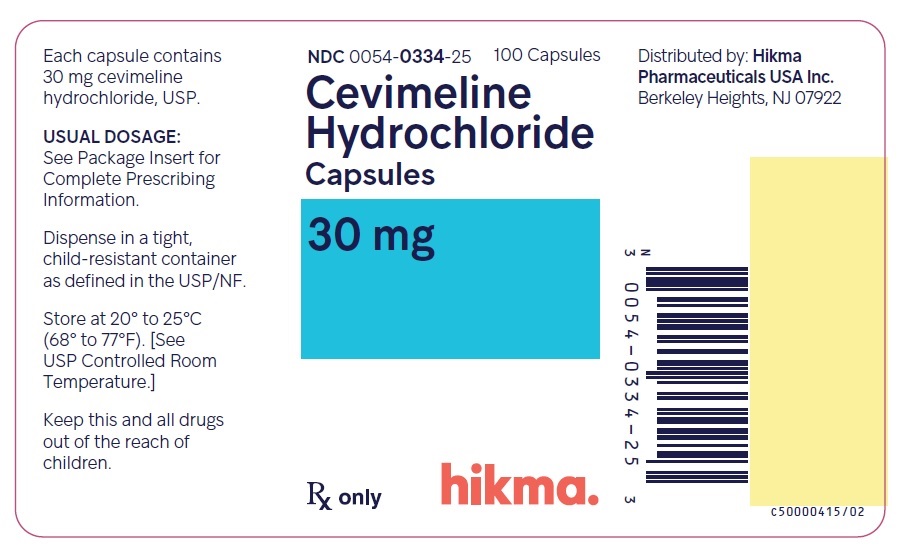
Cevimeline Hydrochloride 30 mg Capsule, 100-count — NDC 0054-0334-25 (Billing 00054-0334-25)
This is a package of 100 capsules of Cevimeline Hydrochloride 30 mg Capsule from Hikma Pharmaceuticals USA Inc., marketed since Jul 2013 and currently FDA-listed; retail pharmacies pay about $0.7289 per capsule (NADAC). It is this product's only package size.
NDC database record
One package, one record: these facts belong to NDC 0054-0334-25 alone.
- Record
- FDA NDC Directory package listing · Human prescription drug
- Code segments
- 0054 labeler · 0334 product · 25 package
- Package marketed since
- Jul 8, 2013
- Sample package
- No — commercial package
- Listing certified through
- Dec 31, 2026
- Billing quantity
- 100 EA per package
- Barcode (UPC)
- 0300540334253
- Medicaid fills, this package
- 3,284 prescriptions in the last four reported quarters
- FDA record last changed
- Jul 24, 2026
Identity & classification
Regulatory identifiers FDA, NLM and CMS codes for this package
Drug-database identifiers Medi-Span GPI and First Databank GCN / HICL / AHFS classification
- GSN (GCN sequence number): 044913
- GCN: 12624
- GPI-14 (Medi-Span): 88501525100120
- HICL (First Databank): 021080
- AHFS class code: 12:04.00.00
- RxCUI (RxNorm): 309140
Where does this data come from?
- FDA openFDA NDC Directory · synced Oct 8, 2026
- FDA label on DailyMed · label index refreshed Oct 6, 2026
- RxNorm (NLM RxNav) · catalog refreshed Oct 1, 2026
- Medi-Span GPI (licensed)
- First Databank (licensed) · refreshed Oct 8, 2026
RxNorm drug class
This medicine belongs to the Cholinergic Receptor Agonist class.
Where does this data come from?
- RxClass (NLM) · catalog refreshed Oct 1, 2026
Clinical
- It treats dry mouth symptoms in people with Sjögren’s Syndrome. It comes as a capsule you take by mouth.
- You take the capsule three times a day. Food slows how fast it is absorbed, so ask me about timing. Don’t take more than prescribed, since higher amounts haven’t been shown to help...
- Sweating is the most common, and nausea, a runny nose and diarrhea can happen too. You may also notice extra saliva. Let your doctor know if they bother you.
- Call if you have chest pain, heart rhythm changes, breathing trouble or vision changes. Be careful driving at night, since vision and depth perception can be affected.
Patient education
Supplement & herbal interactions
Where does this data come from?
- MedlinePlus (NLM) · refreshed Oct 1, 2026
- FDA label on DailyMed · label index refreshed Oct 6, 2026
Ask a licensed pharmacist directly — free, answered by our team.
Pricing
A drug doesn't have one price. Each row is a different public payment system, and none is what you'd pay at the counter — that depends on your insurance. The ⓘ on each row explains what it measures.
| Price system | Per ea | Per package |
|---|---|---|
| Retail pharmacies payNADAC · weekly | $0.729 | $72.89 / 100 capsules |
| Medicaid paysCMS SDUD · 12 mo | $0.8641 | $86.41 / 100 capsules |
| Medicare drug plans payPart D · Q2 2026 | $1.24 | $124.32 / 100 capsules |
Where does this data come from?
- CMS NADAC weekly file · file of Oct 7, 2026
- CMS ASP pricing files · refreshed Sep 20, 2026
- CMS Medicaid State Drug Utilization Data · through Q1 2026
- CMS Part D plan pricing files · refreshed Sep 24, 2026
- VA National Acquisition Center price file
Packaging — all sizes for this product
| Package NDC | Description | Marketing start | Marketing end | Status |
|---|---|---|---|---|
| 00054-0334-25 You're viewing this Main listing | 100 CAPSULE in 1 BOTTLE | 2013-07-08 | — | Active |
Therapeutic equivalents
| Product | Labeler | Pack | NADAC/unit | TE | Status | Price vs. this |
|---|---|---|---|---|---|---|
| Cevimeline Hydrochloride 30 mgthis 00054-0334-25 | Hikma | 100 capsules | $0.729 | AB | Availability likely | — |
| cevimeline hydrochloride 30 mg 00713-0937-01 | Cosette | 100 capsules | $0.729 | AB | Availability likely | — |
| Cevimeline Hydrochloride 30 mg 16571-0657-10 | Rising | 100 capsules | $0.729 | AB | Availability likely | — |
| Cevimeline Hydrochloride 30 mg 33342-0216-11 | Macleods | 100 capsules | $0.729 | AB | Availability likely | — |
| Cevimeline Hydrochloride 30 mg 59651-0422-01 | Aurobindo | 100 capsules | $0.729 | — | Availability likely | — |
| Cevimeline 30 mg 63304-0479-01 | Sun | 100 capsules | $0.729 | AB | Availability likely | — |
| Cevimeline 30 mg 69452-0316-20 | Bionpharma | 100 capsules | $0.729 | AB | Availability likely | — |
| Cevimeline Hydrochloride 30 mg 72578-0208-01 | Viona | 100 capsules | $0.729 | AB | Availability likely | — |
| Evoxac 30 mg 00713-0883-01 | Cosette | 100 capsules | $8.591 | AB | Availability likely | +1079% |
| cevimeline hydrochloride 30 mg 40032-0999-01 | Novel | 100 capsules | — | AB | FDA listed | — |
| Cevimeline Hydrochloride 30 mg 63629-9863-01 | Bryant | 30 capsules | — | AB | FDA listed | — |
| Cevimeline Hydrochloride 30 mg 70771-1982-01 | Zydus | 100 capsules | — | AB | FDA listed | — |
| Cevimeline Hydrochloride 30 mg 71335-2264-01 | Bryant | 30 capsules | — | AB | FDA listed | — |
| Cevimeline Hydrochloride 30 mg 71335-2326-01 | Bryant | 30 capsules | — | AB | FDA listed | — |
| Cevimeline Hydrochloride 30 mg 72162-2563-01 | Bryant | 100 capsules | — | AB | FDA listed | — |
| Cevimeline Hydrochloride 30 mg 72789-0457-01 | PD-Rx | 100 capsules | — | AB | FDA listed | — |
| Cevimeline Hydrochloride 30 mg 72888-0118-00 | Advagen | 1000 capsules | — | AB | FDA listed | — |
| Cevimeline Hydrochloride 30 mg 87063-0180-01 | ASCLEMED | 100 capsules | — | AB | FDA listed | — |
| cevimeline hydrochloride 30 mg 43386-0999-01 | Lupin | 100 capsules | — | AB | FDA listed | — |
| cevimeline hydrochloride 30 mg 71335-3168-01 | Bryant | 30 capsules | — | AB | FDA listed | — |
| cevimeline hydrochloride 30 mg 00054-0893-25 | Hikma | 100 capsules | — | AB | FDA listed | — |
| cevimeline hydrochloride 30 mg 87063-0324-01 | ASCLEMED | 100 capsules | — | AB | FDA listed | — |
Where does this data come from?
- FDA openFDA NDC Directory · synced Oct 8, 2026
- FDA Orange Book · refreshed Oct 3, 2026
- CMS NADAC weekly file · file of Oct 7, 2026
Availability & generic status
This product is an FDA-approved generic. Other versions of the same drug are listed under Therapeutic equivalents, least expensive first.
Where does this data come from?
- FDA Orange Book · refreshed Oct 3, 2026
Inactive Ingredients / Excipients
Inactive ingredients, also called excipients, are components of the drug product other than the active ingredient. They may include fillers, dyes, coatings, preservatives, flavors, or other formulation ingredients.
🧪 Avoiding an ingredient? See Cevimeline inactive ingredients by manufacturer: every current product's list side by side, so you can ask your pharmacy for the version that does not list it.
💡 Tap an ingredient (hover on desktop) to see what it is and why it’s used.
-
UNII 1K09F3G675
Ferric oxide red is an inorganic iron compound used as a colorant in medicines. It gives tablets, capsules, or other dosage forms a red or reddish tint for identification and appearance.
-
UNII 2G86QN327L
Gelatin is a protein derived from animal collagen, commonly used in medicines as a gelling agent and capsule material. It helps create soft or hard capsule shells that hold and release medication, and can also thicken liquid formulations.
-
UNII UKE75GEA7F
Hydroxypropyl cellulose is a plant-based polymer used as a binder and thickener. It helps hold tablet ingredients together, controls how fast the medicine dissolves, and improves the texture of liquid formulations.
-
UNII EWQ57Q8I5X
Lactose monohydrate is a natural sugar derived from milk. It serves as a filler and binder in tablets and capsules, helping create the proper size, texture, and consistency of the medicine.
-
UNII 70097M6I30
Magnesium stearate is a salt made from magnesium and stearic acid, a fatty substance. It's used in tablets and capsules as a lubricant and glidant to help ingredients flow smoothly during manufacturing and prevent sticking.
-
UNII 46N107B71O
Shellac is a natural resin secreted by the lac beetle. It's used as a coating on tablets and capsules to control how quickly the medicine dissolves and to improve appearance and stability.
-
UNII 368GB5141J
A detergent and foaming agent derived from coconut or palm oil. In medications, it helps break down and mix oil and water-based ingredients, aids in tablet disintegration, and improves how the drug dissolves and spreads in the mouth or digestive system.
-
UNII 15FIX9V2JP
Titanium dioxide is a bright white mineral powder commonly used as a colorant and opacifying agent. It makes pills and tablets white or lighter in color and helps make coatings non-transparent.
-
UNII 059QF0KO0R
Water is a liquid solvent that dissolves and mixes ingredients together in liquid medicines, syrups, and injections. It helps distribute the active drug evenly throughout the product.
9 inactive ingredients listed in the exact product block matched to this NDC.
Where does this data come from?
ingredient classCode="IACT" elements from the exact product block matched by this NDC. Label-section narrative from DailyMed / the openFDA label index is shown separately when available.- FDA label on DailyMed · label index refreshed Oct 6, 2026
- FDA openFDA NDC Directory · synced Oct 8, 2026
Inactive ingredient FAQ
Are inactive ingredients the same for every manufacturer?
Why might an inactive ingredient be missing?
Can inactive ingredients matter?
Manufacturer & labeler
More NDCs from Hikma Pharmaceuticals USA Inc. labeler code 00054
- Oxymorphone Hydrochloride 5 mg Tablet NDC 0054-0283-25
- Oxymorphone Hydrochloride 10 mg Tablet NDC 0054-0284-25
- Linezolid 100 mg/5mL Powder, For Suspension NDC 0054-0319-50
- fluticasone propionate and salmeterol 50 ug; 100 ug Powder NDC 0054-0326-56
- fluticasone propionate and salmeterol 50 ug; 250 ug Powder NDC 0054-0327-56
- fluticasone propionate and salmeterol 50 ug; 500 ug Powder NDC 0054-0328-56
- Lisdexamfetamine Dimesylate 20 mg Capsule NDC 0054-0370-25
- Lisdexamfetamine Dimesylate 30 mg Capsule NDC 0054-0371-25
- Lisdexamfetamine Dimesylate 40 mg Capsule NDC 0054-0372-25
- Lisdexamfetamine Dimesylate 50 mg Capsule NDC 0054-0373-25
- Lisdexamfetamine Dimesylate 60 mg Capsule NDC 0054-0374-25
- Lisdexamfetamine Dimesylate 70 mg Capsule NDC 0054-0375-25
Where does this data come from?
- FDA openFDA NDC Directory · synced Oct 8, 2026
- Drugs@FDA
Full prescribing information FDA SPL
🎯 Indications and Usage ▾
INDICATIONS AND USAGE Cevimeline hydrochloride is indicated for the treatment of symptoms of dry mouth in patients with Sjögren’s Syndrome.
⏱️ Dosage and Administration ▾
DOSAGE AND ADMINISTRATION The recommended dose of cevimeline hydrochloride is 30 mg taken three times a day. There is insufficient safety information to support doses greater than 30 mg tid. There is also insufficient evidence for additional efficacy of cevimeline hydrochloride at doses greater than 30 mg tid.
⛔ Contraindications ▾
CONTRAINDICATIONS Cevimeline hydrochloride is contraindicated in patients with uncontrolled asthma, known hypersensitivity to cevimeline, and when miosis is undesirable, e.g., in acute iritis and in narrow-angle (angle-closure) glaucoma.
⚠️ Warnings ▾
WARNINGS Cardiovascular Disease Cevimeline can potentially alter cardiac conduction and/or heart rate. Patients with significant cardiovascular disease may potentially be unable to compensate for transient changes in hemodynamics or rhythm induced by cevimeline. Cevimeline should be used with caution and under close medical supervision in patients with a history of cardiovascular disease evidenced by angina pectoris or myocardial infarction.
Pulmonary Disease Cevimeline can potentially increase airway resistance, bronchial smooth muscle tone, and bronchial secretions. Cevimeline should be administered with caution and with close medical supervision to patients with controlled asthma, chronic bronchitis, or chronic obstructive pulmonary disease. Ocular Ophthalmic formulations of muscarinic agonists have been reported to cause visual blurring which may result in decreased visual acuity, especially at night and in patients with central lens changes, and to cause impairment of depth perception.
Caution should be advised while driving at night or performing hazardous activities in reduced lighting.
🤒 Adverse Reactions ▾
ADVERSE REACTIONS Cevimeline was administered to 1777 patients during clinical trials worldwide, including Sjögren’s patients and patients with other conditions. In placebo-controlled Sjögren’s studies in the U.S., 320 patients received cevimeline doses ranging from 15 mg tid to 60 mg tid, of whom 93% were women and 7% were men. Demographic distribution was 90% Caucasian, 5% Hispanic, 3% Black and 2% of other origin.
In these studies, 14.6% of patients discontinued treatment with cevimeline due to adverse events. The following adverse events associated with muscarinic agonism were observed in the clinical trials of cevimeline in Sjögren’s syndrome patients: Table 1 Adverse Event Cevimeline 30 mg (tid) (N N is the total number of patients exposed to the dose at any time during the study. =533) Placebo (tid) (N=164) Excessive Sweating 18.7% 2.4% Nausea 13.8% 7.9% Rhinitis 11.2% 5.4% Diarrhea 10.3% 10.3% Excessive Salivation 2.2% 0.6% Urinary Frequency 0.9% 1.8% Asthenia 0.5% 0% Flushing 0.3% 0.6% Polyuria 0.1% 0.6% In addition, the following adverse events (≥3% incidence) were reported in the Sjögren’s clinical trials: Table 2 Adverse Event Cevimeline 30 mg (tid) (N N is the total number of patients exposed to the dose at any time during the study. =533) Placebo (tid) (N=164) Headache 14.4% 20.1% Sinusitis 12.3% 10.9% Upper Respiratory Tract Infection 11.4% 9.1% Dyspepsia 7.8% 8.5% Abdominal Pain 7.6% 6.7% Urinary Tract Infection 6.1% 3% Coughing 6.1% 3% Pharyngitis 5.2% 5.4% Vomiting 4.6% 2.4% Injury 4.5% 2.4% Back Pain 4.5% 4.2% Rash 4.3% 6% Conjunctivitis 4.3% 3.6% Dizziness 4.1% 7.3% Bronchitis 4.1% 1.2% Arthralgia 3.7% 1.8% Surgical Intervention 3.3% 3% Fatigue 3.3% 1.2% Pain 3.3% 3.0% Skeletal Pain 2.8% 1.8% Insomnia 2.4% 1.2% Hot Flushes 2.4% 0% Rigors 1.3% 1.2% Anxiety 1.3% 1.2% The following events were reported in Sjögren’s patients at incidences of <3% and ≥1%: constipation, tremor, abnormal vision, hypertonia, peripheral edema, chest pain, myalgia, fever, anorexia, eye pain, earache, dry mouth, vertigo, salivary gland pain, pruritus, influenza-like symptoms, eye infection, post-operative pain, vaginitis, skin disorder, depression, hiccup, hyporeflexia, infection, fungal infection, sialoadenitis, otitis media, erythematous rash, pneumonia, edema, salivary gland enlargement, allergy, gastroesophageal reflux, eye abnormality, migraine, tooth disorder, epistaxis, flatulence, toothache, ulcerative stomatitis, anemia, hypoesthesia, cystitis, leg cramps, abscess, eructation, moniliasis, palpitation, increased amylase, xerophthalmia, allergic reaction.
The following events were reported rarely in treated Sjögren’s patients (<1%): Causal relation is unknown: Body as a Whole Disorders: aggravated allergy, precordial chest pain, abnormal crying, hematoma, leg pain, edema, periorbital edema, activated pain trauma, pallor, changed sensation temperature, weight decrease, weight increase, choking, mouth edema, syncope, malaise, face edema, substernal chest pain Cardiovascular Disorders: abnormal ECG, heart disorder, heart murmur, aggravated hypertension, hypotension, arrhythmia, extrasystoles, t wave inversion, tachycardia, supraventricular tachycardia, angina pectoris, myocardial infarction, pericarditis, pulmonary embolism, peripheral ischemia, superficial phlebitis, purpura, deep thrombophlebitis, vascular disorder, vasculitis, hypertension Digestive Disorders: appendicitis, increased appetite, ulcerative colitis, diverticulitis, duodenitis, dysphagia, enterocolitis, gastric ulcer, gastritis, gastroenteritis, gastrointestinal hemorrhage, gingivitis, glossitis, rectum hemorrhage, hemorrhoids, ileus, irritable bowel syndrome, melena, mucositis, esophageal stricture, esophagitis, oral hemorrhage, peptic ulcer, periodontal destruction, rectal disorder, stomatitis, tenesmus, tongue discoloration, tongue disorder, geographic tongue, tongue ulceration, dental caries Endocrine Disorders: increased glucocorticoids, goiter, hypothyroidism… [Excerpted — this section continues on DailyMed.]
🤰 Pregnancy ▾
Pregnancy Cevimeline was associated with a reduction in the mean number of implantations when given to pregnant Sprague-Dawley rats from 14 days prior to mating through day seven of gestation at a dosage of 45 mg/kg/day (approximately 5 times the maximum recommended dose for a 60 kg human when compared on the basis of body surface area estimates). This effect may have been secondary to maternal toxicity. There are no adequate and well-controlled studies in pregnant women.
Cevimeline should be used during pregnancy only if the potential benefit justifies the potential risk to the fetus.
🧒 Pediatric Use ▾
Pediatric Use Safety and effectiveness in pediatric patients have not been established.
🧓 Geriatric Use ▾
Geriatric Use Although clinical studies of cevimeline included subjects over the age of 65, the numbers were not sufficient to determine whether they respond differently from younger subjects. Special care should be exercised when cevimeline treatment is initiated in an elderly patient, considering the greater frequency of decreased hepatic, renal, or cardiac function, and of concomitant disease or other drug therapy in the elderly.
🧬 Clinical Pharmacology ▾
CLINICAL PHARMACOLOGY Pharmacodynamics Cevimeline is a cholinergic agonist which binds to muscarinic receptors. Muscarinic agonists in sufficient dosage can increase secretion of exocrine glands, such as salivary and sweat glands and increase tone of the smooth muscle in the gastrointestinal and urinary tracts. Pharmacokinetics Absorption: After administration of a single 30 mg capsule, cevimeline was rapidly absorbed with a mean time to peak concentration of 1.5 to 2 hours.
No accumulation of active drug or its metabolites was observed following multiple dose administration. When administered with food, there is a decrease in the rate of absorption, with a fasting T MAX of 1.53 hours and a T MAX of 2.86 hours after a meal; the peak concentration is reduced by 17.3%. Single oral doses across the clinical dose range are dose proportional.
Distribution: Cevimeline has a volume of distribution of approximately 6 L/kg and is <20% bound to human plasma proteins. This suggests that cevimeline is extensively bound to tissues; however, the specific binding sites are unknown. Metabolism: Isozymes CYP2D6 and CYP3A3/4 are responsible for the metabolism of cevimeline.
After 24 hours, 86.7% of the dose was recovered (16% unchanged, 44.5% as cis and trans-sulfoxide, 22.3% of the dose as glucuronic acid conjugate and 4% of the dose as N-oxide of cevimeline). Approximately 8% of the trans-sulfoxide metabolite is then converted into the corresponding glucuronic acid conjugate and eliminated. Cevimeline did not inhibit cytochrome P450 isozymes 1A2, 2A6, 2C9, 2C19, 2D6, 2E1, and 3A4.
Excretion: The mean half-life of cevimeline is 5+/-1 hours. After 24 hours, 84% of a 30 mg dose of cevimeline was excreted in urine. After seven days, 97% of the dose was recovered in the urine and 0.5% was recovered in the feces.
Special Populations: The effects of renal impairment, hepatic impairment, or ethnicity on the pharmacokinetics of cevimeline have not been investigated. Clinical Studies Cevimeline has been shown to improve the symptoms of dry mouth in patients with Sjögren’s Syndrome. A 6-week, randomized, double blind, placebo-controlled study was conducted in 75 patients (10 men, 65 women) with a mean age of 53.6 years (range 33 to 75).
The racial distribution was Caucasian 92%, Black 1% and other 7%. The effects of cevimeline at 30 mg tid (90 mg/day) and 60 mg tid (180 mg/day) were compared to those of placebo. Patients were evaluated by a measure called global improvement, which is defined as a response of “better” to the question, “Please rate the overall condition of your dry mouth now compared with how you felt before starting treatment in this study.” Patients also had the option of selecting “worse” or “no change” as answers.
Seventy-six percent of the patients in the 30 mg tid group reported a global improvement in their dry mouth symptoms compared to 35% of the patients in the placebo group. This difference was statistically significant at p=0.0043. There was no evidence that patients in the 60 mg tid group had better global evaluation scores than the patients in the 30 mg tid group.
A 12-week, randomized, double-blind, placebo-controlled study was conducted in 197 patients (10 men, 187 women) with a mean age of 54.5 years (range 23 to 74). The racial distribution was Caucasian 91.4%, Black 3% and other 5.6%. The effects of cevimeline at 15 mg tid (45 mg/day) and 30 mg tid (90 mg/day) were compared to those of placebo.
Statistically significant global improvement in the symptoms of dry mouth (p=0.0004) was seen for the 30 mg tid group compared to placebo, but not for the 15 mg group compared to placebo. Salivary flow showed statistically significant increases at both doses of cevimeline during the study compared to placebo. A second 12-week, randomized, double-blind, placebo-controlled study was conducted in 212 patients (11 men, 201 women) with a mean age of 55.3 years (range 24 to 75).
The racial distribution was Caucasian 88.7%, Black 1.9% a… [Excerpted — this section continues on DailyMed.]
📦 How Supplied / Storage and Handling ▾
HOW SUPPLIED Cevimeline Hydrochloride Capsules 30 mg capsule is supplied as a white opaque cap and white opaque body with “54 190” printed on the cap and body, containing a white powder. NDC 0054-0334-25: Bottle of 100 Capsules Storage Store at 20° to 25°C (68° to 77°F). [See USP Controlled Room Temperature.] Distributed by: Hikma Pharmaceuticals USA Inc. Berkeley Heights, NJ 07922 C50000416/02 Revised January 2024
📋 Description ▾
DESCRIPTION Cevimeline hydrochloride is Spiro[1-azabicyclo[2.2.2]octane-3,5′-[1,3]oxathiolane], 2′-methyl-,hydrochloride, hydrate (2:1), cis- . Its molecular formula is C 10 H 17 NOS∙HCl∙1/2 H 2 O, and its structural formula is: Cevimeline hydrochloride, USP has a molecular weight of 244.78. It is a white to off white crystalline powder with a melting point range of 201 to 203°C.
It is freely soluble in alcohol and chloroform, very soluble in water, and virtually insoluble in ether. The pH of a 1% solution ranges from 4.6 to 5.6. Inactive ingredients include hydroxypropyl cellulose, lactose monohydrate, and magnesium stearate.
Gelatin capsule shells contain: gelatin, monogramming ink, purified water, sodium lauryl sulfate and titanium dioxide. The monogramming ink contains: ammonium hydroxide, iron oxide, isopropyl alcohol, n-butyl alcohol, propylene glycol and shellac. Chemical Stucture
💬 Information for Patients ▾
Information for Patients Patients should be informed that cevimeline may cause visual disturbances, especially at night, that could impair their ability to drive safely. If a patient sweats excessively while taking cevimeline, dehydration may develop. The patient should drink extra water and consult a health care provider.
⚠️ Precautions ▾
PRECAUTIONS General Cevimeline toxicity is characterized by an exaggeration of its parasympathomimetic effects. These may include: headache, visual disturbance, lacrimation, sweating, respiratory distress, gastrointestinal spasm, nausea, vomiting, diarrhea, atrioventricular block, tachycardia, bradycardia, hypotension, hypertension, shock, mental confusion, cardiac arrhythmia, and tremors. Cevimeline should be administered with caution to patients with a history of nephrolithiasis or cholelithiasis.
Contractions of the gallbladder or biliary smooth muscle could precipitate complications such as cholecystitis, cholangitis and biliary obstruction. An increase in the ureteral smooth muscle tone could theoretically precipitate renal colic or ureteral reflux in patients with nephrolithiasis. Information for Patients Patients should be informed that cevimeline may cause visual disturbances, especially at night, that could impair their ability to drive safely.
If a patient sweats excessively while taking cevimeline, dehydration may develop. The patient should drink extra water and consult a health care provider. Drug Interactions Cevimeline should be administered with caution to patients taking beta adrenergic antagonists, because of the possibility of conduction disturbances.
Drugs with parasympathomimetic effects administered concurrently with cevimeline can be expected to have additive effects. Cevimeline might interfere with desirable antimuscarinic effects of drugs used concomitantly. Drugs which inhibit CYP2D6 and CYP3A3/4 also inhibit the metabolism of cevimeline.
Cevimeline should be used with caution in individuals known or suspected to be deficient in CYP2D6 activity, based on previous experience, as they may be at a higher risk of adverse events. In an in vitro study, cytochrome P450 isozymes 1A2, 2A6, 2C9, 2C19, 2D6, 2E1, and 3A4 were not inhibited by exposure to cevimeline. Carcinogenesis, Mutagenesis, Impairment of Fertility Lifetime carcinogenicity studies were conducted in CD-1 mice and F-344 rats.
A statistically significant increase in the incidence of adenocarcinomas of the uterus was observed in female rats that received cevimeline at a dosage of 100 mg/kg/day (approximately 8 times the maximum human exposure based on comparison of AUC data). No other significant differences in tumor incidence were observed in either mice or rats. Cevimeline exhibited no evidence of mutagenicity or clastogenicity in a battery of assays that included an Ames test, an in vitro chromosomal aberration study in mammalian cells, a mouse lymphoma study in L5178Y cells, or a micronucleus assay conducted in vivo in ICR mice.
Cevimeline did not adversely affect the reproductive performance or fertility of male Sprague-Dawley rats when administered for 63 days prior to mating and throughout the period of mating at dosages up to 45 mg/kg/day (approximately 5 times the maximum recommended dose for a 60 kg human following normalization of the data on the basis of body surface area estimates). Females that were treated with cevimeline at dosages up to 45 mg/kg/day from 14 days prior to mating through day seven of gestation exhibited a statistically significantly smaller number of implantations than did control animals.
Pregnancy Cevimeline was associated with a reduction in the mean number of implantations when given to pregnant Sprague-Dawley rats from 14 days prior to mating through day seven of gestation at a dosage of 45 mg/kg/day (approximately 5 times the maximum recommended dose for a 60 kg human when compared on the basis of body surface area estimates). This effect may have been secondary to maternal toxicity. There are no adequate and well-controlled studies in pregnant women.
Cevimeline should be used during pregnancy only if the potential benefit justifies the potential risk to the fetus. Nursing Mothers It is not known whether this drug is secreted in human milk. Because many drugs are excreted in human milk, and because of the pote… [Excerpted — this section continues on DailyMed.]
🍼 Nursing Mothers ▾
Nursing Mothers It is not known whether this drug is secreted in human milk. Because many drugs are excreted in human milk, and because of the potential for serious adverse reactions in nursing infants from cevimeline, a decision should be made whether to discontinue nursing or discontinue the drug, taking into account the importance of the drug to the mother.
📄 Carcinogenesis, Mutagenesis, Impairment of Fertility ▾
Carcinogenesis, Mutagenesis, Impairment of Fertility Lifetime carcinogenicity studies were conducted in CD-1 mice and F-344 rats. A statistically significant increase in the incidence of adenocarcinomas of the uterus was observed in female rats that received cevimeline at a dosage of 100 mg/kg/day (approximately 8 times the maximum human exposure based on comparison of AUC data). No other significant differences in tumor incidence were observed in either mice or rats.
Cevimeline exhibited no evidence of mutagenicity or clastogenicity in a battery of assays that included an Ames test, an in vitro chromosomal aberration study in mammalian cells, a mouse lymphoma study in L5178Y cells, or a micronucleus assay conducted in vivo in ICR mice. Cevimeline did not adversely affect the reproductive performance or fertility of male Sprague-Dawley rats when administered for 63 days prior to mating and throughout the period of mating at dosages up to 45 mg/kg/day (approximately 5 times the maximum recommended dose for a 60 kg human following normalization of the data on the basis of body surface area estimates).
Females that were treated with cevimeline at dosages up to 45 mg/kg/day from 14 days prior to mating through day seven of gestation exhibited a statistically significantly smaller number of implantations than did control animals.
📄 Package Label / Principal Display Panel ▾
Package/Label Display Panel NDC 0054- 0334 -25 100 Capsules Cevimeline Hydrochloride Capsules 30 mg 30 mg Bottle Label