
Hydroxyzine Hydrochloride 25 mg Tablet, Film Coated, 1,000-count — NDC 0093-5061-10 (Billing 00093-5061-10)
This is a package of 1,000 tablets of Hydroxyzine Hydrochloride 25 mg Tablet, Film Coated from Teva Pharmaceuticals USA, Inc., marketed since Oct 2012 and currently FDA-listed; retail pharmacies pay about $0.0326 per tablet (NADAC). It is the main listing for this product, which comes in 3 package sizes.
NDC database record
One package, one record: these facts belong to NDC 0093-5061-10 alone.
- Record
- FDA NDC Directory package listing · Human prescription drug
- Code segments
- 0093 labeler · 5061 product · 10 package
- Package marketed since
- Oct 11, 2012
- Sample package
- No — commercial package
- Listing certified through
- Dec 31, 2026
- Billing quantity
- 1,000 EA per package
- Barcode (UPC-A, from the NDC)
- 3 0093506110 8
- Medicaid fills, this package
- 307,851 prescriptions in the last four reported quarters
- FDA record last changed
- Jul 24, 2026
Other active recalls for Hydroxyzine Hydrochloride (different manufacturers) — 1 · tap to view
Identity & classification
Regulatory identifiers FDA, NLM and CMS codes for this package
Drug-database identifiers Medi-Span GPI and First Databank GCN / HICL / AHFS classification
- GSN (GCN sequence number): 003728
- GCN: 13943
- GPI-14 (Medi-Span): 57200040100310
- HICL (First Databank): 001608
- AHFS class code: 04:04.00.00
- RxCUI (RxNorm): 995218
Where does this data come from?
- FDA openFDA NDC Directory · synced Oct 1, 2026
- FDA label on DailyMed · label index refreshed Oct 3, 2026
- RxNorm (NLM RxNav) · catalog refreshed Oct 1, 2026
- Medi-Span GPI (licensed)
- First Databank (licensed) · refreshed Oct 1, 2026
RxNorm drug class
This medicine belongs to the Antihistamine class.
Where does this data come from?
- RxClass (NLM) · catalog refreshed Oct 1, 2026
Clinical
Hydroxyzine is used to relieve itching caused by allergic skin reactions, to relieve anxiety and tension, and as a sedative before and after general anesthesia for surgery. Hydroxyzine is in a class of medications called antihistamines. It works by blocking the action of histamine, a substance in the body that causes allergic symptoms. It also works by decreasing activity in the brain.
Read the full MedlinePlus article ↗- Taken by mouth, it's used for anxiety and tension, itching from allergic skin conditions like hives and eczema, and sedation around anesthesia. The injection has additional uses in...
- It can. Drowsiness is the most common effect, though it often fades in a few days or with a lower dose. Don't drive or use dangerous machinery until you know how it affects you.
- It's best not to. Hydroxyzine can strengthen alcohol, narcotics, barbiturates and other sedating drugs. Tell your prescriber about everything you take, since doses of some may need...
- Can I drink alcohol or take other sedating medicines with it?
Patient education
Supplement & herbal interactions
Where does this data come from?
- MedlinePlus (NLM) · refreshed Oct 1, 2026
- FDA label on DailyMed · label index refreshed Oct 3, 2026
Ask a licensed pharmacist directly — free, answered by our team.
Pricing
A drug doesn't have one price. Each row is a different public payment system, and none is what you'd pay at the counter — that depends on your insurance. The ⓘ on each row explains what it measures.
| Price system | Per ea | Per package |
|---|---|---|
| Retail pharmacies payNADAC · weekly | $0.033 | $32.60 / 1000 tablets |
| Medicaid paysCMS SDUD · 12 mo | $0.1714 | $171.40 / 1000 tablets |
| Medicare drug plans payPart D · Q2 2026 | $0.1378 | $137.80 / 1000 tablets |
Where does this data come from?
- CMS NADAC weekly file · file of Sep 30, 2026
- CMS ASP pricing files · refreshed Sep 20, 2026
- CMS Medicaid State Drug Utilization Data · through Q1 2026
- CMS Part D plan pricing files · refreshed Sep 24, 2026
- VA National Acquisition Center price file
Packaging — all sizes for this product
| Package NDC | Description | Per unit | Per pack | Marketing start | Marketing end | Status |
|---|---|---|---|---|---|---|
| 00093-5061-01 0093-5061-01 | 100 TABLET, FILM COATED in 1 BOTTLE | $0.0326 / ea | $3.26 | 2012-10-09 | — | Active |
| 00093-5061-05 0093-5061-05 | 500 TABLET, FILM COATED in 1 BOTTLE | $0.0326 / ea | $16.28 | 2012-10-10 | — | Active |
| 00093-5061-10 You're viewing this Main listing | 1000 TABLET, FILM COATED in 1 BOTTLE | $0.0326 / ea | $32.55 | 2012-10-11 | — | Active |
You're viewing the largest of 3 pack sizes for this product.
This pack effectively ties for the lowest per-ea cost of the 3 priced pack sizes ($0.0326 NADAC).
In Medicaid, this is the most-dispensed pack of this product — about 49% of fills over the last four reported quarters. See all packs ↓
Pack size FAQ
What quantity is in this package?
How does this package differ from NDC 00093-5061-01?
What NDC number is used to bill for this package of Hydroxyzine Hydrochloride 25 mg Tablet, Film Coated?
Prices are the latest CMS NADAC pharmacy acquisition cost per NDC; per-pack figures are per-unit × pack quantity, shown only when the pack is denominated in the same measure NADAC prices.
Therapeutic equivalents
| Product | Labeler | Pack | NADAC/unit | TE | Status | Price vs. this |
|---|---|---|---|---|---|---|
| Hydroxyzine Hydrochloride 25 mgthis 00093-5061-10 | Teva | 1000 tablets | $0.033 | AB | Availability likely | — |
| Hydroxyzine hydrochloride 25 mg 00904-7378-40 | Major | 500 tablets | $0.033 | AB | Availability likely | — |
| Hydroxyzine Hydrochloride 25 mg 10702-0011-01 | KVK-Tech, | 100 tablets | $0.033 | AB | Availability likely | — |
| Hydroxyzine Hydrochloride 25 mg 16571-0114-01 | Rising | 100 tablets | $0.033 | AB | Availability likely | — |
| HydrOXYzine Hydrochloride 25 mg 16714-0082-10 | Northstar | 100 tablets | $0.033 | AB | Availability likely | — |
| Hydroxyzine hydrochloride 25 mg 23155-0501-01 | Heritage | 100 tablets | $0.033 | AB | Availability likely | — |
| Hydroxyzine Hydrochloride 25 mg 24658-0782-10 | PURACAP | 1000 tablets | $0.033 | AB | Availability likely | — |
| Hydroxyzine Hydrochloride 25 mg 59651-0500-01 | Aurobindo | 100 tablets | $0.033 | — | Availability likely | — |
| Hydroxyzine Hydrochloride 25 mg 60687-0675-01 | American | 1 tablet | $0.033 | AB | Availability likely | — |
| Hydroxyzine Hydrochloride 25 mg 62135-0574-05 | Chartwell | 500 tablets | $0.033 | AB | Availability likely | — |
| Hydroxyzine Hydrochloride 25 mg 00904-6617-61 | Major | 1 tablet | $0.034 | AB | Discontinued | +5% |
| Hydroxyzine Hydrochloride 25 mg 42806-0160-01 | Epic | 100 tablets | $0.034 | AB | Availability likely | +5% |
| Hydroxyzine hydrochloride 25 mg 00615-8082-05 | NCS | 15 tablets | — | AB | FDA listed | — |
| Hydroxyzine Hydrochloride 25 mg 10135-0811-01 | Marlex | 100 tablets | — | AB | FDA listed | — |
| Hydroxyzine Hydrochloride 25 mg 11534-0205-01 | Sunrise | 100 tablets | — | AB | FDA listed | — |
| Hydroxyzine Hydrochloride 25 mg 31722-0501-01 | Camber | 100 tablets | — | AB | FDA listed | — |
| Hydroxyzine Hydrochloride 25 mg 43063-0518-06 | PD-Rx | 6 tablets | — | — | FDA listed | — |
| Hydroxyzine Hydrochloride 25 mg 43063-0627-28 | PD-Rx | 28 tablets | — | AB | FDA listed | — |
| Hydroxyzine Hydrochloride 25 mg 43063-0962-01 | PD-Rx | 100 tablets | — | — | FDA listed | — |
| Hydroxyzine hydrochloride 25 mg 45865-0675-20 | Medsource | 20 tablets | — | AB | FDA listed | — |
| Hydroxyzine hydrochloride 25 mg 50090-2648-00 | A-S | 20 tablets | — | AB | FDA listed | — |
| Hydroxyzine hydrochloride 25 mg 50090-3583-01 | A-S | 28 tablets | — | AB | FDA listed | — |
| Hydroxyzine hydrochloride 25 mg 50090-5297-00 | A-S | 90 tablets | — | AB | FDA listed | — |
| Hydroxyzine hydrochloride 25 mg 50090-6624-00 | A-S | 90 tablets | — | AB | FDA listed | — |
| HydrOXYzine Hydrochloride 25 mg 50090-6626-00 | A-S | 90 tablets | — | AB | FDA listed | — |
| HydrOXYzine Hydrochloride 25 mg 50090-6628-00 | A-S | 90 tablets | — | AB | FDA listed | — |
| Hydroxyzine Hydrochloride 25 mg 50090-6653-01 | A-S | 28 tablets | — | — | FDA listed | — |
| Hydroxyzine Hydrochloride 25 mg 50090-6655-00 | A-S | 20 tablets | — | — | FDA listed | — |
| Hydroxyzine Hydrochloride 25 mg 50090-6657-00 | A-S | 90 tablets | — | — | FDA listed | — |
| Hydroxyzine Hydrochloride 25 mg 50090-6659-00 | A-S | 90 tablets | — | — | FDA listed | — |
| Hydroxyzine Hydrochloride 25 mg 50090-7034-00 | A-S | 1 tablet | — | — | FDA listed | — |
| Hydroxyzine Hydrochloride 25 mg 50090-7327-00 | A-S | 90 tablets | — | AB | FDA listed | — |
| Hydroxyzine Hydrochloride 25 mg 50090-7329-00 | A-S | 90 tablets | — | AB | FDA listed | — |
| Hydroxyzine Hydrochloride 25 mg 50090-7330-00 | A-S | 20 tablets | — | AB | FDA listed | — |
| Hydroxyzine Hydrochloride 25 mg 50090-7331-00 | A-S | 30 tablets | — | AB | FDA listed | — |
| Hydroxyzine Hydrochloride 25 mg 50090-7332-00 | A-S | 30 tablets | — | AB | FDA listed | — |
| HydrOXYzine Hydrochloride 25 mg 50090-7582-01 | A-S | 28 tablets | — | AB | FDA listed | — |
| Hydroxyzine hydrochloride 25 mg 51407-0970-10 | Golden | 1000 tablets | — | AB | FDA listed | — |
| Hydroxyzine hydrochloride 25 mg 51655-0080-20 | Northwind | 20 tablets | — | AB | FDA listed | — |
| Hydroxyzine Hydrochloride 25 mg 51655-0589-52 | Northwind | 30 tablets | — | AB | FDA listed | — |
| Hydroxyzine Hydrochloride 25 mg 55154-2148-00 | Cardinal | 1 tablet | — | AB | FDA listed | — |
| Hydroxyzine Hydrochloride 25 mg 55154-7994-00 | Cardinal | 1 tablet | — | AB | Discontinued | — |
| Hydroxyzine Hydrochloride 25 mg 60760-0971-30 | St. | 30 tablets | — | AB | FDA listed | — |
| Hydroxyzine Hydrochloride 25 mg 60760-0990-30 | St. | 30 tablets | — | AB | FDA listed | — |
| Hydroxyzine Hydrochloride 25 mg 62135-0546-05 | Chartwell | 500 tablets | — | AB | FDA listed | — |
| Hydroxyzine hydrochloride 25 mg 63187-0733-20 | Proficient | 20 tablets | — | AB | FDA listed | — |
| Hydroxyzine hydrochloride 25 mg 63629-1856-01 | Bryant | 30 tablets | — | AB | FDA listed | — |
| Hydroxyzine Hydrochloride 25 mg 63629-8740-01 | Bryant | 100 tablets | — | AB | FDA listed | — |
| Hydroxyzine Hydrochloride 25 mg 65162-0671-10 | Amneal | 100 tablets | — | — | FDA listed | — |
| Hydroxyzine hydrochloride 25 mg 67046-0713-03 | Coupler | 30 tablets | — | AB | FDA listed | — |
| Hydroxyzine Hydrochloride 25 mg 67046-1311-03 | Coupler | 30 tablets | — | AB | FDA listed | — |
| HydrOXYzine Hydrochloride 25 mg 68071-2237-02 | NuCare | 20 tablets | — | AB | FDA listed | — |
| HydrOXYzine Hydrochloride 25 mg 68071-3450-04 | NuCare | 4 tablets | — | AB | FDA listed | — |
| Hydroxyzine Hydrochloride 25 mg 68071-3964-03 | NuCare | 30 tablets | — | AB | FDA listed | — |
| Hydroxyzine Hydrochloride 25 mg 68071-4622-03 | NuCare | 30 tablets | — | — | FDA listed | — |
| Hydroxyzine hydrochloride 25 mg 68071-5286-03 | NuCare | 30 tablets | — | AB | FDA listed | — |
| Hydroxyzine Hydrochloride 25 mg 68071-5296-06 | NuCare | 6 tablets | — | AB | FDA listed | — |
| Hydroxyzine hydrochloride 25 mg 68788-7854-03 | Preferred | 30 tablets | — | AB | FDA listed | — |
| Hydroxyzine Hydrochloride 25 mg 68788-8707-03 | Preferred | 30 tablets | — | AB | FDA listed | — |
| Hydroxyzine hydrochloride 25 mg 70518-1692-01 | REMEDYREPACK | 15 tablets | — | AB | Discontinued | — |
| Hydroxyzine Hydrochloride 25 mg 70518-1730-01 | REMEDYREPACK | 30 tablets | — | — | Discontinued | — |
| Hydroxyzine Hydrochloride 25 mg 70518-2066-00 | REMEDYREPACK | 30 tablets | — | AB | FDA listed | — |
| Hydroxyzine Hydrochloride 25 mg 70518-2279-01 | REMEDYREPACK | 30 tablets | — | AB | Discontinued | — |
| Hydroxyzine Hydrochloride 25 mg 70518-4141-00 | REMEDYREPACK | 30 tablets | — | AB | FDA listed | — |
| Hydroxyzine Hydrochloride 25 mg 71205-0155-20 | Proficient | 20 tablets | — | AB | FDA listed | — |
| Hydroxyzine Hydrochloride 25 mg 71205-0273-15 | Proficient | 15 tablets | — | — | FDA listed | — |
| Hydroxyzine Hydrochloride 25 mg 71335-0935-01 | Bryant | 30 tablets | — | AB | FDA listed | — |
| Hydroxyzine Hydrochloride 25 mg 71335-1047-01 | Bryant | 30 tablets | — | — | FDA listed | — |
| Hydroxyzine hydrochloride 25 mg 71335-2340-01 | Bryant | 30 tablets | — | AB | FDA listed | — |
| Hydroxyzine Hydrochloride 25 mg 71335-2451-01 | Bryant | 30 tablets | — | AB | FDA listed | — |
| Hydroxyzine Hydrochloride 25 mg 71335-2776-01 | Bryant | 30 tablets | — | AB | FDA listed | — |
| Hydroxyzine Hydrochloride 25 mg 71335-3035-01 | Bryant | 1000 tablets | — | AB | FDA listed | — |
| HydrOXYzine Hydrochloride 25 mg 71610-0686-53 | Aphena | 60 tablets | — | AB | FDA listed | — |
| Hydroxyzine Hydrochloride 25 mg 71610-0735-30 | Aphena | 30 tablets | — | — | FDA listed | — |
| Hydroxyzine hydrochloride 25 mg 71610-0844-53 | Aphena | 60 tablets | — | AB | FDA listed | — |
| Hydroxyzine hydrochloride 25 mg 71610-0851-30 | Aphena | 30 tablets | — | AB | FDA listed | — |
| Hydroxyzine Hydrochloride 25 mg 72162-1333-02 | Bryant | 20 tablets | — | — | FDA listed | — |
| Hydroxyzine Hydrochloride 25 mg 72162-2512-00 | Bryant | 1000 tablets | — | AB | FDA listed | — |
| Hydroxyzine Hydrochloride 25 mg 72789-0216-12 | PD-Rx | 12 tablets | — | AB | FDA listed | — |
| Hydroxyzine hydrochloride 25 mg 76420-0882-01 | Asclemed | 100 tablets | — | AB | FDA listed | — |
| Hydroxyzine hydrochloride 25 mg 80425-0365-01 | Advanced | 30 tablets | — | AB | FDA listed | — |
| Hydroxyzine Hydrochloride 25 mg 80425-0590-01 | Advanced | 30 tablets | — | AB | FDA listed | — |
Where does this data come from?
- FDA openFDA NDC Directory · synced Oct 1, 2026
- FDA Orange Book · refreshed Oct 3, 2026
- CMS NADAC weekly file · file of Sep 30, 2026
Availability & generic status
This product is an FDA-approved generic. Other versions of the same drug are listed under Therapeutic equivalents, least expensive first.
Where does this data come from?
- FDA Orange Book · refreshed Oct 3, 2026
What it looks like
Where does this data come from?
- FDA label on DailyMed · label index refreshed Oct 3, 2026
Inactive Ingredients / Excipients
Inactive ingredients, also called excipients, are components of the drug product other than the active ingredient. They may include fillers, dyes, coatings, preservatives, flavors, or other formulation ingredients.
Where does this data come from?
IACT rows and label-wide narrative are kept separate; availability and product-level specificity depend on the submitted label.- FDA label on DailyMed · label index refreshed Oct 3, 2026
- FDA openFDA NDC Directory · synced Oct 1, 2026
Inactive ingredient FAQ
Are inactive ingredients the same for every manufacturer?
Why might an inactive ingredient be missing?
Can inactive ingredients matter?
Manufacturer & labeler
More NDCs from Teva Pharmaceuticals USA, Inc. labeler code 00093
- Dexmethylphenidate Hydrochloride 35 mg Capsule, Extended Release NDC 0093-5046-01
- Atorvastatin Calcium 10 mg Tablet, Film Coated NDC 0093-5056-10
- Atorvastatin Calcium 80 mg Tablet, Film Coated NDC 0093-5057-05
- Atorvastatin Calcium 40 mg Tablet, Film Coated NDC 0093-5058-10
- Atorvastatin Calcium 20 mg Tablet, Film Coated NDC 0093-5059-10
- Hydroxyzine Hydrochloride 10 mg Tablet, Film Coated NDC 0093-5060-01
- Hydroxyzine Hydrochloride 50 mg Tablet, Film Coated NDC 0093-5062-01
- Moexipril Hydrochloride 15 mg Tablet, Film Coated NDC 0093-5150-01
- Buspirone Hydrochloride 30 mg Tablet NDC 0093-5200-05
- Efavirenz, Emtricitabine and Tenofovir Disoproxil Fumarate 600 mg; 200 mg; 300 mg Tablet, Film Coated NDC 0093-5234-56
- Olanzapine 5 mg Tablet, Orally Disintegrating NDC 0093-5245-65
- Olanzapine 10 mg Tablet, Orally Disintegrating NDC 0093-5246-65
Where does this data come from?
- FDA openFDA NDC Directory · synced Oct 1, 2026
- Drugs@FDA
Full prescribing information FDA SPL
🎯 Indications and Usage ▾
INDICATIONS AND USAGE For symptomatic relief of anxiety and tension associated with psychoneurosis and as an adjunct in organic disease states in which anxiety is manifested. Useful in the management of pruritus due to allergic conditions such as chronic urticaria and atopic and contact dermatoses and in histamine-mediated pruritus. As a sedative when used as a premedication and following general anesthesia, hydroxyzine may potentiate meperidine and barbiturates , so their use in pre-anesthetic adjunctive therapy should be modified on an individual basis.
Atropine and other belladonna alkaloids are not affected by the drug. Hydroxyzine is not known to interfere with the action of digitalis in any way and it may be used concurrently with this agent. The effectiveness of hydroxyzine as an antianxiety agent for long term use, that is more than 4 months, has not been assessed by systematic clinical studies.
The physician should reassess periodically the usefulness of the drug for the individual patient.
⏱️ Dosage and Administration ▾
DOSAGE AND ADMINISTRATION For symptomatic relief of anxiety and tension associated with psychoneurosis and as an adjunct in organic disease states in which anxiety is manifested: adults, 50 to 100 mg q.i.d.; children under 6 years, 50 mg daily in divided doses; children over 6 years, 50 to 100 mg daily in divided doses. For use in the management of pruritus due to allergic conditions such as chronic urticaria and atopic and contact dermatoses and in histamine-mediated pruritus: adults, 25 mg t.i.d. or q.i.d.; children under 6 years, 50 mg daily in divided doses; children over 6 years, 50 to 100 mg daily in divided doses.
As a sedative when used as a premedication and following general anesthesia: 50 to 100 mg for adults and 0.6 mg/kg of body weight in children. When treatment is initiated by the intramuscular route of administration, subsequent doses may be administered orally. As with all potent medication, the dosage should be adjusted according to the patient’s response to therapy.
⛔ Contraindications ▾
CONTRAINDICATIONS Oral hydroxyzine hydrochloride is contraindicated in patients with known hypersensitivity to hydroxyzine hydrochloride products, and in patients with known hypersensitivity to cetirizine hydrochloride or levocetirizine hydrochloride. Hydroxyzine is contraindicated in patients with a prolonged QT interval. Hydroxyzine, when administered to the pregnant mouse, rat and rabbit induced fetal abnormalities in the rat and mouse at doses substantially above the human therapeutic range.
Clinical data in human beings are inadequate to establish safety in early pregnancy. Until such data are available, hydroxyzine is contraindicated in early pregnancy. Hydroxyzine is contraindicated for patients who have shown a previous hypersensitivity to any component of this medication.
⚠️ Warnings ▾
WARNINGS Nursing Mothers It is not known whether this drug is excreted in human milk. Since many drugs are so excreted, hydroxyzine should not be given to nursing mothers.
🤒 Adverse Reactions ▾
ADVERSE REACTIONS Side effects reported with the administration of hydroxyzine hydrochloride are usually mild and transitory in nature. Anticholinergic: Dry mouth. Central Nervous System: Drowsiness is usually transitory and may disappear in a few days of continued therapy or upon reduction of dose.
Involuntary motor activity including rare instances of tremor and convulsions has been reported, usually with doses considerably higher than those recommended. Clinically significant respiratory depression has not been reported at recommended doses. Cardiac System: QT prolongation, Torsade de Pointes.
In postmarketing experience, the following additional undesirable effects have been reported: Body as a Whole: Allergic reaction. Nervous System: Headache. Psychiatric: Hallucination.
Skin and Appendages: Oral hydroxyzine is associated with Acute Generalized Exanthematous Pustulosis (AGEP) and fixed drug eruptions in postmarketing reports; pruritus, rash, urticaria. To report SUSPECTED ADVERSE REACTIONS, contact Teva at 1-888-838-2872 or FDA at 1-800-FDA-1088 or www.fda.gov/medwatch.
🧓 Geriatric Use ▾
Geriatric Use A determination has not been made whether controlled clinical studies of hydroxyzine included sufficient numbers of subjects aged 65 and over to define a difference in response from younger subjects. Other reported clinical experience has not identified differences in responses between the elderly and younger patients. In general, dose selection for an elderly patient should be cautious, usually starting at the low end of the dosing range, reflecting the greater frequency of decreased hepatic, renal or cardiac function, and of concomitant disease or other drug therapy.
The extent of renal excretion of hydroxyzine has not been determined. Because elderly patients are more likely to have decreased renal function, care should be taken in dose selections. Sedating drugs may cause confusion and over sedation in the elderly; elderly patients generally should be started on low doses of hydroxyzine and observed closely.
🆘 Overdosage ▾
OVERDOSAGE The most common manifestation of hydroxyzine overdosage is hypersedation. Other reported signs and symptoms were convulsions, stupor, nausea and vomiting. As in the management of overdosage with any drug, it should be borne in mind that multiple agents may have been taken.
If vomiting has not occurred spontaneously, it should be induced. Immediate gastric lavage is also recommended. General supportive care, including frequent monitoring of the vital signs and close observation of the patient, is indicated.
Hypotension, though unlikely, may be controlled with intravenous fluids and levarterenol or metaraminol. Do not use epinephrine as hydroxyzine counteracts its pressor action. Hydroxyzine overdose may cause QT prolongation and Torsade de Pointes.
ECG monitoring is recommended in cases of hydroxyzine overdose. There is no specific antidote. It is doubtful that hemodialysis would be of any value in the treatment of overdosage with hydroxyzine.
However, if other agents such as barbiturates have been ingested concomitantly, hemodialysis may be indicated. There is no practical method to quantitate hydroxyzine in body fluids or tissue after its ingestion or administration.
🧬 Clinical Pharmacology ▾
CLINICAL PHARMACOLOGY Hydroxyzine hydrochloride is unrelated chemically to the phenothiazines, reserpine, meprobamate or the benzodiazepines. Hydroxyzine is not a cortical depressant, but its action may be due to a suppression of activity in certain key regions of the subcortical area of the central nervous system. Primary skeletal muscle relaxation has been demonstrated experimentally.
Bronchodilator activity, and antihistaminic and analgesic effects have been demonstrated experimentally and confirmed clinically. An antiemetic effect, both by the apomorphine test and the veriloid test, has been demonstrated. Pharmacological and clinical studies indicate that hydroxyzine in therapeutic dosage does not increase gastric secretion or acidity and in most cases has mild antisecretory activity.
Hydroxyzine is rapidly absorbed from the gastrointestinal tract and hydroxyzine’s clinical effects are usually noted within 15 to 30 minutes after oral administration.
📦 How Supplied / Storage and Handling ▾
HOW SUPPLIED Hydroxyzine Hydrochloride Tablets USP, 10 mg are available as white, round, film-coated, convex tablets, debossed with “TV” on one side and “307” on the other side, containing 10 mg hydroxyzine hydrochloride, USP packaged in bottles of 100 (NDC 0093-5060-01) and 500 (NDC 0093-5060-05) tablets. Hydroxyzine Hydrochloride Tablets USP, 25 mg are available as white, round, film-coated, convex tablets, debossed with “TV” on one side and “308” on the other side, containing 25 mg hydroxyzine hydrochloride, USP packaged in bottles of 100 (NDC 0093-5061-01), 500 (NDC 0093-5061-05) and 1000 (NDC 0093-5061-10) tablets.
Hydroxyzine Hydrochloride Tablets USP, 50 mg are available as white, round, film-coated, convex tablets, debossed with “TV” on one side and “309” on the other side, containing 50 mg hydroxyzine hydrochloride, USP packaged in bottles of 100 (NDC 0093-5062-01) and 500 (NDC 0093-5062-05) tablets. Dispense in a tight container as defined in the USP, with a child-resistant closure (as required). Store at 20° to 25°C (68° to 77°F) [see USP Controlled Room Temperature].
Keep this and all medications out of the reach of children. Manufactured In Croatia By: Pliva Hrvatska d.o.o. Zagreb, Croatia Manufactured For: Teva Pharmaceuticals Parsippany, NJ 07054 Rev.
H 7/2025
📋 Description ▾
DESCRIPTION Hydroxyzine hydrochloride, USP has the chemical name of 2-[2-[4-( p -Chloro-α-phenylbenzyl)-1-piperazinyl]ethoxy] ethanol dihydrochloride. C 21 H 27 ClN 2 O 2 · 2HCl M.W. 447.83 Hydroxyzine hydrochloride, USP occurs as a white, odorless powder which is very soluble in water.
Each tablet for oral administration contains 10 mg, 25 mg or 50 mg hydroxyzine hydrochloride, USP. Inactive ingredients include anhydrous lactose, carnauba wax, colloidal silicon dioxide, crospovidone, hypromellose, magnesium stearate, microcrystalline cellulose, polydextrose, polyethylene glycol, sodium starch glycolate, titanium dioxide and triacetin. structural formula
⚠️ Precautions ▾
PRECAUTIONS THE POTENTIATING ACTION OF HYDROXYZINE MUST BE CONSIDERED WHEN THE DRUG IS USED IN CONJUNCTION WITH CENTRAL NERVOUS SYSTEM DEPRESSANTS SUCH AS NARCOTICS, NON-NARCOTIC ANALGESICS AND BARBITURATES. Therefore, when central nervous system depressants are administered concomitantly with hydroxyzine their dosage should be reduced. QT Prolongation/Torsade de Pointes (TdP): Cases of QT prolongation and Torsade de Pointes have been reported during post-marketing use of hydroxyzine.
The majority of reports occurred in patients with other risk factors for QT prolongation/TdP (pre-existing heart disease, electrolyte imbalances or concomitant arrhythmogenic drug use). Therefore, hydroxyzine should be used with caution in patients with risk factors for QT prolongation, congenital long QT syndrome, a family history of long QT syndrome, other conditions that predispose to QT prolongation and ventricular arrhythmia, as well as recent myocardial infarction, uncompensated heart failure, and bradyarrhythmias.
Caution is recommended during the concomitant use of drugs known to prolong the QT interval. These include Class 1A (e.g., quinidine, procainamide) or Class III (e.g., amiodarone, sotalol) antiarrhythmics, certain antipsychotics (e.g., ziprasidone, iloperidone, clozapine, quetiapine, chlorpromazine), certain antidepressants (e.g., citalopram, fluoxetine), certain antibiotics (e.g., azithromycin, erythromycin, clarithromycin, gatifloxacin, moxifloxacin); and others (e.g., pentamidine, methadone, ondansetron, droperidol).
Since drowsiness may occur with use of this drug, patients should be warned of this possibility and cautioned against driving a car or operating dangerous machinery while taking hydroxyzine. Patients should also be advised against the simultaneous use of other CNS depressant drugs, and cautioned that the effects of alcohol may be increased. Geriatric Use A determination has not been made whether controlled clinical studies of hydroxyzine included sufficient numbers of subjects aged 65 and over to define a difference in response from younger subjects.
Other reported clinical experience has not identified differences in responses between the elderly and younger patients. In general, dose selection for an elderly patient should be cautious, usually starting at the low end of the dosing range, reflecting the greater frequency of decreased hepatic, renal or cardiac function, and of concomitant disease or other drug therapy. The extent of renal excretion of hydroxyzine has not been determined.
Because elderly patients are more likely to have decreased renal function, care should be taken in dose selections. Sedating drugs may cause confusion and over sedation in the elderly; elderly patients generally should be started on low doses of hydroxyzine and observed closely. Acute Generalized Exanthematous Pustulosis (AGEP) Hydroxyzine may rarely cause acute generalized exanthematous pustulosis (AGEP), a serious skin reaction characterized by fever and numerous small, superficial, non-follicular, sterile pustules, arising within large areas of edematous erythema.
Inform patients about the signs of AGEP, and discontinue hydroxyzine at the first appearance of a skin rash, worsening of pre-existing skin reactions which hydroxyzine may be used to treat, or any other sign of hypersensitivity. If signs or symptoms suggest AGEP, use of hydroxyzine should not be resumed and alternative therapy should be considered. Avoid cetirizine or levocetirizine in patients who have experienced AGEP or other hypersensitivity reactions with hydroxyzine, due to the risk of cross-sensitivity.
🍼 Nursing Mothers ▾
Nursing Mothers It is not known whether this drug is excreted in human milk. Since many drugs are so excreted, hydroxyzine should not be given to nursing mothers.
📄 Package Label / Principal Display Panel ▾
Package/Label Display Panel NDC 0093-5060-01 hydrOXYzine Hydrochloride Tablets, USP 10 mg Rx only 100 Tablets 1
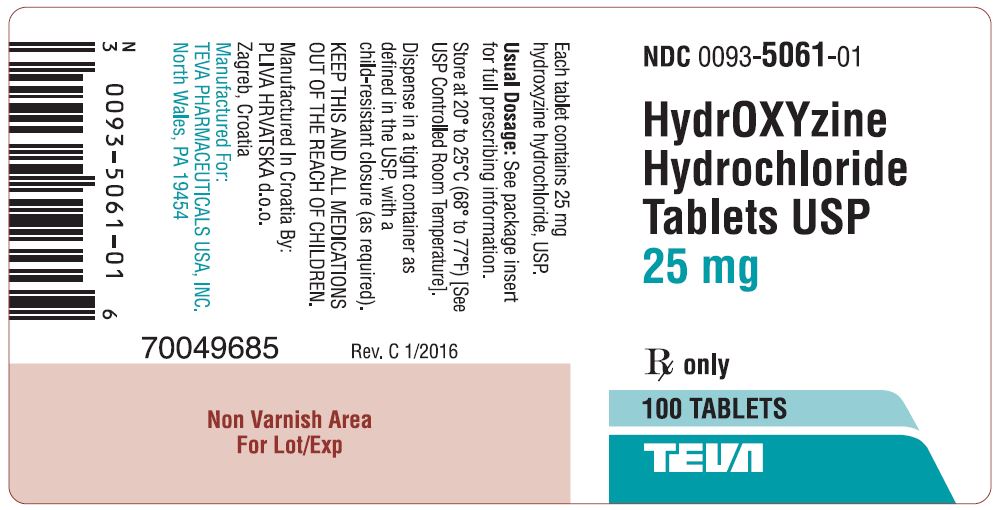
Package/Label Display Panel NDC 0093-5061-01 hydrOXYzine Hydrochloride Tablets, USP 25 mg Rx only 100 Tablets 2
Package/Label Display Panel NDC 0093-5062-01 hydrOXYzine Hydrochloride Tablets, USP 50 mg Rx only 100 Tablets 3