
Mag-AL Liquid Aluminum Hydroxide and Magnesium 200 mg/5mL; 200 mg/5mL Suspension — NDC 0121-1760-30 (Billing 00121-1760-30)
This is a package of Mag-AL Liquid Aluminum Hydroxide and Magnesium 200 mg/5mL; 200 mg/5mL Suspension from PAI Holdings, LLC, marketed since Jan 2004 and currently FDA-listed. It is this product's only package size.
NDC database record
One package, one record: these facts belong to NDC 0121-1760-30 alone.
- Record
- FDA NDC Directory package listing · Human OTC drug
- Code segments
- 0121 labeler · 1760 product · 30 package
- Package marketed since
- Jan 14, 2004
- Sample package
- No — commercial package
- Listing certified through
- Dec 31, 2026
- Barcode (UPC-A, from the NDC)
- 3 0121176030 2
- Medicaid fills, this package
- 2,886 prescriptions in the last four reported quarters
- FDA record last changed
- Oct 1, 2026
Identity & classification
Regulatory identifiers FDA, NLM and CMS codes for this package
Drug-database identifiers Medi-Span GPI and First Databank GCN / HICL / AHFS classification
- GSN (GCN sequence number): 011796
- GCN: 63980
- GPI-14 (Medi-Span): 48990002101815
- HICL (First Databank): 001169
- AHFS class code: 56:04.00.00
- RxCUI (RxNorm): 243463
Where does this data come from?
- FDA openFDA NDC Directory · synced Oct 1, 2026
- FDA label on DailyMed · label index refreshed Oct 6, 2026
- RxNorm (NLM RxNav) · catalog refreshed Oct 1, 2026
- Medi-Span GPI (licensed)
- First Databank (licensed) · refreshed Oct 1, 2026
RxNorm drug class
This medicine belongs to the Aluminium compounds class.
Where does this data come from?
- RxClass (NLM) · catalog refreshed Oct 1, 2026
Clinical
- It relieves acid indigestion, heartburn, sour stomach and upset stomach caused by those symptoms. Mag-AL Liquid is the oral suspension form.
- Shake the bottle well, then measure your dose in teaspoonfuls. Adults and children 12 and older usually take it up to four times a day, or as your doctor directs. Follow the produc...
- Don't take more than 16 teaspoonfuls in 24 hours. Also avoid using the maximum dose for more than 2 weeks unless a doctor is supervising you.
- If your symptoms last more than 2 weeks, stop and check in with a doctor. Ongoing symptoms deserve a proper look.
Patient education
Supplement & herbal interactions
Where does this data come from?
- MedlinePlus (NLM) · refreshed Oct 1, 2026
- FDA label on DailyMed · label index refreshed Oct 6, 2026
Ask a licensed pharmacist directly — free, answered by our team.
Pricing
A drug doesn't have one price. Each row is a different public payment system, and none is what you'd pay at the counter — that depends on your insurance. The ⓘ on each row explains what it measures.
| Price system | Per mL | Per package |
|---|---|---|
| Retail pharmacies payNADAC · weekly | Not in the retail survey — common for institutional, discontinued, or low-volume packs. | |
| Medicaid paysCMS SDUD · 12 mo | $1.46 | $4,373.10 / 3000 ml |
| Medicare drug plans payPart D · quarterly | No Part D plan price is available for this NDC in our data. | |
Where does this data come from?
- CMS NADAC weekly file
- CMS ASP pricing files · refreshed Sep 20, 2026
- CMS Medicaid State Drug Utilization Data · through Q1 2026
- CMS Part D plan pricing files · refreshed Sep 24, 2026
- VA National Acquisition Center price file
Packaging — all sizes for this product
| Package NDC | Description | Marketing start | Marketing end | Status |
|---|---|---|---|---|
| 00121-1760-30 You're viewing this Main listing | 10 TRAY in 1 CASE / 10 CUP, UNIT-DOSE in 1 TRAY / 30 mL in 1 CUP, UNIT-DOSE | 2004-01-14 | — | Active |
Therapeutic equivalents
| Product | Labeler | Pack | NADAC/unit | TE | Status | Price vs. this |
|---|---|---|---|---|---|---|
| Mag-AL Liquid 200 mg/5mL; 200 mg/5mLthis 00121-1760-30 | PAI | 10 cups | — | — | FDA listed | — |
| Kesin MAG-AL 200 mg/5mL; 200 mg/5mL 81033-0005-01 | Kesin | 100 cups | — | — | FDA listed | — |
Where does this data come from?
- FDA openFDA NDC Directory · synced Oct 1, 2026
- FDA Orange Book · refreshed Oct 3, 2026
- CMS NADAC weekly file
Availability & generic status
We did not find an FDA-approved generic match for this exact strength, form and route.
Where does this data come from?
- FDA Orange Book · refreshed Oct 3, 2026
What it looks like
Where does this data come from?
- FDA label on DailyMed · label index refreshed Oct 6, 2026
Inactive Ingredients / Excipients
Inactive ingredients, also called excipients, are components of the drug product other than the active ingredient. They may include fillers, dyes, coatings, preservatives, flavors, or other formulation ingredients.
🧪 Avoiding an ingredient? See Aluminum Hydroxide and Magnesium Hydroxide inactive ingredients by manufacturer: every current product's list side by side, so you can ask your pharmacy for the version that does not list it.
💡 Tap an ingredient (hover on desktop) to see what it is and why it’s used.
-
UNII 3QPI1U3FV8
A preservative derived from benzoic acid that prevents bacterial and fungal growth in medicines. It helps extend shelf life and maintain product safety during storage and use.
-
UNII CZ227117JE
A silicone-based compound made of linked silicon and oxygen atoms arranged in a ring structure. It acts as a solvent, carrier, or conditioning agent to help distribute active ingredients evenly and improve product texture and spreadability.
-
UNII RN3152OP35
Hypromellose is a plant-based thickener and film-former derived from cellulose. In medicines, it's used to create coatings on tablets and capsules, control how fast the drug dissolves, and improve the product's texture and stability.
-
UNII AV092KU4JH
A natural oil extracted from peppermint plants. It's used as a flavoring agent to mask bitter tastes and add a refreshing mint flavor to medicines, making them easier to take.
-
UNII 6DC9Q167V3
Propylene glycol is a clear liquid derived from petroleum or vegetable sources. It acts as a solvent, humectant, and preservative in medicines, helping dissolve active ingredients and maintain product stability.
-
UNII Z8IX2SC1OH
Propylparaben is a chemical preservative used to prevent bacterial and fungal growth in medicines and personal care products. It helps extend shelf life and maintain product safety during storage.
-
UNII SB8ZUX40TY
Saccharin sodium is an artificial sweetener made from saccharin salt. It's added to medicines to improve taste, especially in liquid formulations for children or bitter drugs.
-
UNII 506T60A25R
Sorbitol is a natural sugar alcohol derived from glucose. It serves as a sweetener, humectant, and bulking agent in medications to improve taste and help maintain moisture in the product.
-
UNII 059QF0KO0R
Water is a liquid solvent that dissolves and mixes ingredients together in liquid medicines, syrups, and injections. It helps distribute the active drug evenly throughout the product.
9 inactive ingredients listed in the exact product block matched to this NDC.
Label-section wording can be broader than the structured product block and may mention additional formulation ingredients.
Where does this data come from?
ingredient classCode="IACT" elements from the exact product block matched by this NDC. Label-section narrative from DailyMed / the openFDA label index is shown separately when available.- FDA label on DailyMed · label index refreshed Oct 6, 2026
- FDA openFDA NDC Directory · synced Oct 1, 2026
Inactive ingredient FAQ
Are inactive ingredients the same for every manufacturer?
Why might an inactive ingredient be missing?
Can inactive ingredients matter?
Manufacturer & labeler
More NDCs from PAI Holdings, LLC labeler code 00121
- Metoclopramide 5 mg/5mL Solution NDC 0121-1576-10
- Levetiracetam 1000 mg/10mL Solution NDC 0121-1598-20
- Childrens Ibuprofen Oral Suspension 200 mg/10mL Suspension NDC 0121-1666-00
- Diphenhydramine HCl diphenhydramine hydrochloride 25 mg/10mL Solution NDC 0121-1730-00
- GUAIFENESIN 100 mg/5mL Solution NDC 0121-1744-00
- LACTULOSE 20 g/30mL Solution NDC 0121-1746-00
- Mag-AL Plus Aluminum Hydroxide, Magnesium Hydroxide, and Simethicone 200 mg/5mL; 20 mg/5mL; 200 mg/5mL Suspension NDC 0121-1761-30
- Mag-AL Plus XS Aluminum Hydroxide, Magnesium Hydroxide, and Dimethicone 400 mg/5mL; 400 mg/5mL; 40 mg/5mL Suspension NDC 0121-1762-30
- Guaifenesin and Codeine Phosphate 100 mg/5mL; 10 mg/5mL Solution NDC 0121-1775-00
- Childrens Acetaminophen 160 mg/5mL Suspension NDC 0121-1781-00
- CHLORHEXIDINE GLUCONATE 1.2 mg/mL Rinse NDC 0121-1786-16
- Childrens Ibuprofen Oral Suspension 100 mg/10mL Suspension NDC 0121-1828-00
Where does this data come from?
- FDA openFDA NDC Directory · synced Oct 1, 2026
- Drugs@FDA
FDA label — Drug Facts FDA SPL
🎯 Indications and Usage ▾
Uses for the relief of: acid indigestion heartburn sour stomach upset stomach due to these symptoms
⏱️ Dosage and Administration ▾
Directions shake well before using do not take more than 16 teaspoonfuls in 24 hours or use the maximum dosage for more than 2 weeks adults and children 12 years and older take 2 to 4 teaspoonfuls four times a day or as directed by a physician children under 12 years consult a physician
⚠️ Warnings ▾
Warnings Do not take more than 16 teaspoonfuls in a 24-hour period or use the maximum dosage for more than 2 weeks except under the advice and supervision of a physician. Ask a doctor before use if you have kidney disease a magnesium-restricted diet Ask a doctor or pharmacist before use if you are presently taking a prescription drug. Antacids may interact with certain prescription drugs.
Stop use and ask a doctor if symptoms last more than 2 weeks. Keep out of reach of children.
📦 Storage and Handling ▾
Other information each 5 mL contains: magnesium 83 mg, sodium 1.34 mg does not meet USP requirements for preservative effectiveness store at controlled room temperature 20° - 25°C (68° - 77°F) protect from freezing White colored, peppermint flavored liquid supplied in the following oral dosage form: NDC 0121-1760-30: 30 mL unit dose cup, in a tray of ten cups.
🧪 Active Ingredient ▾
Active ingredients (in each 5 mL = 1 teaspoonful) Purpose Aluminum hydroxide (equiv. to dried gel, USP) 200 mg Antacid Magnesium hydroxide 200 mg Antacid
🧪 Inactive Ingredients ▾
Inactive ingredients Antifoam af emulsion, butylparaben, hydroxypropyl methylcellulose, flavoring, propylene glycol, propylparaben, purified water, sodium saccharin, and sorbitol solution.
🎯 Purpose ▾
Active ingredients (in each 5 mL = 1 teaspoonful) Purpose Aluminum hydroxide (equiv. to dried gel, USP) 200 mg Antacid Magnesium hydroxide 200 mg Antacid
📄 Ask a Doctor Before Use If ▾
Ask a doctor before use if you have kidney disease a magnesium-restricted diet
📄 Ask a Doctor or Pharmacist Before Use If ▾
Ask a doctor or pharmacist before use if you are presently taking a prescription drug. Antacids may interact with certain prescription drugs.
📄 Stop Use and Ask a Doctor If ▾
Stop use and ask a doctor if symptoms last more than 2 weeks.
📄 Keep Out of Reach of Children ▾
Keep out of reach of children.
📄 Questions or Comments ▾
Questions or comments? Call 1-800-845-8210
📄 Package Label / Principal Display Panel ▾
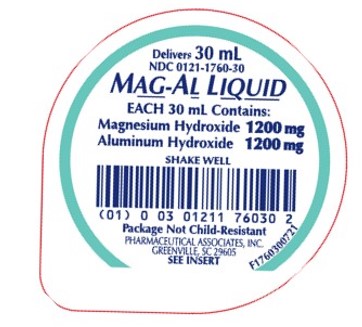
PRINCIPAL DISPLAY PANEL - 30 mL Dose Cup Tray Label Delivers 30 ML NDC 0121-1760-30 MAG-AL Liquid Each 30 mL contains: Magnesium Hydroxide 1200 mg Aluminum Hydroxide 1200 mg SHAKE WELL Package Not Child-Resistant PRINCIPAL DISPLAY PANEL - 30 mL Dose Cup Tray Label
Medicaid utilization & spend
Reported adverse events (FAERS)
Top reported reactions
Reporter sex
Serious outcomes
Where does this data come from?
About this NDC listing & data coverage
What data is (and isn’t) available for this NDC — tap to expand
| NDC identity (package / product / labeler codes) | ✓ Available |
| Labeler | ✓ Available |
| Product & package description | ✓ Available |
| Marketing category & status | ✓ Available |
| Active ingredient / dosage form / route | ✓ Available |
| FDA label (SPL via DailyMed) | ✓ Available |
| Package photos | ✓ Available |
| Inactive ingredients (structured) | ✓ Available |
| NADAC pharmacy acquisition price (CMS) | — Not published for this NDC CMS publishes NADAC only for NDCs reported in its retail-pharmacy survey. |
| Orange Book / therapeutic-equivalence data | — Not published for this NDC Applies only to products approved under an NDA/ANDA; many listings are out of scope. |
| HCPCS J-code billing crosswalk | — Not published for this NDC Most self-administered / retail products have no J-code — that is normal. |
| Medicaid utilization (CMS SDUD) | ✓ Available |