
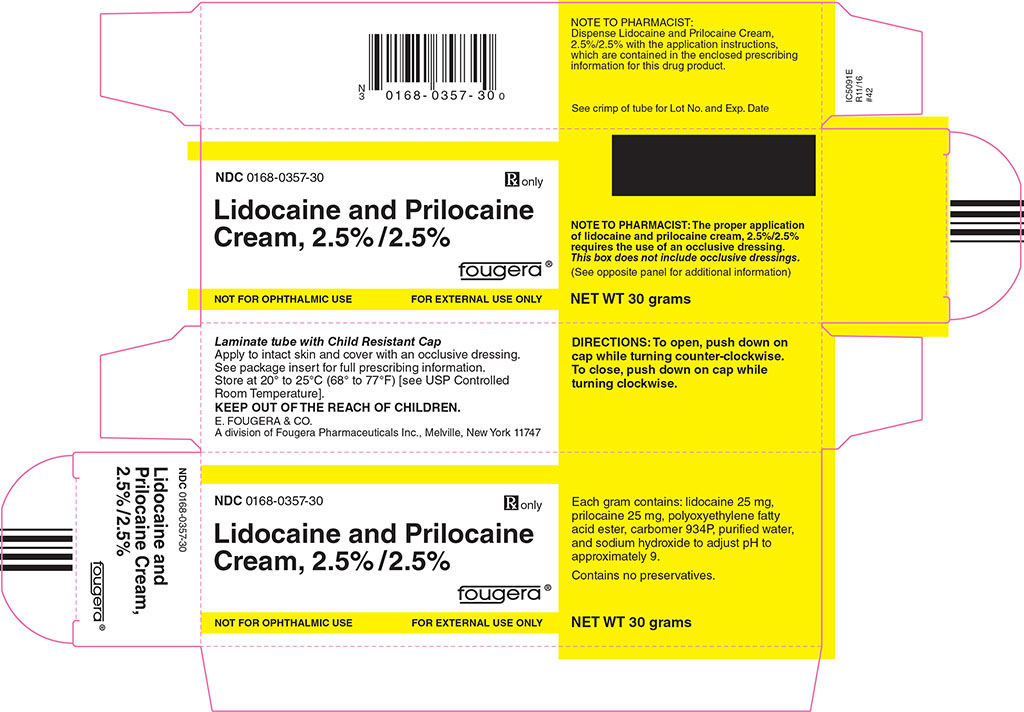
Lidocaine and Prilocaine 25 mg/g; 25 mg/g Cream — NDC 0168-0357-30 (Billing 00168-0357-30)
This is a package of Lidocaine and Prilocaine 25 mg/g; 25 mg/g Cream from E. Fougera & Co. a division of Fougera Pharmaceuticals, LLC, marketed since Aug 2003 and currently FDA-listed; retail pharmacies pay about $0.2317 per g (NADAC). It is the main listing for this product, which comes in 3 package sizes.
NDC database record
One package, one record: these facts belong to NDC 0168-0357-30 alone.
- Record
- FDA NDC Directory package listing · Human prescription drug
- Code segments
- 0168 labeler · 0357 product · 30 package
- Package marketed since
- Aug 18, 2003
- Sample package
- No — commercial package
- Listing certified through
- Dec 31, 2027
- Barcode (UPC)
- 0301680357300
- Medicaid fills, this package
- 115,682 prescriptions in the last four reported quarters
- FDA record last changed
- Jul 24, 2026
Past resolved recalls for this product (1)
Identity & classification
Regulatory identifiers FDA, NLM and CMS codes for this package
Drug-database identifiers Medi-Span GPI and First Databank GCN / HICL / AHFS classification
- GSN (GCN sequence number): 035495
- GCN: 05987
- GPI-14 (Medi-Span): 90859902903710
- HICL (First Databank): 016196
- AHFS class code: 72:00.00.00
- RxCUI (RxNorm): 197877
Where does this data come from?
- FDA openFDA NDC Directory · synced Oct 8, 2026
- FDA label on DailyMed · label index refreshed Oct 8, 2026
- RxNorm (NLM RxNav) · catalog refreshed Oct 1, 2026
- Medi-Span GPI (licensed)
- First Databank (licensed) · refreshed Oct 8, 2026
RxNorm drug class
This medicine belongs to the Antiarrhythmic class.
Where does this data come from?
- RxClass (NLM) · catalog refreshed Oct 1, 2026
Clinical
Patient education
Supplement & herbal interactions
Where does this data come from?
- MedlinePlus (NLM) · refreshed Oct 8, 2026
- FDA label on DailyMed · label index refreshed Oct 8, 2026
Ask a licensed pharmacist directly — free, answered by our team.
Pricing
A drug doesn't have one price. Each row is a different public payment system, and none is what you'd pay at the counter — that depends on your insurance. The ⓘ on each row explains what it measures.
| Price system | Per g | Per package |
|---|---|---|
| Retail pharmacies payNADAC · weekly | $0.232 | $6.95 / 30 g |
| Medicaid paysCMS SDUD · 12 mo | $1.03 | $31.00 / 30 g |
| Medicare drug plans payPart D · Q2 2026 | $0.3852 | $11.56 / 30 g |
Where does this data come from?
- CMS NADAC weekly file · file of Oct 7, 2026
- CMS ASP pricing files · refreshed Sep 20, 2026
- CMS Medicaid State Drug Utilization Data · through Q1 2026
- CMS Part D plan pricing files · refreshed Sep 24, 2026
- VA National Acquisition Center price file
Packaging — all sizes for this product
| Package NDC | Description | Per unit | Per pack | Marketing start | Marketing end | Status |
|---|---|---|---|---|---|---|
| 00168-0357-30 You're viewing this Main listing | 1 TUBE in 1 CARTON / 30 g in 1 TUBE | $0.2317 / g | $6.95 | 2003-08-18 | — | Active |
| 00168-0357-55 0168-0357-55 | 1 TUBE in 1 CARTON / 5 g in 1 TUBE | $1.34 / g | $6.68 | 2004-07-21 | — | Active |
| 00168-0357-56 0168-0357-56 | 1 TUBE in 1 CARTON / 5 g in 1 TUBE | — | — | 2004-07-21 | — | Active |
This pack has the lowest per-g cost of the 2 priced pack sizes ($0.2317 NADAC).
In Medicaid, this is the most-dispensed pack of this product — about 99% of fills over the last four reported quarters. See all packs ↓
Pack size FAQ
What quantity is in this package?
What NDC number is used to bill for this package of Lidocaine and Prilocaine 25 mg/g; 25 mg/g Cream?
Prices are the latest CMS NADAC pharmacy acquisition cost per NDC; per-pack figures are per-unit × pack quantity, shown only when the pack is denominated in the same measure NADAC prices.
Therapeutic equivalents
| Product | Labeler | Pack | NADAC/unit | TE | Status | Price vs. this |
|---|---|---|---|---|---|---|
| Lidocaine and Prilocaine 25 mg/g; 25 mg/g 00121-1002-30 | PAI | 1 tube | $0.221 | — | Discontinued | save 5% |
| Lidocaine and Prilocaine 25 mg/g; 25 mg/gthis 00168-0357-30 | E. | 1 tube | $0.232 | AB | Availability likely | — |
| Lidocaine And Prilocaine 25 mg/g; 25 mg/g 00574-2042-30 | Padagis | 1 tube | $0.232 | AB | Availability likely | — |
| Lidocaine And Prilocaine Lidocaine And Prilocaine 25 mg/g; 25 mg/g 21922-0076-05 | Encube | 1 tube | $0.232 | AB | Availability likely | — |
| Lidocaine and prilocaine 25 mg/g; 25 mg/g 72578-0165-06 | Viona | 1 tube | $0.232 | AB | Availability likely | — |
| Lidocaine and Prilocaine 25 mg/g; 25 mg/g 62332-0582-04 | Alembic | 1 tube | $1.335 | AB | Availability likely | +476% |
| Lidocaine and Prilocaine 25 mg/g; 25 mg/g 46708-0582-04 | Alembic | 1 tube | — | AB | FDA listed | — |
| Lidocaine And Prilocaine 25 mg/g; 25 mg/g 50090-6589-00 | A-S | 1 tube | — | AB | FDA listed | — |
| Lidocaine And Prilocaine 25 mg/g; 25 mg/g 63629-9604-01 | Bryant | 1 tube | — | AB | FDA listed | — |
| Lidocaine and Prilocaine 25 mg/g; 25 mg/g 68071-1625-03 | NuCare | 30 g | — | — | FDA listed | — |
| Lidocaine And Prilocaine 25 mg/g; 25 mg/g 68071-3856-03 | NuCare | 1 tube | — | AB | FDA listed | — |
| Lidocaine And Prilocaine 25 mg/g; 25 mg/g 68788-4090-03 | Preferred | 1 tube | — | AB | FDA listed | — |
| Lidocaine and Prilocaine 25 mg/g; 25 mg/g 68788-8150-03 | Preferred | 1 tube | — | AB | FDA listed | — |
| Lidocaine and prilocaine 25 mg/g; 25 mg/g 70771-1872-02 | Zydus | 1 tube | — | AB | FDA listed | — |
| Lidocaine And Prilocaine 25 mg/g; 25 mg/g 71335-2716-01 | Bryant | 1 tube | — | AB | FDA listed | — |
| Lidocaine And Prilocaine 25 mg/g; 25 mg/g 71335-2970-01 | Bryant | 1 tube | — | AB | FDA listed | — |
| Lidocaine And Prilocaine 25 mg/g; 25 mg/g 72162-1125-03 | Bryant | 1 tube | — | AB | FDA listed | — |
| Cadira Compliant Blood Stat 25 mg/g; 25 mg/g 76420-0313-01 | Asclemed | 1 tube | — | — | FDA listed | — |
| Lidocaine and prilocaine 25 mg/g; 25 mg/g 50090-8089-00 | A-S | 1 tube | — | AB | FDA listed | — |
Where does this data come from?
- FDA openFDA NDC Directory · synced Oct 8, 2026
- FDA Orange Book · refreshed Oct 3, 2026
- CMS NADAC weekly file · file of Oct 7, 2026
Availability & generic status
This product is an FDA-approved generic. Other versions of the same drug are listed under Therapeutic equivalents, least expensive first.
Where does this data come from?
- FDA Orange Book · refreshed Oct 3, 2026
Inactive Ingredients / Excipients
Inactive ingredients, also called excipients, are components of the drug product other than the active ingredient. They may include fillers, dyes, coatings, preservatives, flavors, or other formulation ingredients.
💡 Tap an ingredient (hover on desktop) to see what it is and why it’s used.
-
UNII Z135WT9208
Carbomer is a synthetic polymer that forms a thick, gel-like consistency. It's used in medicines as a thickener and stabilizer to improve texture and keep ingredients evenly mixed throughout the product.
-
UNII R07D3A9614
A synthetic ingredient made from castor oil that has been chemically modified with polyethylene glycol. It acts as an emulsifier and solubilizer in medicines, helping mix oil and water-based components and dissolve poorly soluble drugs.
-
UNII 55X04QC32I
A strong alkaline chemical used to adjust and maintain the pH balance of liquid medicines. It helps keep the medicine stable and ensures it stays effective during storage.
-
UNII 059QF0KO0R
Water is a liquid solvent that dissolves and mixes ingredients together in liquid medicines, syrups, and injections. It helps distribute the active drug evenly throughout the product.
4 inactive ingredients listed in the exact product block matched to this NDC.
Where does this data come from?
ingredient classCode="IACT" elements from the exact product block matched by this NDC. Label-section narrative from DailyMed / the openFDA label index is shown separately when available.- FDA label on DailyMed · label index refreshed Oct 8, 2026
- FDA openFDA NDC Directory · synced Oct 8, 2026
Inactive ingredient FAQ
Are inactive ingredients the same for every manufacturer?
Why might an inactive ingredient be missing?
Can inactive ingredients matter?
Manufacturer & labeler
More NDCs from E. Fougera & Co. a division of Fougera Pharmaceu... labeler code 00168
- Clobetasol Propionate .5 mg/g Gel NDC 0168-0293-15
- Clobetasol Propionate (emollient) .5 mg/g Cream NDC 0168-0301-15
- Metronidazole 7.5 mg/g Cream NDC 0168-0323-46
- Fluticasone Propionate .5 mg/g Cream NDC 0168-0332-15
- Terconazole 4 mg/g Cream NDC 0168-0346-46
- Terconazole Vaginal Cream 0.8% 8 mg/g Cream NDC 0168-0347-20
- Oxiconazole Nitrate 10 mg/g Cream NDC 0168-0358-30
- Metronidazole 7.5 mg/mL Lotion NDC 0168-0383-60
- Tacrolimus 1 mg/g Ointment NDC 0168-0416-30
- Tacrolimus .3 mg/g Ointment NDC 0168-0417-30
- Adapalene 1 mg/g Cream NDC 0168-0424-46
Where does this data come from?
- FDA openFDA NDC Directory · synced Oct 8, 2026
- Drugs@FDA
Full prescribing information FDA SPL
🎯 Indications and Usage ▾
INDICATIONS AND USAGE Lidocaine and prilocaine cream, 2.5%/2.5% (a eutectic mixture of lidocaine 2.5% and prilocaine 2.5%) is indicated as a topical anesthetic for use on: - normal intact skin for local analgesia. - genital mucous membranes for superficial minor surgery and as pretreatment for infiltration anesthesia. Lidocaine and prilocaine cream, 2.5%/2.5% is not recommended in any clinical situation when penetration or migration beyond the tympanic membrane into the middle ear is possible because of the ototoxic effects observed in animal studies (see WARNINGS ).
⏱️ Dosage and Administration ▾
DOSAGE AND ADMINISTRATION Adult Patients-Intact Skin A thick layer of lidocaine and prilocaine cream, 2.5%/2.5% is applied to intact skin and covered with an occlusive dressing (see INSTRUCTIONS FOR APPLICATION ). Minor Dermal Procedures: For minor procedures such as intravenous cannulation and venipuncture, apply 2.5 grams (1/2 the 5 g tube) of lidocaine and prilocaine cream, 2.5%/2.5% over 20 to 25 cm 2 of skin surface for at least 1 hour. In controlled clinical trials using lidocaine and prilocaine cream, 2.5%/2.5%, two sites were usually prepared in case there was a technical problem with cannulation or venipuncture at the first site.
Major Dermal Procedures: For more painful dermatological procedures involving a larger skin area such as split thickness skin graft harvesting, apply 2 grams of lidocaine and prilocaine cream, 2.5%/2.5% per 10 cm 2 of skin and allow to remain in contact with the skin for at least 2 hours. Adult Male Genital Skin: As an adjunct prior to local anesthetic infiltration, apply a thick layer of lidocaine and prilocaine cream, 2.5%/2.5% (1 g/10 cm 2 ) to the skin surface for 15 minutes. Local anesthetic infiltration should be performed immediately after removal of lidocaine and prilocaine cream, 2.5%/2.5%.
Dermal analgesia can be expected to increase for up to 3 hours under occlusive dressing and persist for 1 to 2 hours after removal of the cream. The amount of lidocaine and prilocaine absorbed during the period of application can be estimated from the information in Table 2 , ** footnote, in Individualization of Dose. Adult Female Patients-Genital Mucous Membranes For minor procedures on the female external genitalia, such as removal of condylomata acuminata, as well as for use as pretreatment for anesthetic infiltration, apply a thick layer (5 to 10 grams) of lidocaine and prilocaine cream, 2.5%/2.5% for 5 to 10 minutes.
Occlusion is not necessary for absorption, but may be helpful to keep the cream in place. Patients should be lying down during the lidocaine and prilocaine cream, 2.5%/2.5% application, especially if no occlusion is used. The procedure or the local anesthetic infiltration should be performed immediately after the removal of lidocaine and prilocaine cream, 2.5%/2.5%.
Pediatric Patients-Intact Skin The following are the maximum recommended doses, application areas and application times for lidocaine and prilocaine cream, 2.5%/2.5% based on a child's age and weight: Age and Body Weight Requirements Maximum Total Dose of Lidocaine and Prilocaine Cream, 2.5%/2.5% Maximum Application Area Maximum Application Time 0 up to 3 months or < 5 kg 1g 10 cm 2 1 hour 3 up to 12 months and >5 kg 2g 20 cm 2 4 hours 1 to 6 years and >10 kg 10g 100 cm 2 4 hours 7 to 12 years and >20 kg 20g 200 cm 2 4 hours Please note: If a patient greater than 3 months old does not meet the minimum weight requirement, the maximum total dose of lidocaine and prilocaine cream, 2.5%/2.5% should be restricted to that which corresponds to the patient's weight (see INSTRUCTIONS FOR APPLICATION ).
Practitioners should carefully instruct caregivers to avoid application of excessive amounts of lidocaine and prilocaine cream, 2.5%/2.5% (see PRECAUTIONS ). When applying lidocaine and prilocaine cream, 2.5%/2.5% to the skin of young children, care must be taken to maintain careful observation of the child to prevent accidental ingestion of lidocaine and prilocaine cream, 2.5%/2.5% or the occlusive dressing. A secondary protective covering to prevent inadvertent disruption of the application site may be useful.
Lidocaine and prilocaine cream, 2.5%/2.5% should not be used in neonates with a gestational age less than 37 weeks nor in infants under the age of 12 months who are receiving treatment with methemoglobin-inducing agents (see Methemoglobinemia subsection of WARNINGS ). When lidocaine and prilocaine cream, 2.5%/2.5% is used concomitantly with other products containing local anesthetic agents, the amount absorbed from all f… [Excerpted — this section continues on DailyMed.]
⛔ Contraindications ▾
CONTRAINDICATIONS Lidocaine and prilocaine cream, 2.5%/2.5% is contraindicated in patients with a known history of sensitivity to local anesthetics of the amide type or to any other component of the product.
⚠️ Warnings ▾
WARNINGS Application of lidocaine and prilocaine cream, 2.5%/2.5% to larger areas or for longer times than those recommended could result in sufficient absorption of lidocaine and prilocaine resulting in serious adverse effects (see Individualization of Dose ). Patients treated with class III anti-arrhythmic drugs (e.g., amiodarone, bretylium, sotalol, dofetilide) should be under close surveillance and ECG monitoring considered, because cardiac effects may be additive. Studies in laboratory animals (guinea pigs) have shown that lidocaine and prilocaine cream, 2.5%/2.5% has an ototoxic effect when instilled into the middle ear.
In these same studies, animals exposed to lidocaine and prilocaine cream, 2.5%/2.5% only in the external auditory canal, showed no abnormality. Lidocaine and prilocaine cream, 2.5%/2.5% should not be used in any clinical situation when its penetration or migration beyond the tympanic membrane into the middle ear is possible. Methemoglobinemia: Cases of methemoglobinemia have been reported in association with local anesthetic use.
Although all patients are at risk for methemoglobinemia, patients with glucose- 6-phosphate dehydrogenase deficiency, congenital or idiopathic methemoglobinemia, cardiac or pulmonary compromise, infants under 6 months of age, and concurrent exposure to oxidizing agents or their metabolites are more susceptible to developing clinical manifestations of the condition. If local anesthetics must be used in these patients, close monitoring for symptoms and signs of methemoglobinemia is recommended. Signs of methemoglobinemia may occur immediately or may be delayed some hours after exposure, and are characterized by a cyanotic skin discoloration and/or abnormal coloration of the blood.
Methemoglobin levels may continue to rise; therefore, immediate treatment is required to avert more serious central nervous system and cardiovascular adverse effects, including seizures, coma, arrhythmias, and death. Discontinue lidocaine and prilocaine cream, 2.5%/2.5% and any other oxidizing agents. Depending on the severity of the signs and symptoms, patients may respond to supportive care, i.e., oxygen therapy, hydration.
A more severe clinical presentation may require treatment with methylene blue, exchange transfusion, or hyperbaric oxygen.
🤒 Adverse Reactions ▾
ADVERSE REACTIONS Localized Reactions: During or immediately after treatment with lidocaine and prilocaine cream, 2.5%/2.5% on intact skin, the skin at the site of treatment may develop erythema or edema or may be the locus of abnormal sensation. Rare cases of discrete purpuric or petechial reactions at the application site have been reported. Rare cases of hyperpigmentation following the use of lidocaine and prilocaine cream, 2.5%/2.5% have been reported.
The relationship to lidocaine and prilocaine cream, 2.5%/2.5% or the underlying procedure has not been established. In clinical studies on intact skin involving over 1,300 lidocaine and prilocaine cream, 2.5%/2.5%-treated subjects, one or more such local reactions were noted in 56% of patients, and were generally mild and transient, resolving spontaneously within 1 or 2 hours. There were no serious reactions that were ascribed to lidocaine and prilocaine cream, 2.5%/2.5%.
Two recent reports describe blistering on the foreskin in neonates about to undergo circumcision. Both neonates received 1.0 g of lidocaine and prilocaine cream, 2.5%/2.5%. In patients treated with lidocaine and prilocaine cream, 2.5%/2.5% on intact skin, local effects observed in the trials included: paleness (pallor or blanching) 37%, redness (erythema) 30%, alterations in temperature sensations 7%, edema 6%, itching 2% and rash, less than 1%.
In clinical studies on genital mucous membranes involving 378 lidocaine and prilocaine cream, 2.5%/2.5%-treated patients, one or more application site reactions, usually mild and transient, were noted in 41% of patients. The most common application site reactions were redness (21%), burning sensation (17%) and edema (10%). Allergic Reactions: Allergic and anaphylactoid reactions associated with lidocaine or prilocaine can occur.
They are characterized by urticaria, angioedema, bronchospasm, and shock. If they occur they should be managed by conventional means. The detection of sensitivity by skin testing is of doubtful value.
Systemic (Dose Related) Reactions: Systemic adverse reactions following appropriate use of lidocaine and prilocaine cream, 2.5%/2.5% are unlikely due to the small dose absorbed (see Pharmacokinetics subsection of CLINICAL PHARMACOLOGY ). Systemic adverse effects of lidocaine and/or prilocaine are similar in nature to those observed with other amide local anesthetic agents including CNS excitation and/or depression (light-headedness, nervousness, apprehension, euphoria, confusion, dizziness, drowsiness, tinnitus, blurred or double vision, vomiting, sensations of heat, cold or numbness, twitching, tremors, convulsions, unconsciousness, respiratory depression and arrest).
Excitatory CNS reactions may be brief or not occur at all, in which case the first manifestation may be drowsiness merging into unconsciousness. Cardiovascular manifestations may include bradycardia, hypotension and cardiovascular collapse leading to arrest.
🔄 Drug Interactions ▾
Drug Interactions: Lidocaine and prilocaine cream, 2.5%/2.5% should be used with caution in patients receiving Class I antiarrhythmic drugs (such as tocainide and mexiletine) since the toxic effects are additive and potentially synergistic. Patients who are administered local anesthetics are at increased risk of developing methemoglobinemia when concurrently exposed to the following drugs, which could include other local anesthetics: Examples of Drugs Associated with Methemoglobinemia: Class Examples Nitrates/Nitrites nitric oxide, nitroglycerin, nitroprusside, nitrous oxide Local anesthetics articaine, benzocaine, bupivacaine, lidocaine, mepivacaine, prilocaine, procaine, ropivacaine, tetracaine Antineoplastic agents cyclophosphamide, flutamide, hydroxyurea, ifosfamide, rasburicase Antibiotics dapsone, nitrofurantoin, para-aminosalicylic acid, sulfonamides Antimalarials chloroquine, primaquine Anticonvulsants Phenobarbital, phenytoin, sodium valproate Other drugs acetaminophen, metoclopramide, quinine, sulfasalazine Specific interaction studies with lidocaine/prilocaine and class III anti-arrhythmic drugs (e.g., amiodarone, bretylium, sotalol, dofetilide) have not been performed, but caution is advised (see WARNINGS ).
Should lidocaine and prilocaine cream, 2.5%/2.5% be used concomitantly with other products containing lidocaine and/or prilocaine, cumulative doses from all formulations must be considered.
🧒 Pediatric Use ▾
Pediatric Use: Controlled studies of lidocaine and prilocaine cream, 2.5%/2.5% in children under the age of seven years have shown less overall benefit than in older children or adults. These results illustrate the importance of emotional and psychological support of younger children undergoing medical or surgical procedures. Lidocaine and prilocaine cream, 2.5%/2.5% should be used with care in patients with conditions or therapy associated with methemoglobinemia (see Methemoglobinemia subsection of WARNINGS ) .
When using lidocaine and prilocaine cream, 2.5%/2.5% in young children, especially infants under the age of 3 months, care must be taken to insure that the caregiver understands the need to limit the dose and area of application, and to prevent accidental ingestion (see DOSAGE AND ADMINISTRATION and Methemoglobinemia ). In neonates (minimum gestation age: 37 weeks) and children weighing less than 20 kg, the area and duration of application should be limited ( see TABLE 2 in Individualization of Dose). Studies have not demonstrated the efficacy of lidocaine and prilocaine cream, 2.5%/2.5% for heel lancing in neonates.
🧓 Geriatric Use ▾
Geriatric Use Of the total number of patients in clinical studies of lidocaine and prilocaine cream, 2.5%/2.5%, 180 were age 65 to 74 and 138 were 75 and over. No overall differences in safety or efficacy were observed between these patients and younger patients. Other reported clinical experience has not identified differences in responses between the elderly and younger patients, but greater sensitivity of some older individuals cannot be ruled out.
Plasma levels of lidocaine and prilocaine in geriatric and non-geriatric patients following application of a thick layer of lidocaine and prilocaine cream, 2.5%/2.5% are very low and well below potentially toxic levels. However, there are no sufficient data to evaluate quantitative differences in systemic plasma levels of lidocaine and prilocaine between geriatric and non-geriatric patients following application of lidocaine and prilocaine cream, 2.5%/2.5%. Consideration should be given for those elderly patients who have enhanced sensitivity to systemic absorption (see PRECAUTION S ).
After intravenous dosing, the elimination half-life of lidocaine is significantly longer in elderly patients (2.5 hours) than in younger patients (1.5 hours). (See CLINICAL PHARMACOLOGY ).
🆘 Overdosage ▾
OVERDOSAGE Peak blood levels following a 60 g application to 400 cm 2 of intact skin for 3 hours are 0.05 to 0.16 mcg/mL for lidocaine and 0.02 to 0.10 mcg/mL for prilocaine. Toxic levels of lidocaine (>5 mcg/mL) and/or prilocaine (>6 mcg/mL) cause decreases in cardiac output, total peripheral resistance and mean arterial pressure. These changes may be attributable to direct depressant effects of these local anesthetic agents on the cardiovascular system.
In the absence of massive topical overdose or oral ingestion, evaluation should include evaluation of other etiologies for the clinical effects or overdosage from other sources of lidocaine, prilocaine or other local anesthetics. Consult the package inserts for parenteral Xylocaine (lidocaine HCl) or Citanest (prilocaine HCl) for further information for the management of overdose.
🧬 Clinical Pharmacology ▾
CLINICAL PHARMACOLOGY Mechanism of Action: Lidocaine and prilocaine cream, 2.5%/2.5%, applied to intact skin under occlusive dressing, provides dermal analgesia by the release of lidocaine and prilocaine from the cream into the epidermal and dermal layers of the skin and by the accumulation of lidocaine and prilocaine in the vicinity of dermal pain receptors and nerve endings. Lidocaine and prilocaine are amide-type local anesthetic agents. Both lidocaine and prilocaine stabilize neuronal membranes by inhibiting the ionic fluxes required for the initiation and conduction of impulses, thereby effecting local anesthetic action.
The onset, depth and duration of dermal analgesia on intact skin provided by lidocaine and prilocaine cream, 2.5%/2.5% depends primarily on the duration of application. To provide sufficient analgesia for clinical procedures such as intravenous catheter placement and venipuncture, lidocaine and prilocaine cream, 2.5%/2.5% should be applied under an occlusive dressing for at least 1 hour. To provide dermal analgesia for clinical procedures such as split skin graft harvesting, lidocaine and prilocaine cream, 2.5%/2.5% should be applied under occlusive dressing for at least 2 hours.
Satisfactory dermal analgesia is achieved 1 hour after application, reaches maximum at 2 to 3 hours, and persists for 1 to 2 hours after removal. Absorption from the genital mucosa is more rapid and onset time is shorter (5 to 10 minutes) than after application to intact skin. After a 5 to 10 minute application of lidocaine and prilocaine cream, 2.5%/2.5% to female genital mucosa, the average duration of effective analgesia to an argon laser stimulus (which produced a sharp, pricking pain) was 15 to 20 minutes (individual variations in the range of 5 to 45 minutes).
Dermal application of lidocaine and prilocaine cream, 2.5%/2.5% may cause a transient, local blanching followed by a transient, local redness or erythema. Pharmacokinetics: Lidocaine and prilocaine cream, 2.5%/2.5% is a eutectic mixture of lidocaine 2.5% and prilocaine 2.5% formulated as an oil in water emulsion. In this eutectic mixture, both anesthetics are liquid at room temperature (see DESCRIPTION ) and the penetration and subsequent systemic absorption of both prilocaine and lidocaine are enhanced over that which would be seen if each component in crystalline form was applied separately as a 2.5% topical cream.
Absorption: The amount of lidocaine and prilocaine systemically absorbed from lidocaine and prilocaine cream, 2.5%/2.5% is directly related to both the duration of application and to the area over which it is applied. In two pharmacokinetic studies, 60 g of lidocaine and prilocaine cream, 2.5%/2.5% (1.5 g lidocaine and 1.5 g prilocaine) was applied to 400 cm 2 of intact skin on the lateral thigh and then covered by an occlusive dressing. The subjects were then randomized such that one-half of the subjects had the occlusive dressing and residual cream removed after 3 hours, while the remainder left the dressing in place for 24 hours.
The results from these studies are summarized below. TABLE 1 Absorption of Lidocaine and Prilocaine from Lidocaine and Prilocaine Cream, 2.5%/2.5%: Normal Volunteers (N=16) LIDOCAINE and PRILOCAINE CREAM, 2.5%/2.5% (g) Area (cm 2 ) Time on (hrs) Drug Content (mg) Absorbed (mg) C max (mcg/mL) T max (hr) 60 400 3 lidocaine 1500 54 0.12 4 prilocaine 1500 92 0.07 4 60 400 24* lidocaine 1500 243 0.28 10 prilocaine 1500 503 0.14 10 * Maximum recommended duration of exposure is 4 hours. When 60 g of lidocaine and prilocaine cream, 2.5%/2.5% was applied over 400 cm 2 for 24 hours, peak blood levels of lidocaine are approximately 1/20 the systemic toxic level.
Likewise, the maximum prilocaine level is about 1/36 the toxic level. In a pharmacokinetic study, lidocaine and prilocaine cream, 2.5%/2.5% was applied to penile skin in 20 adult male patients in doses ranging from 0.5 g to 3.3 g for 15 minutes. Plasma concentrations of lidocaine… [Excerpted — this section continues on DailyMed.]
🧬 Mechanism of Action ▾
Mechanism of Action: Lidocaine and prilocaine cream, 2.5%/2.5%, applied to intact skin under occlusive dressing, provides dermal analgesia by the release of lidocaine and prilocaine from the cream into the epidermal and dermal layers of the skin and by the accumulation of lidocaine and prilocaine in the vicinity of dermal pain receptors and nerve endings. Lidocaine and prilocaine are amide-type local anesthetic agents. Both lidocaine and prilocaine stabilize neuronal membranes by inhibiting the ionic fluxes required for the initiation and conduction of impulses, thereby effecting local anesthetic action.
The onset, depth and duration of dermal analgesia on intact skin provided by lidocaine and prilocaine cream, 2.5%/2.5% depends primarily on the duration of application. To provide sufficient analgesia for clinical procedures such as intravenous catheter placement and venipuncture, lidocaine and prilocaine cream, 2.5%/2.5% should be applied under an occlusive dressing for at least 1 hour. To provide dermal analgesia for clinical procedures such as split skin graft harvesting, lidocaine and prilocaine cream, 2.5%/2.5% should be applied under occlusive dressing for at least 2 hours.
Satisfactory dermal analgesia is achieved 1 hour after application, reaches maximum at 2 to 3 hours, and persists for 1 to 2 hours after removal. Absorption from the genital mucosa is more rapid and onset time is shorter (5 to 10 minutes) than after application to intact skin. After a 5 to 10 minute application of lidocaine and prilocaine cream, 2.5%/2.5% to female genital mucosa, the average duration of effective analgesia to an argon laser stimulus (which produced a sharp, pricking pain) was 15 to 20 minutes (individual variations in the range of 5 to 45 minutes).
Dermal application of lidocaine and prilocaine cream, 2.5%/2.5% may cause a transient, local blanching followed by a transient, local redness or erythema.
📦 How Supplied / Storage and Handling ▾
HOW SUPPLIED Lidocaine and prilocaine cream, 2.5%/2.5% is supplied as follows: NDC 0168-0357-30 30 gram tube, with a child-resistant cap NDC 0168-0357-55 5 gram tube, FOR HOSPITAL USE ONLY NDC 0168-0357-56 5 gram tube, with 12 dressings, FOR HOSPITAL USE ONLY NOT FOR OPHTHALMIC USE. KEEP CONTAINER TIGHTLY CLOSED AT ALL TIMES WHEN NOT IN USE. KEEP OUT OF THE REACH OF CHILDREN.
Store at 20°C to 25°C (68°F to 77°F); excursions permitted to 15°C to 30°C (59°F to 86°F) [See USP Controlled Room Temperature]. E. FOUGERA & CO.
A division of Fougera PHARMACEUTICALS INC. Melville, New York 11747 Revised: 01/2024
📋 Description ▾
DESCRIPTION Lidocaine and prilocaine cream, 2.5%/2.5% is an emulsion in which the oil phase is a eutectic mixture of lidocaine and prilocaine in a ratio of 1:1 by weight. This eutectic mixture has a melting point below room temperature and therefore both local anesthetics exist as a liquid oil rather than as crystals. It is packaged in 30 gram tubes and 5 gram tubes for hospital use.
Lidocaine is chemically designated as acetamide, 2-(diethylamino)- N -(2,6-dimethylphenyl), has an octanol: water partition ratio of 43 at pH 7.4, and has the following structure: Prilocaine is chemically designated as propanamide, N -(2-methylphenyl)-2-(propylamino), has an octanol: water partition ratio of 25 at pH 7.4, and has the following structure: Each gram of lidocaine and prilocaine cream, 2.5%/2.5% contains lidocaine 25 mg, prilocaine 25 mg, polyoxyethylene fatty acid esters (as emulsifiers), carbomer 934P (as a thickening agent), sodium hydroxide to adjust to a pH approximating 9, and purified water.
Lidocaine and prilocaine cream, 2.5%/2.5% contains no preservative, however it passes the USP antimicrobial effectiveness test due to the pH. The specific gravity of lidocaine and prilocaine cream, 2.5%/2.5% is approximately 1.00. Structural Formula Structural Formula
💬 Information for Patients ▾
Information for Patients: Inform patients that use of local anesthetics may cause methemoglobinemia, a serious condition that must be treated promptly. Advise patients or caregivers to stop use and seek immediate medical attention if they or someone in their care experience the following signs or symptoms: pale, gray, or blue colored skin (cyanosis); headache; rapid heart rate; shortness of breath; lightheadedness; or fatigue. When lidocaine and prilocaine cream, 2.5%/2.5% is used, the patient should be aware that the production of dermal analgesia may be accompanied by the block of all sensations in the treated skin.
For this reason, the patient should avoid inadvertent trauma to the treated area by scratching, rubbing, or exposure to extreme hot or cold temperatures until complete sensation has returned. Lidocaine and prilocaine cream, 2.5%/2.5% should not be applied near the eyes or on open wounds.
⚠️ Precautions ▾
PRECAUTIONS General: Repeated doses of lidocaine and prilocaine cream, 2.5%/2.5% may increase blood levels of lidocaine and prilocaine. Lidocaine and prilocaine cream, 2.5%/2.5% should be used with caution in patients who may be more sensitive to the systemic effects of lidocaine and prilocaine including acutely ill, debilitated, or elderly patients. Lidocaine and prilocaine cream, 2.5%/2.5% should not be applied to open wounds.
Care should be taken not to allow lidocaine and prilocaine cream, 2.5%/2.5% to come in contact with the eye because animal studies have demonstrated severe eye irritation. Also the loss of protective reflexes can permit corneal irritation and potential abrasion. Absorption of lidocaine and prilocaine cream, 2.5%/2.5% in conjunctival tissues has not been determined.
If eye contact occurs, immediately wash out the eye with water or saline and protect the eye until sensation returns. Patients allergic to para-aminobenzoic acid derivatives (procaine, tetracaine, benzocaine, etc.) have not shown cross sensitivity to lidocaine and/or prilocaine, however, lidocaine and prilocaine cream, 2.5%/2.5% should be used with caution in patients with a history of drug sensitivities, especially if the etiologic agent is uncertain. Patients with severe hepatic disease, because of their inability to metabolize local anesthetics normally, are at greater risk of developing toxic plasma concentrations of lidocaine and prilocaine.
Lidocaine and prilocaine have been shown to inhibit viral and bacterial growth. The effect of lidocaine and prilocaine cream, 2.5%/2.5% on intradermal injections of live vaccines has not been determined. Information for Patients: Inform patients that use of local anesthetics may cause methemoglobinemia, a serious condition that must be treated promptly.
Advise patients or caregivers to stop use and seek immediate medical attention if they or someone in their care experience the following signs or symptoms: pale, gray, or blue colored skin (cyanosis); headache; rapid heart rate; shortness of breath; lightheadedness; or fatigue. When lidocaine and prilocaine cream, 2.5%/2.5% is used, the patient should be aware that the production of dermal analgesia may be accompanied by the block of all sensations in the treated skin. For this reason, the patient should avoid inadvertent trauma to the treated area by scratching, rubbing, or exposure to extreme hot or cold temperatures until complete sensation has returned.
Lidocaine and prilocaine cream, 2.5%/2.5% should not be applied near the eyes or on open wounds. Drug Interactions: Lidocaine and prilocaine cream, 2.5%/2.5% should be used with caution in patients receiving Class I antiarrhythmic drugs (such as tocainide and mexiletine) since the toxic effects are additive and potentially synergistic. Patients who are administered local anesthetics are at increased risk of developing methemoglobinemia when concurrently exposed to the following drugs, which could include other local anesthetics: Examples of Drugs Associated with Methemoglobinemia: Class Examples Nitrates/Nitrites nitric oxide, nitroglycerin, nitroprusside, nitrous oxide Local anesthetics articaine, benzocaine, bupivacaine, lidocaine, mepivacaine, prilocaine, procaine, ropivacaine, tetracaine Antineoplastic agents cyclophosphamide, flutamide, hydroxyurea, ifosfamide, rasburicase Antibiotics dapsone, nitrofurantoin, para-aminosalicylic acid, sulfonamides Antimalarials chloroquine, primaquine Anticonvulsants Phenobarbital, phenytoin, sodium valproate Other drugs acetaminophen, metoclopramide, quinine, sulfasalazine Specific interaction studies with lidocaine/prilocaine and class III anti-arrhythmic drugs (e.g., amiodarone, bretylium, sotalol, dofetilide) have not been performed, but caution is advised (see WARNINGS ).
Should lidocaine and prilocaine cream, 2.5%/2.5% be used concomitantly with other products containing lidocaine and/or prilocaine, cumulative doses from all formulations must be conside… [Excerpted — this section continues on DailyMed.]
🍼 Nursing Mothers ▾
Nursing Mothers: Lidocaine, and probably prilocaine, are excreted in human milk. Therefore, caution should be exercised when lidocaine and prilocaine cream, 2.5%/2.5% is administered to a nursing mother since the milk:plasma ratio of lidocaine is 0.4 and is not determined for prilocaine.
🧬 Pharmacokinetics ▾
Pharmacokinetics: Lidocaine and prilocaine cream, 2.5%/2.5% is a eutectic mixture of lidocaine 2.5% and prilocaine 2.5% formulated as an oil in water emulsion. In this eutectic mixture, both anesthetics are liquid at room temperature (see DESCRIPTION ) and the penetration and subsequent systemic absorption of both prilocaine and lidocaine are enhanced over that which would be seen if each component in crystalline form was applied separately as a 2.5% topical cream.
🔬 Clinical Studies ▾
CLINICAL STUDIES Lidocaine and prilocaine cream, 2.5%/2.5% application in adults prior to IV cannulation or venipuncture was studied in 200 patients in four clinical studies in Europe. Application for at least 1 hour provided significantly more dermal analgesia than placebo cream or ethyl chloride. Lidocaine and prilocaine cream, 2.5%/2.5% was comparable to subcutaneous lidocaine, but was less efficacious than intradermal lidocaine.
Most patients found lidocaine and prilocaine cream, 2.5%/2.5% treatment preferable to lidocaine infiltration or ethyl chloride spray. Lidocaine and prilocaine cream, 2.5%/2.5% was compared with 0.5% lidocaine infiltration prior to skin graft harvesting in one open label study in 80 adult patients in England. Application of lidocaine and prilocaine cream, 2.5%/2.5% for 2 to 5 hours provided dermal analgesia comparable to lidocaine infiltration.
Lidocaine and prilocaine cream, 2.5%/2.5% application in children was studied in seven non-US studies (320 patients) and one US study (100 patients). In controlled studies, application of lidocaine and prilocaine cream, 2.5%/2.5% for at least 1 hour with or without presurgical medication prior to needle insertion provided significantly more pain reduction than placebo. In children under the age of seven years, lidocaine and prilocaine cream, 2.5%/2.5% was less effective than in older children or adults.
Lidocaine and prilocaine cream, 2.5%/2.5% was compared with placebo in the laser treatment of facial port-wine stains in 72 pediatric patients (ages 5 to 16). Lidocaine and prilocaine cream, 2.5%/2.5% was effective in providing pain relief during laser treatment. Lidocaine and prilocaine cream, 2.5%/2.5% alone was compared with lidocaine and prilocaine cream, 2.5%/2.5% followed by lidocaine infiltration and lidocaine infiltration alone prior to cryotherapy for the removal of male genital warts.
The data from 121 patients demonstrated that lidocaine and prilocaine cream, 2.5%/2.5% was not effective as a sole anesthetic agent in managing the pain from the surgical procedure. The administration of lidocaine and prilocaine cream, 2.5%/2.5% prior to lidocaine infiltration provided significant relief of discomfort associated with local anesthetic infiltration and thus was effective in the overall reduction of pain from the procedure only when used in conjunction with local anesthetic infiltration of lidocaine. Lidocaine and prilocaine cream, 2.5%/2.5% was studied in 105 full term neonates (gestational age: 37 weeks) for blood drawing and circumcision procedures.
When considering the use of lidocaine and prilocaine cream, 2.5%/2.5% in neonates, the primary concerns are the systemic absorption of the active ingredients and the subsequent formation of methemoglobin. In clinical studies performed in neonates, the plasma levels of lidocaine, prilocaine, and methemoglobin were not reported in a range expected to cause clinical symptoms. Local dermal effects associated with lidocaine and prilocaine cream, 2.5%/2.5% application in these studies on intact skin included paleness, redness and edema and were transient in nature (see ADVERSE REACTIONS ).
The application of lidocaine and prilocaine cream, 2.5%/2.5% on genital mucous membranes for minor, superficial surgical procedures (e.g., removal of condylomata acuminata) was studied in 80 patients in a placebo-controlled clinical trial (60 patients received lidocaine and prilocaine cream, 2.5%/2.5% and 20 patients received placebo). Lidocaine and prilocaine cream, 2.5%/2.5% (5 to 10 g) applied between 1 and 75 minutes before surgery, with a median time of 15 minutes, provided effective local anesthesia for minor superficial surgical procedures.
The greatest extent of analgesia, as measured by VAS scores, was attained after 5 to 15 minutes’ application. The application of lidocaine and prilocaine cream, 2.5%/2.5% to genital mucous membranes as pretreatment for local anesthetic infiltration was studied in a double-blind, placeb… [Excerpted — this section continues on DailyMed.]
📄 Carcinogenesis, Mutagenesis, Impairment of Fertility ▾
Carcinogenesis, Mutagenesis, Impairment of Fertility Carcinogenesis : Long-term studies in animals designed to evaluate the carcinogenic potential of lidocaine and prilocaine have not been conducted. Metabolites of prilocaine have been shown to be carcinogenic in laboratory animals. In the animal studies reported below, doses or blood levels are compared with the Single Dermal Administration (SDA) of 60 g of lidocaine and prilocaine cream, 2.5%/2.5% to 400 cm 2 for 3 hours to a small person (50 kg).
The typical application of lidocaine and prilocaine cream, 2.5%/2.5% for one or two treatments for venipuncture sites (2.5 or 5 g) would be 1/24 or 1/12 of that dose in an adult or about the same mg/kg dose in an infant. Chronic oral toxicity studies of ortho -toluidine, a metabolite of prilocaine, in mice (450 to 7200 mg/m 2 ; 60 to 960 times SDA) and rats (900 to 4,800 mg/m 2 ; 60 to 320 times SDA) have shown that ortho -toluidine is a carcinogen in both species. The tumors included hepatocarcinomas/adenomas in female mice, multiple occurrences of hemangiosarcomas/ hemangiomas in both sexes of mice, sarcomas of multiple organs, transitional-cell carcinomas/ papillomas of urinary bladder in both sexes of rats, subcutaneous fibromas/fibrosarcomas and mesotheliomas in male rats, and mammary gland fibroadenomas/adenomas in female rats.
The lowest dose tested (450 mg/m 2 in mice, 900 mg/m 2 in rats; 60 times SDA) was carcinogenic in both species. Thus the no-effect dose must be less than 60 times SDA. The animal studies were conducted at 150 to 2,400 mg/kg in mice and at 150 to 800 mg/kg in rats.
The dosages have been converted to mg/m 2 for the SDA calculations above. Mutagenesis: The mutagenic potential of lidocaine HCl has been tested in a bacterial reverse (Ames) assay in Salmonella, an in vitro chromosomal aberration assay using human lymphocytes and in an in vivo micronucleus test in mice. There was no indication of mutagenicity or structural damage to chromosomes in these tests.
Ortho -toluidine, a metabolite of prilocaine, at a concentration of 0.5 mcg/mL, was genotoxic in Escherichia coli DNA repair and phage-induction assays. Urine concentrates from rats treated with ortho -toluidine (300 mg/kg orally; 300 times SDA) were mutagenic when examined in Salmonella typhimurium in the presence of metabolic activation. Several other tests on ortho -toluidine, including reverse mutations in five different Salmonella typhimurium strains in the presence or absence of metabolic activation and a study to detect single strand breaks in DNA of V79 Chinese hamster cells, were negative.
Impairment of Fertility : See Use in Pregnancy .
📄 Patient Package Insert ▾
INSTRUCTIONS FOR APPLICATION Lidocaine and Prilocaine Cream, 2.5%/2.5% 1. In adults, apply 2.5 g of cream per 20 to 25 cm 2 (approx. 2 in. by 2 in.) of skin in a thick layer at the site of the procedure.
For adult and pediatric patients, apply ONLY as prescribed by your physician. If your child is below the age of 3 months or small for their age, please inform your doctor before applying lidocaine and prilocaine cream, 2.5%/2.5%, which can be harmful, if applied over too much skin at one time in young children. If your child becomes very dizzy, excessively sleepy, or develops duskiness of the face or lips after applying lidocaine and prilocaine cream, 2.5%/2.5%, remove the cream and contact your physician at once.
2. Take the dressing (may be supplied in this package) or other occlusive dressing and remove the center cut-out piece. 3.
Peel the paper liner from the dressing. (Instructions continued on reverse side.) 4. Cover the lidocaine and prilocaine cream, 2.5%/2.5% so that you get a thick layer underneath.
Do not spread out the cream. Smooth down the dressing edges carefully and ensure it is secure to avoid leakage. (This is especially important when the patient is a child.) 5.
The time of application can be marked directly on the occlusive dressing. Lidocaine and prilocaine cream, 2.5%/2.5% must be applied at least 1 hour before the start of a routine procedure and for 2 hours before the start of a painful procedure. 6.
Remove the occlusive dressing, wipe off the lidocaine and prilocaine cream, 2.5%/2.5%, clean the entire area with an antiseptic solution and prepare the patient for the procedure. The duration of effective skin anesthesia will be at least 1 hour after removal of the occlusive dressing. PRECAUTIONS 1.
Do not apply near eyes or open wounds. 2. Keep out of the reach of children.
3. If your child becomes very dizzy, excessively sleepy, or develops duskiness of the face or lips after applying lidocaine and prilocaine cream. 2.5%/2.5%, remove the cream and contact the child’s physician at once.
Figure1 Figure Figure Figure Figure Figure
📄 Package Label / Principal Display Panel ▾
PACKAGE LABEL – PRINCIPAL DISPLAY PANEL – 30 G CONTAINER NDC 0168-0357-30 Rx only Lidocaine and Prilocaine Cream, 2.5%/2.5% CHILD-RESISTANT PACKAGE FOUGERA ® NOT FOR OPHTHALMIC USE FOR EXTERNAL USE ONLY NET WT 30 grams Tube30g
PACKAGE LABEL – PRINCIPAL DISPLAY PANEL – 30 G CARTON NDC 0168-0357-30 Rx only Lidocaine and Prilocaine Cream, 2.5%/2.5% FOUGERA ® NOT FOR OPHTHALMIC USE FOR EXTERNAL USE ONLY NET WT 30 grams Carton30gram