
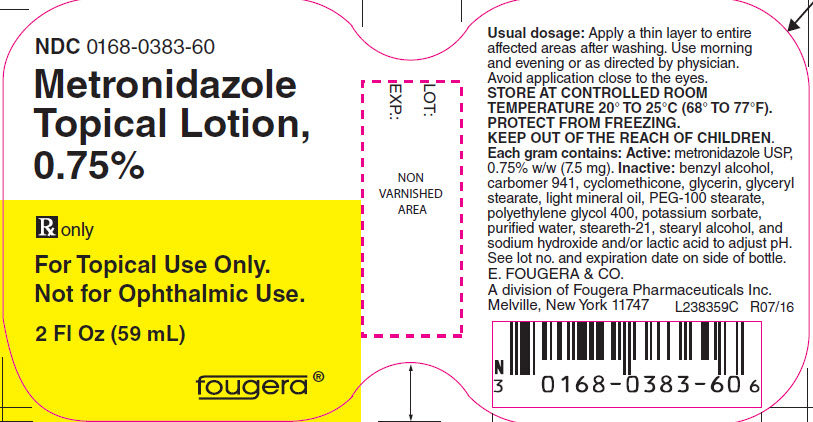
Metronidazole 7.5 mg/mL Lotion, 59 mL — NDC 0168-0383-60 (Billing 00168-0383-60)
This is a package of 59 mL of Metronidazole 7.5 mg/mL Lotion from Fougera Pharmaceuticals, LLC, marketed since May 2006 and currently FDA-listed; retail pharmacies pay about $1.82 per mL (NADAC). It is this product's only package size.
NDC database record
One package, one record: these facts belong to NDC 0168-0383-60 alone.
- Record
- FDA NDC Directory package listing · Human prescription drug
- Code segments
- 0168 labeler · 0383 product · 60 package
- Package marketed since
- May 24, 2006
- Sample package
- No — commercial package
- Listing certified through
- Dec 31, 2027
- Billing quantity
- 59 mL per package
- Barcode (UPC)
- 0301680383606
- Medicaid fills, this package
- 7,652 prescriptions in the last four reported quarters
- FDA record last changed
- Jul 24, 2026
Identity & classification
Regulatory identifiers FDA, NLM and CMS codes for this package
Drug-database identifiers Medi-Span GPI and First Databank GCN / HICL / AHFS classification
- GSN (GCN sequence number): 041797
- GCN: 43201
- GPI-14 (Medi-Span): 90060040004110
- HICL (First Databank): 004157
- AHFS class code: 08:30.04.00
- RxCUI (RxNorm): 242736
Where does this data come from?
- FDA openFDA NDC Directory · synced Oct 8, 2026
- FDA label on DailyMed · label index refreshed Oct 6, 2026
- RxNorm (NLM RxNav) · catalog refreshed Oct 1, 2026
- Medi-Span GPI (licensed)
- First Databank (licensed) · refreshed Oct 8, 2026
RxNorm drug class
This medicine belongs to the Nitroimidazole Antimicrobial class.
Where does this data come from?
- RxClass (NLM) · catalog refreshed Oct 1, 2026
Clinical
Metronidazole topical is used to treat rosacea (a skin disease that causes redness, flushing, and pimples on the face). Metronidazole is in a class of medications called nitroimidazole antimicrobials. It works by stopping the growth of bacteria.
Read the full MedlinePlus article ↗- It depends on the product. Oral forms treat trichomoniasis, and some also treat amebiasis and anaerobic infections. Vaginal gels treat bacterial vaginosis, and topical cream or lot...
- No. Alcohol with oral metronidazole can cause cramps, nausea, vomiting, headache and flushing. Avoid alcohol and products with propylene glycol during treatment and for at least th...
- The most common are nausea, headache, loss of appetite, vomiting, diarrhea and stomach cramps. A metallic taste is also common. Call your doctor if you notice numbness or tingling,...
- Yes. Metronidazole can interact with warfarin, lithium, busulfan, disulfiram and drugs that affect heart rhythm. Some of these combinations need blood tests or should be avoided, s...
Patient education
Supplement & herbal interactions
Some supplements/herbs that may interact with Metronidazole — tap one for details:
Metronidazole may be associated with lower levels of 7 nutrients — worth a chat with your pharmacist, not a cause for alarm.
Where does this data come from?
- MedlinePlus (NLM) · refreshed Oct 1, 2026
- FDA label on DailyMed · label index refreshed Oct 6, 2026
Ask a licensed pharmacist directly — free, answered by our team.
Pricing
A drug doesn't have one price. Each row is a different public payment system, and none is what you'd pay at the counter — that depends on your insurance. The ⓘ on each row explains what it measures.
| Price system | Per mL | Per package |
|---|---|---|
| Retail pharmacies payNADAC · weekly | $1.817 | $107.22 / 59 ml |
| Medicaid paysCMS SDUD · 12 mo | $2.07 | $122.36 / 59 ml |
| Medicare drug plans payPart D · Q2 2026 | $2.37 | $140.01 / 59 ml |
Where does this data come from?
- CMS NADAC weekly file · file of Oct 7, 2026
- CMS ASP pricing files · refreshed Sep 20, 2026
- CMS Medicaid State Drug Utilization Data · through Q1 2026
- CMS Part D plan pricing files · refreshed Sep 24, 2026
- VA National Acquisition Center price file
Packaging — all sizes for this product
| Package NDC | Description | Marketing start | Marketing end | Status |
|---|---|---|---|---|
| 00168-0383-60 You're viewing this Main listing | 59 mL in 1 BOTTLE, PLASTIC | 2006-05-24 | — | Active |
Therapeutic equivalents
| Product | Labeler | Pack | NADAC/unit | TE | Status | Price vs. this |
|---|---|---|---|---|---|---|
| Metronidazole 7.5 mg/mLthis 00168-0383-60 | Fougera | 59 ml | $1.817 | AB | Availability likely | — |
| metronidazole 7.5 mg/g 68308-0712-59 | Mayne | 1 bottle | $1.817 | AB | Availability likely | — |
Where does this data come from?
- FDA openFDA NDC Directory · synced Oct 8, 2026
- FDA Orange Book · refreshed Oct 3, 2026
- CMS NADAC weekly file · file of Oct 7, 2026
Availability & generic status
This product is an FDA-approved generic. Other versions of the same drug are listed under Therapeutic equivalents, least expensive first.
Where does this data come from?
- FDA Orange Book · refreshed Oct 3, 2026
Inactive Ingredients / Excipients
Inactive ingredients, also called excipients, are components of the drug product other than the active ingredient. They may include fillers, dyes, coatings, preservatives, flavors, or other formulation ingredients.
🧪 Avoiding an ingredient? See Metronidazole inactive ingredients by manufacturer: every current product's list side by side, so you can ask your pharmacy for the version that does not list it.
💡 Tap an ingredient (hover on desktop) to see what it is and why it’s used.
-
UNII LKG8494WBH
Benzyl alcohol is a clear liquid used as a preservative and solvent in medicines. It helps prevent bacterial and fungal growth and dissolves other ingredients to create uniform liquid formulations.
-
UNII F68VH75CJC
A synthetic polymer made from acrylic acid that thickens and stabilizes liquid or gel formulations. It's used as a gelling agent and emulsifier to create the desired texture and consistency in topical medicines.
-
UNII NMQ347994Z
Cyclomethicone is a silicone-based fluid that acts as a lubricant and solvent in medicines. It helps products flow smoothly, reduces friction between particles, and aids in even distribution of active ingredients.
-
UNII PDC6A3C0OX
Glycerin is a clear, thick liquid derived from plant oils or fats. It acts as a humectant to retain moisture, a sweetener, and a solvent in medications.
-
UNII 230OU9XXE4
A waxy substance made from glycerin and stearic acid that acts as an emulsifier to blend oily and watery ingredients together. It also helps thicken and stabilize the medicine's texture.
-
UNII 33X04XA5AT
Lactic acid is a naturally occurring organic acid derived from milk or plant sources. It lowers and maintains pH in formulations, helps preserve the product, and can enhance ingredient stability and absorption.
-
UNII N6K5787QVP
Light mineral oil is a clear, odorless liquid derived from petroleum. In medicines, it acts as a lubricant and emollient to help the product spread smoothly and improve texture.
-
UNII YD01N1999R
A waxy substance made from polyethylene glycol and stearic acid. It helps mix oil and water-based ingredients together and serves as an emulsifier and solubilizer in liquid and semi-solid medicines.
-
UNII B697894SGQ
Polyethylene glycol 400 is a clear, thick liquid made from petroleum-derived polymers. It acts as a solvent and humectant in medicines, helping dissolve active ingredients and retain moisture in the formulation.
-
UNII 1VPU26JZZ4
Potassium sorbate is a salt derived from sorbic acid, a naturally occurring preservative. It prevents growth of mold, yeast, and some bacteria, extending the medicine's shelf life.
-
UNII 55X04QC32I
A strong alkaline chemical used to adjust and maintain the pH balance of liquid medicines. It helps keep the medicine stable and ensures it stays effective during storage.
-
UNII 53J3F32P58
A synthetic detergent derived from stearic acid, a fatty substance. It helps dissolve or distribute oil-based ingredients evenly throughout the medicine, acting as an emulsifier and solubilizer in tablets and capsules.
-
UNII 2KR89I4H1Y
Stearyl alcohol is a waxy, fatty substance derived from natural oils or made synthetically. It acts as an emulsifier and thickener in medicines, helping mix ingredients together and give the product the right texture.
-
UNII 059QF0KO0R
Water is a liquid solvent that dissolves and mixes ingredients together in liquid medicines, syrups, and injections. It helps distribute the active drug evenly throughout the product.
14 inactive ingredients listed in the exact product block matched to this NDC.
Where does this data come from?
ingredient classCode="IACT" elements from the exact product block matched by this NDC. Label-section narrative from DailyMed / the openFDA label index is shown separately when available.- FDA label on DailyMed · label index refreshed Oct 6, 2026
- FDA openFDA NDC Directory · synced Oct 8, 2026
Inactive ingredient FAQ
Are inactive ingredients the same for every manufacturer?
Why might an inactive ingredient be missing?
Can inactive ingredients matter?
Manufacturer & labeler
More NDCs from Fougera Pharmaceuticals, LLC labeler code 00168
- Metronidazole 7.5 mg/g Cream NDC 0168-0323-46
- Fluticasone Propionate .5 mg/g Cream NDC 0168-0332-15
- Terconazole 4 mg/g Cream NDC 0168-0346-46
- Terconazole Vaginal Cream 0.8% 8 mg/g Cream NDC 0168-0347-20
- Lidocaine and Prilocaine 25 mg/g; 25 mg/g Cream NDC 0168-0357-30
- Oxiconazole Nitrate 10 mg/g Cream NDC 0168-0358-30
- Tacrolimus 1 mg/g Ointment NDC 0168-0416-30
- Tacrolimus .3 mg/g Ointment NDC 0168-0417-30
- Adapalene 1 mg/g Cream NDC 0168-0424-46
Where does this data come from?
- FDA openFDA NDC Directory · synced Oct 8, 2026
- Drugs@FDA
Full prescribing information FDA SPL
🎯 Indications and Usage ▾
INDICATIONS AND USAGE Metronidazole topical lotion is indicated for topical application in the treatment of inflammatory papules and pustules of rosacea. CLINICAL STUDIES A controlled clinical study was conducted in 144 patients with moderate to severe rosacea, in which metronidazole topical lotion was compared with its vehicle. Applications were made twice daily for 12 weeks during which patients were instructed to avoid spicy foods, thermally hot foods and drinks, alcoholic beverages, and caffeine.
Patients were also provided samples of a soapless cleansing lotion and, if requested, a moisturizer. Metronidazole topical lotion was significantly more effective than its vehicle in mean percent reduction of inflammatory lesions associated with rosacea and in the investigator's global assessment of improvement. The results of the mean percent reduction in inflammatory lesion counts from baseline after 12 weeks of treatment and the investigators' global assessment of improvement at week 12 are presented in the following table: Efficacy Outcomes at Week 12 Mean Percent Reduction in Inflammatory Lesion Counts from Baseline Metronidazole Topical Lotion N=65 Vehicle Lotion N=60 55% 20% Investigators' Global Assessment of Improvement (percent change from baseline) Worse No Change Minimal Improvement Definite Improvement Marked Improvement Clear Metronidazole Topical Lotion N=65 5% 12% 11% 32% 32% 8% Vehicle Lotion N=60 15% 27% 23% 15% 20% 0% The scale is based on the following definitions: Worse: Exacerbation of either erythema or quantitative assessment of papules and/or pustules.
No Change: Condition remains the same. Minimal Improvement: Slight improvement in the quantitative assessment of papules and/or pustules, and/or slight improvement in erythema. Definite Improvement: More pronounced improvement in the quantitative assessment of papules and/or pustules, and/or more pronounced improvement in erythema.
Marked Improvement: Obvious improvement in the quantitative assessment of papules and/or pustules, and/or obvious improvement in erythema. Clear: No papules or pustules and minimal residual or no erythema.
⏱️ Dosage and Administration ▾
DOSAGE AND ADMINISTRATION Apply a thin layer to entire affected areas after washing. Use morning and evening or as directed by physician. Avoid application close to the eyes. Patients may use cosmetics after waiting for the metronidazole topical lotion to dry (not less than 5 minutes).
⛔ Contraindications ▾
CONTRAINDICATIONS Metronidazole topical lotion is contraindicated in individuals with a history of hypersensitivity to metronidazole or to other ingredients of the formulation.
🤒 Adverse Reactions ▾
ADVERSE REACTIONS In a controlled clinical trial, safety data from 141 patients who used metronidazole topical lotion (n=71), or the lotion vehicle (n=70), twice daily and experienced a local cutaneous adverse event which may or may not have been related to the treatments include: local allergic reaction, metronidazole topical lotion 2 (3%), lotion vehicle 0; contact dermatitis, metronidazole topical lotion 2 (3%), lotion vehicle 1 (1%); pruritus, metronidazole topical lotion 1 (1%), lotion vehicle 0; skin discomfort (burning and stinging), metronidazole topical lotion 1 (1%), lotion vehicle 2 (3%); erythema, metronidazole topical lotion 4 (6%), lotion vehicle 0; dry skin, metronidazole topical lotion 0, lotion vehicle 1 (1%); and worsening of rosacea, metronidazole topical lotion 1 (1%), and lotion vehicle 7 (10%).
The following additional adverse experiences have been reported with the topical use of metronidazole: skin irritation, transient redness, metallic taste, tingling or numbness of extremities, and nausea.
🔄 Drug Interactions ▾
Drug Interactions Oral metronidazole has been reported to potentiate the anticoagulant effect of warfarin and coumarin anticoagulants, resulting in a prolongation of prothrombin time. The effect of topical metronidazole on prothrombin time is not known.
🤰 Pregnancy ▾
Pregnancy: Teratogenic Effects: Pregnancy Category B There are no adequate and well-controlled studies with the use of metronidazole topical lotion in pregnant women. Metronidazole crosses the placental barrier and enters the fetal circulation rapidly. No fetotoxicity was observed after oral administration of metronidazole in rats or mice.
However, because animal reproduction studies are not always predictive of human response and since oral metronidazole has been shown to be a carcinogen in some rodents, this drug should be used during pregnancy only if clearly needed.
🧒 Pediatric Use ▾
Pediatric Use Safety and effectiveness in pediatric patients have not been established.
🧬 Clinical Pharmacology ▾
CLINICAL PHARMACOLOGY The mechanisms by which metronidazole acts in the treatment of rosacea are unknown, but appear to include an anti-inflammatory effect. Pharmacokinetics Absorption of metronidazole after topical application of metronidazole topical lotion is less complete and more prolonged than after oral administration. Detectable plasma levels were found in all subjects following the administration of a 1 gram dose of metronidazole topical lotion (containing 7.5 mg of metronidazole) applied every morning and evening for 4 days to the faces of 8 patients.
The highest concentration (96 ng/mL) seen following the morning dose on Day 5 was approximately 80 times lower than the peak concentrations produced by a single 250 mg tablet of metronidazole. The mean (± SD) AUC 0-24 after twice daily administration was 962 ± 373 ng.hr/mL.
📦 How Supplied / Storage and Handling ▾
HOW SUPPLIED Metronidazole Topical Lotion, 0.75% is supplied in the following size: 2 Fl Oz (59 mL) plastic bottle – NDC 0168-0383-60 Store at controlled room temperature, 20°to 25°C (68° to 77°F). Protect from freezing. E. FOUGERA & CO. A division of Fougera Pharmaceuticals Inc. Melville, New York 11747 I2383C/IF2383C R07/16 #124
📋 Description ▾
DESCRIPTION Metronidazole Topical Lotion, 0.75% contains metronidazole, USP, at a concentration of 7.5 mg per gram (0.75% w/w) in a lotion consisting of benzyl alcohol, carbomer 941, cyclomethicone, glycerin, glyceryl stearate, light mineral oil, PEG-100 stearate, polyethylene glycol 400, potassium sorbate, purified water, steareth-21, stearyl alcohol, and sodium hydroxide and/or lactic acid to adjust pH. Metronidazole is an imidazole and is classified therapeutically as an antiprotozoal and antibacterial agent. Chemically, metronidazole is 2-methyl-5-nitro-1 H -imidazole-1-ethanol.
The molecular formula is C 6 H 9 N 3 O 3 and molecular weight is 171.16. Metronidazole is represented by the following structural formula: Structural Formula
💬 Information for Patients ▾
Information for Patients Patients using metronidazole topical lotion should receive the following information and instructions: 1. This medication is to be used only as directed by the physician. 2. It is for external use only. 3. Avoid contact with the eyes. 4. Cleanse affected area(s) before applying this medication. 5. Patients should report any adverse reaction to their physician.
⚠️ Precautions ▾
PRECAUTIONS General: Topical metronidazole formulations have been reported to cause tearing of the eyes. Therefore, contact with the eyes should be avoided. If a reaction suggesting local irritation occurs, patients should be directed to use the medication less frequently or discontinue use.
Metronidazole is a nitroimidazole and should be used with care in patients with evidence or history of blood dyscrasia. Information for Patients Patients using metronidazole topical lotion should receive the following information and instructions: 1. This medication is to be used only as directed by the physician.
2. It is for external use only. 3.
Avoid contact with the eyes. 4. Cleanse affected area(s) before applying this medication.
5. Patients should report any adverse reaction to their physician. Drug Interactions Oral metronidazole has been reported to potentiate the anticoagulant effect of warfarin and coumarin anticoagulants, resulting in a prolongation of prothrombin time.
The effect of topical metronidazole on prothrombin time is not known. Carcinogenesis, Mutagenesis, Impairment of Fertility Metronidazole has shown evidence of carcinogenic activity in a number of studies involving chronic, oral administration in mice and rats. Metronidazole has not been assessed for carcinogenic activity following topical administration.
In several long term studies in mice, oral doses of approximately 200 mg/m 2 /day (approximately 20 times the exposure of a patient that received the estimated maximum human topical daily dose (assuming 100% bioavailability and following normalization of the data on the basis of the body surface area)) or greater were associated with increase incidences of lung tumors in male mice and lymphomas in female mice. In several long-term studies in rats, oral administration of metronidazole resulted in increased incidences of mammary and hepatic tumors in female rats and testicular tumors and pituitary adenomas in male rats at dosages of approximately 1600 mg/m 2 /day (approximately 170 times the exposure of a patient that received the estimated maximum human topical daily dose (assuming 100% bioavailability and following normalization of the data on the basis of the body surface area)) or greater.
In another oral study, an increase of mammary tumors was observed in female rats that received approximately 160 mg/m 2 /day (approximately 17 times the exposure of a patient that received the estimated maximum human topical daily dose (assuming 100% bioavailability and the following normalization of the data on the basis of the body surface area)). Ultraviolet radiation- induced carcinogenesis was enhanced in albino mice by intraperitoneal injection of metronidazole at a dosage of 45 mg/m 2 /day, 5 days per week for 10 weeks, as indicated by a decreased latency period to the development of skin neoplasms.
It is unclear how this level of exposure compares to the clinical situation with respect to the concentration of the drug or metabolics in the skin. This study did not determine if metronidazole must be present during exposure to ultraviolet radiation in order to enhance tumor formation; metronidazole may promote tumor formation in cells that have previously been initiated by ultraviolet radiation. Metronidazole exhibited mutagenic activity in several in vitro bacterial and mammalian assay systems.
Intraperitoneal administration of metronidazole to mice resulted in a dosage-dependent increase in the incidence of chromosomal aberrations in peripheral lymphocytes was reported in patients with Crohn's disease who were treated with metronidazole for 1 to 24 months at a dosage of 200 to 1200 mg/day. However, similar results were not observed in another study, in which humans were treated for 8 months. In rats, oral metronidazole at a dosage of approximately 1800 mg/m 2 /day (approximately 200 times the exposure of a patient that received the estimated maximum human topical daily dose (assuming 100% bioavailability and followin… [Excerpted — this section continues on DailyMed.]
🍼 Nursing Mothers ▾
Nursing Mothers After oral administration, metronidazole is secreted in breast milk in concentrations similar to those found in the plasma. Even though blood levels are significantly lower with topically applied metronidazole than those achieved after oral administration of metronidazole, a decision should be made whether to discontinue nursing or to discontinue the drug, taking into account the importance of the drug to the mother.
🧬 Pharmacokinetics ▾
Pharmacokinetics Absorption of metronidazole after topical application of metronidazole topical lotion is less complete and more prolonged than after oral administration. Detectable plasma levels were found in all subjects following the administration of a 1 gram dose of metronidazole topical lotion (containing 7.5 mg of metronidazole) applied every morning and evening for 4 days to the faces of 8 patients. The highest concentration (96 ng/mL) seen following the morning dose on Day 5 was approximately 80 times lower than the peak concentrations produced by a single 250 mg tablet of metronidazole.
The mean (± SD) AUC 0-24 after twice daily administration was 962 ± 373 ng.hr/mL.
🔬 Clinical Studies ▾
CLINICAL STUDIES A controlled clinical study was conducted in 144 patients with moderate to severe rosacea, in which metronidazole topical lotion was compared with its vehicle. Applications were made twice daily for 12 weeks during which patients were instructed to avoid spicy foods, thermally hot foods and drinks, alcoholic beverages, and caffeine. Patients were also provided samples of a soapless cleansing lotion and, if requested, a moisturizer.
Metronidazole topical lotion was significantly more effective than its vehicle in mean percent reduction of inflammatory lesions associated with rosacea and in the investigator's global assessment of improvement. The results of the mean percent reduction in inflammatory lesion counts from baseline after 12 weeks of treatment and the investigators' global assessment of improvement at week 12 are presented in the following table: Efficacy Outcomes at Week 12 Mean Percent Reduction in Inflammatory Lesion Counts from Baseline Metronidazole Topical Lotion N=65 Vehicle Lotion N=60 55% 20% Investigators' Global Assessment of Improvement (percent change from baseline) Worse No Change Minimal Improvement Definite Improvement Marked Improvement Clear Metronidazole Topical Lotion N=65 5% 12% 11% 32% 32% 8% Vehicle Lotion N=60 15% 27% 23% 15% 20% 0% The scale is based on the following definitions: Worse: Exacerbation of either erythema or quantitative assessment of papules and/or pustules.
No Change: Condition remains the same. Minimal Improvement: Slight improvement in the quantitative assessment of papules and/or pustules, and/or slight improvement in erythema. Definite Improvement: More pronounced improvement in the quantitative assessment of papules and/or pustules, and/or more pronounced improvement in erythema.
Marked Improvement: Obvious improvement in the quantitative assessment of papules and/or pustules, and/or obvious improvement in erythema. Clear: No papules or pustules and minimal residual or no erythema.
📄 Carcinogenesis, Mutagenesis, Impairment of Fertility ▾
Carcinogenesis, Mutagenesis, Impairment of Fertility Metronidazole has shown evidence of carcinogenic activity in a number of studies involving chronic, oral administration in mice and rats. Metronidazole has not been assessed for carcinogenic activity following topical administration. In several long term studies in mice, oral doses of approximately 200 mg/m 2 /day (approximately 20 times the exposure of a patient that received the estimated maximum human topical daily dose (assuming 100% bioavailability and following normalization of the data on the basis of the body surface area)) or greater were associated with increase incidences of lung tumors in male mice and lymphomas in female mice.
In several long-term studies in rats, oral administration of metronidazole resulted in increased incidences of mammary and hepatic tumors in female rats and testicular tumors and pituitary adenomas in male rats at dosages of approximately 1600 mg/m 2 /day (approximately 170 times the exposure of a patient that received the estimated maximum human topical daily dose (assuming 100% bioavailability and following normalization of the data on the basis of the body surface area)) or greater. In another oral study, an increase of mammary tumors was observed in female rats that received approximately 160 mg/m 2 /day (approximately 17 times the exposure of a patient that received the estimated maximum human topical daily dose (assuming 100% bioavailability and the following normalization of the data on the basis of the body surface area)).
Ultraviolet radiation- induced carcinogenesis was enhanced in albino mice by intraperitoneal injection of metronidazole at a dosage of 45 mg/m 2 /day, 5 days per week for 10 weeks, as indicated by a decreased latency period to the development of skin neoplasms. It is unclear how this level of exposure compares to the clinical situation with respect to the concentration of the drug or metabolics in the skin. This study did not determine if metronidazole must be present during exposure to ultraviolet radiation in order to enhance tumor formation; metronidazole may promote tumor formation in cells that have previously been initiated by ultraviolet radiation.
Metronidazole exhibited mutagenic activity in several in vitro bacterial and mammalian assay systems. Intraperitoneal administration of metronidazole to mice resulted in a dosage-dependent increase in the incidence of chromosomal aberrations in peripheral lymphocytes was reported in patients with Crohn's disease who were treated with metronidazole for 1 to 24 months at a dosage of 200 to 1200 mg/day. However, similar results were not observed in another study, in which humans were treated for 8 months.
In rats, oral metronidazole at a dosage of approximately 1800 mg/m 2 /day (approximately 200 times the exposure of a patient that received the estimated maximum human topical daily dose (assuming 100% bioavailability and following normalization of the data on the basis of body surface area)) induced inhibition of spermatogenesis and severe testicular degeneration.
📄 Package Label / Principal Display Panel ▾
PACKAGE LABEL – PRINCIPAL DISPLAY PANEL – 59 ML LABEL NDC 0168-0383-60 Fougera METRONIDAZOLE TOPICAL LOTION, 0.75% Rx Only For Topical Use Only. Not for Ophthalmic Use. WARNING: Keep away from children. 2 Fl Oz (59 mL) E. FOUGERA & CO. A division of Fougera Pharmaceuticals Inc. Melville, New York 11747 PACKAGE LABEL - PRINCIPAL DISPLAY PANEL 59 ML LABEL
PACKAGE LABEL – PRINCIPAL DISPLAY PANEL – 59 ML CARTON NDC 0168-0383-60 Fougera METRONIDAZOLE TOPICAL LOTION, 0.75% Rx only For Topical Use Only. Not for Ophthalmic Use. WARNING: Keep away from children. 2Fl Oz (59 mL) E. FOUGERA & CO. A division of Fougera Pharmaceuticals Inc. Melville, New York 11747 PACKAGE LABEL - PRINCIPAL DISPLAY PANEL - 59 ML CARTON