
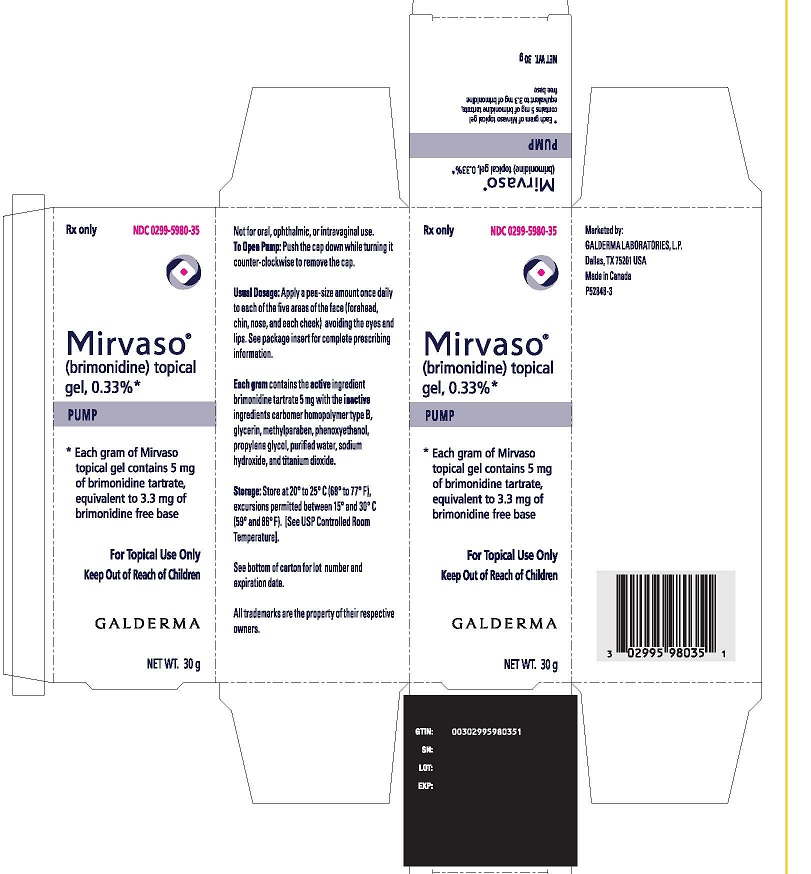
Mirvaso brimonidine tartrate 5 mg/g Gel
🆔 Identity & classification
Where does this data come from?
🏷️ RxNorm drug class
This medicine belongs to the alpha-Adrenergic Agonist class.
Where does this data come from?
🏭 Manufacturer & labeler
Where does this data come from?
🩺 Clinical
- They contain the same active ingredient — brimonidine — but they're very different products. The eye drops are specifically formulated for use in the eye to lower pressure, while t...
- I have both glaucoma drops and the rosacea gel — are they basically the same thing?
- It can happen, and it's worth knowing about. Some people experience flushing or a temporary increase in redness a few hours after applying the gel — the redness-reducing effect can...
- My facial redness seems worse some days after I use the gel — is that normal?
Patient education
Supplement & herbal interactions
Some supplements/herbs that may interact with Brimonidine Tartrate — tap one for details:
Where does this data come from?
Ask a licensed pharmacist directly — free, answered by our team.
🧪 Inactive Ingredients / Excipients
Inactive ingredients, also called excipients, are components of the drug product other than the active ingredient. They may include fillers, dyes, coatings, preservatives, flavors, or other formulation ingredients.
💡 Tap an ingredient (hover on desktop) to see what it is and why it’s used.
-
UNII HHT01ZNK31
Carbomer Homopolymer Type B is a synthetic polymer made from acrylic acid. It absorbs water and forms a gel, so it's used in medicines as a thickener, suspending agent, and to help create a smooth texture in creams, gels, and lotions.
-
UNII PDC6A3C0OX
Glycerin is a clear, thick liquid derived from plant oils or fats. It acts as a humectant to retain moisture, a sweetener, and a solvent in medications.
-
UNII A2I8C7HI9T
Methylparaben is a preservative derived from benzoic acid that prevents growth of bacteria, fungi, and mold in medicines. It extends the product's shelf life and maintains safety during storage.
-
UNII HIE492ZZ3T
Phenoxyethanol is a synthetic preservative and antimicrobial agent used to prevent bacterial and fungal growth in medicines and cosmetic products, extending shelf life and maintaining product safety.
-
UNII 6DC9Q167V3
Propylene glycol is a clear liquid derived from petroleum or vegetable sources. It acts as a solvent, humectant, and preservative in medicines, helping dissolve active ingredients and maintain product stability.
-
UNII 55X04QC32I
A strong alkaline chemical used to adjust and maintain the pH balance of liquid medicines. It helps keep the medicine stable and ensures it stays effective during storage.
-
UNII 15FIX9V2JP
Titanium dioxide is a bright white mineral powder commonly used as a colorant and opacifying agent. It makes pills and tablets white or lighter in color and helps make coatings non-transparent.
-
UNII 059QF0KO0R
Water is a liquid solvent that dissolves and mixes ingredients together in liquid medicines, syrups, and injections. It helps distribute the active drug evenly throughout the product.
8 inactive ingredients listed in the exact product block matched to this NDC.
Where does this data come from?
ingredient classCode="IACT" elements from the exact product block matched by this NDC. Label-section narrative from DailyMed / the openFDA label index is shown separately when available.Inactive ingredient FAQ
Are inactive ingredients the same for every manufacturer?
Why might an inactive ingredient be missing?
Can inactive ingredients matter?
💲 Pricing
A drug doesn't have one price. Each row is a different public payment system, and none is what you'd pay at the counter — that depends on your insurance. The ⓘ on each row explains what it measures.
| Price system | Per g | Per package |
|---|---|---|
| Retail pharmacies payNADAC · weekly | Not in the retail survey — common for institutional, discontinued, or low-volume packs. | |
| Medicaid paysCMS SDUD · 12 mo | No recent Medicaid claims on file for this NDC — rare and low-volume NDCs are suppressed in the public data. | |
| Medicare drug plans payPart D · quarterly | No Part D plan price is available for this NDC in our data. | |
Where does this data come from?
🔁 Therapeutic equivalents
| Product | Labeler | Pack | NADAC/unit | TE | Status | Price vs. this |
|---|---|---|---|---|---|---|
| Brimonidine 5 mg/g 45802-0078-30 | Padagis | 1 bottle | $13.840 | AB | Availability likely | — |
| Mirvaso 5 mg/gthis 00299-5980-00 | Galderma | 1 tube | — | AB | FDA listed | — |
| Brimonidine 5 mg/g 63629-9616-01 | Bryant | 1 bottle | — | AB | FDA listed | — |
Where does this data come from?
⏳ Availability & generic status
The FDA lists approved generic versions of this medicine, but that does not always mean a pharmacy can get one today. Patent rules, launch agreements, supply and pricing can affect when generics actually arrive.
Why the date isn’t exact: Generic timing can change because patents may be challenged, settled, licensed, added, removed, or worked around with a narrower label — and FDA approval does not always mean a pharmacy can get the generic today.
🛈 What do these terms mean?
- Patent
- Legal protection listed in the Orange Book that may delay generic approval or launch. Issued by the U.S. Patent & Trademark Office.
- Substance patent
- Covers the active drug molecule itself — the hardest to design around. A generic generally can’t launch until it expires.
- Formulation (product) patent
- Covers a specific formulation or dosage form. A generic can sometimes work around it with a different formulation.
- Method-of-use patent
- A patent covering one specific approved use of the drug — not necessarily the whole molecule. A generic can sometimes launch with a “skinny label” that carves out the protected use and keeps the others.
- Skinny label
- A generic label that omits a still-patented use when the FDA allows it — letting a generic reach the market for the unprotected uses.
- Exclusivity
- FDA-granted marketing protection, separate from patents — e.g. 5-yr new chemical entity, 7-yr orphan drug, or a +6-month pediatric extension.
- Paragraph IV
- A generic applicant’s formal challenge to a listed patent. It can potentially lead to earlier generic entry, but often involves litigation or a settlement.
- RLD / RS
- Reference Listed Drug — the brand product the FDA uses as the reference for generic applications. Reference Standard — the product the FDA expects generics to compare against in bioequivalence testing.
- TE / AB rating
- FDA therapeutic-equivalence rating. An AB rating generally means the FDA considers a generic therapeutically equivalent to — and substitutable for — the brand.
- LOE (loss of exclusivity)
- The latest patent or exclusivity currently listed — the loss-of-exclusivity / latest-listed-protection date shown on this page. Paragraph-IV challenges and settlements can move the real date earlier; FDA approval and a manufacturer’s decision to market can move it later.
Built from the FDA Orange Book. The bars above are scaled to each protection’s expiry; the red LOE marker is the last one to lapse.
| Patent | Type | Use code | Expires |
|---|---|---|---|
| US 8053427 ↗ | Method of use | U-1428 | Jun 13, 2031 |
| US 8513247 ↗ | Method of use | U-1428 | Mar 25, 2031 |
| US 8513249 ↗ | Method of use | U-1428 | Mar 25, 2031 |
| US 9861631 ↗ | Method of use | U-1428 | Mar 25, 2031 |
| US 9861632 ↗ | Method of use | U-1428 | Mar 25, 2031 |
| US 8163725 ↗ | Drug product | — | Jun 13, 2031 |
| US 10201517 ↗ | Drug product | — | Jun 13, 2031 |
Is there a generic version of MIRVASO 0.33% GEL PUMP?
The FDA approved a generic — why can’t I get it at my pharmacy yet?
Why do different websites show different generic release dates?
What does “FDA listed” mean?
What does a patent or protection date mean here?
What does “current Orange Book estimate” mean?
Can a generic come out before the last patent expires?
Can a generic come out after the listed dates?
What is the difference between patents and exclusivity?
Why are there multiple patent dates?
Where does this data come from?
📊 Medicare Part D spend CMS · PART D · 2026 (Q1)
🔬 Reported adverse events (FAERS)
Top reported reactions
Age at onset
Reporter sex
Serious outcomes
Where does this data come from?
📦 Packaging — all sizes for this product
| Package NDC | Description | Per unit | Per pack | Marketing start | Status |
|---|---|---|---|---|---|
| 00299-5980-00 You're viewing this | 1 TUBE in 1 BLISTER PACK (0299-5980-00) / 2 g in 1 TUBE | — | — | 2013-08-23 | Active |
| 00299-5980-02 | 2 g in 1 TUBE (0299-5980-02) | — | — | 2013-08-23 | Active |
| 00299-5980-30 | 30 g in 1 TUBE (0299-5980-30) | — | — | 2013-08-23 | Active |
| 00299-5980-35 | 1 BOTTLE, PUMP in 1 CARTON (0299-5980-35) / 30 g in 1 BOTTLE, PUMP | $21.47 / g | $643.98 | 2013-08-23 | Active |
| 00299-5980-45 | 45 g in 1 TUBE (0299-5980-45) | — | — | 2013-08-23 | Active |
Pack size FAQ
What quantity is in NDC 00299-5980-00?
What NDC number is used to bill for this package of Mirvaso brimonidine tartrate 5 mg/g Gel?
Prices are the latest CMS NADAC pharmacy acquisition cost per NDC; per-pack figures are per-unit × pack quantity, shown only when the pack is denominated in the same measure NADAC prices.
🧭 About this NDC listing & data coverage
What data is (and isn’t) available for this NDC — tap to expand
| NDC identity (package / product / labeler codes) | ✓ Available |
| Labeler | ✓ Available |
| Product & package description | ✓ Available |
| Marketing category & status | ✓ Available |
| Active ingredient / dosage form / route | ✓ Available |
| FDA label (SPL via DailyMed) | ✓ Available |
| Package photos | ✓ Available |
| Inactive ingredients (structured) | ✓ Available |
| NADAC pharmacy acquisition price (CMS) | — Not published for this NDC CMS publishes NADAC only for NDCs reported in its retail-pharmacy survey. |
| Orange Book / therapeutic-equivalence data | ✓ Available |
| HCPCS J-code billing crosswalk | — Not published for this NDC Most self-administered / retail products have no J-code — that is normal. |
| Medicaid utilization (CMS SDUD) | — Not published for this NDC CMS reports utilization only for NDCs with Medicaid claims above its privacy threshold. |
Questions about this listing
Why is there no price listed?
Is the NDC printed on the package the same as the 11-digit billing NDC?
What do the three segments of this NDC mean?
Is this package still being marketed?
Does this product come in other package sizes?
Who lists this product with the FDA?
Do I need a prescription for this product?
Where does this data come from?
📄 Full prescribing information FDA SPL
🎯 Indications and Usage ▾
1 INDICATIONS AND USAGE MIRVASO (brimonidine) topical gel, 0.33% is an alpha adrenergic agonist indicated for the topical treatment of persistent (nontransient) erythema of rosacea in adults 18 years of age or older. MIRVASO (brimonidine) topical gel, 0.33% is an alpha adrenergic agonist indicated for the topical treatment of persistent (nontransient) facial erythema of rosacea in adults 18 years of age or older.( 1 )
⏱️ Dosage and Administration ▾
2 DOSAGE AND ADMINISTRATION Apply a pea-sized amount once daily to each of the five areas of the face: central forehead, chin, nose, each cheek. MIRVASO topical gel should be applied smoothly and evenly as a thin layer across the entire face avoiding the eyes and lips. Wash hands after applying MIRVASO topical gel.
MIRVASO topical gel is for topical use only and not for oral, ophthalmic, or intravaginal use. Apply a pea-sized amount once daily to each of the five areas of the face (forehead, chin, nose, each cheek) avoiding the eyes and lips. ( 2 ) Hands should be washed immediately after applying MIRVASO topical gel.
( 2 ) For topical use only ( 2 ) Not for oral, ophthalmic, or intravaginal use. ( 2 )
💊 Dosage Forms and Strengths ▾
3 DOSAGE FORMS AND STRENGTHS MIRVASO (brimonidine) topical gel, 0.33% is a white to light yellow opaque aqueous gel. Each gram of gel contains 5 mg of brimonidine tartrate, equivalent to 3.3 mg of brimonidine free base. Gel, 0.33%; Each gram of gel contains 5 mg of brimonidine tartrate, equivalent to 3.3 mg of brimonidine free base. ( 3 )
⛔ Contraindications ▾
4 CONTRAINDICATIONS MIRVASO topical gel is contratindicated in patients who have experienced a hypersensitivity reaction to any component. Reactions have included angioedema, urticaria, and contact dermatitis [ see Warnings and Precautions (5.6) and Adverse Reactions (6.1 , 6.2 ) ]. Known hypersensitivity to any component of MIRVASO topical gel ( 4 )
⚠️ Warnings and Cautions ▾
5 WARNINGS AND PRECAUTIONS Potentiation of Vascular Insufficiency ( 5.1 ) Severe Cardiovascular Disease ( 5.2 ) Serious Adverse Reactions Following Ingestion of MIRVASO topical gel ( 5.3 ) Systemic Adverse Reactions of Alpha-2 Adrenergic Agonists ( 5.4 ) Local Vasomotor Adverse Reactions ( 5.5 ) Hypersensitivity ( 5.6 )
5.1Potentiation of Vascular Insufficiency MIRVASO topical gel should be used with caution in patients with depression, cerebral or coronary insufficiency, Raynaud’s phenomenon, orthostatic hypotension, thrombangiitis obliterans, scleroderma, or Sjögren’s syndrome.
5.2Severe Cardiovascular Disease Alpha-2 adrenergic agonists can lower blood pressure. MIRVASO topical gel should be used with caution in patients with severe or unstable or uncontrolled cardiovascular disease.
5.3Serious Adverse Reactions Following Ingestion of MIRVASO topical gel Two young children of a subject in a clinical trial experienced serious adverse reactions following accidental ingestion of MIRVASO topical gel. Adverse reactions experienced by one or both children included lethargy, respiratory distress with apneic episodes (requiring intubation), sinus bradycardia, confusion, psychomotor hyperactivity, and diaphoresis. Both children were hospitalized overnight and discharged the following day without sequelae.
Keep MIRVASO topical gel out of the reach of children.
5.4Systemic Adverse Reactions of Alpha-2 Adrenergic Agonists Postmarketing cases of bradycardia, hypotension (including orthostatic hypotension) and dizziness have been reported. Some cases required hospitalization. Some cases involved application of MIRVASO topical gel in unapproved dosing regimens and for unapproved indications, including the application of MIRVASO topical gel following laser procedures.
Avoid applying MIRVASO topical gel to irritated skin or open wounds.
5.5Local Vasomotor Adverse Reactions Erythema Some subjects in the clinical trials discontinued use of MIRVASO topical gel because of erythema. Some subjects in the clinical trials reported a rebound phenomenon, where erythema was reported to return worse compared to the severity at baseline. Erythema appeared to resolve after discontinuation of MIRVASO topical gel .[see Adverse Reactions ( 6.1 )].
The treatment effect of MIRVASO topical gel may begin to diminish hours after application. From postmarketing reports, some patients have experienced erythema involving areas of the face that were previously not affected by erythema and in areas (e.g., neck and chest) outside of the treatment sites. Flushing Some subjects in the clinical trials discontinued use of MIRVASO topical gel because of flushing.
Intermittent flushing occurred in some subjects treated with MIRVASO topical gel in the clinical trials. The onset of flushing relative to application of MIRVASO topical gel varied, ranging from approximately 30 minutes to several hours [ see Adverse Reactions ( 6.1 ) ]. Flushing appeared to resolve after discontinuation of MIRVASO topical gel.
From postmarketing reports, some patients have experienced increased frequency of flushing and/or increased depth of erythema with the flushing. Additionally, some patients reported new onset of flushing. Pallor and Excessive Whitening From postmarketing reports, some patients have experienced pallor or excessive whitening at or outside the application site following treatment with MIRVASO topical gel.
5.6Hypersensitivity Allergic contact dermatitis was reported in the clinical trials for MIRVASO topical gel [ see Adverse Reactions ( 6.1 ) ]. Events reported post marketing with the use of MIRVASO topical gel include angioedema, throat tightening, tongue swelling, and urticaria, [ see Adverse Reactions ( 6.2 ) ]. Institute appropriate therapy and discontinue MIRVASO topical gel, if clinically significant hypersensitivity reaction occurs.
🤒 Adverse Reactions ▾
6 ADVERSE REACTIONS The following adverse drug reactions are discussed in greater detail in other sections of the label: Systemic Adverse Reactions of Alpha-2 Adrenergic Agonists [ see Warnings and Precautions ( 5.4 ) ] Local Vasomotor Adverse Reactions [ see Warnings and Precautions ( 5.5 ) ] Hypersensitivity [ see Warnings and Precautions ( 5.6 ) ] In controlled clinical trials with MIRVASO topical gel the most common adverse reactions (incidence > 1%) included erythema, flushing, skin burning sensation, and contact dermatitis.
( 6 ) To report SUSPECTED ADVERSE REACTIONS, contact Galderma Laboratories, L.P. at 1-866-735-4137 or FDA at 1-800-FDA-1088 or www.fda.gov/medwatch .
6.1Clinical Trials Experience Because clinical trials are conducted under widely varying conditions, adverse reaction rates observed in the clinical trials of a drug cannot be directly compared to rates in the clinical trials of another drug and may not reflect the rates observed in practice. During clinical trials, 1210 subjects were exposed to MIRVASO topical gel. A total of 833 subjects were treated for persistent (nontransient) erythema associated with rosacea, and 330 of those were treated once daily for 29 days in vehicle-controlled trials.
Adverse reactions that occurred in at least 1% of subjects treated with MIRVASO topical gel once daily for 29 days and for which the rate for MIRVASO topical gel exceeded the rate for vehicle are presented in Table 1. Table 1 - Adverse Reactions Reported in Clinical Trials by at Least 1% of Subjects Treated for 29 Days Preferred Term MIRVASO Topical Gel (N=330) n (%) Vehicle Gel (N=331) n (%) Subjects with at least one adverse reaction, Number (%) of Subjects 109 (33) 91 (28) Erythema 12 (4%) 3 (1%) Flushing 9 (3%) 0 Skin burning sensation 5 (2%) 2 (1%) Dermatitis contact 3 (1%) 1 (<1%) Dermatitis 3 (1%) 1 (<1%) Skin warm 3 (1%) 0 Paraesthesia 2 (1%) 1 (<1%) Acne 2 (1%) 1 (<1%) Pain of skin 2 (1%) 0 Vision blurred 2 (1%) 0 Nasal congestion 2 (1%) 0 Open-label, Long-term Study An open-label study of MIRVASO topical gel when applied once daily for up to one year was conducted in subjects with persistent (nontransient) facial erythema of rosacea.
Subjects were allowed to use other rosacea therapies. A total of 276 subjects applied MIRVASO topical gel for at least one year. The most common adverse events ( > 4% of subjects) for the entire study were flushing (10%), erythema (8%), rosacea (5%), nasopharyngitis (5%), skin burning sensation (4%), increased intraocular pressure (4%), and headache (4%).
Allergic contact dermatitis Allergic contact dermatitis to MIRVASO topical gel was reported in approximately 1% of subjects across the clinical development program. Two subjects underwent patch testing with individual product ingredients. One subject was found to be sensitive to brimonidine tartrate, and one subject was sensitive to phenoxyethanol (a preservative).
6.2Postmarketing Experience The following adverse reactions have been identified during post-approval use of MIRVASO topical gel. Because these reactions are reported voluntarily from a population of uncertain size, it is not always possible to estimate their frequency or establish a causal relationship to drug exposure. Cardiovascular disorders: bradycardia, hypotension (including orthostatic hypotension) Immune system disorders: angioedema, hypersensitivity, lip swelling, swollen tongue, throat tightness, urticaria Nervous systemic disorders: dizziness Skin and subcutaneous disorders: pallor
🔄 Drug Interactions ▾
7 DRUG INTERACTIONS
7.1Anti-hypertensives/Cardiac Glycosides Alpha-2 agonists, as a class, may reduce blood pressure. Caution in using drugs such as beta-blockers, anti-hypertensives and/or cardiac glycosides is advised.
7.2CNS Depressants Although specific drug-drug interactions studies have not been conducted with MIRVASO topical gel, the possibility of an additive or potentiating effect with CNS depressants (alcohol, barbiturates, opiates, sedatives, or anaesthetics) should be considered.
7.3Monoamine Oxidase Inhibitors Monoamine oxidase (MAO) inhibitors may theoretically interfere with the metabolism of brimonidine and potentially result in an increased systemic side-effect such as hypotension. Caution is advised in patients taking MAO inhibitors which can affect the metabolism and uptake of circulating amines.
👥 Use in Specific Populations ▾
8 USE IN SPECIFIC POPULATIONS
8.1Pregnancy Pregnancy Category B. There are no adequate and well-controlled studies of MIRVASO topical gel in pregnant women. In animal studies, brimonidine crossed the placenta and entered into the fetal circulation to a limited extent.
MIRVASO topical gel should be used during pregnancy only if the potential benefit justifies the potential risk to the fetus. Brimonidine tartrate was not teratogenic when given at oral doses up to 2.5 mg/kg/day in pregnant rats during gestation days 6 through 15 and 5 mg/kg/day in pregnant rabbits during gestation days 6 through 18.
8.3Nursing Mothers It is not known whether brimonidine tartrate is excreted in human milk, although in animal studies, brimonidine tartrate has been shown to be excreted in breast milk. Because of the potential for serious adverse reactions from MIRVASO topical gel in nursing infants, a decision should be made whether to discontinue nursing or to discontinue the drug, taking into account the importance of the drug to the mother.
8.4Pediatric Use Keep MIRVASO topical gel out of reach of children. Serious adverse reactions were experienced by two children of a subject in a clinical trial who accidentally ingested MIRVASO topical gel [ See Warnings and Precautions ( 5.3 ) ] . Safety and effectiveness in pediatric patients have not been established.
8.5Geriatric Use One hundred and five subjects aged 65 and older were included in clinical trials with MIRVASO topical gel. No overall differences in safety or effectiveness were observed between subjects > 65 years of age and younger adult subjects. Clinical studies of MIRVASO topical gel did not include sufficient numbers of subjects aged 65 and over to determine whether they respond differently from younger subjects.
🤰 Pregnancy ▾
8.1Pregnancy Pregnancy Category B. There are no adequate and well-controlled studies of MIRVASO topical gel in pregnant women. In animal studies, brimonidine crossed the placenta and entered into the fetal circulation to a limited extent.
MIRVASO topical gel should be used during pregnancy only if the potential benefit justifies the potential risk to the fetus. Brimonidine tartrate was not teratogenic when given at oral doses up to 2.5 mg/kg/day in pregnant rats during gestation days 6 through 15 and 5 mg/kg/day in pregnant rabbits during gestation days 6 through 18.
🧒 Pediatric Use ▾
8.4Pediatric Use Keep MIRVASO topical gel out of reach of children. Serious adverse reactions were experienced by two children of a subject in a clinical trial who accidentally ingested MIRVASO topical gel [ See Warnings and Precautions ( 5.3 ) ] . Safety and effectiveness in pediatric patients have not been established.
🧓 Geriatric Use ▾
8.5Geriatric Use One hundred and five subjects aged 65 and older were included in clinical trials with MIRVASO topical gel. No overall differences in safety or effectiveness were observed between subjects > 65 years of age and younger adult subjects. Clinical studies of MIRVASO topical gel did not include sufficient numbers of subjects aged 65 and over to determine whether they respond differently from younger subjects.
🆘 Overdosage ▾
10 OVERDOSAGE No information is available on overdose in adults with MIRVASO topical gel. Oral overdoses of other alpha-2 adrenergic agonists have been reported to cause symptoms such as hypotension, asthenia, vomiting, lethargy, sedation, bradycardia, arrhythmias, miosis, apnoea, hypotonia, hypothermia, respiratory depression, and seizure. Treatment of an oral overdose includes supportive and symptomatic therapy; a patent airway should be maintained.
🧬 Clinical Pharmacology ▾
12 CLINICAL PHARMACOLOGY
12.1Mechanism of Action Brimonidine is a relatively selective alpha-2 adrenergic agonist. Topical application of MIRVASO topical gel may reduce erythema through direct vasoconstriction.
12.3Pharmacokinetics Absorption The absorption of brimonidine from MIRVASO topical gel was evaluated in a clinical trial in 24 adult subjects with facial erythema associated with rosacea. All enrolled subjects received once daily topical application of MIRVASO topical gel 1 gram to the entire face for 29 days. Pharmacokinetic assessments were performed on Day 1, Day 15, and Day 29.
The mean plasma maximum concentration (C max ) and area under the concentration-time curve (AUC) were highest on Day 15, with C max and AUC values (± standard deviation) of 46 ± 62 pg/mL and 417 ± 264 pg.hr/mL, respectively. The systemic drug exposure was slightly lower on Day 29 indicating no further drug accumulation. Metabolism Brimonidine is extensively metabolized by the liver.
Excretion Urinary excretion is the major route of elimination of brimonidine and its metabolites.
🧬 Mechanism of Action ▾
12.1Mechanism of Action Brimonidine is a relatively selective alpha-2 adrenergic agonist. Topical application of MIRVASO topical gel may reduce erythema through direct vasoconstriction.
📦 How Supplied / Storage and Handling ▾
16 HOW SUPPLIED/STORAGE AND HANDLING MIRVASO (brimonidine) topical gel, 0.33% is a white to light yellow opaque gel, supplied in a laminated tube or pump with a child resistant cap in the following sizes: 30 gram tube NDC 0299-5980-30 30 gram pump NDC 0299-5980-35 45 gram tube NDC 0299-5980-45 Store at 20°C to 25°C (68°F to 77°F), excursions permitted between 15°C and 30°C (59°F and 86°F) [See USP Controlled Room Temperature].
📋 Description ▾
11 DESCRIPTION MIRVASO (brimonidine) topical gel, 0.33% contains brimonidine tartrate, an alpha adrenergic agonist. The molecular formula of brimonidine tartrate is C 11 H 10 BrN 5 • C 4 H 6 O 6 . It has the following structural formula: Chemically, brimonidine tartrate is 5-Bromo-6-(2-imidazolidinylideneamino) quinoxaline L-tartrate.
Brimonidine tartrate has a molecular weight of 442.24 and appears as white to slightly yellowish powder. Each gram of MIRVASO (brimonidine) topical gel, 0.33% contains 5 mg of the active ingredient brimonidine tartrate (equivalent to 3.3 mg of brimonidine free base), in a white to light yellow opaque gel composed of the inactive ingredients carbomer homopolymer type B, glycerin, methylparaben, phenoxyethanol, propylene glycol, purified water, sodium hydroxide, and titanium dioxide. chem-structure
💬 Information for Patients ▾
17 PATIENT COUNSELING INFORMATION See FDA-approved patient labeling (Patient Information and Instructions for Use) Patients using MIRVASO topical gel should receive the following information and instructions: This medication is to be used as directed by the physician. It is for external use only. MIRVASO topical gel should not be applied to irritated skin or open wounds.
Avoid contact with the eyes and lips. Patients should wash their hands immediately after applying the medication. Some patients using MIRVASO topical gel may experience erythema, flushing or excessive whitening.
Patients should report any adverse reactions to their physician. Keep out of reach of children. Marketed by: GALDERMA LABORATORIES, L.P., Fort Worth, Texas 76177 USA Made in Canada.
All trademarks are the property of their respective owners. P52849-2 or P51217-3
💬 Patient Medication Information ▾
PATIENT INFORMATION MIRVASO (Mer-VAY-soe) (brimonidine) topical gel Important information: MIRVASO ® topical gel is for use on the face only. Do not use MIRVASO topical gel in your eyes, mouth, or vagina. Keep MIRVASO topical gel out of the reach of children.
If anyone, especially a child, accidentally swallows MIRVASO topical gel, they may have serious side effects and need to be treated in a hospital. Get medical help right away if you, a child, or anyone else swallows MIRVASO topical gel and has any of these symptoms: • lack of energy, trouble breathing or stops breathing, a slow heart beat, confusion, sweating, restlessness, muscle spasms, or twitching. What is MIRVASO topical gel?
MIRVASO topical gel is a prescription medicine that is used on your skin (topical) to treat facial redness due to rosacea that does not go away (persistent) in adults who are 18 years of age or older. It is not known if MIRVASO topical gel is safe and effective in children. Who should not use MIRVASO topical gel?
Do not use MIRVASO topical gel if you have had a serious allergic reaction to any of the ingredients in MIRVASO topical gel. See the end of this Patient Information leaflet for a list of ingredients in MIRVASO topical gel. See “What are the possible side effects of MIRVASO topical gel?” What should I tell my doctor before using MIRVASO topical gel?
Before using MIRVASO topical gel, tell your doctor about all of your medical conditions including if you: • have depression • have heart or blood vessel problems • have dizziness or blood pressure problems • have problems with blood circulation or have had a stroke • have dry mouth or Sjögren’s Syndrome • have skin tightening or scleroderma • have Raynaud’s phenomenon • have irritated skin or open sores • plan to have any laser procedures • are pregnant or plan to become pregnant. It is not known if MIRVASO topical gel will harm your unborn baby. • are breastfeeding.
It is not known if MIRVASO topical gel passes into your breast milk. You and your doctor should decide if you will use MIRVASO topical gel or breastfeed. You should not do both.
Tell your doctor about all the medicines you take , including prescription and over-the-counter medicines, skin products, vitamins, and herbal supplements. Using MIRVASO topical gel with certain other medicines may affect each other and can cause serious side effects. How should I use MIRVASO topical gel?
See the detailed Instructions for Use that comes with your MIRVASO topical gel tube or pump for information about how to apply MIRVASO topical gel correctly. • Use MIRVASO topical gel exactly as your doctor tells you. Do not use more MIRVASO topical gel than prescribed. Call your doctor if you are not sure. • You should not apply MIRVASO topical gel to irritated skin or open wounds. • MIRVASO topical gel is for use on your skin only.
Do not use MIRVASO topical gel in your eyes, mouth, or vagina. Avoid contact with your lips and eyes. What are the possible side effects of MIRVASO topical gel?
MIRVASO topical gel may cause serious side effects, including: • See “Important information” at the beginning of this Patient Information leaflet. • Problems with blood circulation. People who use MIRVASO topical gel can have problems with blood circulation, including a slow heart rate, low blood pressure, and dizziness. These problems may sometimes be serious and lead to hospitalization.
See “What should I tell my doctor before using MIRVASO topical gel?” • Serious allergic (hypersensitivity) reactions have happened in people who use MIRVASO topical gel. Stop using MIRVASO topical gel and go to the nearest hospital emergency room right away if you have any of the following signs and symptoms of a serious allergic reaction including: o swelling of your face, lips, tongue, or throat o hives o trouble breathing The most common side effects of MIRVASO topical gel include: • redness • flushing • burning sensation of the skin • skin reactions (contact dermatitis).
Skin re…