
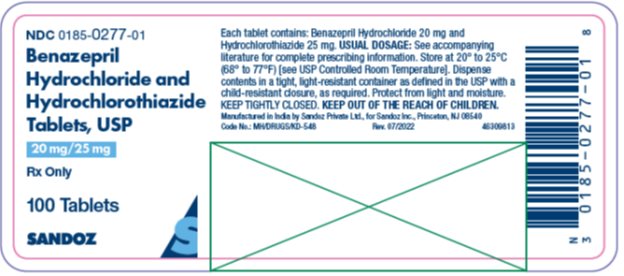
Benazepril Hydrochloride and Hydrochlorothiazide 20 mg; 25 mg Tablet, Film Coated, 100-count — NDC 0185-0277-01 (Billing 00185-0277-01)
This is a package of 100 tablets of Benazepril Hydrochloride and Hydrochlorothiazide 20 mg; 25 mg Tablet, Film Coated from Sandoz Inc, marketed since Feb 2004 and currently FDA-listed; retail pharmacies pay about $0.2526 per tablet (NADAC). It is this product's only package size.
Identity & classification
Regulatory identifiers FDA, NLM and CMS codes for this package
Drug-database identifiers Medi-Span GPI and First Databank GCN / HICL / AHFS classification
- GSN (GCN sequence number): 021726
- GCN: 33194
- GPI-14 (Medi-Span): 36991802150340
- HICL (First Databank): 008962
- AHFS class code: 24:32.04.00
- RxCUI (RxNorm): 898362
Where does this data come from?
- FDA openFDA NDC Directory · synced Oct 1, 2026
- FDA label on DailyMed · label index refreshed Oct 1, 2026
- RxNorm (NLM RxNav) · catalog refreshed Oct 1, 2026
- Medi-Span GPI (licensed)
- First Databank (licensed) · refreshed Oct 1, 2026
RxNorm drug class
This medicine belongs to the Angiotensin Converting Enzyme Inhibitor class.
Where does this data come from?
- RxClass (NLM) · catalog refreshed Oct 1, 2026
Clinical
- It treats high blood pressure. It combines two medicines that work in different ways. It is not usually the first medicine tried.
- Take it by mouth once a day, with or without food. Follow your prescriber's directions. Your doctor may adjust your dose after a few weeks.
- Tiredness, dizziness (especially when standing), headache, and a dry cough are the most common. Most are mild and short-lived. Call your doctor if they bother you or don't go away.
- Get help right away for swelling of your face, lips, tongue, or throat, or trouble breathing. Also call for fainting, yellow skin or eyes, sudden vision changes or eye pain, or sev...
Patient education
Supplement & herbal interactions
Where does this data come from?
- MedlinePlus (NLM) · refreshed Oct 1, 2026
- FDA label on DailyMed · label index refreshed Oct 1, 2026
Ask a licensed pharmacist directly — free, answered by our team.
Pricing
A drug doesn't have one price. Each row is a different public payment system, and none is what you'd pay at the counter — that depends on your insurance. The ⓘ on each row explains what it measures.
| Price system | Per ea | Per package |
|---|---|---|
| Retail pharmacies payNADAC · weekly | $0.253 | $25.26 / 100 tablets |
| Medicaid paysCMS SDUD · 12 mo | $0.4139 | $41.39 / 100 tablets |
| Medicare drug plans payPart D · Q2 2026 | $0.3956 | $39.56 / 100 tablets |
Where does this data come from?
- CMS NADAC weekly file · file of Sep 30, 2026
- CMS ASP pricing files · refreshed Sep 20, 2026
- CMS Medicaid State Drug Utilization Data · through Q1 2026
- CMS Part D plan pricing files · refreshed Sep 24, 2026
- VA National Acquisition Center price file
Packaging — all sizes for this product
| Package NDC | Description | Marketing start | Marketing end | Status |
|---|---|---|---|---|
| 00185-0277-01 You're viewing this Main listing | 100 TABLET, FILM COATED in 1 BOTTLE | 2004-02-11 | — | Active |
Therapeutic equivalents
| Product | Labeler | Pack | NADAC/unit | TE | Status | Price vs. this |
|---|---|---|---|---|---|---|
| Benazepril Hydrochloride and Hydrochlorothiazide 20 mg/1; 25 mgthis 00185-0277-01 | Sandoz | 100 tablets | $0.253 | AB | Availability likely | — |
| benazepril hydrochloride and hydrochlorothiazide 20 mg/1; 25 mg 00574-0228-01 | Padagis | 100 tablets | $0.253 | AB | Availability likely | — |
| Benazepril Hydrochloride and Hydrochlorothiazide 20 mg/1; 25 mg 62559-0417-01 | ANI | 100 tablets | $0.253 | AB | Availability likely | — |
| Benazepril Hydrochloride and Hydrochlorothiazide 20 mg/1; 25 mg 68462-0579-01 | Glenmark | 100 tablets | $0.253 | AB | Availability likely | — |
| benazepril hydrochloride and hydrochlorothiazide 20 mg/1; 25 mg 72888-0222-01 | Advagen | 100 tablets | $0.253 | AB | Availability likely | — |
| Lotensin HCT 20 mg/1; 25 mg 30698-0454-01 | Validus | 100 tablets | — | AB | FDA listed | — |
Where does this data come from?
- FDA openFDA NDC Directory · synced Oct 1, 2026
- FDA Orange Book · refreshed Oct 3, 2026
- CMS NADAC weekly file · file of Sep 30, 2026
Availability & generic status
This product is an FDA-approved generic. Other versions of the same drug are listed under Therapeutic equivalents, least expensive first.
Where does this data come from?
- FDA Orange Book · refreshed Oct 3, 2026
What it looks like
Where does this data come from?
- FDA label on DailyMed · label index refreshed Oct 1, 2026
Inactive Ingredients / Excipients
Inactive ingredients, also called excipients, are components of the drug product other than the active ingredient. They may include fillers, dyes, coatings, preservatives, flavors, or other formulation ingredients.
Where does this data come from?
IACT rows and label-wide narrative are kept separate; availability and product-level specificity depend on the submitted label.- FDA label on DailyMed · label index refreshed Oct 1, 2026
- FDA openFDA NDC Directory · synced Oct 1, 2026
Inactive ingredient FAQ
Are inactive ingredients the same for every manufacturer?
Why might an inactive ingredient be missing?
Can inactive ingredients matter?
Manufacturer & labeler
Where does this data come from?
- FDA openFDA NDC Directory · synced Oct 1, 2026
- Drugs@FDA
Full prescribing information FDA SPL
🚨 Boxed Warning ▾
WARNING: FETAL TOXICITY When pregnancy is detected, discontinue benazepril hydrochloride and hydrochlorothiazide as soon as possible. Drugs that act directly on the renin-angiotensin system can cause injury and death to the developing fetus (see WARNINGS, Fetal Toxicity).
🎯 Indications and Usage ▾
INDICATIONS AND USAGE Benazepril hydrochloride and hydrochlorothiazide tablets are indicated for the treatment of hypertension. This fixed combination drug is not indicated for the initial therapy of hypertension (see DOSAGE AND ADMINISTRATION ).
⏱️ Dosage and Administration ▾
DOSAGE AND ADMINISTRATION Dose once daily. The dosage may then be increased after 2 to 3 weeks as needed to help achieve blood pressure goals. The maximum recommended dose is 20/25 mg.
Switch Therapy A patient whose blood pressure is not adequately controlled with benazepril alone or with hydrochlorothiazide alone may be switched to combination therapy with benazepril hydrochloride and hydrochlorothiazide tablets. The usual recommended starting dose is 10/12.5 mg once daily to control blood pressure. Replacement Therapy The combination may be substituted for the titrated individual components.
⛔ Contraindications ▾
CONTRAINDICATIONS Benazepril hydrochloride and hydrochlorothiazide is contraindicated in patients who are anuric. Benazepril hydrochloride and hydrochlorothiazide is also contraindicated in patients who are hypersensitive to benazepril, to any other ACE inhibitor, to hydrochlorothiazide, or to other sulfonamide-derived drugs. Hypersensitivity reactions are more likely to occur in patients with a history of allergy or bronchial asthma.
Benazepril hydrochloride and hydrochlorothiazide is also contraindicated in patients with a history of angioedema with or without previous ACE inhibitor treatment. Benazepril hydrochloride and hydrochlorothiazide is contraindicated in combination with a neprilysin inhibitor (e.g., sacubitril). Do not administer benazepril hydrochloride and hydrochlorothiazide within 36 hours of switching to or from sacubitril/valsartan, a neprilysin inhibitor (see WARNINGS and PRECAUTIONS ).
Do not coadminister aliskiren with angiotensin receptor blockers, ACE inhibitors, including benazepril hydrochloride and hydrochlorothiazide in patients with diabetes.
⚠️ Warnings ▾
WARNINGS Anaphylactoid and Possibly Related Reactions Presumably because angiotensin-converting enzyme inhibitors affect the metabolism of eicosanoids and polypeptides, including endogenous bradykinin, patients receiving ACE inhibitors (including benazepril) may be subject to a variety of adverse reactions, some of them serious. Head and Neck Angioedema Angioedema of the face, extremities, lips, tongue, glottis, and larynx has been reported in patients treated with angiotensin-converting enzyme inhibitors. In U.S. clinical trials, symptoms consistent with angioedema were seen in none of the subjects who received placebo and in about 0.5% of the subjects who received benazepril.
Angioedema associated with laryngeal edema can be fatal. If laryngeal stridor or angioedema of the face, tongue, or glottis occurs, treatment with benazepril hydrochloride and hydrochlorothiazide should be discontinued and appropriate therapy instituted immediately. When involvement of the tongue, glottis, or larynx appears likely to cause airway obstruction, appropriate therapy, e.g., subcutaneous epinephrine injection 1:1000 (0.3 to 0.5 mL) should be promptly administered (see PRECAUTIONS and ADVERSE REACTIONS ).
Black patients receiving ACE inhibitors have been reported to have a higher incidence of angioedema compared to nonblacks. Patients receiving coadministration of ACE inhibitor and mTOR (mammalian target of rapamycin) inhibitor (e.g., temsirolimus, sirolimus, everolimus) therapy or a neprilysin inhibitor may be at increased risk for angioedema (see PRECAUTIONS ). Intestinal Angioedema Intestinal angioedema has been reported in patients treated with ACE inhibitors.
These patients presented with abdominal pain (with or without nausea or vomiting); in some cases there was no prior history of facial angioedema and C-1 esterase levels were normal. The angioedema was diagnosed by procedures including abdominal CT scan or ultrasound, or at surgery, and symptoms resolved after stopping the ACE inhibitor. Intestinal angioedema should be included in the differential diagnosis of patients on ACE inhibitors presenting with abdominal pain.
Anaphylactoid Reactions During Desensitization Two patients undergoing desensitizing treatment with hymenoptera venom while receiving ACE inhibitors sustained life-threatening anaphylactoid reactions. In the same patients, these reactions were avoided when ACE inhibitors were temporarily withheld, but they reappeared upon inadvertent rechallenge. Anaphylactoid Reactions During Membrane Exposure Anaphylactoid reactions have been reported in patients dialyzed with high-flux membranes and treated concomitantly with an ACE inhibitor.
Anaphylactoid reactions have also been reported in patients undergoing low-density lipoprotein apheresis with dextran sulfate absorption. Hypersensitivity reactions to hydrochlorothiazide are more likely in patients with allergy and asthma. Hypotension Benazepril hydrochloride and hydrochlorothiazide can cause symptomatic hypotension.
Like other ACE inhibitors, benazepril has been only rarely associated with hypotension in uncomplicated hypertensive patients. Symptomatic hypotension is most likely to occur in patients who have been volume and/or salt depleted as a result of prolonged diuretic therapy, dietary salt restriction, dialysis, diarrhea, or vomiting. Volume and/or salt depletion should be corrected before initiating therapy with benazepril hydrochloride and hydrochlorothiazide.
Benazepril hydrochloride and hydrochlorothiazide should be used cautiously in patients receiving concomitant therapy with other antihypertensives. The thiazide component of benazepril hydrochloride and hydrochlorothiazide may potentiate the action of other antihypertensive drugs, especially ganglionic or peripheral adrenergic-blocking drugs. The antihypertensive effects of the thiazide component may also be enhanced in the postsympathectomy patient.
In patients with congestive heart failure, with or without assoc… [Excerpted — this section continues on DailyMed.]
🤒 Adverse Reactions ▾
ADVERSE REACTIONS Benazepril hydrochloride and hydrochlorothiazide has been evaluated for safety in over 2500 patients with hypertension; over 500 of these patients were treated for at least 6 months, and over 200 were treated for more than 1 year. The reported side effects were generally mild and transient, and there was no relationship between side effects and age, sex, race, or duration of therapy. Discontinuation of therapy due to side effects was required in approximately 7% of U.S. patients treated with benazepril hydrochloride and hydrochlorothiazide and in 4% of patients treated with placebo.
The most common reasons for discontinuation of therapy with benazepril hydrochloride and hydrochlorothiazide in U.S. studies were cough (1.0%; see PRECAUTIONS ), “dizziness” (1.0%), headache (0.6%), and fatigue (0.6%). The side effects considered possibly or probably related to study drug that occurred in U.S. placebo-controlled trials in more than 1% of patients treated with benazepril hydrochloride and hydrochlorothiazide are shown in the table below. Reactions Possibly or Probably Drug Related Patients in U.S.
Placebo-Controlled Studies Benazepril Hydrochloride and Hydrochlorothiazide N=665 Placebo N=235 N % N % “Dizziness” 41 6.3 8
3.4Fatigue 34 5.2 6
2.6Postural Dizziness 23 3.5 1
0.4Headache 20 3.1 10
4.3Cough 14 2.1 3
1.3Hypertonia 10 1.5 3
1.3Vertigo 10 1.5 2
0.9Nausea 9 1.4 2
0.9Impotence 8 1.2 0
0.0Somnolence 8 1.2 1
0.4Other side effects considered possibly or probably related to study drug that occurred in U.S. placebo-controlled trials in 0.3% to 1.0% of patients treated with benazepril hydrochloride and hydrochlorothiazide were the following: Cardiovascular Palpitations, flushing. Gastrointestinal Vomiting, diarrhea, dyspepsia, anorexia, and constipation. Neurologic and Psychiatric Insomnia, nervousness, paresthesia, libido decrease, dry mouth, taste perversion, and tinnitus.
Dermatologic Rash and sweating. Other Urinary frequency, arthralgia, myalgia, asthenia, and pain (including chest pain and abdominal pain). Other adverse experiences reported in 0.3% or more of benazepril hydrochloride and hydrochlorothiazide patients in U.S. controlled clinical trials, and rarer events seen in post-marketing experience, were the following; asterisked entries occurred in more than 1% of patients (in some, a causal relationship to benazepril hydrochloride and hydrochlorothiazide is uncertain): Cardiovascular Syncope, peripheral vascular disorder, and tachycardia.
Body as a Whole Infection, back pain*, flu syndrome*, fever, chills, and neck pain. Dermatologic Photosensitivity and pruritus. Gastrointestinal Gastroenteritis, flatulence, and tooth disorder.
Neurologic and Psychiatric Hypesthesia, abnormal vision, abnormal dreams, and retinal disorder. Respiratory Upper respiratory infection*, epistaxis, bronchitis, rhinitis*, sinusitis*, and voice alteration. Other Conjunctivitis, arthritis, urinary tract infection, alopecia, and urinary frequency*.
Post-Marketing Experience The following adverse reactions have been identified during post-approval use of either benazepril or hydrochlorothiazide. Because these reactions are reported voluntarily from a population of uncertain size, it is not always possible to estimate their frequency or establish a causal relationship to drug exposure: Non-melanoma Skin Cancer Hydrochlorothiazide is associated with an increased risk of non-melanoma skin cancer. In a study conducted in the Sentinel System, increased risk was predominantly for squamous cell carcinoma (SCC) and in white patients taking large cumulative doses.
The increased risk for SCC in the overall population was approximately 1 additional case per 16,000 patients per year, and for white patients taking a cumulative dose of ≥50,000mg the risk increase was approximately 1 additional SCC case for every 6,700 patients per year. Benazepril Stevens-Johnson syndrome, pancreatitis, hemolytic anemia, pemphigus, and thrombocytopenia,… [Excerpted — this section continues on DailyMed.]
🤰 Pregnancy ▾
Fertility There are no human fertility data for hydrochlorothiazide. In animal studies, benazepril and hydrochlorothiazide alone or in combination had no effect on fertility and conception (see PRECAUTIONS, Non-Clinical Safety Data ).
🧓 Geriatric Use ▾
Geriatric Use Of the total number of patients who received benazepril hydrochloride and hydrochlorothiazide in U.S. clinical studies of benazepril hydrochloride and hydrochlorothiazide, 19% were 65 or older while about 1.5% were 75 or older. Overall differences in effectiveness or safety were not observed between these patients and younger patients. A limited amount of data suggests that the systemic clearance of hydrochlorothiazide is reduced in both healthy and hypertensive elderly subjects compared to young healthy volunteers.
🧬 Clinical Pharmacology ▾
CLINICAL PHARMACOLOGY Mechanism of Action Benazepril and benazeprilat inhibit angiotensin-converting enzyme (ACE) in human subjects and in animals. ACE is a peptidyl dipeptidase that catalyzes the conversion of angiotensin I to the vasoconstrictor substance, angiotensin II. Angiotensin II also stimulates aldosterone secretion by the adrenal cortex.
Inhibition of ACE results in decreased plasma angiotensin II, which leads to decreased vasopressor activity and to decreased aldosterone secretion. The latter decrease may result in a small increase of serum potassium. Hypertensive patients treated with benazepril alone for up to 52 weeks had elevations of serum potassium of up to 0.2 mEq/L.
Similar patients treated with benazepril and hydrochlorothiazide for up to 24 weeks had no consistent changes in their serum potassium (see PRECAUTIONS ). Removal of angiotensin II negative feedback on renin secretion leads to increased plasma renin activity. In animal studies, benazepril had no inhibitory effect on the vasopressor response to angiotensin II and did not interfere with the hemodynamic effects of the autonomic neurotransmitters acetylcholine, epinephrine, and norepinephrine.
ACE is identical to kininase, an enzyme that degrades bradykinin. Whether increased levels of bradykinin, a potent vasodepressor peptide, play a role in the therapeutic effects of benazepril hydrochloride and hydrochlorothiazide remains to be elucidated. While the mechanism through which benazepril lowers blood pressure is believed to be primarily suppression of the renin-angiotensin-aldosterone system, benazepril has an antihypertensive effect even in patients with low-renin hypertension.
Hydrochlorothiazide is a thiazide diuretic. Thiazides affect the renal tubular mechanisms of electrolyte reabsorption, directly increasing excretion of sodium and chloride in approximately equivalent amounts. Indirectly, the diuretic action of hydrochlorothiazide reduces plasma volume, with consequent increases in plasma renin activity, increases in aldosterone secretion, increases in urinary potassium loss, and decreases in serum potassium.
The renin-aldosterone link is mediated by angiotensin, so coadministration of an ACE inhibitor tends to reverse the potassium loss associated with these diuretics. The mechanism of the antihypertensive effect of thiazides is unknown. Pharmacokinetics and Metabolism Following oral administration of benazepril hydrochloride and hydrochlorothiazide, peak plasma concentrations of benazepril are reached within 0.5 to 1.0 hour.
As determined by urinary recovery, the extent of absorption is at least 37%. In fasting subjects, the rate and extent of absorption of benazepril and hydrochlorothiazide from benazepril hydrochloride and hydrochlorothiazide are not different, respectively, from the rate and extent of absorption of benazepril and hydrochlorothiazide from immediate-release monotherapy formulations. The estimated absolute bioavailability of hydrochlorothiazide after oral administration is about 70%.
Peak plasma hydrochlorothiazide concentrations (C max ) are reached within 2 to 5 hours after oral administration. Hydrochlorothiazide binds to albumin (40% to 70%) and distributes into erythrocytes. The absorption of benazepril from benazepril hydrochloride tablets is not influenced by the presence of food in the gastrointestinal tract.
There is no clinically significant effect of food on the bioavailability of hydrochlorothiazide. Cleavage of the ester group (primarily in the liver) converts benazepril to its active metabolite, benazeprilat. Peak plasma concentrations of benazeprilat are reached 1 to 2 hours after drug intake in the fasting state and 2 to 4 hours after drug intake in the nonfasting state.
The serum protein binding of benazepril is about 96.7% and that of benazeprilat about 95.3%, as measured by equilibrium dialysis; on the basis of in vitro studies, the degree of protein binding should be unaffected by age, hepatic dysfunctio… [Excerpted — this section continues on DailyMed.]
📦 How Supplied / Storage and Handling ▾
HOW SUPPLIED Benazepril Hydrochloride and Hydrochlorothiazide Tablets, USP for oral administration, are available as 5 mg/6.25 mg White to off-white, oblong, film-coated tablets, debossed " E 124" on one side and scored on the other side and supplied as: NDC 0185-0236-01 bottles of 100 10 mg/12.5 mg Pink, oblong, film-coated tablets, debossed " E 204" on one side and scored on the other side and supplied as: NDC 0185-0325-01 bottles of 100 20 mg/12.5 mg Lavender, oblong, film-coated tablets, debossed " E 211" on one side and scored on the other side and supplied as: NDC 0185-0211-01 bottles of 100 20 mg/25 mg Maroon, oblong, film-coated tablets, debossed " E 277" on one side and scored on the other side and supplied as: NDC 0185-0277-01 bottles of 100 Each strength is supplied in bottles that contain a desiccant.
Dispense in a tight, light-resistant container as defined in the USP with a child-resistant closure, as required. Store at 20°C to 25°C (68°F to 77°F) [see USP Controlled Room Temperature]. Protect from light and moisture.
Keep tightly closed. KEEP OUT OF REACH OF CHILDREN. Manufactured by Sandoz Private Limited, India for Sandoz Inc., Princeton, NJ 08540 Revised 04/2025
📋 Description ▾
DESCRIPTION Benazepril hydrochloride, USP is a white to off-white crystalline powder, soluble (>100 mg/mL) in water, in ethanol, and in methanol. Benazepril hydrochloride's chemical name is 3-[[1-(ethoxycarbonyl)-3-phenyl-(1S)-propyl]amino]-2,3,4,5- tetrahydro-2-oxo-1 H -1-(3S)-benzazepine-1-acetic acid monohydrochloride; its structural formula is: Its molecular formula is C 24 H 28 N 2 O 5 •HCl, and its molecular weight is 460.96. Benazeprilat, the active metabolite of benazepril, is a nonsulfhydryl angiotensin-converting enzyme inhibitor.
Benazepril is converted to benazeprilat by hepatic cleavage of the ester group. Hydrochlorothiazide, USP is a white, or practically white, practically odorless, crystalline powder. It is slightly soluble in water; freely soluble in sodium hydroxide solution, in n -butylamine, and in dimethylformamide; sparingly soluble in methanol; and insoluble in ether, in chloroform, and in dilute mineral acids.
Hydrochlorothiazide's chemical name is 6-chloro-3,4-dihydro-2 H -1,2,4-benzothiadiazine-7-sulfonamide 1,1-dioxide; its structural formula is: Its molecular formula is C 7 H 8 ClN 3 O 4 S 2, and its molecular weight is 297.73. Hydrochlorothiazide is a thiazide diuretic. The tablets are a combination of benazepril hydrochloride and hydrochlorothiazide, USP.
They are formulated for oral administration with a combination of 5 mg, 10 mg, or 20 mg of benazepril hydrochloride and 6.25 mg, 12.5 mg, or 25 mg of hydrochlorothiazide, USP. The inactive ingredients of the tablets are colloidal silicon dioxide, crospovidone, hydrogenated castor oil, lactose monohydrate, poloxamer, polyethylene glycol, pregelatinized starch (corn), titanium dioxide and zinc stearate. The 5 mg/6.25 mg tablets also contain polyvinyl alcohol - part hydrolyzed and talc.
The 10 mg/12.5 mg tablets also contain FD&C red No. 40, FD&C yellow No. 6, polyvinyl alcohol and talc.
The 20 mg/12.5 mg tablets also contain FD&C blue No. 2, FD&C red No. 40, hypromellose and polysorbate.
The 20 mg/25 mg tablets also contain FD&C red No. 40, hypromellose and polysorbate. This product meets USP Dissolution Test 2.
Chemical Structure 1 HCTZ Chemical Structure
💬 Information for Patients ▾
Information for Patients Angioedema Angioedema, including laryngeal edema, can occur at any time with treatment with ACE inhibitors. A patient receiving benazepril hydrochloride and hydrochlorothiazide should be told to report immediately any signs or symptoms suggesting angioedema (swelling of face, eyes, lips, or tongue, or difficulty in breathing) and to take no more drugs until after consulting with the prescribing physician. Pregnancy Female patients of childbearing age should be told about the consequences of exposure to benazepril hydrochloride and hydrochlorothiazide during pregnancy.
Discuss treatment options with women planning to become pregnant. Patients should be asked to report pregnancies to their physicians as soon as possible. Symptomatic Hypotension A patient receiving benazepril hydrochloride and hydrochlorothiazide should be cautioned that lightheadedness can occur, especially during the first days of therapy, and that it should be reported to the prescribing physician.
The patient should be told that if syncope occurs, benazepril hydrochloride and hydrochlorothiazide should be discontinued until the physician has been consulted. All patients should be cautioned that inadequate fluid intake, excessive perspiration, diarrhea, or vomiting can lead to an excessive fall in blood pressure, with the same consequences of lightheadedness and possible syncope. Hyperkalemia A patient receiving benazepril hydrochloride and hydrochlorothiazide should be told not to use potassium supplements or salt substitutes containing potassium without consulting the prescribing physician.
Neutropenia Patients should be told to promptly report any indication of infection (e.g., sore throat, fever), which could be a sign of neutropenia. Non-melanoma Skin Cancer Instruct patients taking hydrochlorothiazide to protect skin from the sun and undergo regular skin cancer screening.
⚠️ Precautions ▾
PRECAUTIONS General Serum Electrolyte Abnormalities In clinical trials of benazepril hydrochloride and hydrochlorothiazide, the average change in serum potassium was near zero in subjects who received 5/6.25 mg or 20/12.5 mg, but the average subject who received 10/12.5 mg or 20/25 mg experienced a mild reduction in serum potassium, similar to that experienced by the average subject receiving the same dose of hydrochlorothiazide monotherapy. Hydrochlorothiazide can cause hypokalemia and hyponatremia. Hypomagnesemia can result in hypokalemia which appears difficult to treat despite potassium repletion.
Drugs that inhibit the renin-angiotensin system can cause hyperkalemia. Monitor serum electrolytes periodically. Metabolic Disturbances Hydrochlorothiazide Hydrochlorothiazide may alter glucose tolerance and raise serum levels of cholesterol and triglycerides.
Hydrochlorothiazide may raise the serum uric acid level due to reduced clearance of uric acid and may cause or exacerbate hyperuricemia and precipitate gout in susceptible patients. Thiazides decrease urinary calcium excretion and may cause mild elevation of serum calcium. Avoid using benazepril hydrochloride and hydrochlorothiazide in patients with hypercalcemia.
Cough Presumably due to the inhibition of the degradation of endogenous bradykinin, persistent nonproductive cough has been reported with all ACE inhibitors, always resolving after discontinuation of therapy. ACE inhibitor-induced cough should be considered in the differential diagnosis of cough. Surgery/Anesthesia In patients undergoing surgery or during anesthesia with agents that produce hypotension, benazepril will block the angiotensin II formation that could otherwise occur secondary to compensatory renin release.
Hypotension that occurs as a result of this mechanism can be corrected by volume expansion. Information for Patients Angioedema Angioedema, including laryngeal edema, can occur at any time with treatment with ACE inhibitors. A patient receiving benazepril hydrochloride and hydrochlorothiazide should be told to report immediately any signs or symptoms suggesting angioedema (swelling of face, eyes, lips, or tongue, or difficulty in breathing) and to take no more drugs until after consulting with the prescribing physician.
Pregnancy Female patients of childbearing age should be told about the consequences of exposure to benazepril hydrochloride and hydrochlorothiazide during pregnancy. Discuss treatment options with women planning to become pregnant. Patients should be asked to report pregnancies to their physicians as soon as possible.
Symptomatic Hypotension A patient receiving benazepril hydrochloride and hydrochlorothiazide should be cautioned that lightheadedness can occur, especially during the first days of therapy, and that it should be reported to the prescribing physician. The patient should be told that if syncope occurs, benazepril hydrochloride and hydrochlorothiazide should be discontinued until the physician has been consulted. All patients should be cautioned that inadequate fluid intake, excessive perspiration, diarrhea, or vomiting can lead to an excessive fall in blood pressure, with the same consequences of lightheadedness and possible syncope.
Hyperkalemia A patient receiving benazepril hydrochloride and hydrochlorothiazide should be told not to use potassium supplements or salt substitutes containing potassium without consulting the prescribing physician. Neutropenia Patients should be told to promptly report any indication of infection (e.g., sore throat, fever), which could be a sign of neutropenia. Non-melanoma Skin Cancer Instruct patients taking hydrochlorothiazide to protect skin from the sun and undergo regular skin cancer screening.
Laboratory Tests The hydrochlorothiazide component of benazepril hydrochloride and hydrochlorothiazide may decrease serum PBI levels without signs of thyroid disturbance. Therapy with benazepril hydrochloride and hydrochlorothiazide should be… [Excerpted — this section continues on DailyMed.]
🍼 Nursing Mothers ▾
Nursing Mothers Minimal amounts of unchanged benazepril and benazeprilat are excreted into the breast milk of lactating women treated with benazepril, so that a newborn child ingesting nothing but breast milk would receive less than 0.1% of the maternal doses of benazepril and benazeprilat. Thiazides, on the other hand, are definitely excreted into breast milk. Because of the potential for serious adverse reactions in nursing infants from hydrochlorothiazide and the unknown effects of benazepril in infants, a decision should be made whether to discontinue nursing or to discontinue benazepril hydrochloride and hydrochlorothiazide, taking into account the importance of the drug to the mother.
🧬 Pharmacodynamics ▾
Pharmacodynamics Benazepril Single and multiple doses of 10 mg or more of benazepril cause inhibition of plasma ACE activity by at least 80% to 90% for at least 24 hours after dosing. For up to 4 hours after a 10 mg dose, pressor responses to exogenous angiotensin I were inhibited by 60% to 90%. In normal human volunteers, single doses of benazepril caused an increase in renal blood flow but had no effect on glomerular filtration rate.
Hydrochlorothiazide After oral administration of hydrochlorothiazide, diuresis begins within 2 hours, peaks in about 4 hours and lasts about 6 to 12 hours. Drug Interactions Benazepril hydrochloride and hydrochlorothiazide potentiates the antihypertensive action of other antihypertensive drugs (e.g., curare derivatives, guanethidine, methyldopa, beta-blockers, vasodilators, calcium channel blockers ACE inhibitors and ARBs and DRIs).
🔬 Clinical Studies ▾
CLINICAL STUDIES In single-dose studies, benazepril lowered blood pressure within 1 hour, with peak reductions achieved 2 to 4 hours after dosing. The antihypertensive effect of a single dose persisted for 24 hours. In multiple-dose studies, once-daily doses of 20 mg to 80 mg decreased seated pressure (systolic/diastolic) 24 hours after dosing by about 6-12/4-7 mmHg.
The reductions at trough are about 50% of those seen at peak. Four dose-response studies of benazepril monotherapy using once-daily dosing were conducted in 470 mild-to-moderate hypertensive patients not using diuretics. The minimal effective once-daily dose of benazepril was 10 mg; further falls in blood pressure, especially at morning trough, were seen with higher doses in the studied dosing range (10 mg to 80 mg).
In studies comparing the same daily dose of benazepril given as a single morning dose or as a twice-daily dose, blood pressure reductions at the time of morning trough blood levels were greater with the divided regimen. The antihypertensive effects of benazepril were not appreciably different in patients receiving high- or low-sodium diets. Benazepril-Hydrochlorothiazide In 15 controlled clinical trials, 1453 healthy or hypertensive patients were exposed to benazepril and hydrochlorothiazide of which 459 were exposed for at least 6 months, 214 for at least 12 months and 25 for at least 24 months.
The combination of benazepril-hydrochlorothiazide resulted in mean placebo-adjusted decreases in sitting systolic and diastolic blood pressures of 10/6 mm Hg with 5/6.25 mg and 10/12.5 mg doses, and 20/10 mmHg with 20/25 mg dose. In clinical trials of benazepril/hydrochlorothiazide using benazepril doses of 5/20 mg and hydrochlorothiazide doses of 6.25/25 mg, the antihypertensive effects were sustained for at least 24 hours, and they increased with increasing dose of either component. Although benazepril monotherapy is somewhat less effective in blacks than in nonblacks, the efficacy of combination therapy appears to be independent of race.
🔒 Drug Abuse and Dependence ▾
OVERDOSAGE No specific information is available on the treatment of overdosage with benazepril hydrochloride and hydrochlorothiazide; treatment should be symptomatic and supportive. Therapy with benazepril hydrochloride and hydrochlorothiazide should be discontinued, and the patient should be observed. Dehydration, electrolyte imbalance, and hypotension should be treated by established procedures.
Single oral doses of 1 g/kg of benazepril caused reduced activity in mice, and doses of 3 g/kg were associated with significant lethality. Reduction of activity in rats was not seen until they had received doses of 5 g/kg, and doses of 6 g/kg were not lethal. In single-dose studies of hydrochlorothiazide, most rats survived doses up to 2.75 g/kg.
Data from human overdoses of benazepril are scanty, but the most common manifestation of human benazepril overdosage is likely to be hypotension. In human hydrochlorothiazide overdose, the most common signs and symptoms observed have been those of dehydration and electrolyte depletion (hypokalemia, hypochloremia, hyponatremia). If digitalis has also been administered, hypokalemia may accentuate cardiac arrhythmias.
Laboratory determinations of serum levels of benazepril and its metabolites are not widely available, and such determinations have, in any event, no established role in the management of benazepril overdose. No data are available to suggest physiological maneuvers (e.g., maneuvers to change the pH of the urine) that might accelerate elimination of benazepril and its metabolites. Benazeprilat is only slightly dialyzable, but dialysis might be considered in overdosed patients with severely impaired renal function (see WARNINGS ).
Angiotensin II could presumably serve as a specific antagonist-antidote in the setting of benazepril overdose, but angiotensin II is essentially unavailable outside of scattered research facilities. Because the hypotensive effect of benazepril is achieved through vasodilation and effective hypovolemia, it is reasonable to treat benazepril overdose by infusion of normal saline solution.
📄 Carcinogenesis, Mutagenesis, Impairment of Fertility ▾
Carcinogenesis, Mutagenicity, Fertility No evidence of carcinogenicity was found when benazepril was given to rats and mice for 104 weeks at doses up to 150 mg/kg/day. On a body-surface-area basis, this dose is 18 times (rats) and 9 times (mice) the maximum recommended human dose. No mutagenic activity was detected in the Ames test in bacteria (with or without metabolic activation), in an in vitro test for forward mutations in cultured mammalian cells, or in a nucleus anomaly test.
At doses of 50 to 500 mg/kg/day (6 to 61 times the maximum recommended dose on a body-surface-area basis), benazepril had no adverse effect on the reproductive performance of male and female rats. Under the auspices of the National Toxicology Program, rats and mice received hydrochlorothiazide in their feed for 2 years, at doses up to 600 mg/kg/day in mice and up to 100 mg/kg/day in rats. These studies uncovered no evidence of a carcinogenic potential of hydrochlorothiazide in rats or female mice, but there was equivocal evidence of hepatocarcinogenicity in male mice.
Hydrochlorothiazide was not genotoxic in in vitro assays using strains TA 98, TA 100, TA 1535, TA 1537, and TA 1538 of Salmonella typhimurium (the Ames test); in the Chinese Hamster Ovary (CHO) test for chromosomal aberrations; or in in vivo assays using mouse germinal cell chromosomes, Chinese hamster bone marrow chromosomes, and the Drosophila sex-linked recessive lethal trait gene. Positive test results were obtained in the in vitro CHO Sister Chromatid Exchange (clastogenicity) test and in the Mouse Lymphoma Cell (mutagenicity) assays, using concentrations of hydrochlorothiazide of 43 to 1300 mcg/mL.
Positive test results were also obtained in the Aspergillus nidulans nondisjunction assay, using an unspecified concentration of hydrochlorothiazide.
📄 Package Label / Principal Display Panel ▾
Package/Label Display Panel NDC 0185-0236-01 Benazepril Hydrochloride and Hydrochlorothiazide Tablets, USP 5 mg/6.25 mg Rx only 100 Tablets Sandoz 5-6.25-label
Package/Label Display Panel NDC 0185-0325-01 Benazepril Hydrochloride and Hydrochlorothiazide Tablets, USP 10 mg/12.5 mg Rx only 100 Tablets Sandoz 10-12.5-label
Package/Label Display Panel NDC 0185-0211-01 Benazepril Hydrochloride and Hydrochlorothiazide Tablets, USP 20 mg/12.5 mg Rx only 100 Tablets Sandoz 20-12-5-label
Package/Label Display Panel NDC 0185-0277-01 Benazepril Hydrochloride and Hydrochlorothiazide Tablets, USP 20 mg/25 mg Rx only 100 Tablets Sandoz 20-25-label