
KLOR-Con/EF Potassium Bicarbonate 978 mg Tablet, Effervescent — NDC 0245-5326-01 (Billing 00245-5326-01)
This is a package of KLOR-Con/EF Potassium Bicarbonate 978 mg Tablet, Effervescent from Upsher-Smith Laboratories, Inc., marketed since Sep 2014 and currently FDA-listed; retail pharmacies pay about $0.8594 per unit (NADAC).
Identity & classification
Regulatory identifiers FDA, NLM and CMS codes for this package
Drug-database identifiers Medi-Span GPI and First Databank GCN / HICL / AHFS classification
- GSN (GCN sequence number): 001240
- GCN: 56821
- GPI-14 (Medi-Span): 79700020000810
- HICL (First Databank): 000545
- AHFS class code: 40:12.00.00
- RxCUI (RxNorm): 1088772
Where does this data come from?
- FDA openFDA NDC Directory · synced Oct 1, 2026
- FDA label on DailyMed · label index refreshed Oct 1, 2026
- RxNorm (NLM RxNav) · catalog refreshed Oct 1, 2026
- Medi-Span GPI (licensed)
- First Databank (licensed) · refreshed Oct 1, 2026
RxNorm drug class
This medicine belongs to the Potassium class.
Where does this data come from?
- RxClass (NLM) · catalog refreshed Oct 1, 2026
Clinical
Potassium is essential for the proper functioning of the heart, kidneys, muscles, nerves, and digestive system. Usually the food you eat supplies all of the potassium you need. However, certain diseases (e.g., kidney disease and gastrointestinal disease with vomiting and diarrhea) and drugs, especially diuretics ('water pills'), remove potassium from the body. Potassium supplements are taken to replace potassium losses and prevent potassium deficiency. This medication is sometimes prescribed for other uses; ask your doctor or pharmacist for more information.
Read the full MedlinePlus article ↗KLOR-Con/EF is an effervescent tablet taken by mouth that contains potassium bicarbonate, a mineral salt. Potassium is typically used to help maintain normal heart rhythm and muscle function in the body. This product is marketed without an approved FDA application.
Patient education
Supplement & herbal interactions
Some supplements/herbs that may interact with Potassium Bicarbonate (prescription drug) — tap one for details:
Where does this data come from?
- MedlinePlus (NLM) · refreshed Oct 1, 2026
- FDA label on DailyMed · label index refreshed Oct 1, 2026
Ask a licensed pharmacist directly — free, answered by our team.
Pricing
A drug doesn't have one price. Each row is a different public payment system, and none is what you'd pay at the counter — that depends on your insurance. The ⓘ on each row explains what it measures.
| Price system | Per ea | Per package |
|---|---|---|
| Retail pharmacies payNADAC · weekly | $0.859 | $85.94 / 100 tablet |
| Medicaid paysCMS SDUD · 12 mo | $0.6588 | $65.88 / 100 tablet |
| Medicare drug plans payPart D · quarterly | No Part D plan price is available for this NDC in our data. | |
Where does this data come from?
- CMS NADAC weekly file · file of Sep 30, 2026
- CMS ASP pricing files · refreshed Sep 20, 2026
- CMS Medicaid State Drug Utilization Data · through Q1 2026
- CMS Part D plan pricing files · refreshed Sep 24, 2026
- VA National Acquisition Center price file
Packaging — all sizes for this product
| Package NDC | Description | Per unit | Per pack | Marketing start | Marketing end | Status |
|---|---|---|---|---|---|---|
| 00245-5326-01 You're viewing this | 100 POUCH in 1 CARTON / 1 TABLET, EFFERVESCENT in 1 POUCH | $0.8594 / ea | $85.94 | 2019-06-21 | — | Active |
| 00245-5326-30 0245-5326-30 Main listing | 30 POUCH in 1 CARTON / 1 TABLET, EFFERVESCENT in 1 POUCH | $0.8594 / ea | $25.78 | 2019-06-21 | — | Active |
This pack has the lowest per-ea cost of the 2 priced pack sizes ($0.8594 NADAC).
This pack accounts for about 0.7% of this product's recent Medicaid fills; most go to a different pack size. See all packs ↓
Pack size FAQ
What quantity is in this package?
What NDC number is used to bill for this package of KLOR-Con/EF Potassium Bicarbonate 978 mg Tablet, Effervescent?
Prices are the latest CMS NADAC pharmacy acquisition cost per NDC; per-pack figures are per-unit × pack quantity, shown only when the pack is denominated in the same measure NADAC prices.
Therapeutic equivalents
| Product | Labeler | Pack | NADAC/unit | TE | Status | Price vs. this |
|---|---|---|---|---|---|---|
| Effer-K Orange 977.5 mg 51801-0001-30 | Nomax | 1 tablet | $0.357 | — | Availability likely | save 58% |
| Effer-K Lemon Citrus 977.5 mg 51801-0005-30 | Nomax | 1 tablet | $0.357 | — | Availability likely | save 58% |
| Effer-K Cherry Berry 977.5 mg 51801-0006-30 | Nomax | 1 tablet | $0.357 | — | Availability likely | save 58% |
| Effer-K Unflavored 977.5 mg 51801-0007-30 | Nomax | 1 tablet | $0.357 | — | Availability likely | save 58% |
| KLOR-Con/EF 978 mgthis 00245-5326-01 | Upsher-Smith | 1 tablet | $0.859 | — | Availability likely | — |
Where does this data come from?
- FDA openFDA NDC Directory · synced Oct 1, 2026
- FDA Orange Book · refreshed Sep 3, 2026
- CMS NADAC weekly file · file of Sep 30, 2026
Availability & generic status
We did not find an FDA-approved generic match for this exact strength, form and route.
Where does this data come from?
- FDA Orange Book · refreshed Sep 3, 2026
What it looks like
Where does this data come from?
- FDA label on DailyMed · label index refreshed Oct 1, 2026
Inactive Ingredients / Excipients
Inactive ingredients, also called excipients, are components of the drug product other than the active ingredient. They may include fillers, dyes, coatings, preservatives, flavors, or other formulation ingredients.
💡 Tap an ingredient (hover on desktop) to see what it is and why it’s used.
-
UNII H77VEI93A8
A synthetic yellow dye used to color medications. It helps identify the drug and make it visually distinctive, with no effect on how the medicine works.
-
UNII OP1R32D61U
Microcrystalline cellulose is a purified form of cellulose, a natural fiber from plant sources. It acts as a binder and filler in tablets and capsules, helping hold ingredients together and give the medicine its shape and size.
-
UNII T5L8T28FGP
Mineral oil is a clear, odorless liquid derived from crude oil. It acts as a lubricant and emollient in medications, helping pills slide smoothly during manufacturing and aiding moisture retention in topical products.
-
UNII FST467XS7D
Saccharin is an artificial sweetener derived from benzoic sulfinilanide. It's added to medicines to improve taste and make them easier to take, especially in liquid or chewable formulations.
-
UNII 7SEV7J4R1U
A powder made from a naturally occurring mineral. In medicines, talc works as a glidant and anti-caking agent, helping tablets and capsules flow smoothly during manufacturing and preventing clumping.
5 inactive ingredients listed in the exact product block matched to this NDC.
Where does this data come from?
ingredient classCode="IACT" elements from the exact product block matched by this NDC. Label-section narrative from DailyMed / the openFDA label index is shown separately when available.- FDA label on DailyMed · label index refreshed Oct 1, 2026
- FDA openFDA NDC Directory · synced Oct 1, 2026
Inactive ingredient FAQ
Are inactive ingredients the same for every manufacturer?
Why might an inactive ingredient be missing?
Can inactive ingredients matter?
Manufacturer & labeler
Where does this data come from?
- FDA openFDA NDC Directory · synced Oct 1, 2026
- Drugs@FDA
Full prescribing information FDA SPL
🎯 Indications and Usage ▾
INDICATIONS AND USAGE For the treatment of patients with hypokalemia, with or without metabolic alkalosis; in digitalis intoxication; and in patients with hypokalemic familial periodic paralysis. If hypokalemia is the result of diuretic therapy, consideration should be given to the use of a lower dose of diuretic, which may be sufficient without leading to hypokalemia. For the prevention of hypokalemia in patients who would be at particular risk if hypokalemia were to develop (e.g., digitalized patients or patients with significant cardiac arrhythmias).
The use of potassium salts in patients receiving diuretics for uncomplicated essential hypertension is often unnecessary when such patients have a normal dietary pattern and when low doses of the diuretic are used. Serum potassium should be checked periodically, however, and if hypokalemia occurs, dietary supplementation with potassium-containing foods may be adequate to control milder cases. In more severe cases, and if dose adjustment of the diuretic is ineffective or unwarranted, supplementation with potassium salts may be indicated.
⏱️ Dosage and Administration ▾
DOSAGE AND ADMINISTRATION The usual dietary potassium intake by the average adult is 50 to 100 mEq per day. Potassium depletion sufficient to cause hypokalemia usually requires the loss of 200 mEq or more of potassium from the total body store. Dosage must be adjusted to the individual needs of each patient.
The dose for the prevention of hypokalemia is typically 25 mEq per day. Doses of 50 to 100 mEq per day or more are used for the treatment of potassium depletion. Dosage should be divided if more than 25 mEq per day is given such that no more than 25 mEq is given in a single dose.
The usual adult dose is 25 to 100 mEq of potassium per day (one KLOR-CON ® /EF tablet 1 to 4 times daily after meals). Each KLOR-CON ® /EF tablet should be dissolved in at least 4 ounces of cold or ice water. These preparations, like other potassium supplements, must be properly diluted to avoid the possibility of gastrointestinal irritation.
⛔ Contraindications ▾
CONTRAINDICATIONS Potassium supplements are contraindicated in patients with hyperkalemia since a further increase in serum potassium concentration in such patients can produce cardiac arrest. Hyperkalemia may complicate any of the following conditions: chronic renal failure, systemic acidosis such as diabetic acidosis, acute dehydration, extensive tissue breakdown as in severe burns, adrenal insufficiency or the administration of a potassium-sparing diuretic (e.g., spironolactone, triamterene or amiloride) [see OVERDOSAGE ] .
⚠️ Warnings ▾
WARNINGS Hyperkalemia [see OVERDOSAGE ] In patients with impaired mechanisms for excreting potassium, the administration of potassium salts can produce hyperkalemia and cardiac arrest. This occurs most commonly in patients given potassium by the intravenous route but may also occur in patients given potassium orally. Potentially fatal hyperkalemia can develop rapidly and be asymptomatic.
The use of potassium salts in patients with chronic renal disease, or any other condition which impairs potassium excretion, requires particularly careful monitoring of the serum potassium concentration and appropriate dosage adjustment. Interaction with Potassium-Sparing Diuretics Hypokalemia should not be treated by the concomitant administration of potassium salts and a potassium-sparing diuretic (e.g., spironolactone, triamterene or amiloride), since the simultaneous administration of these agents can produce severe hyperkalemia.
Interaction with Angiotensin Converting Enzyme Inhibitors Angiotensin converting enzyme (ACE) inhibitors (e.g., captopril, enalapril) will produce some potassium retention by inhibiting aldosterone production. Potassium supplements should be given to patients receiving ACE inhibitors only with close monitoring. Metabolic Acidosis Hypokalemia in patients with metabolic acidosis should be treated with an alkalinizing potassium salt such as potassium bicarbonate, potassium citrate, potassium acetate or potassium gluconate.
🤒 Adverse Reactions ▾
ADVERSE REACTIONS One of the most severe adverse effects is hyperkalemia [see CONTRAINDICATIONS , WARNINGS and OVERDOSAGE ] . The most common adverse reactions to oral potassium salts are nausea, vomiting, flatulence, abdominal pain/discomfort and diarrhea. These symptoms are due to irritation of the gastrointestinal tract and are best managed by diluting the preparation further, taking the dose with meals or reducing the dose.
🔄 Drug Interactions ▾
Drug Interactions Potassium-sparing diuretics, angiotensin converting enzyme inhibitors [see WARNINGS ] .
🤰 Pregnancy ▾
Pregnancy Animal reproduction studies have not been conducted with potassium salts. It is not known if potassium salts cause fetal harm when administered to a pregnant woman or affect reproductive capacity. Potassium supplements should be given to a pregnant woman only if clearly needed.
🧒 Pediatric Use ▾
Pediatric Use Safety and effectiveness in children have not been established.
🆘 Overdosage ▾
OVERDOSAGE The administration of oral potassium salts to persons with normal excretory mechanisms for potassium rarely causes serious hyperkalemia. However, if excretory mechanisms are impaired or if potassium is administered too rapidly intravenously, potentially fatal hyperkalemia can result [see CONTRAINDICATIONS and WARNINGS ] . It is important to recognize that hyperkalemia is usually asymptomatic and may be manifested only by an increased serum potassium concentration (6.5 to 8.0 mEq/L) and characteristic electrocardiographic changes (peaking of T-waves, loss of P-wave, depression of S-T segment and prolongation of the QT interval).
Late manifestations include muscle paralysis and cardiovascular collapse from cardiac arrest (9 to 12 mEq/L). Treatment measures for hyperkalemia include the following: 1) elimination of foods and medications containing potassium and elimination of potassium-sparing diuretics; 2) intravenous administration of 300 to 500 mL/hr of 10% dextrose solution containing 10 to 20 units of crystalline insulin per 1,000 mL; 3) correction of acidosis, if present, with intravenous sodium bicarbonate; 4) use of exchange resins, hemodialysis or peritoneal dialysis.
In treating hyperkalemia in patients who have been stabilized on digitalis, too rapid a lowering of the serum potassium concentration can produce digitalis toxicity.
🧬 Clinical Pharmacology ▾
CLINICAL PHARMACOLOGY The potassium ion is the principal intracellular cation of most body tissues. Potassium ions participate in a number of essential physiological processes, including the maintenance of intracellular tonicity, the transmission of nerve impulses, the contraction of cardiac, skeletal and smooth muscle and the maintenance of normal renal function. The intracellular concentration of potassium is approximately 150 to 160 mEq per liter.
The normal adult plasma concentration is 3.5 to 5 mEq per liter. An active ion transport system maintains this gradient across the plasma membrane. Potassium is a normal dietary constituent and under steady state conditions the amount of potassium absorbed from the gastrointestinal tract is equal to the amount excreted in the urine.
The usual dietary intake of potassium is 50 to 100 mEq per day. Potassium depletion will occur whenever the rate of potassium loss through renal excretion and/or loss from the gastrointestinal tract exceeds the rate of potassium intake. Such depletion usually develops as a consequence of therapy with diuretics, primary or secondary hyperaldosteronism, diabetic ketoacidosis or inadequate replacement of potassium in patients on prolonged parenteral nutrition.
Depletion can develop rapidly with severe diarrhea, especially if associated with vomiting. Potassium depletion due to these causes is usually accompanied by a concomitant loss of chloride and is manifested by hypokalemia and metabolic alkalosis. Potassium depletion may produce weakness, fatigue, disturbances of cardiac rhythm (primarily ectopic beats), prominent U-waves in the electrocardiogram and, in advanced cases, flaccid paralysis and/or impaired ability to concentrate urine.
If potassium depletion associated with metabolic alkalosis cannot be managed by correcting the fundamental cause of the deficiency (e.g., patients require long-term diuretic therapy), supplemental potassium in the form of high potassium food or potassium salts may be able to restore normal potassium levels. In rare circumstances (e.g., patients with renal tubular acidosis), potassium depletion may be associated with metabolic acidosis and hyperchloremia. In such patients, potassium replacement should be accomplished with potassium salts such as potassium bicarbonate, potassium citrate, potassium acetate or potassium gluconate.
📦 How Supplied / Storage and Handling ▾
HOW SUPPLIED KLOR-CON ® /EF Potassium Bicarbonate Effervescent Tablets for Oral Solution, USP are supplied as follows: Cartons of 30 individually wrapped tablets NDC 0245-5326-30 Cartons of 100 individually wrapped tablets NDC 0245-5326-01 Store at 20° to 25°C (68° to 77°F); excursions permitted to 15° to 30°C (59° to 86°F) [See USP Controlled Room Temperature].
📦 Storage and Handling ▾
Store at 20° to 25°C (68° to 77°F); excursions permitted to 15° to 30°C (59° to 86°F) [See USP Controlled Room Temperature].
📋 Description ▾
DESCRIPTION Orange-flavored KLOR-CON ® /EF (potassium bicarbonate effervescent tablets for oral solution, USP) are an oral potassium supplement offered as effervescent tablets in individual packets for dissolution in water. Each tablet contains potassium bicarbonate 2.5 g and citric acid 2.1 g which in solution provides 25 mEq (978 mg) potassium as bicarbonate and citrate. Also contains: FD&C Yellow No.
6, FD&C Yellow No. 6 Lake, microcrystalline cellulose, mineral oil, orange flavor, saccharin and talc. KLOR-CON ® /EF tablets are sugar-free.
💬 Information for Patients ▾
Information for Patients Remind the patient to take this medicine following the frequency and amount prescribed. This is especially important if the patient is also taking diuretics and/or digitalis preparations.
⚠️ Precautions ▾
PRECAUTIONS General The diagnosis of potassium depletion is ordinarily made by demonstrating hypokalemia in a patient with a clinical history suggesting some cause for potassium depletion. In interpreting the serum potassium level, the physician should be aware that acute alkalosis per se can produce hypokalemia in the absence of a deficit in total body potassium while acute acidosis per se can increase the serum potassium concentration into the normal range even in the presence of a reduced total body potassium. The treatment of potassium depletion, particularly in the presence of cardiac disease, renal disease or acidosis, requires careful attention to acid-base balance and appropriate monitoring of serum electrolytes, the electrocardiogram and the clinical status of the patient.
Information for Patients Remind the patient to take this medicine following the frequency and amount prescribed. This is especially important if the patient is also taking diuretics and/or digitalis preparations. Laboratory Tests When blood is drawn for analysis of plasma potassium, artifactual elevations can occur after improper venipuncture technique or as a result of in vitro hemolysis of the sample.
Drug Interactions Potassium-sparing diuretics, angiotensin converting enzyme inhibitors [see WARNINGS ] . Carcinogenesis, Mutagenesis, Impairment of Fertility Carcinogenicity, mutagenicity and fertility studies in animals have not been performed. Potassium is a normal dietary constituent.
Pregnancy Animal reproduction studies have not been conducted with potassium salts. It is not known if potassium salts cause fetal harm when administered to a pregnant woman or affect reproductive capacity. Potassium supplements should be given to a pregnant woman only if clearly needed.
Nursing Mothers Many drugs are excreted in human milk and because of the potential for serious adverse reactions in nursing infants from oral potassium supplements, a decision should be made whether to discontinue nursing or discontinue the drug, considering the importance of the drug to the mother. Pediatric Use Safety and effectiveness in children have not been established.
🍼 Nursing Mothers ▾
Nursing Mothers Many drugs are excreted in human milk and because of the potential for serious adverse reactions in nursing infants from oral potassium supplements, a decision should be made whether to discontinue nursing or discontinue the drug, considering the importance of the drug to the mother.
📄 Carcinogenesis, Mutagenesis, Impairment of Fertility ▾
Carcinogenesis, Mutagenesis, Impairment of Fertility Carcinogenicity, mutagenicity and fertility studies in animals have not been performed. Potassium is a normal dietary constituent.
📄 Package Label / Principal Display Panel ▾
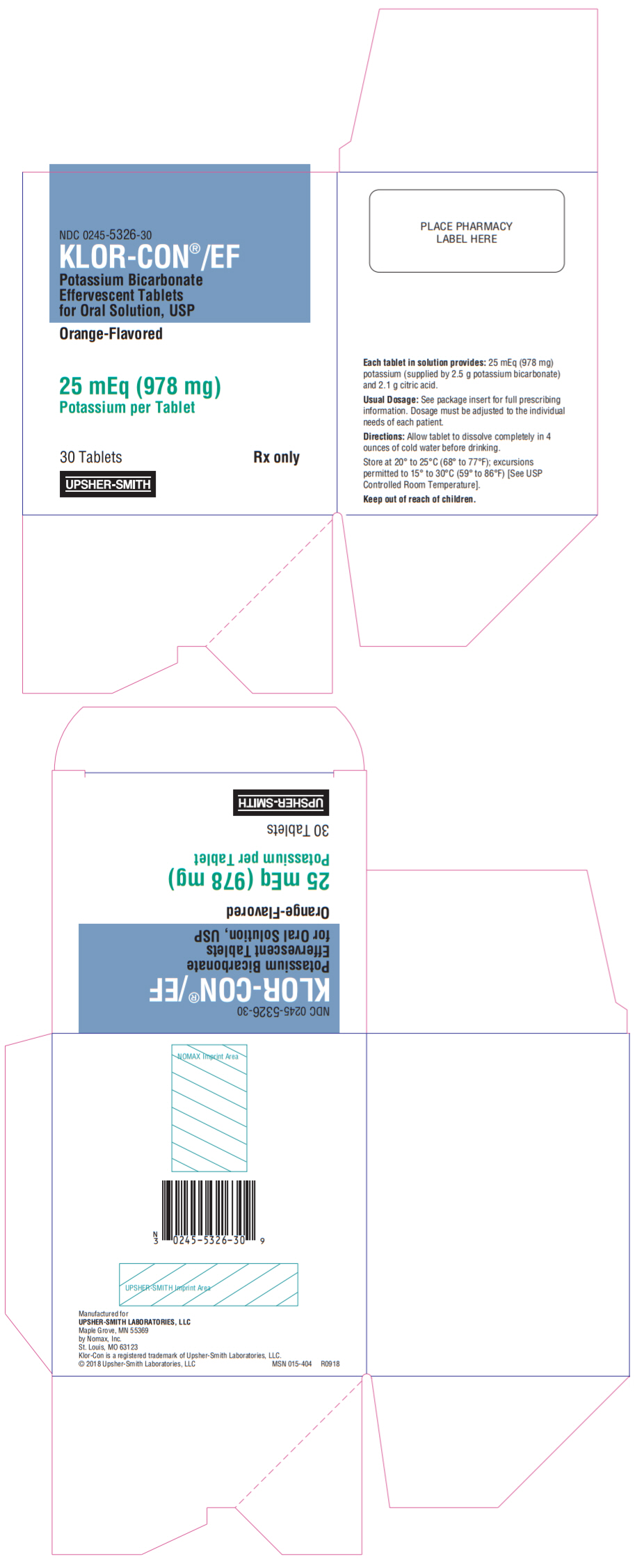
PRINCIPAL DISPLAY PANEL - 978 mg Tablet Pouch Carton NDC 0245-5326-30 KLOR-CON ® /EF Potassium Bicarbonate Effervescent Tablets for Oral Solution, USP Orange-Flavored 25 mEq (978 mg) Potassium per Tablet 30 Tablets Rx only UPSHER-SMITH PRINCIPAL DISPLAY PANEL - 978 mg Tablet Pouch Carton
Medicaid utilization & spend
Medicaid utilization by pack size
Medicare Part D spend CMS · PART D · 2026 (Q1)
About this NDC listing & data coverage
Listed without an FDA application
This product's marketing category indicates it is marketed without an approved FDA application (no NDA, ANDA, or BLA on file). Having an NDC does not by itself establish FDA approval — the NDC Directory is a listing system, not an approval decision. Approval-linked data such as Orange Book therapeutic-equivalence ratings therefore does not apply.
What data is (and isn’t) available for this NDC — tap to expand
| NDC identity (package / product / labeler codes) | ✓ Available |
| Labeler | ✓ Available |
| Product & package description | ✓ Available |
| Marketing category & status | ✓ Available |
| Active ingredient / dosage form / route | ✓ Available |
| FDA label (SPL via DailyMed) | ✓ Available |
| Package photos | ✓ Available |
| Inactive ingredients (structured) | ✓ Available |
| NADAC pharmacy acquisition price (CMS) | ✓ Available |
| Orange Book / therapeutic-equivalence data | — Not published for this NDC Applies only to products approved under an NDA/ANDA; many listings are out of scope. |
| HCPCS J-code billing crosswalk | — Not published for this NDC Most self-administered / retail products have no J-code — that is normal. |
| Medicaid utilization (CMS SDUD) | ✓ Available |