
HomeNDC LookupIngredientsPotassium Bicarbonate › 00245-5326-30
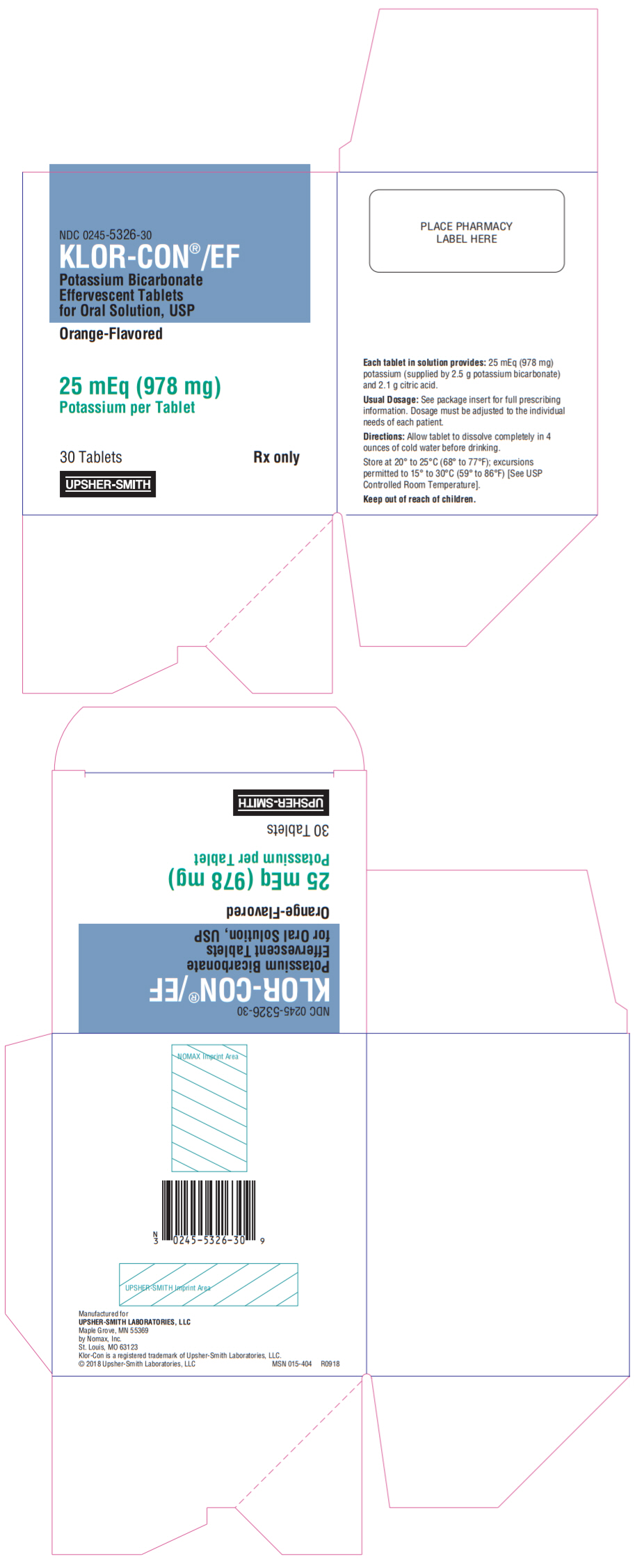
KLOR-Con/EF Potassium Bicarbonate 978 mg Tablet, Effervescent — NDC 00245-5326-30 package photo

KLOR-Con/EF Potassium Bicarbonate 978 mg Tablet, Effervescent

by Upsher-Smith Laboratories, Inc. · 30 POUCH in 1 CARTON (0245-5326-30) / 1 TABLET, EFFERVESCENT in 1 POUCH (0245-5326-89)
NDC 00245-5326-30
🏷️ FDA NDC (as labeled) 0245-5326-30 billing pads the labeler segment with a zero
This package
Contains1 tablet, effervescent in 1 pouch Cost per ea$0.8594 NADAC Per package$25.78 / 30 tablet Pack sizes2 compare ↓
Also priced by: Medicaid pays $0.8627/unit — full pricing hub ↓
Also comes in: 1 tablet 00245-5326-01
Rx only On market Non-controlled
🗂️ Data synced Jul 24, 2026 · sources: openFDA · FDA label (DailyMed) · FDA Orange & Purple Book · First Databank · CMS NADAC, ASP, Medicare & Medicaid · RxNorm
📋 All sources & update times →

🆔 Identity & classification

FDA NDC (as labeled) 0245-5326-30
Product NDC 0245-5326
11-digit billing NDC 00245532630
NCPDP billing unit EA — each (per item)
RxCUI 1088772, 1537082
UNII HM5Z15LEBN
SPL Set ID f9d85c4f-aa46-40b2-ad76-89dbf6ec8e4d
Established class (EPC) Osmotic Laxative; Potassium Salt
Mechanism of action Osmotic Activity
Physiologic effect Increased Large Intestinal Motility; Inhibition Large Intestine Fluid/Electrolyte Absorption
Chemical class Potassium Compounds
DEA schedule Non-controlled
Marketing category UNAPPROVED DRUG OTHER
Marketing status On market
FDA listing status Listed (active directory)
Marketing start 2014-09-01
Route ORAL
Dosage form TABLET, EFFERVESCENT
Substance POTASSIUM BICARBONATE
GPI-14 79700020000810
GPI class Klor-Con/EF
GCN Seq No 001240
GCN 56821
HICL code 000545
Ingredient (HICL) Potassium Bicarbonate/Cit Ac
HIC1 code C
Therapeutic class — broad (HIC1) Electrolyte Balance/Metabolism/Nutrition
HIC2 code C1
Therapeutic class — intermediate (HIC2) Drugs Affecting Electrolyte Balance
HIC3 code C1D
Therapeutic class — specific (HIC3) Potassium Replacement
AHFS code 40:12.00.00
AHFS class Replacement Preparations
FDB label name KLOR-CON-EF 25 MEQ TAB EFF
FDB brand name Klor-Con-Ef
Legend status F — Federal legend — prescription drug or device
Why two NDCs? The FDA registers this code as 0245-5326-30 — a 4-4-2 layout, and that's what's printed on the package and shown on DailyMed. For insurance claims, every NDC is standardized to a uniform 11-digit 5-4-2 format by adding a zero to the labeler segment → 00245-5326-30. Same drug, same package — only the format differs.
Where does this data come from?
Identifiers from the FDA openFDA NDC Directory and Structured Product Labeling; RxCUI from RxNorm (NLM); GPI from Medi-Span; GCN / HIC / AHFS / legend from First Databank.

🏷️ RxNorm drug class

This medicine belongs to the Potassium class.

Drug family (ATC) Potassium
Where does this data come from?
Therapeutic classes from RxNorm RxClass (U.S. National Library of Medicine) — Established Pharmacologic Class (FDA), ATC drug family (WHO) and mechanism of action, matched by this product’s RxCUI.

🏭 Manufacturer & labeler

LabelerUpsher-Smith Laboratories, Inc.
Labeler code00245
First marketedSep 2014
Product typeHuman Prescription Drug
Portfolio3 products on file
The labeler markets the product; the application holder owns the FDA approval. They’re often the same company but can differ (e.g. a repackager or an authorized generic). A mailing address / phone appears here when the manufacturer includes it in the product’s FDA label (not all do).
Where does this data come from?
Labeler, application holder and registered establishment from the FDA openFDA NDC Directory and Drugs@FDA; address/contact from the product’s FDA label.

🩺 Clinical

Label name KLOR-CON-EF 25 MEQ TAB EFF Ingredient Potassium Bicarbonate/Cit Ac
🧪 What is this product?

KLOR-Con/EF is an effervescent tablet taken by mouth that contains potassium bicarbonate, a mineral salt. Potassium is typically used to help maintain normal heart rhythm and muscle function in the body. This product is marketed without an approved FDA application.

Where does this data come from?
Plain-language summary from MedlinePlus (U.S. National Library of Medicine); supplement & herbal interactions and nutrient depletion data from the Natural Medicines database; our full guide is HelloPharmacist editorial content.

💊 What it looks like

Color orange
ShapeRound
Size25 mm
ScoringNot scored
FlavorOrange
One label can cover several strengths, so colors may be combined — always confirm a loose pill against the dispensed prescription label or a pharmacist.
Where does this data come from?
Physical description (imprint, shape, color, scoring, coating) from this product’s FDA Structured Product Labeling (SPL), mirrored from DailyMed / openFDA.

🧪 Inactive Ingredients / Excipients

Inactive ingredients, also called excipients, are components of the drug product other than the active ingredient. They may include fillers, dyes, coatings, preservatives, flavors, or other formulation ingredients.

Loading inactive ingredients from the official FDA label in the background. No external source is being called by this page request.
Where does this data come from?
Source: official FDA Structured Product Labeling (SPL) via DailyMed and the openFDA label index. Structured IACT rows and label-wide narrative are kept separate; availability and product-level specificity depend on the submitted label.

Inactive ingredient FAQ

Are inactive ingredients the same for every manufacturer?
No. Inactive ingredients can differ by manufacturer, dosage form, strength, and package / product version.
Why might an inactive ingredient be missing?
Some SPLs do not provide a complete structured inactive-ingredient list, and older or unusual labels may only include the information in narrative text.
Can inactive ingredients matter?
Yes. They can matter for allergies, intolerances, dyes, gluten / lactose concerns, preservatives, and formulation differences — but confirm with a pharmacist or the manufacturer when it’s clinically important.

💲 Pricing

A drug doesn't have one price. Each row is a different public payment system, and none is what you'd pay at the counter — that depends on your insurance. The ⓘ on each row explains what it measures.

Price systemPer eaPer package
Retail pharmacies payNADAC · weekly $0.859 $25.78 / 30 tablet
Medicaid paysCMS SDUD · 12 mo $0.8627 $25.88 / 30 tablet
Medicare drug plans payPart D · quarterly No Part D plan price is available for this NDC in our data.
NADAC price history (per ea) — tap or hover for the price & month
Feb 2022 Mar 2022 Sep 2023 Nov 2025 $1.169 $0.859
▼ Down 19% over the last 4 months.
Where does this data come from?
NADAC (National Average Drug Acquisition Cost) is the CMS weekly pharmacy-acquisition-cost survey — what pharmacies pay. ASP (Average Sales Price) is the CMS Medicare Part B drug-payment file, published quarterly. Medicaid pays is computed by us from CMS State Drug Utilization Data (total reimbursed ÷ units, trailing 12 months) — gross of rebates and inclusive of dispensing fees, so it reflects what Medicaid paid, not an acquisition cost. Medicare drug plans pay is the median negotiated point-of-sale unit cost across plans listing this NDC in the CMS quarterly Prescription Drug Plan pricing files, before rebates. The VA pays is the federal contract price (FSS, and the statutory Big 4 ceiling where listed) from the VA National Acquisition Center pharmaceutical price file. All are free public government data; each measures a different payer, so the figures are not directly comparable.

🔁 Therapeutic equivalents

ProductLabelerPackNADAC/unitTEStatusPrice vs. this
Effer-K Orange 977.5 mg 51801-0001-30 Nomax 1 tablet $0.357 Availability likely save 59%
Effer-K Lemon Citrus 977.5 mg 51801-0005-30 Nomax 1 tablet $0.357 Availability likely save 59%
Effer-K Cherry Berry 977.5 mg 51801-0006-30 Nomax 1 tablet $0.357 Availability likely save 59%
Effer-K Unflavored 977.5 mg 51801-0007-30 Nomax 1 tablet $0.357 Availability likely save 59%
KLOR-Con/EF 978 mgthis 00245-5326-30 Upsher-Smith 1 tablet $0.859 Availability likely
About this product: other versions of the same ingredient, strength and form are listed above, least expensive first, with FDA equivalence ratings where available.
Where does this data come from?
Equivalents are other NDCs of the same ingredient, form and route from the openFDA NDC Directory, ranked least-expensive-first by NADAC. Therapeutic-equivalence (AB) ratings come from the FDA Orange Book; biologics use the FDA Purple Book for biosimilar & interchangeable status.

Availability & generic status

🏛️
2014
On the market since
Sep 2014
📍
2026
Currently FDA-listed
12 years listed
🔒
·
No generic listed yet
brand only
ℹ️No FDA-approved generic found

We did not find an FDA-approved generic match for this exact strength, form and route.

Where does this data come from?
Patents and exclusivity from the FDA Orange Book (small-molecule drugs), refreshed from public FDA data. Generic launch timing is an estimate, not a guarantee.

🗺️ Medicaid utilization & spend

📍 This exact package only: Medicaid data is reported per full 11-digit NDC — labeler, product and pack size — so every number here is for 00245-5326-30, not the drug overall. Other pack sizes report separately.
💊 Pharmacy benefit only: These are Medicaid outpatient pharmacy claims, billed by NDC. They exclude the medical benefit — clinic- or hospital-administered drugs billed under HCPCS J-codes — so drugs used mostly that way (e.g. Avastin, Lucentis, Keytruda) can look low or missing here. That’s expected, not an error.
📅 Q1 2025 – Q1 2026 · 5 quarters of data
ⓘ The newest quarter is usually incomplete when first published; states restate recent quarters in later CMS releases, so the latest figures typically revise upward. State coverage-policy changes can also shift quarter-to-quarter totals.
Prescriptions last 4 qtrs
1.7K
Units reimbursed last 4 qtrs
87.6K
Gross reimbursed last 4 qtrs
$75.6K
Avg / prescription
$45.69
Avg / unit
$0.8627
Latest quarter Q1 2026
126Rx
Medicaid pays / ea
$0.8627
gross reimbursed
vs
NADAC / ea
$0.8594
acquisition cost
=
Spread
+$0.0033
+0% vs cost
What Medicaid paid per ea (before rebates; includes the pharmacy’s dispensing fee) compared with NADAC — the average price pharmacies pay to buy the drug. A positive spread means Medicaid reimbursed more than the purchase price, before manufacturer rebates.
Fee-for-service vs managed care
43% FFS 57% MCO
Fee-for-service · 715 Rx Managed care · 940 Rx
State Medicaid map
Alaska: no data reported AK Maine: no data reported ME Washington: no data reported WA Idaho: no data reported ID Montana: no data reported MT North Dakota: no data reported ND Minnesota: no data reported MN Wisconsin: 603 units · 10.2 per 100k residents WI Michigan: 11,406 units · 114 per 100k residents MI New York: 9,094 units · 46.5 per 100k residents NY Vermont: no data reported VT New Hampshire: no data reported NH Oregon: no data reported OR Nevada: no data reported NV Wyoming: no data reported WY South Dakota: no data reported SD Iowa: no data reported IA Illinois: 9,411 units · 75.0 per 100k residents IL Indiana: 4,042 units · 58.9 per 100k residents IN Ohio: 17,135 units · 145 per 100k residents OH Pennsylvania: 676 units · 5.2 per 100k residents PA New Jersey: no data reported NJ Massachusetts: 630 units · 9.0 per 100k residents MA California: 12,110 units · 31.1 per 100k residents CA Utah: no data reported UT Colorado: 1,813 units · 30.8 per 100k residents CO Nebraska: no data reported NE Missouri: 1,454 units · 23.5 per 100k residents MO Kentucky: no data reported KY West Virginia: 1,967 units · 111 per 100k residents WV Virginia: 1,584 units · 18.2 per 100k residents VA Maryland: no data reported MD Connecticut: 1,987 units · 54.9 per 100k residents CT Rhode Island: no data reported RI Arizona: no data reported AZ New Mexico: 2,360 units · 112 per 100k residents NM Kansas: no data reported KS Arkansas: no data reported AR Tennessee: 101 units · 1.4 per 100k residents TN North Carolina: no data reported NC South Carolina: no data reported SC Delaware: no data reported DE Oklahoma: 306 units · 7.5 per 100k residents OK Louisiana: 1,390 units · 30.4 per 100k residents LA Mississippi: no data reported MS Alabama: no data reported AL Georgia: no data reported GA D.C.: no data reported DC Hawaii: no data reported HI Texas: 4,980 units · 16.3 per 100k residents TX Florida: 4,598 units · 20.3 per 100k residents FL
Units reimbursed · per 100k residents
1.4145
gray = no data reported
Colors are per 100,000 residents, so big states don’t automatically dominate. Tap or hover a state for its actual totals.
Tap or hover a state
…for its Medicaid breakdown
🏆 Top states by units · per 100k residents
1 Ohio 145 /100k
2 Michigan 114 /100k
3 New Mexico 112 /100k
4 West Virginia 111 /100k
5 Illinois 75.0 /100k
6 Indiana 58.9 /100k
7 Connecticut 54.9 /100k
8 New York 46.5 /100k
National units — by quarter
💵 About the dollar figures: “reimbursed” is what Medicaid paid pharmacies before confidential manufacturer rebates, so the program’s real net cost is lower than these numbers. Fee-for-service and managed-care claims are combined unless split above. Source: CMS State Drug Utilization Data; per-100k rates use 2023 Census population estimates.

💊 Medicaid utilization by pack size

Medicaid (SDUD) totals over the four most recent reported quarters for every package size of this drug — handy when a specific package (e.g. a starter/titration pack) carries little or no Medicaid volume on its own.
1 tablet this page00245-5326-30 1,655 Rx · $75,611
1 tablet00245-5326-01 11 Rx · $358
Drug total (last 4 qtrs): 1,666 Rx · 88,190 units · $75,969 gross reimbursed
Tap a pack size to open its page. Source: CMS State Drug Utilization Data, last 4 quarters.

📊 Medicare Part D spend CMS · PART D · 2026 (Q1)

Medicare Part D (outpatient prescription) spending for Klor-Con-Ef — the program that covers self-administered drugs. 1 manufacturer.
⚠️ Drug-level data: CMS publishes Part D spending by drug, not by NDC — these figures combine every manufacturer, strength and package size sold under the name Klor-Con-Ef. That’s a different level of aggregation than the Medicaid card above, which is specific to this exact 11-digit NDC (pack size included), so the two aren’t directly comparable.
Period
Total Part D spend
$16.5K
Claims incl. refills
274
Beneficiaries
221
Spend / beneficiary
$74.66
Spend / claim
$60.22
Trend by period
💵 About the dollar figures: spending is what Part D plans paid before confidential manufacturer rebates, so the program’s real net cost is lower. A blank patient count means fewer than 11 people — CMS hides counts that small to protect privacy. Source: CMS Medicare Quarterly Part D Spending by Drug (data.cms.gov), updated quarterly.

🔬 Reported adverse events (FAERS)

Read carefully: FAERS reports are voluntary and unverified. Counts are not incidence, do not establish causation, are subject to reporting bias, and cannot be used to compare one drug to another. Shown for signal context only. Reports for KLOR-Con/EF (this brand).

Top reported reactions

Diarrhoea67
Fatigue47
Acute Kidney Injury44
Dyspnoea44
Pain42
Pneumonia42
Asthenia38

Age at onset

Neonate1
Adult67
Elderly65

Reporter sex

660 reports
Male · 35%
Female · 65%

Serious outcomes

Hospitalization292
Life-threatening41
Disabling22
Reports over time (by year) — tap or hover for the count & year
2023 2024 2025 2026 62 0
Most recent year is provisional (FAERS lags ~3 months).
Where does this data come from?
Adverse-event reports from the FDA Adverse Event Reporting System (FAERS) via openFDA. FAERS reports are voluntary and unverified — counts are not incidence and don’t establish causation.

📦 Packaging — all sizes for this product

Package NDCDescription Per unit Per pack Marketing startStatus
00245-5326-01 100 POUCH in 1 CARTON (0245-5326-01) / 1 TABLET, EFFERVESCENT in 1 POUCH (0245-5326-89) $0.8594 / ea $85.94 2019-06-21 Active
00245-5326-30 You're viewing this 30 POUCH in 1 CARTON (0245-5326-30) / 1 TABLET, EFFERVESCENT in 1 POUCH (0245-5326-89) $0.8594 / ea $25.78 2019-06-21 Active

This pack effectively ties for the lowest per-ea cost of the 2 priced pack sizes ($0.8594 NADAC).

In Medicaid, this is the most-dispensed pack of this product — about 99% of fills over the last four reported quarters. See all packs ↓

Pack size FAQ

What quantity is in NDC 00245-5326-30?
NDC 00245-5326-30 is listed by the FDA — 30 pouch in 1 carton / 1 tablet, effervescent in 1 pouch.
What NDC number is used to bill for this package of KLOR-Con/EF Potassium Bicarbonate 978 mg Tablet, Effervescent?
Bill NDC 00245-5326-30 — the 11-digit billing format is 00245532630. Pharmacy and medical claims use the 11-digit form; the FDA label may print a shorter form of the same code.

Prices are the latest CMS NADAC pharmacy acquisition cost per NDC; per-pack figures are per-unit × pack quantity, shown only when the pack is denominated in the same measure NADAC prices.

🧭 About this NDC listing & data coverage

Finished prescription product Marketed without an FDA application

Listed without an FDA application

This product's marketing category indicates it is marketed without an approved FDA application (no NDA, ANDA, or BLA on file). Having an NDC does not by itself establish FDA approval — the NDC Directory is a listing system, not an approval decision. Approval-linked data such as Orange Book therapeutic-equivalence ratings therefore does not apply.

What data is (and isn’t) available for this NDC — tap to expand
NDC identity (package / product / labeler codes) ✓ Available
Labeler ✓ Available
Product & package description ✓ Available
Marketing category & status ✓ Available
Active ingredient / dosage form / route ✓ Available
FDA label (SPL via DailyMed) ✓ Available
Package photos ✓ Available
Inactive ingredients (structured) — Not published for this NDC The labeler did not submit a structured excipient list, or no SPL is available.
NADAC pharmacy acquisition price (CMS) ✓ Available
Orange Book / therapeutic-equivalence data — Not published for this NDC Applies only to products approved under an NDA/ANDA; many listings are out of scope.
HCPCS J-code billing crosswalk — Not published for this NDC Most self-administered / retail products have no J-code — that is normal.
Medicaid utilization (CMS SDUD) ✓ Available
“Not published” reflects what the public FDA / CMS / NLM sources provide for this exact package code — it is a property of the data feeds, not a judgment about the product.

Questions about this listing

Is this NDC FDA-approved?
An NDC listing does not by itself establish FDA approval — the NDC Directory records that a product is listed with FDA, not that it was reviewed and approved. This listing's marketing category is "Unapproved Drug Other". Products approved under an application carry an NDA, ANDA, or BLA number.
Is the NDC printed on the package the same as the 11-digit billing NDC?
Yes, they identify this exact package in different formats. The FDA registers it as 0245-5326-30, which is what is printed on the packaging and shown on DailyMed. Insurance claims use a fixed 11-digit 5-4-2 format, so the short segment is padded with a leading zero: 00245-5326-30, written without dashes as 00245532630. The Identity section at the top of this page lists every form of this code.
What do the three segments of this NDC mean?
In 00245-5326-30, the first segment (00245) is the labeler code FDA assigned to Upsher-Smith Laboratories, Inc.; the middle segment (5326) identifies this specific product — its ingredient, strength, and dosage form; and the last segment (30) identifies this exact package size and type. Together they name one specific package of one specific product.
Is this package still being marketed?
Yes, per the latest FDA NDC Directory data on this page: this package is listed as actively marketed, with no marketing end date reported by Upsher-Smith Laboratories, Inc.. Listing status can change — the directory data on this page refreshes weekly.
Does this product come in other package sizes?
Yes — the FDA directory lists 1 other package presentation of this same product, including 1 tablet (00245-5326-01). Each has its own NDC and its own page — see the package list near the top of this page.
Who lists this product with the FDA?
Upsher-Smith Laboratories, Inc. is the labeler of record for this NDC — the company under whose FDA-assigned code the package is listed. The labeler may be the manufacturer itself or a distributor marketing the product under its own code.
Do I need a prescription for this product?
This NDC is listed with FDA as a prescription product, so it is dispensed under a prescriber's order. Your pharmacist can tell you whether any over-the-counter forms of the same medication exist.
This page identifies an FDA-listed package (the NDC) and reports public regulatory and pricing data about the listing. It is reference information, not a medical recommendation — talk to your pharmacist or prescriber about your own medication.
Where does this data come from?
Listing facts (marketing category, packager status, marketing dates) from the FDA openFDA NDC Directory; label availability from DailyMed; pricing coverage from CMS NADAC; equivalence scope from the FDA Orange Book.

📄 Full prescribing information FDA SPL

The complete FDA label for this product — the official prescribing information, verbatim, section by section. Jump with a chip, search within the label, or expand everything.
🎯 Indications and Usage 160 words

INDICATIONS AND USAGE For the treatment of patients with hypokalemia, with or without metabolic alkalosis; in digitalis intoxication; and in patients with hypokalemic familial periodic paralysis. If hypokalemia is the result of diuretic therapy, consideration should be given to the use of a lower dose of diuretic, which may be sufficient without leading to hypokalemia. For the prevention of hypokalemia in patients who would be at particular risk if hypokalemia were to develop (e.g., digitalized patients or patients with significant cardiac arrhythmias).

The use of potassium salts in patients receiving diuretics for uncomplicated essential hypertension is often unnecessary when such patients have a normal dietary pattern and when low doses of the diuretic are used. Serum potassium should be checked periodically, however, and if hypokalemia occurs, dietary supplementation with potassium-containing foods may be adequate to control milder cases. In more severe cases, and if dose adjustment of the diuretic is ineffective or unwarranted, supplementation with potassium salts may be indicated.

⏱️ Dosage and Administration 169 words

DOSAGE AND ADMINISTRATION The usual dietary potassium intake by the average adult is 50 to 100 mEq per day. Potassium depletion sufficient to cause hypokalemia usually requires the loss of 200 mEq or more of potassium from the total body store. Dosage must be adjusted to the individual needs of each patient.

The dose for the prevention of hypokalemia is typically 25 mEq per day. Doses of 50 to 100 mEq per day or more are used for the treatment of potassium depletion. Dosage should be divided if more than 25 mEq per day is given such that no more than 25 mEq is given in a single dose.

The usual adult dose is 25 to 100 mEq of potassium per day (one KLOR-CON ® /EF tablet 1 to 4 times daily after meals). Each KLOR-CON ® /EF tablet should be dissolved in at least 4 ounces of cold or ice water. These preparations, like other potassium supplements, must be properly diluted to avoid the possibility of gastrointestinal irritation.

Contraindications 68 words

CONTRAINDICATIONS Potassium supplements are contraindicated in patients with hyperkalemia since a further increase in serum potassium concentration in such patients can produce cardiac arrest. Hyperkalemia may complicate any of the following conditions: chronic renal failure, systemic acidosis such as diabetic acidosis, acute dehydration, extensive tissue breakdown as in severe burns, adrenal insufficiency or the administration of a potassium-sparing diuretic (e.g., spironolactone, triamterene or amiloride) [see OVERDOSAGE ] .

⚠️ Warnings 186 words

WARNINGS Hyperkalemia [see OVERDOSAGE ] In patients with impaired mechanisms for excreting potassium, the administration of potassium salts can produce hyperkalemia and cardiac arrest. This occurs most commonly in patients given potassium by the intravenous route but may also occur in patients given potassium orally. Potentially fatal hyperkalemia can develop rapidly and be asymptomatic.

The use of potassium salts in patients with chronic renal disease, or any other condition which impairs potassium excretion, requires particularly careful monitoring of the serum potassium concentration and appropriate dosage adjustment. Interaction with Potassium-Sparing Diuretics Hypokalemia should not be treated by the concomitant administration of potassium salts and a potassium-sparing diuretic (e.g., spironolactone, triamterene or amiloride), since the simultaneous administration of these agents can produce severe hyperkalemia.

Interaction with Angiotensin Converting Enzyme Inhibitors Angiotensin converting enzyme (ACE) inhibitors (e.g., captopril, enalapril) will produce some potassium retention by inhibiting aldosterone production. Potassium supplements should be given to patients receiving ACE inhibitors only with close monitoring. Metabolic Acidosis Hypokalemia in patients with metabolic acidosis should be treated with an alkalinizing potassium salt such as potassium bicarbonate, potassium citrate, potassium acetate or potassium gluconate.

🤒 Adverse Reactions 64 words

ADVERSE REACTIONS One of the most severe adverse effects is hyperkalemia [see CONTRAINDICATIONS , WARNINGS and OVERDOSAGE ] . The most common adverse reactions to oral potassium salts are nausea, vomiting, flatulence, abdominal pain/discomfort and diarrhea. These symptoms are due to irritation of the gastrointestinal tract and are best managed by diluting the preparation further, taking the dose with meals or reducing the dose.

🔄 Drug Interactions 12 words

Drug Interactions Potassium-sparing diuretics, angiotensin converting enzyme inhibitors [see WARNINGS ] .

🤰 Pregnancy 44 words

Pregnancy Animal reproduction studies have not been conducted with potassium salts. It is not known if potassium salts cause fetal harm when administered to a pregnant woman or affect reproductive capacity. Potassium supplements should be given to a pregnant woman only if clearly needed.

🧒 Pediatric Use 11 words

Pediatric Use Safety and effectiveness in children have not been established.

🆘 Overdosage 190 words

OVERDOSAGE The administration of oral potassium salts to persons with normal excretory mechanisms for potassium rarely causes serious hyperkalemia. However, if excretory mechanisms are impaired or if potassium is administered too rapidly intravenously, potentially fatal hyperkalemia can result [see CONTRAINDICATIONS and WARNINGS ] . It is important to recognize that hyperkalemia is usually asymptomatic and may be manifested only by an increased serum potassium concentration (6.5 to 8.0 mEq/L) and characteristic electrocardiographic changes (peaking of T-waves, loss of P-wave, depression of S-T segment and prolongation of the QT interval).

Late manifestations include muscle paralysis and cardiovascular collapse from cardiac arrest (9 to 12 mEq/L). Treatment measures for hyperkalemia include the following: 1) elimination of foods and medications containing potassium and elimination of potassium-sparing diuretics; 2) intravenous administration of 300 to 500 mL/hr of 10% dextrose solution containing 10 to 20 units of crystalline insulin per 1,000 mL; 3) correction of acidosis, if present, with intravenous sodium bicarbonate; 4) use of exchange resins, hemodialysis or peritoneal dialysis.

In treating hyperkalemia in patients who have been stabilized on digitalis, too rapid a lowering of the serum potassium concentration can produce digitalis toxicity.

🧬 Clinical Pharmacology ~2 min read

CLINICAL PHARMACOLOGY The potassium ion is the principal intracellular cation of most body tissues. Potassium ions participate in a number of essential physiological processes, including the maintenance of intracellular tonicity, the transmission of nerve impulses, the contraction of cardiac, skeletal and smooth muscle and the maintenance of normal renal function. The intracellular concentration of potassium is approximately 150 to 160 mEq per liter.

The normal adult plasma concentration is 3.5 to 5 mEq per liter. An active ion transport system maintains this gradient across the plasma membrane. Potassium is a normal dietary constituent and under steady state conditions the amount of potassium absorbed from the gastrointestinal tract is equal to the amount excreted in the urine.

The usual dietary intake of potassium is 50 to 100 mEq per day. Potassium depletion will occur whenever the rate of potassium loss through renal excretion and/or loss from the gastrointestinal tract exceeds the rate of potassium intake. Such depletion usually develops as a consequence of therapy with diuretics, primary or secondary hyperaldosteronism, diabetic ketoacidosis or inadequate replacement of potassium in patients on prolonged parenteral nutrition.

Depletion can develop rapidly with severe diarrhea, especially if associated with vomiting. Potassium depletion due to these causes is usually accompanied by a concomitant loss of chloride and is manifested by hypokalemia and metabolic alkalosis. Potassium depletion may produce weakness, fatigue, disturbances of cardiac rhythm (primarily ectopic beats), prominent U-waves in the electrocardiogram and, in advanced cases, flaccid paralysis and/or impaired ability to concentrate urine.

If potassium depletion associated with metabolic alkalosis cannot be managed by correcting the fundamental cause of the deficiency (e.g., patients require long-term diuretic therapy), supplemental potassium in the form of high potassium food or potassium salts may be able to restore normal potassium levels. In rare circumstances (e.g., patients with renal tubular acidosis), potassium depletion may be associated with metabolic acidosis and hyperchloremia. In such patients, potassium replacement should be accomplished with potassium salts such as potassium bicarbonate, potassium citrate, potassium acetate or potassium gluconate.

📦 How Supplied / Storage and Handling 55 words

HOW SUPPLIED KLOR-CON ® /EF Potassium Bicarbonate Effervescent Tablets for Oral Solution, USP are supplied as follows: Cartons of 30 individually wrapped tablets NDC 0245-5326-30 Cartons of 100 individually wrapped tablets NDC 0245-5326-01 Store at 20° to 25°C (68° to 77°F); excursions permitted to 15° to 30°C (59° to 86°F) [See USP Controlled Room Temperature].

📦 Storage and Handling 22 words

Store at 20° to 25°C (68° to 77°F); excursions permitted to 15° to 30°C (59° to 86°F) [See USP Controlled Room Temperature].

📋 Description 80 words

DESCRIPTION Orange-flavored KLOR-CON ® /EF (potassium bicarbonate effervescent tablets for oral solution, USP) are an oral potassium supplement offered as effervescent tablets in individual packets for dissolution in water. Each tablet contains potassium bicarbonate 2.5 g and citric acid 2.1 g which in solution provides 25 mEq (978 mg) potassium as bicarbonate and citrate. Also contains: FD&C Yellow No.

6, FD&C Yellow No. 6 Lake, microcrystalline cellulose, mineral oil, orange flavor, saccharin and talc. KLOR-CON ® /EF tablets are sugar-free.

💬 Information for Patients 30 words

Information for Patients Remind the patient to take this medicine following the frequency and amount prescribed. This is especially important if the patient is also taking diuretics and/or digitalis preparations.

Source: FDA Structured Product Labeling, mirrored from DailyMed / openFDA. Prefer the government’s original formatting? View this label on DailyMed ↗
For educational and professional reference only — not medical advice. Pricing reflects published NADAC and CMS ASP (free public data) and may differ from your acquisition cost; always verify before billing or dispensing.