
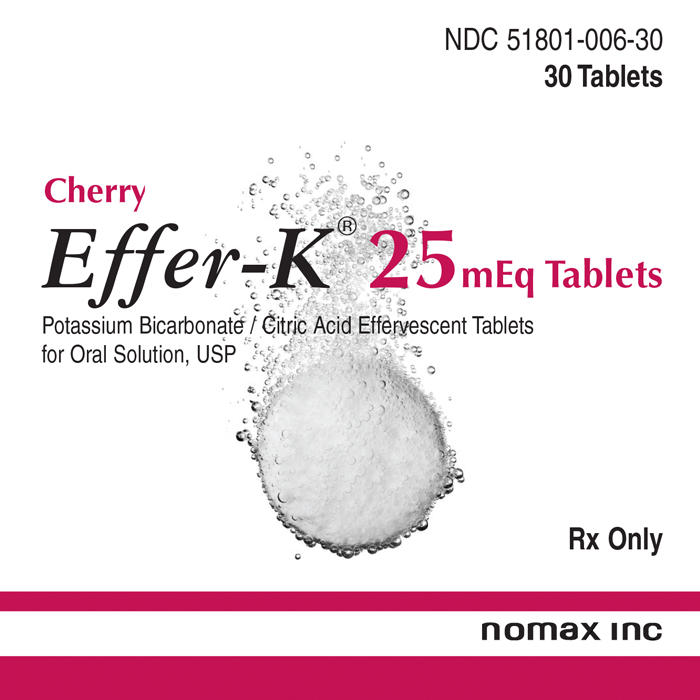
Effer-K Cherry Berry POTASSIUM BICARBONATE 977.5 mg Tablet, Effervescent
🆔 Identity & classification
Where does this data come from?
🏷️ RxNorm drug class
This medicine belongs to the Potassium class.
Where does this data come from?
🏭 Manufacturer & labeler
Where does this data come from?
🩺 Clinical
Potassium is essential for the proper functioning of the heart, kidneys, muscles, nerves, and digestive system. Usually the food you eat supplies all of the potassium you need. However, certain diseases (e.g., kidney disease and gastrointestinal disease with vomiting and diarrhea) and drugs, especially diuretics ('water pills'), remove potassium from the body. Potassium supplements are taken to replace potassium losses and prevent potassium deficiency. This medication is sometimes prescribed for other uses; ask your doctor or pharmacist for more information.
Read the full MedlinePlus article ↗Effer-K Cherry Berry is an effervescent tablet taken by mouth that contains potassium bicarbonate. Potassium bicarbonate is a mineral supplement typically used to raise potassium levels in the body when they are low. This product is marketed without an approved FDA application. The effervescent form dissolves in water before ingestion.
Patient education
Supplement & herbal interactions
Some supplements/herbs that may interact with Potassium Bicarbonate (prescription drug) — tap one for details:
Where does this data come from?
Ask a licensed pharmacist directly — free, answered by our team.
💊 What it looks like
Where does this data come from?
🧪 Inactive Ingredients / Excipients
Inactive ingredients, also called excipients, are components of the drug product other than the active ingredient. They may include fillers, dyes, coatings, preservatives, flavors, or other formulation ingredients.
💡 Tap an ingredient (hover on desktop) to see what it is and why it’s used.
-
100 mg
UNII OP1R32D61U
Microcrystalline cellulose is a purified form of cellulose, a natural fiber from plant sources. It acts as a binder and filler in tablets and capsules, helping hold ingredients together and give the medicine its shape and size.
-
2100 mg
UNII 2968PHW8QP
A weak organic acid derived from citrus fruits or made through fermentation. It works as a buffer to control pH, a preservative to extend shelf life, and a flavoring agent in medications.
-
34 mg
UNII T5L8T28FGP
Mineral oil is a clear, odorless liquid derived from crude oil. It acts as a lubricant and emollient in medications, helping pills slide smoothly during manufacturing and aiding moisture retention in topical products.
-
20 mg
UNII 7SEV7J4R1U
A powder made from a naturally occurring mineral. In medicines, talc works as a glidant and anti-caking agent, helping tablets and capsules flow smoothly during manufacturing and preventing clumping.
4 inactive ingredients listed in the exact product block matched to this NDC.
Where does this data come from?
ingredient classCode="IACT" elements from the exact product block matched by this NDC. Label-section narrative from DailyMed / the openFDA label index is shown separately when available.Inactive ingredient FAQ
Are inactive ingredients the same for every manufacturer?
Why might an inactive ingredient be missing?
Can inactive ingredients matter?
💲 Pricing
A drug doesn't have one price. Each row is a different public payment system, and none is what you'd pay at the counter — that depends on your insurance. The ⓘ on each row explains what it measures.
| Price system | Per ea | Per package |
|---|---|---|
| Retail pharmacies payNADAC · weekly | $0.357 | $10.70 / 30 tablet |
| Medicaid paysCMS SDUD · 12 mo | $0.5726 | $17.18 / 30 tablet |
| Medicare drug plans payPart D · quarterly | No Part D plan price is available for this NDC in our data. | |
Where does this data come from?
🔁 Therapeutic equivalents
| Product | Labeler | Pack | NADAC/unit | TE | Status | Price vs. this |
|---|---|---|---|---|---|---|
| Effer-K Orange 977.5 mg 51801-0001-30 | Nomax | 1 tablet | $0.357 | — | Availability likely | — |
| Effer-K Lemon Citrus 977.5 mg 51801-0005-30 | Nomax | 1 tablet | $0.357 | — | Availability likely | — |
| Effer-K Cherry Berry 977.5 mgthis 51801-0006-30 | Nomax | 1 tablet | $0.357 | — | Availability likely | — |
| Effer-K Unflavored 977.5 mg 51801-0007-30 | Nomax | 1 tablet | $0.357 | — | Availability likely | — |
| KLOR-Con/EF 978 mg 00245-5326-01 | Upsher-Smith | 1 tablet | $0.859 | — | Availability likely | +141% |
Where does this data come from?
⏳ Availability & generic status
We did not find an FDA-approved generic match for this exact strength, form and route.
Where does this data come from?
🗺️ Medicaid utilization & spend
📦 Packaging — all sizes for this product
| Package NDC | Description | Marketing start | Status |
|---|---|---|---|
| 51801-0006-30 You're viewing this | 30 POUCH in 1 CARTON (51801-006-30) / 1 TABLET, EFFERVESCENT in 1 POUCH | 2013-01-30 | Active |
🧭 About this NDC listing & data coverage
Listed without an FDA application
This product's marketing category indicates it is marketed without an approved FDA application (no NDA, ANDA, or BLA on file). Having an NDC does not by itself establish FDA approval — the NDC Directory is a listing system, not an approval decision. Approval-linked data such as Orange Book therapeutic-equivalence ratings therefore does not apply.
What data is (and isn’t) available for this NDC — tap to expand
| NDC identity (package / product / labeler codes) | ✓ Available |
| Labeler | ✓ Available |
| Product & package description | ✓ Available |
| Marketing category & status | ✓ Available |
| Active ingredient / dosage form / route | ✓ Available |
| FDA label (SPL via DailyMed) | ✓ Available |
| Package photos | ✓ Available |
| Inactive ingredients (structured) | ✓ Available |
| NADAC pharmacy acquisition price (CMS) | ✓ Available |
| Orange Book / therapeutic-equivalence data | — Not published for this NDC Applies only to products approved under an NDA/ANDA; many listings are out of scope. |
| HCPCS J-code billing crosswalk | — Not published for this NDC Most self-administered / retail products have no J-code — that is normal. |
| Medicaid utilization (CMS SDUD) | ✓ Available |
Questions about this listing
Is this NDC FDA-approved?
Is the NDC printed on the package the same as the 11-digit billing NDC?
What do the three segments of this NDC mean?
Is this package still being marketed?
Who lists this product with the FDA?
Do I need a prescription for this product?
Where does this data come from?
📄 Full prescribing information FDA SPL
🎯 Indications and Usage ▾
Indications and Usage For therapeutic use in patients with hypokalemia with or without metabolic alkalosis; in chronic digitalis intoxication; and in patients with hypokalemic familial periodic paralysis. For prevention of potassium depletion when the dietary intake of potassium ion is inadequate in the following conditions; patients receiving digitalis and diuretics for congestive heart failure; hepatic cirrhosis with ascites; states of aldosterone excess with normal renal function; potassiumlosing nephropathy, and certain diarrheal states; long-term corticosteroid therapy.
The use of potassium salts in patients receiving diuretics for uncomplicated essential hypertension or receiving certain antibiotics is often unnecessary when such patients have a normal dietary pattern. Serum potassium should be checked periodically, however, and, if hypokalemia occurs, dietary supplementation with potassium-containing foods may be adequate to control milder cases. In more severe cases supplementation with potassium salts may be indicated.
⏱️ Dosage and Administration ▾
Dosage and administration Dosage and Administration: Adults- One Effer-K ® flavored tablet, (Orange, Lemon Citrus or Cherry Berry) each containing 25 mEq (978 mg) of potassium, completely dissolved in 4 ounces of cold or ice water, 1 to 4 times daily, depending on the requirement of the patient. For Effer-K ® unflavored tablets (each containing 25 mEq (978 mg) of potassium) we recommend completely dissolving one tablet in 12 to 16 ounces of cold juice of the patient's choice. NOTE: It is suggested that any effervescent potassium tablets be taken with meals and sipped slowly over a 5 to 10 minute period.
⛔ Contraindications ▾
Contraindications Potassium supplements are contraindicated in patients with hyperkalemia since a further increase in serum potassium concentration in such patients can produce cardiac arrest. Conditions predisposing to hyperkalemia include: chronic renal failure, acute metabolic acidosis, uncontrolled diabetes mellitus, esophageal compression or delayed gastric emptying or intestinal obstruction/stricture or peptic ulcer. Potassium supplements should be used with caution and only where medically indicated in patients with familial periodic paralysis, myotonia congenita or severe/complete heart block.
IMPORTANT: Potassium supplements are contraindicated in patients receiving potassium-sparing diuretics (e.g. spironolactone, triamterene) since such use may produce severe hyperkalemia.
⚠️ Warnings ▾
Warnings In patients with hyperkalemia and impaired mechanisms for excreting potassium the administration of potassium salts can produce hyperkalemia and cardiac arrest. This occurs most commonly in patients given potassium by the intravenous route but may also occur in patients given potassium orally. Potentially fatal hyperkalemia can develop rapidly and be asymptomatic.
The use of potassium salts in patients with chronic renal disease, or any other condition which impairs potassium excretion, requires particularly careful monitoring of the serum potassium concentration and appropriate dosage adjustment. Note: There is no conclusive evidence that potassium supplements lower blood pressure in hypertensive patients.
🤒 Adverse Reactions ▾
Adverse Reactions One of the most severe adverse effects is hyperkalemia (see Contraindications , Warnings and Overdosage ). The most common adverse reactions to oral potassium salts are nausea, vomiting, abdominal discomfort, and diarrhea. These symptoms are due to irritation of the gastrointestinal tract and are best managed by diluting the preparation further, taking the dose with meals, or reducing the dose. Skin rash has been reported rarely.
🔄 Drug Interactions ▾
Drug Interactions The simultaneous administration of potassium supplements and a potassium-sparing diuretic can produce severe hyperkalemia (see Contraindications ). Potassium supplements should be used cautiously in patients who are using salt substitutes, because most of the latter contain substantial amounts of potassium. Such concomitant use could result in hyperkalemia.
Moreover, the following drugs may produce unfavorable interactions when used concomitantly with potassium supplements: angiotension-converting enzyme (ACE) inhibitors, nonsteroid anti-inflammatory drugs (NSAIDs), beta-adrenergic blocking drugs, heparin, low-salt foods, other potassium containing medications, digitalis glycosides and others.
🤰 Pregnancy ▾
Usage in Pregnancy Pregnancy Category C Animal reproduction studies have not been conducted with Effer-K ® 25mEq TABLETS (Potassium Bicarbonate Effervescent Tablets for Oral Solution, USP). It is also not known whether these products can cause fetal harm when administered to a pregnant woman or can affect reproduction capacity. Effer-K ® 25mEq TABLETS (Potassium Bicarbonate Effervescent Tablets for Oral Solution, USP) should be given to a pregnant woman only if clearly needed.
🧒 Pediatric Use ▾
Usage in Children Safety and effectiveness in children have not been established.
🆘 Overdosage ▾
Overdosage The administration of oral potassium salts to persons with normal excretory mechanisms for potassium rarely causes serious hyperkalemia. However, if excretory mechanisms are impaired or if potassium is administered too rapidly intravenously, potentially fatal hyperkalemia can result (see Contraindications and Warnings ). It is important to recognize that initally hyperkalemia is usually asymptomatic and may be manifested only by an increased serum potassium concentration and characteristic electrocardiographic changes (peaking of T-waves, loss of P-wave, depression of S-T segment, and prolongation of the QT interval).
Late manifestations include muscle paralysis and cardiovascular collapse from cardiac arrest. Treatment measures for hyperkalemia include the elimination of foods and medications containing potassium and potassium-sparing diuretics, as well as ACE inhibitors, beta blocking agents, NSAIDs, heparin, and cyclosporine. In cases of life-threatening hyperkalemia, treatment measures may include: (1) intravenous administration of 300 to 500 ml/hr of 10% dextrose solution containing 10-20 units of insulin per 1,000 ml; (2) correction of acidosis, if present, with intravenous sodium bicarbonate; (3) use of exchange resins, hemodialysis, or peritoneal dialysis; (4) administration of a calcium salt to antagonize the cardiotoxic effects in patients whose electrocardiograms show appropriate characteristics, and who are not receiving digitalis glycosides; and (5) maintenance of a high urine output in suitable patients.
In treating hyperkalemia, it should be recalled that in patients who have been stabilized on digitalis, rapid lowering of serum potassium can produce digitalis toxicity.
🧬 Clinical Pharmacology ▾
Clinical Pharmacology Potassium ion is the principal intracellular cation of most body tissues, whereas sodium ion is relatively low in concentration. In extracellular fluid the opposite exists, sodium ion being principal and potassium ion being low. The situation is maintained by an active membrane-bound enzyme (Na + K + ATPase).
This potassium ion concentration gradient is essential to conduct nerve impulses in such specialized tissues as the brain, heart, and skeletal muscle; and in addition, to maintain normal renal function, acid-base balance, and various cellular metabolic functions. Elimination values are 90% renal and 10% fecal. Potassium depletion may occur if the rate of potassium ion loss by renal excretion and/or loss from the gastrointestinal tract exceeds the rate of potassium ion intake.
Such depletion usually develops slowly as a consequence of prolonged therapy with oral diuretics, primary or secondary hyperaldosteronism, diabetic ketoacidosis, severe diarrhea, or inadequate replacement of potassium in patients on prolonged parenteral nutrition. Potassium depletion due to these causes is usually accompanied by a concomitant deficiency of chloride and is manifested by hypokalemia and metabolic alkalosis. Potassium depletion may produce weakness, fatigue, mood or mental changes, nausea, vomiting, disturbances of cardiac rhythm (primarily ectopic beats), prominent U-waves in the electrocardiogram, and in advanced cases flaccid paralysis and/or impaired ability to concentrate urine.
📦 How Supplied / Storage and Handling ▾
How Supplied Effer-K ® 25 mEq TABLETS (Potassium Bicarbonate Effervescent Tablets for Oral Solution, USP). Each tablet in solution provides 25 mEq of elemental potassium as potassium citrate. Store below 40˚C (104˚F) preferably between 15˚ and 30˚C (59˚ and 86˚F), in original hermetic packaging.
Tablets are one inch diameter round, flat face on both sides with large bevels. "EK 25" is imprinted one side of the tablets. Each tablet is pouched with the product description on one side of the pouch and the lot number, expiration date, and barcode on the other. NDC 51801-001-30 Orange-flavored, package of 30 tablets.
NDC 51801-005-30 Lemon Citrus-flavored, package of 30 tablets. NDC 51801-001-40 Orange-flavored, package of 100 tablets. NDC 51801-006-30 Cherry Berry-flavored, package of 30 tablets.
NDC 51801-007-30 Unflavored, package of 30 tablets. Nomax, Inc. St.
Louis, MO 63123 - Made in USA MSN 015-031 Rev. 08/10
📦 Storage and Handling ▾
Effer-K ® 25 mEq TABLETS (Potassium Bicarbonate Effervescent Tablets for Oral Solution, USP). Each tablet in solution provides 25 mEq of elemental potassium as potassium citrate. Store below 40˚C (104˚F) preferably between 15˚ and 30˚C (59˚ and 86˚F), in original hermetic packaging.
Tablets are one inch diameter round, flat face on both sides with large bevels. "EK 25" is imprinted one side of the tablets. Each tablet is pouched with the product description on one side of the pouch and the lot number, expiration date, and barcode on the other. NDC 51801-001-30 Orange-flavored, package of 30 tablets.
NDC 51801-005-30 Lemon Citrus-flavored, package of 30 tablets. NDC 51801-001-40 Orange-flavored, package of 100 tablets. NDC 51801-006-30 Cherry Berry-flavored, package of 30 tablets.
NDC 51801-007-30 Unflavored, package of 30 tablets. Nomax, Inc. St.
Louis, MO 63123 - Made in USA MSN 015-031 Rev. 08/10
📋 Description ▾
Description Description: Effer-K® 25 mEq TABLETS (Potassium Bicarbonate Effervescent Tablets for Oral Solution, USP) are intended for the preparation of an oral solution of potassium. Each tablet contains 2.5 g. potassium bicarbonate and 2.1 g. citric acid which in solution provides 25 mEq (978 mg) of elemental potassium as potassium citrate. Tablets also contain: SD flavors, microcrystalline cellulose, mineral oil, saccharine and talc.
The orange tablets contain FD&C yellow No. 6 and FD&C yellow No, 6 lake. The lemon citrus tablets contain D&C yellow No.
10 and yellow No. 10 lake. The cherry berry tablets contain FD&C red No.
40 and FD&C red No. 40 lake. The unflavored tablets do not contain any natural or synthetic dyes, flavors or sweeteners.
Tablets are one inch in diameter round, flat face on both sides with large bevels. "EK-25" is imprinted on one side of the tablets. Each tablet is foil-pouched with the product description on one side of the pouch and the lot number, expiration and barcode on the other.
💬 Information for Patients ▾
Information for patients To minimize the possibility of gastrointestinal irritation associated with the oral ingestion of concentrated potassium salt preparations, patients should be directed to dissolve each dose completely in the stated amount of water. Each dose should be taken immediately after a meal or with food. Patients should avoid low-salt foods and salt substitutes, unless approved by physician.
The patient should be cautioned to comply strictly with the regimen, particularly when taking diuretics or digitalis, to visit the physician regularly and to report at once any unusual symptoms (e.g. blackish stools, a sign of gastrointestinal bleeding). As with any other medicine, the patient should be counseled on this background information and advised to report to the physician any changes in routine (e.g. starting a fitness program). Proper storage and handling of the product is important.
Tablets should not be removed from foil pouch until shortly before use.