
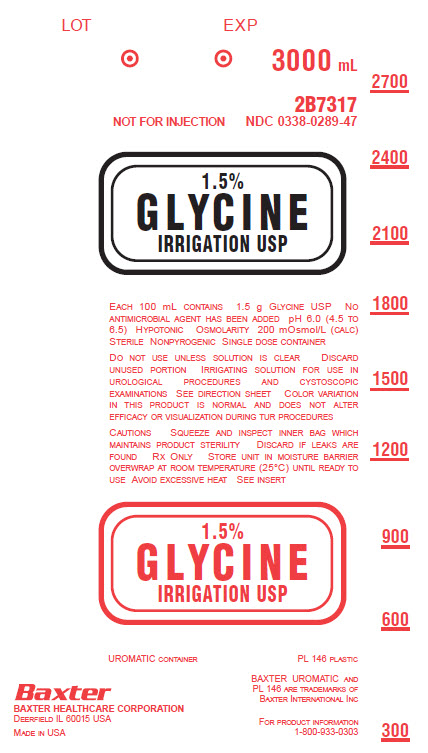
Glycine 1.5 g/100mL Solution, 3000 mL — NDC 0338-0289-47 (Billing 00338-0289-47)
This is a package of 3,000 mL of Glycine 1.5 g/100mL Solution from Baxter Healthcare Corporation, marketed since May 1980 and currently FDA-listed. It is this product's only package size.
NDC database record
One package, one record: these facts belong to NDC 0338-0289-47 alone.
- Record
- FDA NDC Directory package listing · Human prescription drug
- Code segments
- 0338 labeler · 0289 product · 47 package
- Package marketed since
- May 30, 1980
- Sample package
- No — commercial package
- Listing certified through
- Dec 31, 2027
- Billing quantity
- 3,000 mL per package
- Barcode (UPC-A, from the NDC)
- 3 0338028947 9
- FDA record last changed
- Jul 24, 2026
Identity & classification
Regulatory identifiers FDA, NLM and CMS codes for this package
Drug-database identifiers Medi-Span GPI and First Databank GCN / HICL / AHFS classification
- GSN (GCN sequence number): 009879
- GCN: 45760
- GPI-14 (Medi-Span): 56700050002005
- HICL (First Databank): 004306
- AHFS class code: 40:36.00.00
- RxCUI (RxNorm): 310571
Where does this data come from?
- FDA openFDA NDC Directory · synced Oct 8, 2026
- FDA label on DailyMed · label index refreshed Oct 6, 2026
- RxNorm (NLM RxNav) · catalog refreshed Oct 1, 2026
- Medi-Span GPI (licensed)
- First Databank (licensed) · refreshed Oct 8, 2026
RxNorm drug class
This medicine belongs to the Other irrigating solutions class.
Where does this data come from?
- RxClass (NLM) · catalog refreshed Oct 1, 2026
Clinical
Patient education
Supplement & herbal interactions
Some supplements/herbs that may interact with Glycine (prescription drug) — tap one for details:
Where does this data come from?
- MedlinePlus (NLM) · refreshed Oct 1, 2026
- FDA label on DailyMed · label index refreshed Oct 6, 2026
Ask a licensed pharmacist directly — free, answered by our team.
Pricing
A drug doesn't have one price. Each row is a different public payment system, and none is what you'd pay at the counter — that depends on your insurance. The ⓘ on each row explains what it measures.
| Price system | Per mL | Per package |
|---|---|---|
| Retail pharmacies payNADAC · weekly | Not in the retail survey — common for institutional, discontinued, or low-volume packs. | |
| Medicaid paysCMS SDUD · 12 mo | No recent Medicaid claims on file for this NDC — rare and low-volume NDCs are suppressed in the public data. | |
| Medicare drug plans payPart D · quarterly | No Part D plan price is available for this NDC in our data. | |
Where does this data come from?
- CMS NADAC weekly file
- CMS ASP pricing files · refreshed Sep 20, 2026
- CMS Medicaid State Drug Utilization Data · refreshed Oct 8, 2026
- CMS Part D plan pricing files · refreshed Sep 24, 2026
- VA National Acquisition Center price file
Packaging — all sizes for this product
| Package NDC | Description | Marketing start | Marketing end | Status |
|---|---|---|---|---|
| 00338-0289-47 You're viewing this Main listing | 3000 mL in 1 BAG | 1980-05-30 | — | Active |
Therapeutic equivalents
| Product | Labeler | Pack | NADAC/unit | TE | Status | Price vs. this |
|---|---|---|---|---|---|---|
| Glycine 1.5 g/100mL 00264-7390-60 | B. | 3000 ml | — | AT | FDA listed | — |
| Glycine 1.5 g/100mLthis 00338-0289-47 | Baxter | 3000 ml | — | AT | FDA listed | — |
| Glycine 1.5 g/100mL 00990-7974-08 | ICU | 4 pouches | — | AT | FDA listed | — |
Where does this data come from?
- FDA openFDA NDC Directory · synced Oct 8, 2026
- FDA Orange Book · refreshed Oct 3, 2026
- CMS NADAC weekly file
Availability & generic status
We did not find an FDA-approved generic match for this exact strength, form and route.
Where does this data come from?
- FDA Orange Book · refreshed Oct 3, 2026
Inactive Ingredients / Excipients
Inactive ingredients, also called excipients, are components of the drug product other than the active ingredient. They may include fillers, dyes, coatings, preservatives, flavors, or other formulation ingredients.
💡 Tap an ingredient (hover on desktop) to see what it is and why it’s used.
-
UNII 059QF0KO0R
Water is a liquid solvent that dissolves and mixes ingredients together in liquid medicines, syrups, and injections. It helps distribute the active drug evenly throughout the product.
1 inactive ingredient listed in the exact product block matched to this NDC.
Where does this data come from?
ingredient classCode="IACT" elements from the exact product block matched by this NDC. Label-section narrative from DailyMed / the openFDA label index is shown separately when available.- FDA label on DailyMed · label index refreshed Oct 6, 2026
- FDA openFDA NDC Directory · synced Oct 8, 2026
Inactive ingredient FAQ
Are inactive ingredients the same for every manufacturer?
Why might an inactive ingredient be missing?
Can inactive ingredients matter?
Manufacturer & labeler
More NDCs from Baxter Healthcare Corporation labeler code 00338
- Dextrose 5 g/100mL Injection NDC 0338-0208-04
- CLINIMIX E Leucine, Phenylalanine, Lysine, Methionine, Isoleucine, Valine, Histidine, Threonine, Tryptophan, Alanine, Glycine, Arginine, Proline, Serine, Tyrosine, Dibasic Potassium Phosphate, Magnesium Chloride, Sodium Chloride, Calcium Chloride, Dextrose 584 mg/100mL; 448 mg/100mL; 464 mg/100mL; 320 mg/100mL; 480 mg/100mL; 464 mg/100mL; 384 mg/100mL; 336 mg/100mL; 144 mg/100mL; 1656 mg/100mL; 824 mg/10 Injection NDC 0338-0210-06
- Dextrose 2.5 g/50mL Injection NDC 0338-0211-04
- CLINIMIX E Leucine, Phenylalanine, Lysine, Methionine, Isoleucine, Valine, Histidine, Threonine, Tryptophan, Alanine, Glycine, Arginine, Proline, Serine, Tyrosine, Dibasic Potassium Phosphate, Magnesium Chloride, Sodium Chloride, Calcium Chloride, Dextrose 584 mg/100mL; 448 mg/100mL; 464 mg/100mL; 320 mg/100mL; 480 mg/100mL; 464 mg/100mL; 384 mg/100mL; 336 mg/100mL; 144 mg/100mL; 1656 mg/100mL; 824 mg/10 Injection NDC 0338-0214-04
- Dextrose 5 g/100mL Injection NDC 0338-0216-04
- Plasma-Lyte A Sodium Chloride, Sodium Gluconate, Sodium Acetate, Potassium Chloride and Magnesium 526 mg/100mL; 502 mg/100mL; 368 mg/100mL; 37 mg/100mL; 30 mg/100mL Injection, Solution NDC 0338-0221-03
- Sorbitol 30 g/1000mL Irrigant NDC 0338-0295-47
- RECOTHROM thrombin topical recombinant Kit NDC 0338-0322-01
- RECOTHROM thrombin topical recombinant Kit NDC 0338-0326-01
- RECOTHROM thrombin topical recombinant Kit NDC 0338-0330-01
- Cardioplegic Calcium Chloride, Magnesium Chloride, Potassium Chloride and Sodium 17.6 mg/100mL; 325.3 mg/100mL; 119.3 mg/100mL; 643 mg/100mL Solution NDC 0338-0341-04
- Osmitrol Mannitol 10 g/100mL Injection, Solution NDC 0338-0353-03
Where does this data come from?
- FDA openFDA NDC Directory · synced Oct 8, 2026
- Drugs@FDA
Full prescribing information FDA SPL
🎯 Indications and Usage ▾
INDICATIONS AND USAGE 1.5% Glycine Irrigation, USP is indicated for use as a urologic irrigating fluid with endoscopic instruments during transurethral procedures requiring distension, irrigation, and lavage of the urinary bladder. It may be used for lavage of an indwelling catheter to maintain patency.
⏱️ Dosage and Administration ▾
DOSAGE AND ADMINISTRATION The volume of solution needed will vary with the nature and duration of the urologic procedure. If desired, warm in overwrap to near body temperature in a water bath or oven heated to not more than 45°C. Parenteral drug products should be inspected visually for particulate matter and discoloration prior to administration whenever solution and container permit.
⛔ Contraindications ▾
CONTRAINDICATIONS Anuria.
⚠️ Warnings ▾
WARNINGS Not for injection. Solutions for urologic irrigation must be used with caution in patients with severe cardiopulmonary or renal dysfunction. Irrigating fluids used during transurethral prostatectomy have been demonstrated to enter the systemic circulation in relatively large volumes; thus 1.5% Glycine Irrigation, USP must be regarded as a systemic drug.
Absorption of large amounts of fluids containing glycine may significantly alter cardiopulmonary and renal dynamics. Careful cardiovascular monitoring should be maintained due to the possibility of fluid overload. Should fluid overload occur, intensive fluid and electrolyte management is necessary.
Monitoring of fluid and electrolyte levels beyond the acute phase may be considered due to the possibility of delayed fluid absorption. (See ADVERSE REACTIONS, Post-Marketing Experience). The contents of an opened container should be used promptly to minimize the possibility of bacterial growth or pyrogen formation.
Discard the unused portion of irrigating solution since no antimicrobial agent has been added.
🤒 Adverse Reactions ▾
ADVERSE REACTIONS Adverse reactions may result from intravascular absorption of glycine. Large intravenous doses of glycine are known to cause salivation, nausea and lightheadedness. Other consequences of absorption of urologic irrigating solutions include fluid and electrolyte disturbances such as acidosis, electrolyte loss, marked diuresis, urinary retention, edema, dryness of mouth, thirst, dehydration, coma from hyponatremia, secondary hyponatremia due to fluid overload, and hyperammonemia with resultant coma and/or encephalopathy; cardiovascular disorders such as hypotension, tachycardia, angina-like pains; pulmonary disorders such as pulmonary congestion; and other general reactions such as blurred vision, convulsions, nausea, vomiting, rhinitis, chills, vertigo, backache, transient blindness and urticaria.
Allergic reactions from glycine are unknown or exceedingly rare. Should adverse reactions occur, discontinue the irrigation and re-evaluate the clinical status of the patient. Post-Marketing Experience Following off-label use of 1.5% Glycine Irrigation, USP for hysteroscopic procedures in women, life-threatening adverse events related to fluid overload have been reported.
🤰 Pregnancy ▾
Pregnancy Teratogenic Effects Animal reproduction studies have not been conducted with 1.5% Glycine Irrigation, USP. It is not known whether 1.5% Glycine Irrigation, USP can cause fetal harm when administered to a pregnant woman or can affect reproductive capacity. 1.5% Glycine Irrigation, USP should be given to a pregnant woman only if clearly needed.
🧒 Pediatric Use ▾
Pediatric Use Safety and effectiveness in pediatric patients have not been established.
🧓 Geriatric Use ▾
Geriatric Use Clinical studies of Irrigation Solutions did not include sufficient numbers of subjects aged 65 and over to determine whether they respond differently from other younger subjects. Other reported clinical experience has not identified differences in responses between the elderly and younger patients. Do not administer unless the solution is clear and the seal is intact.
🆘 Overdosage ▾
OVERDOSAGE In the event of overhydration or solute overload, re-evaluate the patient and institute appropriate corrective measures. See WARNINGS, PRECAUTIONS and ADVERSE REACTIONS.
🧬 Clinical Pharmacology ▾
CLINICAL PHARMACOLOGY 1.5% Glycine Irrigation, USP is useful as an irrigating solution for the urinary bladder because this solution is nonhemolytic, nonelectrolytic or very weakly ionized, and provides a high degree of visibility for urologic procedures requiring endoscopy. During transurethral surgical procedures, the solution acts as a lavage for removing blood and tissue fragments. It also maintains the patency of an indwelling catheter in the immediate postoperative period.
Glycine which enters the systemic circulation is converted to serine and glyoxylic acid.
📦 How Supplied / Storage and Handling ▾
HOW SUPPLIED 1.5% Glycine Irrigation, USP in UROMATIC plastic containers is available as follows: 2B7317 3000mL NDC 0338-0289-47 Color variation in this product is normal and does not alter efficacy or visualization during TUR procedures. Exposure of pharmaceutical products to heat should be minimized. Avoid excessive heat.
It is recommended the product be stored at room temperature (25°C); brief exposure up to 40°C does not adversely affect the product. Directions for Use Tear overwrap down side at slit and remove solution container. Visually inspect the container.
If the outlet port protector is damaged, detached, or not present, discard container as solution path sterility may be impaired. Some opacity of the plastic due to moisture absorption during the sterilization process may be observed. This is normal and does not affect the solution quality or safety.
The opacity will diminish gradually. Check for minute leaks by squeezing bag firmly. If leaks are found, discard solution as sterility may be impaired.
Use Aseptic Technique. 1. Suspend container using hanger hole.
2. Remove protector from outlet port. 3.
Attach irrigation set. Refer to complete directions accompanying set. Baxter Healthcare Corporation Deerfield, IL 60015 USA Printed in USA 07-19-00-0226 Rev.
January 2018 Baxter and Uromatic are trademarks of Baxter International Inc.
📋 Description ▾
DESCRIPTION 1.5% Glycine Irrigation, USP is a sterile, nonpyrogenic, nonhemolytic, nonelectrolytic or very weakly ionized solution in single dose UROMATIC containers for use as a urologic irrigating solution. Each liter contains 15 g Glycine, USP (NH 2 CH 2 COOH) in water for injection. pH 6.0 (4.5 to 6.5). Osmolarity 200 mOsmol/L (calc.).
Normal physiologic osmolarity range is approximately 280 to 310 mOsmol/L. No antimicrobial agent has been added. The UROMATIC plastic container is fabricated from a specially formulated polyvinyl chloride (PL 146 plastic).
The amount of water that can permeate from inside the container into the overwrap is insufficient to affect the solution significantly. Solutions in contact with the plastic container can leach out certain of its chemical components in very small amounts within the expiration period, e.g., di-2-ethylhexyl phthalate (DEHP), up to 5 parts per million; however, the safety of the plastic has been confirmed in tests in animals according to USP biological tests for plastic containers as well as by tissue culture toxicity studies.
⚠️ Precautions ▾
PRECAUTIONS The cardiovascular status, especially of the patient with cardiac disease, should be carefully observed before and during transurethral resection of the prostate when using 1.5% Glycine Irrigation, USP, because the quantity of fluid absorbed into the systemic circulation by opened prostatic veins may produce significant expansion of the intravascular fluid and lead to fulminating congestive heart failure. Shift of sodium-free intracellular fluid into the extracellular compartment, following systemic absorption, may lower serum sodium concentration and aggravate preexisting hyponatremia.
Care should be exercised if impaired liver function is known or suspected. Under such conditions ammonia resulting from metabolism of glycine may accumulate in the blood. Pregnancy Teratogenic Effects Animal reproduction studies have not been conducted with 1.5% Glycine Irrigation, USP.
It is not known whether 1.5% Glycine Irrigation, USP can cause fetal harm when administered to a pregnant woman or can affect reproductive capacity. 1.5% Glycine Irrigation, USP should be given to a pregnant woman only if clearly needed. Pediatric Use Safety and effectiveness in pediatric patients have not been established.
Geriatric Use Clinical studies of Irrigation Solutions did not include sufficient numbers of subjects aged 65 and over to determine whether they respond differently from other younger subjects. Other reported clinical experience has not identified differences in responses between the elderly and younger patients. Do not administer unless the solution is clear and the seal is intact.
📄 Package Label / Principal Display Panel ▾
PACKAGE LABEL.PRINCIPAL DISPLAY PANEL 1.5% Glycine Irrigation USP Container Label 1.5% Glycine Irrigation USP Container Label LOT EXP 3000 mL 2B7317 NOT FOR INJECTION NDC 0338-0289-47 1.5% GLYCINE IRRIGATION USP EACH 100 mL CONTAINS 1.5g GLYCINE USP NO ANTIMICROBIAL AGENT HAS BEEN ADDED pH 6.0 (4.5 to 6.5) HYPOTONIC OSMOLARITY 200 mOsmol/L (CALC) STERILE NONPYROGENIC SINGLE DOSE CONTAINER DO NOT USE UNLESS SOLUTION IS CLEAR DISCARD UNUSED PORTION IRRIGATING SOLUTION FOR USE IN UROLOGICAL PROCEDURES AND CYSTOSCOPIC EXAMINATIONS SEE DIRECTION SHEET COLOR VARIATION IN THIS PRODUCT IS NORMAL AND DOES NOT ALTER EFFICACY OR VISUALIZATION DURING TUR PROCEDURES CAUTIONS SQUEEZE AND INSPECT INNER BAG WHICH MAINTAINS PRODUCT STERILITY DISCARD IF LEAKS ARE FOUND RX ONLY STORE UNIT IN MOISTURE BARRIER OVERWRAP AT ROOM TEMPERATURE (25°C) UNTIL READY TO USE AVOID EXCESSIVE HEAT SEE INSERT 1.5% GLYCINE IRRIGATION USP UROMATIC CONTAINER PL 146 PLASTIC Baxter Logo BAXTER HEALTHCARE CORPORATION DEERFIELD IL 60015 USA MADE IN USA BAXTER UROMATIC AND PL 146 ARE TRADEMARKS OF BAXTER INTERNATIONAL INC FOR PRODUCT INFORMATION 1-800-933-0303 Glycine Representative Container Label
About this NDC listing & data coverage
What data is (and isn’t) available for this NDC — tap to expand
| NDC identity (package / product / labeler codes) | ✓ Available |
| Labeler | ✓ Available |
| Product & package description | ✓ Available |
| Marketing category & status | ✓ Available |
| Active ingredient / dosage form / route | ✓ Available |
| FDA label (SPL via DailyMed) | ✓ Available |
| Package photos | ✓ Available |
| Inactive ingredients (structured) | ✓ Available |
| NADAC pharmacy acquisition price (CMS) | — Not published for this NDC CMS publishes NADAC only for NDCs reported in its retail-pharmacy survey. |
| Orange Book / therapeutic-equivalence data | ✓ Available |
| HCPCS J-code billing crosswalk | — Not published for this NDC Most self-administered / retail products have no J-code — that is normal. |
| Medicaid utilization (CMS SDUD) | — Not published for this NDC CMS reports utilization only for NDCs with Medicaid claims above its privacy threshold. |