
Trihexyphenidyl Hydrochloride 5 mg Tablet, 40,008-count — NDC 0591-5337-77 (Billing 00591-5337-77)
This is a package of 40,008 tablets of Trihexyphenidyl Hydrochloride 5 mg Tablet from Actavis Pharma, Inc., marketed since Nov 1987 and currently FDA-listed.
NDC database record
One package, one record: these facts belong to NDC 0591-5337-77 alone.
- Record
- FDA NDC Directory package listing · Drug for further processing
- Code segments
- 0591 labeler · 5337 product · 77 package
- Package marketed since
- Jul 22, 2024
- Listing certified through
- Dec 31, 2026
- Barcode (UPC-A, from the NDC)
- 3 0591533777 8
- FDA record last changed
- Oct 1, 2026
Identity & classification
Regulatory identifiers FDA, NLM and CMS codes for this package
Drug-database identifiers Medi-Span GPI and First Databank GCN / HICL / AHFS classification
- GSN (GCN sequence number): 004582
- GCN: 17563
- GPI-14 (Medi-Span): 73100070100320
- HICL (First Databank): 001900
- AHFS class code: 12:08.04.00
Where does this data come from?
- FDA openFDA NDC Directory · synced Oct 1, 2026
- FDA label on DailyMed · label index refreshed Oct 6, 2026
- RxNorm (NLM RxNav) · catalog refreshed Oct 1, 2026
- Medi-Span GPI (licensed)
- First Databank (licensed) · refreshed Oct 1, 2026
Clinical
- Trihexyphenidyl is used with other treatment for parkinsonism, and it often works well alongside levodopa. It is also used to control movement problems caused by certain medicines...
- It can be taken before or after meals, depending on how you feel. If your mouth gets very dry, before meals may help, unless it upsets your stomach. If thirst bothers you after mea...
- Dry mouth, blurred vision, dizziness, mild nausea, and nervousness are common. They often ease as your body adjusts. Tell your doctor if they bother you, because adjusting the dose...
- Please don't stop it suddenly. Stopping abruptly can make parkinsonism symptoms flare and may cause a serious reaction called neuroleptic malignant syndrome. Talk with your prescri...
Patient education
Supplement & herbal interactions
Where does this data come from?
- MedlinePlus (NLM) · refreshed Oct 1, 2026
- FDA label on DailyMed · label index refreshed Oct 6, 2026
Ask a licensed pharmacist directly — free, answered by our team.
Pricing
A drug doesn't have one price. Each row is a different public payment system, and none is what you'd pay at the counter — that depends on your insurance. The ⓘ on each row explains what it measures.
| Price system | Per each | Per package |
|---|---|---|
| Retail pharmacies payNADAC · weekly | Not in the retail survey — common for institutional, discontinued, or low-volume packs. | |
| Medicaid paysCMS SDUD · 12 mo | No recent Medicaid claims on file for this NDC — rare and low-volume NDCs are suppressed in the public data. | |
| Medicare drug plans payPart D · quarterly | No Part D plan price is available for this NDC in our data. | |
Where does this data come from?
- CMS NADAC weekly file
- CMS ASP pricing files · refreshed Sep 20, 2026
- CMS Medicaid State Drug Utilization Data · refreshed Oct 6, 2026
- CMS Part D plan pricing files · refreshed Sep 24, 2026
- VA National Acquisition Center price file
Packaging — all sizes for this product
| Package NDC | Description | Per unit | Per pack | Marketing start | Marketing end | Status |
|---|---|---|---|---|---|---|
| 00591-5337-01 0591-5337-01 Main listing | 100 TABLET in 1 BOTTLE, PLASTIC | $0.1191 / ea | $11.91 | 1987-11-01 | — | Active |
| 00591-5337-10 0591-5337-10 | 1000 TABLET in 1 BOTTLE, PLASTIC | $0.1191 / ea | $119.10 | 1987-11-01 | — | Active |
| 00591-5337-00 0591-5337-00 | 33000 TABLET in 1 BAG | — | — | — | — | Active |
| 00591-5337-77 You're viewing this | 40008 TABLET in 1 CONTAINER | — | — | — | — | Active |
You're viewing the largest of 4 pack sizes for this product.
This pack shows little to no recent Medicaid volume — the 100 tablets pack carries most fills. See all packs ↓
Pack size FAQ
What quantity is in this package?
How does this package differ from NDC 00591-5337-01?
What NDC number is used to bill for this package of Trihexyphenidyl Hydrochloride 5 mg Tablet?
Prices are the latest CMS NADAC pharmacy acquisition cost per NDC; per-pack figures are per-unit × pack quantity, shown only when the pack is denominated in the same measure NADAC prices.
Therapeutic equivalents
| Product | Labeler | Pack | NADAC/unit | TE | Status | Price vs. this |
|---|---|---|---|---|---|---|
| Trihexyphenidyl Hydrochloride 5 mg 70954-0211-10 | Novitium | 100 tablets | $0.119 | AA | Availability likely | — |
| Trihexyphenidyl Hydrochloride 5 mgthis 00591-5337-77 | Actavis | 40008 tablets | — | — | FDA listed | — |
| Trihexyphenidyl Hydrochloride 5 mg 51407-0266-01 | Golden | 100 tablets | — | AA | FDA listed | — |
| Trihexyphenidyl Hydrochloride 5 mg 63850-0022-01 | Natco | 100 tablets | — | AA | FDA listed | — |
| Trihexyphenidyl Hydrochloride 5 mg 70518-1140-00 | REMEDYREPACK | 30 tablets | — | AA | FDA listed | — |
| Trihexyphenidyl Hydrochloride 5 mg 70518-1657-01 | REMEDYREPACK | 100 tablets | — | AA | FDA listed | — |
| Trihexyphenidyl Hydrochloride 5 mg 70518-2409-02 | REMEDYREPACK | 100 tablets | — | AA | FDA listed | — |
Where does this data come from?
- FDA openFDA NDC Directory · synced Oct 1, 2026
- FDA Orange Book · refreshed Oct 3, 2026
- CMS NADAC weekly file
Availability & generic status
FDA-approved generic versions are listed, and recent pricing/market data suggests they may be available — see Therapeutic equivalents.
Where does this data come from?
- FDA Orange Book · refreshed Oct 3, 2026
What it looks like
Where does this data come from?
- FDA label on DailyMed · label index refreshed Oct 6, 2026
Inactive Ingredients / Excipients
Inactive ingredients, also called excipients, are components of the drug product other than the active ingredient. They may include fillers, dyes, coatings, preservatives, flavors, or other formulation ingredients.
🧪 Avoiding an ingredient? See Trihexyphenidyl inactive ingredients by manufacturer: every current product's list side by side, so you can ask your pharmacy for the version that does not list it.
Where does this data come from?
IACT rows and label-wide narrative are kept separate; availability and product-level specificity depend on the submitted label.- FDA label on DailyMed · label index refreshed Oct 6, 2026
- FDA openFDA NDC Directory · synced Oct 1, 2026
Inactive ingredient FAQ
Are inactive ingredients the same for every manufacturer?
Why might an inactive ingredient be missing?
Can inactive ingredients matter?
Manufacturer & labeler
More NDCs from Actavis Pharma, Inc. labeler code 00591
- Prednisone 5 mg Tablet NDC 0591-5052-00
- Promethazine Hydrochloride 25 mg Tablet NDC 0591-5307-00
- Promethazine Hydrochloride 50 mg Tablet NDC 0591-5319-00
- Primidone 250 mg Tablet NDC 0591-5321-00
- Probenecid and Colchicine 500 mg; .5 mg Tablet NDC 0591-5325-00
- Trihexyphenidyl Hydrochloride 2 mg Tablet NDC 0591-5335-00
- Probenecid 500 mg Tablet, Film Coated NDC 0591-5347-00
- Prednisone 10 mg Tablet NDC 0591-5442-00
- Prednisone 20 mg Tablet NDC 0591-5443-00
- Carisoprodol 350 mg Tablet NDC 0591-5513-00
- Allopurinol 100 mg Tablet NDC 0591-5543-00
- Allopurinol 300 mg Tablet NDC 0591-5544-00
Where does this data come from?
- FDA openFDA NDC Directory · synced Oct 1, 2026
- Drugs@FDA
Full FDA label FDA SPL
🎯 Indications and Usage ▾
INDICATIONS This drug is indicated as an adjunct in the treatment of all forms of parkinsonism (postencephalitic, arteriosclerotic, and idiopathic). It is often useful as adjuvant therapy when treating these forms of parkinsonism with levodopa. Additionally, it is indicated for the control of extrapyramidal disorders caused by central nervous system drugs such as the dibenzoxazepines, phenothiazines, thioxanthenes, and butyrophenones.
⏱️ Dosage and Administration ▾
DOSAGE AND ADMINISTRATION Dosage should be individualized. The initial dose should be low and then increased gradually, especially in patients over 60 years of age. Whether trihexyphenidyl HCl may best be given before or after meals should be determined by the way the patient reacts.
Postencephalitic patients, who are usually more prone to excessive salivation, may prefer to take it after meals and may, in addition, require small amounts of atropine which, under such circumstances, is sometimes an effective adjuvant. If trihexyphenidyl HCl tends to dry the mouth excessively, it may be better to take it before meals, unless it causes nausea. If taken after meals, the thirst sometimes induced can be allayed by mint candies, chewing gum or water.
Trihexyphenidyl HCl in Idiopathic Parkinsonism As initial therapy for parkinsonism, 1 mg may be administered the first day. The dose may then be increased by 2 mg increments at intervals of three to five days, until a total of 6 to 10 mg is given daily. The total daily dose will depend upon what is found to be the optimal level.
Many patients derive maximum benefit from this daily total of 6 to 10 mg, but some patients, chiefly those in the postencephalitic group, may require a total daily dose of 12 to 15 mg. Trihexyphenidyl HCl in Drug-Induced Parkinsonism The size and frequency of dose of trihexyphenidyl HCl needed to control extrapyramidal reactions to commonly employed tranquilizers, notably the phenothiazines, thioxanthenes, and butyrophenones, must be determined empirically. The total daily dosage usually ranges between 5 and 15 mg, although, in some cases, these reactions have been satisfactorily controlled on as little as 1 mg daily.
It may be advisable to commence therapy with a single 1 mg dose. If the extrapyramidal manifestations are not controlled in a few hours, the subsequent doses may be progressively increased until satisfactory control is achieved. Satisfactory control may sometimes be more rapidly achieved by temporarily reducing the dosage of the tranquilizer on instituting trihexyphenidyl HCl therapy and then adjusting dosage of both drugs until the desired ataractic effect is retained without onset of extrapyramidal reactions.
It is sometimes possible to maintain the patient on a reduced trihexyphenidyl HCl dosage after the reactions have remained under control for several days. Instances have been reported in which these reactions have remained in remission for long periods after trihexyphenidyl HCl therapy was discontinued. Concomitant Use of Trihexyphenidyl HCl with Levodopa When trihexyphenidyl HCl is used concomitantly with levodopa, the usual dose of each may need to be reduced.
Careful adjustment is necessary, depending on side effects and degree of symptom control. Trihexyphenidyl HCl dosage of 3 to 6 mg daily, in divided doses, is usually adequate. Concomitant Use of Trihexyphenidyl HCl with Other Parasympathetic Inhibitors Trihexyphenidyl HCl may be substituted, in whole or in part, for other parasympathetic inhibitors.
The usual technique is partial substitution initially, with progressive reduction in the other medication as the dose of trihexyphenidyl HCl is increased. Trihexyphenidyl Hydrochloride Tablets - The total daily intake of trihexyphenidyl HCl tablets is tolerated best if divided into 3 doses and taken at mealtimes. High doses (> 10 mg daily) may be divided into 4 parts, with 3 doses administered at meal times and the fourth at bedtime.
⚠️ Warnings ▾
WARNINGS Patients to be treated with trihexyphenidyl HCl should have a gonioscope evaluation and close monitoring of intraocular pressures at regular periodic intervals.
🤒 Adverse Reactions ▾
ADVERSE REACTIONS Minor side effects, such as dryness of the mouth, blurring of vision, dizziness, mild nausea, or nervousness, will be experienced by 30 to 50 percent of all patients. These sensations, however, are much less troublesome with trihexyphenidyl HCl than with belladonna alkaloids and are usually less disturbing than unalleviated parkinsonism. Such reactions tend to become less pronounced, and even to disappear, as treatment continues.
Even before these reactions have remitted spontaneously, they may often be controlled by careful adjustment of the dosage form, amount of drug, or interval between doses. Isolated instances of suppurative parotitis secondary to excessive dryness of the mouth, skin rashes, dilatation of the colon, paralytic ileus, and certain psychiatric manifestations such as delusions and hallucinations, plus one doubtful case of paranoia all of which may occur with any of the atropine-like drugs, have been rarely reported with trihexyphenidyl hydrochloride.
Patients with arteriosclerosis or with a history of idiosyncrasy to other drugs may exhibit reactions of mental confusion, agitation, disturbed behavior, or nausea and vomiting. Such patients should be allowed to develop a tolerance through the initial administration of a small dose and gradual increase in dose until an effective level is reached. If a severe reaction should occur, administration of the drug should be discontinued for a few days and then resumed at a lower dosage.
Psychiatric disturbances can result from indiscriminate use (leading to overdosage) to sustain continued euphoria. Potential side effects associated with the use of any atropine-like drugs include constipation, drowsiness, urinary hesitancy or retention, tachycardia, dilation of the pupil, increased intraocular tension, weakness, vomiting, and headache. The occurrence of angle-closure glaucoma due to long-term treatment with trihexyphenidyl hydrochloride has been reported.
To report SUSPECTED ADVERSE EVENTS, contact Teva at 1-888-838-2872 or FDA at 1-800-FDA-1088 or http://www.fda.gov/medwatch for voluntary reporting of adverse reactions.
🧬 Clinical Pharmacology ▾
CLINICAL PHARMACOLOGY Trihexyphenidyl HCl is the substituted piperidine salt, 3-(1-piperidyl)-1-phenylcyclohexyl-1-propanol hydrochloride, which exerts a direct inhibitory effect upon the parasympathetic nervous system. It also has a relaxing effect on smooth musculature; exerted both directly upon the muscle tissue itself and indirectly through an inhibitory effect upon the parasympathetic nervous system. Its therapeutic properties are similar to those of atropine, although undesirable side effects are ordinarily less frequent and severe than with the latter.
📦 How Supplied / Storage and Handling ▾
HOW SUPPLIED Trihexyphenidyl hydrochloride tablets USP, 2 mg are scored, round, white, flat faced, tablets imprinted DAN DAN and 5335 supplied in bottles of 100 (NDC 0591-5335-01) and 1000 (NDC 0591-5335-10). Trihexyphenidyl hydrochloride tablets USP, 5 mg are scored, round, white, tablets imprinted DAN DAN and 5337 supplied in bottles of 100 (NDC 0591-5337-01) and 1000 (NDC 0591-5337-10). Dispense in a tight container with child-resistant closure.
Store at 20° to 25° (68° to 77°F) [See USP Controlled Room Temperature]. Manufactured In India By: Watson Pharma Private Limited Verna, Salcette Goa 403 722 INDIA Manufactured For: Teva Pharmaceuticals Parsippany, NJ 07054 Rev. A 2/2024
📋 Description ▾
DESCRIPTION Trihexyphenidyl hydrochloride is a synthetic antispasmodic drug available in the following forms: Tablets, 2 mg and 5 mg. It is designated chemically 1-Piperidinepropanol,α-cyclohexyl-α-phenyl-, hydrochloride. The structural formula is represented below: C 20 H 31 NO•HCl M.W.
337.93 Trihexyphenidyl hydrochloride tablets USP, 2 mg and 5 mg contain the following inactive ingredients: colloidal silicon dioxide, dibasic calcium phosphate, lactose monohydrate, magnesium stearate, microcrystalline cellulose and sodium starch glycolate. 7066154a-figure-01
⚠️ Precautions ▾
PRECAUTIONS Although trihexyphenidyl HCl is not contraindicated for patients with cardiac, liver, or kidney disorders, or with hypertension, such patients should be maintained under close observation. Since the use of trihexyphenidyl HCl may, in some cases, continue indefinitely and since it has atropine-like properties, patients should be subjected to constant and careful long-term observation to avoid allergic and other untoward reactions. In as much as trihexyphenidyl HCl possesses some parasympatholytic activity, it should be used with caution in patients with glaucoma, obstructive disease of the gastrointestinal or genitourinary tracts, and in elderly males with possible prostatic hypertrophy.
Geriatric patients, particularly over the age of 60, frequently develop increased sensitivity to the actions of drugs of this type, and hence, require strict dosage regulation. Incipient glaucoma may be precipitated by parasympatholytic drugs such as trihexyphenidyl HCl. Tardive dyskinesia may appear in some patients on long term therapy with antipsychotic drugs or may occur after therapy when these drugs have been discontinued.
Antiparkinson agents do not alleviate the symptoms of tardive dyskinesia and in some instances may aggravate them. However, parkinsonism and tardive dyskinesia often coexist in patients receiving chronic neuroleptic treatment, and anticholinergic therapy with trihexyphenidyl hydrochloride may relieve some of these parkinsonism symptoms.
📄 Package Label / Principal Display Panel ▾
PRINCIPAL DISPLAY PANEL NDC 0591-5335-01 Trihexyphenidyl Hydrochloride Tablets, USP 2 mg Rx only 100 Tablets tri
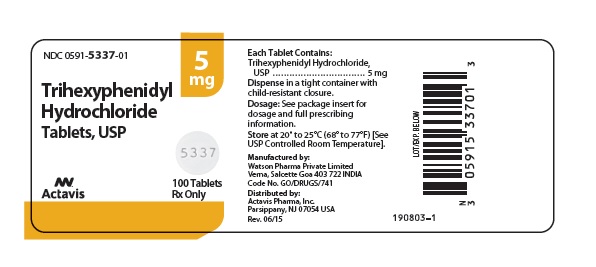
PRINCIPAL DISPLAY PANEL NDC 0591-5337-01 Trihexyphenidyl Hydrochloride Tablets, USP 5 mg Rx only 100 Tablets tri
Medicaid utilization by pack size
Reported adverse events (FAERS)
Top reported reactions
Age at onset
Reporter sex
Serious outcomes
Where does this data come from?
About this NDC listing & data coverage
What "drug for further processing" means
FDA lists this package under the "drug for further processing" marketing category: Actavis Pharma, Inc. supplies it to other companies for further processing or repackaging (blister cards that are later repackaged or co-packaged are a common example). The units themselves are a finished dosage form — which is why pricing or Medicaid data can still appear — but this exact package code may not be the presentation a retail pharmacy dispenses.
What data is (and isn’t) available for this NDC — tap to expand
| NDC identity (package / product / labeler codes) | ✓ Available |
| Labeler | ✓ Available |
| Product & package description | ✓ Available |
| Marketing category & status | ✓ Available |
| Active ingredient / dosage form / route | ✓ Available |
| FDA label (SPL via DailyMed) | ✓ Available |
| Package photos | ✓ Available |
| Inactive ingredients (structured) | — Not published for this NDC The labeler did not submit a structured excipient list, or no SPL is available. |
| NADAC pharmacy acquisition price (CMS) | — Not published for this NDC CMS publishes NADAC only for NDCs reported in its retail-pharmacy survey. |
| Orange Book / therapeutic-equivalence data | — Not published for this NDC Applies only to products approved under an NDA/ANDA; many listings are out of scope. |
| HCPCS J-code billing crosswalk | — Not published for this NDC Most self-administered / retail products have no J-code — that is normal. |
| Medicaid utilization (CMS SDUD) | — Not published for this NDC CMS reports utilization only for NDCs with Medicaid claims above its privacy threshold. |