
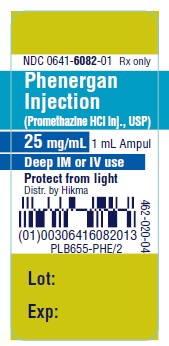
PHENERGAN Promethazine Hydrochloride 25 mg/mL Injection, 25 ampules — NDC 0641-6082-25 (Billing 00641-6082-25)
This is a package of 25 ampules of PHENERGAN Promethazine Hydrochloride 25 mg/mL Injection from Hikma Pharmaceuticals USA Inc., no longer marketed (first marketed Sep 1973), no longer in the FDA NDC Directory. It is this product's only package size.
NDC database record
One package, one record: these facts belong to NDC 0641-6082-25 alone.
- Record
- FDA NDC Directory package listing · Human prescription drug
- Code segments
- 0641 labeler · 6082 product · 25 package
- Package marketed since
- Sep 19, 1973
- Sample package
- No — commercial package
- Listing certified through
- Dec 31, 2026
- Barcode (UPC-A, from the NDC)
- 3 0641608225 9
- Medicaid fills, this package
- 2,213 prescriptions in the last four reported quarters
- FDA record last changed
- Jul 24, 2026
Identity & classification
Regulatory identifiers FDA, NLM and CMS codes for this package
Drug-database identifiers Medi-Span GPI and First Databank GCN / HICL / AHFS classification
- GSN (GCN sequence number): 003866
- GCN: 14970
- GPI-14 (Medi-Span): 41400020102005
- HICL (First Databank): 012014
- AHFS class code: 04:04.12.00
- RxCUI (RxNorm): 992460
Where does this data come from?
- FDA openFDA NDC Directory · synced Oct 8, 2026
- FDA label on DailyMed · label index refreshed Oct 8, 2026
- RxNorm (NLM RxNav) · catalog refreshed Oct 1, 2026
- Medi-Span GPI (licensed)
- First Databank (licensed) · refreshed Oct 8, 2026
RxNorm drug class
This medicine belongs to the Phenothiazine class.
Where does this data come from?
- RxClass (NLM) · catalog refreshed Oct 1, 2026
Clinical
- It treats allergy symptoms like allergic rhinitis and hives, motion sickness, and nausea and vomiting around surgery. It is also used for sedation. Which uses apply depends on the...
- Very likely. Drowsiness is its most common effect. Don't drive or use machinery until you know how it affects you, and avoid alcohol and other sedating medicines.
- Not if the child is under 2. It can cause fatal slowed breathing in that age group. For children 2 and older, it needs real caution and the lowest effective dose, so only use it as...
- Use an accurate measuring device, not a kitchen teaspoon, which can lead to overdose. I can give you an oral syringe or dosing cup and show you how to measure.
Patient education
Supplement & herbal interactions
Where does this data come from?
- MedlinePlus (NLM) · refreshed Oct 8, 2026
- FDA label on DailyMed · label index refreshed Oct 8, 2026
Ask a licensed pharmacist directly — free, answered by our team.
Pricing
A drug doesn't have one price. Each row is a different public payment system, and none is what you'd pay at the counter — that depends on your insurance. The ⓘ on each row explains what it measures.
| Price system | Per each | Per package |
|---|---|---|
| Retail pharmacies payNADAC · weekly | Not in the retail survey — common for institutional, discontinued, or low-volume packs. | |
| Medicaid paysCMS SDUD · 12 mo | $3.10 | $77.40 / 25 ampules |
| Medicare drug plans payPart D · quarterly | No Part D plan price is available for this NDC in our data. | |
| Medicare Part B allowsASP · J2550 | $3.639 / J2550 unit | — |
Where does this data come from?
- CMS NADAC weekly file
- CMS ASP pricing files · refreshed Sep 20, 2026
- CMS Medicaid State Drug Utilization Data · through Q1 2026
- CMS Part D plan pricing files · refreshed Sep 24, 2026
- VA National Acquisition Center price file
Billing & reimbursement
Where does this data come from?
- CMS ASP NDC-HCPCS crosswalk · refreshed Sep 22, 2026
- DMEPDAC NDC-HCPCS crosswalk
- openFDA NSDE billing units · refreshed Oct 7, 2026
Packaging — all sizes for this product
| Package NDC | Description | Marketing start | Marketing end | Status |
|---|---|---|---|---|
| 00641-6082-25 You're viewing this Main listing | 25 AMPULE in 1 CARTON / 1 mL in 1 AMPULE | 1973-09-19 | — | Discontinued by firm |
Therapeutic equivalents
| Product | Labeler | Pack | NADAC/unit | TE | Status | Price vs. this |
|---|---|---|---|---|---|---|
| Promethazine Hydrochloride 25 mg/mL 00641-0948-35 | Hikma | 25 ampules | $1.335 | AP | Discontinued | — |
| Promethazine Hydrochloride 25 mg/mL 00641-1495-35 | Hikma | 25 ampules | $1.335 | AP | Discontinued | — |
| Promethazine Hydrochloride 25 mg/mL 39822-5525-03 | XGen | 25 ampules | $1.335 | AP | Availability likely | — |
| Promethazine Hydrochloride 25 mg/mL 00641-0928-25 | Hikma | 25 vials | $1.748 | AP | Availability likely | — |
| Promethazine Hydrochloride 25 mg/mL 00641-0955-25 | Hikma | 25 vials | $1.748 | AP | Availability likely | — |
| Promethazine Hydrochloride 25 mg/mL 00641-6208-25 | Hikma | 25 vials | $1.748 | AP | Availability likely | — |
| Promethazine Hydrochloride 25 mg/mL 00404-9940-01 | Henry | 1 vial | — | AP | FDA listed | — |
| Promethazine Hydrochloride 25 mg/mL 00404-9941-01 | Henry | 1 ampule | — | AP | FDA listed | — |
| Phenergan 25 mg/mLthis 00641-6082-25 | Hikma | 25 ampules | — | AP | Discontinued | — |
| Phenergan 25 mg/mL 00641-6084-25 | Hikma | 25 vials | — | AP | FDA listed | — |
| Promethazine Hci 25 mg/mL 51662-1247-01 | HF | 1 ml | — | AP | FDA listed | — |
| Promethazine Hydrochloride 25 mg/mL 55154-2861-05 | Cardinal | 5 vials | — | AP | FDA listed | — |
| Promethazine Hydrochloride 25 mg/mL 71872-7077-01 | Medical | 1 vial | — | AP | FDA listed | — |
| Promethazine Hydrochloride 25 mg/mL 71872-7285-01 | Medical | 1 ampule | — | AP | FDA listed | — |
| Promethazine Hydrochloride 25 mg/mL 84549-0525-03 | ProPharma | 1 ml | — | AP | FDA listed | — |
| Promethazine Hydrochloride 25 mg/mL 84549-0928-25 | ProPharma | 1 ml | — | AP | FDA listed | — |
Where does this data come from?
- FDA openFDA NDC Directory · synced Oct 8, 2026
- FDA Orange Book · refreshed Oct 3, 2026
- CMS NADAC weekly file
Availability & generic status
This product is an FDA-approved generic. Other versions of the same drug are listed under Therapeutic equivalents, least expensive first.
Where does this data come from?
- FDA Orange Book · refreshed Oct 3, 2026
Inactive Ingredients / Excipients
Inactive ingredients, also called excipients, are components of the drug product other than the active ingredient. They may include fillers, dyes, coatings, preservatives, flavors, or other formulation ingredients.
🧪 Avoiding an ingredient? See Promethazine inactive ingredients by manufacturer: every current product's list side by side, so you can ask your pharmacy for the version that does not list it.
💡 Tap an ingredient (hover on desktop) to see what it is and why it’s used.
-
UNII Q40Q9N063P
Acetic acid is a weak organic acid commonly used in medicines as a buffer and pH adjuster. It helps maintain the proper acidity level to ensure the drug remains stable and effective in its formulation.
-
0.04 mg / 1 mL
UNII M4I0D6VV5M
Calcium chloride is a salt compound that acts as a firming agent and source of calcium ions in medications. It's used in formulations to help maintain tablet structure, improve texture, or serve as a buffering agent.
-
0.1 mg / 1 mL
UNII 7FLD91C86K
Edetate disodium is a chemical compound that binds and removes certain metal ions. In medicines, it acts as a preservative and stabilizer by preventing metals like calcium from interfering with the product's shelf life and consistency.
-
5 mg / 1 mL
UNII 339NCG44TV
Phenol is a chemical compound derived from coal tar or petroleum. It serves as a preservative and antimicrobial agent in medicines, helping prevent bacterial and fungal growth to keep the product stable and safe during storage.
-
UNII 4550K0SC9B
Sodium acetate is a salt derived from acetic acid. It acts as a buffer to help maintain the medicine's pH stability and may serve as a preservative or solubilizer in liquid formulations.
-
0.25 mg / 1 mL
UNII 4VON5FNS3C
Sodium metabisulfite is a preservative derived from sulfur compounds. It prevents microbial growth and oxidation in medicines, helping extend shelf life and maintain product stability.
-
UNII 059QF0KO0R
Water is a liquid solvent that dissolves and mixes ingredients together in liquid medicines, syrups, and injections. It helps distribute the active drug evenly throughout the product.
7 inactive ingredients listed in the exact product block matched to this NDC.
Where does this data come from?
ingredient classCode="IACT" elements from the exact product block matched by this NDC. Label-section narrative from DailyMed / the openFDA label index is shown separately when available.- FDA label on DailyMed · label index refreshed Oct 8, 2026
- FDA openFDA NDC Directory · synced Oct 8, 2026
Inactive ingredient FAQ
Are inactive ingredients the same for every manufacturer?
Why might an inactive ingredient be missing?
Can inactive ingredients matter?
Manufacturer & labeler
More NDCs from Hikma Pharmaceuticals USA Inc. labeler code 00641
- Midazolam 5 mg/mL Injection NDC 0641-6060-10
- Midazolam 5 mg/mL Injection NDC 0641-6061-10
- Midazolam 5 mg/mL Injection NDC 0641-6063-10
- Ondansetron 2 mg/mL Injection NDC 0641-6078-25
- Ondansetron 2 mg/mL Injection NDC 0641-6079-01
- Ondansetron 2 mg/mL Injection NDC 0641-6080-25
- PHENERGAN Promethazine Hydrochloride 50 mg/mL Injection NDC 0641-6083-25
- PHENERGAN Promethazine Hydrochloride 25 mg/mL Injection NDC 0641-6084-25
- PHENERGAN Promethazine Hydrochloride 50 mg/mL Injection NDC 0641-6085-25
- ROBAXIN methocarbamol 100 mg/mL Injection NDC 0641-6103-10
- Ampicillin and Sulbactam 1 g/1.5g; .5 g/1.5g Injection, Powder, For Solution NDC 0641-6116-10
- Ampicillin and Sulbactam 2 g/3g; 1 g/3g Injection, Powder, For Solution NDC 0641-6117-10
Where does this data come from?
- FDA openFDA NDC Directory · synced Oct 8, 2026
- Drugs@FDA
Full prescribing information FDA SPL
🚨 Boxed Warning ▾
WARNING: RESPIRATORY DEPRESSION IN PEDIATRICSAND SEVERE TISSUE INJURY INCLUDING GANGRENE Respiratory Depression – Pediatrics PHENERGAN injection should not be used in pediatric patients less than 2 years of age because of the potential for fatal respiratory depression. Postmarketing cases of respiratory depression, including fatalities, have been reported with use of promethazine in pediatric patients less than 2 years of age. Caution should be exercised when administering PHENERGAN injection to pediatric patients 2 years of age and older (see WARNINGS – Respiratory Depression ) Severe Tissue Injury, Including Gangrene Severe chemical irritation and damage to tissues regardless of the route of parenteral administration has been reported in patients treated with PHENERGAN injection including gangrene, tissue necrosis, and thrombophlebitis; and in some cases, surgical intervention including fasciotomy, skin graft, and/or amputation have been required (see WARNINGS – Severe Tissue Injury, Including Gangrene. ).
The use of PHENERGAN injection by the following routes of administration is CONTRAINDICATED: Intravenous injection at concentrations greater than 1 mg/mL Intra-arterial injection Subcutaneous injection (see CONTRAINDICATIONS ). The preferred route of administration is by deep intramuscular administration. PHENERGAN injection may be administered intravenously after dilution through an intravenous catheter inserted in a large vein.
Preferably through a central venous catheter (see DOSAGE AND ADMINISTRATION ). If pain occurs at the injection site during intravenous infusion, immediately discontinue the infusion and evaluate for possible arterial injection or perivascular extravasation, and initiate appropriate medical management.
🎯 Indications and Usage ▾
INDICATIONS AND USAGE PHENERGAN injection is indicated for the following conditions: Amelioration of allergic reactions to blood or plasma. In anaphylaxis as an adjunct to epinephrine and other standard measures after the acute symptoms have been controlled. For other uncomplicated allergic conditions of the immediate type when oral therapy is impossible or contraindicated.
For sedation and relief of apprehension and to produce light sleep from which the patient can be easily aroused. Active treatment of motion sickness. Prevention and control of nausea and vomiting associated with certain types of anesthesia and surgery.
As an adjunct to analgesics for the control of postoperative pain. Preoperative, postoperative, and obstetric (during labor) sedation. Intravenously in special surgical situations, such as repeated bronchoscopy, ophthalmic surgery, and poor-risk patients, with reduced amounts of meperidine or other narcotic analgesic as an adjunct to anesthesia and analgesia.
⏱️ Dosage and Administration ▾
DOSAGE AND ADMINISTRATION Important Administration Information for Adult and Pediatric Patients 2 Years of Age and Older The preferred route of administration of PHENERGAN injection is by deep intramuscular administration (see WARNINGS - Severe Tissue Injury, Including Gangrene ). PHENERGAN injection may be administered intravenously after dilution as recommended below (see Preparation and Administration ). If pain occurs at the injection site during intravenous infusion, immediately discontinue the infusion, and evaluate for possible arterial injection or perivascular extravasation.
Allergic Conditions The average adult dose is 25 mg. This dose may be repeated within two hours if necessary, but continued therapy, if indicated, should be via the oral route as soon as existing circumstances permit. After initiation of treatment, dosage should be adjusted to the smallest amount adequate to relieve symptoms.
The average adult dose for amelioration of allergic reactions to blood or plasma is 25 mg. Sedation In hospitalized adult patients, nighttime sedation may be achieved by a dose of 25 to 50 mg of PHENERGAN Injection. Nausea and Vomiting For control of nausea and vomiting, the usual adult dose is 12.5 to 25 mg, not to be repeated more frequently than every four hours.
When used for control of postoperative nausea and vomiting, the dosage of analgesics and barbiturates should be reduced accordingly (see PRECAUTIONS – Drug Interactions ). Antiemetics should not be used in vomiting of unknown etiology in children and adolescents (see PRECAUTIONS – Pediatric Use ). Preoperative and Postoperative Use As an adjunct to preoperative or postoperative medication, 25 to 50 mg of PHENERGAN Injection in adults may be combined with appropriately reduced doses of analgesics and atropine-like drugs as desired.
Dosage of concomitant analgesic or hypnotic medication should be reduced accordingly (see PRECAUTIONS – Drug Interactions ). PHENERGAN is contraindicated for use in pediatric patients less than two years of age. Obstetrics PHENERGAN Injection in doses of 50 mg will provide sedation and relieve apprehension in the early stages of labor.
When labor is definitely established, 25 to 75 mg (average dose, 50 mg) PHENERGAN Injection may be given with an appropriately reduced dose of any desired narcotic (see PRECAUTIONS – Drug Interactions ). If necessary, PHENERGAN Injection with a reduced dose of analgesic may be repeated once or twice at four-hour intervals in the course of a normal labor. A maximum total dose of 100 mg of PHENERGAN Injection may be administered during a 24-hour period to patients in labor.
Pediatric Patients PHENERGAN injection is contraindicated for use in pediatric patients less than 2 years of age (see WARNINGS - Respiratory Depression ). Caution should be exercised when administering promethazine hydrochloride to pediatric patients 2 years of age or older. It is recommended that the lowest effective dose of promethazine hydrochloride be used in pediatric patients 2 years of age and older and concomitant administration of other drugs with respiratory depressant effects be avoided (see WARNINGS - Respiratory Depression ).
In pediatric patients 2 years of age and older, the dosage should not exceed half that of the suggested adult dose. As an adjunct to premedication, the suggested dose is 1.1 mg per kg of body weight in combination with an appropriately reduced dose of narcotic or barbiturate and the appropriate dose of an atropine-like drug (see PRECAUTIONS - Drug Interactions ). Antiemetics should not be used in vomiting of unknown etiology in pediatric patients.
Preparation and Administration Instructions for Diluted Intravenous Infusion in Adults Inspect the solution for particulate matter and discoloration, before dilution, after dilution, and before administration. Discard the vial, ampule, or bag if particulates and/or discoloration are observed. 1.
Determine the recommended dose of promethazine hydrochloride injec… [Excerpted — this section continues on DailyMed.]
⛔ Contraindications ▾
CONTRAINDICATIONS The use of PHENERGAN injection is contraindicated: In pediatric patients less than 2 years of age due to the risk of respiratory depression (see WARNINGS – Respiratory Depression ). For use as an intravenous injection at concentrations greater than 1 mg/mL due to the risk of perivascular extravasation, unintentional intra-arterial injection, and intraneuronal or perineuronal infiltration (see WARNINGS - Severe Tissue Injury, Including Gangrene and DOSAGE AND ADMINISTRATION ). For use as an intra-arterial injection due to the likelihood of severe arteriospasm and the possibility of resultant gangrene (see WARNINGS - Severe Tissue Injury, Including Gangrene ).
For use as a subcutaneous injection because chemical irritation and necrotic lesions have been reported (see WARNINGS - Severe Tissue Injury, Including Gangrene ). In patients in a comatose state. In patients who have demonstrated an idiosyncratic reaction or hypersensitivity to promethazine hydrochloride or other phenothiazines.
⚠️ Warnings ▾
WARNINGS Respiratory Depression Pediatrics PHENERGAN injection should not be used in pediatric patients less than 2 years of age because of the potential for fatal respiratory depression. Postmarketing cases of respiratory depression, including fatalities, have been reported with use of promethazine in pediatric patients less than 2 years of age. A wide range of weight-based doses of PHENERGAN injection have resulted in respiratory depression in these patients.
Caution should be exercised when administering PHENERGAN injection to pediatric patients 2 years of age and older. It is recommended that the lowest effective dose of PHENERGAN injection be used in pediatric patients 2 years of age and older. Avoid concomitant administration of other drugs with respiratory depressant effects because of an association with respiratory depression, and sometimes death, in pediatric patients.
Other Because of the risk of potentially fatal respiratory depression, use of PHENERGAN injection in patients with compromised respiratory function or patients at risk for respiratory failure (e.g. COPD, sleep apnea) should be avoided. Severe Tissue Injury, Including Gangrene PHENERGAN injection has been reported to cause severe chemical irritation and damage to tissues, including gangrene, regardless of the route of parenteral administration.
Intra-arterial and subcutaneous administration have resulted in more significant complications. The use of PHENERGAN injection by intravenous injection at concentrations greater than 1 mg/mL, intra- arterial injection, or subcutaneous injection is contraindicated (see CONTRAINDICATIONS ). Irritation and damage can result from perivascular extravasation, intra- arterial injection, and intraneuronal or perineuronal infiltration.
Inadvertent intra-arterial injection can cause severe arteriospasm. Other reported adverse reactions included burning, pain, erythema, swelling, sensory loss, palsies, paralysis, severe spasm of distal vessels, thrombophlebitis, venous thrombosis, phlebitis, abscesses, tissue necrosis, and gangrene. In some cases, surgical intervention, including fasciotomy, skin graft, and/or amputation have been required.
The preferred route of administration of PHENERGAN injection is by deep intramuscular administration. PHENERGAN injection may be administered intravenously after dilution through an intravenous catheter inserted in a large vein. Preferably through a central venous catheter (see DOSAGE AND ADMINISTRATION ).
If pain occurs at the injection site during intravenous infusion, immediately discontinue the infusion, evaluate for possible arterial injection or perivascular extravasation, and initiate appropriate medical management. CNS Depression PHENERGAN injection may impair the mental and/or physical abilities required for the performance of potentially hazardous tasks, such as driving a vehicle or operating machinery. The impairment may be amplified by concomitant use of other central-nervous-system depressants such as alcohol, sedative/hypnotics (including barbiturates), general anesthetics, narcotics, narcotic analgesics, tricyclic antidepressants, and tranquilizers; therefore such agents should either be eliminated or given in reduced dosage in the presence of promethazine hydrochloride (see PRECAUTIONS - Information for Patients and Drug Interactions ).
Lower Seizure Threshold PHENERGAN injection may lower seizure threshold and should be used with caution in persons with seizure disorders or in persons who are using concomitant medications, such as narcotics or local anesthetics, which may also affect seizure threshold. Bone-Marrow Depression PHENERGAN injection should be used with caution in patients with bone-marrow depression. Leukopenia and agranulocytosis have been reported, usually when promethazine hydrochloride has been used in association with other known marrow-toxic agents.
Neuroleptic Malignant Syndrome A potentially fatal symptom complex sometimes referred to as Neuroleptic M… [Excerpted — this section continues on DailyMed.]
🤒 Adverse Reactions ▾
ADVERSE REACTIONS Respiratory Depression PHENERGAN injection is contraindicated in pediatric patients less than 2 years of age, because of the potential for fatal respiratory depression. PHENERGAN injection should be used with caution in pediatric patients 2 years of age and older (see WARNINGS - Respiratory Depression ). Severe Tissue Injury, Including Gangrene PHENERGAN injection has been reported to cause severe chemical irritation and damage to tissues, including gangrene, regardless of the route of parenteral administration .
Intra-arterial and subcutaneous injection have resulted in more significant complications (see CONTRAINDICATIONS ). Reported adverse reactions included burning, pain, erythema, swelling, sensory loss, palsies, paralysis, severe spasm of distal vessels, thrombophlebitis, venous thrombosis, phlebitis, abscesses, tissue necrosis, and gangrene (see WARNINGS - Severe Tissue Injury, Including Gangrene ). Central Nervous System Drowsiness is the most prominent CNS effect of this drug.
Sedation, somnolence, blurred vision, dizziness, confusion, disorientation, and extrapyramidal symptoms such as oculogyric crisis, torticollis, and tongue protrusion; lassitude, tinnitus, incoordination, fatigue, euphoria, nervousness, diplopia, insomnia, tremors, convulsive seizures, excitation, catatonic-like states, hysteria. Hallucinations have also been reported. Cardiovascular Increased or decreased blood pressure, tachycardia, bradycardia, faintness.
Dermatologic Dermatitis, photosensitivity, urticaria. Hematologic Leukopenia, thrombocytopenia, thrombocytopenic purpura, agranulocytosis. Gastrointestinal Dry mouth, nausea, vomiting, jaundice.
Respiratory Asthma, nasal stuffiness, respiratory depression (potentially fatal) and apnea (potentially fatal). (See WARNINGS - Respiratory Depression .) Other Angioneurotic edema. Neuroleptic Malignant Syndrome (potentially fatal) has also been reported.
(See WARNINGS - Neuroleptic Malignant Syndrome .) Paradoxical Reactions Hyperexcitability and abnormal movements have been reported in patients following a single administration of PHENERGAN Injection. Consideration should be given to the discontinuation of PHENERGAN Injection and to the use of other drugs if these reactions occur. Respiratory depression, nightmares, delirium, and agitated behavior have also been reported in some of these patients.
🔄 Drug Interactions ▾
Drug Interactions CNS Depressants PHENERGAN injection may increase, prolong, or intensify the sedative action of central-nervous-system depressants, such as alcohol, sedative/hypnotics (including barbiturates), general anesthetics, narcotics, narcotic analgesics, tricyclic antidepressants, and tranquilizers; therefore, such agents should be avoided or administered in reduced dosage to patients receiving promethazine hydrochloride. When given concomitantly with PHENERGAN injection, the dose of barbiturates should be reduced by at least one-half, and the dose of narcotics should be reduced by one-quarter to one-half.
Dosage must be individualized. Excessive amounts of PHENERGAN injection relative to a narcotic may lead to restlessness and motor hyperactivity in the patient with pain; these symptoms usually disappear with adequate control of the pain. Epinephrine Because of the potential for promethazine hydrochloride to reverse epinephrine’s vasopressor effect, epinephrine should NOT be used to treat hypotension associated with PHENERGAN injection overdose.
Anticholinergics Concomitant use of other agents with anticholinergic properties should be undertaken with caution. Monoamine Oxidase (MAO) Inhibitors Drug interactions, including an increased incidence of extrapyramidal effects, have been reported when some MAO Inhibitors and phenothiazines are used concomitantly. This possibility should be considered with PHENERGAN injection.
🔄 Drug / Laboratory Test Interactions ▾
Drug/Laboratory Test Interactions The following laboratory tests may be affected in patients who are receiving therapy with PHENERGAN Injection: Pregnancy Tests Diagnostic pregnancy tests based on immunological reactions between HCG and anti-HCG may result in false-negative or false-positive interpretations. Glucose Tolerance Test An increase in blood glucose has been reported in patients receiving promethazine hydrochloride.
🤰 Pregnancy ▾
Pregnancy Teratogenic Effects—Pregnancy Category C Teratogenic effects have not been demonstrated in rat-feeding studies at doses of 6.25 and 12.5 mg/kg (approximately 2.1 and 4.2 times the maximum recommended human daily dose) of PHENERGAN injection. Daily doses of 25 mg/kg intraperitoneally have been found to produce fetal mortality in rats. There are no adequate and well-controlled studies of PHENERGAN injection in pregnant women.
Because animal reproduction studies are not always predictive of human response, PHENERGAN injection should be used during pregnancy only if the potential benefit justifies the potential risk to the fetus. Adequate studies to determine the action of the drug on parturition, lactation and development of the animal neonate have not been conducted. Nonteratogenic Effects PHENERGAN Injection administered to a pregnant woman within two weeks of delivery may inhibit platelet aggregation in the newborn.
🧒 Pediatric Use ▾
Pediatric Use PHENERGAN injection is contraindicated for use in pediatric patients less than 2 years of age, because of the potential for fatal respiratory depression. PHENERGAN injection should be used with caution in pediatric patients 2 years of age and older (see WARNINGS - Respiratory Depression ). Antiemetics are not recommended for treatment of uncomplicated vomiting in pediatric patients, and their use should be limited to prolonged vomiting of known etiology.
The extrapyramidal symptoms which can occur secondary to PHENERGAN injection administration may be confused with the CNS signs of undiagnosed primary disease, e.g. encephalopathy or Reye’s syndrome. The use of PHENERGAN injection should be avoided in pediatric patients whose signs and symptoms may suggest Reye’s syndrome or other hepatic diseases. Excessively large dosages of antihistamines, including PHENERGAN injection, in pediatric patients may cause sudden death (see OVERDOSAGE ).
Hallucinations and convulsions have occurred with therapeutic doses and overdoses of PHENERGAN injection in pediatric patients. In pediatric patients who are acutely ill associated with dehydration, there is an increased susceptibility to dystonias with the use of PHENERGAN injection.
🧓 Geriatric Use ▾
Geriatric Use (patients approximately 60 years or older) Since therapeutic requirements for sedative drugs tend to be less in geriatric patients, the dosage should be reduced for these patients.
🆘 Overdosage ▾
OVERDOSAGE Signs and symptoms of overdosage range from mild depression of the central nervous system and cardiovascular system to profound hypotension, respiratory depression, unconsciousness and sudden death. Other reported reactions include hyperreflexia, hypertonia, ataxia, athetosis, and extensor-plantar reflexes (Babinski reflex). Stimulation may be evident, especially in pediatric patients and geriatric patients.
Convulsions may rarely occur. A paradoxical-type reaction has been reported in pediatric patients receiving single doses of 75 mg to 125 mg orally, characterized by hyperexcitability and nightmares. Atropine-like signs and symptoms-dry mouth; fixed, dilated pupils; flushing; etc., as well as gastrointestinal symptoms, may occur.
Treatment Treatment of overdosage is essentially symptomatic and supportive. Only in cases of extreme overdosage or individual sensitivity do vital signs, including respiration, pulse, blood pressure, temperature, and EKG, need to be monitored. Attention should be given to the reestablishment of adequate respiratory exchange through provision of a patent airway and institution of assisted or controlled ventilation.
Diazepam may be used to control convulsions. Acidosis and electrolyte losses should be corrected. Note that any depressant effects of PHENERGAN injection are not reversed by naloxone.
Avoid analeptics, which may cause convulsions. The treatment of choice for resulting hypotension is administration of intravenous fluids, accompanied by repositioning if indicated. In the event that vasopressors are considered for the management of severe hypotension which does not respond to intravenous fluids and repositioning, the administration of norepinephrine or phenylephrine should be considered.
EPINEPHRINE SHOULD NOT BE USED, since its use in a patient with partial adrenergic blockade may further lower the blood pressure. Extrapyramidal reactions may be treated with anticholinergic antiparkinson agents, diphenhydramine, or barbiturates. Oxygen may also be administered.
Limited experience with dialysis indicates that it is not helpful.
🧬 Clinical Pharmacology ▾
CLINICAL PHARMACOLOGY Promethazine hydrochloride is a phenothiazine derivative which possesses antihistaminic, sedative, antimotion-sickness, antiemetic, and anticholinergic effects. Promethazine is a competitive H 1 receptor antagonist, but does not block the release of histamine. Structural differences from the neuroleptic phenothiazines result in its relative lack (1/10 that of chlorpromazine) of dopamine antagonist properties.
Clinical effects are generally apparent within 5 minutes of an intravenous injection and within 20 minutes of an intramuscular injection. Duration of action is four to six hours, although effects may persist up to 12 hours. Promethazine hydrochloride is metabolized in the liver, with the sulfoxides of promethazine and N-desmethylpromethazine being the predominant metabolites appearing in the urine.
Following intravenous administration in healthy volunteers, the plasma half-life for promethazine has been reported to range from 9 to 16 hours. The mean plasma half-life for promethazine after intramuscular administration in healthy volunteers has been reported to be 9.8 ± 3.4 hours.
📦 How Supplied / Storage and Handling ▾
HOW SUPPLIED PHENERGAN Injection (promethazine hydrochloride injection, USP) is available as follows: 25 mg/mL 1 mL ampuls packaged in 25s (NDC 0641-6082-25) 50 mg/mL 1 mL ampuls packaged in 25s (NDC 0641-6083-25) Storage Store at 20 ° to 25 °C (68 ° to 77 °F) [See USP Controlled Room Temperature]. Protect from light. Keep covered in carton until time of use.
Do not use if solution has developed color or contains a precipitate. To report SUSPECTED ADVERSE REACTIONS, contact Hikma Pharmaceuticals USA Inc. at 1-877-845-0689, or the FDA at 1-800-FDA-1088 or www.fda.gov/medwatch. For Product Inquiry call 1-877-845-0689.
Phenergan is a registered trademark and is used under license. Manufactured by: HIKMA FARMACÊUTICA (PORTUGAL), S.A. Estrada do Rio da Mό, 8, 8A e 8B – Fervença – 2705-906 Terrugem SNT, PORTUGAL Distributed by: Hikma Pharmaceuticals USA Inc.
Berkeley Heights, NJ 07922 Revised December 2023 462-639-03 PIN294-PHE/4
📦 Storage and Handling ▾
Storage Store at 20 ° to 25 °C (68 ° to 77 °F) [See USP Controlled Room Temperature]. Protect from light. Keep covered in carton until time of use.
Do not use if solution has developed color or contains a precipitate. To report SUSPECTED ADVERSE REACTIONS, contact Hikma Pharmaceuticals USA Inc. at 1-877-845-0689, or the FDA at 1-800-FDA-1088 or www.fda.gov/medwatch. For Product Inquiry call 1-877-845-0689.
Phenergan is a registered trademark and is used under license. Manufactured by: HIKMA FARMACÊUTICA (PORTUGAL), S.A. Estrada do Rio da Mό, 8, 8A e 8B – Fervença – 2705-906 Terrugem SNT, PORTUGAL Distributed by: Hikma Pharmaceuticals USA Inc.
Berkeley Heights, NJ 07922 Revised December 2023 462-639-03 PIN294-PHE/4
📋 Description ▾
DESCRIPTION PHENERGAN Injection (promethazine hydrochloride injection, USP), is a sterile, pyrogen-free solution for deep intramuscular or intravenous administration. Promethazine hydrochloride (10 H -Phenothiazine-10-ethanamine, N,N, α-trimethyl-, monohydrochloride, (±)-) is a racemic compound and has the following structural formula: C 17 H 21 ClN 2 S MW 320.88 Each mL contains promethazine hydrochloride, either 25 mg or 50 mg, edetate disodium 0.1 mg, calcium chloride 0.04 mg, sodium metabisulfite 0.25 mg and phenol 5 mg in Water for Injection. pH 4.0 to 5.5; buffered with acetic acid-sodium acetate.
PHENERGAN Injection (promethazine hydrochloride injection, USP) is a clear, colorless solution. The product is light sensitive. It should be inspected before use and discarded if either color or particulate is observed. chemical structure
💬 Information for Patients ▾
Information for Patients Patients should be advised of the risk of respiratory depression, including potentially fatal respiratory depression in children less than 2 years of age (see WARNINGS - Respiratory Depression ). Patients should be advised of the risk of severe tissue injury, including gangrene (see WARNINGS - Severe Tissue Injury, Including Gangrene ). Patients should be advised to immediately report persistent or worsening pain or burning at the injection site.
PHENERGAN injection may cause marked drowsiness or impair the mental or physical abilities required for the performance of potentially hazardous tasks, such as driving a vehicle or operating machinery. Pediatric patients should be supervised to avoid potential harm in bike riding or in other hazardous activities. The concomitant use of alcohol, sedative/hypnotics (including barbiturates), general anesthetics, narcotics, narcotic analgesics, tricyclic antidepressants, and tranquilizers may enhance impairment (see WARNINGS - CNS Depression and PRECAUTIONS - Drug Interactions ).
Patients should be advised to report any involuntary muscle movements (see ADVERSE REACTIONS - Paradoxical Reactions ). Patients should be advised to avoid prolonged exposure to the sun (see ADVERSE REACTIONS - Dermatologic ).
⚠️ Precautions ▾
PRECAUTIONS General Drugs having anticholinergic properties should be used with caution in patients with narrow-angle glaucoma, prostatic hypertrophy, stenosing peptic ulcer, pyloroduodenal obstruction, and bladder-neck obstruction. PHENERGAN injection should be used cautiously in persons with cardiovascular disease or impairment of liver function. Information for Patients Patients should be advised of the risk of respiratory depression, including potentially fatal respiratory depression in children less than 2 years of age (see WARNINGS - Respiratory Depression ).
Patients should be advised of the risk of severe tissue injury, including gangrene (see WARNINGS - Severe Tissue Injury, Including Gangrene ). Patients should be advised to immediately report persistent or worsening pain or burning at the injection site. PHENERGAN injection may cause marked drowsiness or impair the mental or physical abilities required for the performance of potentially hazardous tasks, such as driving a vehicle or operating machinery.
Pediatric patients should be supervised to avoid potential harm in bike riding or in other hazardous activities. The concomitant use of alcohol, sedative/hypnotics (including barbiturates), general anesthetics, narcotics, narcotic analgesics, tricyclic antidepressants, and tranquilizers may enhance impairment (see WARNINGS - CNS Depression and PRECAUTIONS - Drug Interactions ). Patients should be advised to report any involuntary muscle movements (see ADVERSE REACTIONS - Paradoxical Reactions ).
Patients should be advised to avoid prolonged exposure to the sun (see ADVERSE REACTIONS - Dermatologic ). Drug Interactions CNS Depressants PHENERGAN injection may increase, prolong, or intensify the sedative action of central-nervous-system depressants, such as alcohol, sedative/hypnotics (including barbiturates), general anesthetics, narcotics, narcotic analgesics, tricyclic antidepressants, and tranquilizers; therefore, such agents should be avoided or administered in reduced dosage to patients receiving promethazine hydrochloride.
When given concomitantly with PHENERGAN injection, the dose of barbiturates should be reduced by at least one-half, and the dose of narcotics should be reduced by one-quarter to one-half. Dosage must be individualized. Excessive amounts of PHENERGAN injection relative to a narcotic may lead to restlessness and motor hyperactivity in the patient with pain; these symptoms usually disappear with adequate control of the pain.
Epinephrine Because of the potential for promethazine hydrochloride to reverse epinephrine’s vasopressor effect, epinephrine should NOT be used to treat hypotension associated with PHENERGAN injection overdose. Anticholinergics Concomitant use of other agents with anticholinergic properties should be undertaken with caution. Monoamine Oxidase (MAO) Inhibitors Drug interactions, including an increased incidence of extrapyramidal effects, have been reported when some MAO Inhibitors and phenothiazines are used concomitantly.
This possibility should be considered with PHENERGAN injection. Drug/Laboratory Test Interactions The following laboratory tests may be affected in patients who are receiving therapy with PHENERGAN Injection: Pregnancy Tests Diagnostic pregnancy tests based on immunological reactions between HCG and anti-HCG may result in false-negative or false-positive interpretations. Glucose Tolerance Test An increase in blood glucose has been reported in patients receiving promethazine hydrochloride.
Carcinogenesis, Mutagenesis and Impairment of Fertility Long-term animal studies have not been performed to assess the carcinogenic potential of PHENERGAN Injection, nor are there other animal or human data concerning carcinogenicity, mutagenicity, or impairment of fertility. PHENERGAN Injection was nonmutagenic in the Salmonella test system of Ames. Pregnancy Teratogenic Effects—Pregnancy Category C Teratogenic effects have not been demonstrated in rat-feeding studies at dos… [Excerpted — this section continues on DailyMed.]
🍼 Nursing Mothers ▾
Nursing Mothers It is not known whether PHENERGAN injection is excreted in human milk. Because many drugs are excreted in human milk, and because of the potential for serious adverse reactions in nursing infants from PHENERGAN injection, a decision should be made whether to discontinue nursing or to discontinue the drug, taking into account the importance of the drug to the mother.
📄 Carcinogenesis, Mutagenesis, Impairment of Fertility ▾
Carcinogenesis, Mutagenesis and Impairment of Fertility Long-term animal studies have not been performed to assess the carcinogenic potential of PHENERGAN Injection, nor are there other animal or human data concerning carcinogenicity, mutagenicity, or impairment of fertility. PHENERGAN Injection was nonmutagenic in the Salmonella test system of Ames.
📄 Package Label / Principal Display Panel ▾
PRINCIPAL DISPLAY PANEL NDC 0641- 6082 -01 Rx only Phenergan Injection (Promethazine HCl Inj., USP) 25 mg/mL 1 mL Ampul Deep IM or IV Infusion Protect from light NDC 0641- 6082 -25 Rx only Phenergan Injection (Promethazine HCl Injection, USP) 25 mg/mL Deep Intramuscular Use Preferred Must be Diluted Prior to Intravenous Use 25 x 1 mL Single-Dose Ampuls 25 mg mL Vial 25 mg/mL Carton label
PRINCIPAL DISPLAY PANEL NDC 0641- 6083 -01 Rx only Phenergan Injection (Promethazine HCl Inj., USP) 50 mg/mL 1 mL Ampul Deep IM or IV Infusion Protect from light NDC 0641- 6083 -25 Rx only Phenergan Injection (Promethazine HCl Injection, USP) 50 mg/mL Deep Intramuscular Use Preferred Must be Diluted Prior to Intravenous Use 25 x 1 mL Single-Dose Ampuls 50 mg mL vial 50 mg/mL Carton label
Medicaid utilization & spend
Medicare Part D spend CMS · PART D · 2026 (Q1)
About this NDC listing & data coverage
What data is (and isn’t) available for this NDC — tap to expand
| NDC identity (package / product / labeler codes) | ✓ Available |
| Labeler | ✓ Available |
| Product & package description | ✓ Available |
| Marketing category & status | ✓ Available |
| Active ingredient / dosage form / route | ✓ Available |
| FDA label (SPL via DailyMed) | ✓ Available |
| Package photos | ✓ Available |
| Inactive ingredients (structured) | ✓ Available |
| NADAC pharmacy acquisition price (CMS) | — Not published for this NDC CMS publishes NADAC only for NDCs reported in its retail-pharmacy survey. |
| Orange Book / therapeutic-equivalence data | ✓ Available |
| HCPCS J-code billing crosswalk | ✓ Available |
| Medicaid utilization (CMS SDUD) | ✓ Available |