
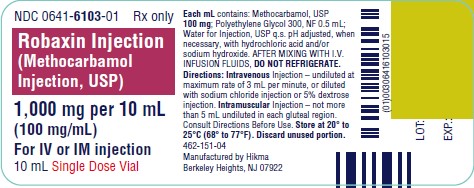
ROBAXIN methocarbamol 100 mg/mL Injection — NDC 0641-6103-10 (Billing 00641-6103-10)
This is a package of ROBAXIN methocarbamol 100 mg/mL Injection from Hikma Pharmaceuticals USA Inc., marketed since Jun 1959 and currently FDA-listed.
NDC database record
One package, one record: these facts belong to NDC 0641-6103-10 alone.
- Record
- FDA NDC Directory package listing · Human prescription drug
- Code segments
- 0641 labeler · 6103 product · 10 package
- Package marketed since
- Oct 4, 2023
- Sample package
- No — commercial package
- Listing certified through
- Dec 31, 2026
- Barcode (UPC-A, from the NDC)
- 3 0641610310 7
- Medicaid fills, this package
- 107 prescriptions in the last four reported quarters
- FDA record last changed
- Jul 24, 2026
Other active recalls for Methocarbamol (different manufacturers) — 2 · tap to view
Identity & classification
Regulatory identifiers FDA, NLM and CMS codes for this package
Drug-database identifiers Medi-Span GPI and First Databank GCN / HICL / AHFS classification
- GSN (GCN sequence number): 004653
- GCN: 17881
- GPI-14 (Medi-Span): 75100070002010
- HICL (First Databank): 001938
- AHFS class code: 12:20.04.00
- RxCUI (RxNorm): 207014
Where does this data come from?
- FDA openFDA NDC Directory · synced Oct 8, 2026
- FDA label on DailyMed · label index refreshed Oct 6, 2026
- RxNorm (NLM RxNav) · catalog refreshed Oct 1, 2026
- Medi-Span GPI (licensed)
- First Databank (licensed) · refreshed Oct 8, 2026
RxNorm drug class
This medicine belongs to the Muscle Relaxant class.
Where does this data come from?
- RxClass (NLM) · catalog refreshed Oct 1, 2026
Clinical
- It's used along with rest and physical therapy to ease discomfort from sudden, painful muscle and bone conditions. It's an add-on, not a replacement for those other measures.
- It's best to avoid it. Methocarbamol can add to the effects of alcohol and other sedating medicines. Deaths have been reported with overdose, including when alcohol was involved.
- Be careful. It can affect your mental and physical abilities. Wait until you know how it affects you before driving or using machinery.
- Tablets and Atmeksi suspension are taken by mouth several times a day. Usually a higher amount is used for the first couple of days, then less. If you use Atmeksi, shake it well fo...
Patient education
Supplement & herbal interactions
Some supplements/herbs that may interact with Methocarbamol — tap one for details:
Where does this data come from?
- MedlinePlus (NLM) · refreshed Oct 1, 2026
- FDA label on DailyMed · label index refreshed Oct 6, 2026
Ask a licensed pharmacist directly — free, answered by our team.
Pricing
A drug doesn't have one price. Each row is a different public payment system, and none is what you'd pay at the counter — that depends on your insurance. The ⓘ on each row explains what it measures.
| Price system | Per each | Per package |
|---|---|---|
| Retail pharmacies payNADAC · weekly | Not in the retail survey — common for institutional, discontinued, or low-volume packs. | |
| Medicaid paysCMS SDUD · 12 mo | $1.06 | $10.60 / 10 vials |
| Medicare drug plans payPart D · quarterly | No Part D plan price is available for this NDC in our data. | |
| Medicare Part B allowsASP · J2800 | $4.509 / J2800 unit | — |
Where does this data come from?
- CMS NADAC weekly file
- CMS ASP pricing files · refreshed Sep 20, 2026
- CMS Medicaid State Drug Utilization Data · through Q1 2026
- CMS Part D plan pricing files · refreshed Sep 24, 2026
- VA National Acquisition Center price file
Billing & reimbursement
Where does this data come from?
- CMS ASP NDC-HCPCS crosswalk · refreshed Sep 22, 2026
- DMEPDAC NDC-HCPCS crosswalk
- openFDA NSDE billing units · refreshed Oct 7, 2026
Packaging — all sizes for this product
| Package NDC | Description | Marketing start | Marketing end | Status |
|---|---|---|---|---|
| 00641-6103-25 0641-6103-25 Main listing | 25 VIAL in 1 CARTON / 10 mL in 1 VIAL | 1959-06-16 | — | Active |
| 00641-6103-10 You're viewing this | 10 VIAL in 1 CARTON / 10 mL in 1 VIAL | 1959-06-16 | — | Active |
This pack accounts for about 30% of this product's recent Medicaid fills; most go to a different pack size. See all packs ↓
Pack size FAQ
What quantity is in this package?
What NDC number is used to bill for this package of ROBAXIN methocarbamol 100 mg/mL Injection?
Therapeutic equivalents
| Product | Labeler | Pack | NADAC/unit | TE | Status | Price vs. this |
|---|---|---|---|---|---|---|
| Methocarbamol 1000 mg/10mL 00404-9992-10 | Henry | 1 vial | — | AP | FDA listed | — |
| Robaxin 100 mg/mLthis 00641-6103-10 | Hikma | 10 vials | — | AP | FDA listed | — |
| Robaxin 100 mg/mL 00641-6217-25 | Hikma | 25 vials | — | AP | FDA listed | — |
| Methocarbamol 100 mg/mL 25021-0675-10 | Sagent | 25 vials | — | AP | FDA listed | — |
| Methocarbamol 100 mg/mL 25021-0689-10 | Sagent | 25 vials | — | AP | FDA listed | — |
| methocarbamol 100 mg/mL 36000-0302-25 | Baxter | 25 vials | — | — | FDA listed | — |
| Methocarbamol 100 mg/mL 43598-0839-36 | Dr.Reddys | 10 vials | — | AP | FDA listed | — |
| Methocarbamol 1000 mg/10mL 55150-0223-10 | Eugia | 25 vials | — | AP | FDA listed | — |
| Methocarbamol 100 mg/mL 63323-0778-10 | Fresenius | 25 vials | — | AP | FDA listed | — |
| Methocarbamol 100 mg/mL 68083-0317-25 | Gland | 25 vials | — | AP | FDA listed | — |
| Methocarbamol 100 mg/mL 70069-0101-05 | Somerset | 5 vials | — | AP | FDA listed | — |
| methocarbamol 100 mg/mL 70436-0149-55 | Slate | 25 vials | — | AP | FDA listed | — |
| Methocarbamol 100 mg/mL 71288-0716-10 | Meitheal | 25 vials | — | AP | FDA listed | — |
| Methocarbamol 100 mg/mL 86211-0114-10 | JVET | 10 vials | — | AP | FDA listed | — |
Where does this data come from?
- FDA openFDA NDC Directory · synced Oct 8, 2026
- FDA Orange Book · refreshed Oct 3, 2026
- CMS NADAC weekly file
Availability & generic status
The FDA lists approved generic versions of this medicine, but that does not always mean a pharmacy can get one today. Patent rules, launch agreements, supply and pricing can affect when generics actually arrive.
Where does this data come from?
- FDA Orange Book · refreshed Oct 3, 2026
Inactive Ingredients / Excipients
Inactive ingredients, also called excipients, are components of the drug product other than the active ingredient. They may include fillers, dyes, coatings, preservatives, flavors, or other formulation ingredients.
🧪 Avoiding an ingredient? See Methocarbamol inactive ingredients by manufacturer: every current product's list side by side, so you can ask your pharmacy for the version that does not list it.
💡 Tap an ingredient (hover on desktop) to see what it is and why it’s used.
-
UNII QTT17582CB
A strong acid used to adjust and maintain the proper pH level in liquid medicines, ensuring stability and preventing breakdown of active ingredients.
-
0.5 mL / 1 mL
UNII 5655G9Y8AQ
A synthetic liquid polymer used as a solvent and humectant in medications. It helps dissolve active ingredients, maintain moisture in the formulation, and improve how the medicine flows and is absorbed.
-
UNII 55X04QC32I
A strong alkaline chemical used to adjust and maintain the pH balance of liquid medicines. It helps keep the medicine stable and ensures it stays effective during storage.
-
UNII 059QF0KO0R
Water is a liquid solvent that dissolves and mixes ingredients together in liquid medicines, syrups, and injections. It helps distribute the active drug evenly throughout the product.
4 inactive ingredients listed in the exact product block matched to this NDC.
Where does this data come from?
ingredient classCode="IACT" elements from the exact product block matched by this NDC. Label-section narrative from DailyMed / the openFDA label index is shown separately when available.- FDA label on DailyMed · label index refreshed Oct 6, 2026
- FDA openFDA NDC Directory · synced Oct 8, 2026
Inactive ingredient FAQ
Are inactive ingredients the same for every manufacturer?
Why might an inactive ingredient be missing?
Can inactive ingredients matter?
Manufacturer & labeler
More NDCs from Hikma Pharmaceuticals USA Inc. labeler code 00641
- Ondansetron 2 mg/mL Injection NDC 0641-6079-01
- Ondansetron 2 mg/mL Injection NDC 0641-6080-25
- PHENERGAN Promethazine Hydrochloride 25 mg/mL Injection NDC 0641-6082-25
- PHENERGAN Promethazine Hydrochloride 50 mg/mL Injection NDC 0641-6083-25
- PHENERGAN Promethazine Hydrochloride 25 mg/mL Injection NDC 0641-6084-25
- PHENERGAN Promethazine Hydrochloride 50 mg/mL Injection NDC 0641-6085-25
- Ampicillin and Sulbactam 1 g/1.5g; .5 g/1.5g Injection, Powder, For Solution NDC 0641-6116-10
- Ampicillin and Sulbactam 2 g/3g; 1 g/3g Injection, Powder, For Solution NDC 0641-6117-10
- Ampicillin and Sulbactam 100 mg/mL; 50 mg/mL Injection, Powder, For Solution NDC 0641-6118-01
- Morphine Sulfate 4 mg/mL Injection NDC 0641-6125-25
- Morphine Sulfate 8 mg/mL Injection NDC 0641-6126-25
- Morphine Sulfate 10 mg/mL Injection NDC 0641-6127-25
Where does this data come from?
- FDA openFDA NDC Directory · synced Oct 8, 2026
- Drugs@FDA
Full prescribing information FDA SPL
🎯 Indications and Usage ▾
INDICATIONS AND USAGE The injectable form of methocarbamol is indicated as an adjunct to rest, physical therapy, and other measures for the relief of discomfort associated with acute, painful musculoskeletal conditions. The mode of action of this drug has not been clearly identified, but may be related to its sedative properties. Methocarbamol does not directly relax tense skeletal muscles in man.
⏱️ Dosage and Administration ▾
DOSAGE AND ADMINISTRATION For Intravenous and Intramuscular Use Only. Total adult dosage should not exceed 30 mL (3 vials) a day for more than 3 consecutive days except in the treatment of tetanus. If the condition persists, a like course may be repeated after a drug-free interval of 48 hours.
Dosage and frequency of injection should be based on the severity of the condition being treated and therapeutic response noted. For the relief of symptoms of moderate degree, one dose of 1 gram (one 10 mL vial) may be adequate. Ordinarily this injection need not be repeated, as the administration of the oral form will usually sustain the relief initiated by the injection.
For the severest cases or in postoperative conditions in which oral administration is not feasible, additional doses of 1 gram may be repeated every 8 hours up to a maximum of 3 g/day for no more than 3 consecutive days. Directions for Intravenous Use ROBAXIN Injectable may be administered undiluted directly into the vein at a maximum rate of three mL per minute. It may also be added to an intravenous drip of Sodium Chloride Injection (Sterile Isotonic Sodium Chloride Solution for Parenteral Use) or five percent Dextrose Injection (Sterile 5 percent Dextrose Solution); one vial given as a single dose should not be diluted to more than 250 mL for I.V. infusion.
AFTER MIXING WITH I.V. INFUSION FLUIDS, DO NOT REFRIGERATE. Care should be exercised to avoid vascular extravasation of this hypertonic solution, which may result in thrombophlebitis.
It is preferable that the patient be in a recumbent position during and for at least 10 to 15 minutes following the injection. Directions for Intramuscular Use When the intramuscular route is indicated, not more than five mL (one-half vial) should be injected into each gluteal region. The injections may be repeated at eight hour intervals, if necessary.
When satisfactory relief of symptoms is achieved, it can usually be maintained with tablets. Not Recommended for Subcutaneous Administration. Special Directions for Use in Tetanus There is clinical evidence which suggests that methocarbamol may have a beneficial effect in the control of the neuromuscular manifestations of tetanus.
It does not, however, replace the usual procedure of debridement, tetanus antitoxin, penicillin, tracheotomy, attention to fluid balance, and supportive care. ROBAXIN Injectable should be added to the regimen as soon as possible. For adults: Inject one or two vials directly into the tubing of the previously inserted indwelling needle.
An additional 10 mL or 20 mL may be added to the infusion bottle so that a total of up to 30 mL (three vials) is given as the initial dose (see PRECAUTIONS ). This procedure should be repeated every six hours until conditions allow for the insertion of a nasogastric tube. Crushed methocarbamol tablets suspended in water or saline may then be given through this tube.
Total daily oral doses up to 24 grams may be required as judged by patient response. For pediatric patients: A minimum initial dose of 15 mg/kg or 500 mg/m 2 is recommended. This dosage may be repeated every six hours, if required.
The total dose should not exceed 1.8 g/m 2 for 3 consecutive days. The maintenance dosage may be given by injection into tubing or by I.V. infusion with an appropriate quantity of fluid. See directions for I.V. use.
⛔ Contraindications ▾
CONTRAINDICATIONS ROBAXIN Injectable should not be administered to patients with known or suspected renal pathology. This caution is necessary because of the presence of polyethylene glycol 300 in the vehicle. A much larger amount of polyethylene glycol 300 than is present in recommended doses of ROBAXIN Injectable is known to have increased pre-existing acidosis and urea retention in patients with renal impairment.
Although the amount present in this preparation is well within the limits of safety, caution dictates this contraindication. ROBAXIN Injectable is contraindicated in patients hypersensitive to methocarbamol or to any of the injection components.
⚠️ Warnings ▾
WARNINGS Since methocarbamol may possess a general CNS depressant effect, patients receiving ROBAXIN Injectable should be cautioned about combined effects with alcohol and other CNS depressants. Safe use of ROBAXIN Injectable has not been established with regard to possible adverse effects upon fetal development. There have been very rare reports of fetal and congenital abnormalities following in utero exposure to methocarbamol.
Therefore, ROBAXIN Injectable should not be used in women who are or may become pregnant and particularly during early pregnancy unless in the judgment of the physician the potential benefits outweigh the possible hazards (see PRECAUTIONS, Pregnancy ). Use in Activities Requiring Mental Alertness Methocarbamol may impair mental and/or physical abilities required for performance of hazardous tasks, such as operating machinery or driving a motor vehicle. Patients should be cautioned about operating machinery, including automobiles, until they are reasonably certain that methocarbamol therapy does not adversely affect their ability to engage in such activities.
🤒 Adverse Reactions ▾
ADVERSE REACTIONS The following adverse reactions have been reported coincident with the administration of methocarbamol. Some events may have been due to an overly rapid rate of intravenous injection. Body as a whole: Anaphylactic reaction, angioneurotic edema, fever, headache Cardiovascular system: Bradycardia, flushing, hypotension, syncope, thrombophlebitis In most cases of syncope there was spontaneous recovery.
In others, epinephrine, injectable steroids, and/or injectable antihistamines were employed to hasten recovery. Digestive system: Dyspepsia, jaundice (including cholestatic jaundice), nausea and vomiting Hemic and lymphatic system: Leukopenia Immune system: Hypersensitivity reactions Nervous system: Amnesia, confusion, diplopia, dizziness or light-headedness, drowsiness, insomnia, mild muscular incoordination, nystagmus, sedation, seizures (including grand mal), vertigo The onset of convulsive seizures during intravenous administration of methocarbamol has been reported in patients with seizure disorders.
The psychic trauma of the procedure may have been a contributing factor. Although several observers have reported success in terminating epileptiform seizures with ROBAXIN Injectable, its administration to patients with epilepsy is not recommended (see PRECAUTIONS, General ). Skin and special senses: Blurred vision, conjunctivitis, nasal congestion, metallic taste, pruritus, rash, urticaria Other: Pain and sloughing at the site of injection
🔄 Drug Interactions ▾
Drug Interactions See WARNINGS and PRECAUTIONS for interaction with CNS drugs and alcohol. Methocarbamol may inhibit the effect of pyridostigmine bromide. Therefore, methocarbamol should be used with caution in patients with myasthenia gravis receiving anticholinesterase agents.
🔄 Drug / Laboratory Test Interactions ▾
Drug/Laboratory Test Interactions Methocarbamol may cause a color interference in certain screening tests for 5‑hydroxyindoleacetic acid (5-HIAA) using nitrosonaphthol reagent and in screening tests for urinary vanillylmandelic acid (VMA) using the Gitlow method.
🤰 Pregnancy ▾
Pregnancy Teratogenic Effects-Pregnancy Category C Animal reproduction studies have not been conducted with methocarbamol. It is also not known whether methocarbamol can cause fetal harm when administered to a pregnant woman or can affect reproduction capacity. ROBAXIN Injectable should be given to a pregnant woman only if clearly needed.
Safe use of ROBAXIN Injectable has not been established with regard to possible adverse effects upon fetal development. There have been reports of fetal and congenital abnormalities following in utero exposure to methocarbamol. Therefore, ROBAXIN Injectable should not be used in women who are or may become pregnant and particularly during early pregnancy unless in the judgment of the physician the potential benefits outweigh the possible hazards (see WARNINGS ).
🧒 Pediatric Use ▾
Pediatric Use Safety and effectiveness of ROBAXIN Injectable in pediatric patients have not been established except in tetanus. See DOSAGE AND ADMINISTRATION, Special Directions for Use in Tetanus , For Pediatric Patients .
🆘 Overdosage ▾
OVERDOSAGE Limited information is available on the acute toxicity of methocarbamol. Overdose of methocarbamol is frequently in conjunction with alcohol or other CNS depressants and includes the following symptoms: nausea, drowsiness, blurred vision, hypotension, seizures, and coma. In post-marketing experience deaths have been reported with an overdose of methocarbamol alone or in the presence of other CNS depressants, alcohol or psychotropic drugs.
Treatment Management of overdose includes symptomatic and supportive treatment. Supportive measures include maintenance of an adequate airway, monitoring urinary output and vital signs, and administration of intravenous fluids if necessary. The usefulness of hemodialysis in managing overdose is unknown.
🧬 Clinical Pharmacology ▾
CLINICAL PHARMACOLOGY The mechanism of action of methocarbamol in humans has not been established, but may be due to general CNS depression. It has no direct action on the contractile mechanism of striated muscle, the motor end plate or the nerve fiber. Pharmacokinetics In healthy volunteers, the plasma clearance of methocarbamol ranges between 0.20 and
0.80L/h/kg, the mean plasma elimination half-life ranges between 1 and 2 hours, and the plasma protein binding ranges between 46% and 50%. Methocarbamol is metabolized via dealkylation and hydroxylation. Conjugation of methocarbamol also is likely.
Essentially all methocarbamol metabolites are eliminated in the urine. Small amounts of unchanged methocarbamol also are excreted in the urine. SPECIAL POPULATIONS Elderly The mean (± SD) elimination half-life of methocarbamol in elderly healthy volunteers (mean (± SD) age, 69 (± 4) years) was slightly prolonged compared to a younger (mean (± SD) age, 53.3 (± 8.8) years), healthy population (1.5 (± 0.4) hours versus 1.1 (± 0.27) hours, respectively).
The fraction of bound methocarbamol was slightly decreased in the elderly versus younger volunteers (41 to 43% versus 46 to 50%, respectively). Renally Impaired The clearance of methocarbamol in 8 renally-impaired patients on maintenance hemodialysis was reduced about 40% compared to 17 normal subjects, although the mean (± SD) elimination half-life in these two groups was similar (1.2 (± 0.6) versus 1.1 (± 0.3) hours, respectively). Hepatically Impaired In 8 patients with cirrhosis secondary to alcohol abuse, the mean total clearance of methocarbamol was reduced approximately 70% compared to that obtained in 8 age- and weight-matched normal subjects.
The mean (± SD) elimination half-life in the cirrhotic patients and the normal subjects was 3.38 (± 1.62) hours and 1.11 (± 0.27) hours respectively. The percent of methocarbamol bound to plasma proteins was decreased to approximately 40 to 45% compared to 46 to 50% in the normal subjects.
📦 How Supplied / Storage and Handling ▾
HOW SUPPLIED ROBAXIN Injectable (100 mg/mL) supplied in – 10 mL single dose vials in packages of 10 (NDC 0641-6103-10). Store at 20 ° - 25 ° C (68 ° - 77 ° F), excursions permitted to 15 ° - 30 ° C (59 ° - 86 ° F). Not made with natural rubber latex.
To report SUSPECTED ADVERSE REACTIONS, contact West-Ward Pharmaceuticals Corp. at 1-877-845-0689 or the FDA at 1-800-FDA-1088 or www.fda.gov/medwatch . For Product Inquiry call 1-877-845-0689. Manufactured by: Hikma Pharmaceuticals USA Inc.
Berkeley Heights, NJ 07922 Revised February 2023 462-153-05
📋 Description ▾
DESCRIPTION ROBAXIN (methocarbamol injection, USP) Injectable, a carbamate derivative of guaifenesin, is a central nervous system (CNS) depressant with sedative and musculoskeletal relaxant properties. It is a sterile, pyrogen-free solution intended for intramuscular or intravenous administration. Each mL contains: methocarbamol, USP 100 mg, polyethylene glycol 300, NF 0.5 mL, Water for Injection, USP q.s.
The pH is adjusted, when necessary, with hydrochloric acid and/or sodium hydroxide. The chemical name of methocarbamol is 3‑(2‑methoxyphenoxy)‑1,2-propanediol 1‑carbamate and has the empirical formula of C 11 H 15 NO 5 . Its molecular weight is 241.24.
The structural formula is shown below: Methocarbamol is a white powder, sparingly soluble in water and chloroform, soluble in alcohol (only with heating) and propylene glycol, and insoluble in benzene and n ‑hexane. ROBAXIN Injectable has a pH between 3.5 and 6.0. AFTER MIXING WITH I.V.
INFUSION FLUIDS, DO NOT REFRIGERATE. Structural formula
💬 Information for Patients ▾
Information for Patients Patients should be cautioned that methocarbamol may cause drowsiness or dizziness, which may impair their ability to operate motor vehicles or machinery. Because methocarbamol may possess a general CNS-depressant effect, patients should be cautioned about combined effects with alcohol and other CNS depressants.
⚠️ Precautions ▾
PRECAUTIONS General As with other agents administered either intravenously or intramuscularly, careful supervision of dose and rate of injection should be observed. Rate of injection should not exceed 3 mL per minute–i.e., one 10 mL vial in approximately three minutes. Since ROBAXIN Injectable is hypertonic, vascular extravasation must be avoided.
A recumbent position will reduce the likelihood of side reactions. Blood aspirated into the syringe does not mix with the hypertonic solution. This phenomenon occurs with many other intravenous preparations.
The blood may be injected with the methocarbamol, or the injection may be stopped when the plunger reaches the blood, whichever the physician prefers. The total dosage should not exceed 30 mL (three vials) a day for more than three consecutive days except in the treatment of tetanus. Caution should be observed in using the injectable form in patients with suspected or known seizure disorders.
Information for Patients Patients should be cautioned that methocarbamol may cause drowsiness or dizziness, which may impair their ability to operate motor vehicles or machinery. Because methocarbamol may possess a general CNS-depressant effect, patients should be cautioned about combined effects with alcohol and other CNS depressants. Drug Interactions See WARNINGS and PRECAUTIONS for interaction with CNS drugs and alcohol.
Methocarbamol may inhibit the effect of pyridostigmine bromide. Therefore, methocarbamol should be used with caution in patients with myasthenia gravis receiving anticholinesterase agents. Drug/Laboratory Test Interactions Methocarbamol may cause a color interference in certain screening tests for 5‑hydroxyindoleacetic acid (5-HIAA) using nitrosonaphthol reagent and in screening tests for urinary vanillylmandelic acid (VMA) using the Gitlow method.
Carcinogenesis, Mutagenesis, Impairment of Fertility Long-term studies to evaluate the carcinogenic potential of methocarbamol have not been performed. No studies have been conducted to assess the effect of methocarbamol on mutagenesis or its potential to impair fertility. Pregnancy Teratogenic Effects-Pregnancy Category C Animal reproduction studies have not been conducted with methocarbamol.
It is also not known whether methocarbamol can cause fetal harm when administered to a pregnant woman or can affect reproduction capacity. ROBAXIN Injectable should be given to a pregnant woman only if clearly needed. Safe use of ROBAXIN Injectable has not been established with regard to possible adverse effects upon fetal development.
There have been reports of fetal and congenital abnormalities following in utero exposure to methocarbamol. Therefore, ROBAXIN Injectable should not be used in women who are or may become pregnant and particularly during early pregnancy unless in the judgment of the physician the potential benefits outweigh the possible hazards (see WARNINGS ). Nursing Mothers Methocarbamol and/or its metabolites are excreted in the milk of dogs; however, it is not known whether methocarbamol or its metabolites are excreted in human milk.
Because many drugs are excreted in human milk, caution should be exercised when ROBAXIN Injectable is administered to a nursing woman. Pediatric Use Safety and effectiveness of ROBAXIN Injectable in pediatric patients have not been established except in tetanus. See DOSAGE AND ADMINISTRATION, Special Directions for Use in Tetanus , For Pediatric Patients .
🍼 Nursing Mothers ▾
Nursing Mothers Methocarbamol and/or its metabolites are excreted in the milk of dogs; however, it is not known whether methocarbamol or its metabolites are excreted in human milk. Because many drugs are excreted in human milk, caution should be exercised when ROBAXIN Injectable is administered to a nursing woman.
🧬 Pharmacokinetics ▾
Pharmacokinetics In healthy volunteers, the plasma clearance of methocarbamol ranges between 0.20 and
0.80L/h/kg, the mean plasma elimination half-life ranges between 1 and 2 hours, and the plasma protein binding ranges between 46% and 50%. Methocarbamol is metabolized via dealkylation and hydroxylation. Conjugation of methocarbamol also is likely.
Essentially all methocarbamol metabolites are eliminated in the urine. Small amounts of unchanged methocarbamol also are excreted in the urine. SPECIAL POPULATIONS Elderly The mean (± SD) elimination half-life of methocarbamol in elderly healthy volunteers (mean (± SD) age, 69 (± 4) years) was slightly prolonged compared to a younger (mean (± SD) age, 53.3 (± 8.8) years), healthy population (1.5 (± 0.4) hours versus 1.1 (± 0.27) hours, respectively).
The fraction of bound methocarbamol was slightly decreased in the elderly versus younger volunteers (41 to 43% versus 46 to 50%, respectively). Renally Impaired The clearance of methocarbamol in 8 renally-impaired patients on maintenance hemodialysis was reduced about 40% compared to 17 normal subjects, although the mean (± SD) elimination half-life in these two groups was similar (1.2 (± 0.6) versus 1.1 (± 0.3) hours, respectively). Hepatically Impaired In 8 patients with cirrhosis secondary to alcohol abuse, the mean total clearance of methocarbamol was reduced approximately 70% compared to that obtained in 8 age- and weight-matched normal subjects.
The mean (± SD) elimination half-life in the cirrhotic patients and the normal subjects was 3.38 (± 1.62) hours and 1.11 (± 0.27) hours respectively. The percent of methocarbamol bound to plasma proteins was decreased to approximately 40 to 45% compared to 46 to 50% in the normal subjects.
📄 Carcinogenesis, Mutagenesis, Impairment of Fertility ▾
Carcinogenesis, Mutagenesis, Impairment of Fertility Long-term studies to evaluate the carcinogenic potential of methocarbamol have not been performed. No studies have been conducted to assess the effect of methocarbamol on mutagenesis or its potential to impair fertility.
📄 Package Label / Principal Display Panel ▾
PRINCIPAL DISPLAY PANEL NDC 0641-6103-01 Rx only ROBAXIN Injectable (Methocarbamol Injection, USP) 1,000 mg/10 mL (100 mg/mL) 10 mL Single Dose Vial NDC 0641-6103-10 Rx only ROBAXIN Injectable (Methocarbamol Injection, USP) 1,000 mg/10 mL (100 mg/mL) 10 x 10 mL Single Dose Vials FOR INTRAVENOUS OR INTRAMUSCULAR INJECTION unit label carton label
Medicaid utilization & spend
Medicaid utilization by pack size
Medicare Part D spend CMS · PART D · 2026 (Q1)
About this NDC listing & data coverage
What data is (and isn’t) available for this NDC — tap to expand
| NDC identity (package / product / labeler codes) | ✓ Available |
| Labeler | ✓ Available |
| Product & package description | ✓ Available |
| Marketing category & status | ✓ Available |
| Active ingredient / dosage form / route | ✓ Available |
| FDA label (SPL via DailyMed) | ✓ Available |
| Package photos | ✓ Available |
| Inactive ingredients (structured) | ✓ Available |
| NADAC pharmacy acquisition price (CMS) | — Not published for this NDC CMS publishes NADAC only for NDCs reported in its retail-pharmacy survey. |
| Orange Book / therapeutic-equivalence data | ✓ Available |
| HCPCS J-code billing crosswalk | ✓ Available |
| Medicaid utilization (CMS SDUD) | ✓ Available |