
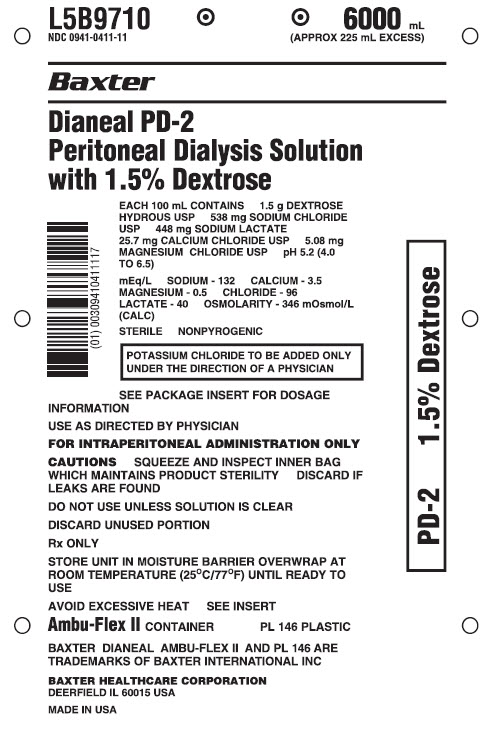
DIANEAL PD-2 with Dextrose sodium chloride, sodium lactate, calcium chloride, magnesium chloride and 4.25 g/100mL; 538 mg/100mL; 448 mg/100mL; 25.7 mg/100mL; 5.08 mg/100mL Injection, Solution, 2500 mL
Past resolved recalls for this product (4)
🆔 Identity & classification
Where does this data come from?
🏷️ RxNorm drug class
This medicine belongs to the Organic acids class.
Where does this data come from?
🏭 Manufacturer & labeler
Where does this data come from?
🩺 Clinical
- The solution acts like an artificial filter. The sugar (dextrose) in it creates a pull that draws excess fluid and waste products out of your blood, across the lining of your abdom...
- What exactly is this solution doing when it's inside my abdomen?
- The biggest warning sign is cloudy or milky drained fluid — normal drained fluid is generally clear. You might also notice abdominal pain, tenderness, fever, or a general sense of...
- How do I know if I'm developing peritonitis — an infection in my abdomen?
Patient education
Supplement & herbal interactions
Where does this data come from?
Ask a licensed pharmacist directly — free, answered by our team.
🧪 Inactive Ingredients / Excipients
Inactive ingredients, also called excipients, are components of the drug product other than the active ingredient. They may include fillers, dyes, coatings, preservatives, flavors, or other formulation ingredients.
💡 Tap an ingredient (hover on desktop) to see what it is and why it’s used.
-
UNII 059QF0KO0R
Water is a liquid solvent that dissolves and mixes ingredients together in liquid medicines, syrups, and injections. It helps distribute the active drug evenly throughout the product.
1 inactive ingredient listed in the exact product block matched to this NDC.
Where does this data come from?
ingredient classCode="IACT" elements from the exact product block matched by this NDC. Label-section narrative from DailyMed / the openFDA label index is shown separately when available.Inactive ingredient FAQ
Are inactive ingredients the same for every manufacturer?
Why might an inactive ingredient be missing?
Can inactive ingredients matter?
💲 Pricing
A drug doesn't have one price. Each row is a different public payment system, and none is what you'd pay at the counter — that depends on your insurance. The ⓘ on each row explains what it measures.
| Price system | Per mL | Per package |
|---|---|---|
| Retail pharmacies payNADAC · weekly | Not in the retail survey — common for institutional, discontinued, or low-volume packs. | |
| Medicaid paysCMS SDUD · 12 mo | No recent Medicaid claims on file for this NDC — rare and low-volume NDCs are suppressed in the public data. | |
| Medicare drug plans payPart D · quarterly | No Part D plan price is available for this NDC in our data. | |
Where does this data come from?
🔁 Therapeutic equivalents
| Product | Labeler | Pack | NADAC/unit | TE | Status | Price vs. this |
|---|---|---|---|---|---|---|
| DIANEAL PD-2 with Dextrose 4.25 g/100mL; 538 mg/100mL; 448 mg/100mL; 25.7 mg/100mL; 5.08 mg/100mL 00941-0415-01 | Vantive | 6000 ml | — | AT | FDA listed | — |
| DIANEAL PD-2 with Dextrose 4.25 g/100mL; 538 mg/100mL; 448 mg/100mL; 25.7 mg/100mL; 5.08 mg/100mLthis 00941-0429-53 | Vantive | 2500 ml | — | AT | FDA listed | — |
Where does this data come from?
⏳ Availability & generic status
We did not find an FDA-approved generic match for this exact strength, form and route.
Where does this data come from?
🔬 Reported adverse events (FAERS)
Top reported reactions
Reporter sex
Serious outcomes
Where does this data come from?
📦 Packaging — all sizes for this product
| Package NDC | Description | Marketing start | Status |
|---|---|---|---|
| 00941-0429-52 | 2000 mL in 1 BAG (0941-0429-52) | 1992-12-04 | Active |
| 00941-0429-53 You're viewing this | 2500 mL in 1 BAG (0941-0429-53) | 1992-12-04 | Active |
| 00941-0429-55 | 3000 mL in 1 BAG (0941-0429-55) | 1992-12-04 | Active |
You're viewing one of 3 pack sizes for this product.
Pack size FAQ
What quantity is in NDC 00941-0429-53?
What is the difference between NDC 00941-0429-53 and NDC 00941-0429-52?
What NDC number is used to bill for this package of DIANEAL PD-2 with Dextrose sodium chloride, sodium lactate, calcium chloride, magnesium chloride and 4.25 g/100mL; 538 mg/100mL; 448 mg/100mL; 25.7 mg/100mL; 5.08 mg/100mL Injection, Solution?
🧭 About this NDC listing & data coverage
What data is (and isn’t) available for this NDC — tap to expand
| NDC identity (package / product / labeler codes) | ✓ Available |
| Labeler | ✓ Available |
| Product & package description | ✓ Available |
| Marketing category & status | ✓ Available |
| Active ingredient / dosage form / route | ✓ Available |
| FDA label (SPL via DailyMed) | ✓ Available |
| Package photos | ✓ Available |
| Inactive ingredients (structured) | ✓ Available |
| NADAC pharmacy acquisition price (CMS) | — Not published for this NDC CMS publishes NADAC only for NDCs reported in its retail-pharmacy survey. |
| Orange Book / therapeutic-equivalence data | ✓ Available |
| HCPCS J-code billing crosswalk | — Not published for this NDC Most self-administered / retail products have no J-code — that is normal. |
| Medicaid utilization (CMS SDUD) | — Not published for this NDC CMS reports utilization only for NDCs with Medicaid claims above its privacy threshold. |
Questions about this listing
Why is there no price listed?
Is the NDC printed on the package the same as the 11-digit billing NDC?
What do the three segments of this NDC mean?
Is this package still being marketed?
Does this product come in other package sizes?
Who lists this product with the FDA?
Do I need a prescription for this product?
Where does this data come from?
📄 Full prescribing information FDA SPL
🎯 Indications and Usage ▾
1 INDICATIONS AND USAGE DIANEAL peritoneal dialysis solutions are indicated for patients in acute or chronic renal failure. For management of acute or chronic renal failure.
⏱️ Dosage and Administration ▾
2 DOSAGE AND ADMINISTRATION For intraperitoneal administration only. ( 2 )
2.1Basic Dosing Information DIANEAL peritoneal dialysis solutions are intended for intraperitoneal administration only. Not for intravenous or intra-arterial administration. Select mode of therapy, frequency of treatment, formulation, fill volume, duration of dwell, and length of dialysis based on the patient’s clinical condition, fluid, electrolyte and specific needs.
The fill volume depends on body size, usually from 2.0 to 2.5 liters per 1.73m 2 for adults. DIANEAL peritoneal dialysis solutions are intended for use in Continuous Ambulatory Peritoneal Dialysis (CAPD) or Automated Peritoneal Dialysis (APD). Refer to directions accompanying ancillary equipment for CAPD and APD system preparation.
Product Selection To avoid the risk of severe dehydration and hypovolemia and to minimize the loss of protein, it is advisable to select the peritoneal dialysis solution with the lowest level of osmolarity consistent with the fluid removal requirements for that exchange. As the patient’s body weight becomes closer to the ideal dry weight, lowering the dextrose concentration of DIANEAL solution is recommended. DIANEAL 4.25% dextrose-containing solution has the highest osmolarity of the DIANEAL solutions and using it for all exchanges may cause dehydration [see Dosage Forms and Strengths (3) ] .
2.2Adding Medications If the resealable rubber plug on the medication port is missing or partly removed, do not use the product if medication is to be added. To add a medication: 1. Put on mask.
Clean and/or disinfect hands. 2. Prepare medication port site using aseptic technique.
3. Using a syringe with a 1-inch long, 25- to 19-gauge needle, puncture the medication port and inject additive. 4.
Reposition container with container ports up and evacuate medication port by squeezing and tapping it. 5. Mix solution and additive thoroughly.
2.3Directions for Use Warming DIANEAL peritoneal dialysis solution can be warmed to 37°C (98.6°F). Only dry heat should be used. For CAPD, it is best to warm solutions within the overwrap using a heating pad.
Do not immerse DIANEAL solutions in water for warming. Do not use a microwave oven to warm DIANEAL solutions. To Open To open, tear the overwrap down at the slit and remove the solution container.
Do not use sharp objects to remove the overwrap. Product Inspection Parenteral drug products should be inspected visually for particulate matter and discoloration prior to administration. Do not use solutions that are cloudy, discolored, contain visible particulate matter, or show evidence of leakage.
Some opacity of the plastic, due to moisture absorption during the sterilization process, may be observed. This does not affect the solution quality or safety and may often leave a slight amount of moisture within the overwrap. The opacity should diminish gradually.
Inspect the bag connector to ensure the tip protector (pull ring or blue pull tip) is attached. Do not use if the tip protector is not attached to the connector. Inspect the DIANEAL solution container for signs of leakage and check for minute leaks by squeezing the container firmly.
If the container has frangible(s), inspect that they are positioned correctly and are not broken. Do not use DIANEAL solution if the frangible(s) are broken or leaks are suspected as sterility may be impaired. For DIANEAL solutions in ULTRABAG containers, inspect the tubing and drain container for presence of solution.
Small droplets are acceptable, but if solution flows past the frangible prior to use, do not use and discard the units. CAPD therapy using ULTRABAG containers Select appropriate formulation from Table 1. Put on mask.
Clean and/or disinfect hands. Using aseptic technique; 1. Uncoil tubing and drain bag, ensuring that the transfer set is closed.
2. Break the connector (Y-set) frangible. 3.
Remove the tip protector from connector of solution container. Do not reuse the solution or container…
💊 Dosage Forms and Strengths ▾
3 DOSAGE FORMS AND STRENGTHS DIANEAL peritoneal dialysis solution is clear with color being slightly yellow to colorless and is formulated with the following ionic concentrations: Table 1 - DIANEAL PD-2 and Low Calcium Peritoneal Dialysis Solution ULTRABAG Container for CAPD therapy AMBU-FLEX Container with pull ring for APD therapy Ionic Concentration (mEq/L) OSMOLARITY (mOsmol/L) (calc) pH Sodium Calcium Magnesium Chloride Lactate DIANEAL PD-2 1.5% Dextrose 346 5.2 (4.0 to 6.5) 132 3.5 0.5 96 40 DIANEAL PD-2 2.5% Dextrose 396 5.2 (4.0 to 6.5) 132 3.5 0.5 96 40 DIANEAL PD-2 4.25% Dextrose 485 5.2 (4.0 to 6.5) 132 3.5 0.5 96 40 DIANEAL Low Calcium (2.5 mEq/L) 1.5% Dextrose 344 5.2 (4.0 to 6.5) 132 2.5 0.5 95 40 DIANEAL Low Calcium (2.5 mEq/L) 2.5% Dextrose 395 5.2 (4.0 to 6.5) 132 2.5 0.5 95 40 DIANEAL Low Calcium (2.5 mEq/L) 4.25% Dextrose 483 5.2 (4.0 to 6.5) 132 2.5 0.5 95 40 Table 2 - DIANEAL Low Calcium Peritoneal Dialysis Solution Plastic container with blue pull tip for APD therapy Ionic Concentration (mEq/L) OSMOLARITY (mOsmol/L) (calc) pH Sodium Calcium Magnesium Chloride Lactate DIANEAL Low Calcium (2.5 mEq/L) 1.5% Dextrose 344 5.0 to 6.5 132 2.5 0.5 95 40 DIANEAL Low Calcium (2.5 mEq/L) 2.5% Dextrose 395 5.0 to 6.5 132 2.5 0.5 95 40 DIANEAL Low Calcium (2.5 mEq/L) 4.25% Dextrose 483 5.0 to 6.5 132 2.5 0.5 95 40 Table 3 – DIANEAL PD-2 and DIANEAL Low Calcium Peritoneal Dialysis Solution Plastic container with pull ring for APD therapy OSMOLARITY (mOsmol/L) (calc) pH Ionic Concentration (mEq/L) Sodium Calcium Magnesium Chloride Lactate DIANEAL PD-2 1.5% Dextrose 346 5.0 to 5.6 132 3.5 0.5 96 40 DIANEAL PD-2 2.5% Dextrose 396 5.0 to 5.6 132 3.5 0.5 96 40 DIANEAL PD-2 4.25% Dextrose 485 5.0 to 5.6 132 3.5 0.5 96 40 DIANEAL Low Calcium (2.5 mEq/L) 1.5% Dextrose 344 5.0 to 5.6 132 2.5 0.5 95 40 DIANEAL Low Calcium (2.5 mEq/L) 2.5% Dextrose 395 5.0 to 5.6 132 2.5 0.5 95 40 DIANEAL Low Calcium (2.5 mEq/L) 4.25% Dextrose 483 5.0 to 5.6 132 2.5 0.5 95 40 DIANEAL solutions are available in multiple combinations of ingredients and in composition, calculated osmolarity, pH, and ionic concentrations.
See full prescribing information for detailed descriptions of each formulation. ( 3 )
⛔ Contraindications ▾
4 CONTRAINDICATIONS DIANEAL peritoneal dialysis solutions are contraindicated in patients with severe lactic acidosis. • Pre-existing severe lactic acidosis ( 4 )
⚠️ Warnings and Cautions ▾
5 WARNINGS AND PRECAUTIONS • Encapsulating peritoneal sclerosis ( 5.1 ) • Peritonitis: Initiate appropriate antimicrobial therapy ( 5.1 ) • Monitor for lactic acidosis in patients at risk ( 5.2 ) • Monitor for electrolyte, fluid, and nutrition imbalances ( 5.4 )
5.1Peritonitis and Encapsulating Peritoneal Sclerosis Peritonitis has been associated with DIANEAL peritoneal dialysis solution use. Following use, inspect the drained fluid for the presence of fibrin or cloudiness, which may indicate the presence of peritonitis. Improper clamping or priming sequence may result in infusion of air into the peritoneal cavity, which may result in abdominal pain and/or peritonitis.
If peritonitis occurs, treat with appropriate therapy. Encapsulating Peritoneal Sclerosis (EPS), sometimes fatal, is a complication of peritoneal dialysis therapy and has been reported in patients using DIANEAL solutions.
5.2Lactic Acidosis Monitor patients with conditions known to increase the risk of lactic acidosis [e.g., severe hypotension or sepsis that can be associated with acute renal failure, hepatic failure, inborn errors of metabolism, and treatment with drugs such as nucleoside/nucleotide reverse transcriptase inhibitors (NRTIs)] before the start of treatment and during treatment with lactate-based peritoneal dialysis solutions. Use of DIANEAL solutions in patients with severe lactic acidosis is contraindicated [see Contraindications (4) ].
5.3Overinfusion Overinfusion of peritoneal dialysis solution volume into the peritoneal cavity may be characterized by abdominal distention, feeling of fullness and/or shortness of breath. Drain the peritoneal dialysis solution from the peritoneal cavity to treat overinfusion.
5.4Electrolyte, Fluid, and Nutrition Imbalances Peritoneal dialysis may affect a patient’s protein, water-soluble vitamin, potassium, bicarbonate, calcium, and magnesium levels and volume status. Monitor hematology, electrolytes, blood chemistry and fluid status periodically and take appropriate clinical action. Potassium is omitted from DIANEAL solutions because dialysis may be performed to correct hyperkalemia.
In situations where there is a normal serum potassium level or hypokalemia, addition of potassium chloride (up to a concentration of 4 mEq/L) to the solution may be necessary to prevent severe hypokalemia. Monitor fluid status to avoid hyper- or hypovolemia and potentially severe consequences including congestive heart failure, volume depletion and hypovolemic shock.
5.5Hyperglycemia DIANEAL solutions contain dextrose and may increase the risk for hyperglycemia in patients with impaired glucose tolerance. Patients may require initiation or modification of antidiabetic therapy during treatment with DIANEAL solutions. Monitor blood glucose.
🤒 Adverse Reactions ▾
6 ADVERSE REACTIONS The following adverse reactions are discussed elsewhere in the label: Peritonitis and Encapsulating Peritoneal Sclerosis [see Warnings and Precautions (5.1) ] Electrolyte and Fluid Imbalances [see Warnings and Precautions (5.4) ] To report SUSPECTED ADVERSE REACTIONS, contact Vantive US Healthcare LLC at 1-855-857-0003 or FDA at 1-800-FDA-1088 or www.fda.gov/medwatch.
6.1Clinical Trials Experience There are no data available on adverse reactions from controlled clinical trials conducted to evaluate the safety of DIANEAL peritoneal dialysis solutions.
6.2Post-Marketing Experience The following adverse experiences have been identified during post-approval use of DIANEAL solutions or in conjunction with performing the peritoneal dialysis procedure. Because these experiences are reported voluntarily from a population of uncertain size, it is not always possible to reliably estimate their frequency or establish a causal relationship during drug exposure. Most of these adverse experiences are believed to be consequences of peritoneal dialysis.
INFECTIONS AND INFESTATIONS: Fungal peritonitis, Peritonitis bacterial, Catheter related infection METABOLISM AND NUTRITION DISORDERS: Hypovolemia, Hypervolemia, Fluid retention, Hypokalemia, Hyponatremia, Dehydration, Hypochloremia VASCULAR DISORDERS: Hypotension, Hypertension RESPIRATORY, THORACIC, AND MEDIASTINAL DISORDERS: Dyspnea GASTROINTESTINAL DISORDERS: Sclerosing encapsulating peritonitis, Peritonitis, Peritoneal cloudy effluent, Vomiting, Diarrhea, Nausea, Constipation, Abdominal pain, Abdominal distension, Abdominal discomfort SKIN AND SUBCUTANEOUS DISORDERS: Stevens-Johnson syndrome, Urticaria, Rash, (including pruritic, erythematous and generalized), Pruritus MUSCULOSKELETAL, CONNECTIVE TISSUE DISORDERS: Myalgia, Muscle spasms, Musculoskeletal pain GENERAL DISORDERS AND ADMINISTRATION SITE CONDITIONS: Generalized edema, Pyrexia, Malaise, Infusion site pain, Catheter related complication
🔄 Drug Interactions ▾
7 DRUG INTERACTIONS As with other dialysis solutions, blood concentrations of dialyzable drugs may be reduced by dialysis. Dosage adjustment of concomitant medications may be necessary. Diabetic patients may require dosage adjustments of insulin or other treatments for hyperglycemia [see Warnings and Precautions (5.5) ] .
👥 Use in Specific Populations ▾
8 USE IN SPECIFIC POPULATIONS
8.1Pregnancy DIANEAL peritoneal dialysis solution is a pharmacologically inactive solution. While there are no adequate and well controlled studies in pregnant women, appropriate administration of DIANEAL solutions, with appropriate monitoring of hematology, electrolytes, blood chemistry and fluid status is not expected to cause fetal harm. Animal reproduction studies have not been conducted with DIANEAL solutions.
The estimated background risk of major birth defects and miscarriage for the indicated population is unknown. In the U.S. general population, the estimated background risk of major birth defects and miscarriage in clinically recognized pregnancies is 2-4% and 15-20%, respectively.
8.2Lactation The components of DIANEAL solutions are excreted in human milk.
8.4Pediatric Use Safety and effectiveness have been established based on published clinical data. No adequate and well-controlled studies have been conducted with DIANEAL solutions in pediatric patients.
8.5Geriatric Use Safety and effectiveness have been established based on published clinical data.
🤰 Pregnancy ▾
8.1Pregnancy DIANEAL peritoneal dialysis solution is a pharmacologically inactive solution. While there are no adequate and well controlled studies in pregnant women, appropriate administration of DIANEAL solutions, with appropriate monitoring of hematology, electrolytes, blood chemistry and fluid status is not expected to cause fetal harm. Animal reproduction studies have not been conducted with DIANEAL solutions.
The estimated background risk of major birth defects and miscarriage for the indicated population is unknown. In the U.S. general population, the estimated background risk of major birth defects and miscarriage in clinically recognized pregnancies is 2-4% and 15-20%, respectively.
🧒 Pediatric Use ▾
8.4Pediatric Use Safety and effectiveness have been established based on published clinical data. No adequate and well-controlled studies have been conducted with DIANEAL solutions in pediatric patients.
🧓 Geriatric Use ▾
8.5Geriatric Use Safety and effectiveness have been established based on published clinical data.
🆘 Overdosage ▾
10 OVERDOSAGE There is a potential for overdose resulting in hypervolemia, hypovolemia, electrolyte disturbances or hyperglycemia. Excessive use of DIANEAL peritoneal dialysis solution with 4.25% dextrose during a peritoneal dialysis treatment can result in significant removal of water from the patient.
🧬 Clinical Pharmacology ▾
12 CLINICAL PHARMACOLOGY
12.1Mechanism of Action DIANEAL peritoneal dialysis solutions are a pharmacologically inactive, hypertonic peritoneal dialysis solution containing dextrose, a monosaccharide, as the primary osmotic agent. An osmotic gradient must be created between the peritoneal membrane and the dialysis solution in order for ultrafiltration to occur. The hypertonic concentration of glucose in DIANEAL solutions exert an osmotic pressure across the peritoneal membrane resulting in transcapillary ultrafiltration.
Like other peritoneal dialysis solutions, DIANEAL solutions contain electrolytes to facilitate the correction of electrolyte abnormalities. DIANEAL solutions contain a buffer, lactate, to help normalize acid-base abnormalities.
12.3Pharmacokinetics Absorption Glucose is rapidly absorbed from the peritoneal cavity by diffusion and appears quickly in the circulation due to the high glucose concentration gradient between DIANEAL solutions compared to blood capillary glucose level. Absorption per unit time will be the highest at the start of an exchange and decreases over time. The rate of glucose absorption will be dependent upon the transport characteristics of the patient’s peritoneal membrane as determined by a peritoneal equilibration test (PET).
Glucose absorption will also depend upon the concentration of glucose used for the exchange and the length of the dwell. Transport of other molecules will be dependent upon the molecular size of the solute, the concentration gradient, and the effective peritoneal surface area as determined by the PET. Metabolism and Elimination Glucose is metabolized by normal cellular pathways (i.e., glycolysis).
Metabolism of lactate occurs in the liver and results in the generation of the bicarbonate. Glucose not absorbed during PD exchange procedure is removed by drainage of the PD solution from the peritoneal cavity. Drug Interaction Studies Heparin No human drug interaction studies with heparin were conducted.
In vitro studies demonstrated no evidence of incompatibility of heparin with DIANEAL solutions. Antibiotics No formal clinical drug interaction studies have been performed. In vitro studies of the following medications have demonstrated stability with DIANEAL solutions: amphotericin B, ampicillin, cefazolin, cefepime, cefotaxime, ceftazidime, ceftriaxone, ciprofloxacin, clindamycin, deferoxamine, erythromycin, gentamicin, linezolid, mezlocillin, miconazole, moxifloxacin, nafcillin, ofloxacin, penicillin G, piperacillin, sulfamethoxazole/trimethoprim, ticarcillin, tobramycin, and vancomycin.
However, aminoglycosides should not be mixed with penicillins due to chemical incompatibility.
🧬 Mechanism of Action ▾
12.1Mechanism of Action DIANEAL peritoneal dialysis solutions are a pharmacologically inactive, hypertonic peritoneal dialysis solution containing dextrose, a monosaccharide, as the primary osmotic agent. An osmotic gradient must be created between the peritoneal membrane and the dialysis solution in order for ultrafiltration to occur. The hypertonic concentration of glucose in DIANEAL solutions exert an osmotic pressure across the peritoneal membrane resulting in transcapillary ultrafiltration.
Like other peritoneal dialysis solutions, DIANEAL solutions contain electrolytes to facilitate the correction of electrolyte abnormalities. DIANEAL solutions contain a buffer, lactate, to help normalize acid-base abnormalities.
📦 How Supplied / Storage and Handling ▾
16 HOW SUPPLIED/STORAGE AND HANDLING DIANEAL peritoneal dialysis solutions are available in the following single-dose containers and fill volumes as shown in Tables 6-7. The solution is clear with color being slightly yellow to colorless. Table 6 - DIANEAL Peritoneal Dialysis Solutions for CAPD therapy Container Fill Volume (mL) Container Size (mL) Product Code NDC ULTRABAG Container DIANEAL PD-2 Peritoneal Dialysis Solution with 1.5% Dextrose 2000 2500 2000 3000 5B9866 5B9868 0941-0426-52 0941-0426-53 DIANEAL PD-2 Peritoneal Dialysis Solution with 2.5% Dextrose 2000 2500 2000 3000 5B9876 5B9878 0941-0427-52 0941-0427-53 DIANEAL PD-2 Peritoneal Dialysis Solution with 4.25% Dextrose 2000 2500 2000 3000 5B9896 5B9898 0941-0429-52 0941-0429-53 DIANEAL Low Calcium (2.5 mEq/L) Peritoneal Dialysis Solution with 1.5% Dextrose 1500 2000 2500 2000 2000 3000 5B9765 5B9766 5B9768 0941-0424-51 0941-0424-52 0941-0424-53 DIANEAL Low Calcium (2.5 mEq/L) Peritoneal Dialysis Solution with 2.5% Dextrose 1500 2000 2500 2000 2000 3000 5B9775 5B9776 5B9778 0941-0430-51 0941-0430-52 0941-0430-53 DIANEAL Low Calcium (2.5 mEq/L) Peritoneal Dialysis Solution with 4.25% Dextrose 1500 2000 2500 2000 2000 3000 5B9795 5B9796 5B9798 0941-0433-51 0941-0433-52 0941-0433-53 Table 7 - DIANEAL Peritoneal Dialysis Solutions for APD therapy Container Fill Volume (mL) Container Size (mL) Product Code NDC AMBU-FLEX / Plastic Container with pull ring DIANEAL PD-2 Peritoneal Dialysis Solution with 1.5% Dextrose 1000 2000 3000 5000 6000 1000 3000 3000 6000 6000 L5B5163 L5B5166 L5B5169 L5B5193 L5B9710 0941-0411-05 0941-0411-06 0941-0411-04 0941-0411-07 0941-0411-11 DIANEAL PD-2 Peritoneal Dialysis Solution with 2.5% Dextrose 1000 2000 3000 5000 6000 1000 3000 3000 6000 6000 L5B5173 L5B5177 L5B5179 L5B5194 L5B9711 0941-0413-05 0941-0413-06 0941-0413-04 0941-0413-07 0941-0413-01 DIANEAL PD-2 Peritoneal Dialysis Solution with 4.25% Dextrose 1000 2000 3000 5000 6000 1000 3000 3000 6000 6000 L5B5183 L5B5187 L5B5189 L5B5195 L5B9712 0941-0415-05 0941-0415-06 0941-0415-04 0941-0415-07 0941-0415-01 DIANEAL Low Calcium (2.5 mEq/L) Peritoneal Dialysis Solution with 1.5%Dextrose 2000 3000 5000 6000 3000 3000 6000 6000 L5B4825 L5B9901 L5B4826 L5B9770 0941-0409-06 0941-0409-05 0941-0409-07 0941-0409-01 DIANEAL Low Calcium (2.5 mEq/L) Peritoneal Dialysis Solution with 2.5% Dextrose 2000 3000 5000 6000 3000 3000 6000 6000 L5B9727 L5B9902 L5B5202 L5B9771 0941-0457-08 0941-0457-02 0941-0457-05 0941-0457-01 DIANEAL Low Calcium (2.5 mEq/L) Peritoneal Dialysis Solution with 4.25% Dextrose 2000 3000 5000 6000 3000 3000 6000 6000 L5B9747 L5B9903 L5B5203 L5B9772 0941-0459-08 0941-0459-02 0941-0459-05 0941-0459-01 Plastic container with blue pull tip DIANEAL Low Calcium (2.5 mEq/L) Peritoneal Dialysis Solution with 1.5% Dextrose 5000 5000 EZPB5245R 0941-0484-01 DIANEAL Low Calcium (2.5 mEq/L) Peritoneal Dialysis Solution with 2.5% Dextrose 5000 5000 EZPB5255R 0941-0487-01 DIANEAL Low Calcium (2.5 mEq/L) Peritoneal Dialysis Solution with 4.25% Dextrose 5000 5000 EZPB5265R 0941-0490-01 All DIANEAL peritoneal dialysis solutions have overfills which are declared on container labeling.
Freezing of solution may occur at temperatures below 0°C (32°F). Allow to thaw naturally in ambient conditions and thoroughly mix contents by shaking. Exposure of pharmaceutical products to heat should be minimized.
Avoid excessive heat. It is recommended the product be stored at room temperature (25°C/77°F): brief exposure up to 40°C (104°F) does not adversely affect the product. Store in moisture barrier overwrap and in carton until ready to use.
📋 Description ▾
11 DESCRIPTION DIANEAL peritoneal dialysis solutions are sterile, nonpyrogenic solutions in flexible containers for intraperitoneal administration only. The peritoneal dialysis solutions contain no bacteriostatic or antimicrobial agents. DIANEAL solutions are hyperosmolar solutions.
Table 4 - DIANEAL PD-2 and Low Calcium Peritoneal Dialysis Solution ULTRABAG Container for CAPD therapy AMBU-FLEX/Plastic Container with pull ring for APD therapy Composition/100 mL *Dextrose, Hydrous, USP Sodium Chloride, USP (NaCl) Sodium Lactate (C 3 H 5 NaO 3 ) Calcium Chloride, USP (CaCl2•2H2O) Magnesium Chloride, USP (MgCl2•6H2O) DIANEAL PD-2 1.5% Dextrose 1.5 g 538 mg 448 mg 25.7 mg 5.08 mg DIANEAL PD-2 2.5% Dextrose 2.5 g 538 mg 448 mg 25.7 mg 5.08 mg DIANEAL PD-2 4.25% Dextrose 4.25 g 538 mg 448 mg 25.7 mg 5.08 mg DIANEAL Low Calcium (2.5 mEq/L) 1.5% Dextrose 1.5 g 538 mg 448 mg 18.3 mg 5.08 mg DIANEAL Low Calcium (2.5 mEq/L) 2.5% Dextrose 2.5 g 538 mg 448 mg 18.3 mg 5.08 mg DIANEAL Low Calcium (2.5 mEq/L) 4.25% Dextrose 4.25 g 538 mg 448 mg 18.3 mg 5.08 mg Table 5 - DIANEAL Low Calcium Peritoneal Dialysis Solution Plastic container with blue pull tip for APD therapy Composition/100 mL *Dextrose, Hydrous Sodium Chloride (NaCl) Sodium Lactate (C3H5NaO3) Calcium Chloride (CaCl2•2H2O) Magnesium Chloride (MgCl2•6H2O) DIANEAL Low Calcium (2.5 mEq/L) 1.5% Dextrose 1.5 g 538 mg 448 mg 18.4 mg 5.08 mg DIANEAL Low Calcium (2.5 mEq/L) 2.5% Dextrose 2.5 g 538 mg 448 mg 18.4 mg 5.08 mg DIANEAL Low Calcium (2.5 mEq/L) 4.25% Dextrose 4.25 g 538 mg 448 mg 18.4 mg 5.08 mg The plastic container is fabricated from polyvinyl chloride (PVC Plastic).
Exposure to temperatures above 25°C/77°F during transport and storage will lead to minor losses in moisture content. Higher temperatures lead to greater losses. It is unlikely that these minor losses will lead to clinically significant changes within the expiration period.
The amount of water that can permeate from inside the solution container into the overwrap is insufficient to affect the solution significantly. Solutions in contact with the plastic container can leach out certain of its chemical components in very small amounts within the expiration period, e.g. di-2-ethylhexyl phthalate (DEHP), up to 5 parts per million; however, the safety of the plastic has been confirmed in tests in animals according to USP biological tests for plastic containers as well as by cell culture toxicity studies.
Structural Formula Dextrose Hydrous USP
💬 Information for Patients ▾
17 PATIENT COUNSELING INFORMATION Inspection: Advise patients to inspect DIANEAL peritoneal dialysis solutions before use, and not to use if the solution is cloudy, discolored, contains particulate matter or if there is evidence of leakage. Administration: Advise patients on proper administration and the importance of using aseptic technique throughout the entire PD procedure. Advise patients only to use dry heat to warm solution to about 37°C (98°F) and not to microwave or submerge in water.
Peritonitis: Advise patients to seek medical attention if they experience signs or symptoms of peritonitis.