
Curosurf poractant alfa 80 mg/mL Suspension, 3 mL — NDC 10122-510-03 (Billing 10122-0510-03)
This is a package of 3 mL of Curosurf poractant alfa 80 mg/mL Suspension from Chiesi USA, Inc., marketed since Nov 1999 and currently FDA-listed.
NDC database record
One package, one record: these facts belong to NDC 10122-510-03 alone.
- Record
- FDA NDC Directory package listing · Human prescription drug
- Code segments
- 10122 labeler · 510 product · 03 package
- Package marketed since
- Nov 18, 1999
- Sample package
- No — commercial package
- Listing certified through
- Dec 31, 2026
- Billing quantity
- 3 mL per package
- Barcode (UPC-A, from the NDC)
- 3 1012251003 6
- FDA record last changed
- Jul 24, 2026
Identity & classification
Regulatory identifiers FDA, NLM and CMS codes for this package
Drug-database identifiers Medi-Span GPI and First Databank GCN / HICL / AHFS classification
- GSN (GCN sequence number): 044523
- GCN: 90893
- GPI-14 (Medi-Span): 45000080111830
- HICL (First Databank): 011813
- AHFS class code: 48:36.00.00
- RxCUI (RxNorm): 259216
Where does this data come from?
- FDA openFDA NDC Directory · synced Oct 8, 2026
- FDA label on DailyMed · label index refreshed Oct 6, 2026
- RxNorm (NLM RxNav) · catalog refreshed Oct 1, 2026
- Medi-Span GPI (licensed)
- First Databank (licensed) · refreshed Oct 8, 2026
RxNorm drug class
This medicine belongs to the Surfactant class.
Where does this data come from?
- RxClass (NLM) · catalog refreshed Oct 1, 2026
Clinical
Patient education
Supplement & herbal interactions
Where does this data come from?
- MedlinePlus (NLM) · refreshed Oct 1, 2026
- FDA label on DailyMed · label index refreshed Oct 6, 2026
Ask a licensed pharmacist directly — free, answered by our team.
Pricing
A drug doesn't have one price. Each row is a different public payment system, and none is what you'd pay at the counter — that depends on your insurance. The ⓘ on each row explains what it measures.
| Price system | Per mL | Per package |
|---|---|---|
| Retail pharmacies payNADAC · weekly | Not in the retail survey — common for institutional, discontinued, or low-volume packs. | |
| Medicaid paysCMS SDUD · 12 mo | No recent Medicaid claims on file for this NDC — rare and low-volume NDCs are suppressed in the public data. | |
| Medicare drug plans payPart D · quarterly | No Part D plan price is available for this NDC in our data. | |
Where does this data come from?
- CMS NADAC weekly file
- CMS ASP pricing files · refreshed Sep 20, 2026
- CMS Medicaid State Drug Utilization Data · refreshed Oct 8, 2026
- CMS Part D plan pricing files · refreshed Sep 24, 2026
- VA National Acquisition Center price file
Packaging — all sizes for this product
| Package NDC | Description | Marketing start | Marketing end | Status |
|---|---|---|---|---|
| 10122-0510-01 10122-510-01 Main listing | 1.5 mL in 1 VIAL, GLASS | 1999-11-18 | — | Active |
| 10122-0510-03 You're viewing this | 3 mL in 1 VIAL, GLASS | 1999-11-18 | — | Active |
Pack size FAQ
What quantity is in this package?
How does this package differ from NDC 10122-0510-01?
What NDC number is used to bill for this package of Curosurf poractant alfa 80 mg/mL Suspension?
Therapeutic equivalents
| Product | Labeler | Pack | NADAC/unit | TE | Status | Price vs. this |
|---|---|---|---|---|---|---|
| Curosurf 80 mg/mLthis 10122-0510-03 | Chiesi | 3 ml | — | — | FDA listed | — |
Where does this data come from?
- FDA openFDA NDC Directory · synced Oct 8, 2026
- FDA Purple Book · refreshed Oct 5, 2026
- CMS NADAC weekly file
Availability & biosimilar status
Biologics have no small-molecule generics; biosimilar competition is tracked in the FDA Purple Book.
Where does this data come from?
- FDA Purple Book · refreshed Oct 5, 2026
Inactive Ingredients / Excipients
Inactive ingredients, also called excipients, are components of the drug product other than the active ingredient. They may include fillers, dyes, coatings, preservatives, flavors, or other formulation ingredients.
💡 Tap an ingredient (hover on desktop) to see what it is and why it’s used.
-
UNII 8MDF5V39QO
A white powder form of baking soda that acts as a buffer and pH regulator in medicines. It helps maintain the right acid-base balance and may aid tablet disintegration.
-
UNII 451W47IQ8X
Sodium chloride is common table salt. It's used in medicines as a buffer to maintain proper pH, as a filler to add bulk, or to adjust the osmotic balance in liquid formulations.
2 inactive ingredients listed in the exact product block matched to this NDC.
Where does this data come from?
ingredient classCode="IACT" elements from the exact product block matched by this NDC. Label-section narrative from DailyMed / the openFDA label index is shown separately when available.- FDA label on DailyMed · label index refreshed Oct 6, 2026
- FDA openFDA NDC Directory · synced Oct 8, 2026
Inactive ingredient FAQ
Are inactive ingredients the same for every manufacturer?
Why might an inactive ingredient be missing?
Can inactive ingredients matter?
Manufacturer & labeler
More NDCs from Chiesi USA, Inc. labeler code 10122
- Juxtapid lomitapide mesylate 5 mg Capsule NDC 10122-405-28
- Juxtapid lomitapide mesylate 10 mg Capsule NDC 10122-410-28
- Juxtapid lomitapide mesylate 20 mg Capsule NDC 10122-420-28
- Juxtapid lomitapide mesylate 30 mg Capsule NDC 10122-430-28
- Trimbow beclomethasone dipropionate/formoterol fumarate/glycopyrrolate 86 ug; 4.9 ug; 10.6 ug Aerosol, Metered NDC 10122-460-02
- Revcovi elapegademase-lvlr 1.6 mg/mL Injection NDC 10122-502-01
- Mycapssa Octreotide 20 mg Capsule, Delayed Release NDC 10122-550-28
- Trimbow beclomethasone dipropionate/formoterol fumarate/glycopyrrolate 172 ug; 4.9 ug; 10.6 ug Aerosol, Metered NDC 10122-590-02
- Cleviprex clevipidine .5 mg/mL Emulsion NDC 10122-610-10
- Cleviprex clevipidine .5 mg/mL Emulsion NDC 10122-611-10
- Kengreal cangrelor 50 mg Injection, Powder, Lyophilized, For Solution NDC 10122-620-10
- BETHKIS tobramycin 300 mg/4mL Solution NDC 10122-820-04
Where does this data come from?
- FDA openFDA NDC Directory · synced Oct 8, 2026
- Drugs@FDA
Full prescribing information FDA SPL
🎯 Indications and Usage ▾
1 INDICATIONS AND USAGE CUROSURF ® (poractant alfa) Intratracheal Suspension is indicated for the rescue treatment of Respiratory Distress Syndrome (RDS) in premature infants. CUROSURF reduces mortality and pneumothoraces associated with RDS. CUROSURF is a surfactant indicated for the rescue treatment, including the reduction of mortality and pneumothoraces, of Respiratory Distress Syndrome (RDS) in premature infants. ( 1 )
⏱️ Dosage and Administration ▾
2 DOSAGE AND ADMINISTRATION Before administering CUROSURF, assure proper placement and patency of endotracheal tube ( 2.1 ) Administer intratracheally either in ( 2.1 ): Two divided aliquots through a 5 French end-hole catheter; or A single bolus through secondary lumen of a dual lumen endotracheal tube without interrupting mechanical ventilation Initial recommended dose is 2.5 mL/kg birth weight ( 2.2 ) Up to two repeat doses of 1.25 mL/kg birth weight may be administered at approximately 12-hour intervals ( 2.2 ) Maximum total dose (initial plus repeat doses) is 5 mL/kg ( 2.2 ) See Full Prescribing Information for instructions on preparation and administration of the CUROSURF suspension ( 2.3 , 2.4 )
2.1Important Administration Instructions For intratracheal administration only. CUROSURF should be administered by, or under the supervision of clinicians experienced in intubation, ventilator management, and general care of premature infants. Before administering CUROSURF, assure proper placement and patency of the endotracheal tube.
At the discretion of the clinician, the endotracheal tube may be suctioned before administering CUROSURF. Allow the infant to stabilize before proceeding with dosing. Administer CUROSURF either: Intratracheally by instillation in two divided aliquots through a 5 French end-hole catheter or Intratracheally in a single bolus through the secondary lumen of a dual lumen endotracheal tube without interrupting mechanical ventilation.
2.2Recommended Dosage The initial recommended dose is 2.5 mL/kg birth weight, administered as one or two aliquots depending upon the instillation procedure [see Dosage and Administration ( 2.4 )]. Up to two repeat doses of 1.25 mL/kg birth weight each may be administered at approximately 12-hour intervals in infants in whom RDS is considered responsible for their persisting or deteriorating respiratory status. The maximum recommended total dosage (sum of the initial and up to two repeat doses) is 5 mL/kg.
2.3Preparation of the CUROSURF Suspension Remove the vial of CUROSURF suspension from a refrigerator at +2°C to +8°C (36°F to 46°F) and slowly warm the vial to room temperature before use. Visually inspect the CUROSURF suspension for discoloration prior to administration. The color of the CUROSURF suspension should be white to creamy white.
Discard the CUROSURF vial if the suspension is discolored. Gently turn the vial upside-down, in order to obtain a uniform suspension. DO NOT SHAKE.
Locate the notch (FLIP UP) on the colored plastic cap and lift the notch and pull upwards. Pull the plastic cap with the aluminum portion downwards. Remove the whole ring by pulling off the aluminum wrapper.
Remove the rubber cap to extract content. Unopened, unused vials of CUROSURF suspension that have warmed to room temperature can be returned to refrigerated storage within 24 hours for future use. Do not warm to room temperature and return to refrigerated storage more than once.
Protect from light.
2.4Administration For endotracheal tube instillation using a 5 French end-hole catheter Slowly withdraw the entire contents of the vial of CUROSURF suspension into a 3 or 5 mL plastic syringe through a large-gauge needle (e.g., at least 20 gauge). Enter each single-use vial only once. Attach the 5 French end-hole catheter of appropriate length to position the catheter tip proximal to the distal portion of the endotracheal tube, to the syringe.
Fill the catheter with CUROSURF suspension. Discard excess CUROSURF through the catheter so that only the dose to be given remains in the syringe. For the first dose: 1.25 mL/kg (birth weight) per aliquot For each repeated dose: 0.625 mL/kg (birth weight) per aliquot First aliquot of CUROSURF suspension: Position the infant in a neutral position (head and body in alignment without inclination), with either the right or left side dependent.
Immediately before CUROSURF administration, ventilate the infant with supplemental oxygen sufficient to maintain… [Excerpted — this section continues on DailyMed.]
💊 Dosage Forms and Strengths ▾
2.4Administration For endotracheal tube instillation using a 5 French end-hole catheter Slowly withdraw the entire contents of the vial of CUROSURF suspension into a 3 or 5 mL plastic syringe through a large-gauge needle (e.g., at least 20 gauge). Enter each single-use vial only once. Attach the 5 French end-hole catheter of appropriate length to position the catheter tip proximal to the distal portion of the endotracheal tube, to the syringe.
Fill the catheter with CUROSURF suspension. Discard excess CUROSURF through the catheter so that only the dose to be given remains in the syringe. For the first dose: 1.25 mL/kg (birth weight) per aliquot For each repeated dose: 0.625 mL/kg (birth weight) per aliquot First aliquot of CUROSURF suspension: Position the infant in a neutral position (head and body in alignment without inclination), with either the right or left side dependent.
Immediately before CUROSURF administration, ventilate the infant with supplemental oxygen sufficient to maintain SaO 2 > 92%. Insert the catheter into the endotracheal tube and instill the first aliquot of CUROSURF suspension. After the first aliquot is instilled, remove the catheter from the endotracheal tube and manually ventilate with supplemental oxygen until clinically stable.
Second aliquot of CUROSURF suspension: When the infant is stable, reposition the infant such that the other side is dependent. Administer the remaining aliquot using the same procedures as the first aliquot. After completion of the dosing procedure, do not suction airways for 1 hour after surfactant instillation unless signs of significant airway obstruction occur [see Clinical Studies ( 14.1 )] .
For endotracheal tube instillation using the secondary lumen of a dual lumen endotracheal tube Slowly withdraw the entire contents of the vial of CUROSURF suspension into a 3 or 5 mL plastic syringe through a large-gauge needle (e.g., at least 20 gauge). Do not attach 5 French end-hole catheter. Remove the needle and discard excess CUROSURF so that only the dose to be given remains in the syringe.
Keep the infant in a neutral position (head and body in alignment without inclination). Administer CUROSURF suspension through the proximal end of the secondary lumen of the endotracheal tube as a single dose, given over 1 minute, and without interrupting mechanical ventilation. After completion of this dosing procedure, ventilator management may require transient increases in FiO 2 , ventilator rate, or PIP.
Do not suction airways for 1 hour after surfactant instillation unless signs of significant airway obstruction occur.
3 DOSAGE FORMS AND STRENGTHS Intratracheal suspension: CUROSURF (poractant alfa) is a white to creamy white suspension available in: 120 mg/1.5 mL (80 mg/mL) single-dose vials 240 mg/3 mL (80 mg/mL) single-dose vials Intratracheal Suspension: 120 mg/1.5 mL (80 mg/mL) single-dose vials ( 3 ) 240 mg/3 mL (80 mg/mL) single-dose vials ( 3 )
⛔ Contraindications ▾
4 CONTRAINDICATIONS None. None.
⚠️ Warnings and Cautions ▾
5 WARNINGS AND PRECAUTIONS Acute Changes in Lung Compliance : Frequently assess need to modify oxygen and ventilatory support to respiratory changes ( 5.1 ) Administration-Related Adverse Reactions : Transient adverse effects include bradycardia, hypotension, endotracheal tube blockage, and oxygen desaturation. These events require stopping CUROSURF administration and taking appropriate measures to alleviate the condition ( 5.2 )
5.1Acute Changes in Oxygenation and Lung Compliance The administration of exogenous surfactants, including CUROSURF, can rapidly affect oxygenation and lung compliance. Therefore, infants receiving CUROSURF should receive frequent clinical and laboratory assessments so that oxygen and ventilatory support can be modified to respond to respiratory changes. CUROSURF should only be administered by those trained and experienced in the care, resuscitation, and stabilization of pre-term infants.
5.2Administration-Related Adverse Reactions Transient adverse reactions associated with administration of CUROSURF include bradycardia, hypotension, endotracheal tube blockage, and oxygen desaturation. These events require stopping CUROSURF administration and taking appropriate measures to alleviate the condition. After the patient is stable, dosing may proceed with appropriate monitoring.
5.1Acute Changes in Oxygenation and Lung Compliance The administration of exogenous surfactants, including CUROSURF, can rapidly affect oxygenation and lung compliance. Therefore, infants receiving CUROSURF should receive frequent clinical and laboratory assessments so that oxygen and ventilatory support can be modified to respond to respiratory changes. CUROSURF should only be administered by those trained and experienced in the care, resuscitation, and stabilization of pre-term infants.
5.2Administration-Related Adverse Reactions Transient adverse reactions associated with administration of CUROSURF include bradycardia, hypotension, endotracheal tube blockage, and oxygen desaturation. These events require stopping CUROSURF administration and taking appropriate measures to alleviate the condition. After the patient is stable, dosing may proceed with appropriate monitoring.
🤒 Adverse Reactions ▾
6 ADVERSE REACTIONS Common adverse reactions associated with the administration of CUROSURF include bradycardia, hypotension, endotracheal tube blockage, and oxygen desaturation. ( 6 ) To report SUSPECTED ADVERSE REACTIONS, contact Chiesi USA, Inc. at 1-888-661-9260 or FDA at 1-800-FDA-1088 or www.fda.gov/medwatch .
6.1Clinical Trials Experience Because clinical studies are conducted under widely varying conditions, adverse reaction rates observed in the clinical studies of a drug cannot be directly compared to rates in the clinical studies of another drug and may not reflect the rates observed in practice. Adverse Reactions in Studies in Premature Infants with Respiratory Distress Syndrome The safety data described below reflect exposure to CUROSURF at a single dose of 2.5 mL/kg (200 mg/kg), in 78 infants of 700-2000 grams birth weight with RDS requiring mechanical ventilation and a FiO 2 ≥ 0.60 (Study 1) [see Clinical Studies ( 14.1 )].
A total of 144 infants were studied after RDS developed and before 15 hours of age; 78 infants received CUROSURF 2.5 mL/kg single dose (200 mg/kg), and 66 infants received control treatment (disconnection from the ventilator and manual ventilation for 2 minutes). Transient adverse reactions seen with the administration of CUROSURF included bradycardia, hypotension, endotracheal tube blockage, and oxygen desaturation. The rates of the most common serious complications associated with prematurity and RDS observed in Study 1 are shown in Table 1.
Table 1: Most Common Serious Complications Associated with Prematurity and RDS in Study 1 CUROSURF 2.5 mL/kgn=78 CONTROL*n=66 Acquired Pneumonia 17% 21% Acquired Septicemia 14% 18% Bronchopulmonary Dysplasia 18% 22% Intracranial Hemorrhage 51% 64% Patent Ductus Arteriosus 60% 48% Pneumothorax 21% 36% Pulmonary Interstitial Emphysema 21% 38% *Control patients were disconnected from the ventilator and manually ventilated for 2 minutes. No surfactant was instilled. Seventy-six infants (45 treated with CUROSURF) from study 1 were evaluated at 1 year of age and 73 infants (44 treated with CUROSURF) were evaluated at 2 years of age to assess for potential long-term adverse reactions.
Data from follow-up evaluations for weight and length, persistent respiratory symptoms, incidence of cerebral palsy, visual impairment, or auditory impairment was similar between treatment groups. In 16 patients (10 treated with CUROSURF and 6 controls) evaluated at 5.5 years of age, the developmental quotient, derived using the Griffiths Mental Developmental Scales, was similar between groups.
6.2Immunogenicity Immunological studies have not demonstrated differences in levels of surfactant-anti-surfactant immune complexes and anti-CUROSURF antibodies between patients treated with CUROSURF and patients who received control treatment.
6.3Postmarketing Experience Pulmonary hemorrhage, a known complication of premature birth and very low birth-weight, has been reported both in clinical trials with CUROSURF and in postmarketing adverse event reports in infants who had received CUROSURF.
6.1Clinical Trials Experience Because clinical studies are conducted under widely varying conditions, adverse reaction rates observed in the clinical studies of a drug cannot be directly compared to rates in the clinical studies of another drug and may not reflect the rates observed in practice. Adverse Reactions in Studies in Premature Infants with Respiratory Distress Syndrome The safety data described below reflect exposure to CUROSURF at a single dose of 2.5 mL/kg (200 mg/kg), in 78 infants of 700-2000 grams birth weight with RDS requiring mechanical ventilation and a FiO 2 ≥ 0.60 (Study 1) [see Clinical Studies ( 14.1 )].
A total of 144 infants were studied after RDS developed and before 15 hours of age; 78 infants received CUROSURF 2.5 mL/kg single dose (200 mg/kg), and 66 infants received control treatment (disconnection from the ventilator and manual ventilation for 2 minutes). Transient… [Excerpted — this section continues on DailyMed.]
👥 Use in Specific Populations ▾
8 USE IN SPECIFIC POPULATIONS
8.4Pediatric Use The safety and effectiveness of CUROSURF for the rescue treatment, including the reduction of mortality and pneumothoraces, of Respiratory Distress Syndrome (RDS) have been established in premature infants and the information on this use is discussed throughout the labeling. The safety and effectiveness of CUROSURF in the treatment of full term infants or older pediatric patients with respiratory failure has not been established.
🧒 Pediatric Use ▾
8.4Pediatric Use The safety and effectiveness of CUROSURF for the rescue treatment, including the reduction of mortality and pneumothoraces, of Respiratory Distress Syndrome (RDS) have been established in premature infants and the information on this use is discussed throughout the labeling. The safety and effectiveness of CUROSURF in the treatment of full term infants or older pediatric patients with respiratory failure has not been established.
🆘 Overdosage ▾
10 OVERDOSAGE There have been no reports of overdosage following the administration of CUROSURF. In the event of accidental overdosage, and if there are clear clinical effects on the infant's respiration, ventilation, or oxygenation, aspirate as much of the suspension as possible and provide the infant with supportive treatment, with particular attention to fluid and electrolyte balance.
🧬 Clinical Pharmacology ▾
12 CLINICAL PHARMACOLOGY
12.1Mechanism of Action Endogenous pulmonary surfactant reduces surface tension at the air-liquid interface of the alveoli during ventilation and stabilizes the alveoli against collapse at resting transpulmonary pressures. A deficiency of pulmonary surfactant in preterm infants results in Respiratory Distress Syndrome (RDS) characterized by poor lung expansion, inadequate gas exchange, and a gradual collapse of the lungs (atelectasis). CUROSURF compensates for the deficiency of surfactant and restores surface activity to the lungs of these infants.
12.2Pharmacodynamics In vitro - CUROSURF lowers minimum surface tension to ≤ 4mN/m as measured by the Wilhelmy Balance System.
12.3Pharmacokinetics CUROSURF is administered directly to the lung, where biophysical effects occur at the alveolar surface. No human pharmacokinetic studies have been performed to characterize the absorption, biotransformation, or elimination of CUROSURF.
🧬 Mechanism of Action ▾
12.1Mechanism of Action Endogenous pulmonary surfactant reduces surface tension at the air-liquid interface of the alveoli during ventilation and stabilizes the alveoli against collapse at resting transpulmonary pressures. A deficiency of pulmonary surfactant in preterm infants results in Respiratory Distress Syndrome (RDS) characterized by poor lung expansion, inadequate gas exchange, and a gradual collapse of the lungs (atelectasis). CUROSURF compensates for the deficiency of surfactant and restores surface activity to the lungs of these infants.
📦 How Supplied / Storage and Handling ▾
16 HOW SUPPLIED/STORAGE AND HANDLING CUROSURF (poractant alfa) intratracheal suspension is a white to creamy white suspension available in sterile, rubber-stoppered clear glass vials containing (one vial per carton): 120 mg/1.5 mL (80 mg/mL) poractant alfa (surfactant extract) of suspension: NDC Number: 10122-510-01 240 mg/3 mL (80 mg/mL) poractant alfa (surfactant extract) of suspension. NDC Number: 10122-510-03 Store CUROSURF intratracheal suspension in a refrigerator at +2°C to +8°C (36°F to 46°F). PROTECT FROM LIGHT.
Do not shake. Vials are for single-dose only. After opening the vial discard the unused portion [see Dosage and Administration ( 2.3 )].
Manufactured by: Chiesi USA, Inc. Cary, NC 27518 U.S.License No. 2150 Manufactured at and licensed from: Chiesi Farmaceutici, S.p.A.
Parma, Italy 43100 CTC-007-0320-03-SPL-2
📋 Description ▾
11 DESCRIPTION Poractant alfa is an extract of natural porcine lung (pulmonary) surfactant consisting of 99% polar lipids (mainly phospholipids) and 1% hydrophobic low molecular weight surfactant associated proteins (SP). The molecular weight of SP-B is
8.7 KDa and the molecular weight of SP-C is
3.7KDa. CUROSURF (poractant alfa) intratracheal suspension is a sterile, white to creamy white suspension provided in a single-dose vial for intratracheal use. Each milliliter of suspension contains 80 mg of poractant alfa (surfactant extract) that includes 76 mg of phospholipids and 1 mg of SP of which 0.45 mg is SP-B, a 79-amino acid protein and 0.59 mg is SP-C, a 35-amino acid peptide .
The amount of phospholipids is calculated from the content of phosphorus and contains 55 mg of phosphatidylcholine of which 30 mg is dipalmitoylphosphatidylcholine. It is suspended in 0.9% sodium chloride solution. The pH is adjusted with sodium bicarbonate to a pH of 6.2 (5.5 to 6.5).
Curosurf contains no preservatives.
🧬 Pharmacokinetics ▾
12.3Pharmacokinetics CUROSURF is administered directly to the lung, where biophysical effects occur at the alveolar surface. No human pharmacokinetic studies have been performed to characterize the absorption, biotransformation, or elimination of CUROSURF.
🧬 Pharmacodynamics ▾
12.2Pharmacodynamics In vitro - CUROSURF lowers minimum surface tension to ≤ 4mN/m as measured by the Wilhelmy Balance System.
🔬 Clinical Studies ▾
14 CLINICAL STUDIES
14.1Rescue Treatment of Respiratory Distress Syndrome The clinical efficacy of CUROSURF in the treatment of established Respiratory Distress Syndrome (RDS) in premature infants was demonstrated in one single-dose study (Study 1) and one multiple-dose study (Study 2) involving approximately 500 infants. Each study was randomized, multicenter, and controlled. In study 1, premature infants 700 to 2000 grams birth weight with RDS requiring mechanical ventilation and a FiO 2 ≥ 0.60 were enrolled.
CUROSURF 2.5 mL/kg single dose (200 mg/kg) or control (disconnection from the ventilator and manual ventilation for 2 minutes) was administered after RDS developed and before 15 hours of age. The results from Study 1 are shown below in Table 2. Table 2: Study 1 Results in Premature Infants with Respiratory Distress Syndrome Efficacy Parameter Single DoseCUROSURFn=78 Controln=67 p-Value Mortality at 28 Days (All Causes) 31% 48% ≤0.05 Bronchopulmonary Dysplasia* 18% 22% N.S.
Pneumothorax 21% 36% ≤0.05 Pulmonary Interstitial Emphysema 21% 38% ≤0.05 *Bronchopulmonary dysplasia (BPD) diagnosed by positive x-ray and supplemental oxygen dependence at 28 days of life. N.S.: not statistically significant In Study 2, premature infants 700 to 2000 g birth weight with RDS requiring mechanical ventilation and a FiO 2 ≥ 0.60 were enrolled. In this two-arm trial, CUROSURF was administered after RDS developed and before 15 hours of age, as a single-dose or as multiple doses.
In the single-dose arm, infants received CUROSURF 2.5 mL/kg (200 mg/kg). In the multiple-dose arm, the initial dose of CUROSURF was 2.5 mL/kg followed by up to two 1.25 mL/kg (100 mg/kg) doses of CUROSURF. The results from Study 2 are shown below in Table 3.
Table 3: Study 2 Results in Premature Infants with Respiratory Distress Syndrome Efficacy Parameter Single DoseCUROSURFn=184Rate (%) Multiple DoseCUROSURFn=173Rate (%) p-Value Mortality at 28 Days (All Causes) 21 13 0.048 Bronchopulmonary Dysplasia* 18 18 N.S. Pneumothorax 17 9
0.03Pulmonary Interstitial Emphysema 27 22 N.S. *Bronchopulmonary dysplasia (BPD) diagnosed by positive x-ray and supplemental oxygen dependence at 28 days of life. N.S.: not statistically significant There is no controlled experience on the effects of administering initial doses of CUROSURF other than 2.5 mL/kg (200 mg/kg), subsequent doses other than 1.25 mL/kg (100 mg/kg), administration of more than three total doses, dosing more frequently than every 12 hours, or initiating therapy with CUROSURF more than 15 hours after diagnosing RDS.
Adequate data are not available on the use of CUROSURF in conjunction with experimental therapies of RDS, e.g., high-frequency ventilation or extracorporeal membrane oxygenation.
14.1Rescue Treatment of Respiratory Distress Syndrome The clinical efficacy of CUROSURF in the treatment of established Respiratory Distress Syndrome (RDS) in premature infants was demonstrated in one single-dose study (Study 1) and one multiple-dose study (Study 2) involving approximately 500 infants. Each study was randomized, multicenter, and controlled. In study 1, premature infants 700 to 2000 grams birth weight with RDS requiring mechanical ventilation and a FiO 2 ≥ 0.60 were enrolled.
CUROSURF 2.5 mL/kg single dose (200 mg/kg) or control (disconnection from the ventilator and manual ventilation for 2 minutes) was administered after RDS developed and before 15 hours of age. The results from Study 1 are shown below in Table 2. Table 2: Study 1 Results in Premature Infants with Respiratory Distress Syndrome Efficacy Parameter Single DoseCUROSURFn=78 Controln=67 p-Value Mortality at 28 Days (All Causes) 31% 48% ≤0.05 Bronchopulmonary Dysplasia* 18% 22% N.S.
Pneumothorax 21% 36% ≤0.05 Pulmonary Interstitial Emphysema 21% 38% ≤0.05 *Bronchopulmonary dysplasia (BPD) diagnosed by positive x-ray and supplemental oxygen dependence at 28 days of life. N.S.: not statistically significant In Study 2, premature infants 700 to 20… [Excerpted — this section continues on DailyMed.]
🧪 Nonclinical Toxicology ▾
13 NONCLINICAL TOXICOLOGY
13.1Carcinogenesis, Mutagenesis, Impairment of Fertility Studies to assess potential carcinogenic effects of CUROSURF have not been conducted. Poractant alfa was negative for genotoxicity in the following assays: bacterial reverse mutation assay (Ames test), gene mutation assay in Chinese hamster V79 cells, chromosomal aberration assay in Chinese hamster ovary cells, unscheduled DNA synthesis in HELA S3 cells, and in vivo mouse micronucleus assay. No studies to assess reproductive effects of CUROSURF have been performed.
📄 Carcinogenesis, Mutagenesis, Impairment of Fertility ▾
13.1Carcinogenesis, Mutagenesis, Impairment of Fertility Studies to assess potential carcinogenic effects of CUROSURF have not been conducted. Poractant alfa was negative for genotoxicity in the following assays: bacterial reverse mutation assay (Ames test), gene mutation assay in Chinese hamster V79 cells, chromosomal aberration assay in Chinese hamster ovary cells, unscheduled DNA synthesis in HELA S3 cells, and in vivo mouse micronucleus assay. No studies to assess reproductive effects of CUROSURF have been performed.
📄 Package Label / Principal Display Panel ▾
1.5 mL vial label
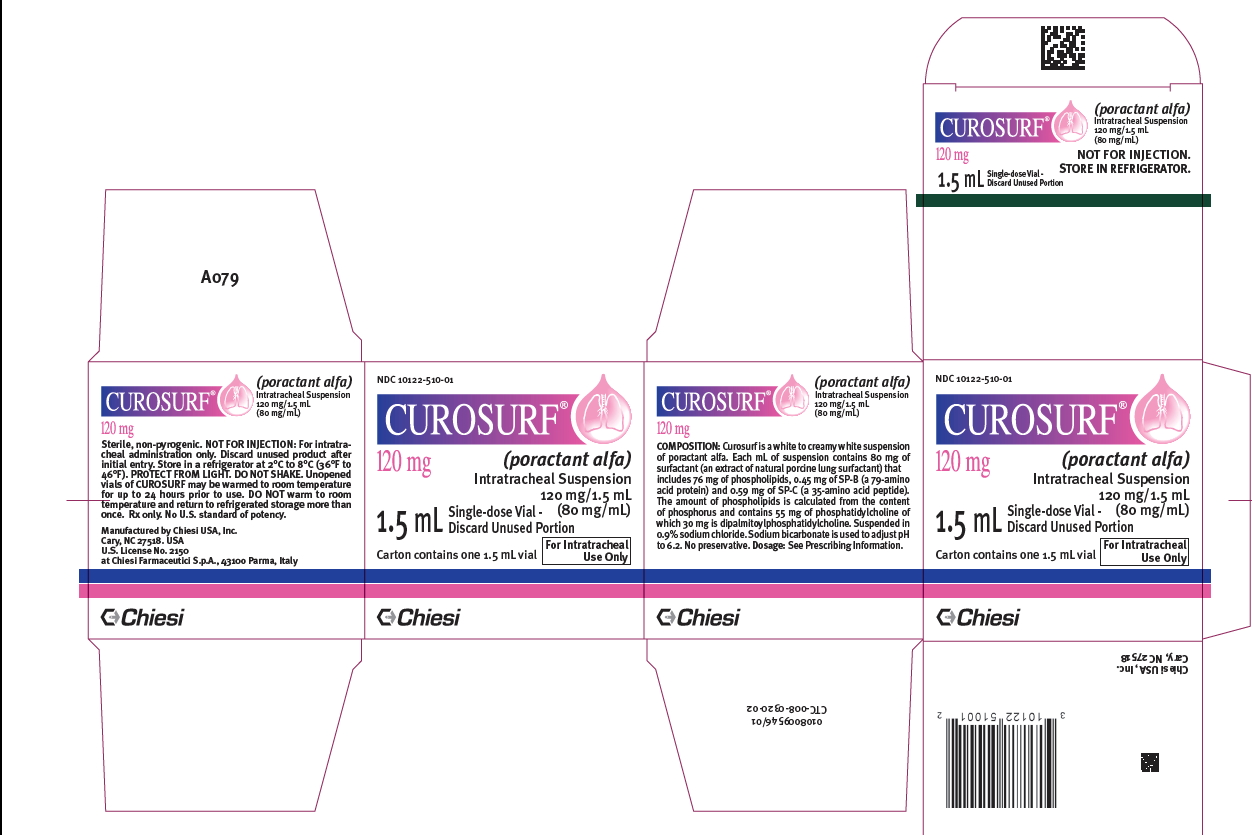
Curosurf 1.5mL carton
Reported adverse events (FAERS)
Top reported reactions
Age at onset
Reporter sex
Serious outcomes
Where does this data come from?
About this NDC listing & data coverage
What data is (and isn’t) available for this NDC — tap to expand
| NDC identity (package / product / labeler codes) | ✓ Available |
| Labeler | ✓ Available |
| Product & package description | ✓ Available |
| Marketing category & status | ✓ Available |
| Active ingredient / dosage form / route | ✓ Available |
| FDA label (SPL via DailyMed) | ✓ Available |
| Package photos | ✓ Available |
| Inactive ingredients (structured) | ✓ Available |
| NADAC pharmacy acquisition price (CMS) | — Not published for this NDC CMS publishes NADAC only for NDCs reported in its retail-pharmacy survey. |
| Orange Book / therapeutic-equivalence data | — Not published for this NDC Applies only to products approved under an NDA/ANDA; many listings are out of scope. |
| HCPCS J-code billing crosswalk | — Not published for this NDC Most self-administered / retail products have no J-code — that is normal. |
| Medicaid utilization (CMS SDUD) | — Not published for this NDC CMS reports utilization only for NDCs with Medicaid claims above its privacy threshold. |