
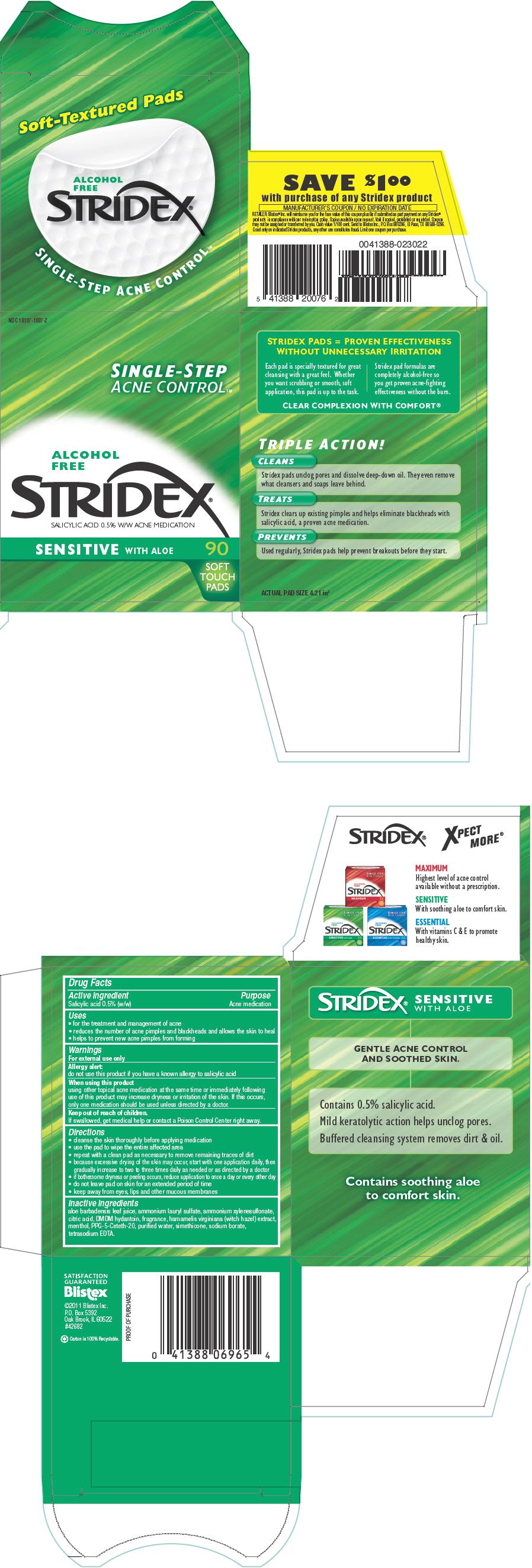
Stridex Sensitive Salicylic Acid .5 g/100mL Liquid — NDC 10157-1007-2 (Billing 10157-1007-02)
This is a package of Stridex Sensitive Salicylic Acid .5 g/100mL Liquid from Blistex Inc, marketed since Dec 2012 and currently FDA-listed.
NDC database record
One package, one record: these facts belong to NDC 10157-1007-2 alone.
- Record
- FDA NDC Directory package listing · Human OTC drug
- Code segments
- 10157 labeler · 1007 product · 2 package
- Package marketed since
- Dec 1, 2012
- Sample package
- No — commercial package
- Listing certified through
- Dec 31, 2026
- Barcode (UPC-A, from the NDC)
- 3 1015710072 1
- FDA record last changed
- Jul 24, 2026
Identity & classification
Regulatory identifiers FDA, NLM and CMS codes for this package
Drug-database identifiers Medi-Span GPI and First Databank GCN / HICL / AHFS classification
- GSN (GCN sequence number): 005763
- GCN: 22700
- GPI-14 (Medi-Span): 90750030004320
- HICL (First Databank): 002465
- AHFS class code: 84:28.00.00
Where does this data come from?
- FDA openFDA NDC Directory · synced Oct 8, 2026
- FDA label on DailyMed · label index refreshed Oct 8, 2026
- RxNorm (NLM RxNav) · catalog refreshed Oct 1, 2026
- Medi-Span GPI (licensed)
- First Databank (licensed) · refreshed Oct 8, 2026
Clinical
Stridex Sensitive is a topical liquid containing salicylic acid, marketed as an over-the-counter skin care product under FDA's OTC monograph rules. Salicylic acid is commonly used in acne and blemish treatment products where it functions as a keratolytic agent to help exfoliate the outer skin layer. This product is applied directly to the skin surface as part of a daily cleansing or treatment routine.
Patient education
Supplement & herbal interactions
Where does this data come from?
- MedlinePlus (NLM) · refreshed Oct 8, 2026
- FDA label on DailyMed · label index refreshed Oct 8, 2026
Ask a licensed pharmacist directly — free, answered by our team.
Pricing
A drug doesn't have one price. Each row is a different public payment system, and none is what you'd pay at the counter — that depends on your insurance. The ⓘ on each row explains what it measures.
| Price system | Per mL | Per package |
|---|---|---|
| Retail pharmacies payNADAC · weekly | Not in the retail survey — common for institutional, discontinued, or low-volume packs. | |
| Medicaid paysCMS SDUD · 12 mo | No recent Medicaid claims on file for this NDC — rare and low-volume NDCs are suppressed in the public data. | |
| Medicare drug plans payPart D · quarterly | No Part D plan price is available for this NDC in our data. | |
Where does this data come from?
- CMS NADAC weekly file
- CMS ASP pricing files · refreshed Sep 20, 2026
- CMS Medicaid State Drug Utilization Data · refreshed Oct 8, 2026
- CMS Part D plan pricing files · refreshed Sep 24, 2026
- VA National Acquisition Center price file
Packaging — all sizes for this product
| Package NDC | Description | Marketing start | Marketing end | Status |
|---|---|---|---|---|
| 10157-1007-01 10157-1007-1 Main listing | 1 JAR in 1 CARTON / 55 APPLICATOR in 1 JAR / 2 mL in 1 APPLICATOR | 2012-12-01 | — | Active |
| 10157-1007-02 You're viewing this | 1 JAR in 1 CARTON / 70 APPLICATOR in 1 JAR / 2 mL in 1 APPLICATOR | 2012-12-01 | — | Active |
| 10157-1007-03 10157-1007-3 | 1 JAR in 1 CARTON / 90 APPLICATOR in 1 JAR / 2 mL in 1 APPLICATOR | 2012-12-01 | — | Active |
| 10157-1007-04 10157-1007-4 | 1 JAR in 1 CARTON / 110 APPLICATOR in 1 JAR / 2 mL in 1 APPLICATOR | 2012-12-01 | — | Active |
Pack size FAQ
What quantity is in this package?
What NDC number is used to bill for this package of Stridex Sensitive Salicylic Acid .5 g/100mL Liquid?
Therapeutic equivalents
| Product | Labeler | Pack | NADAC/unit | TE | Status | Price vs. this |
|---|---|---|---|---|---|---|
| In the Clear Acne Serum .5 g/100mL 69366-0414-31 | The | 1 bottle | — | — | FDA listed | — |
| So Totally Clean Deep Pore Cleanser .5 g/100mL 70626-0104-21 | ASPIRE | 200 ml | — | — | FDA listed | — |
| Caring Mill Acne Clearing Cleanser .5 g/100mL 81522-0100-01 | FSA | 250 ml | — | — | FDA listed | — |
| Clear Smart Clarifying Cleansing Foam .5 g/100mL 68828-0244-01 | Distribuidora | 125 ml | — | — | FDA listed | — |
| Stridex Sensitive .5 g/100mLthis 10157-1007-02 | Blistex | 1 jar | — | — | FDA listed | — |
| Clear Smart Clear Complexion Toner .5 g/100mL 68828-0289-01 | Distribuidora | 200 ml | — | — | FDA listed | — |
| Clarifying Cleanser .5 g/100mL 70381-0128-02 | Murad, | 1 tube | — | — | FDA listed | — |
Where does this data come from?
- FDA openFDA NDC Directory · synced Oct 8, 2026
- FDA Orange Book · refreshed Oct 3, 2026
- CMS NADAC weekly file
Availability & generic status
We did not find an FDA-approved generic match for this exact strength, form and route.
Where does this data come from?
- FDA Orange Book · refreshed Oct 3, 2026
Inactive Ingredients / Excipients
Inactive ingredients, also called excipients, are components of the drug product other than the active ingredient. They may include fillers, dyes, coatings, preservatives, flavors, or other formulation ingredients.
💡 Tap an ingredient (hover on desktop) to see what it is and why it’s used.
-
UNII ZY81Z83H0X
Aloe vera leaf is a plant extract derived from the aloe plant. It is used in medicines as a natural moisturizer and skin-soothing agent in topical formulations.
-
UNII Q7AO2R1M0B
Ammonium lauryl sulfate is a mild detergent and foaming agent derived from plant oils. It helps mix water and oil-based ingredients together and creates a light foam in topical formulations like shampoos and cleansers.
-
UNII 4FZY6L6XCM
A synthetic compound derived from xylenol and ammonia. It functions as a solubilizing agent and surfactant, helping dissolve poorly water-soluble active ingredients and improve their absorption in the body.
-
UNII 2968PHW8QP
A weak organic acid derived from citrus fruits or made through fermentation. It works as a buffer to control pH, a preservative to extend shelf life, and a flavoring agent in medications.
-
UNII BYR0546TOW
DMDM hydantoin is a preservative chemical used to prevent the growth of bacteria and fungi in medicines. It helps keep the product safe and stable throughout its shelf life.
-
UNII MP1J8420LU
A salt derived from edetic acid that binds to trace metals in medicines. It serves as a chelating agent and preservative to prevent metal-catalyzed breakdown of the drug and extend shelf life.
-
UNII UDA30A2JJY
A plant extract from witch hazel used as an astringent and skin-conditioning agent in topical formulations. It helps tone and soothe the skin while functioning as a natural preservative.
-
UNII L7T10EIP3A
A cooling compound from mint plants used as a flavoring agent and to create a fresh sensation in medicines. It helps mask bitter tastes and improve how the product feels in the mouth.
-
UNII 4AAN25P8P4
A synthetic liquid derived from propylene glycol and cetyl alcohol, used as an emulsifier and solubilizer to help mix oil and water-based ingredients and keep the medicine uniform throughout.
-
UNII 91MBZ8H3QO
Sodium borate is an inorganic salt compound used in medicines as a buffer to help maintain a stable pH level, and sometimes as a mild preservative or cleansing agent in topical formulations.
-
UNII 059QF0KO0R
Water is a liquid solvent that dissolves and mixes ingredients together in liquid medicines, syrups, and injections. It helps distribute the active drug evenly throughout the product.
11 inactive ingredients listed in the exact product block matched to this NDC.
Label-section wording can be broader than the structured product block and may mention additional formulation ingredients.
Where does this data come from?
ingredient classCode="IACT" elements from the exact product block matched by this NDC. Label-section narrative from DailyMed / the openFDA label index is shown separately when available.- FDA label on DailyMed · label index refreshed Oct 8, 2026
- FDA openFDA NDC Directory · synced Oct 8, 2026
Inactive ingredient FAQ
Are inactive ingredients the same for every manufacturer?
Why might an inactive ingredient be missing?
Can inactive ingredients matter?
Manufacturer & labeler
More NDCs from Blistex Inc labeler code 10157
- Stridex Maximum SALICYLIC ACID 2 g/100mL Liquid NDC 10157-1006-1
- Blistex Medicated Lip Balm DIMETHICONE, OCTINOXATE, and OCTISALATE 2 g/100g; 6.6 g/100g; 4.4 g/100g Stick NDC 10157-1119-1
- Blistex Medicated Mint Balm DIMETHICONE, OCTINOXATE, and OCTISALATE 2 g/100g; 6.6 g/100g; 4.4 g/100g Stick NDC 10157-1120-1
- Blistex Medicated Berry Balm Dimethicone, Octinoxate, and Octisalate 2 g/100g; 6.6 g/100g; 4.4 g/100g Stick NDC 10157-1121-1
- Deep Renewal Broad Spectrum dimethicone, avobenzone, homosalate, and octisalate 2 g/100g; 3 g/100g; 9 g/100g; 4.4 g/100g Stick NDC 10157-1170-1
- Blistex Five Star Lip Protection Broad Spectrum Homosalate, Octisalate, Avobenzone, and Dimethicone 15 g/100g; 5 g/100g; 3 g/100g; 2 g/100g Stick NDC 10157-1171-1
- Repair and Protect Petrolatum 45 g/100g Stick NDC 10157-1189-1
Where does this data come from?
- FDA openFDA NDC Directory · synced Oct 8, 2026
- Drugs@FDA
FDA label — Drug Facts FDA SPL
🎯 Indications and Usage ▾
Uses for the treatment and management of acne reduces the number of acne pimples and blackheads and allows the skin to heal helps to prevent new acne pimples from forming
⏱️ Dosage and Administration ▾
Directions cleanse the skin thoroughly before applying medication use the pad to wipe the entire affected area repeat with a clean pad as necessary to remove remaining traces of dirt because excessive drying of the skin may occur, start with one application daily, then gradually increase to two to three times daily as needed or as directed by a doctor if bothersome dryness or peeling occurs, reduce application to once a day or every other day do not leave pad on skin for an extended period of time keep away from eyes, lips and other mucous membranes
⚠️ Warnings ▾
Warnings For external use only Allergy alert do not use this product if you have a known allergy to salicylic acid When using this product using other topical acne medication at the same time or immediately following use of this product may increase dryness or irritation of the skin. If this occurs, only one medication should be used unless directed by a doctor. Keep out of reach of children.
If swallowed, get medical help or contact a Poison Control Center right away.
🧪 Active Ingredient ▾
Active ingredient Salicylic acid 0.5% (w/w)
🧪 Inactive Ingredients ▾
Inactive ingredients aloe barbadensis leaf juice, ammonium lauryl sulfate, ammonium xylenesulfonate, citric acid, DMDM hydantoin, fragrance, hamamelis virginiana (witch hazel) extract, menthol, PPG-5-Ceteth-20, purified water, simethicone, sodium borate, tetrasodium EDTA.
🎯 Purpose ▾
Purpose Acne medication
📄 Do Not Use ▾
do not use this product if you have a known allergy to salicylic acid
📄 When Using This Product ▾
When using this product using other topical acne medication at the same time or immediately following use of this product may increase dryness or irritation of the skin. If this occurs, only one medication should be used unless directed by a doctor.
📄 Keep Out of Reach of Children ▾
Keep out of reach of children. If swallowed, get medical help or contact a Poison Control Center right away.
📄 Package Label / Principal Display Panel ▾
PRINCIPAL DISPLAY PANEL - 90 Pad Jar Carton NDC 10157-1007-2 SINGLE-STEP ACNE CONTROL ™ ALCOHOL FREE STRIDEX ® SALICYLIC ACID 0.5% W/W ACNE MEDICATION SENSITIVE WITH ALOE 90 SOFT TOUCH PADS Principal Display Panel - 90 Pad Jar Carton
Medicare Part D spend CMS · PART D · 2026 (Q1)
Reported adverse events (FAERS)
Top reported reactions
Age at onset
Reporter sex
Serious outcomes
Where does this data come from?
About this NDC listing & data coverage
What data is (and isn’t) available for this NDC — tap to expand
| NDC identity (package / product / labeler codes) | ✓ Available |
| Labeler | ✓ Available |
| Product & package description | ✓ Available |
| Marketing category & status | ✓ Available |
| Active ingredient / dosage form / route | ✓ Available |
| FDA label (SPL via DailyMed) | ✓ Available |
| Package photos | ✓ Available |
| Inactive ingredients (structured) | ✓ Available |
| NADAC pharmacy acquisition price (CMS) | — Not published for this NDC CMS publishes NADAC only for NDCs reported in its retail-pharmacy survey. |
| Orange Book / therapeutic-equivalence data | — Not published for this NDC Applies only to products approved under an NDA/ANDA; many listings are out of scope. |
| HCPCS J-code billing crosswalk | — Not published for this NDC Most self-administered / retail products have no J-code — that is normal. |
| Medicaid utilization (CMS SDUD) | — Not published for this NDC CMS reports utilization only for NDCs with Medicaid claims above its privacy threshold. |