
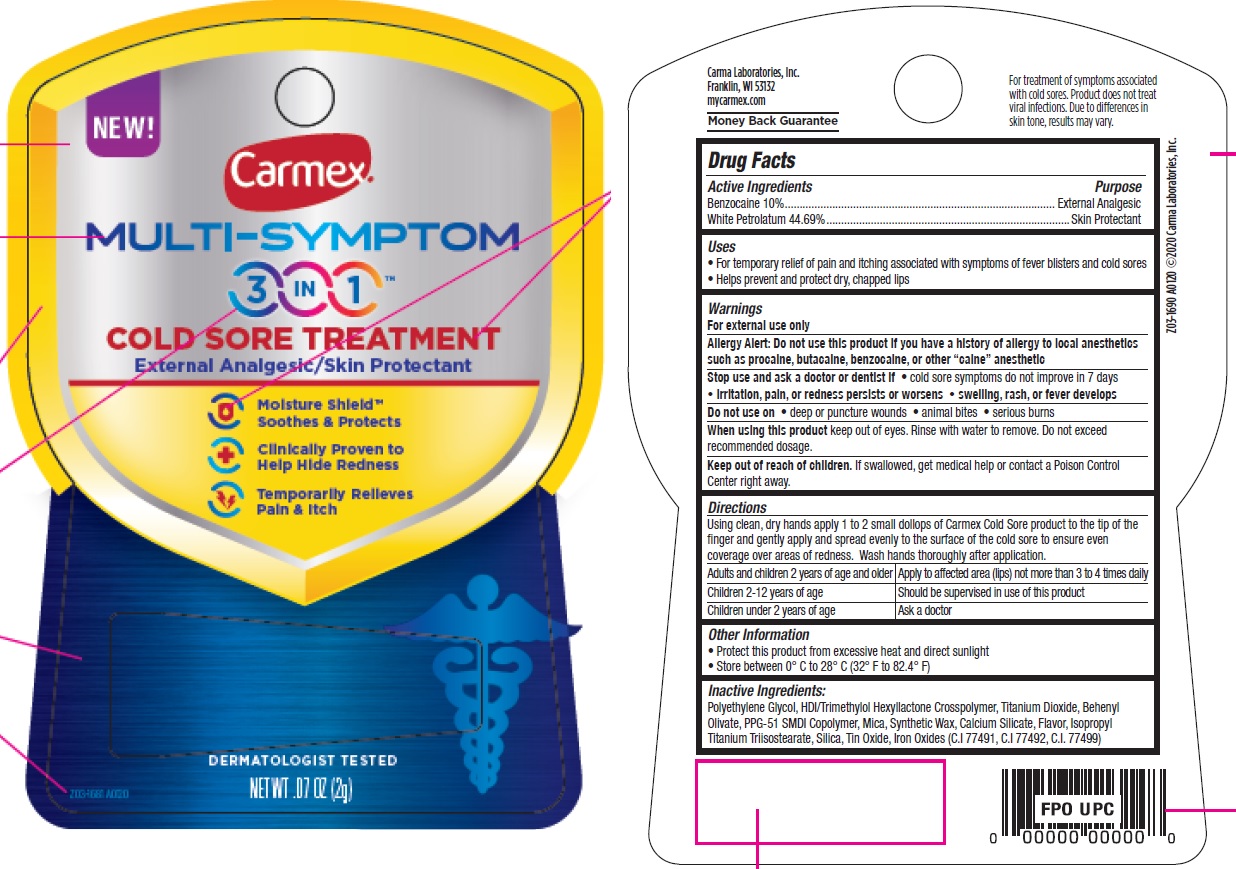
CARMEX Multi-Symptom 3 in 1 COLD Sore treatment External Analgesic Skin Protectant BENZOCAINE, WHITE PETROLATUM 100 mg/g; 446.9 mg/g Cream — NDC 10210-0048-1 (Billing 10210-0048-01)
This is a package of CARMEX Multi-Symptom 3 in 1 COLD Sore treatment External Analgesic Skin Protectant BENZOCAINE, WHITE PETROLATUM 100 mg/g; 446.9 mg/g Cream from Carma Laboratories, Inc., marketed since Jul 2020 and currently FDA-listed. It is this product's only package size.
NDC database record
One package, one record: these facts belong to NDC 10210-0048-1 alone.
- Record
- FDA NDC Directory package listing · Human OTC drug
- Code segments
- 10210 labeler · 0048 product · 1 package
- Package marketed since
- Jul 1, 2020
- Sample package
- No — commercial package
- Listing certified through
- Dec 31, 2026
- Barcode (UPC-A, from the NDC)
- 3 1021000481 2
- FDA record last changed
- Jul 24, 2026
Identity & classification
Regulatory identifiers FDA, NLM and CMS codes for this package
- RxCUI (RxNorm): 2479726
Where does this data come from?
- FDA openFDA NDC Directory · synced Oct 1, 2026
- FDA label on DailyMed · label index refreshed Oct 5, 2026
- RxNorm (NLM RxNav) · catalog refreshed Oct 1, 2026
- Medi-Span GPI (licensed)
- First Databank (licensed) · refreshed Oct 1, 2026
RxNorm drug class
This medicine belongs to the Standardized Chemical Allergen class.
Where does this data come from?
- RxClass (NLM) · catalog refreshed Oct 1, 2026
Clinical
This is a topical cream marketed for cold sore treatment. It contains benzocaine, a local anesthetic that is typically used to numb pain and discomfort on the skin surface, and white petrolatum, a skin protectant that is commonly used to help moisturize and protect affected areas. The product is sold as an over-the-counter monograph drug, meaning it follows established FDA guidelines for this category rather than being individually reviewed.
Patient education
Supplement & herbal interactions
Where does this data come from?
- MedlinePlus (NLM) · refreshed Oct 1, 2026
- FDA label on DailyMed · label index refreshed Oct 5, 2026
Ask a licensed pharmacist directly — free, answered by our team.
Pricing
A drug doesn't have one price. Each row is a different public payment system, and none is what you'd pay at the counter — that depends on your insurance. The ⓘ on each row explains what it measures.
| Price system | Per g | Per package |
|---|---|---|
| Retail pharmacies payNADAC · weekly | Not in the retail survey — common for institutional, discontinued, or low-volume packs. | |
| Medicaid paysCMS SDUD · 12 mo | No recent Medicaid claims on file for this NDC — rare and low-volume NDCs are suppressed in the public data. | |
| Medicare drug plans payPart D · quarterly | No Part D plan price is available for this NDC in our data. | |
Where does this data come from?
- CMS NADAC weekly file
- CMS ASP pricing files · refreshed Sep 20, 2026
- CMS Medicaid State Drug Utilization Data · refreshed Oct 5, 2026
- CMS Part D plan pricing files · refreshed Sep 24, 2026
- VA National Acquisition Center price file
Packaging — all sizes for this product
| Package NDC | Description | Marketing start | Marketing end | Status |
|---|---|---|---|---|
| 10210-0048-01 You're viewing this Main listing | 1 TUBE in 1 BLISTER PACK / 2 g in 1 TUBE | 2020-07-01 | — | Active |
Therapeutic equivalents
| Product | Labeler | Pack | NADAC/unit | TE | Status | Price vs. this |
|---|---|---|---|---|---|---|
| CARMEX Multi-Symptom 3 in 1 COLD Sore treatment External Analgesic Skin Protectant 100 mg/g; 446.9 mg/gthis 10210-0048-01 | Carma | 1 tube | — | — | FDA listed | — |
Where does this data come from?
- FDA openFDA NDC Directory · synced Oct 1, 2026
- FDA Orange Book · refreshed Oct 3, 2026
- CMS NADAC weekly file
Availability & generic status
We did not find an FDA-approved generic match for this exact strength, form and route.
Where does this data come from?
- FDA Orange Book · refreshed Oct 3, 2026
Inactive Ingredients / Excipients
Inactive ingredients, also called excipients, are components of the drug product other than the active ingredient. They may include fillers, dyes, coatings, preservatives, flavors, or other formulation ingredients.
💡 Tap an ingredient (hover on desktop) to see what it is and why it’s used.
-
UNII NGS1GGK4GW
A plant-derived emollient and emulsifier made from olive oil and behenic acid. It helps blend oil and water ingredients together in formulations and provides a smooth texture.
-
UNII S4255P4G5M
Calcium silicate is a white powder made from calcium and silicon compounds. It acts as an anti-caking agent and flow aid, helping powder ingredients move smoothly during tablet or capsule manufacturing.
-
UNII 1K09F3G675
Ferric oxide red is an inorganic iron compound used as a colorant in medicines. It gives tablets, capsules, or other dosage forms a red or reddish tint for identification and appearance.
-
UNII EX438O2MRT
Ferric oxide yellow is a naturally occurring iron compound used as a colorant in medications. It gives tablets, capsules, and other forms a yellow or golden hue for identification and appearance.
-
UNII XM0M87F357
A dark iron oxide compound that gives medicines their black or dark color. It's used as a colorant in tablets and capsules to help identify the product and make it visually distinctive.
-
UNII WB5K9Y35Y9
A synthetic crosslinked polymer made by combining hexamethylene diisocyanate with trimethylol hexyllactone. It's used as a film-former and binder to help create protective coatings on tablets or capsules and improve product stability.
-
UNII 949E3KBJ1I
Isopropyl titanium triisostearate is a titanium-based compound used in medicines as a glidant and anticaking agent. It helps powders and granules flow smoothly during manufacturing and prevents clumping in the finished product.
-
UNII V8A1AW0880
Mica is a naturally occurring mineral that's ground into fine powder. It's used in medicines as a colorant and anti-caking agent to improve appearance and prevent clumping in tablets or powders.
-
UNII 3WJQ0SDW1A
Polyethylene glycol is a synthetic liquid or solid polymer used in medicines as a solvent, lubricant, and humectant. It helps dissolve active ingredients, reduces friction during manufacturing, and retains moisture in the final product.
-
UNII KQ9JG3O3YA
A synthetic polymer made from propylene glycol and isocyanate compounds. It functions as a film-former and binder in medications, helping create protective coatings on tablets or holding ingredients together in solid dosage forms.
-
UNII ETJ7Z6XBU4
Silicon dioxide is a naturally occurring mineral used as a glidant and anti-caking agent. It helps powder ingredients flow smoothly and prevents clumping during manufacturing and storage.
-
UNII KM7N50LOS6
Tin oxide is an inorganic mineral compound used in medicines as a colorant and opacifying agent. It provides white or off-white color to tablets, capsules, and coatings while helping make formulations less transparent.
-
UNII 15FIX9V2JP
Titanium dioxide is a bright white mineral powder commonly used as a colorant and opacifying agent. It makes pills and tablets white or lighter in color and helps make coatings non-transparent.
13 inactive ingredients listed in the exact product block matched to this NDC.
Label-section wording can be broader than the structured product block and may mention additional formulation ingredients.
Where does this data come from?
ingredient classCode="IACT" elements from the exact product block matched by this NDC. Label-section narrative from DailyMed / the openFDA label index is shown separately when available.- FDA label on DailyMed · label index refreshed Oct 5, 2026
- FDA openFDA NDC Directory · synced Oct 1, 2026
Inactive ingredient FAQ
Are inactive ingredients the same for every manufacturer?
Why might an inactive ingredient be missing?
Can inactive ingredients matter?
Manufacturer & labeler
More NDCs from Carma Laboratories, Inc. labeler code 10210
- Carmex Daily Care Moisturizing Lip Balm SPF 15 Assorted OCTINOXATE, OXYBENZONE Kit NDC 10210-0041-1
- Carmex Daily Care Moisturizing Lip Balm SPF 15 Assorted OCTINOXATE, OXYBENZONE Kit NDC 10210-0042-1
- Carmex Daily Care Moisturizing Lip Balm Free Wintergreen and Fresh Cherry SPF 15 OCTINOXATE, OXYBENZONE Kit NDC 10210-0043-1
- Carmex Daily Care Moisturizing Lip Balm Favorites SPF 15 OCTINOXATE, OXYBENZONE Kit NDC 10210-0044-1
- Carmex Daily Care Moisturizing Lip Balm Sweets SPF 15 OCTINOXATE, OXYBENZONE Kit NDC 10210-0046-1
- Carmex Classic Lip Balm Medicated Free Wintergreen Stick OCTINOXATE, OXYBENZONE, CAMPHOR (SYNTHETIC), WHITE PETROLATUM Kit NDC 10210-0047-1
- Carmex Daily Care Moisturizing Lip Balm Holiday SPF 15 OCTINOXATE, OXYBENZONE Kit NDC 10210-0049-1
- Carmex Classic Lip Balm Medicated Triple Force Formula WHITE PETROLATUM 412.5 mg/g Salve NDC 10210-0053-1
- Carmex Classic Lip Balm Medicated Triple Force Formula WHITE PETROLATUM 453 mg/g Salve NDC 10210-0054-1
- Carmex Classic Lip Balm Medicated Lip Protectant WHITE PETROLATUM 453 mg/g Salve NDC 10210-0055-1
- Carmex Weather Guard Moisturizing Lip Balm SPF 30 AVOBENZONE, HOMOSALATE, OCTISALATE, OCTOCRYLENE, WHITE PETROLATUM 30 mg/g; 100 mg/g; 50 mg/g; 90 mg/g; 310 mg/g Salve NDC 10210-0056-1
- Carmex 10 Count Variety Pack SPF 15 Sunscreen OCTINOXATE, OXYBENZONE, PETROLATUM Kit NDC 10210-0057-1
Where does this data come from?
- FDA openFDA NDC Directory · synced Oct 1, 2026
- Drugs@FDA
FDA label — Drug Facts FDA SPL
🎯 Indications and Usage ▾
Uses • For temporary relief of pain and itching associated with symptoms of fever blisters and cold sores • Helps prevent and protect dry, chapped lips
⏱️ Dosage and Administration ▾
Directions Using clean, dry hands apply 1 to 2 small dollops of Carmex Cold Sore product to the tip of the finger and gently apply and spread evenly to the surface of the cold sore to ensure even coverage over areas of redness. Wash hands thoroughly after application. Adults and children 2 years of age and older Apply to affected area (lips) not more than 3 to 4 times daily Children 2-12 years of age Should be supervised in use of this product Children under 2 years of age Ask a doctor
⚠️ Warnings ▾
Warnings For external use only Allergy Alert: Do not use this product if you have a history of allergy to local anesthetics such as procaine, butacaine, benzocaine, or other “caine” anesthetic Stop use and ask a doctor or dentist if • cold sore symptoms do not improve in 7 days • irritation, pain, or redness persists or worsens • swelling, rash, or fever develops Do not use on • deep or puncture wounds • animal bites • serious burns When using this product keep out of eyes. Rinse with water to remove. Do not exceed recommended dosage.
Keep out of reach of children. If swallowed, get medical help or contact a Poison Control Center right away.
🧪 Active Ingredient ▾
Active Ingredients Benzocaine 10% White Petrolatum 44.69% Purpose External Analgesic Skin Protectant
🧪 Inactive Ingredients ▾
Inactive Ingredients: Polyethylene Glycol, HDI/Trimethylol Hexyllactone Crosspolymer, Titanium Dioxide, Behenyl Olivate, PPG-51 SMDI Copolymer, Mica, Synthetic Wax, Calcium Silicate, Flavor, Isopropyl Titanium Triisostearate, Silica, Tin Oxide, Iron Oxides (C.I 77491, C.I 77492, C.I. 77499)
🎯 Purpose ▾
Purpose External Analgesic Skin Protectant
📄 Do Not Use ▾
Do not use on • deep or puncture wounds • animal bites • serious burns
📄 When Using This Product ▾
When using this product keep out of eyes. Rinse with water to remove. Do not exceed recommended dosage.
📄 Stop Use and Ask a Doctor If ▾
Stop use and ask a doctor or dentist if • cold sore symptoms do not improve in 7 days • irritation, pain, or redness persists or worsens • swelling, rash, or fever develops
📄 Keep Out of Reach of Children ▾
Keep out of reach of children. If swallowed, get medical help or contact a Poison Control Center right away.
📄 Package Label / Principal Display Panel ▾
Package Labeling: Label4 Label5
About this NDC listing & data coverage
What data is (and isn’t) available for this NDC — tap to expand
| NDC identity (package / product / labeler codes) | ✓ Available |
| Labeler | ✓ Available |
| Product & package description | ✓ Available |
| Marketing category & status | ✓ Available |
| Active ingredient / dosage form / route | ✓ Available |
| FDA label (SPL via DailyMed) | ✓ Available |
| Package photos | ✓ Available |
| Inactive ingredients (structured) | ✓ Available |
| NADAC pharmacy acquisition price (CMS) | — Not published for this NDC CMS publishes NADAC only for NDCs reported in its retail-pharmacy survey. |
| Orange Book / therapeutic-equivalence data | — Not published for this NDC Applies only to products approved under an NDA/ANDA; many listings are out of scope. |
| HCPCS J-code billing crosswalk | — Not published for this NDC Most self-administered / retail products have no J-code — that is normal. |
| Medicaid utilization (CMS SDUD) | — Not published for this NDC CMS reports utilization only for NDCs with Medicaid claims above its privacy threshold. |