
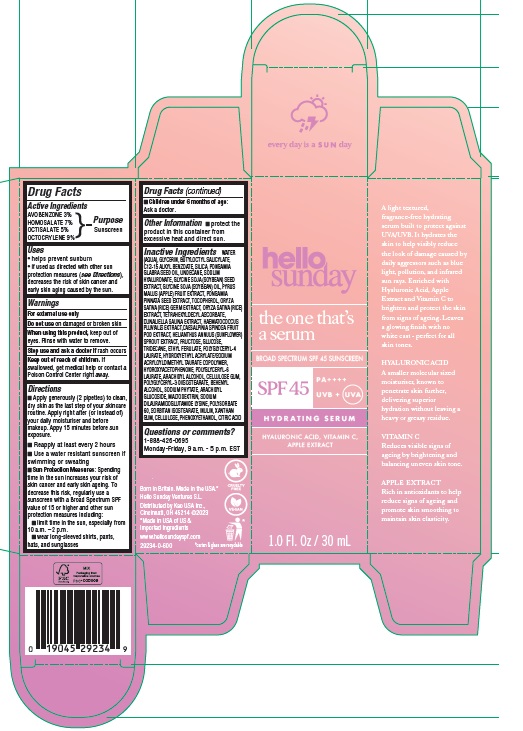
Hello Sunday The One Thats a Serum Hydrating Serum SPF 45 Avobenzone, Homosalate, Octisalate, Octocrylene 50 mg/mL; 90 mg/mL; 70 mg/mL; 30 mg/mL Emulsion
🆔 Identity & classification
Where does this data come from?
🏭 Manufacturer & labeler
Where does this data come from?
🩺 Clinical
Hello Sunday The One Thats a Serum is a topical emulsion sunscreen product marketed as an over-the-counter drug under FDA's monograph rules. It contains four active ingredients (avobenzone, homosalate, octisalate, and octocrylene) that function as ultraviolet light filters, commonly used in sunscreens to help protect skin from UVA and UVB radiation. The product is formulated as a hydrating serum with a sun protection factor of 45 and is applied to skin topically.
Patient education
Supplement & herbal interactions
Where does this data come from?
Ask a licensed pharmacist directly — free, answered by our team.
🧪 Inactive Ingredients / Excipients
Inactive ingredients, also called excipients, are components of the drug product other than the active ingredient. They may include fillers, dyes, coatings, preservatives, flavors, or other formulation ingredients.
💡 Tap an ingredient (hover on desktop) to see what it is and why it’s used.
-
UNII A9EJ3J61HQ
A synthetic liquid derived from benzoic acid and long-chain alcohols. It functions as a solvent and penetration enhancer in topical formulations, helping active ingredients dissolve and absorb into the skin.
-
UNII 5SL0G7R0OK
A simple sugar made from corn or other plants, used in medicines as a filler and sweetener. It helps create the right texture and taste in tablets, powders, and liquid formulations.
-
UNII B423VGH5S9
A natural fruit ingredient derived from apples, used as a flavoring agent and sweetener to improve taste and palatability of the medicine.
-
UNII 1QR1QRA9BU
A fatty alcohol derived from peanut oil or made synthetically. It serves as an emollient and thickener in creams and ointments, helping create smooth texture and improve product consistency.
-
UNII 6JVW35JOOJ
Arachidyl glucoside is a plant-derived emulsifier and skin-conditioning agent made from arachidyl alcohol and glucose. It helps mix oil and water-based ingredients together in formulations and improves product texture and spreadability.
-
UNII 2EH13UN8D3
A synthetic compound used as a solvent and penetration enhancer in topical formulations. It helps dissolve active ingredients and allows them to penetrate the skin more effectively.
-
UNII EXY4496LWD
A plant-derived ingredient from the pods of the Caesalpinia spinosa tree, native to South America. It's used as a natural thickener, binder, and source of fiber in formulations.
-
UNII K679OBS311
Carboxymethylcellulose sodium is a plant-derived thickening agent made from cellulose. In medicines, it acts as a binder to hold ingredients together, a disintegrant to help the tablet break apart, or a thickener in liquids.
-
UNII 2968PHW8QP
A weak organic acid derived from citrus fruits or made through fermentation. It works as a buffer to control pH, a preservative to extend shelf life, and a flavoring agent in medications.
-
UNII 9G1OE216XY
Docosanol is a waxy, fatty alcohol derived from plant sources. It acts as an emollient and thickener in topical medicines, helping to soften the skin and improve product texture and stability.
-
UNII F4O1DKI9A6
A type of algae used as a natural colorant and source of beta-carotene (which gives products an orange-yellow color). It helps color the medication and may provide antioxidant properties to the formulation.
-
UNII 5B8915UELW
A plant-derived compound used as an antioxidant in medicines. It helps prevent spoilage and degradation of active ingredients during storage by protecting them from oxidative damage.
-
UNII 6YSS42VSEV
Fructose is a natural sugar derived from fruits and plants. It's used in medicines as a sweetener and filler to improve taste and add bulk to tablets or syrups.
-
UNII PDC6A3C0OX
Glycerin is a clear, thick liquid derived from plant oils or fats. It acts as a humectant to retain moisture, a sweetener, and a solvent in medications.
-
UNII 31T0FF0472
A red microalgae used as a natural colorant and source of astaxanthin pigment in medications and supplements. It adds color to tablets and capsules.
-
UNII 4P26HG1S5W
A plant extract from sunflower sprouts used in formulations as an antioxidant and preservative to help maintain product stability and prevent degradation of active ingredients.
-
UNII YSE9PPT4TH
Hyaluronate sodium is a natural carbohydrate that holds moisture. It's used in medicines as a lubricant, thickener, and moisture-retaining agent to improve texture and delivery of the active ingredient.
-
UNII G1L3HT4CMH
A synthetic compound used in medicines as a preservative and antimicrobial agent. It helps prevent bacterial and fungal growth, extending the product's shelf life.
-
UNII 86FQE96TZ4
A synthetic polymer, this ingredient acts as a thickener and suspending agent in liquid formulations. It helps maintain uniform consistency and keeps particles evenly distributed throughout the medicine.
-
UNII JOS53KRJ01
Inulin is a fiber derived from plants like chicory root. It acts as a filler and binder in medicines to add bulk and help hold tablets together.
-
UNII 62160PU6FJ
A natural oil derived from caraway seeds, used as a flavoring agent and solvent to improve taste and help dissolve or mix other ingredients in the medicine.
-
UNII 7CVR7L4A2D
A starch-derived carbohydrate produced by breaking down corn, potato, or tapioca starch. It functions as a filler and binder to give the medicine bulk and texture, and sometimes as a mild sweetener or texture enhancer in powders and tablets.
-
UNII HIE492ZZ3T
Phenoxyethanol is a synthetic preservative and antimicrobial agent used to prevent bacterial and fungal growth in medicines and cosmetic products, extending shelf life and maintaining product safety.
-
UNII 88496G1ERL
Sodium phytate is a plant-derived salt used in medications as a chelating agent and preservative. It helps stabilize formulations and may improve how the body absorbs certain minerals in the medicine.
-
UNII 46P231IQV8
A synthetic emulsifier derived from glycerin and fatty acids. It helps blend oil and water-based ingredients together in cosmetic and pharmaceutical formulations to create stable, uniform products.
-
UNII 82V7NG3DYT
A surfactant derived from glycerin and lauric acid. It helps blend oil and water-based ingredients together and aids in distributing active ingredients evenly throughout the formulation.
-
UNII Q48X4BL3TV
A synthetic emulsifier made from plant-derived glycerin and lauric acid. It helps blend oil and water-based ingredients together in creams and lotions for smooth, uniform texture.
-
UNII CAL22UVI4M
A synthetic emulsifier derived from sorbitol and fatty acids. It helps mix oil and water-based ingredients together and improves the texture and stability of the medicine.
-
UNII C2BRV53B1V
A plant-derived oil from pongamia seeds used as an emollient and skin-conditioning agent in topical formulations. It helps soften and smooth the product texture while improving how it spreads on skin.
-
UNII SMD1X3XO9M
Powdered cellulose is a fine, plant-based powder made from purified wood fibers. In medicines, it acts as a filler to add bulk and volume, and helps tablets or capsules hold together during manufacturing and storage.
-
UNII 7N2B70SFEZ
Rice germ is the nutrient-rich inner layer of the rice grain. It's used in medicines as a filler and bulking agent to add volume and help bind ingredients together in tablets and capsules.
-
UNII ETJ7Z6XBU4
Silicon dioxide is a naturally occurring mineral used as a glidant and anti-caking agent. It helps powder ingredients flow smoothly and prevents clumping during manufacturing and storage.
-
UNII MNJ7VPT2R5
A synthetic compound derived from amino acids and fatty acids, used as an emulsifier and surfactant. It helps blend oil and water-based ingredients together in formulations.
-
UNII 01S2G2C1E4
Sorbitan isostearate is an emulsifier derived from sorbitol and isostearic acid. It helps mix oil and water-based ingredients together and keeps them blended throughout the medicine's shelf life.
-
UNII L7HT8F1ZOD
A plant-based oil extracted from soybeans. It's used as an emulsifier and lubricant to help mix ingredients evenly and prevent sticking during tablet or capsule manufacturing.
-
UNII 241ATL177A
Soybean oil is a natural plant oil derived from soybean seeds. It's used in medicines as a solvent and carrier to help dissolve or suspend active ingredients and improve how the body absorbs them.
-
UNII 9LBV3F07AZ
A synthetic, oil-soluble form of vitamin C used as an antioxidant to prevent degradation of the medicine and maintain its stability during storage.
-
UNII R0ZB2556P8
Tocopherol is a form of vitamin E derived from plant oils. It acts as an antioxidant in medicines to prevent oils and fats from breaking down and spoiling during storage.
-
UNII A3LZF0L939
Tridecane is a clear, colorless liquid hydrocarbon derived from petroleum. It acts as a solvent and lubricant in medicines, helping distribute active ingredients evenly and reducing friction during manufacturing and tablet compression.
-
UNII JV0QT00NUE
Undecane is a clear liquid hydrocarbon derived from petroleum. It functions as a solvent and processing aid in medicines, helping dissolve or suspend active ingredients and improve how the drug is manufactured and delivered.
-
UNII 059QF0KO0R
Water is a liquid solvent that dissolves and mixes ingredients together in liquid medicines, syrups, and injections. It helps distribute the active drug evenly throughout the product.
-
UNII TTV12P4NEE
Xanthan gum is a thickening and stabilizing ingredient made from fermented corn or other sugars. It's added to medicines to improve texture, prevent separation of liquids and solids, and help the product stay consistent.
42 inactive ingredients listed in the exact product block matched to this NDC.
Label-section wording can be broader than the structured product block and may mention additional formulation ingredients.
Where does this data come from?
ingredient classCode="IACT" elements from the exact product block matched by this NDC. Label-section narrative from DailyMed / the openFDA label index is shown separately when available.Inactive ingredient FAQ
Are inactive ingredients the same for every manufacturer?
Why might an inactive ingredient be missing?
Can inactive ingredients matter?
💲 Pricing
A drug doesn't have one price. Each row is a different public payment system, and none is what you'd pay at the counter — that depends on your insurance. The ⓘ on each row explains what it measures.
| Price system | Per mL | Per package |
|---|---|---|
| Retail pharmacies payNADAC · weekly | Not in the retail survey — common for institutional, discontinued, or low-volume packs. | |
| Medicaid paysCMS SDUD · 12 mo | No recent Medicaid claims on file for this NDC — rare and low-volume NDCs are suppressed in the public data. | |
| Medicare drug plans payPart D · quarterly | No Part D plan price is available for this NDC in our data. | |
Where does this data come from?
🔁 Therapeutic equivalents
| Product | Labeler | Pack | NADAC/unit | TE | Status | Price vs. this |
|---|---|---|---|---|---|---|
| Hello Sunday The One Thats a Serum Hydrating Serum SPF 45 50 mg/mL; 90 mg/mL; 70 mg/mL; 30 mg/mLthis 10596-0803-01 | Kao | 1 bottle | — | — | FDA listed | — |
Where does this data come from?
⏳ Availability & generic status
We did not find an FDA-approved generic match for this exact strength, form and route.
Where does this data come from?
📦 Packaging — all sizes for this product
| Package NDC | Description | Marketing start | Status |
|---|---|---|---|
| 10596-0803-01 You're viewing this | 1 BOTTLE in 1 CARTON (10596-803-01) / 30 mL in 1 BOTTLE | 2024-02-01 | Active |
🧭 About this NDC listing & data coverage
What data is (and isn’t) available for this NDC — tap to expand
| NDC identity (package / product / labeler codes) | ✓ Available |
| Labeler | ✓ Available |
| Product & package description | ✓ Available |
| Marketing category & status | ✓ Available |
| Active ingredient / dosage form / route | ✓ Available |
| FDA label (SPL via DailyMed) | ✓ Available |
| Package photos | ✓ Available |
| Inactive ingredients (structured) | ✓ Available |
| NADAC pharmacy acquisition price (CMS) | — Not published for this NDC CMS publishes NADAC only for NDCs reported in its retail-pharmacy survey. |
| Orange Book / therapeutic-equivalence data | — Not published for this NDC Applies only to products approved under an NDA/ANDA; many listings are out of scope. |
| HCPCS J-code billing crosswalk | — Not published for this NDC Most self-administered / retail products have no J-code — that is normal. |
| Medicaid utilization (CMS SDUD) | — Not published for this NDC CMS reports utilization only for NDCs with Medicaid claims above its privacy threshold. |
Questions about this listing
Is this NDC FDA-approved?
Why is there no price listed?
Is the NDC printed on the package the same as the 11-digit billing NDC?
What do the three segments of this NDC mean?
Is this package still being marketed?
Who lists this product with the FDA?
Do I need a prescription for this product?
Where does this data come from?
📄 FDA label — Drug Facts FDA SPL
🎯 Indications and Usage ▾
Uses helps prevent sunburn if used as directed with other sun protection measures ( see Directions ), decreases the risk of skin cancer and early skin ageing caused by the sun.
⏱️ Dosage and Administration ▾
Directions Apply generously (2 pipettes) to clean, dry skin as the last step of your skincare routine. Apply right after (or instead of) your daily moisturiser and before makeup. Appy 15 minutes before sun exposure.
Reapply at least every 2 hours. Use a water resistant sunscreen if swimming or sweating Sun Protection Measures : Spending time in the sun increases your risk of skin cancer and early skin ageing. To decrease this risk, regularly use a sunscreen with a Broad Spectrum SPF value of 15 or higher and other sun protection measures including: limit time in the sun, especially from 10 a.m. – 2 p.m. wear long-sleeved shirts, pants, hats, and sunglasses Children under 6 months of age : Ask a doctor.
⚠️ Warnings ▾
Warnings For external use only Do not use on damaged or broken skin Stop use and ask a doctor if rash occurs When using this product keep out of eyes. Rinse with water to remove. Keep out of reach of children. If swallowed, get medical help or contact a Poison Control Center right away.
🧪 Active Ingredient ▾
Active Ingredients AVOBENZONE 3% HOMOSALATE 7% OCTISALATE 5% OCTOCRYLENE 9%
🧪 Inactive Ingredients ▾
Inactive Ingredients WATER (AQUA), GLYCERIN, BUTYLOCTYL SALICYLATE, C12-15 ALKYL BENZOATE, SILICA, PONGAMIA GLABRA SEED OIL, UNDECANE, SODIUM HYALURONATE, GLYCINE SOJA (SOYBEAN) SEED EXTRACT, GLYCINE SOJA (SOYBEAN) OIL, PYRUS MALUS (APPLE) FRUIT EXTRACT, PONGAMIA PINNATA SEED EXTRACT, TOCOPHEROL, ORYZA SATIVA (RICE) GERM EXTRACT, ORYZA SATIVA (RICE) EXTRACT, TETRAHEXYLDECYL ASCORBATE, DUNALIELLA SALINA EXTRACT, HAEMATOCOCCUS PLUVIALIS EXTRACT, CAESALPINIA SPINOSA FRUIT POD EXTRACT, HELIANTHUS ANNUUS (SUNFLOWER) SPROUT EXTRACT, FRUCTOSE, GLUCOSE, TRIDECANE, ETHYL FERULATE, POLYGLYCERYL-4 LAURATE, HYDROXYETHYL ACRYLATE/SODIUM ACRYLOYLDIMETHYL TAURATE COPOLYMER, HYDROXYACETOPHENONE, POLYGLYCERYL-6 LAURATE, ARACHIDYL ALCOHOL, CELLULOSE GUM, POLYGLYCERYL-3 DIISOSTEARATE, BEHENYL ALCOHOL, SODIUM PHYTATE, ARACHIDYL GLUCOSIDE, MALTODEXTRIN, SODIUM DILAURAMIDOGLUTAMIDE LYSINE, POLYSORBATE 60, SORBITAN ISOSTEARATE, INULIN, XANTHAN GUM, CELLULOSE, PHENOXYETHANOL, CITRIC ACID
🎯 Purpose ▾
Purpose Sunscreen