
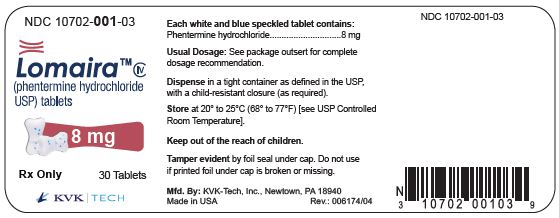
LOMAIRA Phentermine Hydrochloride 8 mg Tablet, 90-count
Other active recalls for Phentermine Hydrochloride (different manufacturers) — 1 · tap to view
🆔 Identity & classification
Where does this data come from?
🏷️ RxNorm drug class
This medicine belongs to the Sympathomimetic Amine Anorectic class.
Where does this data come from?
🏭 Manufacturer & labeler
Where does this data come from?
🩺 Clinical
Phentermine is used for a limited period of time to speed weight loss in overweight people who are exercising and eating a low-calorie diet. Phentermine is in a class of medications called anorectics. It works by decreasing appetite.
Read the full MedlinePlus article ↗- Phentermine works by suppressing your appetite, which can help you eat less as part of a calorie-controlled plan. But it is not a magic pill — it's meant to be used alongside a red...
- What exactly is phentermine supposed to do, and will it make me lose weight on its own?
- Most phentermine capsules and tablets are taken once a day — either before breakfast or within a couple of hours of breakfast. You can take them with or without food. The one excep...
- The most common ones people notice are dry mouth, trouble sleeping, feeling jittery or restless, a faster heartbeat, and sometimes constipation or stomach upset. Those are usually...
Patient education
Supplement & herbal interactions
Where does this data come from?
Ask a licensed pharmacist directly — free, answered by our team.
💊 What it looks like
Where does this data come from?
🧪 Inactive Ingredients / Excipients
Inactive ingredients, also called excipients, are components of the drug product other than the active ingredient. They may include fillers, dyes, coatings, preservatives, flavors, or other formulation ingredients.
💡 Tap an ingredient (hover on desktop) to see what it is and why it’s used.
-
UNII OP1R32D61U
Microcrystalline cellulose is a purified form of cellulose, a natural fiber from plant sources. It acts as a binder and filler in tablets and capsules, helping hold ingredients together and give the medicine its shape and size.
-
UNII H3R47K3TBD
FD&C Blue No. 1 is a synthetic blue dye approved for use in foods and medicines. It serves as a colorant to give the medication its distinctive appearance and help with product identification.
-
UNII 70097M6I30
Magnesium stearate is a salt made from magnesium and stearic acid, a fatty substance. It's used in tablets and capsules as a lubricant and glidant to help ingredients flow smoothly during manufacturing and prevent sticking.
-
UNII O8232NY3SJ
A plant-based carbohydrate derived from corn kernels. It acts as a filler to add bulk, a binder to hold ingredients together, and a disintegrant to help the tablet break apart in your stomach for absorption.
-
UNII 4ELV7Z65AP
Stearic acid is a fatty acid derived from plant or animal sources. It acts as a binder and lubricant in tablets and capsules, helping them hold together and flow smoothly during manufacturing.
-
UNII C151H8M554
A natural sugar derived from sugar cane or sugar beets. It's used as a sweetener, filler, and binder to improve taste, add bulk, and help hold tablet or capsule ingredients together.
6 inactive ingredients listed in the exact product block matched to this NDC.
Where does this data come from?
ingredient classCode="IACT" elements from the exact product block matched by this NDC. Label-section narrative from DailyMed / the openFDA label index is shown separately when available.Inactive ingredient FAQ
Are inactive ingredients the same for every manufacturer?
Why might an inactive ingredient be missing?
Can inactive ingredients matter?
💲 Pricing
A drug doesn't have one price. Each row is a different public payment system, and none is what you'd pay at the counter — that depends on your insurance. The ⓘ on each row explains what it measures.
| Price system | Per ea | Per package |
|---|---|---|
| Retail pharmacies payNADAC · weekly | $0.616 | $55.44 / 90 tablets |
| Medicaid paysCMS SDUD · 12 mo | $0.6353 | $57.18 / 90 tablets |
| Medicare drug plans payPart D · quarterly | No Part D plan price is available for this NDC in our data. | |
Where does this data come from?
🔁 Therapeutic equivalents
| Product | Labeler | Pack | NADAC/unit | TE | Status | Price vs. this |
|---|---|---|---|---|---|---|
| Lomaira 8 mgthis 10702-0001-09 | KVK-TECH, | 90 tablets | $0.616 | AA | Availability likely | — |
| Phentermine Hydrochloride 8 mg 62135-0959-90 | Chartwell | 90 tablets | $0.616 | — | Availability likely | — |
| Phentermine Hydrochloride 8 mg 10702-0067-03 | KVK-TECH, | 30 tablets | — | AA | FDA listed | — |
| Lomaira 8 mg 17224-0840-28 | Calvin | 28 tablets | — | AA | FDA listed | — |
| Lomaira 8 mg 50090-7560-00 | A-S | 90 tablets | — | AA | Discontinued | — |
Where does this data come from?
⏳ Availability & generic status
This product is an FDA-approved generic. Other versions of the same drug are listed under Therapeutic equivalents, least expensive first.
Where does this data come from?
🗺️ Medicaid utilization & spend
💊 Medicaid utilization by pack size
🔬 Reported adverse events (FAERS)
Top reported reactions
Age at onset
Reporter sex
Serious outcomes
Where does this data come from?
📦 Packaging — all sizes for this product
| Package NDC | Description | Per unit | Per pack | Marketing start | Status |
|---|---|---|---|---|---|
| 10702-0001-03 | 30 TABLET in 1 BOTTLE (10702-001-03) | — | — | 2016-09-12 | Active |
| 10702-0001-06 | 60 TABLET in 1 BOTTLE (10702-001-06) | — | — | 2016-09-12 | Active |
| 10702-0001-09 You're viewing this | 90 TABLET in 1 BOTTLE (10702-001-09) | $0.6160 / ea | $55.44 | 2016-09-12 | Active |
| 10702-0001-10 | 1000 TABLET in 1 BOTTLE (10702-001-10) | — | — | 2016-09-12 | Active |
| 10702-0001-25 | 250 TABLET in 1 BOTTLE (10702-001-25) | — | — | 2016-09-12 | Active |
| 10702-0001-50 | 500 TABLET in 1 BOTTLE (10702-001-50) | — | — | 2016-09-12 | Active |
You're viewing one of 6 pack sizes for this product.
In Medicaid, this is the most-dispensed pack of this product — about 100% of fills over the last four reported quarters. See all packs ↓
Pack size FAQ
What quantity is in NDC 10702-0001-09?
What is the difference between NDC 10702-0001-09 and NDC 10702-0001-03?
What NDC number is used to bill for this package of LOMAIRA Phentermine Hydrochloride 8 mg Tablet?
Prices are the latest CMS NADAC pharmacy acquisition cost per NDC; per-pack figures are per-unit × pack quantity, shown only when the pack is denominated in the same measure NADAC prices.
📄 Full prescribing information FDA SPL
🎯 Indications and Usage ▾
INDICATIONS AND USAGE LOMAIRA™ tablets are indicated as a short-term (a few weeks) adjunct in a regimen of weight reduction based on exercise, behavioral modification and caloric restriction in the management of exogenous obesity in patients with an initial body mass index greater than or equal to 30 kg/m 2 , or greater than or equal to 27 kg/m 2 in the presence of other risk factors (e.g., controlled hypertension, diabetes, hyperlipidemia). Below is a chart of body mass index (BMI) based on various heights and weights.
BMI is calculated by taking the patient’s weight, in kilograms (kg), divided by the patient’s height, in meters (m), squared. Metric conversions are as follows: pounds ÷ 2.2 = kg; inches x 0.0254 = meters. BODY MASS INDEX (BMI), kg/m 2 The limited usefulness of agents of this class, including phentermine (see Clinical Pharmacology ), should be measured against possible risk factors inherent in their use such as those described below. table
⏱️ Dosage and Administration ▾
DOSAGE AND ADMINISTRATION Dosage should be individualized to obtain an adequate response with the lowest effective dose. The usual adult dose is one tablet three times a day ½ hour before meals. This tablet is scored to facilitate administering one half of the usual dosage for patients not requiring the full dose.
Phentermine hydrochloride is not recommended for use in pediatric patients less than or equal to 16 years of age. Late evening medication should be avoided because of the possibility of resulting insomnia.
⛔ Contraindications ▾
CONTRAINDICATIONS • History of cardiovascular disease (e.g., coronary artery disease, stroke, arrhythmias, congestive heart failure, uncontrolled hypertension) • During or within 14 days following the administration of monoamine oxidase inhibitors • Hyperthyroidism • Glaucoma • Agitated states • History of drug abuse • Pregnancy (see Precautions ) • Nursing (see Precautions ) • Known hypersensitivity, or idiosyncrasy to the sympathomimetic amines
⚠️ Warnings ▾
WARNINGS Coadministration with Other Drug Products for Weight Loss LOMAIRA™ tablets are indicated only as short-term (a few weeks) monotherapy for the management of exogenous obesity. The safety and efficacy of combination therapy with phentermine and any other drug products for weight loss including prescribed drugs, over-the-counter preparations, and herbal products, or serotonergic agents such as selective serotonin reuptake inhibitors (e.g., fluoxetine, sertraline, fluvoxamine, paroxetine), have not been established.
Therefore, coadministration of phentermine and these drug products is not recommended. Primary Pulmonary Hypertension Primary Pulmonary Hypertension (PPH) – a rare, frequently fatal disease of the lungs – has been reported to occur in patients receiving a combination of phentermine with fenfluramine or dexfenfluramine. The possibility of an association between PPH and the use of phentermine alone cannot be ruled out; there have been rare cases of PPH in patients who reportedly have taken phentermine alone.
The initial symptom of PPH is usually dyspnea. Other initial symptoms may include angina pectoris, syncope or lower extremity edema. Patients should be advised to report immediately any deterioration in exercise tolerance.
Treatment should be discontinued in patients who develop new, unexplained symptoms of dyspnea, angina pectoris, syncope or lower extremity edema, and patients should be evaluated for the possible presence of pulmonary hypertension. Valvular Heart Disease Serious regurgitant cardiac valvular disease, primarily affecting the mitral, aortic and/or tricuspid valves, has been reported in otherwise healthy persons who had taken a combination of phentermine with fenfluramine or dexfenfluramine for weight loss. The possible role of phentermine in the etiology of these valvulopathies has not been established and their course in individuals after the drugs are stopped is not known.
The possibility of an association between valvular heart disease and the use of phentermine alone cannot be ruled out; there have been rare cases of valvular heart disease in patients who reportedly have taken phentermine alone. Development of Tolerance, Discontinuation in Case of Tolerance When tolerance to the anorectant effect develops, the recommended dose should not be exceeded in an attempt to increase the effect; rather, the drug should be discontinued. Effect on the Ability to Engage in Potentially Hazardous Tasks Phentermine may impair the ability of the patient to engage in potentially hazardous activities such as operating machinery or driving a motor vehicle; the patient should therefore be cautioned accordingly.
Risk of Abuse and Dependence Phentermine is related chemically and pharmacologically to amphetamine (d- and dll-amphetamine) and other related stimulant drugs have been extensively abused. The possibility of abuse of phentermine should be kept in mind when evaluating the desirability of including a drug as part of a weight reduction program. See Adverse Reactions / Drug Abuse and Dependence and Overdosage .
The least amount feasible should be prescribed or dispensed at one time in order to minimize the possibility of overdosage. Usage with Alcohol Concomitant use of alcohol with phentermine may result in an adverse drug reaction. Use in Patients with Hypertension Use caution in prescribing phentermine for patients with even mild hypertension (risk of increase in blood pressure).
Use in Patients on Insulin or Oral Hypoglycemic Medications for Diabetes Mellitus A reduction in insulin or oral hypoglycemic medications in patients with diabetes mellitus may be required.
🤒 Adverse Reactions ▾
ADVERSE REACTIONS The following adverse reactions are described, or described in greater detail, in other sections: - Primary pulmonary hypertension (see Warnings ) - Valvular heart disease (see Warnings ) - Effect on the ability to engage in potentially hazardous tasks (see Warnings ) - Withdrawal effects following prolonged high dosage administration (see Drug Abuse and Dependence ) The following adverse reactions to phentermine have been identified: Cardiovascular Primary pulmonary hypertension and/or regurgitant cardiac valvular disease, palpitation, tachycardia, elevation of blood pressure, ischemic events.
Central Nervous System Overstimulation, restlessness, dizziness, insomnia, euphoria, dysphoria, tremor, headache, psychosis. Gastrointestinal Dryness of the mouth, unpleasant taste, diarrhea, constipation, other gastrointestinal disturbances. Allergic Urticaria.
Endocrine Impotence, changes in libido.
🆘 Overdosage ▾
OVERDOSAGE The least amount feasible should be prescribed or dispensed at one time in order to minimize the possibility of overdosage. Acute Overdosage Manifestations of acute overdosage include restlessness, tremor, hyperreflexia, rapid respiration, confusion, assaultiveness, hallucinations, and panic states. Fatigue and depression usually follow the central stimulation.
Cardiovascular effects include arrhythmia, hypertension or hypotension, and circulatory collapse. Gastrointestinal symptoms include nausea, vomiting, diarrhea and abdominal cramps. Overdosage of pharmacologically similar compounds has resulted in fatal poisoning usually terminates in convulsions and coma.
Management of acute phentermine hydrochloride intoxication is largely symptomatic and includes lavage and sedation with a barbiturate. Experience with hemodialysis or peritoneal dialysis is inadequate to permit recommendations in this regard. Acidification of the urine increases phentermine excretion.
Intravenous phentolamine (Regitine ® , CIBA) has been suggested on pharmacologic grounds for possible acute, severe hypertension, if this complicates overdosage. Chronic Intoxication Manifestations of chronic intoxication with anorectic drugs include severe dermatoses, marked insomnia, irritability, hyperactivity and personality changes. The most severe manifestation of chronic intoxications is psychosis, often clinically indistinguishable from schizophrenia.
See Drug Abuse and Dependence .
🧬 Clinical Pharmacology ▾
CLINICAL PHARMACOLOGY Mechanism of Action Phentermine is a sympathomimetic amine with pharmacologic activity similar to the prototype drugs of this class used in obesity, amphetamine (d- and dll-amphetamine). Drugs of this class used in obesity are commonly known as “anorectics” or “anorexigenics.” It has not been established that the primary action of such drugs in treating obesity is one of appetite suppression since other central nervous system actions, or metabolic effects, may also be involved. Pharmacodynamics Typical actions of amphetamines include central nervous system stimulation and elevation of blood pressure.
Tachyphylaxis and tolerance have been demonstrated with all drugs of this class in which these phenomena have been looked for. Pharmacokinetics Specific Populations Renal Impairment Phentermine was not studied in patients with renal impairment. The literature reported cumulative urinary excretion of phentermine under uncontrolled urinary pH conditions is 62%-85%.
Exposure increases can be expected in patients with renal impairment. Use caution when administering phentermine to patients with renal impairment.
🧬 Mechanism of Action ▾
Mechanism of Action Phentermine is a sympathomimetic amine with pharmacologic activity similar to the prototype drugs of this class used in obesity, amphetamine (d- and dll-amphetamine). Drugs of this class used in obesity are commonly known as “anorectics” or “anorexigenics.” It has not been established that the primary action of such drugs in treating obesity is one of appetite suppression since other central nervous system actions, or metabolic effects, may also be involved.
📦 How Supplied / Storage and Handling ▾
HOW SUPPLIED/STORAGE AND HANDLING LOMAIRA™ is available as follows: LOMAIRA™ 8 mg is supplied as white butterfly shaped tablets with blue speckles, debossed “K1” on one side and bisected on the other side. Bottles of 30, NDC 10702-001-03 Bottles of 60, NDC 10702-001-06 Bottles of 90, NDC 10702-001-09 Bottles of 250, NDC 10702-001-25 Bottles of 500, NDC 10702-001-50 Bottles of 1000, NDC 10702-001-10 Store at 20° to 25°C (68° to 77°F) [See USP Controlled Room Temperature]. Dispense in a tight container as defined in the USP, with a child-resistant closure (as required).
Keep out of the reach of children. Manufactured by: KVK-Tech, Inc. 110 Terry Drive Newtown, PA 18940 Item ID# 006178/09 Manufacturer’s Code: 10702 12/23 company-logo
📋 Description ▾
DESCRIPTION Phentermine hydrochloride is a sympathomimetic amine anorectic. Its chemical name is α,α,-dimethylphenethylamine hydrochloride. The structural formula is as follows: Phentermine hydrochloride is a white, odorless, hygroscopic, crystalline powder which is soluble in water and lower alcohols, slightly soluble in chloroform and insoluble in ether.
LOMAIRA™ tablet is available as an oral tablet containing 8 mg of phentermine hydrochloride (equivalent to 6.4 mg of phentermine base). Each LOMAIRA™ tablet also contains the following inactive ingredients: Corn Starch, Magnesium Stearate, NF, Microcrystalline Cellulose 102, NF, Stearic Acid, NF, FD&C Blue #1 and Sucrose. chemical-structure