
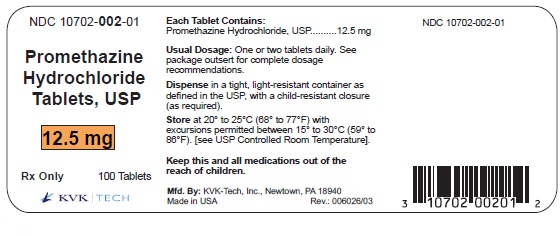
Promethazine Hydrochloride 12.5 mg Tablet, 100-count — NDC 10702-002-01 (Billing 10702-0002-01)
This is a package of 100 tablets of Promethazine Hydrochloride 12.5 mg Tablet from KVK-Tech, Inc., marketed since May 2007 and currently FDA-listed; retail pharmacies pay about $0.0468 per tablet (NADAC). It is the main listing for this product, which comes in 2 package sizes.
NDC database record
One package, one record: these facts belong to NDC 10702-002-01 alone.
- Record
- FDA NDC Directory package listing · Human prescription drug
- Code segments
- 10702 labeler · 002 product · 01 package
- Package marketed since
- May 4, 2007
- Sample package
- No — commercial package
- Listing certified through
- Dec 31, 2027
- Billing quantity
- 100 EA per package
- Barcode (UPC-A, from the NDC)
- 3 1070200201 2
- FDA record last changed
- Jul 24, 2026
Identity & classification
Regulatory identifiers FDA, NLM and CMS codes for this package
Drug-database identifiers Medi-Span GPI and First Databank GCN / HICL / AHFS classification
- GSN (GCN sequence number): 003877
- GCN: 15042
- GPI-14 (Medi-Span): 41400020100305
- HICL (First Databank): 012014
- AHFS class code: 04:04.12.00
- RxCUI (RxNorm): 992438
Where does this data come from?
- FDA openFDA NDC Directory · synced Oct 8, 2026
- FDA label on DailyMed · label index refreshed Oct 8, 2026
- RxNorm (NLM RxNav) · catalog refreshed Oct 8, 2026
- Medi-Span GPI (licensed)
- First Databank (licensed) · refreshed Oct 8, 2026
RxNorm drug class
This medicine belongs to the Phenothiazine class.
Where does this data come from?
- RxClass (NLM) · catalog refreshed Oct 8, 2026
Clinical
Promethazine is used to relieve the symptoms of allergic reactions such as allergic rhinitis (runny nose and watery eyes caused by allergy to pollen, mold or dust), allergic conjunctivitis (red, watery eyes caused by allergies), allergic skin reactions, and allergic reactions to blood or plasma products. Promethazine is used with other medications to treat anaphylaxis (sudden, severe allergic reactions) and the symptoms of the common cold such as sneezing, cough, and runny nose. Promethazine is also used to relax and sedate patients before and after surgery, during labor, and at other times. P...
Read the full MedlinePlus article ↗- It treats allergy symptoms like allergic rhinitis and hives, motion sickness, and nausea and vomiting around surgery. It is also used for sedation. Which uses apply depends on the...
- Very likely. Drowsiness is its most common effect. Don't drive or use machinery until you know how it affects you, and avoid alcohol and other sedating medicines.
- Not if the child is under 2. It can cause fatal slowed breathing in that age group. For children 2 and older, it needs real caution and the lowest effective dose, so only use it as...
- Use an accurate measuring device, not a kitchen teaspoon, which can lead to overdose. I can give you an oral syringe or dosing cup and show you how to measure.
Patient education
Supplement & herbal interactions
Where does this data come from?
- MedlinePlus (NLM) · refreshed Oct 8, 2026
- FDA label on DailyMed · label index refreshed Oct 8, 2026
Ask a licensed pharmacist directly — free, answered by our team.
Pricing
A drug doesn't have one price. Each row is a different public payment system, and none is what you'd pay at the counter — that depends on your insurance. The ⓘ on each row explains what it measures.
| Price system | Per ea | Per package |
|---|---|---|
| Retail pharmacies payNADAC · weekly | $0.047 | $4.68 / 100 tablets |
| Medicaid paysCMS SDUD · 12 mo | No recent Medicaid claims on file for this NDC — rare and low-volume NDCs are suppressed in the public data. | |
| Medicare drug plans payPart D · Q2 2026 | $0.1075 | $10.75 / 100 tablets |
| Medicare Part B allowsASP · Q0169 | No ASP payment limit on file for Q0169 this quarter. | |
Where does this data come from?
- CMS NADAC weekly file · file of Nov 23, 2022
- CMS ASP pricing files · refreshed Sep 20, 2026
- CMS Medicaid State Drug Utilization Data · refreshed Oct 9, 2026
- CMS Part D plan pricing files · refreshed Sep 24, 2026
- VA National Acquisition Center price file
Billing & reimbursement
Where does this data come from?
- CMS ASP NDC-HCPCS crosswalk · refreshed Sep 22, 2026
- DMEPDAC NDC-HCPCS crosswalk
- openFDA NSDE billing units · refreshed Oct 7, 2026
Packaging — all sizes for this product
| Package NDC | Description | Per unit | Per pack | Marketing start | Marketing end | Status |
|---|---|---|---|---|---|---|
| 10702-0002-01 You're viewing this Main listing | 100 TABLET in 1 BOTTLE | $0.0468 / ea | $4.68 | 2007-05-04 | — | Active |
| 10702-0002-10 10702-002-10 | 1000 TABLET in 1 BOTTLE | — | — | 2007-05-04 | — | Active |
You're viewing the smallest of 2 pack sizes for this product.
Pack size FAQ
What quantity is in this package?
How does this package differ from NDC 10702-0002-10?
What NDC number is used to bill for this package of Promethazine Hydrochloride 12.5 mg Tablet?
Prices are the latest CMS NADAC pharmacy acquisition cost per NDC; per-pack figures are per-unit × pack quantity, shown only when the pack is denominated in the same measure NADAC prices.
Therapeutic equivalents
| Product | Labeler | Pack | NADAC/unit | TE | Status | Price vs. this |
|---|---|---|---|---|---|---|
| Promethazine Hydrochloride 12.5 mgthis 10702-0002-01 | KVK-Tech, | 100 tablets | $0.047 | AB | FDA listed | — |
| Promethazine Hydrochloride 12.5 mg 53746-0745-01 | Amneal | 100 tablets | $0.054 | AB | Availability likely | +16% |
| Promethazine Hydrochloride 12.5 mg 60687-0660-01 | American | 100 tablets | $0.054 | AB | Availability likely | +16% |
| Promethazine Hydrochloride 12.5 mg 65162-0745-10 | Amneal | 100 tablets | $0.054 | AB | Availability likely | +16% |
| Promethazine Hydrochloride 12.5 mg 68001-0161-00 | BluePoint | 100 tablets | $0.054 | AB | Availability likely | +16% |
| Promethazine Hydrochloride 12.5 mg 68382-0040-01 | Zydus | 100 tablets | $0.054 | AB | Availability likely | +16% |
| Promethazine Hydrochloride 12.5 mg 43063-0875-01 | PD-Rx | 100 tablets | — | AB | FDA listed | — |
| Promethazine Hydrochloride 12.5 mg 50090-6216-01 | A-S | 21 tablets | — | AB | FDA listed | — |
| Promethazine Hydrochloride 12.5 mg 63629-1591-00 | Bryant | 30 tablets | — | AB | FDA listed | — |
| Promethazine Hydrochloride 12.5 mg 65841-0040-01 | Zydus | 100 tablets | — | AB | FDA listed | — |
| Promethazine Hydrochloride 12.5 mg 70518-2488-00 | REMEDYREPACK | 30 tablets | — | AB | FDA listed | — |
| Promethazine Hydrochloride 12.5 mg 71335-0989-00 | Bryant | 30 tablets | — | AB | FDA listed | — |
| Phenergan 12.5 mg 72189-0402-12 | Direct_Rx | 12 tablets | — | AB | FDA listed | — |
| Promethazine Hydrochloride 12.5 mg 76420-0678-01 | Asclemed | 100 tablets | — | AB | FDA listed | — |
| Promethazine Hydrochloride 12.5 mg 85766-0108-00 | Sportpharm | 1000 tablets | — | AB | FDA listed | — |
| Promethazine Hydrochloride 12.5 mg 87063-0014-00 | ASCLEMED | 1000 tablets | — | AB | FDA listed | — |
Where does this data come from?
- FDA openFDA NDC Directory · synced Oct 8, 2026
- FDA Orange Book · refreshed Oct 9, 2026
- CMS NADAC weekly file · file of Nov 23, 2022
Availability & generic status
This product is an FDA-approved generic. Other versions of the same drug are listed under Therapeutic equivalents, least expensive first.
Where does this data come from?
- FDA Orange Book · refreshed Oct 9, 2026
What it looks like
Where does this data come from?
- FDA label on DailyMed · label index refreshed Oct 8, 2026
Inactive Ingredients / Excipients
Inactive ingredients, also called excipients, are components of the drug product other than the active ingredient. They may include fillers, dyes, coatings, preservatives, flavors, or other formulation ingredients.
🧪 Avoiding an ingredient? See Promethazine inactive ingredients by manufacturer: every current product's list side by side, so you can ask your pharmacy for the version that does not list it.
💡 Tap an ingredient (hover on desktop) to see what it is and why it’s used.
-
UNII H77VEI93A8
A synthetic yellow dye used to color medications. It helps identify the drug and make it visually distinctive, with no effect on how the medicine works.
-
UNII EWQ57Q8I5X
Lactose monohydrate is a natural sugar derived from milk. It serves as a filler and binder in tablets and capsules, helping create the proper size, texture, and consistency of the medicine.
-
UNII 70097M6I30
Magnesium stearate is a salt made from magnesium and stearic acid, a fatty substance. It's used in tablets and capsules as a lubricant and glidant to help ingredients flow smoothly during manufacturing and prevent sticking.
-
UNII 4GFU244C4J
Methylcellulose is a plant-based thickening agent made from cellulose. It acts as a binder to hold pill ingredients together and as a bulking agent to add texture and consistency to liquid or semi-solid medicines.
4 inactive ingredients listed in the exact product block matched to this NDC.
Where does this data come from?
ingredient classCode="IACT" elements from the exact product block matched by this NDC. Label-section narrative from DailyMed / the openFDA label index is shown separately when available.- FDA label on DailyMed · label index refreshed Oct 8, 2026
- FDA openFDA NDC Directory · synced Oct 8, 2026
Inactive ingredient FAQ
Are inactive ingredients the same for every manufacturer?
Why might an inactive ingredient be missing?
Can inactive ingredients matter?
Manufacturer & labeler
More NDCs from KVK-Tech, Inc. labeler code 10702
- LOMAIRA Phentermine Hydrochloride 8 mg Tablet NDC 10702-001-03
- Promethazine Hydrochloride 25 mg Tablet NDC 10702-003-01
- Promethazine Hydrochloride 50 mg Tablet NDC 10702-004-01
- Cyclobenzaprine Hydrochloride 5 mg Tablet, Film Coated NDC 10702-006-01
- Cyclobenzaprine Hydrochloride 10 mg Tablet, Film Coated NDC 10702-007-01
- Oxycodone Hydrochloride 15 mg Tablet NDC 10702-008-01
- Oxycodone Hydrochloride 30 mg Tablet NDC 10702-009-01
Where does this data come from?
- FDA openFDA NDC Directory · synced Oct 8, 2026
- Drugs@FDA
Full prescribing information FDA SPL
🎯 Indications and Usage ▾
INDICATIONS AND USAGE Promethazine hydrochloride tablet is useful for: Perennial and seasonal allergic rhinitis. Vasomotor rhinitis. Allergic conjunctivitis due to inhalant allergens and foods.
Mild, uncomplicated allergic skin manifestations of urticaria and angioedema. Amelioration of allergic reactions to blood or plasma. Dermographism.
Anaphylactic reactions, as adjunctive therapy to epinephrine and other standard measures, after the acute manifestations have been controlled. Preoperative, postoperative, or obstetric sedation. Prevention and control of nausea and vomiting associated with certain types of anesthesia and surgery.
Therapy adjunctive to meperidine or other analgesics for control of postoperative pain. Sedation in both children and adults, as well as relief of apprehension and production of light sleep from which the patient can be easily aroused. Active and prophylactic treatment of motion sickness.
Antiemetic therapy in postoperative patients.
⏱️ Dosage and Administration ▾
DOSAGE AND ADMINISTRATION Promethazine hydrochloride tablets are contraindicated for children under 2 years of age (see WARNINGS: Black Box Warning and Use in Pediatric Patients). Promethazine hydrochloride tablets are for oral administration only. Allergy: The average oral dose is 25 mg taken before retiring; however, 12.5 mg may be taken before meals and on retiring, if necessary.
Single 25 mg doses at bedtime or 6.25 mg to 12.5 mg taken three times daily will usually suffice. After initiation of treatment in children or adults, dosage should be adjusted to the smallest amount adequate to relieve symptoms. The administration of promethazine hydrochloride in 25 mg doses will control minor transfusion reactions of an allergic nature.
Motion Sickness: The average adult dose is 25 mg taken twice daily. The initial dose should be taken one-half to one hour before anticipated travel and be repeated 8 to 12 hours later, if necessary. On succeeding days of travel, it is recommended that 25 mg be given on arising and again before the evening meal.
For children, promethazine hydrochloride tablets12.5 mg to 25 mg, twice daily, may be administered. Nausea and Vomiting: Antiemetics should not be used in vomiting of unknown etiology in children and adolescents (see WARNINGS: Use in Pediatric Patients). The average effective dose of promethazine hydrochloride for the active therapy of nausea and vomiting in children or adults is 25 mg.
12.5to 25 mg doses may be repeated, as necessary, at 4 to 6 hour intervals. For nausea and vomiting in children, the usual dose is 0.5 mg per pound of body weight, and the dose should be adjusted to the age and weight of the patient and the severity of the condition being treated. For prophylaxis of nausea and vomiting, as during surgery and the postoperative period, the average dose is 25 mg repeated at 4 to 6 hour intervals, as necessary.
Sedation: This product relieves apprehension and induces a quiet sleep from which the patient can be easily aroused. Administration of 12.5 to 25 mg promethazine hydrochloride orally at bedtime will provide sedation in children. Adults usually require 25 to 50 mg for nighttime, presurgical, or obstetrical sedation.
Pre- and Postoperative Use: Promethazine hydrochloride in 12.5 to 25 mg doses for children and 50 mg doses for adults the night before surgery relieves apprehension and produces a quiet sleep. For preoperative medication, children require doses of 0.5 mg per pound of body weight in combination with an appropriately reduced dose of narcotic or barbiturate and the appropriate dose of an atropine-like drug. Usual adult dosage is 50 mg promethazine hydrochloride with an appropriately reduced dose of narcotic or barbiturate and the required amount of a belladonna alkaloid.
Postoperative sedation and adjunctive use with analgesics may be obtained by the administration of 12.5 to 25 mg in children and 25 to 50 mg doses in adults. Promethazine hydrochloride tablets is contraindicated for children under 2 years of age.
⛔ Contraindications ▾
CONTRAINDICATIONS Promethazine hydrochloride tablets are contraindicated for use in pediatric patients less than two years of age. Promethazine is contraindicated in comatose states, and in individuals known to be hypersensitive or to have had an idiosyncratic reaction to promethazine or to other phenothiazines. Antihistamines are contraindicated for use in the treatment of lower respiratory tract symptoms including asthma.
⚠️ Warnings ▾
WARNINGS Promethazine hydrochloride should not be used in pediatric patients less than 2 years of age because of the potential for fatal respiratory depression. Postmarketing cases of respiratory depression, including fatalities, have been reported with use of promethazine hydrochloride in pediatric patients less than 2 years of age. A wide range of weight-based doses of promethazine hydrochloride have resulted in respiratory depression in these patients.
Caution should be exercised when administering promethazine hydrochloride to pediatric patients 2 years of age and older. It is recommended that the lowest effective dose of promethazine hydrochloride be used in pediatric patients 2 years of age and older and concomitant administration of other drugs with respiratory depressant effects be avoided. CNS Depression Promethazine hydrochloride tablets may impair the mental and/or physical abilities required for the performance of potentially hazardous tasks, such as driving a vehicle or operating machinery.
The impairment may be amplified by concomitant use of other central-nervous-system depressants such as alcohol, sedatives/hypnotics (including barbiturates), narcotics, narcotic analgesics, general anesthetics, tricyclic antidepressants, and tranquilizers; therefore such agents should either be eliminated or given in reduced dosage in the presence of promethazine hydrochloride (see PRECAUTIONS: Information for Patients and Drug Interactions). Respiratory Depression Promethazine hydrochloride tablets may lead to potentially fatal respiratory depression.
Use of promethazine hydrochloride tablets in patients with compromised respiratory function (e.g., COPD, sleep apnea) should be avoided. Lower Seizure Threshold Promethazine hydrochloride tablets may lower seizure threshold. It should be used with caution in persons with seizure disorders or in persons who are using concomitant medications, such as narcotics or local anesthetics, which may also affect seizure threshold.
Bone-Marrow Depression Promethazine hydrochloride tablets, should be used with caution in patients with bone-marrow depression. Leukopenia and agranulocytosis have been reported, usually when promethazine hydrochloride have been used in association with other known marrow-toxic agents. Neuroleptic Malignant Syndrome A potentially fatal symptom complex sometimes referred to as Neuroleptic Malignant Syndrome (NMS) has been reported in association with promethazine hydrochloride alone or in combination with antipsychotic drugs.
Clinical manifestations of NMS are hyperpyrexia, muscle rigidity, altered mental status and evidence of autonomic instability (irregular pulse or blood pressure, tachycardia, diaphoresis and cardiac dysrhythmias). The diagnostic evaluation of patients with this syndrome is complicated. In arriving at a diagnosis, it is important to identify cases where the clinical presentation includes both serious medical illness (e.g. pneumonia, systemic infection, etc.) and untreated or inadequately treated extrapyramidal signs and symptoms (EPS).
Other important considerations in the differential diagnosis include central anticholinergic toxicity, heat stroke, drug fever and primary central nervous system (CNS) pathology. The management of NMS should include 1) immediate discontinuation of promethazine hydrochloride, antipsychotic drugs, if any, and other drugs not essential to concurrent therapy, 2) intensive symptomatic treatment and medical monitoring, and 3) treatment of any concomitant serious medical problems for which specific treatments are available.
There is no general agreement about specific pharmacological treatment regimens for uncomplicated NMS. Since recurrences of NMS have been reported with phenothiazines, the reintroduction of promethazine hydrochloride should be carefully considered. Use in Pediatric Patients: Promethazine hydrochloride is contraindicated for use in pediatric patients less than two years of age.
Caution should be exerc… [Excerpted — this section continues on DailyMed.]
🤒 Adverse Reactions ▾
ADVERSE REACTIONS Central Nervous System: Drowsiness is the most prominent CNS effect of this drug. Sedation, somnolence, blurred vision, dizziness; confusion, disorientation, and extrapyramidal symptoms such as oculogyric crisis, torticollis, and tongue protrusion; lassitude, tinnitus, incoordination, fatigue, euphoria, nervousness, diplopia, insomnia, tremors, convulsive seizures, excitation, catatonic-like states, hysteria. Hallucinations have also been reported.
Cardiovascular: Increased or decreased blood pressure, tachycardia, bradycardia, faintness. Dermatologic: Dermatitis, photosensitivity, urticaria. Hematologic: Leukopenia, thrombocytopenia, thrombocytopenic purpura, agranulocytosis.
Gastrointestinal: Dry mouth, nausea, vomiting, jaundice. Respiratory: Asthma, nasal stuffiness, respiratory depression (potentially fatal) and apnea (potentially fatal). (See WARNINGS: Respiratory Depression).
Other: Angioneurotic edema. Neuroleptic malignant syndrome (potentially fatal) has also been reported. (See WARNINGS: Neuroleptic Malignant Syndrome).
Paradoxical Reactions: Hyperexcitability and abnormal movements have been reported in patients following a single administration of promethazine hydrochloride. Consideration should be given to the discontinuation of promethazine hydrochloride and to the use of other drugs if these reactions occur. Respiratory depression, nightmares, delirium, and agitated behavior have also been reported in some of these patients.
To report SUSPECTED ADVERSE REACTIONS, contact KVK-Tech, Inc. at 1-800-862-3895 or FDA at 1-800-FDA-1088 or www.fda.gov/medwatch.
🔄 Drug Interactions ▾
Drug Interactions CNS Depressants: Promethazine hydrochloride tablets may increase, prolong, or intensify the sedative action of other central-nervous-system depressants, such as alcohol, sedatives/hypnotics (including barbiturates), narcotics, narcotic analgesics, general anesthetics, tricyclic antidepressants, and tranquilizers; therefore, such agents should be avoided or administered in reduced dosage to patients receiving promethazine hydrochloride. When given concomitantly with promethazine hydrochloride tablets, the dose of barbiturates should be reduced by at least one-half, and the dose of narcotics should be reduced by one-quarter to one-half.
Dosage must be individualized. Excessive amounts of promethazine hydrochloride relative to a narcotic may lead to restlessness and motor hyperactivity in the patient with pain; these symptoms usually disappear with adequate control of the pain. Epinephrine: Because of the potential for promethazine hydrochloride to reverse epinephrine’s vasopressor effect, epinephrine should NOT be used to treat hypotension associated with promethazine hydrochloride tablets overdose.
Anticholinergics: Concomitant use of other agents with anticholinergic properties should be undertaken with caution. Monoamine Oxidase Inhibitors (MAOI): Drug interactions, including an increased incidence of extrapyramidal effects, have been reported when some MAOI and phenothiazines are used concomitantly. This possibility should be considered with promethazine hydrochloride tablets.
🔄 Drug / Laboratory Test Interactions ▾
Drug/Laboratory Test Interactions The following laboratory tests may be affected in patients who are receiving therapy with promethazine hydrochloride: Pregnancy Tests: Diagnostic pregnancy tests based on immunological reactions between HCG and anti- HCG may result in false-negative or false-positive interpretations. Glucose Tolerance Test: An increase in blood glucose has been reported in patients receiving promethazine hydrochloride.
🤰 Pregnancy ▾
Pregnancy Teratogenic Effects - Pregnancy Category C: Teratogenic effects have not been demonstrated in rat-feeding studies at doses of 6.25 mg/kg and 12.5 mg/kg of promethazine hydrochloride. These doses are from approximately 2.1 to 4.2 times the maximum recommended total daily dose of promethazine for a 50-kg subject, depending upon the indication for which the drug is prescribed. Daily doses of 25 mg/kg intraperitoneally have been found to produce fetal mortality in rats.
Specific studies to test the action of the drug on parturition, lactation, and development of the animal neonate were not done, but a general preliminary study in rats indicated no effect on these parameters. Although antihistamines have been found to produce fetal mortality in rodents, the pharmacological effects of histamine in the rodent do not parallel those in man. There are no adequate and well-controlled studies of promethazine in pregnant women.
Promethazine hydrochloride tablets should be used during pregnancy only if the potential benefit justifies the potential risk to the fetus. Nonteratogenic Effects: Promethazine administered to a pregnant woman within two weeks of delivery may inhibit platelet aggregation in the newborn.
🧒 Pediatric Use ▾
Pediatric Use PROMETHAZINE HYDROCHLORIDE TABLETS ARE CONTRAINDICATED FOR USE IN PEDIATRIC PATIENTS LESS THAN TWO YEARS OF AGE (see WARNINGS: Black Box Warning and Use in Pediatric Patients). Promethazine hydrochloride tablets should be used with caution in pediatric patients 2 years of age and older (see WARNINGS: Use in Pediatric Patients).
🧓 Geriatric Use ▾
Geriatric Use Clinical studies of promethazine hydrochloride did not include sufficient numbers of subjects aged 65 and over to determine whether they respond differently from younger subjects. Other reported clinical experience has not identified differences in responses between the elderly and younger patients. In general, dose selection for an elderly patient should be cautious, usually starting at the low end of the dosing range, reflecting the greater frequency of decreased hepatic, renal or cardiac function, and of concomitant disease or other drug therapy.
Sedating drugs may cause confusion and over-sedation in the elderly; elderly patients generally should be started on low doses of promethazine hydrochloride tablets and observed closely.
🆘 Overdosage ▾
OVERDOSAGE Signs and symptoms of overdosage with promethazine hydrochloride range from mild depression of the central nervous system and cardiovascular system to profound hypotension, respiratory depression, unconsciousness, and sudden death. Other reported reactions include hyperreflexia, hypertonia, ataxia, athetosis, and extensor-plantar reflexes (Babinski reflex). Stimulation may be evident, especially in children and geriatric patients.
Convulsions may rarely occur. A paradoxical-type reaction has been reported in children receiving single doses of 75 mg to 125 mg orally, characterized by hyperexcitability and nightmares. Atropine-like signs and symptoms-dry mouth, fixed, dilated pupils, flushing, as well as gastrointestinal symptoms - may occur.
Treatment Treatment of overdosage is essentially symptomatic and supportive. Only in cases of extreme overdosage or individual sensitivity do vital signs, including respiration, pulse, blood pressure, temperature, and EKG, need to be monitored. Activated charcoal orally or by lavage may be given, or sodium or magnesium sulfate orally as a cathartic.
Attention should be given to the reestablishment of adequate respiratory exchange through provision of a patent airway and institution of assisted or controlled ventilation. Diazepam may be used to control convulsions. Acidosis and electrolyte losses should be corrected.
Note that any depressant effects of promethazine hydrochloride are not reversed by naloxone. Avoid analeptics which may cause convulsions. The treatment of choice for resulting hypotension is administration of intravenous fluids, accompanied by repositioning if indicated.
In the event that vasopressors are considered for the management of severe hypotension which does not respond to intravenous fluids and repositioning, the administration of norepinephrine or phenylephrine should be considered. EPINEPHRINE SHOULD NOT BE USED, since its use in patients with partial adrenergic blockade may further lower the blood pressure. Extrapyramidal reactions may be treated with anticholinergic antiparkinsonian agents, diphenhydramine, or barbiturates.
Oxygen may also be administered. Limited experience with dialysis indicates that it is not helpful.
🧬 Clinical Pharmacology ▾
CLINICAL PHARMACOLOGY Promethazine is a phenothiazine derivative which differs structurally from the antipsychotic phenothiazines by the presence of a branched side chain and no ring substitution. It is thought that this configuration is responsible for its relative lack (1/10 that of chlorpromazine) of dopamine antagonist properties. Promethazine is an H1 receptor blocking agent.
In addition to its antihistaminic action, it provides clinically useful sedative and antiemetic effects. Promethazine is well absorbed from the gastrointestinal tract. Clinical effects are apparent within 20 minutes after oral administration and generally last four to six hours, although they may persist as long as 12 hours.
Promethazine is metabolized by the liver to a variety of compounds; the sulfoxides of promethazine and N-demethylpromethazine are the predominant metabolites appearing in the urine.
📦 How Supplied / Storage and Handling ▾
HOW SUPPLIED Promethazine hydrochloride tablets, USP for oral administration are available as: 12.5 mg: Orange colored, round shaped, biconvex tablets, debossed “K” on left and “2” on right of bisect, on one side and plain on the other side are supplied as: Bottles of 100: NDC 10702-002-01 Bottles of 1000: NDC 10702-002-10 25 mg: White colored, round shaped, flat face bevel edge tablets, debossed “K 3” on one side and quadrisected on the other side are supplied as: Bottles of 100: NDC 10702-003-01 Bottles of 500: NDC 10702-003-50 Bottles of 1000: NDC 10702-003-10 50 mg: Pink colored, round shaped, biconvex tablets, debossed “K 4” on one side and plain on the other side are supplied as: Bottles of 100: NDC 10702-004-01 Bottles of 1000: NDC 10702-004-10 Store at 20° to 25°C with excursions permitted between 15° to 30°C (59° to 86°F) [See USP Controlled Room Temperature].
Protect from light. Dispense in a tight, light-resistant container as defined in the USP with a child-resistant closure. (as required).
Manufactured by: KVK-TECH, INC. 110 Terry Drive Newtown, PA 18940-1850 Item ID # 006025/04 01/2026 Manufacturer’s Code: 10702 company-logo
📋 Description ▾
DESCRIPTION Promethazine hydrochloride, a phenothiazine derivative, is designated chemically as 10H-Phenothiazine-10-ethanamine, N,N,α-trimethyl-, monohydrochloride, (±)-; and has the following structural formula: Promethazine hydrochloride, is a racemic compound; the molecular formula is C17H20N2S•HCl and its molecular weight is 320.88. Promethazine hydrochloride, occurs as a white to faint yellow, practically odorless, crystalline powder which slowly oxidizes and turns blue on prolonged exposure to air. It is freely soluble in water and soluble in alcohol.
Each tablet for oral administration contains 12.5 mg, 25 mg or 50 mg of promethazine hydrochloride. The inactive ingredients include: lactose monohydrate, magnesium stearate and methylcellulose. In addition, 50 mg tablet contains FD&C Red #40 and 12.5 mg tablet contains FD&C Yellow #6. chemical-structure
💬 Information for Patients ▾
Information for Patients Promethazine hydrochloride tablets may cause marked drowsiness or impair the mental and/or physical abilities required for the performance of potentially hazardous tasks, such as driving a vehicle or operating machinery. The use of alcohol or other central- nervous-system depressants such as sedatives/hypnotics (including barbiturates), narcotics, narcotic analgesics, general anesthetics, tricyclic antidepressants, and tranquilizers, may enhance impairment (see WARNINGS: CNS Depression and PRECAUTIONS: Drug Interactions).
Pediatric patients should be supervised to avoid potential harm in bike riding or in other hazardous activities. Patients should be advised to report any involuntary muscle movements. Avoid prolonged exposure to the sun.
⚠️ Precautions ▾
PRECAUTIONS General Drugs having anticholinergic properties should be used with caution in patients with narrow-angle glaucoma, prostatic hypertrophy, stenosing peptic ulcer, pyloroduodenal obstruction, and bladder-neck obstruction. Promethazine hydrochloride tablets should be used cautiously in persons with cardiovascular disease or with impairment of liver function. Information for Patients Promethazine hydrochloride tablets may cause marked drowsiness or impair the mental and/or physical abilities required for the performance of potentially hazardous tasks, such as driving a vehicle or operating machinery.
The use of alcohol or other central- nervous-system depressants such as sedatives/hypnotics (including barbiturates), narcotics, narcotic analgesics, general anesthetics, tricyclic antidepressants, and tranquilizers, may enhance impairment (see WARNINGS: CNS Depression and PRECAUTIONS: Drug Interactions). Pediatric patients should be supervised to avoid potential harm in bike riding or in other hazardous activities. Patients should be advised to report any involuntary muscle movements.
Avoid prolonged exposure to the sun. Drug Interactions CNS Depressants: Promethazine hydrochloride tablets may increase, prolong, or intensify the sedative action of other central-nervous-system depressants, such as alcohol, sedatives/hypnotics (including barbiturates), narcotics, narcotic analgesics, general anesthetics, tricyclic antidepressants, and tranquilizers; therefore, such agents should be avoided or administered in reduced dosage to patients receiving promethazine hydrochloride. When given concomitantly with promethazine hydrochloride tablets, the dose of barbiturates should be reduced by at least one-half, and the dose of narcotics should be reduced by one-quarter to one-half.
Dosage must be individualized. Excessive amounts of promethazine hydrochloride relative to a narcotic may lead to restlessness and motor hyperactivity in the patient with pain; these symptoms usually disappear with adequate control of the pain. Epinephrine: Because of the potential for promethazine hydrochloride to reverse epinephrine’s vasopressor effect, epinephrine should NOT be used to treat hypotension associated with promethazine hydrochloride tablets overdose.
Anticholinergics: Concomitant use of other agents with anticholinergic properties should be undertaken with caution. Monoamine Oxidase Inhibitors (MAOI): Drug interactions, including an increased incidence of extrapyramidal effects, have been reported when some MAOI and phenothiazines are used concomitantly. This possibility should be considered with promethazine hydrochloride tablets.
Drug/Laboratory Test Interactions The following laboratory tests may be affected in patients who are receiving therapy with promethazine hydrochloride: Pregnancy Tests: Diagnostic pregnancy tests based on immunological reactions between HCG and anti- HCG may result in false-negative or false-positive interpretations. Glucose Tolerance Test: An increase in blood glucose has been reported in patients receiving promethazine hydrochloride. Carcinogenesis, Mutagenesis, Impairment of Fertility Long-term animal studies have not been performed to assess the carcinogenic potential of promethazine, nor are there other animal or human data concerning carcinogenicity, mutagenicity, or impairment of fertility with this drug.
Promethazine was nonmutagenic in the Salmonella test system of Ames. Pregnancy Teratogenic Effects - Pregnancy Category C: Teratogenic effects have not been demonstrated in rat-feeding studies at doses of 6.25 mg/kg and 12.5 mg/kg of promethazine hydrochloride. These doses are from approximately 2.1 to 4.2 times the maximum recommended total daily dose of promethazine for a 50-kg subject, depending upon the indication for which the drug is prescribed.
Daily doses of 25 mg/kg intraperitoneally have been found to produce fetal mortality in rats. Specific studies to test the action of the drug on parturitio… [Excerpted — this section continues on DailyMed.]
🍼 Nursing Mothers ▾
Nursing Mothers It is not known whether promethazine hydrochloride is excreted in human milk. Because many drugs are excreted in human milk and because of the potential for serious adverse reactions in nursing infants from promethazine hydrochloride tablets, a decision should be made whether to discontinue nursing or to discontinue the drug, taking into account the importance of the drug to the mother.
📄 Carcinogenesis, Mutagenesis, Impairment of Fertility ▾
Carcinogenesis, Mutagenesis, Impairment of Fertility Long-term animal studies have not been performed to assess the carcinogenic potential of promethazine, nor are there other animal or human data concerning carcinogenicity, mutagenicity, or impairment of fertility with this drug. Promethazine was nonmutagenic in the Salmonella test system of Ames.
📄 Package Label / Principal Display Panel ▾
PACKAGE LABEL.PRINCIPAL DISPLAY PANEL NDC 10702-002-01 PROMETHAZINE HYDROCHLORIDE TABLETS, USP 12.5 mg 100 TABLETS Rx Only KVK-TECH, INC. NDC 10702-002-10 PROMETHAZINE HYDROCHLORIDE TABLETS, USP 12.5 mg 1000 TABLETS Rx Only KVK-TECH, INC. NDC 10702-003-01 PROMETHAZINE HYDROCHLORIDE TABLETS, USP 25 mg 100 TABLETS Rx Only KVK-TECH, INC.
NDC 10702-003-50 PROMETHAZINE HYDROCHLORIDE TABLETS, USP 25 mg 500 TABLETS Rx Only KVK-TECH, INC. NDC 10702-003-10 PROMETHAZINE HYDROCHLORIDE TABLETS, USP 25 mg 1000 TABLETS Rx Only KVK-TECH, INC. NDC 10702-004-01 PROMETHAZINE HYDROCHLORIDE TABLETS, USP 50 mg 100 TABLETS Rx Only KVK-TECH, INC.
NDC 10702-004-10 PROMETHAZINE HYDROCHLORIDE TABLETS, USP 50 mg 1000 TABLETS Rx Only KVK-TECH, INC. 12.5 mg - 100s 12.5 mg - 1000s 25 mg - 100s 25 mg - 500s 25 mg - 1000s 50 mg - 100s 50 mg - 1000s