
NEUROLITE Bicisate dihydrochloride Kit — NDC 11994-006-02 (Billing 11994-0006-02)
This is a package of NEUROLITE Bicisate dihydrochloride Kit from Lantheus Medical Imaging, Inc., marketed since Nov 1994 and currently FDA-listed. It is the main listing for this product, which comes in 2 package sizes.
NDC database record
One package, one record: these facts belong to NDC 11994-006-02 alone.
- Record
- FDA NDC Directory package listing · Human prescription drug
- Code segments
- 11994 labeler · 006 product · 02 package
- Package marketed since
- Nov 23, 1994
- Sample package
- No — commercial package
- Listing certified through
- Dec 31, 2026
- Barcode (UPC-A, from the NDC)
- 3 1199400602 3
- FDA record last changed
- Jul 24, 2026
Identity & classification
Regulatory identifiers FDA, NLM and CMS codes for this package
Drug-database identifiers Medi-Span GPI and First Databank GCN / HICL / AHFS classification
- GSN (GCN sequence number): 070071
- GCN: 33358
- GPI-14 (Medi-Span): 94359070106400
- HICL (First Databank): 039672
- AHFS class code: 36:00.00.00
Where does this data come from?
- FDA openFDA NDC Directory · synced Oct 1, 2026
- FDA label on DailyMed · label index refreshed Oct 3, 2026
- RxNorm (NLM RxNav) · catalog refreshed Oct 1, 2026
- Medi-Span GPI (licensed)
- First Databank (licensed) · refreshed Oct 1, 2026
Clinical
Patient education
Supplement & herbal interactions
Where does this data come from?
- MedlinePlus (NLM) · refreshed Oct 1, 2026
- FDA label on DailyMed · label index refreshed Oct 3, 2026
Ask a licensed pharmacist directly — free, answered by our team.
Pricing
A drug doesn't have one price. Each row is a different public payment system, and none is what you'd pay at the counter — that depends on your insurance. The ⓘ on each row explains what it measures.
| Price system | Per each | Per package |
|---|---|---|
| Retail pharmacies payNADAC · weekly | Not in the retail survey — common for institutional, discontinued, or low-volume packs. | |
| Medicaid paysCMS SDUD · 12 mo | No recent Medicaid claims on file for this NDC — rare and low-volume NDCs are suppressed in the public data. | |
| Medicare drug plans payPart D · quarterly | No Part D plan price is available for this NDC in our data. | |
Where does this data come from?
- CMS NADAC weekly file
- CMS ASP pricing files · refreshed Sep 20, 2026
- CMS Medicaid State Drug Utilization Data · refreshed Oct 4, 2026
- CMS Part D plan pricing files · refreshed Sep 24, 2026
- VA National Acquisition Center price file
Packaging — all sizes for this product
| Package NDC | Description | Marketing start | Marketing end | Status |
|---|---|---|---|---|
| 11994-0006-02 You're viewing this Main listing | 2 KIT in 1 PACKAGE, COMBINATION / 1 KIT in 1 KIT * 1 INJECTION in 1 VIAL * 1 mL in 1 VIAL | 1994-11-23 | — | Active |
| 11994-0006-05 11994-006-05 | 5 KIT in 1 PACKAGE, COMBINATION / 1 KIT in 1 KIT * 1 INJECTION in 1 VIAL * 1 mL in 1 VIAL | 1994-11-23 | — | Active |
Pack size FAQ
What quantity is in this package?
What NDC number is used to bill for this package of NEUROLITE Bicisate dihydrochloride Kit?
Therapeutic equivalents
| Product | Labeler | Pack | NADAC/unit | TE | Status | Price vs. this |
|---|---|---|---|---|---|---|
| Neurolitethis 11994-0006-02 | Lantheus | 2 kits | — | — | FDA listed | — |
| Neurolite 87333-0006-02 | SHINE | 2 kits | — | — | FDA listed | — |
Where does this data come from?
- FDA openFDA NDC Directory · synced Oct 1, 2026
- FDA Orange Book · refreshed Oct 3, 2026
- CMS NADAC weekly file
Availability & generic status
We did not find an FDA-approved generic match for this exact strength, form and route.
Where does this data come from?
- FDA Orange Book · refreshed Oct 3, 2026
Inactive Ingredients / Excipients
Inactive ingredients, also called excipients, are components of the drug product other than the active ingredient. They may include fillers, dyes, coatings, preservatives, flavors, or other formulation ingredients.
Where does this data come from?
IACT rows and label-wide narrative are kept separate; availability and product-level specificity depend on the submitted label.- FDA label on DailyMed · label index refreshed Oct 3, 2026
- FDA openFDA NDC Directory · synced Oct 1, 2026
Inactive ingredient FAQ
Are inactive ingredients the same for every manufacturer?
Why might an inactive ingredient be missing?
Can inactive ingredients matter?
Manufacturer & labeler
More NDCs from Lantheus Medical Imaging, Inc. labeler code 11994
- Cardiolite TETRAKIS(2-METHOXYISOBUTYLISOCYANIDE)COPPER(I) TETRAFLUOROBORATE 1 mg/mL Injection, Powder, Lyophilized, For Solution NDC 11994-001-20
- Kit for the Preparation of Technetium Tc99m Sestamibi TETRAKIS(2-METHOXYISOBUTYLISOCYANIDE)COPPER(I) TETRAFLUOROBORATE 1 mg/mL Injection, Powder, Lyophilized, For Solution NDC 11994-003-20
- Definity perflutren 6.52 mg/mL Injection, Suspension NDC 11994-011-01
- DEFINITY RT perflutren 6.52 mg/mL Injection, Suspension NDC 11994-017-01
- TechneLite Technetium Tc99m Generator 250 mCi/mL Injection, Solution NDC 11994-090-01
- TechneLite Technetium Tc99m Generator 250 mCi/mL Injection, Solution NDC 11994-091-01
- Xenon 10 mCi Gas NDC 11994-127-11
- Xenon 20 mCi Gas NDC 11994-128-21
Where does this data come from?
- FDA openFDA NDC Directory · synced Oct 1, 2026
- Drugs@FDA
Full prescribing information FDA SPL
🎯 Indications and Usage ▾
INDICATIONS Neurolite single photon emission computerized tomography (SPECT) is indicated as an adjunct to conventional CT or MRI imaging in the localization of stroke in patients in whom stroke has already been diagnosed. Neurolite is not indicated for assessment of functional viability of brain tissue. Also, Neurolite is not indicated for distinguishing between stroke and other brain lesions.
⏱️ Dosage and Administration ▾
DOSAGE AND ADMINISTRATION Before administration, a patient should be well hydrated. After administration, the patient should be encouraged to drink fluids liberally and to void frequently. The recommended dose range for intravenous administration for a 70 kg patient is 370-1110 MBq (10-30mCi).
Dose adjustments for age, weight, gender or renal or hepatic impairment have not been studied. The dose for the patient should be measured by a suitable radioactivity calibration system immediately before administration to the patient. Radiochemical purity should be checked before administration to the patient.
Neurolite, like other parenteral drug products, should be inspected visually for particulate matter and discoloration prior to administration whenever solution and container permit. Preparations containing particulate matter or discoloration should not be administered. They should be disposed of in a safe manner, in compliance with all applicable regulations.
Prior to reconstitution, vial A and vial B are stored at 15-25°C. Protect vial A from light. Store at controlled room temperature after preparation.
Aseptic techniques and effective shielding should be employed in withdrawing doses for administration to patients. Waterproof gloves and effective shielding should be worn when handling the product.
⛔ Contraindications ▾
CONTRAINDICATIONS None known.
⚠️ Warnings ▾
WARNINGS None known.
🤒 Adverse Reactions ▾
ADVERSE REACTIONS In clinical trials, Neurolite has been administered to 1063 subjects (255 normals, 808 patients). Of these, 566 (53%) were men and 494 (47%) were women. The mean age was 58 years (range 17 to 92 years).
In the 808 patients, who had experienced neurologic events, there were 11 (1.4%) deaths, none of which were clearly attributed to Neurolite. A total of 60 subjects experienced adverse reactions; the adverse reaction rates were comparable in the <65 year, and the >65 year age groups. The following adverse effects were observed in ≤ 1% of the subjects: headache, dizziness, seizure, agitation/anxiety, malaise/somnolence, parosmia, hallucinations, rash, nausea, syncope, cardiac failure, hypertension, angina, and apnea/cyanosis.
In clinical trials of 197 patients, there were inconsistent changes in the serum calcium and phosphate levels. The cause of the changes has not been identified and their frequency and magnitude have not been clearly characterized. None of the changes required medical intervention.
🤰 Pregnancy ▾
Pregnancy: Teratogenic Effects Animal reproduction studies have not been conducted with Technetium Tc99m Bicisate. It is also not known whether Technetium Tc99m Bicisate can cause fetal harm when administered to a pregnant woman or can affect reproduction capacity. Therefore, Technetium Tc99m Bicisate should not be administered to a pregnant woman unless the potential benefit justifies the potential risk to the fetus.
🧒 Pediatric Use ▾
Pediatric Use Safety and effectiveness in the pediatric population has not been established.
🧓 Geriatric Use ▾
Geriatric Use Of 808 patients in clinical studies of NEUROLITE®, 421 patients were 65 or older and 190 were 75 or older. Based on the evaluation of the frequency of adverse events and review of vital signs and laboratory data, no overall differences in safety were observed between these subjects and younger subjects. Although reported clinical experience has not identified differences in response between elderly and younger patients, greater sensitivity of some older individuals cannot be ruled out.
NEUROLITE® is known to be substantially excreted by the kidney, and the risk of toxic reactions to this drug may be greater in patients with impaired renal function. Because elderly patients are more likely to have decreased renal function, care should be taken in dose selection, and it may be useful to assess renal function prior to administration.
🧬 Clinical Pharmacology ▾
CLINICAL PHARMACOLOGY General Neurolite®, Kit for the Preparation of Technetium Tc99m Bicisate for Injection forms a stable, lipophilic complex which can cross the blood brain barrier. Technetium Tc99m Bicisate crosses intact cell membranes and the intact blood brain barrier by passive diffusion. Five percent of the injected dose remains in the blood at one hour.
The amount of Technetium Tc99m Bicisate in the brain is stable until about 6 hours. After background clearance, images of the brain can be obtained from 10 minutes to 6 hours after injection. Optimal images occur 30-60 minutes after injection.
Technetium Tc99m Bicisate is cleared primarily by the kidneys. Pharmacokinetics In a study in 16 normals (13 men and 3 women, mean age of 31 ± 10 years; mean weight of 72 ± 11 kg), the pharmacokinetic profile in blood best fits a three compartment model with half-lives of 43 seconds, 49.5 minutes and 533 minutes. The highest concentration of radioactivity measured in blood was found at 0.5 minutes after intravenous injection and was 13.9% of the injected dose.
Technetium Tc99m Bicisate and its major metabolites are not protein-bound. Metabolism Technetium Tc99m Bicisate is metabolized by endogenous enzymes to the mono- and di-acids of Technetium Tc99m Bicisate that can be detected in blood and urine. No studies have been performed to compare the concentration of Technetium Tc99m Bicisate or its metabolites in normal, ischemic and infarcted cells.
Technetium Tc99m Bicisate is excreted primarily through the kidneys. Within two hours, 50% of the injected dose is excreted and by 24 hours, 74% is found in urine. It is not known whether the parent drug molecule or its metabolites are dialyzable.
Fecal excretion accounts for 12.5% of the injected dose after 48 hours. Pharmacodynamics Localization of the parent compound in the brain in part depends upon both perfusion of the region and uptake of Technetium Tc99m Bicisate by the cell. Once in the brain cells, the parent compound is metabolized to polar, less diffusible compounds.
Studies in 21 normal volunteers show cellular uptake of 4.8-6.5% of the injected dose at five minutes after injection. The degree of cell function or viability needed for uptake is not known. The degree of cell function or viability needed for metabolism of the parent compound to the less diffusible compounds has not been determined.
The likelihood that the metabolic pathway is damaged by ischemia is not known. Whether or not and to what extent uptake correlates with viability or function is not known. The pharmacodynamics of Neurolite have not been evaluated for differences associated with age, gender, weight and liver or renal impairment.
It is not known whether dosage adjustments for these factors are needed. Clinical Trials Two clinical trials were performed in a total of 359 subjects (273 with stroke, 86 normal). Of these 56% were men and 44% were women.
The mean age was 60.2 years (range 23 to 92 years). Subjects were 87.2% Caucasian, 8.4% Black, 2.2% Hispanic, 1.7% Oriental and 0.6% other. Eligible patients had a confirmed stroke.
Patients with other brain lesions were not evaluated. Subjects received Neurolite (mean dose range 10-30mCi) and underwent SPECT imaging and either CT or MRI scans within 0-30 days of the onset of signs and symptoms of stroke. CT or MRI and the administration of Neurolite occurred at different and variable times after the onset of a stroke.
The effect of the timing on the accuracy of the images cannot be evaluated. The Neurolite scan results were blindly compared to unblinded CT/MRI results, the short standardized neurologic examination (SSNE) and the final diagnosis (e.g., the overall combined clinical impression with CT/MRI and SSNE). In these studies, at least one of three blinded readers made a diagnosis of stroke in 190 (85%) of the Neurolite SPECT studies and in 238 (88%) CT/MRI studies.
The Neurolite and CT/MRI imaging results versus the SSNE and final diagnosis were comp… [Excerpted — this section continues on DailyMed.]
📦 How Supplied / Storage and Handling ▾
HOW SUPPLIED Lantheus Medical Imaging, Inc. Neurolite® Kit for the Preparation of Technetium Tc99m Bicisate for Injection, is supplied in kits of two (2) vials of A and two (2) vials of B (NDC # 11994-006-02); and five (5) vials of A and five (5) vials of B (NDC 11994-006-05). Included in each kit are one (1) package insert and twelve (12) radiation labels.
Prior to reconstitution, vial A and vial B are stored 15-25°C. Protect vial A from light. Store at controlled room temperature after preparation.
Use within 6 hours of preparation. This reagent kit is approved for distribution to persons licensed pursuant to the Code of Massachusetts Regulations 105 CMR 120.500 for the uses listed in 105 CMR 120.547 or 120.552 or under equivalent regulations of the U.S. Nuclear Regulatory Commission, Agreement States or Licensing States.
📋 Description ▾
DESCRIPTION This kit formulation consists of two nonradioactive vials: Vial A contains bicisate dihydrochloride (N, N'-1,2-ethylenediylbis-L-cysteine diethyl ester dihydrochloride) and a reducing agent as a lyophilized solid and vial B contains a buffer solution. Both vials are sterile and non-pyrogenic. Vial A – Bicisate dihydrochloride (ECD•2HCl) 0.9 mg Edetate disodium, dihydrate 0.36 mg Mannitol 24 mg Stannous chloride, dihydrate, theoretical (SnCl 2 •2H 2 O) 72 µg Stannous chloride, dihydrate, minimum (SnCl 2 •2H 2 O) 12 µg Total Tin, (stannous and stannic), dihydrate (as SnCl 2 •2H 2 O) 83 µg The contents of vial A are lyophilized and stored under nitrogen.
The pH of the solution before lyophilization is 2.7 ± 0.25. This vial is stored at 15-25°C. Protect from light.
Vial B – Sodium phosphate dibasic heptahydrate 4.1 mg Sodium phosphate monobasic monohydrate 0.46 mg Water for Injection qs 1 mL The contents of vial B are stored under air. The pH of the solution is 7.6 ± 0.4. This vial is stored at 15-25°C.
This drug is administered by intravenous injection for diagnostic use after reconstitution with sterile, non-pyrogenic, oxidant-free Sodium Pertechnetate Tc99m Injection. The precise structure of the Technetium complex is [ N , N '-ethylenedi- L -cysteinato(3-)]oxo[ 99m Tc] technetium (V), diethyl ester.
⚠️ Precautions ▾
PRECAUTIONS General USE WITH CAUTION IN PATIENTS WITH RENAL OR HEPATIC IMPAIRMENT. TECHNETIUM Tc99m BICISATE IS ELIMINATED PRIMARILY BY RENAL EXCRETION. WHETHER TECHNETIUM Tc99m BICISATE IS DIALYZABLE IS NOT KNOWN.
DOSE ADJUSTMENTS IN PATIENTS WITH RENAL OR HEPATIC IMPAIRMENT HAVE NOT BEEN STUDIED. Patients should be encouraged to drink fluids and to void frequently during the 2-6 hours immediately after injection to minimize radiation dose to the bladder and other target organs. Contents of the vials are intended only for use in the preparation of Technetium Tc99m Bicisate and are not to be administered directly to the patient without first undergoing the preparation procedure.
The contents of each vial are sterile and non-pyrogenic. To maintain sterility, aseptic technique must be used during all operations in the manipulations and administration of Neurolite. Technetium Tc99m Bicisate should be used within six hours of the time of preparation.
As with any other radioactive material, appropriate shielding should be used to avoid unnecessary radiation exposure to the patient, occupational workers, and other people. Radiopharmaceuticals should be used only by physicians who are qualified by specific training in the safe use and handling of radionuclides. Carcinogenesis, Mutagenesis, Impairment of Fertility Studies have not been conducted to evaluate carcinogenic potential or effects on fertility.
When tested in vitro, Neurolite prepared with decayed generator eluate induced unscheduled DNA synthesis in rat hepatocytes and caused an increased frequency of sister chromatid exchanges in CHO cells; but, it did not induce chromosome aberrations in human lymphocytes or cause gene mutations in the Ames test or in a CHO/HGPRT test. Unreacted bicisate dihydrochloride increased the apparent rate of gene mutation of the TA 97a strain of S. typhimurium in the Ames test; but, it did not demonstrate clastogenic activity in an in vivo micronucleus assay in mice.
Pregnancy: Teratogenic Effects Animal reproduction studies have not been conducted with Technetium Tc99m Bicisate. It is also not known whether Technetium Tc99m Bicisate can cause fetal harm when administered to a pregnant woman or can affect reproduction capacity. Therefore, Technetium Tc99m Bicisate should not be administered to a pregnant woman unless the potential benefit justifies the potential risk to the fetus.
Nursing Mothers Technetium Tc99m Pertechnetate can be excreted in human milk. Therefore, formula should be substituted for breast milk until the technetium has cleared from the body of the nursing woman. Pediatric Use Safety and effectiveness in the pediatric population has not been established.
Geriatric Use Of 808 patients in clinical studies of NEUROLITE®, 421 patients were 65 or older and 190 were 75 or older. Based on the evaluation of the frequency of adverse events and review of vital signs and laboratory data, no overall differences in safety were observed between these subjects and younger subjects. Although reported clinical experience has not identified differences in response between elderly and younger patients, greater sensitivity of some older individuals cannot be ruled out.
NEUROLITE® is known to be substantially excreted by the kidney, and the risk of toxic reactions to this drug may be greater in patients with impaired renal function. Because elderly patients are more likely to have decreased renal function, care should be taken in dose selection, and it may be useful to assess renal function prior to administration.
🍼 Nursing Mothers ▾
Nursing Mothers Technetium Tc99m Pertechnetate can be excreted in human milk. Therefore, formula should be substituted for breast milk until the technetium has cleared from the body of the nursing woman.
🔬 Clinical Studies ▾
Clinical Trials Two clinical trials were performed in a total of 359 subjects (273 with stroke, 86 normal). Of these 56% were men and 44% were women. The mean age was 60.2 years (range 23 to 92 years).
Subjects were 87.2% Caucasian, 8.4% Black, 2.2% Hispanic, 1.7% Oriental and 0.6% other. Eligible patients had a confirmed stroke. Patients with other brain lesions were not evaluated.
Subjects received Neurolite (mean dose range 10-30mCi) and underwent SPECT imaging and either CT or MRI scans within 0-30 days of the onset of signs and symptoms of stroke. CT or MRI and the administration of Neurolite occurred at different and variable times after the onset of a stroke. The effect of the timing on the accuracy of the images cannot be evaluated.
The Neurolite scan results were blindly compared to unblinded CT/MRI results, the short standardized neurologic examination (SSNE) and the final diagnosis (e.g., the overall combined clinical impression with CT/MRI and SSNE). In these studies, at least one of three blinded readers made a diagnosis of stroke in 190 (85%) of the Neurolite SPECT studies and in 238 (88%) CT/MRI studies. The Neurolite and CT/MRI imaging results versus the SSNE and final diagnosis were comparable.
Neurolite had 11 false positive and 34 false negatives. CT/MRI had 0 false positive and 31 false negatives. Both Neurolite and CT/MRI missed strokes (true positives) that were identified by the other modality.
The majority of the false negatives in either modality were within 15 days of the clinical stroke. The trials were not designed to determine when Neurolite or CT/MRI studies could become positive in relationship to the time of the stroke. The relevance of the Neurolite scan results to the prediction of neurologic function or brain cell viability is not known.
Also, not known is the ability of the Neurolite findings to distinguish between a stroke and pre-existing CNS lesions. Neurolite should not be used for these purposes. (See Pharmacodynamics Section ).
📄 Carcinogenesis, Mutagenesis, Impairment of Fertility ▾
Carcinogenesis, Mutagenesis, Impairment of Fertility Studies have not been conducted to evaluate carcinogenic potential or effects on fertility. When tested in vitro, Neurolite prepared with decayed generator eluate induced unscheduled DNA synthesis in rat hepatocytes and caused an increased frequency of sister chromatid exchanges in CHO cells; but, it did not induce chromosome aberrations in human lymphocytes or cause gene mutations in the Ames test or in a CHO/HGPRT test. Unreacted bicisate dihydrochloride increased the apparent rate of gene mutation of the TA 97a strain of S. typhimurium in the Ames test; but, it did not demonstrate clastogenic activity in an in vivo micronucleus assay in mice.
📄 Package Label / Principal Display Panel ▾
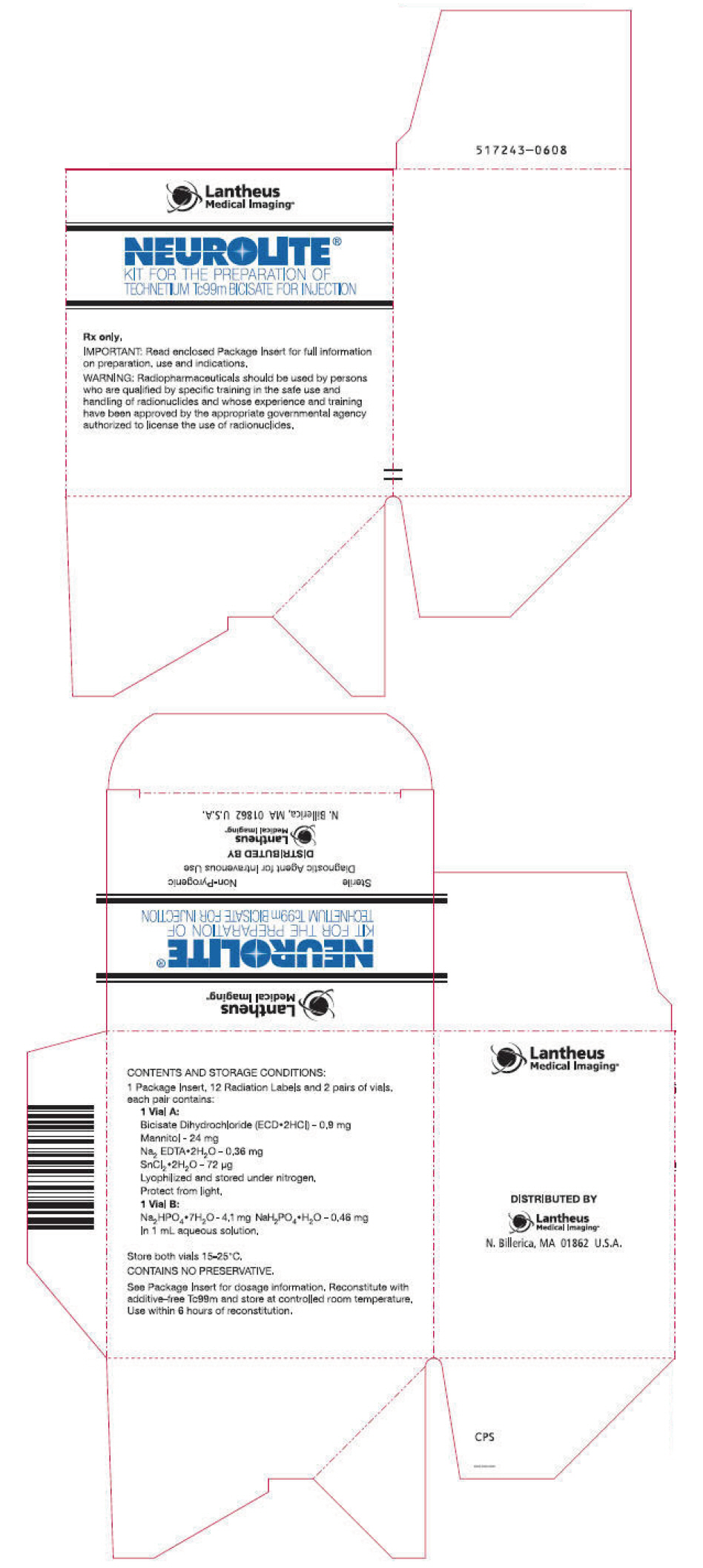
PRINCIPAL DISPLAY PANEL - Kit Package Lantheus Medical Imaging ® NEUROLITE ® KIT FOR THE PREPARATION OF TECHNETIUM Tc99m BICISATE FOR INJECTION Rx only, IMPORTANT: Read enclosed Package Insert for full information on preparation, use and indications. WARNING: Radiopharmaceuticals should be used by persons who are qualified by specific training in the safe use and handling of radionuclides and whose experience and training have been approved by the appropriate governmental agency authorized to license the use of radionuclides.
PRINCIPAL DISPLAY PANEL - Kit Package
Reported adverse events (FAERS)
Top reported reactions
Age at onset
Reporter sex
Serious outcomes
Where does this data come from?
About this NDC listing & data coverage
Kit / multi-component package
This NDC identifies a kit — a package containing more than one component. Structured data (pricing, ingredients, equivalents) is often reported per component rather than for the kit NDC itself, which can make this page look thinner than the components' own pages.
What data is (and isn’t) available for this NDC — tap to expand
| NDC identity (package / product / labeler codes) | ✓ Available |
| Labeler | ✓ Available |
| Product & package description | ✓ Available |
| Marketing category & status | ✓ Available |
| Active ingredient / dosage form / route | ✓ Available |
| FDA label (SPL via DailyMed) | ✓ Available |
| Package photos | ✓ Available |
| Inactive ingredients (structured) | — Not published for this NDC The labeler did not submit a structured excipient list, or no SPL is available. |
| NADAC pharmacy acquisition price (CMS) | — Not published for this NDC CMS publishes NADAC only for NDCs reported in its retail-pharmacy survey. |
| Orange Book / therapeutic-equivalence data | — Not published for this NDC Applies only to products approved under an NDA/ANDA; many listings are out of scope. |
| HCPCS J-code billing crosswalk | — Not published for this NDC Most self-administered / retail products have no J-code — that is normal. |
| Medicaid utilization (CMS SDUD) | — Not published for this NDC CMS reports utilization only for NDCs with Medicaid claims above its privacy threshold. |